pods
for primates : a catalogue of surfboards in australia since 1900
 |
surfresearch.com.au
glossary
: s
|
|
S- Deck
a rounded, convex or domed deck profile,
with a ‘S’ deck line.
See Camel deck..
S Glass/Silane
a woven cloth of extensively washed
glass fibres resulting in a near transparent finish introduced circa
1975. In construction it eliminated taping the reverse side of the blank
and cutting the laminated cloth , best at 90% cured.
See Volan (predessor), free
lap and rail lap.
Sailboard / ’Windsurfer’:
wind powered board with pivoting rig (mast,
boom and sail), standing rider.
Original design (‘Windsurfer’ trademark)
by Hoyle Scheiwster and Jim Drake (both USA) circa 1969, molded plastic
oversized Malibu board with centreboard and fin/box (similar to Waveset
design).
Rapid technological and design developments
followed; harness, rubber universal, footstraps, custom glass/foam boards,
epoxy production and custom boards, fins/boxes, and a corresponding
advance in rig (mast, sail and boom) design.
Sam
1966 World Championship (San Diego, California)
winning board of Nat Young.
Manufactured at Gordon
Woods Surfboards (diamond decal), December-January 1966,
shaped by Nat Young, clear with ½” redwood stringer, Volan glassed
with wide rail lap by Darryl Holmes.
Length 9ft 4”, Width 22”, Wide point –6”,
Thickness 2 ½”
Thin egg rails, flat nose with rounded
bottom deepest in front of the fin.
Thirty six layer Greenough Stage III fin.
First ridden at The Kick, Collaroy.
The board disappeared during the post
contest celebrations.
Initially derived from a Joey Cabell design,
it developed at the Noosa sessions late 1965 with George Greenough, Bob
McTavish, Russell Hughes and Bob Cooper, based at Hayden Kenny Surfboards,
and subsequently Cord Surfboards, Alexandria Headlands.
Many Australian designers were producing
similar designs – all of those mentioned above and Midget Farrelly (see
Stringerless model), Keith Paull, Bobby Brown, Peter Drouyn, and others;
but Nat Young’s win saw the design exposed internationally as well as becoming
the accepted common design in Australia.
Since the design directly preceded the
sub 9ft Vee-bottom design, it is now considered the last of the original
Malibus/Longboards.
Design known in New Zealand as a Thin Rail.
Not to be confused with a Mid 1980's Modern
Malibu design by Nat Young featured a Sam - an old friend decal,
manufactured by Mike Davis Surfboards, Kiama.
References
Nat Young ‘Nat’s
Nat and that’s that’ 1998 pp 110 to 145.
McGillvary and Freeman : Free and
Easy,1967.
Keyo example
#36
sand
use of an abrasive, by hand or power tool,
to scour or smooth either a blank or fibreglass.
sandwich construction
a composite structure of at least three
layers.
See Hollow board - 5. Hollow Wave.
Sausage board
classically a rounded double-ender parallel
railed Malibu board, 1960.
scarf
application by Bob Simmons (USA) circa
1948 of balsawood and fibreglass addition to solid wood boards to give
increased nose lift.
Also termed Scoop or Wedge (John Ewell).
scoop nose lift,
circa 1950’s.
scoop tail
a chamfered square tail, featured on some
Vee-bottoms boards, 1967-1968.
New Zealand term, alternative design to
Gretel/Pattie tail.
US term Ashtray tail.?
Screw tail
One variation on Rod ball's Ski tail, circa 1974 by Terry Fitzgerald
at Hot Buttered Surfboards, circa 1977.
Also called the Fanger, circa 1976.
screw and plate
stainless steel screw and companion metal
plate used to secure a fin in a finbox.
seat belt
(Surf ski)
webbing belt with quick release buckle
fitted to the seat.
First credited to Merv Larson (USA) circa
1970.
See John Severson : Pacific Vibrations
It revolutionized surf ski performance.
semi
in a modified form e.g.-Gun/ -pin/ -pig/
Shape
design features of a blank, board or fin.
Shaper
sculptor of a wood or foam blank/board
Shoe
1. A short snub nosed surf kayak.
2. Model name for Shane Surfboards
Kneeboard, 1970.
short board
1. a board shorter in length than
current designs, e.g. a short board in 1956 was 9 ft, in 1967 it was 7
ft 6 inches, in 1970 it was 5 ft 4 inches.
2. a board with two riding positions
( trim and turn), the rider linking them by walking, stepping or shuffling.
First commonly accepted design 1967 VeeBottom
Stubby by Bob McTavish, Midget Farrelly, Kevin Platt, Keith Paull, Ted
Spencer, and others Sydney; May 1967 to January 1968.
See longboard, super/micro board.
Side Slipper
1969-1970, hyperkicked nose, soft low
rails and small ‘drift’ fin and /or finbox; by Reno Abellira (Hawaii) and
Midget Farrelly.
Designed to be ridden in the curl by controlled
fin drift (fin drop out stall); the lack of perfect uncrowded conditions,
the required skill level and the philosophical contradiction with the current
‘power’ ethos meant it had a limited popularity.
Gerry Lopez: SURFER TIPS- The Side-Slip
also Reno Aberllira in Brewer ad with
S'Deck flip tip Side slipper.
SURFER, January 1970, Volume10
Number 6
Sinker
a fibreglassed polyurethane sailboard,
usually for wave riding, circa 1983.
Term relates to difficulty in uphauling.
Silane / S Glass
a woven cloth of extensively bleached/washed
glass fibres resulting in a near transparent finish introduced circa
1975.
In construction it introduced Free-laping,
eliminating taping the reverse side of the blank and cutting the
laminated cloth , best at 90% cured.
See Volan (predecessor) and
Rail
Lap.
skeg / fin
1. stabilizing wing attached to
the bottom of the board, usually at the tail.
Dimensions are height (length / depth),
base, rake, foil and surface area (sailboards).
First credited to Tom Blake (Hawaii) 1934.
Fin use did not become established until
1940, the experiment (make the board with a fin slot, ride the board without
and with a fin) was by George Downing (Hawaii).
2. the afterpart of a ship’s keel
/ a projection abaft of a ship’s keel for the support of a rudder.
ski
see Surf ski, Wave ski
Ski
model name, originally 1968 round/rounded
pin tail Tracker type design
by Nat Young, about 7 ft 10” for Weber Surfboards (USA).
Keyo Surfboards
was Nat’s Australian manufacturer. |

 |
Decal image and the following correspondence
from Randy Rarrick contributed by Peter Robinson of the British
Surfing Museum, September 2007.
"Hi Peter,
I had the Weber dealership in 1969/70
when these boards came along.
You are right in that all the name
"Weber Australia" was about, was capitalizing on the fad of having the
Aussie's associated with an American label.
Nat Young was endorsing boards for
Weber, but never shaped any of them.
All of them were made in the factory
in California, and they were run on Weber's shaping machines and just finished
off.
Both the boards you have were fairly
typical of the era.
What is interesting is the adjustable
W.A.V.E. Set fin system, which fit in the old W.A.V.E. Set boxes, but allowed
the fin to be moved up and down.
They were a shitty sytem, as they always
broke off at the base.
These came out after "The Ski", which
was a popular design in 1969 and came in a green label and then a purple
label and that model was replaced with the "Weber Australia" in 1970.
It's interesting that the early ones
had the rolled nose in the bottom and then they switched to the full low
rail all the way as that design feature came into it's own after the world
contest in 1970.
Aloha, Randy Rarick"
Ski tail
Design by Rod Ball circa 1974, initially
on kneeboards and adapted to stand-up boards by Ball and others, for example
Terry Fitzgerald at Hot Buttered Surfboards.
See
Rod Ball Design Ski tail Kneeboard #227
Shane Ski Tail #327
Slab
Rounded nose, rounded square tail wide
kneeboard originally designed by Peter Crawford in
1969 at Wallace Surfboards.
The name is credited
to Midget Farrelly.
An alternative to
the low floatation Greenough Spoon, the Slab has been in constant production
in all fin combinations.
Still in current use in all fin combinations
2005.
Rotomolded model 1977. See Pop-outs
#6.
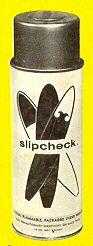
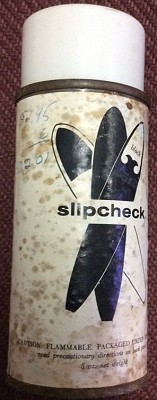
Slipcheck / Grip Feet
Aerosol spray
wax alternative developed by Tom Morey and Karl Pope at the innovative
Morey-Pope Co. (USA) in 1965 following the popular success of Tom Morey’s
Noseriding contest at Ventura.
Initially only available in white (see
below), it was later marketed in a wide range of colours.
The most popular use was a white nose
patch (tip to sweet spot).
See Tom
Morey's Noseriding Contest 1965
Grip Feet was a (possible) Australian
variation.
Noted in a Surfing World - Surfabout
magazine advertisment, circa 1965...
Nose ride graphic and address 53 Bay Road,
Taren Point, Phone 525-0795 |
 |
2.
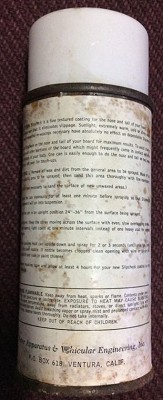
SLIPCHECK.
A fine textured
coating for the nose or tail of your board which is so firm when wet it
completely eliminates slipping.
Apply SLIPCHECK
once, touch up occasionally.
For sale in white
only.
One can, $3.50,
is more than enough for initial coat plus touch ups.
Include 40c postage
and tax with your order. |
|
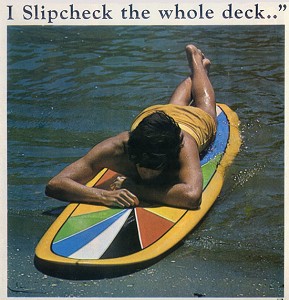
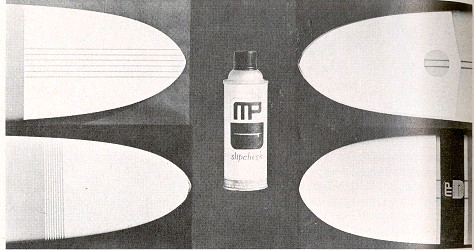
Morey-Pope
Slipcheck Advertisement titled "Inventions".
Surfer Magazine
January
1966, Volume 6 Number 6, page 66.
The other inventions
were the Trisect and the Snub.
|
Morey-Pope
Slipcheck Advertisement,
featuring
David Nuuihwa.
Surfer Magazine
circa 1967.
|

slot (s)
twin channels (hard edged shallow and
narrow concave lines in the bottom of a board. ) in front of fin.
A feaure of Miki
Dora's da Cat Model for Greg Noll Surfboards, USA, circa
1966.
See Concave bottom, Channels, Clinker
bottom, Bonzer.
soft board
a surfboard made of soft sponge foam e.g.
Morey-Doyle, also see Mac-T
Speed board/Speed shape
pin nose narrow tail foiled template
sub 7ft 6 inch single fin board, circa 1971.
Post 1970 World Titles, Johanna Vic. see
Mini-gun.
Predecessor to Gerry Lopez’ Rounded Pintail,
1974.
spiral vee
1. a vee in the bottom with concave panels
between the rail and the apex of the vee.
2. (?) a vee in the bottom tail section
that has its apex under the back foot, generally in front of the fin/fins.
Attributed to Terry Fitzgerald, circa
1974.
See reverse vee.
spoon – upturned nose
lift, circa 1948. See scoop.
Spoon
1. Bob Simmon’s board design, 1948.
2. George Greenough (USA) designed
kneeboard; originally a dished deck fibreglassed balsa twin fin, 1962,
later a single fin; second model a flex fibreglass bottom with shaped foam
rails and Greenough fin, Velo 1965.
3. Full foam bodied kneeboard with
scooped/concave deck in Greenough fashion, see above.
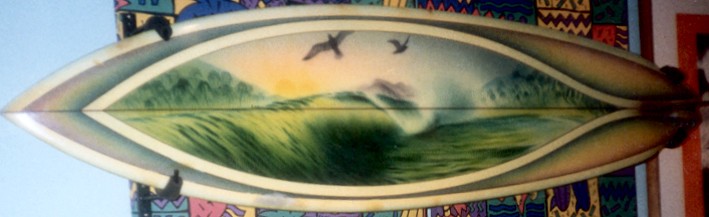
spray
Circa 1990 : Acrylic paint
design sprayed onto the filler / hot coat before glossing or Pro-tech finish.
1972 – 1990 spray was applied to the shaped
blank before laminating, generally giving a ‘deeper’ effect.
This method is still used by some manufacturers
or on request.
Notable examples include the work of Martin
Worthington for Hot Buttered Surfboards and others in the 1970’s.
spring
exaggerated, usually tail, rocker.Used
to describe early surf boats. Maxwell,
page 92. See Banana.
squeegee
a rubber blade used to distribute and
impregnate laminating resin into fibreglass cloth so that it adheres to
the blank.
Star tail
a tail with two points (?), see Swallow,
Fish. - US, Cralle.
step bottom/stepped bottom
design feature, see Hydroplane, Stinger
2.
step deck/stepped deck
design feature, see concave deck 3.
stern
tail
stick
early alternative to stringer, see stringer.
sticker
a adhesive backed printed vinyl label.
Although sometimes may bear a board manufacturer’s
logo, stickers should not be confused with decals.
See decals.
See also Surf Permit / Registratrion
sticker.
Stinger
1974 Ben Apia (Hawaii) design characterized
by flyers/wings set 2/3 rds back from the nose
(see 442 by Hap Jacobs, 1962).
Early models featured a stepped bottom
(see Hydroplane by John Kelly Jr., 1965) at the flyers, not found on most
copies, and a swallow tail.
Reported, with thanks, by Saxon June 2003...
Hydroplane Stingers were made extensively
by Len Dibben (Surfboards) in Perth in the seventies.
I have seen the photo albums to prove
it.
stock
a board built to the manufacturer or retailer’s
specifications and offered for sale ‘off the rack’. Compare custom.
Stor-a-board
board storage facilities in Sydney beachside
surf shops 1965-1969 for inland surfers relying on public transport.
Disappeared circa 1970 when most boards
were about 6 ft.
Most famous shop : Bob Brewster’s Stor-a-board,
Pittwater Road Manly, also the home of Bower Boy Surfwax.
stress factures/marks
hairline cracks in the laminate and/or
the filler coat, usually across the centre of the board (caused by extreme
flexing/compression) or around the fin (impact).
Occassionally stress factures will accompany
impact dings.
see Compresssion ding, Onion fracture,
May result from rapid curing.
US term 'crazing'.Cralle.
stringer/stick
(rare)
A timber beam inserted into a blank to
add structural strength.
The stringer defines a board's length,
thickness, deck profile and the bottom rocker.
Originally used in laminated solid wood
boards after WW I to maintain strength while incorporating lighter timbers
such as balsa, see Pacific Homes Systems Swastika
model.
With the initial introduction of
fibreglass and resin, stringers were not considered essential in an all
balsa wood blank.
In 1953, stringer use was detailed in the construction of a polystyrene
foam board. The blank was first covered in muslin cloth and a plastic sealer,
before being laminated with resin and fibreglass cloth.
See... Bill Reid : "Fun
on a Plastic Surfboard"
Popular Mechanics Magazine July 1953 Volume 100 Number 1 pages
157 - 159
Early polyester foam experiments were probably
subject to snapping, as well as a multitude of other structural and production
difficulties.
Note an alternative explanation, discussed
below, by Matt Warshaw,
2005, page 566.
Circa 1957-1958 the inserting of a timber
stringer, as pioneered by Pacific Homes Systems, reappeared to give the
board lateral strength.
Matt
Warshaw, 2005, indicates the reason was "a way to remove flex",
page 566.
Since early foam blanks often had many
surface defects, these were covered by a solid colour gel coat.
Identification of stringer use in examples
of coloured foam boards of the period can be difficult.
The use of the timber stringer in foam
boards has been credited to Hobie Alter, circa 1957, and Gordon Duane,
circa 1958.
Phil Edwards'
(1966)
account of experiments by Hobie Alter and Gordon Clark in foam production
(in the late 1950's?) notes ...
"Finally , they came upon the idea of molding the boards
in halves - cut down the long way
- that proved more stable.
They added strips of balsa wood in
the centre for stiffener,
and we began to turnout pioneer
boards." - Page 96
Scott Hulet notes a claim by Hobie Alter
for the "first use of wooden stringers in a foam blank (1957)"
See Scott Hulet : "In Trim : Hobie
Alter",
Longboard
Magazine, Volume 5, Number 4 August 1997, page 43.
Matt
Warshaw, 2005, in his entry for stringer, page 566, states
it...
"was invented in 1958 by California
surfboard manufacturer Duane Gordon".
However, in the entry for Duane Gordon,
page 169, he presents a modified...
" In early 1958, Duane was one of
the first manufacturers to put a wooden stringer down the center
" (sic).
- my emphasis.
Also note the email
from Jeff, below.
The contending claims are difficult to
assess.
Hobie Altter and Phil Edwards (a Hobie
employee) are not totally independent sources and Warshaw,
2005, does not cite his source.
It is difficult to conceive of what type
of evidence would be satisfactory to confirm or deny either (or any alternative)
claim.
Furthermore, the claim that this development
was a new "invention" is questionable, it appears rather the application
of a previous design to a new material.
Hobie Alter, Duane Gordon, Dale Velsey,
Gordon Clark and Harold Walker would have all been familiar with the Pacific
Systems Homes models, circa 1920 to 1945. (Note top photograph, Edwards,
1966, page 27.) and the potential influence of the widely ciculated Popular
Mechanics article of 1953, see above, cannot de dismissed
In Australia, Scott Dillon has reported
(personal interview, 1999) circa 1959, that some blanks were moulded too
narrow, so the width was increased with the insertion of a 2 inch
wide balsa stringer.
One example of the period has been noted
- Catalogue #85.???
This may be an echo from a similar account
by Hobie Alter in 1997, see Scott Hulet : "In Trim : Hobie Alter",
Longboard
Magazine, Volume 5, Number 4 August 1997, page 47.
An important advantage of a stringer is
that it provides the shaper and the glasser/decorator a line of symmetry
on the all white blank.
Shapers of stringerless boards of the
late 1960's found the lack of a stringer a problem.
The coloured resin glue line was a
possible compromise.
Many post-foam balsa boards have adopted,
perhaps unnecessarily, stringer use.
Multi-stringer placement can be used to
balance the board and stringers are invariably attractive.
Surf Romantics have been known to view
the timber stringer in their modern foam boards as an historical remnant
from ancient Hawaiian solid wood surfboards.
See also foam stringer, glue
line, T Band, stringerless.
Also see Stringer
Index
Note :
This
entry was updated April 2005 in response to an email from Jeff...
Amigo,
You must research your history
on the stringer better.
Hobie stole the stringer idea,
as well as Velzy, form Duane, Gordon of Gordie surfboards (est 1956).
Clearly most reputable surf history
books and peoples will tell you that Gordie, of Huntington Beach, Ca, did,
in fact, invent the stringer for use in foam boards.
Please research and confirm, and then
change your information that is posted under 'stringer' on your website.
Thank you and aloha,
Jeff
stringerless
a (foam) blank without timber/resin reinforcement
strip/s, usually for weight reduction, originally developed by Midget Farrelly
1965.
The lack of a centre line made shaping
difficult and in the late 1960’s often a glueline was used as a compromise.
Glassing was also difficullt, often the
blank was weighted to prevent the bottom rocker warping or flattening during
curing.
Last application was in 1970 Popouts –
some models had a knife cut down the centre of the blank that filled with
resin during laminating to produce a faux glueline.
Pre 1940 solid wood boards did not have
stringers and pre 1960 fibreglassed balsa boards were usually glueups of
four or more blocks.
Stringerless
design first used by Midget Farrelly at
the 1965 World Titles, Peru.
Extensively copied.
Stubby/Vee Bottom/Plastic Machine/Stringerless
A sub 8 ft long, 23 inch wide round nose
square/diamond tail board with a substantial negative wide point.
Common features : stringerless, Volan
glass, three phase bottom (flat/concave nose, round, deep vee tail), deep
Greenough Stage III flex fin, chamfered tail, psychedelic style decals.
Design by Bob McTavish, Midget Farrelly,
Kevin Platt, Keith Paull, Ted Spencer, and others Sydney; May 1967 to January
1968.
Note the extensively documented ‘short
boards’ taken to Hawaii in November/December 1967 by Nat Young (9 ft 4
inch) and Bob McTavish (9 ft) were elongated big wave or gunned versions
of current Australian designs which by November 1967 were commonly sub
7 ft 6 inches.
See Little Red, Mini-gun.
See Witzig's Hot Generation.
styrene – a resin
thinner.
Super board/Micro board
– a board with one riding position, the rider making small foot adjustments.
First commonly accepted design sub 6 ft Super Stubby by George Greenough,
Bob McTavish, Nat Young, Wayne Lynch, Ted Spencer and others; Sydney, North
coast NSW and Victoria 1969. Followed by Twin Fin #1 1970; Twin Fin #2
1976; No-nose 1979: Thruster 1982. See long board, shortboard.
Super Stubby
wide sub 6 ft board by George Greenough,
Bob McTavish, Nat Young, Wayne Lynch, Ted Spencer and others; Sydney, North
coast NSW, Victoria 1969 Commonly a double-ender Egg or pin nose square
tail Bullet. See Stubby.
Surform – a hand plane
with rasp-like removable blades used to shape foam, fibreglass and resin.
Brand name by Stanley Co.
Surf Kayak / Shoe
short, flat bottomed kayak developed particularly
for surfriding, probably by members of the British Canoe Union in the early
1970’s.
Some craft were used in Australia and
‘paddle surfing’ competitions were held by the NSW Canoe Federation, but
by 1980 these craft were replaced by the more popular recreational/performance
Wave-ski.
Surf Life Saving Clubs
SLSC / Australian Surf Lifesaving Association ASLA
beginning as groups of surfers who saw
the danger to those unfamiliar with the ocean, with encouragement from
local councils they quickly organized into clubs with committees, equipment
and clubhouses in prime beachfront locations.
It was to Freshwater Surf Life Saving
Club that Duke Kahanamoku was invited to give a demonstration of
boardriding in 1915.
Because the size of the craft and the
lack of personal transport the use of clubhouses for board storage became
an integral factor in the subsequent growth in surfboard use.
The various clubs associated as the Surf
Bathers’ Association of NSW in 1907.
Riding competitions were included in surf
carnivals but as the movement became more committed to civic duty boardriders
were progressively marginalized.
The growing conservatism of the life saving
clubs (e.g. the continued use of the potentially lethal belt and reel,
while boards were not acceptable for rescue work. The belt and reel was
finally retired in 197x?.), the introduction of the lightweight fibreglassed
board in 1957, the increase in automobile ownership and the development
of commercial storage facilities (e.g. Stor-a-Board) saw the relationship
further stretched.
The low point was 1962 – 1964 when surf
club members policed the unpopular board registration system introduced
by Sydney beach side councils.
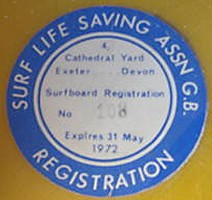
See Registration Sticker.
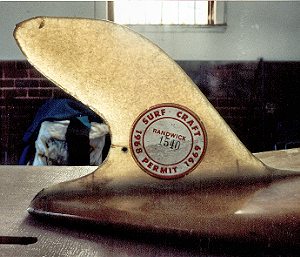
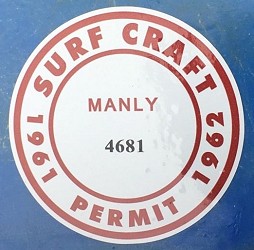
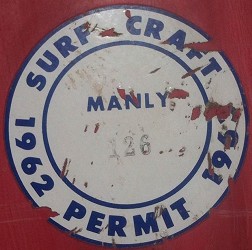
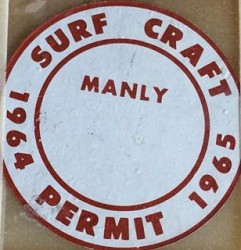
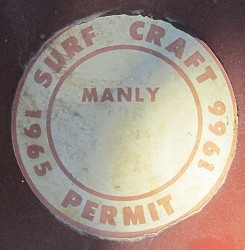
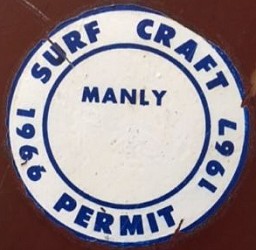
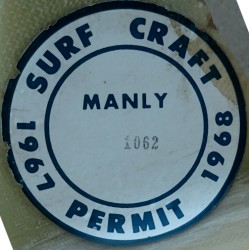
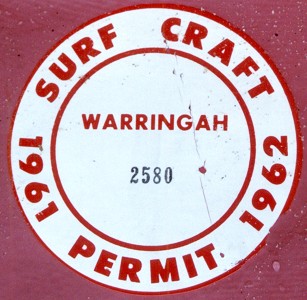
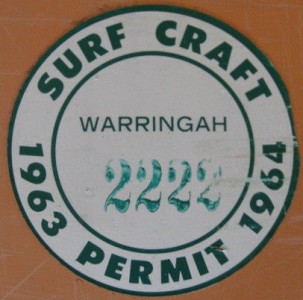
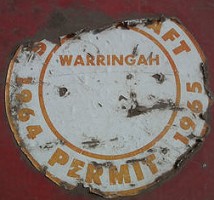
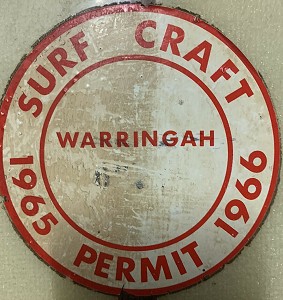
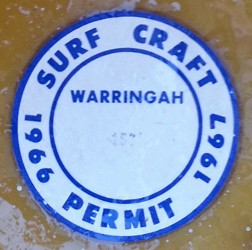
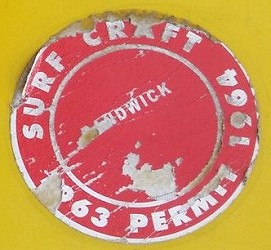
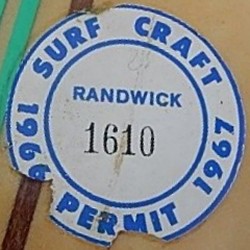
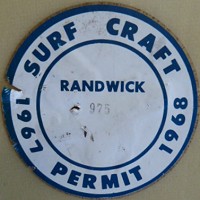
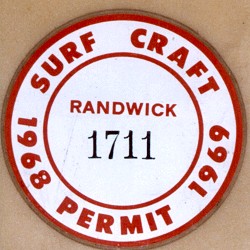
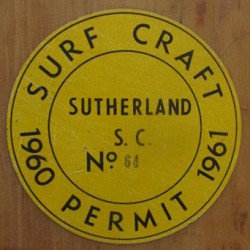
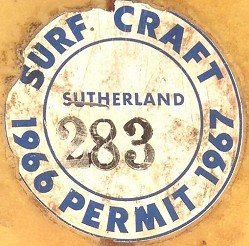
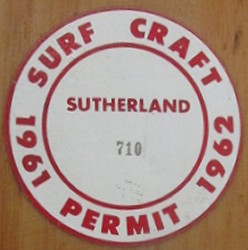
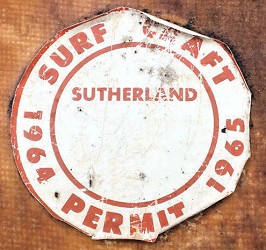
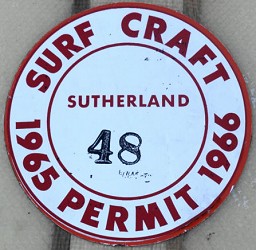
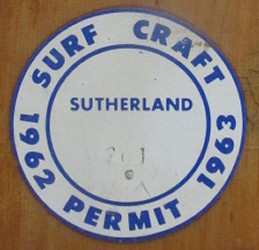
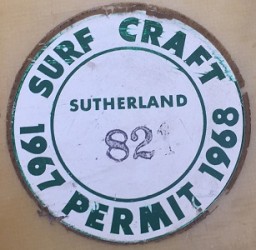
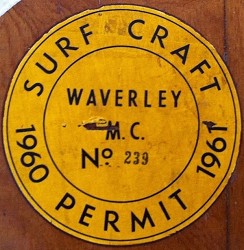
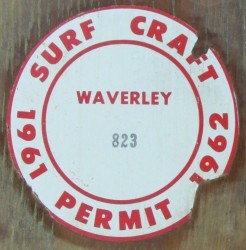
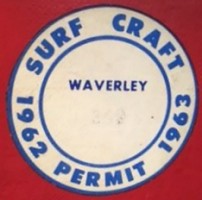
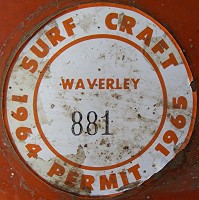
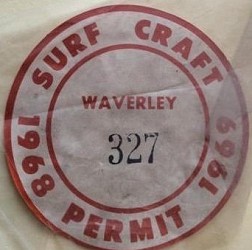
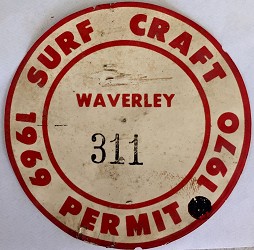
Surf
Permit / registration sticker
circular vinyl sticker (usually white,
indicating council area, year by date and print colour, and stamped serial
number) issued by Sydney beach side councils 1962 – 1968 as a reaction
to public concerns about safety.
Valid only for the beaches of the issuing
council and policed by beach inspectors and surf club members (sometimes
resulting in confiscation) the system was reviled by boardriders.
Perversely the stickers are now highly
prized by surfboard collectors.
A similar system was in use in the US
at this time.
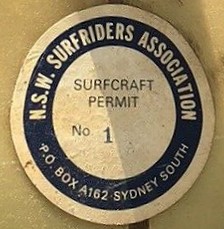
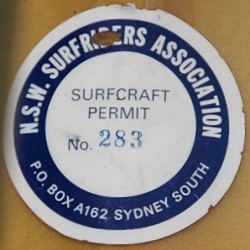
Circa 1969 a similar design Surfcraft Permit
was used to identify members of N.S.W. Surfriders Association.
PO Box A162 Sydney South
eg, San Juan board circa 1969, Permit
No:1141 in Blue and white. |
 |
Surf Philosophy
'the why and the how of riding waves'
- although surfing technique is usually leant or taught via demonstration
(free/contest surfing, still/moving photography - note George Greenough),
some surfers have attempted to analyse and theorise in print.
The earliest example is possibly
an article by Phil Edwards entitled What is Good?, published
in SURFER magazine in the early 1960's.(?)
Despite some dispute during the last 30
years about Bob McTavish's design ideas and his surfing performance ('the
Spin-out King' - 1968), in the field of Surf Philosophy his contribution
has been unequaled.
An infectious sytle (reminiscent of the
print contributions of Mickey Dora), intensive analysis and over-the-top
enthusiasm for his subject has produced some excellent work.
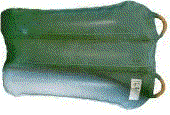
Surfoplane / Mat :
Inflatable rubber mat with molded handles
was invented by a Sydney doctor in 1933, Dr Ernest Smithers of Bronte NSW,
who worked for eight years to develop it.
Sir Charles Kingsford Smith, his friend
was a proprietor of the invention.
(Thanks to Alison Lee, see email
below.) |
|
The design '' was soon in mass production,
being hired by the half hour on Sydney beaches, and proving popular with
all ages and both genders. Surf-o-planes were... filmed for
Movietone
News 6/7 (1935), ...Movietone News 7/15 (1936), ...Movietone
News 8/13 (1937), ...Movietone News 9/14 (1938) , which included
shots of Dr Smithers riding his invention at Bronte, ...and...Movietone
News 10/6 (1939) " - Thoms
: Surfmovies page 40.
The craft was extremely popular, Manly
Surf Life Saving Club reported 261 rescues for the 1938-9 season, half
of which were carried out on or swept off rubber floats.(
Bloomfield,
pages 54 to 57). Surf-o-plane riding was included in 1938 Australian Surf
Titles (only time, won by Jack 'Strawb' Turnbull) and in the Makaha contest
for a period in the 1930's.
In the 1940's, Olympic swimmer and industrialist
Sir Frank Beaurepaire's rubber company manufactured a Surf-o-plane/Rubber
Air Mat using the Advanx brand. There were eventually three models - Elite
(5ft), Standard (4ft) and Small (3ft). Colours other than black were also
available - yellow and black with yellow stripes. Sold to the public from
the factory at Neild Avenue, Rushcutters Bay Sydney for 8 pounds ($16.00),
the company also offered a repair service and compressed air fill ups.
By the 1960 the design was available from
several companies, notably Clarke Rubber and Advanx, and with the expanded
use of the automobile sales were directed more at the general public than
the hire concessions. This was principally done by elaborate decor, for
example the Advanx Marlin
model as surfed by Nick Carroll in 1969, while some later models had
twin fins.
The contribution of this design to moderm
surfing is immense. In Australia it was used extensively by all types of
beach-goers and was the basis for juvinile surfers to gain surf experience
before advancing to surfboards - for example, four times world champion,
Mark Richards (
Knox
: M.R. pages 6 to 8, 14 and 16). The Surfoplane had similar impact
around the world, photographic and text evidence suggests the craft was
widely used in New Zealand, Hawaii, California, South Africa and England.
The Surfoplane would be superceded in the
1970's by the..
Coolite
Zippy
Board , and/or the
Canvas Mat.
COMMENTS
Performance :
The
Surfoplane had high bouyancy, but were relatively heavy and stiff, unlike
the craft that replaced them. This combination of features assisted both
getting through the surf and wave riding.
Examples : The
nature of the rubber used in the Surfoplane meant that if it was not constantly
inflated they would bond internally, and become useless. As a result, it
appears few have survived to the present day. One blue/yellow example is
held by the Penisular Surf Centre, Victoria. Thanks to Ted Bainbridge.
surf-riding
- this entry is too large to go here, please use link.
Surf-Ski
First credited to Dr. G. A. ‘Saxon’ Cranckanthorp
of the Manly Surf Club in 1933.
It was originally a 8 ft x 28 inch cedar
planked board; with seat, footstraps and propelled with a two bladed paddle,
possibly derived from the use of canoes in the surf.
By the late 1930’s construction had been
changed to plywood fixed on a timber frame, based on Tom Blake’s (Hawaii)
hollow board design.
In 1956 a current model was taken to Hawaii
by Duke Kahanamoku after his Melbourne Olympic Games visit. Adopted by
SLSC for rescue work and general beach duties, in preference to surfboards,
surf carnival races saw lengths increase (up to 17 ft) and widths narrow
22 inches) to increase paddling speed.
This emphasis on paddling led to double
surf skis (up to 23 ft) developed by Mickey Morris and Billy Langford,
Maroubra.
Early photographs show many with a leash
between board and paddle and the surfers riding in a standing position.
later models incorporated a rudder activated by a foot pedal.
From the late 1970’s hollow fibreglass,
foam filled and epoxy boards were developed as an alternative to the hollow
timber construction.
See Wave Ski.
Swallow Tail
tail design featuring symmetrical pintails.
A split tail design where the internal
edges are straight, as opposed to the curved edges of a fish tail.
SURFER Volume 13#Number 3 September
1972
Bill Hamilton & Gerry Lopez: Ben,
page 88 .
Article on Ben AIPA by ..in which the
first SWALLOW TAIL is sited in SURFER mag, although strangley not talked
about at all.
2/there are NO Swallowtails in Mote..definately
after 71,this sept72 mag was probably outlayed in June/July so this very
early picture of key swallow tail exponent Ben Aipa was likely taken just
before then. Keep in mind that Terry Fitz would have 'for sure' taken it
on if it had been touted about in the previous Hawaiian winter, only months
before.(tri fins were the rage at this time) By the time this mag
came out Fitz would have kicked off Hot Buttered..if memory serves TF has
been noted as saying his first flyers were later that year, 72. So when
did the swallow kick off here???. Surfer mag doesn't really show adverts
of swallows until the following year march 1973 (which is to say
images might be captured 3 months earlier)..and in Australian mags,there
are possible glimpses and guestimates but NO ads for swallow tails until
74?? I remember Reno Aberllira having great influence with his swallows
in oZ via McCoy post 'Rolling Home'. And with McCoy, swallows were before
flyers.But it would seem with Hot Buttered it was the other way round.
Anyway, either way you look at it swallows didn't take off until 73/74
a good 1>2 years after it first appeared in this mag!
Sweet Spot
1. Performance: the position
of foreword maximum trim or rear maximum maneuverability.
These positions would closely correspond
to the decal positions on a traditional Malibu board.
Term credited to Bob McTavish.
2. Decal: usually 2/3rds
from the nose or 2/3rds from the nose (the Golden section), the sweet spot
would be in front of the rider’s face when prone paddling or at the
rider’s feet if kneel paddling.
Swelling box
Circa 1960, A heated cabinet to allow
polyester blanks to stabilize before shaping.
Unstabilized examples of the period feature a 'sunken' stringer.
See Dillon Pig #99.
Notes
on Glossary