pods
for primates : a catalogue of surfboards in australia since 1900
 |
surfresearch.com.au
glossary
: d
|
|
Date : usually an
estimation, since shapers rarely date their work. Claims of design firsts
without current published documentation must be treated with suspicion
and many retrospective articles have errors. Note that books, magazines
and films have a lag time due to production difficulties. In the case of
books and film this can be as long as twelve months. For glossy magazines
it can be three months between a design being documented and it appearing
on the news stand. Historical exception : 1965 advertising campaign for
Mickey Dora’s ‘da Cat’ model for Greg Noll Surfboards (both USA) was begun
before the board was designed. In 1970 Tracks magazine put itself at the
cutting edge by adopting a newsprint format and reducing print time to
four weeks. In the case of contest articles or footage the lag is not a
difficulty because of specific dates. English method (e.g. 1st February
1915) is preferred, general dating (e.g. Summer 1914) should be avoided
because of possible confusion between Northern and Southern hemispheres.
The Hawaiian season has difficulties because it spans the new year.
*It is currently (1999) the fashion
for shapers to mark the blank with a string of dimensions. Apart from the
fact that these dimensions are sometimes incorrect, a 6ft board today will
still be a 6ft board in twenty years time. Dating of boards would be useful
information to historians / collectors of the future, if not for the designers
themselves.
Decal /
sticker
usually a graphic logo or text indicating
the manufacturer printed on rice paper and laminated onto the blank.
Decal is the preferred term.
In pre-factoy production times riders
would often decorate their boards with paint, often a name in decorative
script, cartoon character or club logo.
In Australia the Surf Life Saving Club
‘Reel’ logo was popular.
First production logo credited to Outrigger
Canoe Club (Hawaii) circa 1935
–paddle graphic over “O” branded into
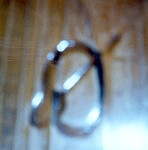
solid wood boards. Image 1.
Other variations included
metal medallion fixed by screws (circa
1940 – Tom Blake, (Hawaii),
laminated business card (circa 1947 x,
USA),
external metal foil adhesive sticker (1960
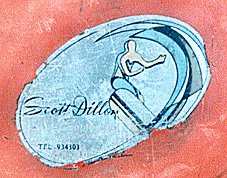
Gordon Woods, Australia). Example : Image 2.
First rice paper decals possibly by Velzy-Jacobs
(USA) circa 1955, first used in Australia by Scott Dillon circa 1958.
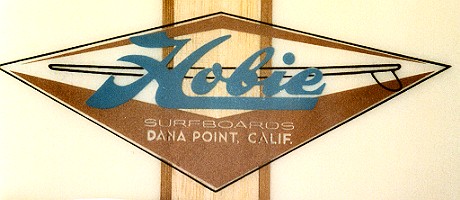
The Hobie decal, circa 1956, set a precedent
in design, the highly stylized script and framing. Image 2.
In Australia, Keyo was one of the manufacturers
that adapted the theme. Image 4.
Professional surfing in the 1980’s saw
a preference for clear boards and prominent positioning of sponsor’s decals.
1. branded logo (solid wood board)
|
2. metal foil adhesive sticker
|
3. The Hobie decal, circa 1956,
set a precedent in design, the highly stylized script and framing.
4. In Australia, Keyo adapted Hobie'shighly
stylized script.
deck: top surface
of the board that supports the rider, the term obviously deriving from
ships. The deck can be described as a cross section or a profile.
deck grip –
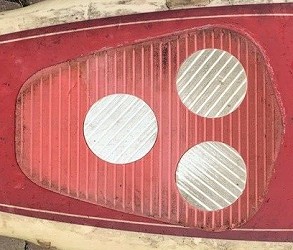
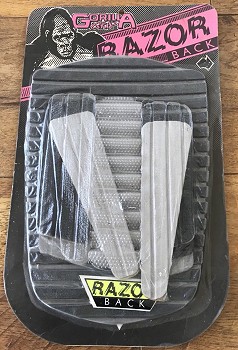
synthetic rubber non-slip mat glued to the deck, usually at the tail,
as a substitute for wax. First commercial product (probably) was AstroDeck
by Herbie Fletcher (USA) circa 1978. Australian product : Gorilla Grip,
circa 1982.
deck patch / kneel patch
: extra layer of fibreglass cloth to prevent knee dents in the deck
of a board. Essentially a feature on + 8 ft boards of the early1960’s,
i.e. boards that could be knee paddled, its use continued into the late
1960’s when often inappropriate. By the early 1970’s when kneel paddling
had become obsolete ( sub 7 ft ) it was relocated to the more useful tail
patch. See Patch.
Décor : any
feature added to a board; excluding wax, fins and legrope plugs; for identification
and/or decoration. Sub groups :
Markings, Decals, Colour (includes adhesive
grip).
delaminate : separation
of fibreglass cloth layers from one another or from the blank. Most
often occurring from depressions in the back foot area. Decals and fibreglass
fins are also particularly subject to delaminating.
Design : general features
that proscribe a particular type of board, usually starting with the template.
Design is a function of available materials and technology, the intended
wave type, the rider’s skill and the designer’s imagination. Contrast Model.
Diamond tail –a straight
edged pointed tail with distinctive hips. Also Rounded Diamond tail, with
curved corners.
Dimensions : the external
parameters of a board; specifically length, width, nose and tail width
(measured 12” back), thickness. Other measurements may be applicable depending
on the design, e.g. pod. A useful measurement is the Wide Point. There
is no recognized method of measuring nose and tail lift.
ding : crack, fracture
or hole in a board as a result of misadventure.
displacement
: total
weight of water displaced by the weight of the board, or the
combined weight of board and its rider or load.
domed deck –rounded
or convex deck, usually in cross section. Occasionaly in profile, see S
deck , Camel deck
Dol–fin / Dorsal fin –
1960’s racked fin resembling the dorsal fin of a porpoise. Early use by
Mike Hynson / Gordon and Smith Surfboards (USA) – ‘The Red Fin Army’.
Double ender
–almost
symmetrical nose and tail templates. See Sausage board.
double glassed /double
laminated – two layers of fiberglass cloth laminated together on one
side of a board, usually the deck.
Double Ski
– large
surf-ski designed for two paddlers/riders.
down rail
–a low profile
rail, either rounded (soft) or with a break away edge (hard). Originally
in conjunction with a flat bottom.
Down Railer : 1969
design by Mike Hynson (USA) featuring a soft down rail. The rail design
was initially exploited in the Side Slipper and went on to become an design
standard.
In 1970 a advertisemnet for Bahne Surfboards
had the heading "Many of our competitors have just introduced the full-length
breakaway edge design- We're very flattered", the design attributed to
Mike Hynson.
drag : the resistance
to forward motion of a craft caused by the shape of the bottom, breakaway
edges (rails) and fin/s.
draw knife –small
hand tool used in the shaping of timber boards. Some modern use in trimming
wooden stringers in foam boards.
drift-(fin drift)
–lack of forward thrust of the fin. See Sideslip
Drifta – model name
by Terry Fitzgerald / Hot Buttered Surfboards; rounded nose with distinct
wide point and soft rails circa 1983. Said to be based on 1970 Sideslipper
design, most models featured a traditional (1972) Tri fin setup (?).
dropped rail : see down rail
Dry laminating, dry glassing
... a dry glass
job ... the resin ... is sparingly worked out with a squeegee leaving only
enough resin for proper saturation of the cloth and securing a good bond
to the foam, here the glasser has to be very careful of drain-outs (little
air bubbles in the weave) which becomes weak spots when the resin has cured,
sometimes the cause of stress cracks, drain-outs are more noticeable in
tinted glass jobs.
Another way
to save a couple of ounces is, a small rail lap, you may have noticed over
the past three years the decrease in the size of rail laps, once anything
up to three inches was quite standard now three-quarter inch is normal
with some manufacturers using the diminishing lap on the bottoms of their
boards."
Steve
Core: Surfboards
Today
Surfing World
Magazine Volume 14 Number 4. Page 70. circa 1970.
surfresearch.com.au