 |
surfresearch.com.au
the catalogue #146 |
| home | catalogue | history | references | appendix |
|
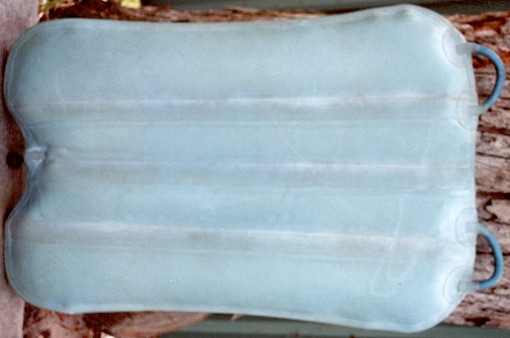
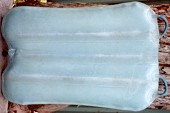
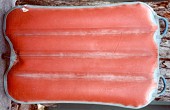
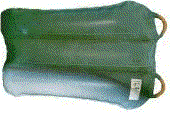
| 1933 Surf-o-plane 2 ft 7 " |
#146
|
|
Length :
|
2 | ft | 7 | inches | L2: | |
|
Width :
|
20 | inches |
Wide Point :
|
+ve 12 | inches | |
|
Nose :
|
n/a
|
inches |
Tail :
|
n/a
|
inches | |
|
Thickness :
|
6
|
inches |
Pod :
|
10
|
inches | |
|
Nose Lift :
|
0
|
inches |
Tail Lift :
|
0
|
inches | |
|
Weight :
|
kilos |
Volume :
|
litres | |||
|
Handles :
|
4
|
inches x |
2
|
inches |
| DECOR
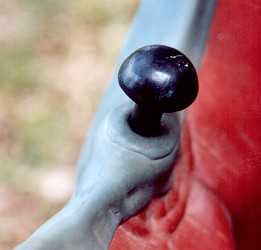
DECALS: Deck: none Bottom: MARKINGS Deck: none Bottom: COLOUR Deck: green Bottom: orange |
 |
|
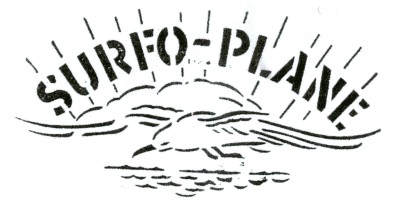
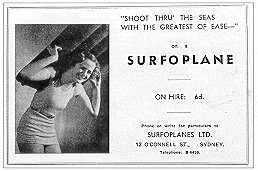
Surfo-Plane Trade Mark, 1933. Official Journal of
Trade Marks and Designs |
 |
Thoms : Surfmovies page 40.
Stan MacDonald, resigned from his
position as Chief Beach Inspector at Bondi in September 1933, to
take up the Surfoplane and deck-chair franchise at the North
groyne on Bondi Beach.
Excluding time at the war, Stan was
hiring out surfoplanes, etc (and spraying on coconut oil for
suntans-1937) for well on 50 years.
- reported by John Ruffels,having
spoken to Stan's son, Neil MacDonald. (Thanks to John Ruffels)
Examining the events of Black Sunday (the most celebrated rescue in the history of Australian surf life saving), 6th February 1938, Brawley comments on the development of the Surfo-plane.
"The surfoplane had been
introduced to Bondi Beach a few seasons earlier by Stan
McDonald.
On his retirement, McDonald had
designed a rubber surf mat that he called a 'beacher'.
Along with his chairs and
mutton oil tan: spray, McDonald leased the mats in their
hundreds;riding them became a popular surfing activity at a
time when board riding was still a marginal and almost
exclusively surf club activity.
The surf mats soon became more
popularly known as 'surfo- planes', the name of a rival surf
mat manufacturer."
Brawley
(2007) page 134.
This is in conflict with the
substantial claim by Thoms (2000,
page 40), and others, that the craft was invented by Dr
Ernest Smithers circa 1934 which, at the worst, parallels
Brawley's estimated time frame.
Certainly it post dates Smithers and
C. D. Richardson's patent application of 7th October 1932 noted
above.
The craft was extremely popular,
Manly Surf Life Saving Club reported 261 rescues for the 1938-9
season, half of which were carried out on or swept off rubber
floats.
Bloomfield,
pages 54 to 57.
Surf-o-plane riding was included in
1938 Australian Surf Titles (only time, won by Jack 'Strawb'
Turnbull) and in the Makaha contest for a period in the 1930's.
Bondi Surf
Bathers Life Saving Club- Online
Matthew John
Blanch:Australian Surf Life Saving Champions
Surfoplane
Race: 1937-38 J. E. Turnbull
| Surf Life Saving
Association of Australia: Surf in Australia.
March 1, 1939 Page 22 Cronulla. ... Bob Holcombe has proved himself the consistent individual competitor for Cronulla in this series of carnivals. Bob's fame is derived from his uncanny skill on the surf-o'-plane; in fact, local clubmen consider this race a benefit event for him. Last season, after winning a novice surf race, the major number of surf-o'-plane events, including the Australian championship, he continues his sequence for 1937-38 with nine consecutive wins to date, including the championship again. Image
right: |
 |
Matthew John
Blanch:Australian Surf Life Saving Champions
Surfoplane
Race: 1937-38 J. E. Turnbull
In 1940 the Surfoplane company,
concerned about increasing patent infringements, manufactures
only black and/or yellow models and favours sales to beach hire
concessions.
Wells
page 155.
In the 1940's, the Advanx Company
acquired the manufacturing rights and marketed the Surf-o-plane
using the Advanx brand.
Although the company is often
associated with Olympic swimmer and industrialist Sir Frank
Beaurepaire, he resigned his directorship of Advanx in February
1923 to persue business interests in Melbourne, where he
started the Olympic Tyre and Rubber Company in August
1933.
- Lomas, Graham: The Will To Win
- The Story of Frank Beaurepaire.
Heinman, Melbourne, 1960, pages 77
and 103 to 107.
There were eventually three models -
Elite (5 ft), Standard (4 ft) and Small (3 ft). Colours other
than black were also available - yellow and black with yellow
stripes.
Sold to the public from the factory
at Neild Avenue, Rushcutters Bay Sydney for 8 pounds ($16.00),
the company also offered a repair service and compressed air
fill ups.
In the 1950s an unknow company
marketed two models designated:
Narn SF2 approximately 3ft
(900mm) long, two tone yellow and green.
Available with palm tree and
beach scene decor.
Narn SF3 approximately 3ft 7''
(1100mm) long, two tone yellow and green.
By the 1960 the design was available
from several companies, notably Clarke Rubber and Advanx, and
with the expanded use of the automobile sales were directed more
at the general public than the hire concessions.
This was principally done by
elaborate decor, for example the Advanx
Marlin model as surfed by Nick Carroll in 1969, while some
later models had twin fins.
Production ceased in 1978.
The contribution of this design to
modern surfing is immense.
In Australia it was used extensively
by all types of beach-goers and was the basis for juvenile
surfers to gain surf experience before advancing to surfboards -
for example, four times world champion, Mark Richards Knox : M.R. pages 6 to
8, 14 and 16.
The Surfoplane had similar impact
around the world, photographic and text evidence suggests the
craft was widely used in New Zealand, Hawaii, California, South
Africa and England.
The Surfoplane would be superseded
in the 1970's by the Coolite, the Zippy Board and/or the
Canvas Mat.
In the 1980's the dominant prone
board would be the Morey Boogie.
A 2001 model of the Surfoplane
is under development from a Newcastle consortium, at http://www.surfoplane.com/home.asp
COMMENTS
Performance:
The Surfoplane had high buoyancy, but were relatively
heavy and stiff, unlike the craft that replaced them.
This
combination of features assisted both getting through the surf
and wave riding.
Examples: The nature of the rubber used in the Surfoplane meant that if it was not constantly inflated they would bond internally, and become useless. As a result, it appears few have survived to the present day. One blue/yellow example is held by the Peninsular Surf Centre, Victoria. Thanks to Ted Bainbridge.
REFERENCES
Other Boards
See Surfoplane 1969 and
Paipo Catalogue
Books
Webster's Encyclopaedia CD Rom Aust
Inventors 1997
Thoms :
Surfmovies page 40
Margan
and
Finney photographs
pages 137, 138 and 158.
Bloomfield,
pages 54 to 57
Radio
Damien Lovelock and Angela Katerns
and public contributors, on ABC Regional Radio, 1999.
Newspaper Article
Natalie Williams :Surfo
Resurfaces, Daily Telegraph, September 24, 2001. Page 13.
Steve Meacham: Lifesaving's
unsung hero brought to life
SMH.com, September 7, 2007.
"FOR five decades, the humble surfoplane was a comforting part of the Australian summer - an ingenious but simple device that helped generations of grommets grow confident enough in the waves to become surfers or surf-lifesavers.
But, says John Ruffels, a Bondi postman and amateur historian, the dramatic story of the surfoplane's inventor, Ernest Smithers, a Bondi doctor, has been largely forgotten.
Next week, Ruffels will give an illustrated talk on the surfoplane and the eccentric physician who devised it.
He stumbled on Smithers's story on his postal round when he delivered a letter to Dawn Ping, the widow of Dr Aubrey Ping, one of the early "test pilots" of the surfoplane, an inflatable floatation device made of rubber, which Smithers first demonstrated on Bondi Beach in 1933.
What surprised Ruffels was the range of the doctor's ingenuity. "He also invented the true-slice breadknife, the stainless steel steak tenderiser and the Capsulex contraceptive gel," Ruffels says. "They were an odd mix but, like the surfoplane, they were all designed to give people confidence."
Ruffels says Smithers began his working life as a court stenographer before deciding to study for the leaving certificate at night school. He studied medicine at the University of Sydney before falling out with the authorities. Despite being married, with two young children, he set off to Scotland to complete his studies before returning to Australia.
Short of cash, he took a part-time job at Palm Beach, where he bought, repaired and sold yachts. There he encountered canvas floatation devices that were used to keep the yachts afloat while they were being repaired.
"He used the floatation devices to get ashore," Ruffels says. "On another occasion, he had a go on one of those huge surfboards, which had just come into fashion in the 1920s, unwieldy things made of redwood or balsa."
By combining the two concepts, Smithers came up with the idea of a much shorter, more manageable inflatable device that could be used easily in the surf. However, it took eight years, and many different prototypes, before he was ready to launch the final, four-tube surfoplane in 1933.
His hero, the aviator Sir Charles Kingsford Smith, proved a critical backer when Smithers was trying to persuade councils to allow him to hire out surfoplanes on beaches in Sydney.
By February 1934 the first official surfoplane race had been held at Coogee Beach, and soon the device was a popular feature of beach holidays in many countries, including Britain, South Africa and New Zealand.
The surfoplane remained popular until the 1970s, and many emerging surfers, including Nat Young, Wayne "Rabbit" Bartholomew and Tom Carroll, learnt their surfing skills on one before progressing to a surfboard.
In the 1950s Smithers's design was refined by North Australian Rubber Mills, which introduced a model with handles.
Smithers made little money from his inventions, however.
"He was a bit of a hippie," Ruffels says. "He would invent all this wonderful stuff then sell the rights for very little."
Smithers died in 1976, about the time manufacture of the surfoplane ended, but in 2001 three Newcastle businessmen bought the rights and began manufacturing new, highly coloured versions.
However, the day the surfoplane came of age was February 6, 1938 - the infamous Black Sunday, when five people drowned at Bondi Beach and 250 were rescued.
Rescuers were handed surfoplanes, who in turn gave them to people who had been washed out to sea. "The fact that they had something to hang on to probably saved a lot of people," Ruffels says, "but half of them shouldn't have been out there in the first place." Using surfoplanes had made them overconfident in the surf.
John Ruffels's surfoplane lecture
is at Bondi Junction RSL on Monday at 4pm."
CONDITION:
0
 |
 |
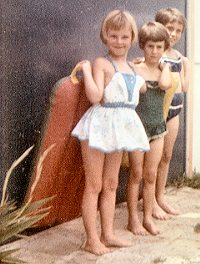 Jane Flack and friends and Surfoplanes, Shoalhaven Heads, circa 1963 Paul Flack Collection. |
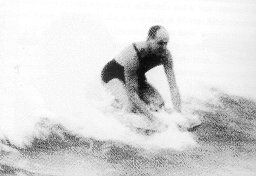
Drawing Top Will Fisher : Riding the Waves Two Hundred Years Issue No 47 , pages 1124 - 1127 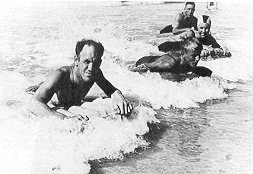 Australian Surfboard champion, Claude West surfoplaning at Manly Beach, circa 1940. Wilson: page 73. Note the photograph is credited as 1924 - this is surely incorrect |
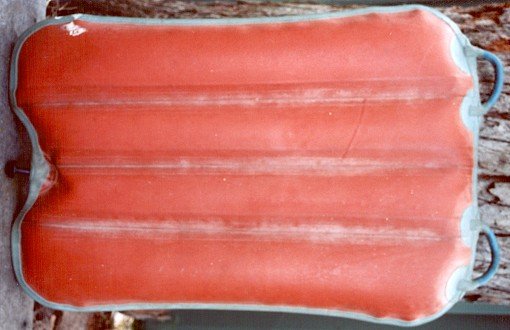
Because I have recently had two enquiries from your readers about Surfoplanes, I thought I'd rouse myself and fine-tune the Herald interview (shown on your excellent site), and try to clear up the mystery of the three barrelled Surfo.
Point one: Dr Ernest Smithers got his
design from combining the canvas floatation device used to
keep boats afloat during repair work, and a long board (of the
Redwood design) made entirely of hard rubber!!
When Smithers had a ride in
the surf on one of those, it snapped in half!
This gave him the idea,
because he then proceeded to surf on the truncated
device - shorter board. (We are talking the mid 1920's).
So, from using the inflatable
canvas idea from the flotation device, and the short rubber
board from the bigger (hard rubber) original, he combined both
to create the Surfoplane.
It took him eight years and his test pilot mate, (Dr) Aubrey Ping of Bondi, recalled them, both going round the local motor garages at Bondi beach asking for old motor car tyre inner tubes to work on. (Mid 1920's).
Dr. Aubrey Ping, who not only named " Phar
Lap" (he was Queensland-born Malayan Chinese)
which is Malayan for
"Lightning", but told his wife he played a big part in
developing the design of the Surfoplane.
His widow said he was a
strong surfer and Dr Smithers was not, but Dr Smithers
invented several things, and in retirement to Sussex Inlet,
used to swim the bay as exercise!
So, my doubts creep in there.
Although he does look a bit
ungainly in the Cinesound clip at Bronte.
Now, as regards the three barrelled
Surfoplane.
Because Dr Smithers sold the
rights to the original Surfoplane design to business men (he
had it made of rubber from the North Australian Rubber Mills
in the NT), Dr Smithers and his best franchisee, Stan McDonald
at Bondi, decided to "invent" a different design and call it
"The Beacher". It was this designed Surfoplane which was hired
out at Bronte, Maroubra, and, for a short while in
World War Two in Manly.
I had thought 'The Beacher" had three
barrels, but now I'm not so sure.
The State Library of New South Wales has an interesteing photo
of a three barrelled surfoplane, which looks like an early
prototype.
Its on their Picture Search site.
Smithers did take Advanx Rubber to court for making their own
surfoplane, but settled, in 1936.
Sorry this is so long, but, hey, so is history!
Regards, and more strength to your Surf Research arm!,
JOHN RUFFELS.
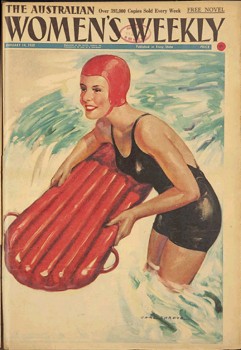 |
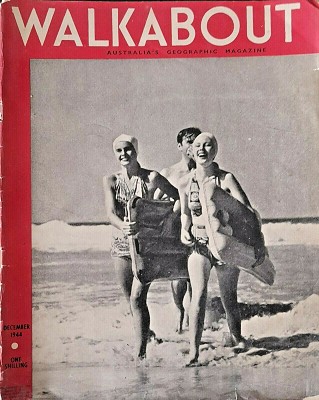
The Australian Womens'
Weekly Saturday 14 January 1939, page 1. Walkabout - Australia's
Geographic Magazine
December, 1944 |
 |
| home | catalogue | history | references | appendix |