pods for primates : a catalogue of surfboards in australia since 1900
home catalogue history references appendix

Click for catalogue entries by date - start 1914 with Duke's 8ft 8''
surfresearch.com.au 
  the paipo* catalogue 
the paipo* catalogue
*Prone and Kneeling Craft - Paipo, Lamaroo, Bellyboard, Surf-o-plane, Coolite, Kneeboard, Spoon, Slab, Mat, Boogie, etc
#00000172 1930 Solid wood Bellyboard 4 ft 5''
#00000173 1930 Solid wood Bellyboard 4 ft 3''
#00000146 1933 Surf-o-plane,  Dr Ernest Smithers 
#00000166 1950  Lamaroo 5ft 1''
#00000113 1956 Paipo, Balsa 3ft 8"
#00000325 1953  Plywood Bellyboard 2ft 11''
#00000194 1960  Paipo Bellyboard  2 ft 8''
#00000204 1960 Plywood Bellyboard Twin fin 'Rocket'  4ft 6''
#00000193 1960 Paipo by Farfor, 3 ft 5''  Tapa cloth laminated bottom
#00000307 1960 Bill Wallace Balsa Bellyboard 4 ft
#00000050 1963 Barry Bennett, Bellyboard Twin fin 5ft 1"
#00000311 1964 McDonagh Twin Fin Kneeboard 4 ft 9''
#00000313 1964 Wallace Belly/Knee board  5ft 3''
#00000197 1966 Bay Area Belly board 5 ft 5''
#00000219 1974 Barry Bennett  Kneeboard 5 ft 7''
#00000147 1969 Surf-o-plane Marlin model, surfer Nick Carroll
#00000034 1972 Midget Farrelly, Coolite 4 ft 10" Rubber fin
#00000195 1970 The Shoe by Shane, 4 ft 11''. Spooned deck kneeboard.
#00000203 1970 Zippy Board Small 'Hunters Toyline' 16''
#00000076 1973 Jackson, Greenough Spoon 5 ft 10" 
#00000320 1973 Ron Wade Spoon  4ft 8''
#00000083 1973  Barry Taylor, Flextail Kneeboard 5 ft 6" Hand made fin box
#00000202 1973 Zippy Board Large 'Super Surfer' 3ft
#00000227 1975 Rod Ball Design Ski tail Kneeboard 5ft 8
#00000068 1975? Backyard,  Spoon deck Kneeboard 5ft 6"
#00000150 1975 Belly Bogger 3ft 7''
#00000066 1976 Merrin, Air mat twin fin 5 ft 4" 
#00000058 1976 Crozier, Kneeboard  Slab 5 ft 4" Tri boxes
#00000310 1978  Sky Kneeboard 5 ft 8 1/2"George Greenough Design Shaped by Chris Brock 
#00000088 1980 Coolite Twin fin adaptation
#00000030 1980 Morey Boogie, Mach 7
#00000206 1985 Express Four fin Kneeboard 5 ft 7''
#00000205 1989 The Pod - Molded Handboard 12''
#00000091 1990 Zero Utra Light (Thruster Coolite)  5 ft 
paipo* catalogue : images
Paipo Catalogue for...
Rod Rodgers, Baltimore, Maryland : My Paipo Boards and ...More.

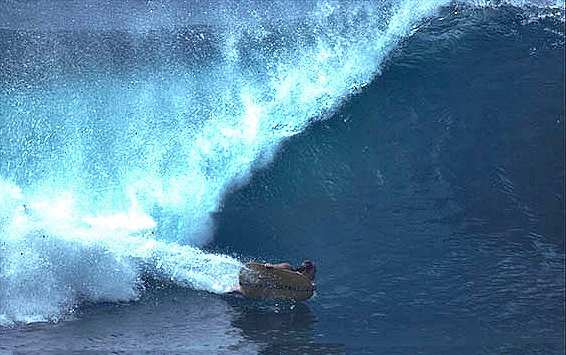
Before bodyboards there was plywood.
Sean Ross, Pipeline, Hawaii.
Board by Paul Lindbergh's Hawaii Paipo Designs.
Photo: Alan (Bud) McCray.
Sean was a life guard at the Ehukai Beach (Pipeline) during the1970's.
Photo courtesy Rod Rodgers

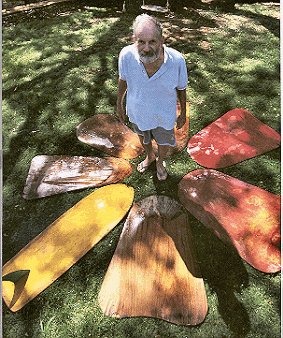
David Swanson and his and Val Valentine's
Paipo Collection, Haleiwa, 2000.
Photo and article by David Pu'u
The Surfer's Journal,
Vol 9 No 3, 2000 Pages 122-123

Paipo, Lamaroo, Bellyboard, Surf-o-plane, Coolite, Kneeboard, Spoon, Slab, Mat, Boogie
Often denegated, usually ignored, prone surfboards play an integral part in surfboard design and riding performance.
Note..
1. The art of Hawaiian surfriding as evidenced by Captain Cook in 1770 must have developed in the Pacific islands over centuries. Obviously the initial ventures would have been on small boards in small surf, close to shore. Only with a vast increase in skill and experience over a long time and the availability of suitable materials (for example wili wili, an Hawaiian equivalent of balsa wood) would stand up surfing be possible.
2. Most surfers begin their surfing on prone boards - for example Mark Richards on a Surf-o-plane and Tom Carroll on a Coolite.
3. Many surfboard design features have either been initially developed or taken to their extremes by non-standup surfers, for example George Greenough.
4. In many cases, performance levels have been set by prone/kneel boards. This was partically the case up to 1974, before the introduction of the legrope. Prone or knee boarders, by virtue of their proximity, have more control of the board during wipe outs and this enabled them to ride deeper in the wave with confidence and to dominate at breaks were wipeouts were board destroying, for example Little Avalon, Sydney.
5. Subequent to the general adoption of the legrope, prone craft still establish some performance levels. Photographic evidence appears to confirm that Boogie riders ride deer and longer in the tube.
6. In other performance areas, such as "getting air", the manourves were established by Boogie riders ten years before being adapte by standup surfers.

catalogue menu
the catalogue : text
paipo* catalogue : text
catalogue master base :text
manufacturer/shaper index
surfboard catalogue : images
paipo* catalogue : images
fin catalogue : images
catalogue specifications

home catalogue history references appendix