surfresearch.com.au
the catalogue #335
the catalogue #335
| home | catalogue | history | references | appendix |
|
surfresearch.com.au
the catalogue #335 |
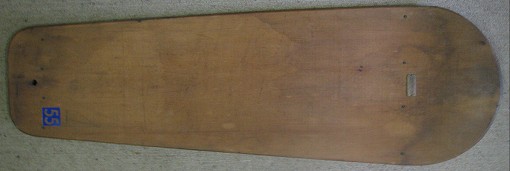
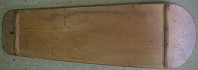
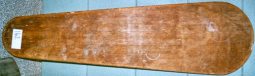
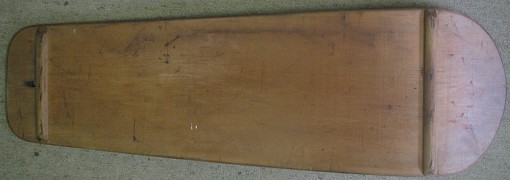
| 1930 Risby Bros. Solid Wood Belly Board 3ft 6" |
#335
|
|
Length :
|
3
|
ft |
6
|
inches | L2 | 3ft 5 1/4'' |
|
Width :
|
13 1/2
|
inches | ||||
|
Thickness :
|
5/8
|
inches |
Pod :
|
9
|
inches | |
|
Nose Lift :
|
3
|
inches |
Tail Lift :
|
inches | ||
|
Weight :
|
kilos |
Volume :
|
litres | |||
|
Other, Flyer/s :
|
inches |
| FEATURES
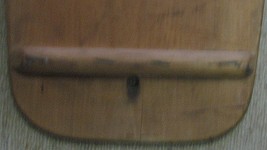
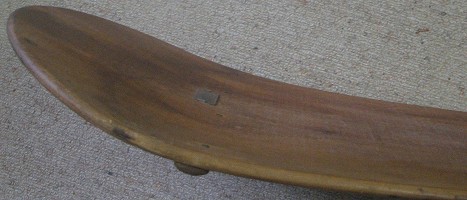
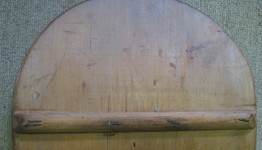
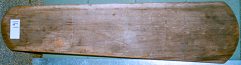
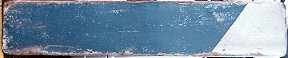
Nose: round Tail: rounded square with hole for hanging storage. Deck: flat Bottom: flat with two cross cleats. Rails: rounded square Rocker: flat with nose lift. Image right : Tail cleat and hole. |
 |
| DECOR
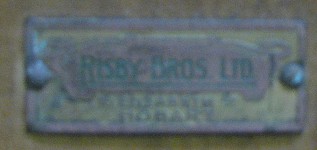
DECALS: Deck: Risby Bros.Ltd., Elizabeth Street, Hobart - bronze plate at sweet spot. Image right. Bottom: MARKINGS Deck: none Bottom: COLOUR Deck: natural timber. Possibly originally stained or varnished. Bottom: |
 |
 |
 |
|
|
|
BOARD
HISTORY
Dimensions and
photographs Australian Surf Museum, Manly Suf Life Saving
Club, 23 November 2007.
Thanks to Ray
Moran, Ray Petersen and and Manly Suf Life Saving Club.
Australian Surf
Museum Catalogue (2006) No. 55 .
The board is
on-loan from Dave Montgomery, Balgowlah, NSW.
Dave reports:
"The board was
purchased from an elderly resident of Belrieve, Tasmania circa
1997.
Built of huon
pine, the nose lift was set by steaming the timber ande
bending it over a metal pole.
The hole in the
tail is original and allowed the board to be hung flat against
a wall after use for drying and to decrease the possibility of
the timber warping.
The owner
purchased the board new and had several black and white
photographs illustrating the boards in use.
This was in
signficantly sized waves, large and powerful enough for some
riders to ride in a standing position."
- Dave
Montgomery in phone conversation, November 2007.
Many thanks to
Dave for his assistance.
Between 1848-1894, they built Spy (a cargo schooner), Nellie (a cargo ketch) and a number of whaleboats.
Builders
from the Register of Australian and New Zealand Vessels by
Mori Flapan
http://www.boatregister.net/TasmanianBuilders.htm
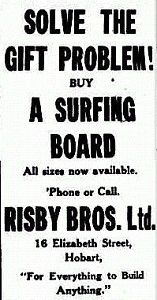
At the end of the 1920s, they offered their prone "surfing boards" in a range of sizes:
|
BUY A SURFING BOARD All sizes now available. 'Phone or Call. RISBY BROS. Ltd. 16 Elizabeth Street, Hobart, "For Everything to Build Anything". - The Mercury (Hobart), Saturday 21 December 1929, page 3. |
 |
In early 1938,
they moved premises from their Elizabeth Street store to a new
location in Collins Street, Hobart.
The clearance
sale of a diverse range of products included a stock of 20
boards:
GREAT SALE OF TIMBER AT RISBY'S
Owing to
Removal from Present Site, Our Entire Stock MUST Be
Cleared!
...
SURF
BOARDS
20 SURFING
BOARDS, in Huon Pine, shaped and cleated, with curved
ends, at .... 12/6 each.
...
RISBY
BROS. LTD., cnr. Elizabeth & Davey Streets, Hobart
- The Mercury (Hobart), Saturday 8 January 1938, page 9.
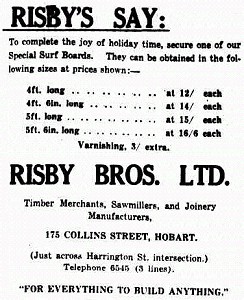
At the Collins
Street store the range of board sizes were specified from 4 to
5ft 6'', with an addition fee for varnishing.
The previuous "surfing
boards"
was now shortened to "surf boards".
| RISBY'S SAY:
To complete the joy of holiday time, secure one of our Special Surf Boards. They can be obtained in the fol- lowing sizes at prices shown: 4ft. 6in. long .. .. at 14/ each 5ft. long .. .. .. .. at 15/ each 5ft. 6in. long .. .. at 16/6 each Varnishing, 3/ extra. RlSBY
BROS. LTD. |
 |
| DESIGN
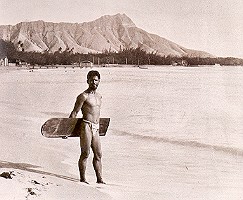
HISTORY Circa 400, the Paipo developed as small wooden prone board, used thoughout the Pacific Islands primarily as juvenile sport. In Tahiti and Hawaii the boards were ridden prone, kneeling and, occassionally, standing. Other Pacific Islands were restricted to prone riding only. The
origin of these boards is speculative, but broken
sections from discarded canoes, outrigger floats or
paddles (the blades) are possible sources.
|
|
The earliest record of these boards in Australia is by swimming champion, Charles Steedman in 1867:
"A small
deal (1) board, about five feet long, one foot broad, and
an inch thick, termed a 'surf board,' is
of
considerable help to a swimmer who is crossing water on
which the foam is deep -for by its aid he
can raise
his head to breathe above the surface of the foam."
Steedman: Manual of Swimming (1867), page 268.
Solid timber
handboards/bellyboards were in use on Sydney's beaches before
the visit of Duke Kahanamoku in 1914.
Sydney surfer
and swimming champion, Harold Baker noted in 1910:
"The
surf-board is used to a great ,advantage on flat, shallow
beaches.
It is a
piece of board, cedar for preference, about 18in. long,
10in, wide, and about half-an-inch in
thickness.
It is
square at one end, and half-round at the other.
The
rounded end is to the front when shooting."
Baker: General Physical Culture (1910) pages 58-59.
Also see History/Duke/Detailed Analysis.
The enthusiasm generated by Kahanamoku's visit saw Sydney surfers persue the developement of the standing board and prone craft were dominated by the Surf-o-plane, circa 1933.
These prone
boards were in Victorian use as early as 1915, by a Mr.
Jackson and Mr. Goldie at Point Lonsdale, after a visit to
Hawaii.
They were
either imported or homemade adaptations and in 1915 they
encouraged a local girl, Grace Smith Wootton,
to take up the sport.
In Tasmania:
"Surfing
arrived in Tasmania in the second half of the 1920s,
although no clubs were formed until after the Second World
War.
The man
credited with bringing surfing to Tasmania is Harvie
Thompson, who came to Hobart in 1926, having grown up and
learned to surf at Manley (sic), NSW.
Thompson soon befriended a local, Cedric Cane, and the two
men became central to a project that subdivided and sold
land behind Clifton Beach, near Cremorne.
Only
eighteen blocks were sold before the Second World War, but
by then a small, tight-knit community of shack dwellers
had developed.
Their
summer activities included swimming, fishing, flounder
spearing and surfing.
Men,
women and children surfed.
Their
boards were entirely homemade from the pine sides of
kerosene boxes, sawn up second-hand tables or any planks
of suitable size.
During
the 1930s they obtained more sophisticated commercially
produced plywood boards with upraised forward ends.
Harvie
Thompson's much-prized board was fashioned from cedar.
Most, if
not all, boards were hand-painted with marine motifs."
Young, David:
Sporting Island -
A History of Sport and Recreation in Tasmania.,
pages 205 and 206.
| Image
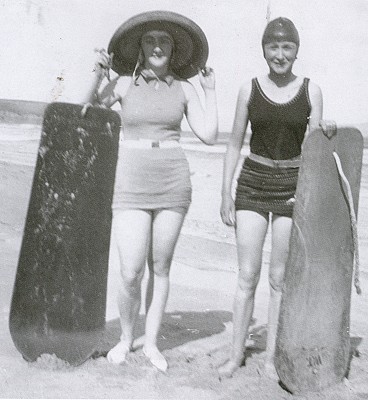
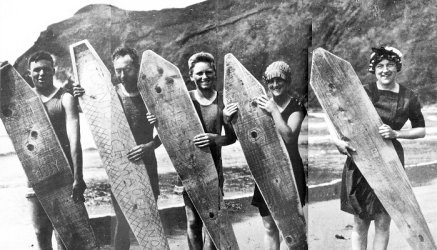
right: "Female surfers on Clifton beach in the 1920s. Courtesy: Diana Gee." Young,
David: Note
the holes and ropes at the tail of these boards to
allow the boards to be hung to dry after use as
described in the account by Dave Montgomery, above.
|
 |
Plans of solid
timber prone boards were pulished in Popular
Mechanics magazine July 1934 and Popular Science
magazine August 1935.
These
illustrated that such boards were already in use in the USA and
publication in such magazines probably saw these plans
distrubuted world wide.
The design was
popular in the southern states of Australia and in New Zealand, South Africa and
UK.
Hence the
descriptive name, Empire boards.
Although many
were probably home made, this and several New Zealand examples
were probably factory made - note regular shape, nose lift and
paint decor.
With the
development of an adult surfing culture, prone boards
became essential in acquiring basic surf skills. In the 20th
century, the Paipo has been re-invented several times...
| the Surf-o-plane | the Bellyboard | the Kneeboard |
| the Spoon | the Coolite | and the Mat. |
Also see Paipo Catalogue
| Huon Pine Prone Board,
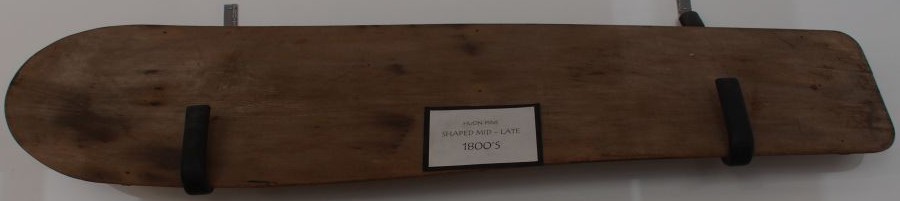
Tasmania. Photograph and information thanks to Bob Green, March 2020. On display at the Long Point Surf Shop, Bicheno,Tasmania. Bicheno is an interesting place as lots of whalers visited there. The board has cleats on the bottom, but is still very warped. The date of 1800s is probably inaccurate. |
 |
Books
Wells pages
157 - 159
Edmunson
pages157 - 167, note Figures 51 and 52.
Websites
Maritime
Museum of Tasmania: Homemade- Surfing in Tasmania
http://www.maritimetas.org/collection/displays/home-made-surfing-tasmania
CONDITION: 8.5
 |
Prout
brand solid wood belly board, New Zealand 1940's 5ft
Longboard Surfshop (NZ) On-line Auction catalogue, 1999. |
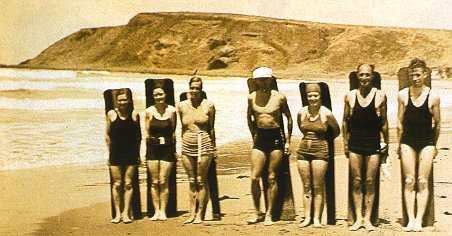
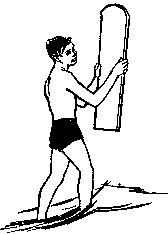 Boy with bellyboard, UK circa 1960 Edmunson ; page 162 Text reports dimensions as 4 ft x 12'' x 3/8'' Waterproof resin-bonded or marine plywood. Commercially available, cost up to 30 shillings ($3.00) |
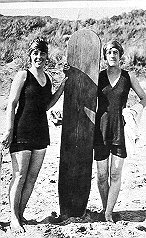 Grace Smith Wooton and Win Harrison Point Lonsdale Victoria, circa 1916. Wells page 157 The board was made by a local carpenter, cost 12 shillings ($1.20), with her initials carved in one end. |
| home | catalogue | history | references | appendix |
Risby Bros
Years Active:
1848-1894
Where Built:
Hobart, Tas
Number of
Vessels: 2
Material: Wood
Type of
vessels: Cargo schooner, cargo ketch
Names of
vessels: Spy, Nellie
Email:
p.butler@internode.on.net