surfresearch.com.au
 |
surfresearch.com.au
baker
: surf bathing,
1910
|
Harold Baker
: Surf Bathing, 1910.
Baker, Harold:
Surf Bathing.
in
Baker, Reg
"Snowy":
General
Physical
Culture.
With
Articles
On Special Subjects By Leading Australian Athletics. (Health
Strength Skill).
Melbourne.
G.Robertson
& Co., 1910.
Introduction.
The chapter on
surf
bathing was written by Harold Baker, a brother of the author.
William
Harold
Baker (1887-19620 won three state swimming championships in 1906
and captained
the Australian water polo team.
Captain
of Maroubra Surf Club in 1900-10, on 28 January
1910 Harold took part in a famous surf rescue of over 100 people
at Cronulla
Beach and was awarded the Albert Medal for bravery; a public
subscription
for him raised £1000 in its first week.
From late 1913 to 1915, as Harald Baker,
he was the swimming and surf columnist for Sydney's
Evening News.
He represented Australia in Rugby
three times against New Zealand and won boxing and wrestling
championships.
Along with contributing to his brother's book, Harold worked for
Snowy
at Stadiums Ltd, refereeing many important fights,
including several featuring Les Darcy..
Page 54
Surf
Bathing
"Oh! how
lovely
to shoot down the breaker's white crest,
While gently
the waves seem to rock you to rest"
How can I
hope
to tell of the pleasures and of surf bathing?
The words
quoted
will, perhaps, help some to understand, in a small degree,
the wonderful
fascinations of the delightfully healthy pastime of
"surfing," or, more
correctly, "breaker shooting."
As breaker
shooting,
or "cavorting," is a much more scientific performance than
the every day
indulged-in sport of sea bathing, I will endeavour to
describe it in its
order, and enumerate some of the recommendations of the
"surf."
Its very
first
claim upon us is its health-giving, physique-building
properties:
One has only
to visit the numerous beaches surrounding the city of Sydney
to see its
wonderful effects.
How many of
our
friends do we know who have been delicately inclined, and
ordered into
the open air, and have become surf converts?
Almost any
of
these once unfortunate beings could, at this moment, be
pronounced "absolute
cures."
I have at
this
moment a friend, said to be an incurable consumptive, and he
swears by
the surf, together with the sun.
This may
seem
paradoxical, as most chest weaknesses are ordered away from
the salt air.
However,
such
is the case.
There are
hundreds
of persons taking to the surf nowadays for reasons other
than those of
pleasure.
One of its
most
particular claims is laid upon those suffering from obesity.
Very seldom
will
be seen a regular surf bather suffering from that complaint,
which, I think,
goes to show its effect on the abdominal regions.
These
things may
be classed under the heading of "curative effects 6f the
surf."
Leaving
these,
I come to its "formative values," as applied to the human
frame.
Go to the
beach
and cast your eyes over the many hundreds bathing there.
What grander
sight is there to behold?
The surfers
are
all bronzed of colour, full in chest, and thick of limb.
The surf
will
not, in its true sense, tolerate a weakling.
No; it will
keep
on improving him ...
Page 55
... until he
reaches a respectable physical standard.
Only the
surf-
bather knows the physical effort called for in getting out
against a good
sea, taking a good wave, and hanging to it, till it lands
him on the sand.
This is not
child's
play.
No; 'tis
something
more, requiring a considerable amount of stamina.
One
unacquainted
with the ocean, might remark that he failed to see where the
work came
in.
He has
evidently
never "taken" a breaker.
To dispel
his
idea, let me take events as they happen when you enter the
water.
First, you
have
to swim out probably one hundred yards to the line of
breakers.
This is no
mean
effort in a "lumpy" sea.
On getting
out,
you will have to hang about for a while until a decent wave
happens along.
All this
time
you will have to support yourself, maybe in deep water,
maybe in shallow,
but whichever
it is, you
will
have to keep ducking under waves, to maintain your position.
Eventually
the
wave you fancy comes along; you take it and go up ,ashore,
your body tense,
and your breathing restrained slightly.
This, I am
sure;
is a physical strain, but one relieved by the exhilarating
sensation of
"cavorting" the wave.
There is as
much
"fitness" required in breaker shooting as in most other
games, but it is
gained under much more pleasurable circumstances than in
other pastimes.
I think I
have
dealt sufficientlv with the curative effects of bathing, so
I will now
advance to the highest stage of surf-craft, and endeavour to
explain to
the readers of this book how to shoot a breaker.
To begin
with,
the man who has done a fair amount of bath swimming and
racing will be
found to adapt himself to the peculiarities of a wave much
more rapidly
than one who has been debarred from the advantages of an
up-to-date swimming
club.
Hence are to
be recognised out in the further line of breakers such men
as Healy, Wickham,
the Martins, and Colquhoun-Thompson, all members of the East
Sydney Flying
Squadron team, besides Read, F. C. Williams, Bell, and many
others well
known in the racing world.
These men
are
some of our best shooters, and I quote them to show how much
better the
fast men are than the slow.
Now, as to
the
method of taking a wave.
The shooter
gets
out to the line of breakers that he intends to take off
from, and there
he remains till the most suitable wave rolls in.
I say ...
Page 56
... most
suitable,
because a lot depends upon the choice of breaker to take.
You may have
to allow four or five apparently decent waves to go by
before you get one
that you can take, the others being either "dumpy" or "short
runs."
These
defects
in a breaker I will explain later.
At last you
have
decided upon the wave you want.
It is
rolling
in now.
Possibly you
will have to go out and meet it, or maybe you will have to
come inshore
a little to get it on the ''catch' or "pick-up."
The
"pick-up"
or "catch" is that part of the wave which has a tendency to
lift you up,
and carry you onward with its rolls.
It is that
part
which is still green water, but is about to turn into a
"comber" and run
inshore.
The reader
may
ask, At what point do I take the breaker?
Well, you
take
it when it is about to turn from green water into a foaming
billow.
Neither
before
nor after.
There is
absolutely
one moment when you must get off on a wave, and that is the
instant the
breaker "catches."
If you get
away
late you will find that you will be buried in the wave all
the way ashore,
or that you will drop behind on the take-off.
Then, again,
if you take it too soon it will break on the top of you.
From this
you
will gather that there is that one instant only for the
"pick-off."
Of course,
onecan
shoot a wave long after it has turned to foam in a sort of
way, but it
lacks that fascinating sensation of coming down the crest of
a billow -
a sensation one never tires of.
A word here
as
to the most desirable waves for shooting.
The one I
would
fancy would be of fairly large proportions, rolling up
lazily with a second
bank behind it.
This wave
will
be known to most surfers as a "double-banker."
It will be
fast,
and certain to land you on the beach.
Should the
front
one become expended, the second one reinforces it, thereby
making it the
best style of wave to shoot.
But the
"double-bankers"
do not often come along.
The next
best
wave will be the green comber, that breaks and runs down its
own body,
being free from a "dump."
This wave
can
be taken by even a moderate shooter.
There are
some
things that must be avoided in a wave.
Should the
shooter
be just in the act of taking off, and the wave rear itself
up in such a
way that it presents a wall-like appearance, you must
immediately pull
back, or the consequence will be that you will be grinding
and churning
in the sand.
That wave
was
a "dumper," so be careful next time.
Every surfer
knows the pains and penalties of this particular ...
Page 57
... wave,
and
is on the alert to avoid it.
The dump or
drop
in the breaker is caused by the wave getting up so high that
it loses all
its body, and falls straight down again into the sand.
Almost any
other
wave can be taken in safety.
Regarding
shooting
ashore in a breaker, and landing on the beach, I have had
the question
put to me by some sage-looking persons, as to whether I
turned my hands
round like a propeller whilst coming along in the breakers.
One often
meets
with questions like these when in the sea, and I will take
this opportunity
of answering them.
Back again
to
the line of breakers for the take-off.
The wave is
coming,
and your chief consideration is now to pick it up, and get
away.
There are
two
recognised methods amongst shooters.
The first
is,
as the wave goes to break or "catch" you, take one trudgeon
kick, and you
are off.
You then
bring
your hands in between the thighs and hold your body rigid,
your shoulders
and head being well out and ahead of the wave.
If the wave
is
strong and fast you will be able to throw your head high in
the air, and
arch your back. This is one of the prettiest things to be
seen about a
good shooter, and can only be done with a good wave, with
plenty of power
behind it - for preference, a double-banker.
But, on the
contrary,
should the wave be weak, and inclined to drop you, it will
be then necessary
to hang the head low over the crest of the wave, hump the
shoulders, and
paddle the feet slightly, using the crawl kick.
The paddling
of the feet is not to be altogether recommended, as it
detracts from the
grace of the shooter, but still there are times when it is
the only means
of finishing on a wave.
The second
method
of shootjng a breaker is with arms advanced under the water,
as in the
underarm stroke, and the legs ready for a trudgeon kick.
As the
breaker
picks up, you draw both hands back, as in the first method,
snap the legs
together, and you are away, as before.
There are
many
other so-called styles of shooting the breakers, such as
standing on the
bottom, and pushing-off in a diving attitude as the wave
breaks.
This is
unpleasant,
as your head is buried in foam all the time.
Another
practice
is to take the wave long after it has broken, and start in
the foam.
It is indeed
hard to get them properly, though the feat may be
accomplished most easily
with a surf-board.
The
surf-board
is used to a great ,advantage on flat, shallow beaches.
Page 58
It is a
piece
of board, cedar for preference, about 18in. long, 10in,
wide, and about
half-an-inch in thickness.
It is square
at one end, and half-round at the other.
The rounded
end
is to the front when shooting.
In taking a
wave
in deep water the board is held with the underarm hand.
As you take
off,
one stroke is taken with the overarm hand, and then as you
are coming down
on the wave it is brought, forward on to the board, which is
then held
out rigidly in front of the body, with extended arms.
In taking a
wave
in shallow water, whilst standing on the bottom, the board
is held with
both hands in front of the body.
As the wave
comes
down you swing forward from the bottom, bringing the board
with extended
arms out in front, and in that way go ashore.
There are
other
ways of shooting with boards of much larger proportions, but
as the methods
are not carried out in this country I will refrain from
describing them
here.
A point
which
I have so far omitted, and which, to my mind, gives a very
great finish
to one's water craft, is trick or fancy shooting.
What finer
sight
is there, or one carrying so much grace and finish, than for
the shooter,
as he takes off, to complete one, or even two, revolutions,
whilst coming
down the crest of a huge billow?
This
performance
is commonly known as the "roll," and is only negotiable by
our best shooters.
There is also the "back shoot."
Instead of
taking
off in the front, as before, you take off on your back, and
remain that
way till you get ashore.
There is
also
the "double shoot."
In this, two
shooters get away together, and come down the breaker
double-banked, or
one on top of the other.
The one who
is
to have the top position requires to be much lighter than
the one underneath.
Yet another
pretty
movement is to take the wave on your back, and as you are
coming down with
the crest, to gracefully roll over on your front.
If the
half-roll
is completed with finish it will bring you out, quite to
your hips, in
advance of the wave. A delightful sensation, indeed.
As a shooter
is cavorting, or coming down, there is nothing finer than to
see him soaring
from his left to his right side.
It has the
same
appearance as a bird hovering.
One of the
hardest
things to perform is to roll twice on the take-off, shoot in
on your front
for some distance, and roll again once, and then still
onward.
You need a
double-banked
wave for it.
There is
one feature
which is of the utmost importance to sea ...
Page 59
... bathers,
in that it either breaks or makes your swim.
It is the
much-dreaded
undertow which in the past has been responsible for so many
tragedies.
This loss of
life would be greatly minimised if bathers unfamiliar with
the spot would
take particular care to inquire as to the part in which they
enter.
They should
never
heiitate to ask one who swims frequently at the spot where
the safest part
for bathing is.
There are
two
distinct kinds of under- tow, or, more correctly, current.
One, which
is
nearly always to be seen at the rock end of a beach, sweeps
round the rocks
into the sea.
Then, again,
there is the current which runs out at different parts of
the beach.
Neither of
these
are very desirable playmates, although the fore-front
surfers, in time,
acquire a
contempt for
them.
It is
difficult
to set a hard and fast rule as to the means of getting out
of an undertow
when caught in it. It is harder still to allow yourself, in
the recognised
way of getting out of an undertow, to be carried out to sea
in the current
tin it expends itself.
This,
however,
is one way.
Another, and
most effective one, too, is to swim across the current until
you are clear
of it.
An undertow,
by the way, is rather a grim finish to a chapter on
surf-bathing, but I
trust that after following the forms of physical culture set
forth in this
book all the readers will be strong enough to stem the
strongest current
that ever ran.
HAROLD
BAKER'S
RECORD
Swimming:
1900, won
100 yds. Championship of Darlinghurst School;
1901, won 50
yds. Championship of Commonwealth, under 12 years;
1902, won 100
yds. Championship of Darlinghurst School;
1903-4-5-6,
member
of East Sydney Polo Team, winners of Championship of New South
Wales; 1903-4-5-6-7-8,
member of East Sydney Flying Squadron Championship Team, 500
yds. world's
record holders;
1903, 2nd in
880 yds. Championship of N.S.W.;
1904, swam 2nd
in 500 yds. and 800 yds. Championships of N.S.W.;
1905,
represented
N.S.W. against rest of Australia in water polo;
1905, won 100
yds. Championship of N.S.W. Defence Forces;
1905, swam 3rd
to Cavill and Kieran in 440 yds. Australasian Championship;
1906, won 100,
200 and 300 yds. Championships of N.S.W;
1907, swam 2nd
in 220 yds. and 500 yds. ... (Championships of N.S.W.;)
Page 60
...
Championships
of N .S. W.;
1908,
represented
Australia against New Zealand at water polo;
1908,
represented
N.S.W. at Australasian meeting, in New Zealand;
won 100 and
220
yds. Australasian Championships;
1908-9,
member
of E.S.S.C. Flying Squadron Team, 2nd in 500 yds. Teams'
Championship of
N.S.W., also numerous scratch and handicap races;
1908-9-10,
Captain
of Maroubra Surf Club;
1909-10, won
several alarm reel races and resuscitation events in the
surf.
Football.-
1905, member
of Womerah F.C. Club, winners of A Grade Eastern Suburbs
Junior Competition;
1906-7-8-9-10, member of Sydney District First Grade Club;
1908,
represented
combined Metropolis against combined New Zealand
Universities;
1910,
represented
combined Metropolis 2nds against combined Metropolis 1sts;
also,
represented
combined Metropolis 1sts against combined Country;
also,
represented
combined Metropolis lsts against Combined American
Universities.
1907-8-9,
won
Wrestling-on-Horseback Championship of Sydney Squadron N .S.
W. Lancers.
HAROLD
BAKER'S
HEROISM
While this
book was
in the press, the people of Sydney in particular, and
Australians generally,
were thrilled by the accounts of heroic exploits performed by
Harold Baker
in the surf at Coogee on January 28th.
The young
champion
is no tyro as a life-saver.
It is
estimated
that he has snatched over a hundred from a watery grave - in
many instances
at much risk to himself; but this latest and greatest of
achievements has
set the seal on his fame.
Shortly
before
mid-day on the date mentioned, Baker noticed that a number
of persons in
the water at the popular Ooogee Beach were in difficulties.
He ran down
a
couple of hundred yards, and on drawing nearer to the surf
saw that his
worst fears
were being
realised.
Fully
dressed
as he was, he swam rapidly to the mass of struggling,
choking, despairing
bathers, who had been carried far beyond the safety zone by
the force of
the strong current, running in a deep channel caused by
storm waters from
the land.
Page 61
Then ensued
a
terrible time.
The drowning
men and women clutched frantically at their rescuer, and it
was only after
super- human efforts that he sucooeded in quietening them
sufficiently
to be able to get to work.
One by one
he
bore the helpless bathers a'shore, shedding portions of his
garments as
he returned, until at length he worked in comparative
freedom.
James
Clarken,
a well-known footballer, also dashed to the rescue, and he
and Baker succeeded
in safely bringing ashore no fewer than ten women and men
who were on the
point of perishing. Unfortunately, four lives were lost,
despite the desperate
efforts of Baker and Olarken, who were subsequently much
downcast by the
tragedy.
A day or
two later
Mr. Hugh Ward, the actor-manager, came forward with the
proposal to raise
£1000 for the purpose of rewarding the heroes of the Coogee
sensation.
The idea was
taken up with alacrity, subscriptions poured in rapidly, and
a big sum
was raised by an athletic carnival on the following Friday.
In very
little
over a week the sum called for was in hand - apart from a
substantial fund
raised for relatives of the victim's - and Harold Baker and
James Olarken
were given tangible proof of the public appreciation of
their bravery and
self-sacrifice.
In addition
to
the a'bove monetary reward, the Royal Humane Society has
decided to confer
upon each of the two heroes its, highest distinction - a
gold medal.
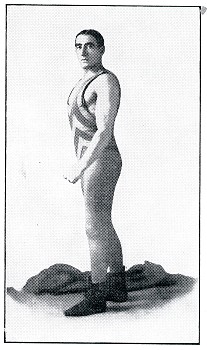
|
Image
left:
"MR.
HAROLD
BAKER
The
Noted
Swimmer, Surfer, and Lifesaver."
Baker,
Reg "Snowy":
General
Physical Culture.
Melbourne.
G.Robertson
& Co., 1910. Page 53.
|
Baker, Reg "Snowy":
General
Physical
Culture.
With
Articles
On Special Subjects By Leading Australian
Athletics.
(Health
Strength
Skill).
Melbourne.
G.Robertson
& Co., 1910.
|
 |
surfresearch.com.au
Geoff
Cater
(2007-2016) : Harold Baker : Surf Bathing, 1910.
http://www.surfresearch.com.au/1910_Baker_Surf_Bathing.html
FURTHER
REFERENCES
BAKER, R. L
(SNOWY).
A Little Light On A Big Subject. Baker Recreative And
Scientific Physical
Culture And What It Signifies.
Syd. R.L.Baker.,
1909., 1909. 16mo. (48pp). Plates: Fully Illustrated With B/W
Photo's.
Orig Coloured Illust 1st ed.
"Book Appears
To Have Been Issued When "Snowy" Baker Opened His Physical
Culture Studio
In Sydney, Contents Include Biography On Baker + His Athletic
Record, Enlistinmg
In His Studio The Follwing Will Be Taught. The Benefits Of
Boxing, Benifits
Of Scientific Physical Culture, Scientific Excercise,
Swimming, Treatment
For Obesity By Natural Means."
Growden,
Greg
The Snowy Baker Story (ISBN: 1740512367)
Random House,
Australia,
2003.
"THE SNOWY
BAKER
STORY is an action-packed romp full of astounding true tales
and 16 pages
of fabulous photographs and images. Reginald 'Snowy' Baker -
a non-drinker
and health and fitness fanatic - represented Australia in
three sports
at the 1908 Olympic Games, played in two rugby union tests,
represented
his country as a horseman and travelled the world as a
champion swimmer,
diver and boxer. His life story is entwined with the stories
of all the
major sports figures of the first half of the 20th Century:
Frank Beaurepaire,
Les Darcy, Duke Kahanamoku, H.H. Dally Messenger and Freddy
Lane.Snowy
next embraced the life of an entrepreneur, potion maker,
publisher and
boxing promoter, mixing with many of the major figures in
Australian social
history before he and his trusty 'Boomerang the wonder
horse' took up a
career in film. Snowy starred, produced and undertook all of
his own stunts
in some of the first feature-length Australian films
including The Man
From Kangaroo.Then it was off to Hollywood where his
escapades included
filmmaking with Charlie Chaplin, teaching Rudolf Valentino
to kiss and
to fence, instructing Elizabeth Taylor to ride for National
Velvet, playing
polo with Roy Rogers, providing advice and a front for
Spencer Tracy as
he began his affair with Katharine Hepburn and protecting a
philandering
Douglas Fairbanks Snr from his wife.A full life indeed for a
working class
boy from Surry Hills."
BIOGRAPHY
Australian
Dictionary
of Biography - Online Edition
http://www.adb.online.anu.edu.au/biogs/A070152b.htm
Note: Includes
image
of "Baker, Kahanamoku and Beaurepaire"
" Reginald
Leslie
(Snowy) Baker (1884 - 1953), by unknown photographer, courtesy
of State
Library of New South Wales. Original : PXE 653 (v.58)."
at
State Library of
NSW
http://image.sl.nsw.gov.au/cgi-bin/ebindshow.pl?doc=pxe653/a468;seq=10
Davis sporting
collection
part II : Swimming
65. Snowy Baker,
Duke Kahanamoku and Frank Beaurepaire
BAKER,
REGINALD
LESLIE (SNOWY) (1884-1953),
- sportsman
and
showman, was born on 8 February 1884 at Surry Hills, Sydney,
son of George
Baker, an Irish-born Sydney Municipal Council clerk, and his
wife Elizabeth
Jane, née Robertson. Very blond, he was called 'Snowy' from
childhood;
he was educated at Crown Street Public School and,
reputedly, learned horsemanship
at dawn work-outs on Randwick Racecourse. In 1897-99 he won
a series of
swimming championships for his school, swam and played water
polo for the
East Sydney Swimming Club, and in 1901 finished second to R.
Cavill in
the State half-mile championship. He did not, as was later
claimed, study
engineering at the University of Sydney or win several
'blues'; he may
have worked for the Colonial Sugar Refining Co. as an
engineering draftsman.
He played Rugby Union for Eastern Suburbs and represented
New South Wales
at half-back against both Queensland and the touring Great
Britain side
in 1904. A 'rare tackler … and as hard a player for his
weight as has been
seen in the game', he played for Australia in the first
Test. As an oarsman,
he rowed for the Mercantile Rowing Club in championship
maiden and junior
fours and eights in 1905-06; he was also a capable
cricketer.
Baker
served as
a trooper with the New South Wales Lancers from about 1902,
gaining the
rank of sergeant and excelling in a variety of military
sports: over the
years he won many prizes in such activities as fencing (with
the sword
and bayonet), wrestling on horseback and tent-pegging. A
fair shot, he
was 'a decidedly handy man in the event of a foe descending
on our peaceful
shores'. In 1902 he took up boxing; for many years he
weighed 11 st. 7
lb. (73 kg). In 1905 he became New South Wales amateur
middleweight champion
and next year retained his title, won the same belt in
Victoria, and became
the heavyweight champion of both States.
In December
1906,
farewelled by 1000 people in Sydney including a boatload of
twenty young
ladies who pursued him to the Heads, Baker left for England
to compete
in the Amateur Boxing Association's championships, but
contracted enteric
fever and pneumonia. However, he boxed in the 1908 Olympic
tournament held
in London in October, three months after the games proper.
As a middleweight
he won three fights in the one day, two of them by
knockouts, to reach
the final which he lost narrowly on points to J. W. H. T.
Douglas. He visited
Scotland, Ireland, Scandinavia and Europe and performed at
both exhibition
and competition level, mainly in aquatic sports. He was
welcomed as a distinguished
athlete at gentlemen's sporting clubs wherever he went.
Returning
to a
considerable welcome in Sydney in December 1908, Baker began
to capitalize
on his athletic and boxing fame and opened a physical
culture establishment,
with mail-order courses, in Castlereagh Street. On 31 March
1909 at St
Mark's Anglican Church, Darling Point, he married
37-year-old Ethel Rose
Mackay, daughter of a squatter and widow of Augustus Daniel
Kearney, a
Victorian physician and notable tennis player. A journalist
of skill, Baker
contributed to the Sydney Evening News in 1908-10, published
a book, General
Physical Culture (Melbourne, 1910), and in 1912 began Snowy
Baker's Magazine,
a penny monthly that attained a circulation of over 3000 in
its two years
of existence.
Meanwhile
he had
become involved in H. D. McIntosh's Stadiums boxing
organization, mainly
as a referee; at times controversial, Baker wore green
trousers and a felt
hat, later evening dress. In December 1912 he arranged the
purchase of
the Rushcutters Bay Stadium for £30,000 and soon, with John
Wren,
had Baker's Stadiums in Melbourne, Adelaide and Brisbane,
and was following
McIntosh's policy of bringing international boxers to
Australia. In July
1914 the stadium staged its first Les Darcy fight and Baker
soon controlled
the Maitland boxer's engagements. He was annoyed when Darcy
left Australia
secretly in October 1916, and had to face accusations
thereafter that he
had been largely responsible for the boycotting and even the
death of Darcy
in the United States of America in May 1917. Baker always
denied the charges
and seems conclusively to have disproved them face-to-face
with a Maitland
committee of inquiry in October.
He tried
three
times to enlist in the Australian Imperial Force, but was
prevented by
a spinal injury; instead he devoted himself to fund-raising
concerts. Boxing
declined in popularity and he put on shows and film-nights
at the stadium.
Baker moved into the film business in 1918, and played a
secret agent in
The Enemy Within and a stationhand in The Lure of the Bush.
In 1919 he
was co-producer with E. J. Carroll and starred as a boxing
parson in The
Man from Kangaroo, as a bushranger in The Shadow of
Lightning Ridge, and
as a jackeroo in The Jackeroo of Coolabong (1920). All his
roles featured
his horsemanship, with his famous grey, Boomerang.
In August
1920
Baker left for the United States of America to further his
film career,
but although he did appear in some movies, succeeded rather
as a coach
and instructor in athletic feats and as a businessman. In
1933 he became
a director and major operating partner of the Riviera
Country Club, near
Santa Monica, California, and spent an active life largely
as a riding
instructor to Hollywood stars and as a polo player. In the
early 1930s
he had contributed a column to the Sydney Referee. He
re-visited Australia
briefly in 1925, 1932 and 1952.
Survived by
his
wife and a step-daughter, Baker died of cerebro-vascular
disease on 2 December
1953 at Los Angeles, and was cremated. His estate in New
South Wales was
valued for probate at £39,111. His stature as an athlete
depends
largely upon the enormous range rather than the outstanding
excellence
of his activities; it was as an entrepreneur-showman,
publicist and businessman
that he seems in retrospect to have been most important.
His brother
William
Harold (1887-1962), was born on 29 September 1887 in Sydney.
He was a notable
swimmer, winning three New South Wales championships in 1906
and captaining
the Australian water polo team. He played Rugby football for
Australia
three times against New Zealand and won boxing and wrestling
championships.
With Snowy he worked for Stadiums Ltd and refereed many of
Darcy's most
important fights, including the one against Fritz Holland on
12 September
1914 when he disqualified Darcy for a foul. He was described
as a 'man
with a marble mouth and a jaw of steel. A man of ice with
frozen eyes and
a frozen voice'. Captain of Maroubra Surf Club in 1900-10,
on 28 January
1910 he took part in a famous surf rescue of over 100 people
at Cronulla
Beach and was awarded the Albert Medal for bravery; a public
subscription
for him raised £1000 in its first week. He died on 17
October 1962
at Woollahra, survived by a daughter and by his wife Nellie
Innes Sara,
née Crawshaw, whom he had married on 12 June 1912.
His
brothers Frank,
who joined the film industry in Los Angeles in the 1920s,
and Ernest were
water polo players; Frederick was an amateur welterweight
champion of Australia,
and refereed for Stadiums Ltd.
Select
Bibliography
R.
Swanwick, Les
Darcy, Australia's Golden Boy of Boxing (Syd, 1965); E.
Reade, Australian
Silent Films (Melb, 1970); People (Sydney), 27 Sept 1950;
Parade, Oct 1959;
Referee, 1908, Dec 1912–Dec 1913, 31 Oct 1917, 13 Apr 1932;
Punch (Melbourne),
19 June 1913; Sydney Morning Herald, 4 Dec 1953. More on the
resources
Author: W.
F.
Mandle
Print
Publication
Details: W. F. Mandle, 'Baker, Reginald Leslie (Snowy) (1884
- 1953)',
Australian Dictionary of Biography, Volume 7, Melbourne
University Press,
1979, pp 150-152.
AOC
http://www.olympics.com.au/athletes.cfm?AthleteID=252
Reginald
'Snowy'
Baker Boxing Diving Swimming 1884 - 1953
Harry Gordon,
AOC
historian
Reginald
Leslie
“Snowy” Baker, Australia’s greatest all-round athlete,
competed in 26 different
sports, and excelled in all of them. He was an international
footballer,
swimmer, boxer and diver, and was in championship class as a
horseman,
rower, wrestler, polo and water polo player, track athlete,
fencer and
gymnast.
He remains
the
only Australian to have represented the nation in three
separate sports
at the Olympic Games, and he played rugby union for
Australia against the
touring Great Britain team in 1904.
At the
London
1908 Olympics, he competed in the boxing, swimming and
diving, winning
a silver medal in the middleweight boxing division after
losing narrowly
on points in a hard-fought encounter with Britain’s J.W.H.T.
(“Johnny Won’t
Hit Today”) Douglas.
Douglas, who
earned his nickname as a stonewalling cricketer, later
captained England
on a Test tour of Australia.
Baker’s
Olympic
boxing performance has been matched by only one other
Australian – light-welterweight
Grahame ‘Spike’ Cheney, who won silver in Seoul in 1988.
Baker was a
member
(with swimmers Frank Beaurepaire, Theo Tartakova and Frank
Springfield)
of the Australian 4 x 200m freestyle relay team that won its
heat and finished
fourth in the final.
He had
little
preparation for his springboard diving event, and finished
sixth in his
heat.
Baker had a
varied
post-Olympic career, most notably as a boxing referee,
boxing promoter,
entrepreneur, writer, actor, film-maker, Hollywood stuntman
and director
of an exclusive country club in California.
During the
1932
Olympics in Los Angeles, he was both Australia’s team
attaché and
a perceptive correspondent for the Sydney Referee.
Harry
Gordon,
AOC historian
"Snowy" Baker
also
produced a magazine:
Snowy Baker's
magazine.
Sydney, N.S.W. :
The Sydney and Melbourne Publishing Co. Ltd., 1912-[192-?]
Vol 1, no. 1
(Jan.
1912) - Date publication ceased is unknown, probably 192-?
National Library
of Australia. National Library of Australia (ANL) N 613.70994
BAK
Vol.1, no.1-7,
no.10,
no.12; v.2, no.1, no.[13]-18, no.20-24; v.3, no. 25-26, no. 28
1912-1914