 |
surfresearch.com.au
the catalogue #191 |
| home | catalogue | history | references | appendix |
|
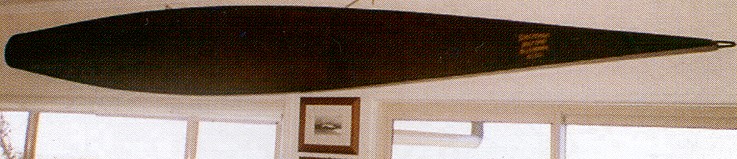
| 1933 Lou Morath's Paddleboard #2, 14 ft 1" |
#191
|
|
Length
:
|
14
|
ft |
1
|
inches | ||
|
Width
:
|
21
1/2
|
inches |
Wide
Point :
|
+ve
5
|
inches ?? | |
|
Nose
:
|
17
|
inches ?? |
Tail
:
|
9
1/2
|
inches | |
|
Thickness
:
|
5
|
inches |
Pod
:
|
6
or 0
|
inches ?? | |
|
Nose
Lift :
|
inches |
Tail
Lift :
|
inches | |||
|
Weight
:
|
kilos |
Volume
:
|
litres | |||
|
Gunnels
:
|
78
|
inches @ |
24
|
inches from | tail |
| FEATURES
Nose: pin, with black painted sheet metal nose plate. Tail: square, with black painted sheet metal tail plate. Deck Flat multi panelled plywood deck with alternative dark and light timbers. The panels are in three sections joined in a cross cut mitre producing a "W" pattern. Bottom: Rounded bottom with distinct rocker in four dark plywood sections. Rails: square, the seams are corked with a black pitch and fixed with brass nails and screws. Rocker: distinct |
IMAGES REQUIRED
FOR...
1.DECK MITRE DETAIL 2.NOSE/TAIL PLATES 3. RAIL AND SEALING
|
| DECOR
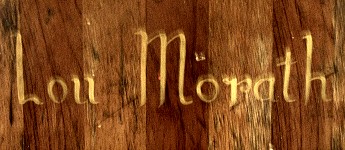
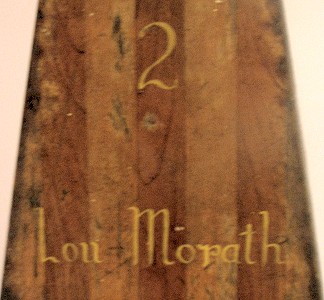
DECAL: MARKINGS Deck Hand painted numerlal "2" and script "Lou Morath" in gold paint on the nose. COLOUR Deck Multi panelled plywood deck with alternative dark and light timbers. The panels are in three sections joined in a cross cut mitre producing a "W" pattern. Black painted sheet metal nose plate. Bottom Four dark plywood sections. Black painted sheet metal tail plate. |
 |
| FIN
Long based solid timber keel fin. 3 1/2 inch x 48 inches (base) x 3/4 inches thick The fin has the markings "L / 58" in white paint, but these are possibly a museum catalogue number ??? |
IMAGE OF KEEL FIN REQUIRED |
"Surf Ski c1933
-This is a surf ski of hollow construction with three ply veneer over a
timber frame and a solid timber reel/fin sealed with pitch rails on top
from centre to rear.
There is an
inscription painted on the top front 'Lou Morath'. MO529
Gift of Lou
Morath 1984."
Shirley Neil: ManlyArt
Gallery and Museum Catalogue Notes, November 2007.
Many thanks to Shirley
Neil and Catherine Roberts.
| This board was probably
built by Lou Morath in the late 1930's and used by him in the 1939 Pacific
Games in Hawaii.
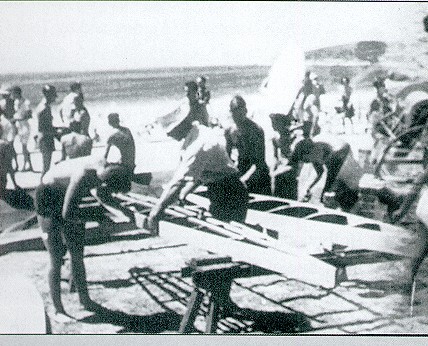
The board is described as a "Backyarder" and it was probably built at the Morath family home. However, in this period when board building was completed with hand tools only, constuction could take place anywhere. Many boards were built literally on the beach front at the Surf Life Saving Clubs. Image right : Australian paddleboard constuction, Still from : Cinesound Newsreel : " Thrill of the Surf " 1949. Filmworld, reproduced in Thoms 2000, page 55. |
 |
| Strictly a paddle
board, it is a companion to Lou Morath's wave riding board, see #105.
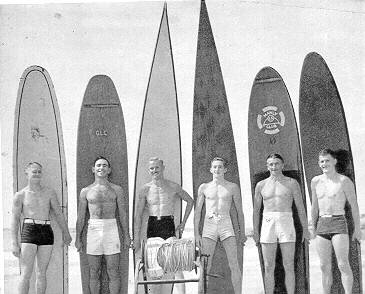
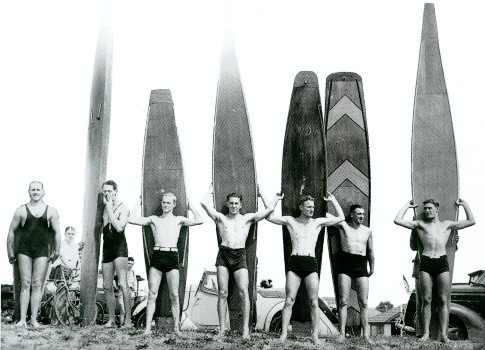
Both boards were probably taken to Hawaii. Image right : Lou Morath and his wave board circa 1939 - second from the right. The two centre boards are the tails of hollow paddleboards similar to #191. Harris, 1961, page Forty-four. Photograph by Ray Leighton For full credit details
see
|
 |
The Source
Harris, Reg. S.:
The
History of Manly Life Saving Club 1911-1961
Published by Manly
Life Saving Club, NSW Printed by Publicity Press Ltd. 1961.
Page Forty-four
(uncredited)
The Surfers
(Left to right) :
M.B."Bossy" Sutton,
Geoff. Cohen - was
the first Manly S.L.S.C. member killed in World War II and his board became
the club's
War Honour Roll.
See Manly SLSC:
Australian
Surf Museum (2006) page
Harry Wicke
- was Australian Surfboard Champion in 1939-1940.
Jim Austin,
Lou Morath - came
third in the Australian Titles and represented Australia at the Pacific
Games in Honolulu in
1939.
Ken Simpson - was
awarded a D.F.C. for service with the R.A.A.F.and was also killed in the
war.
The Surfboards
In the centre are
the tails of two timber framed/plywood covered boards based on Tom Blake's
Hollow
design, circa 1934.
The othes are solid
wood Alaia ('Church Windows' in Australia, 'Gothics' in mainland USA) of
similar design to
the board used in
Australia by Duke Kahanamoku in 1915. All the boards were finless.
Geoff. Cohen's board
is still with the Manly Surf Life Saving Club, see above.
Lou Morath's board
(#105) is 8 ft 8" x 23 1/2" exists in original condition and is held
by the Balmoral Beach
Club, Sydney.
|
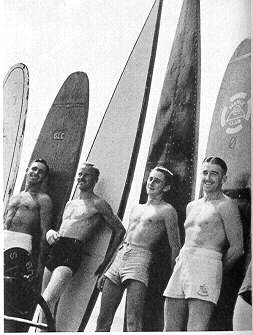
by Ray Leighton. Lou Morath and his board are on the right. Margan and Finney photograph page 127 |
 |
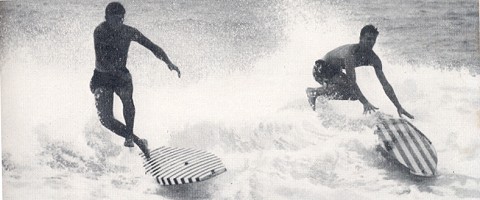 |
Image left :
The board on the left appears very similar to #191 Riders unidentified. "Surfers jumping from their boards before grasping them with their hands to halt them at the end of the shoot.- News and Information Bureau." Bloomfield, 1959, facing page 80. |
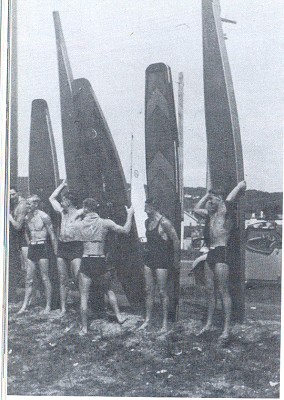 |
Image left :
"Blue Russell (far left) and other Club members prepare for a paddling race around Narrabeen Lakes in the late 1930s. The race was used to help select the Australian team for the hawaii trip." -Brawley: Palm Beach SLSC (1996) page 66. Note the two distinct lengths of the hollow boards in this photograph. "...Keightly 'Blue' Russell ... built hollow boards at Palm Beach. Russell pioneered the kneeling position in Australia, become (sic) so general that one picks out the board enthusiasts by the knee calluses most of them sport. As a member of the Australian surfer's team to Honolulu, Russell won the Hawaiian championship there. Board-riding,
like other aspects of surf activity, belongs to some beaches rarther than
to all. Manly has always been a boardman's beach since the Walkers and
Claude West...with nowdays men like Lou Morath, Roger Duck, Ray Leighton,
and a young Fred Notting... North Bondi has sponsored a most active group
since Dick Chapple , who with Russell and Morath was Australian representative
at Honolulu."
|
| Image right :
Selection trials for the Pacific Games team, March 1939. Second photograph. Longhurst page 78 Note
|
 |
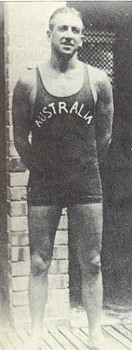
Thoms
2000, page 39
 |
Following the 1939
Australian titles at Manly on 18th March ...
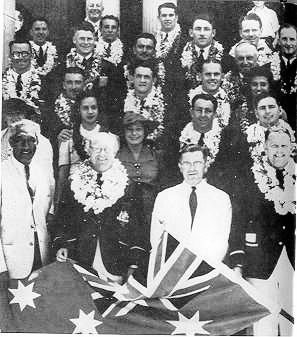
" Dickson, Harkness, Mackney (all Mona Vale), B. Fraund (Palm Beach) and Frank Davis (Manly) were selected in a demonstration boat crew to go with an Australian team to Hawaii. The other members of that team were C.H. Chapple (North Bondi), Lou Morath (Manly), R.K. Russell (Palm Beach), Hermie Doerner (Bondi), Alan Fitzgerald (North Wollongong), Bill Furey (North Steyne), Alan Imrie (Burleigh), J.L. McCay (North Cronulla), Hec Scott (Newcastle), Robin Biddup (Manly) with officials H. Spry, Harry Hay, H. Chapple, Clem Morath, Jack McMaster, Tom Meagher and F. Boorman." Galton, 1984, page 65 Image left :
|
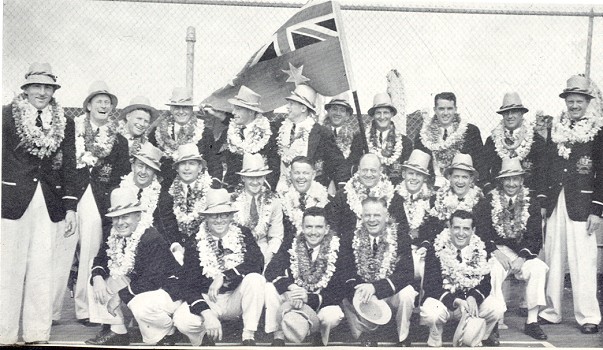
Note :
1. Location possibly
Honolulu Harbour.
2. The red, not
blue, Ensign is the team flag.
3. Officals as listed
by Galton, see above, are credited as "visitor" by Harris.
4. The officals
received special treatment, courteousy of the Sheriff of Honolulu.
See Duke and Surf ski image below.
|
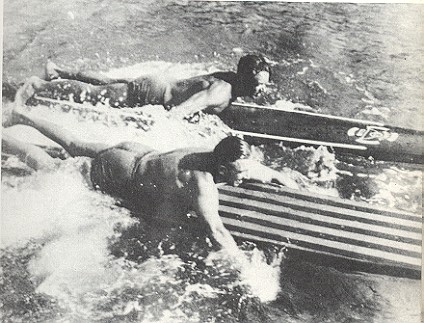
"Lou Morath and another paddler in training for the 1939 Pacific Games ". Margan and Finney, 1970, page 127 This board is certainly #191 |
 |
 |
"Duke Kahanamoku (left) welcomes the Australian team to the Pacific Games Honolulu, 1939." Wilson, 1977, page 36. Note:
See Duke and Surf
ski image below, and
|
| Image right
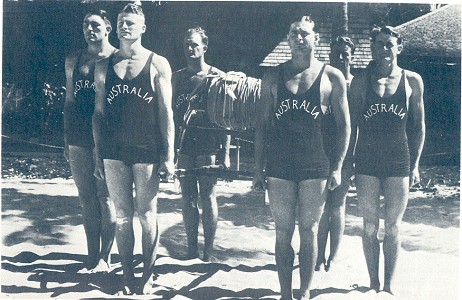
"The R. & R. squad which represented Australia in Hawaii in 1939. From left to right : Les McCay, Alan Fitzgerald, famous water polo player Hermie Doerner, Hec Scott, 'Wild Bill' Furrey and Alan Imrie." Galton, 1984, page 65 This photograph probably taken in the grounds of the Outrigger Canoe Club, Honolulu. See Yost.,1971. |
 |
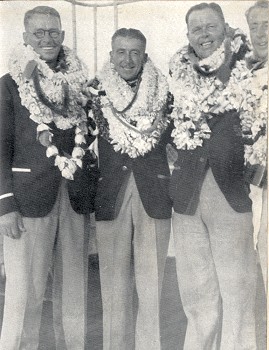 |
"After the Pacific Games at Honolulu, Tom Meagher, Lou Morath and Jack Cameron, with "Wild Bill" Furey just managing to get into the picture." Maxwell, 1949, facing page 256. |
| Image right :
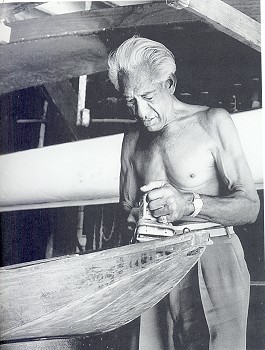
"Duke was not materialistic or wasteful. He took good care of all his possessions. In this photograph in 1963,he uses an electric sander on his Australian surf ski, a gift to him in 1939 when a team of Australian surf lifesvers and swimmers came to compete in an aquatics meet. Knowing that Aussies enjoy a good laugh, then-Sherriff Duke staged a mock arrest and lock-up of the visiting officals." Hall and Ambrose 1995, page 83 "When the team
returned, a number of boardmen met and formulated a precise method of handling
a patient during a surfboard rescue. It included proceedure for for getting
a patient on to the board, holding him there and bringing him back to the
beach. This drill was incorpoatedin the S.L.S.A. handbook."
|
 |
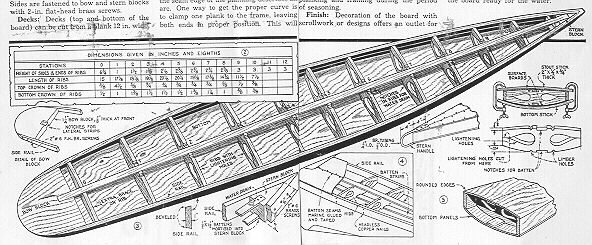
He rapidly incorporated
current aircraft and boat building techniques into surfboard design and
his design of a light timber frame covered with plywood panels resulted
in a huge weight reduction.
On 18th April, 1931
Thomas Edward Blake submitted three pages with a detailed drawing for a
' Water Sled'. and was subsequently granted US Patent No. 1,872,230 by
the US Patents and Trademarks Office, Washington DC.Initially viewed with
scepticism, the paddling advantages were emphatically demonstrated as Tom
Blake dominated paddle races in California and Hawaii in the 1930’s.
Aware of the life
saving potential of such a craft and an enthusiastic promoter of his sport,
Tom Blake gave his design international exposure by publishing the
blueprints and construction details, principally in various Popular Mechanics
Magazines of the period. See below or Plans
and Specifications. Publication saw the design rapidly adopted
around the world, notably Australia, New Zealand, Peru and South
Africa. In these countries it had an extended life due to the lag before
these countries caught up with the developments in fibreglass and foam.
In Australia the design first appearred as the Racing 16 and was later
modified to a finned Malibu (1956-1958) while in New Zealand the lag was
even longer and hollow Malibu boards were manufactured up to 1961. (Maxwell
page 240-241).
Circa 1934 Tom Blake
added a small water ski type fin/skeg to one of his hollow boards. Although
an significant addition, because of the emphasis on paddling, the small
size relative to the board, the increased danger and the difficulty in
attachment, many riders do not consider fins as a necessity. It rarely
appears on Australian examples of long Hollows.
REFERENCES
Dick Morath
(many thanks)
Books
1.
Maxwell,
C. Bede Surf : Australians Against the Sea
Angus and Robertson,
Sydney 1949. pages 241-242.
2.
Harris,
Reg. S. The History of Manly Life Saving Club 1911-1961
Published by Manly
Life Saving Club, NSW Printed by Publicity Press Ltd. 1961
pages 54 - 56, and
elsewhere.
3.
Margan,
Frank and Finney, Ben R.(Margan
and Finney) : A Pictorial History of Surfing
Paul Hamlyn Pty
Ltd, 176 South Creek Road, Dee Why West, NSW 2099.1970.
photographs page
118 and 127
4.
Galton,
Barry Gladiators of the Surf
AH & AW Read
Pty Ltd, 2 Aquatic Drive Frenchs Forest NSW 2086 1984 page 64 -65
5.
Thoms,
Albie: Surfmovies The Blue Group PO Box 321 Noosa Heads Queensland
4567. 2000
Page 39
CONDITION: 8
| home | catalogue | history | references | appendix |