1937 Tom
Blake Hollow Paddle Board Australian
Racing 16, Cigar Box, Kook Box Tom
Blake : Riding the Breakers on this Hollow Hawaiian
Surfboard - Popular Mechanics Magazine
July 1937 Volume 68 Number 1, pages
114 - 117.
Notes
First designed in 1926 by Tom Blake
based on 16 ft ancient Olo board, and lightened by drilling the
board full of holes then covering them with thin sheets of timber.
This success, primarily as a paddle
board, was followed by the common hollow design of plywood
covering over a light wood frame, with a bung.
On 18th April, 1931 Thomas Edward
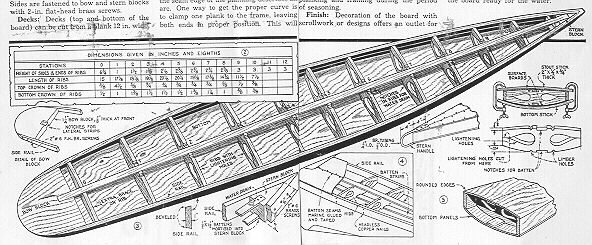
Blake submitted three pages with a detailed drawing for a '
Water Sled'. and was subsequently granted US Patent No.
1,872,230 by the US Patents and Trademarks Office, Washington
DC.
Apart from competitive success in
many paddling races, Blake published construction plans, e.g. Popular
Mechanics, 1937, with the result that his design was used
throughout the then surfing world.
This had definite influence in Peru
(first surfers), New Zealand and Australia, where it first
appeared as the Australian Racing 16.
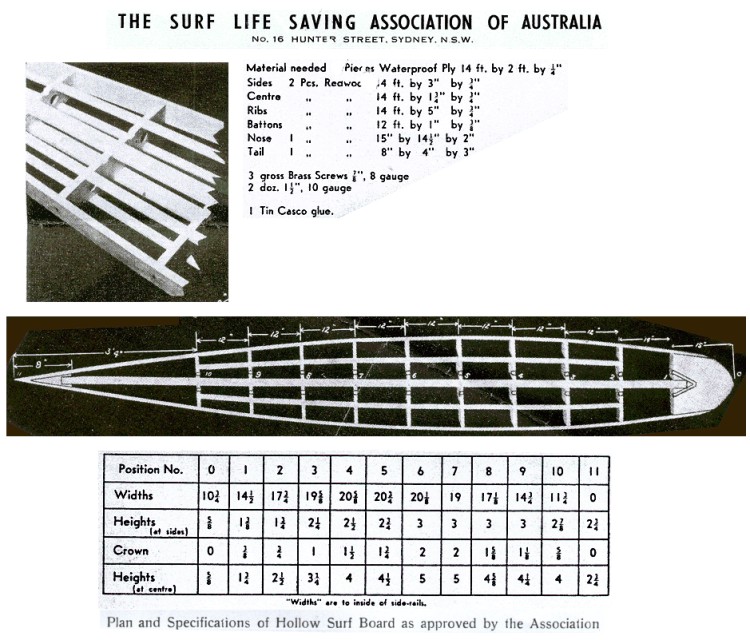
In 1945 the Surf Life Saving
Association of Australia issued plans for the approved design of
a Hollow Surfboard.
These bore close resemblance to
Blake's plans of 1935, above.
Image has
be manipulated to improve legability.
Source :
Unknown.
In 1957 the
construction method was used to make hollow examples of the Malibu
board (Okinuee) when balsa wood was unavailable in Australia, and
was similarly used in New Zealand up to 1961. XXXXXXXXXX
I am a curator at the Victoria and Albert Museum in London, and am
working on an exhibition about the history of plywood.
I am very interested in plywood surfboards, examples of which we
plan to show in the exhibition.
I have seen Tom Blake described in various places as the first
designer to use plywood in his boards, but haven’t been able to
find any definite evidence that he did in fact use plywood as a
material (neither his patent nor his article about building your
own surfboard seem to specify it).
I was fascinated to read through the material on your very helpful
website, and wondered if you are aware of any surviving Blake
boards where plywood construction is definitely visible?
I would be very grateful for any help or suggestions that you
could give about this.
Best wishes, and thank you in advance,
Lizzie Bisley. Project Curator Plywood exhibition Furniture, Textiles and
Fashion Department V&A Cromwell Road London SW7 2RL
Lizzie,
Thank you for your fascinating questions.
Please note the distinction between a board made by Tom
Blake, a board made by a licensed company, and a
board made by anyone to his design plans, which he distributed
widely and never appears to have enforced his patent.
The first might number about 3000 (?), but the second were far
more numerous, both largely used in Hawaii and
the US.
Boards constructed to Blake's design probably numbered in the
10's of thousands and were used world wide.
Also, I think there are reports of some surfboards built with
plywood before the mid-1920s, but as these were not marine-grade
they had a short and inglorious life and were only recorded as
an experimental failure.
evidence that Blake did in fact use plywood
as a material?
(neither his patent nor his article about building your
own surfboard seem to specify it.)
Plywood was not used on the
early Blake designs, in Hawaiian Surfboard (1935) the
board is said to be made from mahogany and in 1937 he suggested
spruce frames with African mahogany first choice for the
planking- two pieces 12'' x 14ft x 0.75" for each side.
Sometime after 1933-1934, when reliable water-proof marine
grade plywood (Weldwood, Harbord) became
available, someone
(possibly Tom Blake) was the first to replace the solid decking with
a sheet of ply, either in constructing a new board or, perhaps
just as likely, in replacing the panels on a damaged board. The
advantages, includingabout a 50% reduction in weight in the panels, were significant and around 1936-7 Blake-Rodgers
was the first company to successfully design, manufacture,
distribute, and
actively promote with
adverting and plans a hollow timber and plywood surfboard.
In plans dated
1937, reproduced
in Lynch and Gault-Williams' Tom Blake: The Uncommon
Journey of a Pioneer Waterman (2001), veneer or
planking are suggested as alternatives for covering the
deck and bottom of a Square-tail Hollow Board (fold-out, page
99?).
And a reproduced brochure for Thomas Rogers Company,
specifications for design numbers 4, 5, 6 and 7 are Mahogany
side rails planked with Weldwood water-proof 3-ply panel
(page 97).
Blake worked with Rogers from 1932 to 1939 and the authors
date this document circa 1934, however I feel it might
be closer to the 1937 plans noted above.
Hopefully, this answers your first question.
However, I have added some further notes below on Weldwood and
marine ply (1), although there is a good chance you are
already familiar with most of the material.
are you aware of any
surviving Blake boards where plywood construction is
definitely visible?
Here is a later one from 1948, specified as plywood:
- http://www.thevintagesurfauction.com/tom-blake/
Generally,
up
to this point, advances in maritime technology were
viewed with a conservative cynicism,and were only
adopted after rigorous testing and experience.
However, it appears that once easily-worked,
lightweight, and flexible (and low cost?) reliable water-proof
marine grade plywood became widely available in
the late 1930s, builders around the world readily used
it to replace
solid timber planking, used since antiquity, in a
wide variety of small watercraft Before the outbreak of war, marine plywood
was used to sheath canoes, small boats,and
hollow surfboards and hollow surf-skis, with some
designs available in kit form. The use of marine plywood was welcomed by canoe
builders (see note 2),
many who had been working with standard ply, and
water proofing it by laminating the timber between layers of
painted canvas, The surf-ski was invented in Australian oyster-farmer, Harry McLaren, in the late 1920s; around the same time that
Blake was developing his surfboard designs in Hawaii (note 3). The molded Haskell canoe
(link above) and the molded small boat designs by Eugene
Luther Vidal, featured on pages 25-26 of The
Plywood Catalog of 1940 are particularly interesting (link below).
The supply
and application of marine ply vastly accelerated during WW2,
famously for the superstructure of light-weight PT boats, and after the war a timber frame sheathed in marine plywood became
a common design for
constructing surfboards, surf-skis, canoes, racing shells and many small rowing and sailing
boats.
These were progressively superseded by laminated fibreglass
and plastics.
Geoff.
NOTES
1. WELDWOOD AND MARINE PLY
The
Lumber Co-operator
Northeastern Retail Lumbermens Association, Rochester,
N.Y. Volume
14 Number 11 November 1935, page 47.
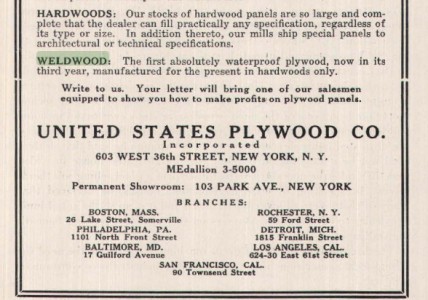
WELDWOOD:
The first absolutely waterproof plywood, now
in its third year, manufactured for the present in
hardwoods only.
Eugene Luther Vidal Eugene Luther "Gene" Vidal (April 13, 1895 – February 20,
1969) was an American commercial aviation pioneer, New Deal
official and athlete.
He was the father of author Gore Vidal.
For eight years, from 1929 to 1937, he worked closely with Amelia
Earhart in a number of aviation-related enterprises.
... After leaving the BAC, Vidal experimented from
1937 to 1940 with wood-resin composites using a thermosetting
polymer process similar to Duramold under the banner of the
Vidal Research Corporation.
The experiments with the durable waterproof plywood material,
said to have a greater tensile strength than a comparable
thickness of aluminum, evolved initially into a small business
producing only trays and dinghies.
Vidal patented the process as "Vidal Weldwood",[34] variously
described as "cooked wood" or "molded plywood."
...
After the United States was drawn into World War II, Vidal
obtained contracts to manufacture war materiel, primarily deck
houses for PT boats, pontoons and aircraft drop tanks, that
earned him the wealth that had eluded his earlier
entrepreneurial attempts. [The variant of the Vidal process used for
watercraft was known as Weldwood Marine] Restrictions
on the use of metals in 1942, particularly aluminum, caused by
an increased demand by shipbuilders and aircraft manufacturers
led both the Army and the Navy to demand designs for
components and training equipment that could be manufactured
from wood composites.
Investments in factories to build Weldwood products under
license boomed immediately.
One such licensee was the Hughes Aircraft Division of Hughes
Tool Company, and another was U. S. Plywood.[36]
The success of the product was well-publicized and earned him
an honorary doctorate from Lawrence College.[8]
...
After the 1936 elections, (Amelia) Earhart began final
planning for her proposed equatorial circumnavigation of the
world, with fuel and routing across the Pacific Ocean major
considerations.
Vidal suggested that landing strips be built on tiny,
uninhabitable Howland Island as the largest point of land
along the planned route within range of both New Guinea and
Hawaii.
Earhart agreed with the suggestion and made the request for
its use.
...
It is alleged in Susan Butler's biography East to the Dawn:
The Life of Amelia Earhart, and the possibility endorsed by
Kathleen Winters in Amelia Earhart: The Turbulent Life of an
American Icon, that Vidal had a long-standing romantic
relationship with Earhart,[42][43] from 1929 when they worked
together for Transcontinental Air Transport to her
disappearance in 1937.
His son Gore Vidal's cover testimonial to Butler's biography
adds credence to the story.[44][n 17]
UNITED STATES PLYWOOD
CORPORATION
MANUFACTURERS OF PLYWOOD AND ALLIED PRODUCTS
616 WEST 46th STREET • NEW YORK, N. Y. Phone
CIRCLE 6-7100
Page 27
WELDWOOD WELDWOOD is waterproof Plywood.
Its plies are welded together under heat and pressure with a
phenol-formaldehyde binder (Bakelite type).
This binder is not only waterproof but is chemically inert and is
heat resistant up to the charring point of the wood used in the
fabrication of the panel.
Weldwood can be used outdoors for any purpose where lumber is
usually required.
It is suitable for siding, bill boards and other outdoor signs,
farm buildings, truck bodies, trailers, store fronts, paneling for
below-grade basements and boat building.
In every instance in which Weldwood is used, it represents
tremendous economy in labor.
It is much lighter than any of the materials which it replaces and
the finished job is far superior as it eliminates cracks and
reduces joints to a minimum.
WELDWOOD can be obtained from stock in Fir, Birch, Mahogany and
Walnut.
On special order, it can be obtained in practically any other
wood.
...
EXTRA SELECTED MARINE
Specially fabricated for Boat-building Industry
Boatbuilders and others requiring WELDWOOD for extra hard
service may now specify "Marine WELDWOOD" for their jobs.
The bond used in Marine WELDWOOD is identical with that used in
standard WELDWOOD but this product is made with tight cores
and "no patch" faces.
The introduction of this special grade
marks the final step in the perfection of WELDWOOD.
An advertisement for Weldwood appeared in Australia in 1944 and
two sheets of Waterproof Ply (14ft x 2ft x
1/4'') were specified in plans for a Blake-type hollow board prepared for the Surf
Life Saving Association of Australia in 1945.
However, marine plywood was
probably available in Australia well before this time.
It
appears Vidal's Weldwood was not the only marine ply
produced in the 1930s, the Harbor Plywood Corporation produced a product
known as (Super) Harbord following the work
of James Nevin in 1934:
A Technological
Breakthrough: Waterproof Adhesive
Lack of a waterproof adhesive that would make
plywood suitable for exterior exposure eventually led automobile
manufacturers to switch from plywood to more durable metal running
boards.
A breakthrough came in 1934 when Dr. James Nevin, a chemist at
Harbor Plywood Corporation in Aberdeen, Washington, finally
developed a fully waterproof adhesive.
This technology advancement had the potential to open up
significant new markets.
But the industry remained fragmented.
Product quality and grading systems varied widely from mill to
mill.
Individual companies didn’t have the technical or in most cases
marketing resources to research, develop and promote new uses for
plywood.
The industry looked for help from its newly formed trade
association, the Douglas Fir Plywood
Dating back to
antiquity, the dugout, bark or skin canoe was the
basic vessel of aboriginal peoples around the
world
However, as a recreational craft the canoe
captured the imagination of Europe following the
publication of John MacGregor’s best-sellingA Thousand
Miles in the Rob Roy Canoe in 1866.
A clinker oak hull with a
cedar deck, the original Rob Roy canoe, built in 1865 by
Thames boatbuilders Searle & Sons of Lambeth for
John MacGregor’s tour of Europe, is now preserved at the
River and Rowing Museum, Mill Meadows, Henley on Thames,
Oxfordshire.
Around the turn of the 20th
century canoe builders used standard plywood laminated between
layers of painted canvas to produce a lighter craft, before the
introduction of relatively inexpensive marine grade plywood in
the late 1930s.
After the WW2, recreational plywood canoes were ubiquitous on
the lakes, rivers and bays of Australia, often available from
boat-hire services at resorts, before they were progressively replaced by
fibreglass canoes during the 1970s.
With the coming of the 21st century, plastic molded canoes
dominate the recreational market.
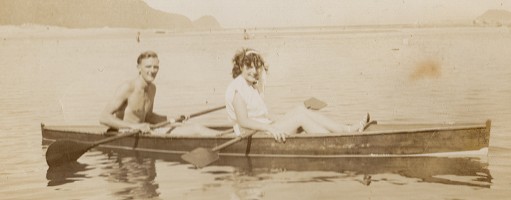
Frank
and Betty Cater and plywood canoe, Patonga NSW, 1950.
4. TOM BLAKE - AMELIA EARHART - HAWAII - 1935
In 1935 Amelia Earhart wrote an article My
Flight from Hawaii, published in National Geographic,
May 1935.
The magazine also contained eight surfing
photographs at
Waikiki by Tom Blake, including one of
Amelia riding in an outrigger canoe.
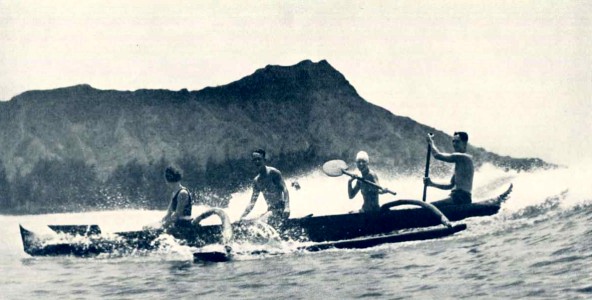
AMELIA
EARHART,
WHILE AWAITING FAVORABLE FLIGHT WEATHER,
ENJOYED RIDES IN SUCH
OUTRIGGER CANOES AT WAIKIKI
Easier
to handle than the tricky board, the canoes offer good fun.
When the surf is
not too big, gay parties, sometimes as many as seven in a boat,
may be seen
riding the waves in these queer craft, which are hollowed koa
logs, with side
floats to prevent capsizing.
At the steersman's signal all paddle furiously
till the swell lifts them and bears them fast toward shore.
Lashed together
anil provided with woven grass sails, such vessels have been
used by natives
for long ocean voyages.
WELD-WOOD SYNTHETIC-RESIN
WELDED
WATERPROOF
PLYWOOD
Suitable for
All External Linings and Outdoor Uses.