 |
surfresearch.com.au
history : the surf
ski
|
the development and design of the surf ski
| home | catalogue | history | references | appendix |
|
surfresearch.com.au
history : the surf
ski
|
The Surf
Ski
The history of
the development of the surf-ski, a unique Australian surfcraft
design that has world wide impact, is poorly documented and
largely overlooked by both surfriding and surf life saving
historians.
Critically, it
is possible that early models used hollow timber construction
prior to the widely promoted designs by American, Tom Blake,
who patented his work in 1931 and first published detailed
plans and construction notes in Modern Mechanix
magazine in 1933.
See Paul W.
Gartner: Hawaiian
Water Sled.
Alleyn Best, citing Barry Galton (2005?), notes:
"The first official ski was made 1912-1913 by Port Macquarie fisherman, Harry McLaren, who saw it as an easy way for Harry and his brother to get about oyster beds in nearby Lake Innes".
Best, Alleyn: Chapter 5: Surf Lifesaving Technology, in Jaggard (2006) page 123.
Best does not
comment on their construction, define "official" or
indicate if their intial use extended beyond inland waters.
A similar claim
was earlier identified by Lana Wells, however she dates the
design as circa 1930.
Wells(1982)
page
160.
Henry Thomas "Harry" McLaren (1897-19xx) was an oyster farmer and one of thirteen children who grew up on the banks of the Hastings River, Port Macquarie.
- Noted by Kay
Browne, Port Macquarie-Hastings Local Studies Librarian, in
conversation, October 2007.
Kay
specifically identified as significant resources an article "Without
Doubt" , incorporating interviews with McLaren family
members, in the Port Macquarie News, 8th
September 2000 and Charles Uptin's A History of the Port
Macquarie Surf Life Saving Club 1929-1979 (1979),
the later available as an inter-library loan.
Port Macquarie
was founded by:
"...
convicts and officers who arrived to establish a penal
settlement in 1821, and free settlers who flocked to the
timber-rich farming and fishing district after 1840.
Late in
the 19th century the wealthier citizens of Sydney and
Newcastle recognised its leisure attractions.
Port
Macquarie became Australia's first resort town."
Readers Digest: Guide to the Australian Coast (1983) page 262.
Amoung those attracted to the area, P. G. Hampshire introduced some of the surf life saving practices developed at the Manly and North Steyne (originally the Seagulls) Surf Bathing Clubs following their formation in 1907.
"A man
from Manly, Mr. P. G. Hampshire (Dairy Officer for the
area Manning to Nambucca), made his home in Port Macquarie
in 1910.
'Born in
the surf,' he was instrumental in the formation of Port
Macquarie Surf Bathers' Club, on Town Beach.
Drill and
swim trials for efficiency badges engendered rivalry."
Uptin: Port Macquarie
SLSClub (1979) page 6.
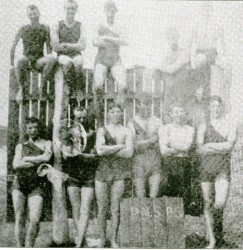 |
Members of the Port Macquarie Surf Bathing Club, circa 1914. "In the picture (and that's a
dressing shed; you stood behind it to change)
are Kevin Flynn (bottom right), of Flynn's Beach
family; two of the late Pountney brothers, and
Barney Turner. Uptin: Port Macquarie SLSClub (1979) page 6. Note
the board in the foreground is inscribed with the
initials |
"There
is a local claim that the McLaren brothers, Harry and Jack
("Tacko") were the first to ride surf skis.
They
built the somewhat monstrous, hollow skis, for use around
their oyster leases and surfed with them for pleasure.
That was in the 1920's, before the Port Macquarie Surf Club was formed, and a Harry Crakanthorp, who was town clerk here in that period, surfed with them on their skis.
Manly
Surf Club's 50 year history (Harris: Manly
SLSC (1961) page 56) says the surf ski was
designed and introduced by Dr. J. S. Crakanthorp in the
1920's.
Whichever
way it goes, fact remains that Port Macquarie has had surf
skis for as long as they have been about."
Uptin: Port Macquarie SLSC
(1979) page 33.
|
"This 1919 picture establishes Harry McLaren as the first maker of surf skis. Harry is second from the left, with Ray Dick, Herb Reckless and Bert McLaren, left to right." Uptin:
Port
Macquarie SLSC |
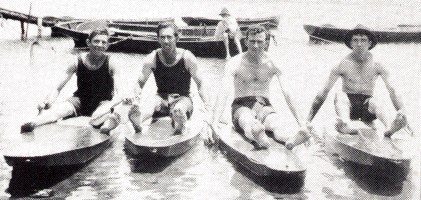 |
Further
significant photograhic evidence of Harry McLaren's design,
detailed below, is online at the State Library NSW (PICMAN):
http://libapp.sl.nsw.gov.au/cgi-bin/spydus/TRN/PM/SUHDG/211/49664
The earliest
photographs show the board (the description surf
ski is questionable at this early stage) was propelled
in a sitting position with two small hand blades, which was
probably not a highly efficient method to negotiate the surf
zone.
The deck is
flat with a bung plug at the rear and a nose ring with a
leash, possibly originally required for mooring.
The rails are
square and there is pronounced rocker.
The boards'
obvious bouyancy undoubtedly indicate hollow construction
(confirmed by Uptin, above); probably thin boards of cedar
fixed longtitudinally down the board.
Also see:
State
Library
NSW "At Work and Play - 05005
Three men
on surf skis.
The skis
were built by Harry McLaren, one in 1912 (Spring) and the
other Xmas 1913, to his own design - Port Macquarie, NSW."
Note that this
photograph is not dated as 1913, and is probably taken
sometime after the craft's construction.
It is
comtemporary with the other image, dated 1919, noted above.
Kay Browne,
Port Macquarie-Hastings Local Studies Librarian, noted
that the images of the McLaren's were probably taken by a
member of the Dick family, who were relatives with a interest
in photography.
Thomas Dick
would be renown for his images of Australian aborigines taken
in the Port Macquarie area in the 1920s, some of which are
held by the Australian Museum.
See http://timbertown.com.au/pages.asp?code=104
- Noted by Kay Browne, Port Macquarie-Hastings Local Studies Librarian, in conversation, October 2007.
Citing documents held by the Manly SLSC and identified by club historian Ray Moran, Bill Beale, reported:
"Harry
McLaren was only 15 when he came up with the original
design in 1912.
Prior to
that, Harry had used his Uncle Ern's duck hunting canoe to
'shoot the breakers' near Pelican Island.
But the
canoe would 'bury its head' when coming down the face.
' … I got
a brainwave then if I built something that was on the
style of a porpoise and made the front of it fairly round
and tapered off at the stern and gave it a spring up in
the front it would shoot the waves fairly good.
That was
when I was a kid 15.
Round the
latter part of 1912 I made one out of New Zealand Kauri
and nailed it all together … after Christmas in 1913 I
made another one for my brother … then I went off to the
War.
I still
have photos of the two skis'."
Beale, Bill:
History of the Surf Ski
http://www.manlypaddlers.com/extdoc/history_of_surf_ski.htm
Note that
McLaren saw the craft from inception as a wave riding
vechicle, and makes no reference to it's use on oyster leases.
Pelican Island
is an inland sand island adjacent to the mouth of the Hastings
River and with extreme tides and/or swells it had recognisable
surfriding conditions, although substantantial land
reclaimation and the construction of a breakwater (circa 1938)
have since dramatically reduced the wave action inside the
river.
Similar
surfriding breaks are found along the NSW coast, for example
Port Hacking south of Sydney.
With their
craft stored at a boat shed on the banks of the Hasting River,
the McLaren brothers had direct access to both Pelican Island
and were able to paddle to Town Beach (see below), the first
beach seaward and south of the river mouth.
"Without
Doubt" (Port Macquarie News, 8th
September, 2000) repeats the claim that the original board was
built in 1912 and notes that the family holds a copy of
"original plans", dated 12th July 1919.
- Noted by Kay Browne, Port Macquarie-Hastings Local Studies Librarian, in conversation, October 2007.
Harry McLaren
enlisted in the Australian Imperial Force on the 26th July
1915, in company with four other Port Macquarie residents.
He embarked
from Sydney on HMAT Euripides on 2nd November 1915,
achieved the rank of Temporary Captain in the Royal Engineers
and was recommended for the Military Cross.
He was stood
down/demobbed in 1919?
Australian War Memorial Service Records, Canberra.
It exact design of "Uncle Ern's duck hunting canoe" is unclear as these craft are largely undocumented.
In its most
simple form, a duck hunting canoe was a flat bottomed
punt with low gunnels, sometimes a mere four inches deep.
It was widely
used on NSW coastal waters and the standard method of
propulsion was with small hand blades, as adopted by Harry
McLaren.
- Noted by Ray Moran, Manly SLSC, in conversation, October 2007.
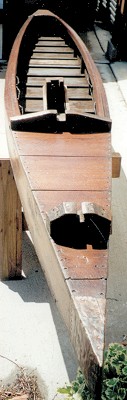
Shoalhaven Heads antique enthusiast, Tony Broomfield, in a phone conversation noted that duck punts (duck canoes) were originally an English design.
"DUCK
PUNT
Used for
the once fashionable sport of punt-gunning or wildfowling,
the duck punt or gun punt was a type of shallow
flat-bottomed craft pointed at each end and covered over
at bow and stern.
It was
used in the marshes, estuaries and rivers of the fens and
the Wash, and was usually propelled by a paddle but could
also step a mast for sailing.
The fore
part of the gun punt, shaped something like an Eskimo
kayak, supported the long barrel of a muzzle-loading
cannon used for shooting waterfowl including geese, teal
and shellduck.
The
single occupant was the gunner who fired at flocks of game
birds, a single shot in a day might kill as many as fifty
birds.
The
craft, however, was difficult to control and easy to
capsize, its navigation fraught with dangers and
discomforts.
A good
example of the use of a Gun Punt can be seen in the Royal
Armouries Museum at Leeds."
Jim Shead: Rowing
and
Sculling Boats
http://easyweb.easynet.co.uk/jim.shead/Boats4.html
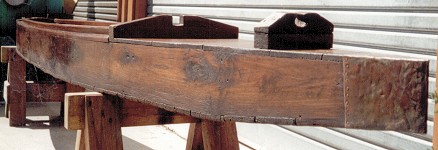
In Australia,
Tony Broomfield indicated these were not recreational sporting
craft but a commercial hunting boat, fitted with a large bore
"duck gun" primed with "grape-shot" (nails, sinkers,
metal off-cuts) to bring down a maximun number of birds with a
single blast.
One shot in the
Shoalhaven district was said to have yielded 76 birds, usually
sold at Greenwell Point for transport by ship to the Sydney
market.
Tony provided
the photographs of one example from the Shoalhaven area, see
below, and noted that a second example he observed included
the original hand paddles, as reportedly used by McLaren on
his board.
These were made
of a lightweight timber with thumb holes that were comfortable
to grip.

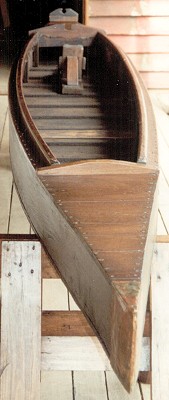 |
Duck punt, Shoalhaven River, circa 1920. (Dimensions unrecorded.) Image
left: Image
right: Image
below: All
photographs circa December 1995. |
 |
In the USA, similar craft were known as "sneakbox" and were substantially more sophisticated - a shallow draft boat with a panelled deck, usually propelled with oars and occassionally sail.
- Noted by
David Payne, Australian National Maritime Museum, in
conversation October 2007.
See:
http://en.wikipedia.org/wiki/Sneakbox
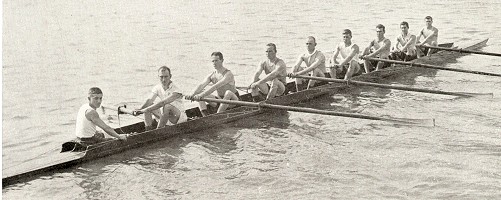
The fixing of
thin timber sheets over a timber frame (carvel construction)
was an established method of small boat contruction before the
turn of the century.
It was used in
racing scull or racing shell building in England since the mid
1800s.
"Eight-oared
shell
(modern rowing boat)
Dating
back to 1855 when this keelless eight-oared racing boat
made its appearance at Henley on
Thames.
Designed
by Matthew Taylor, for the Royal Rowing Club, it was
built, with an outer skin of bent or
moulded
cedar wood, bottom side upwards on the moulds.
Ribs were
fitted inside the skin after the boat had been reversed.
Oxford
University launched a similar craft of their own, at
Putney in 1857, 63 feet in length and 25
inches in
beam.
...
Hulls
were made of cedar wood imported from Central America
which although only three sixteenths of an inch thick
could withstand pressures of 8,000 pounds below the
waterline."
Jim Shead: Rowing
and
Sculling Boats
http://easyweb.easynet.co.uk/jim.shead/Boats4.html
In Australia the sport of sculling enjoyed great popularity, the first national championship was held in 1892, and it was considered that Australian craft were lighter and faster than some English models:
"Practice
boats, of course, differ in different localities, but the
light racing craft in Australia are all of the usual "best
and best" type - carvel built.
...
Without
doubt the Australian-built boat will bear comparison with
any in the world.
Some few
years ago a prominent New South Wales sportsman presented
an English-built eight-oared boat to the Rowing
Association, so that, if possible, the New South Wales
crew should be better boated than their rivals.
Out of
compliment to the donor the boat was used in one race; but
it was generally recognized that the crew was in reality
handicapped by the sturdy craft, and after the race she
was housed - and forgotten."
Inglis(1912) page 207.
In the image
below, note that McLaren's design esentially joins the
enclosed nose and tail sections of the illustrated craft and
any experienced boat builder of the period would be able to
replicate McLaren's design.
Also note the
splash guard at the prow, a feature on surf skis of the1940s.
|
"The 'original' surf skis, and ' Tacko' McLaren's transport for them." Uptin:
Port
Macquarie SLSClub |
 |
Around this time, a stalwart of the Manly surfing scene, Dr. J. S. 'Saxon' Crakanthorp (various spellings) apparently encounted the McLaren brothers in the Port Macquarie area and was sufficiently impressed with their craft's surfriding potential to arrange the purchase a board.
Apart from the
attractraction as a holiday resort, Crakanthorp probably had
family connections with the area before 1930 - his brother
Hereward Harvey "Harry" Crakanthorp, also a member of the
Manly SLSC, served as Port Macquarie's Town Clerk from 1938
(?) to his death in 1974 (?).
As an official
of the surf life saving movement, Crackanthorp's visit
coincided with the development of the Port Macquarie Surf Life
Saving Club, formally established in 1929 with the assistance
of members of the Manly and Bondi clubs.
- Noted by Kay Browne, Port Macquarie-Hastings Local Studies Librarian, in conversation, October 2007.
Certainly Harry Crakanthorp (Crakanthrope) was an active participant, Charles Uptin notes:
''The
present Port Macquarie Surf Life Saving Club was formed at
a meeting held in the Town Hall, on 24th October, 1929.
Officers
elected were: Patron, Mr. A. A. Cumming; President, Mr. H.
J. Blair; Vice-presidents, Messrs. Cyril Lewis, H.
Crakanthorpe, A. Lonsdale, W. McMillan, G. Prentice, A. C.
Elliot; Treasurer, Mr. L. Atkinson; Secretary, Mr. A.
Henderson.''
Uptin: Port Macquarie SLSC (1979) page 6.
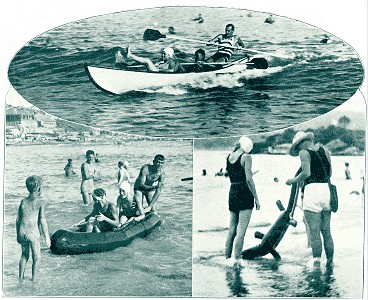
Manly was a centre for surfcraft with a significant number of boardriders and the first surf life saving club to adopt the surfboat.
| Specifically,
J.S. Crakanthrop may have been influenced by
Russell Henry 'Busty' Walker, who during the
1920's used a canoe to act as a judge at the buoys at
Manly Surf Carnivals. .Harris: Manly SLSC (1961) page 90. Manly
was not the only beach were a variety of craft were
in evidence, as shown by the late 1920s photgraphic
montage, right. Image
right: |
|
The surf ski
is held by the Manly
Art Gallery and Museum, catalogue number ??
The dimensions
are 350 cm x 64 cm x 15.5 cm.
Imperial: 11
foot 6'' x 25'' x 6''
Specificaions:
Timber frame, cedar planking, plywood bottom, timber keel,
canvas seat.
Accredition:
Made by Harry McLaren, Port Macquarie, 1933.
Providence:
Donated by Mrs. A. Crakanthorp, 1985.
- Noted by Catherine Roberts, Manly Art Gallery and Museum, in conversation, November 2007.
Significantly, the providence confirms the photographic evidence.
Note that the
photograph includes a belt attached to the nose leash, an
accessory perhaps only used by Harry and pre-dating the
general adoption of the leg rope by surboard riders (circa
1975) by forty-five years.
Bill Beale
writes:
.
"Of
particular interest, when using his ski, Harry McLaren did
not use the now conventional double-bladed paddle.
He used
two square butter-bats (like square table tennis bats, 15
cm wide by 35 cm long) strapped to each hand.
He used
these while kneeling on his surf ski.
"They
work a damn lot better than today's paddles … if knocked
off, a ski paddler would not be separated from the
paddles.'
The rider
also had a rope tied to the waist and the ski.
Harry
also proffered that the kneeling position offered less
wave resistance than the present seated method."
Beale, Bill:
History of the Surf Ski
http://www.manlypaddlers.com/extdoc/history_of_surf_ski.htm
Indeed, if others followed Harry McLaren's advice and used the separate hand blades and rode and paddled in a kneeling position, then the craft would be a surfboard.
Importantly,
Crakanthrop significantly improved propulsion, and surf
suitability, by introducing a two bladded canoe paddle instead
of McLaren's two small hand blades.
Also note the
short stub keels at the tail, noted above, are illustrated in
this image.
See
"At Work
and Play - 05011
Three
surf skis on the back of a 1928 Chevrolet utility in the
backyard at 23 Gore Street.
The
paddle on the side belonged to Mr Crackenthorpe from
Sydney - Port Macquarie, NSW
January
1931."
Certainly
these developments in northern NSW occurred independently of
the hollow board experiments carried out, most famously, by
Tom Blake in Hawaii from 1926 to 1931, and others elsewhere.
By 1932, the
"boards" were ridden in a sitting position and propelled
with a double bladed paddle, convieniently attached to the
nose leash, and fitted with foot straps, thus definitely
identifiable as surf skis.
McLaren also
sold other surf skis, in some cases less than the premium paid
by Dr. Crackanthorp.
See
State
Library
NSW "At Work and Play - 05008
Surf
skiing off Town Beach.
All skis
built and designed by Harry McLaren.
Sold one
ski to his cousin for 10 shillings - Port Macquarie, NSW c
1932."
For other
photographs of Surf skis in surf circa 1932, see
05006, 05007 and 05009.
05020 notes:
"Three men
with surf skis at Town Beach.
Ray Dick
bought his ski from Harry McLaren for 10 shillings and a
carburettor - Port Macquarie, NSW c 1932."
From the
earliest days of surfbathing, Town Beach was the easiest
accessed location for most residents.
It was
prefered to Flynns Beach, which was later to be developed and
became the site for the Port Macquarie Surf Life Saving
Clubhouse in 1956.
From the late
1930's, surfriding conditions at Town Beach were substantially
modified with the construction and extension of breakwaters at
the mouth of the Hastings River to maintain a navigatable
entrance.
"Before the southern breakwall was extended sightly, before the original north wall was completed (it was also extended) favourable surfing conditions prevailed at Town Beach towards the southern wall, and the beach being handier to town it was more infavour than Flynn's Beach."
Uptin: Port Macquarie SLSC (1979) page 7.
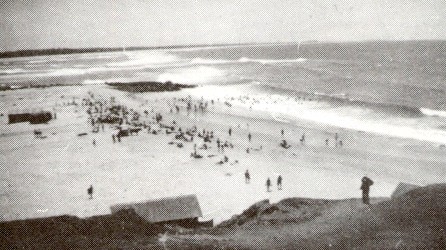
The image of
Town Beach below is circa 1935, before the construction of the
northern breakwater between 1935 and 1939.
- Noted by Kay
Browne, Port Macquarie-Hastings Local Studies Librarian, in
correspondence, November 2007.
It illustrates
the extensive banks in the river mouth to the north of Town
Beach and lines of swell running upriver towards Pelican
Island.
"J S
Crakanthorp's brother, Harry Crakanthorp, was the Town
Clerk of Port Macquarie from 1938 till his death in the
early 1970s.
According
to a mutual friend of the Town Clerk, Mr R Lindsay of
Wamberal, Harry Crakanthorp always attributed the building
of the first surf skis to Harry McLaren of Port Macquarie.
Harry
Crakanthorp's brother , Sacka, had visited him at Port
Macquarie, had used McLaren's ski, and took its
measurements and the idea back to Sydney."
Beale, Bill:
History of the Surf Ski
http://www.manlypaddlers.com/extdoc/history_of_surf_ski.htm
The surf ski purchased from McLaren is likely the craft Crakanthrop brought back to Manly, accredited as his design by C. Bede Maxwell in 1949:
"Maroubra,
too,
has become tlle favoured home of that purely Australian
invention, the surf ski.
This
contrivance represents what is more or less a logical
development of the hollow surf-board, and it made its
first appearance under the hands of Dr G. A. ("Saxon")
Crackanthorp (sic), an enthusiast who
couldn't acquire the trick of managing a standard
surfboard as well as he wished to.
He
fashioned a something that was wider in the beam, with a
turned-up nose, the centre of gravity set low, and
presently found he could negotiate even the biggest
breakers without capsizing. Hollow-decked, buoyant,
steered and driven with a paddle, the surf ski sets the
rider above water, and possesses all the advantages of a
canoe, plus stability.
It also
lacks the disadvantage of likely filling up, and is easier
to control; the rider sitting with his feet in straps can
lean inboard or outboard in any direction that the
requirements of balance dictate.
The
first skis were built of cedar planking, so heavy that it
took a man all his time to carry one.
Later,
laminated plywood bonded with resin was substituted.
The
earliest models were about 8ft. by 28in., with a 6-inch
depth and a l2-inch spring in the keel. Competition drew
these out longer, often narrower.
Big
modern "double" skis are almost as long as a standard
surf- boat."
Maxwell (1949) page 245.
While the
length is probably under-estimated by Maxwell (the photographs
indicate a length of approximately ten feet), the other
dimensions appear consistent with the Port Macquarie
photographs.
Note that she
does not specify a date for the introduction of the surf ski
and considers it as "a logical development of the hollow
surf- board" as designed by Tom Blake and first built
in Australia by Frank Adler at Maroubra in 1934.
Maxwell
(1949) pages 240-241.
Critically,
the development of the hollow surf ski by Harry McLaren at
Port Macquarie would appear to pre-date or, at least, coincide
with Blake's experiments in Hawaii.
Specifically
the report that "the first skis were built of
cedar planking" would appear to describe McLaren's
design based on the duck punt and a construction method
familar to Sydney boat buiders, and not derived from Blake's
hollow surfboard.
The earliest
publication of Blake's design in1933 indicated the use of
plywood or (the structually questionable) "Masonite
Tempered Presdwood" over a spruce frame.
Paul W.
Gartner: Hawaiian
Water Sled, page 86.
Dr Crakanthrop
is subsequently credited with the design of the surf ski by
John Bloomfield (1959) and Reg S. Harris (1961), probably
based on the Maxwell's report.
Note that
Bloomfield dates the introduction of the surf ski as "about
1933", consistent with the claim of Crakanthorp and
Toyer's patent and before Maxwell's (and his own, page 61)
report of the first hollow surfboard, circa 1934:
"The
surf ski is a cross between a surf board and a canoe.
It can
now be seen on most Australian surf beaches, and is also
popular in South Africa, New Zealand, Ceylon and England.
The ski
is purely an Australian innovation, having been invented
by Dr G. A. Crackenthorp (sic) of Manly
Surf Life Saving Club about 1933.
The early
model was heavy and short compared to those we see today,
being only 8 feet long and 28 inches wide, 6 inches in
depth and with a 12-inch spring in the keel."
Bloomfield: Know How in the Surf (1959) page 69.
Harris' account notes Saxon Crakanthorp's surfing and athletic abilities, consistent with his interest in the surf ski, but does not record a relevant date for the introduction of the surf ski at Manly.
"The
surf-ski was designed and introduced by Dr. J. S.
Crakanthorp, who was one ot our outstanding members in the
club's golden era of success- the 1920's.
In
addition to being one of the club's strongest swimmers,
with a long string of wins in the belt and in Cecil Healy
Memorial Shield events, Saxon Crakanthorp toured New
Zealand with the N.S.W. Rugby Union team of 1923."
Harris: Manly SLSC (1961) page 56.
Uptin's claim in The History of Port Macquarie SLSC (1979) that:
By the early
1930s, Bronte, Bondi, Maroubra and Freshwater SLS Clubs had
tested a variety of canoes in the surf and a canoe race was
listed in the program of the 1930 Australian Championships at
Manly, an event noted for its large surf.
No results were
recorded but canoe races were popular at carnivals between
1931 and 1935.
Maxwell
(1949) page 237, Galton
(1984) page 43, Myers
(1983) page 85.
In 1933 Jack
Toyer of Cronulla and Dr. J. S. Crakanthrop (the later
possibly looking to recoup his initial investment of 3 pounds)
registered a patent for the surf ski.
Wells:Sunny
Memories (1982) page 155.
Harry McLaren's recollections appear to confirm these developments:
"He (Crakanthorp)
was entrepreneurial and took out a patent on it.
Harry
said that during the winter of 1933 he read in the Evening
News ' …that there was to be a new surf boat of some
description to be introduced to the beaches in the spring
of 1933.
Then Dr
Crakanthorp got the credit of inventing the surf ski … But
he didn't make them.
He had a
friend called Jack Toyer who was a boat builder … I met
him and he said they'd made a lot of money …'."
Beale, Bill:
History of the Surf Ski
http://www.manlypaddlers.com/extdoc/history_of_surf_ski.htm
Note that E. J. Thomas, writing of surf skis at the Dee Why SLSC, adjusts the players and the locations but the dates correspond roughly with the McLaren-Crakanthorp account and also parallel the dates of Blake's Hawaiian experiments.
"first appearance on Newcastle beaches during the 'twenties, and came to Deewhy about 1932."
Thomas (1962) page 31.
As introduced
to Manly by Dr. Crakanthrop, the surf ski proved popular
(detailed in C. Bede Maxwell's assessment, above), probably
due to the the ease of paddling as a result of the high
bouyancy in comparison with the solid timber surfboards of the
period.
Compared to
canoes, the enclosed deck completely avoided the possibility
of the craft being swamped by a wave.
Critically, the
high floatation, the stability of the rider while sitting and
the ability to adjust the craft speed by paddling meant that
the rider could avoid the breaking curl and safely take a
straight line towards the beach, similar to surf boats.
While the skis
could (and did) tranverse the wave face, this feature
encouraged their use at many beaches that generally did not
have suitable conditions for quality (that is, transverse)
surfboard riding.
Construction would be further improved in with the replacement of cedar planking with plywood (replicating Blake's hollow board specifications) and the design made more surf friendly with the addition of footstraps.
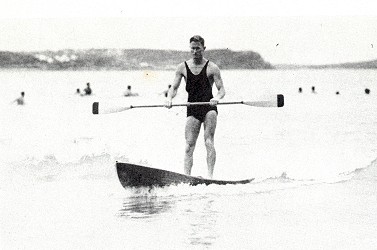
| Interestingly, the nose leash, now affixed to the paddle, continued to be used into the 1940s before disappearing with the construction of longer and narrower skis more suitable for SLSC competition. Initially paddled and ridden sitting on the board, in the hands of skilled riders the skis enjoyed a short period of popularity ridden standing up, possibly at the time rivalling surfboards in populatity. Image
right: |
|
It is
impossible at this point to assess to what extent McLaren's
hollow surf ski design impacted on the development of the
hollow surfboard in Australia.
While Harry
McLaren's relative isolation in Port Macquarie certainly
implies he was unaware of Tom Blake's experimental boards, it
is possible that Crakanthrop became aware of Blake's patent of
1931.
He may have
seen a copy of Blake's plans (including mention of the patent)
published in Modern Mechanix magazine in 1933
and recgonised an opportunity, with possible financial
advantage, to apply for an Australian patent.
An analysis of the claims for the first successful hollow surfboard in Australia is outside the scope of this paper, suffice it to say a current favoured candidate is Frank Adler at Maroubra, circa 1929-1934.
As the 1930s
progressed, Blake's potential influence grew with further
publications; his book, Hawaiian Surfboard, and its
companion National Geographic article were
printed in1935 and further board plans published in 1936 and
1940.
There were also
a number of promotional brochures prepared by US companies,
initially the Thomas Rodgers Company, that manufactured a
range of Blake boards under licence from 1932 to 1940.
See Lynch and
Gault-Williams (2001).
It is highly
probable that some of this literature was acquired by
Australian boardriders and board builders.
There is a
possibility that before1940 Australian travellers encounted,
even purchased and imported, Blake's designs in Hawaii
or mainland USA.
In Australia
this was a period of vibrant experimentation in surfcraft
design.
There was
continued development of the surf boat, the introduction and
refinement of the surf ski and the Dr. Ernest Smithers
"Surf-o-plane", the hugely popular rubber surf mat.
See #146
At selection
trials for the 1939-1940 Pan Pacific Games at Honolulu,
Australian boardriders (strictly in this context, board
paddlers) used a variety of hollow timber designs.
In particular note the metal sheathing on the nose of the three
shorter boards, a feature unique to Australian surfboards up to
1940.
Note that similar metal sheathing is also present on the bow of
the duck punt detailed above.
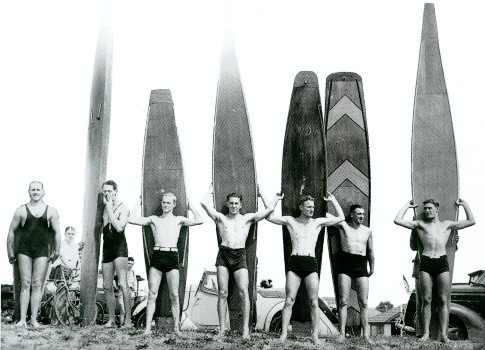 |
Entrants for paddleboard race, Northern beaches, Sydney, circa 1939. Note the variations in
board Longhurst (2000) page 78. |
In 1935 "G.K."
, Manly Surf Life Saving Club’s 7th surfboat, was
carvel built by E. & A. Townes, of Newcastle.
This design was
substantially lighter than the standard clinker hull and
later adopted by many other clubs.
Harris
(1961) pages 45-47.
In 1936 Jack
Toyer of Cronulla, the joint surf ski patent holder with
Crakanthorp, extended the surf ski to improve paddling speed,
but at the expense of wave riding.
Length would
increase up to 17 feet and widths narrowed to 22 inches.
Bloomfield
(1959) page 69
Concurrently,
'Mickey' Morris and 'Billy' Langford at Maroubra SLSC
developed the double ski, whose length could reach 23 feet,
although their first model proved too narrow.
Maxwell
(1949) page 245.
The surf ski
officially became became part the surf life saving movement
when, after a period extensive testing at Maroubra, it
was adopted as standard life saving equipment in 1937.
Maxwell
(1949) page 245
At the end of
the year it was included in the Australian Chamionships as a
rescue event with a paddler and patient.
Galton
(1984) page 79.
| The Surf-ski was first seen on film in Movietone News 8/51 in 1937 at Manly, the riders riding sitting and standing with the paddles attached to the nose by rope. Thoms (2000) page 40. In
1937 at Hurstville, NSW, a company ("the only
surf ski manufacturers") marketed a surf ski
at seven pounds and fifteen shillings, packing and
delivery by rail or boat for two shillings and
sixpence, or fifteen shillings deposit and payments
of three shillings and sixpence per week.
Image
right: Circa
1938, Manly surfboard champion, 'Snowy' McAlister
replaced his solid timber board with a hollow
longboard and several seasons later converted it to
a surf ski. |
|
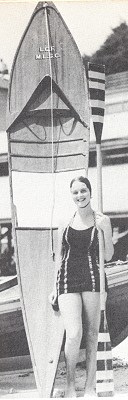
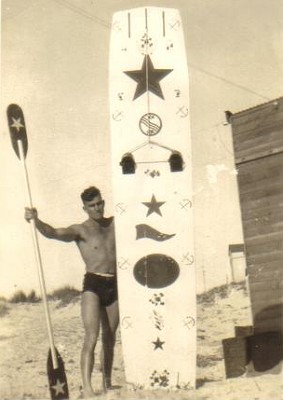
| Several
surf skis were constructed in Western Australia in the
late 1930s, possibly based on reports or from surf
life saving club members in the Eastern states.
Image
right: Margot
Riou, Allan's daughter contributed the image and
noted: |
 |
-Margot's
original email was posted (January 2008) to her friend, Jill
Marfleet, to be forwarded to her son who is known to have an
interest in surfriding history, Henry Marfleet.
Thanks to
Margot Riou and Jill and Henry Marfleet.
Margot also
provided another surf ski photograph, post 1945, see below.
In the early
1940s, an Australian surf ski was accquired by Duke Paoa
Kahanamoku, possibly a gift by the Australian team at the
1939-1940 Pan Pacific Games at Honolulu, see above.
Hall
and
Ambrose (1995) Page 83.
Film of the period illustrates Kahanamoku riding the surf ski at Waikiki, with remarkable skill.
After the
Second World War, the hollow timber surf ski resumed duty on
Australian beaches, along side the reel and the surf boat, as
a resue craft and for racing at SLSC competitions.
In this form it
was exported around the world to British Commonweath countries
as the Australian surf life saving movement expanded
internationally.
Despite it's intoduction at Port Macquarie, the surf ski apparently disappeared from the local beaches until it was re-introduced in the late 1940s:
"In the
1940's, Harry Morris, shire engineer at Wauchope, built a
ski of wooden frame and canvas
covering.
...
Johnny
Elliott, a junior of the club, bought the ski in the
1951-52 season.
'The
Green Hornet', as it was known, was a ski of massive
dimensions and weight ...
Elliott
and a few friends began to build their own craft,
experimenting with designs at frequent
intervals.
They rode
these skis at every possible opportunity for the sheer
thrill of challenging a big wave."
Uptin: Port Macquarie SLSC (1979) page 33.
Port Macquarie SLSC had several successful surf ski competitors, notably the Pullen brothers and their double ski partner Peter Hennessey:
"In 1956
Larry Pullen gained his bronze medallion and it soon
became apparent that Port Macquarie
had a
champion in the making, not only as a ski rider but as a
rower, sweep oarsman and board rider;
in 1960
he went within six inches of winning an Australian
championship."
Uptin: Port Macquarie SLSC (1979) page 33.
in 1946 W. F.
"Wally" Prott started his marine centre, with the assistance
of his father, on returning home from World War Two.
The business
was located in rental premises at 65 Parramatta Road, Five
Dock before the puchase a building at 8 Parramatta Road, Five
Dock.
The company built a range of small recreational craft under the Prot-Craft label in timber and plywood including dinghies, runabouts, surf skis, surfboards and waterskis and retailed water sports accessories, for example waterski ropes.
Surf skis
ranged from a wide 11 foot 6 inch (a recreational model, that
is #328) to a narrow 18''
x 18 feet racing competition design used by the surf life
saving movement.
They were
usually fitted with leather foot straps fixed with screws onto
the deck.
Apart from the
domestic market, Prot-craft surf skis were exported to Lord
Howe Island, Honolulu, Saigon, Madagascar, South Africa and
Florida.
- Noted by Wal Prott, Boronia Park, in conversation, October 2007.
Image below:
Prot-Craft Surf Ski, circa 1948.
Photograph by
Murray Palmer. Click image for craft specifications.

Outdoors
and Fishing Magazine, Hudson Publications, Sydney,
December 1948.
Document
contributed by Mick Mock, Manly, with thanks.
| In
Victoria, a flat-water surf ski derivative became
extremely popular for use on bays, rivers and lakes
during the 1950s. A large number of these "Paddleboards" are still in existence and it is likely they ranged from commercial models manufactured by professional boat building companies to back-yard models by home-builders. The later were possibly based on plans available in contemporary sporting magazines, similar to the Seacraft surfboard and surf ski plans available from Sydney in 1948, noted above. When traded, these craft are regularly accompanied by a two bladded paddle and are occassionally, but probably innocently, mis-represented (surf ski or even surfboard). Approximate
dimensions are 8 to 9 feet long, about 23 inches
wide and 5 inches thick. "The paddle boards you
mentioned were very popular as ocean craft on
Port Phillip bay. -
email correspondence from Bob Smith, in reply to an
enquiry to Jeff Arkinstall at Surfworld Museum,
Torquay, Victoria, November 2007. |
| In
Western Australia, surf ski design resembled the
models developed in Sydney and featured distinct
rocker, splash guard, leather foot straps and a metal
ring and leash on the nose.
Image
right: |
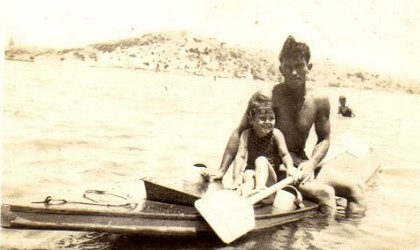 |
- Image and
notes contibuted by Margot Riou in January 2008 following an
earlier email to Jill and Henry Marfleet, see above
Thanks to
Margot Riou and Jill and Henry Marfleet.
The status of the surf ski as a rescue and racing craft would become further entrenched from 1957 when the increasing popularity of the fibreglass surfboard was seen as a threat to Life Saving Club dominance.
In 1965,
Surf Life Saving Australia sent a team to California, possibly
in conjunction with the formation of an national surl life
saving organisation.
Amoung the team
was surf ski and Olympic canoe paddler Phil Coles, who was
later a long-serving Olypmic official.
"He won
25 national canoe championships and was national surf
lifesaving ...
He
captained the first Australian surf lifeguard team to
compete in California in 1965."
- Coles
AM, Mr Phillip - Sport Australia Hall of Fame - Member
Profile
www.sahof.org.au/hall-of-fame/member-profile/?memberID.
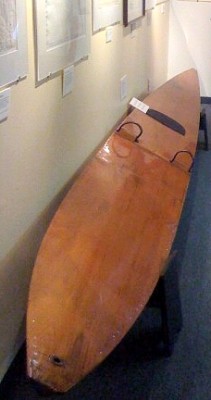
Merv Larson
|
"Merv
Larson bought this ski in late 1964.
- Patrick and
DeAnne Hemmens: OceanPaddleSports
News, Fri, September 25, 2009, viewed 13
September 2013. Also
see
|
 |
With the
introduction of poylester foam billets in the early 1960s,
surfboard designers embarked on an intensive ten year
experimental program that saw surfriding performance soar and
board volume shrink.
Circa 1967,
American lifeguard and Olympic kayaker, Merv Larson
revolutionized surf ski design and riding performance on
a short fibreglassed ski without a fin.
Larson
initially started with an Australian surf ski, purchased
following the visist of an Australian team to California in
1965, see above.
A combination
of footstraps and a seat belt (Larson's major innovation)
bound the rider and craft, similar to a kayak, and virtually
guaranteed he could survive the most extreme wave riding
situations.
The craft would
later be termed wave skis.
In 1970, with
the leg rope still four to five years away for the general
surfriding population, Larson noted:
"In three years, I've never had to swim."
-
Unaccredited: The New Adam
Surfer
Magazine, May 1970, Volume 11 Number Two page 56.
Larson's
performance was eclectic - using the rail and the paddle
blade, he carved hard high speed turns comparable with best
surfboard riders of the period.
Alternatively,
(without a fin) he could side-slip and spin the surf ski in a
combination of extreme stalling manourves.
Merv Larson's
surfriding is documented in John Severson's Pacific
Vibrations (1971).
|
Rincon, California, circa 1970. Photograph by Glen Fye. Surfer Magazine May 1970 Volume 11 Number Two page 59. |
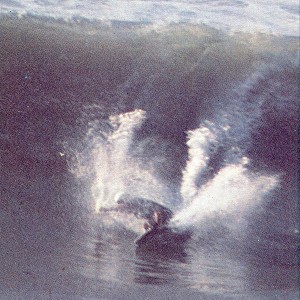 |
"A group
including Paul Brockman, Rippon Morford, and Jack James
started paddle surfing, as it was known in South Africa,
back in 1972.
River
canoeists, who enjoyed taking their kayaks into the surf,
and would-be surfers who found boardriding too hard, soon
swelled the ranks.
The
competitive nature of South Africans resulted very quickly
in the formation of clubs and organised competition.
Far away
in the UK, the British Canoe Union had for years been
holding surf competitions for kayaks.
Certain
devotees thought the kayak unsuitable for the surf and
developed a short flat-bottomed boat called a surf shoe.
The surf
shoe is actually the conceptual forerunner of the modern
wave ski.
It was
designed for performance surfing, unlike the early
Australian surf skis which were hollow plywood and 17
feet."
Shackleton (1985) page 25.
The kayak, if
the rider was properly sealed, firmly attached the rider and
craft roviding a stable platform, replicated by Merv Larson's
combination of footstraps and seatbelt on his surf ski.
Correct sealing
also made the kayak particularly suitable for extremely cold
conditions, and these craft retain their popularity in high
latitude surfriding locations such as Scotland.
Paddle Surfing Competition, 1975.
In 1975 the
first International Paddle Surfing Competition was held in
conjunction with that years Gunston 500 surfriding competition
at Durban, South Africa.
Amoung the Soth
African competitors were Englishmen Tony Blackwell and Danny
Broadhurst, the later currently living on the east coast of
the USA.
Broadhurst
organised a second contest at Atlantic City in 1976.
"The
contest was attended by six South Africans, nine
Englishmen and a group of resident Americans.
The
competition was won by South African, Paul Brockman."
Shackleton (1985) page 25.
Concurrently, in Australia a similar amalgamation of kayaks and surf skis were used in competitive surfriding events.
"Gary
Nelson of the NSW Canoe Federation had been holding
regular surf canoe competitions and current World
Champion, John Christensen, was one of Gary's regulars,
using a surf shoe.
Toward
the late seventies surf ski owners started to filter into
these competitions.
A group
of keen riders from Tamarama on Sydney's south side had
been pushing the limits for some time, designing and
making their own skis out of polystyrene foam and epoxy
resin.
The group
comprised Tom Blake (Tom introduced the others to wave
skis), Westo, Phil Avalon and Alan Blake.
Alan
Blake was another expatriate English canoe paddler.
He wasn't
a very good swimmer.
When he
started to ride a surf ski he attached a seat belt so that
he could roll up if he tipped over.
Alan
taught us all how to roll."
Shackleton (1985) page 25.
In the late 1970s, a series of competitive events, largely based in Sydney, confirmed the popularity of the wave ski:
"Gary
Nelson's 1979 'Metropolitan Titles' were overrun with wave
skis and all the surf shoes were outclassed.
This
competition was won by Newcastle campaigner, Bernard
Burns. and the scene was set for wave ski domination."
Shackleton (1985) page 28.
Surf Skis in Hawaii, 1979.|
Mike Bennett (formerly the "Canadian Kook", South Bondi Board Riders Club, circa 1960) of Scottsdale, Arizona,emailed the following notes and images in June 2011 (edited): "Read some articles in your 'surf history' about surf skis.Have a couple of pictures of a great wave at Sunset Beach, Hawaii, about 25 years ago, see below. Hayden Kenny pretty much introduced surf skis to Hawaii around 1979 when Grant Kenney won his first race. It was the first year his son came to Hawaii to race 'long skis' from Molokai to Oahu. They were purchased by some locals including John 'Wheels' Williams, Rick DeRuiter & myself. 'Wheels' Williams was a resident at that time, he had permanently moved to Hawaii about 1967. He sold us two of the 'short' ski's, and at least one of the traditional longer racing versions. The shorter one a little less than 8 ft and the longer about 8 ft 8", and constructed in foam and fiberglass. The
skis have fin boxes and were 'adjustable.'
Hoole/McCoy: North Shore Pictorial
Backdoor Number 13 January-February 1977, page 15. |
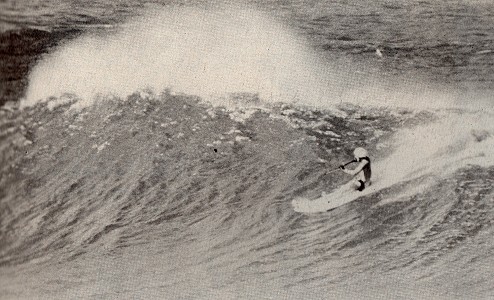 With
the popularity of surf skiis in Australia being so
high that
many breaks are "threatened" one place we can't forsee being overtaken by skiis is Sunset Beach. This guy was the only surf skier to make it out there this winter, and although he shredded, we don't expect his performances to encourage many others. |
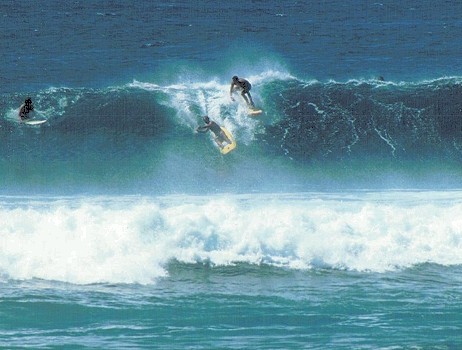 Sunset on waveski - take off. |
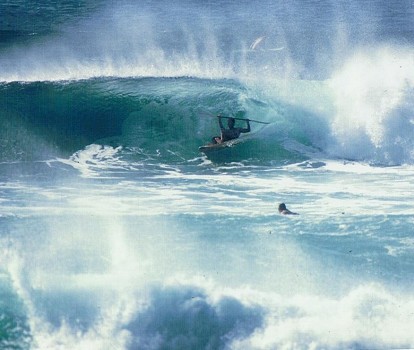 Sunset on wave ski - inside section. |
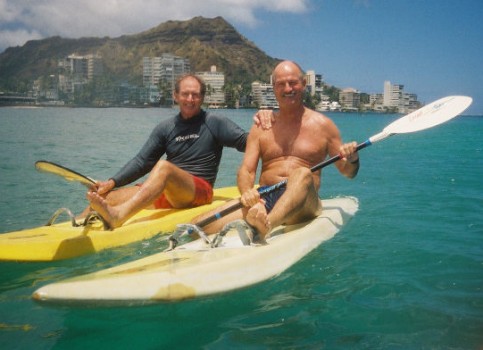 |
Hayden wave skis, Waikiki, 2006. Above
and right, images and captions by Mike Bennett.
|
"(Oahu
native,
Marshall) Rosa grew up in Hawaii surfing and paddling
outriggers canoes from the time he could stand upright.
In the
late 1970’s he was part of the winning Molokai six-man
outrigger canoe team with the Outrigger Canoe Club.
'When the
Australian surf ski invasion came to Hawaii in the early
eighties,' Sandvold said, 'Marshall learned the sport from
Hayden and Grant Kenny.
When
Marshall was 40 he raced against Grant in the Molokai ski
race.
He never
beat Grant but he always gave him a good race till the
very end.
Then the
Big O (Oscar Chalupsky, 11 wins)came to Hawaii and much
the same happened -- with Marshall being the only
competitor to give Oscar a run for his money.' ”
- Joe Glickman
(Saturday, 10 March 2007: A Rosa by any other name.
SurfSki.Info
http://www.surfskidev.info/content/view/372/129/
Stand Up Paddle Boards (SUPs), 2000.
Hobie Canoes, 20000.
Circa 2000, the
American Hobie company, famous for their surfboards and the
Hobie-Cat, produced a range of roto-molded "kayaks" or
"canoes" (later termed "yaks") that incorporate a enclosed
deck, essentially replicating the surf ski design.
Their
advertizing claimed "Their mother was a sailboat, their
father was a surfboard."
Perhaps
"Their mother was an sailboat, their father was a surfki" would
be more more accurate.
Note that
Hobie's designs, typical of this innovative company, have a
full range of accessories including paddles, outriggers, sails
and the remarkable MirageDrive pedaling system.
See http://www.hobiecat.com/kayaking/index.html
| home | catalogue | history | references | appendix |