 |
surfresearch.com.au
appendix
: stringers
|
stringer index
| home | catalogue | history | references | appendix |
|
surfresearch.com.au
appendix
: stringers
|
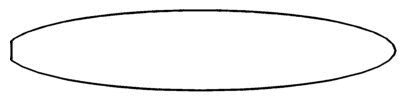 |
Stringerless
Common in many timber boards. Introduced by Midget Farrelly in foam boards 1965 for weight reduction. See # 110 |
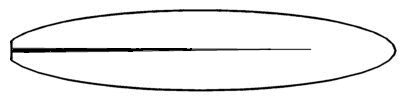 |
Three -Quarter
Unusual, notably used in the Featherlite model by Hansen Surfboards, USA circa 1967. See copied version See # 3 |
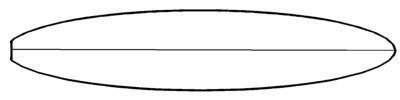 |
Single
Standard foam blank addition |
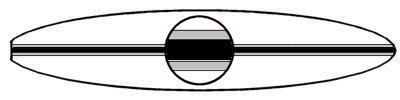 |
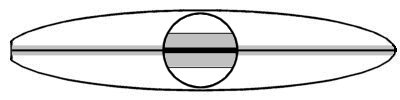
T - Band
One thick stringer laminated between two thinner stringers - the ' T' indicating a total of Three. See # 48 |
 |
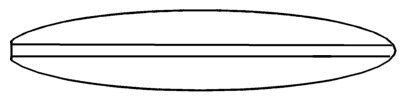
Reverse T - Band
One thin stringer laminated between two thicker stringers - the ' T' indicating a total of Three. |
 |
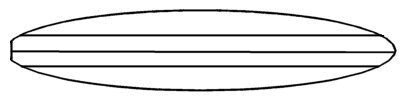
Twin/Double
Unusual in surfboards but common in sailboard blanks to allow support for the mast-track and finbox inserts. |
 |
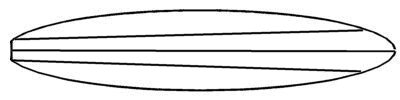
Multi
Two or more stringers See # 67 |
 |
Offset
Multi stringers, not parrallel to the centre line. See # 80 |
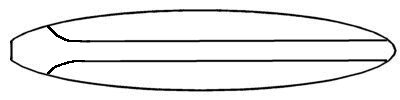 |
Flared
A mostly straight stringer that curves out to the rail line at one end. |
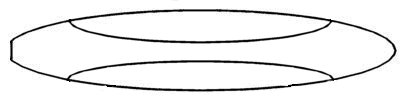 |
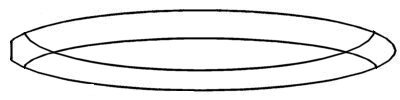
Curved |
 |
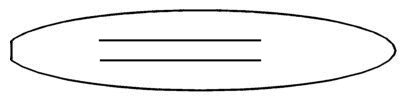
Detailed
Multi stringers that twist or cross. Extremely rare. See # 127 below. |
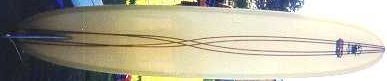 |
Detailed stringers by John Rhodes/Tony Nicholas Sufboards, Cronulla NSW, circa 1966 |
 |
Inserts
Not real stringers but timber inserts added post production, usually to repair and strenghten broken/cracked boards. |
stringerless
a (foam) blank without timber/resin
reinforcement
strip/s, usually for weight reduction,
originally developed by Midget
Farrelly
1965. The lack of a centre line made shaping difficult and in
the late
1960’s often a glueline was used as a compromise. Last
application was
in 1970 Popouts – some models had a knife cut down the centre of
the blank
that filled with resin during laminating to produce a faux
glueline. Pre
1920 solid wood boards did not have stringers and pre 1960
fibreglassed
balsa boards
were usually glueups of four or more
blocks.
glue line a resin line joining sections of the blank as a lightweight alternative to a wood stringer. It alsousually serves to provide the shaper with a line of symmetry – contrast difficulties with a stringerless blank. Mostly used from about 1967 to 1972 for weight reduction.
T-band
1. wide three part (hence T)
stringer,
usually comprised of a wide soft stringer (balsa, spruce, high
density
foam) laminated between two thin redwood stringers. Also Reverse
T Band,
thin centre
between two thicker stringers.
2. a wood stringer and matching
wood tail block, thus forming a ‘T’
- Kelly: Surf and
Sea (1965).
Flared Stringers
A mostly straight stringer that
curves
out to the rail line at one end.
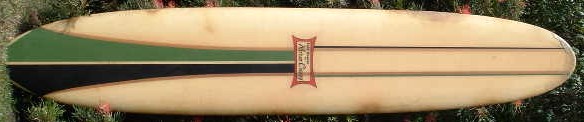
| Twin flared stringers circa 1965.
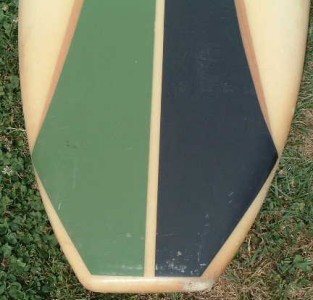
Surfboards by (Norm) Casey. Image contributed, with thanks, by Tim Clarkson, Victoria, January 2006. Tim reported... Length 9 ft 3'' x 20 1/2 inches My father in law says he got it second hand in 1967. He bought it of a workmate's mate in Camberwell Victoria. It already had a couple of dings and that the fin had already been replaced. Note that the 'stringers' are inlayed and do not extend through the blank. The bottom has a single straight centre 'stringer'. In detail image, right, the 'stringers' are taped and do not extend into the rail. |
 |

| home | catalogue | history | references | appendix |