surfreseach.com.au
 |
surfresearch.com.au
glossary : b
|
Baby
circa 1961
Phil Edwards’ balsa / fibreglass Malibu
board, ridden in Australia 1964?
shown in Bruce Brown’s Waterlogged?
(The) Baby Surfboard
1962,
short, multi laminated balsa /
fibreglass board similar to Simmons’ Spoon template, built by
George Greenough at Wilderness Surfboards, Santa Barbara (USA).
Starting as a twin fin it was
progressively modified, including nose scarfing and Waveset fin
box, and ridden by a host of different riders, most significantly
by Bob McTavish in 1966 as a precursor to the short board
(Greenough) revolution.
baby-gun
US term, Cralle.
See Mini-gun
backhand
riding with the surfer’s back towards
the wave face, as opposed to forehand where the surfer faces the
wave. Because turning the board is directed with heels, rather
than the more precise toes and balls of the foot (of a forehand
turn), the rider usually adopts a alternative stance and/or style.
Backhand
model name for Nat Young/Nat Young Surf
Design asymmetrical-railed, pin-nose/square tail single fin 1971
to 1982.
Designed for riding with the surfer’s
back towards the wave face, featuring accentuated nose rocker,
flat deck, tucked rails a small chamfered pod and a Greenough
Stage IV fin.
Early Byron Bay models in blue/white
pigment laminate, later Mona Vale models sprayed.
Nat Young Falline (Surfboards) model
shaped by xxx, 1982 in Thruster fin set up noted..
Backyarder
1. A board built by an amateur.
2. a board not built in a
factory.
3. a board without printed
decals.
4. a board displaying crude
construction technique.
5. All of the above and a
Cut-down...
Commonly first boards are shaped from
existing obsolete (hence usually larger) boards that have had all
the fibreglass removed.
This course of action is invariably
regretted (see backyard butchery, below)
backyard butchery
reshaping of an existing board,
virtually destroying the work of the original builder.
Particularly virulent in the late
1960’s.
Term credited to Peter Turner, Kirra
Surf Shop, 1999.
See Cut down.
balsa wood (Ochroma
lagopus)
"a soft, lightweight porous, wood found
mainly in Ecador and parts of tropical South America" - Cralle.
First used in the 1940's, laminated
with redwood and/or pine to make solid boards, later used as a
shaped blank in the first fibreglassed boards in the 1950's.
Wide balsa stringers were a feature of
early foam boards - Longboard magazine Vol.5 #4 page 47.
Current use is rare.
See Malibu, stringer, Spoon .
banana
extreme rocker
First credited use: Fred Notting's
original surf boat design for Manly Life Saving Club (MLSC) in
1913. - Maxwell,
pages 91-92.
bastard / illegitimate
a board built by professionals
but "rebadged" to avoid tax (or the unathorised use of the
employer's factory and/or materials).
Bat tail
usually a wide tail in template with three points
separated by two concaves.
The design was possibly first used for an episode the
televsion series Batman 1965 - 1967.
Batman is challenged to a surfing contest (by the Riddler?) and
uses a board with "Bat" decor and tail (similar to the
Batmobile.design).
More general use in mid 1970's, I think initially from the USA,
possibly Rick Rasmussen, originally from the East coast.
Australian examples are rare and most likely to be single fin
boards from 1973 to 1976, a period of considerable design focus on
the tail.
Examples include the Swallow tail, Fangtail, Fish tail, Flex tail,
Tinkler tail, Ski/Screwdriver tail and variations to all the
common tail templates.with the addition of single and multi
Flyers/Wings.
The Catalogue has one example of this design # 93, circa 1981 - but the tail is
severvely damaged and no suitable photograph.I believe
this board is a throw-back by the shaper to his 1970's.work.
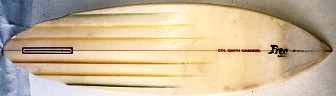
Bee
Tail
triple or double flyer pintail , by Jim
Pollard/Col Smith (Newcastle), used in conjunction with full
length channels exiting at the flyers. See channels.
belly
middle curved contour on the bottom of
a board
Mostly used in the1960’s when most
boards used a round bottom.
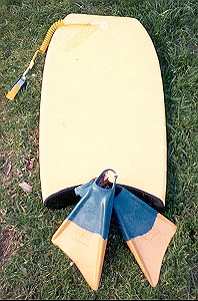
Belly Board
A short board with a fin or fins,
designed to be riden prone usually with flippers or swim fins.
Originally of built of wood laminated with fibreglass in the early
1950s, later built with a foam core in the 1960s, and manufactured
in molded plastic in the late 1970s.
Note that some types of prone boards,
such as coolite boards (1970s) and boogie boards are occassionally fitted with fins.
Not to be confused with body board,
paipo board, knee board, spoon, boogie board, etc.
See Paipo*
Catalogue
billet
Crude timber or polyurethane foam block
from which a board is shaped.
Common usage ‘blank’.
blank
1. Crude timber or polyurethane
foam block from which a board is shaped
2. The shaped board before it is
fibreglassed. Preferred term ‘shaped blank’.
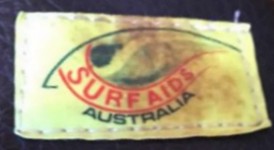
board cover
Surf Aids label,
knitted cover, circa 1976.
|
|
Bonker board
semi derogatory 1970’s term, usually of
a 1960’s Malibu board.
Bonzer
(design/bottom/fins)
original design 1973 by
Campbell brothers (USA)
Characterized by forward
concave leading to double concave each side of the centre
fin with two keel- type fins set on the rails ( toed-in
and cambered).
Australian expression for
“excellent”.
Australian exponents :
Peter Townend (Gordon and Smith
Surfboards) and
Terry Richardson (Skipp
Surfboards).
See ...
tri-fin
(precedent),
Thruster
(influence)
Phazer (adaptation) |
|
Boogie (Board)
Flexible foam bellyboard
invented by Tom Morey in 1971 as an offshoot of his
experimentation leading to the Morey-Doyle flexible
surfboard.
Based on the Hawaiian paipo and
incorporating flex and ‘vacuum track rails’ (Greenough /
Brock hull design). Soft construction circumvents
bodysurfing area restrictions.
Originally offered as a buyer
assembled mail order product.
Extensively imitated. |
|
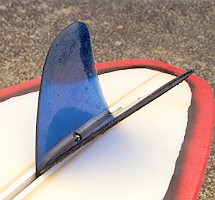
Boomerang fin
narrow based and bladed fin with
extreme rake.
Originally an early 1980’s sailboard
design, probably by Mark Paul, Bombora Sailboards.
Surfboard adaptation credited to Bobby
Owens (Hawaii), circa 1984. -Cralle.,
photograph page 13.
bottom / hull
planing surface of the board, often
varying in cross section from the nose to the tail.
Common cross sections are flat,
round, vee, concave and channel.
A change in cross section is designated
as one phase.
bottom curve
(profile) / rocker
the bottom of the board described in
profile, from nose to tail.
There is no recognized universal method
of measuring bottom curve.
break away edge
trailing or rear edge of a board or
fin. -Cralle.
Bullet
board template, usually full pin nose,
forward wide point and a wide squared tail.
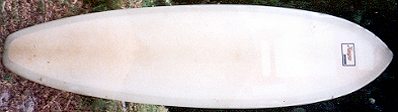
Bull nose
"A 1960's surfboard shape featuring a
nose more rounded and wider than the tail"
-Australian Surfing Kit Co.in Cralle.
bullets
see Q-cells.
bung
plug used to seal hollow boards.
Cork, rubber, metal, plastic.
bung hole
draining hole for hollow boards, sealed
by a bung.
Bump Board/Bump
Tail
alternative term for Pig template,
Circa 1956 USA.
Bump Wing
see Wing and Flyers, obscure in
Australia, term listed in Cralle.(USA)
1991.
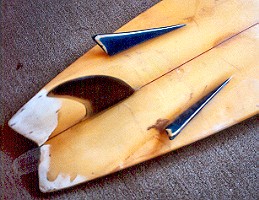
Butterfly Fin / Rabbit
Ears Fin
a two bladed fin located at the
centre of the tail.
First credited 1954 to Velzy
/Jacobs
Others by ...
Scott Dillon - 1962
Brad Larkin's Honey Surf fin
box model - 1974.
- Image left
Notes
on Glossary |
|
surfresearch.com.au
Geoff Cater (1999-2016) : Appendix :
Glossary : B
http://www.surfresearch.com.au/agb.html
Gday Geoff
how are things going at surf
research?
Fine.
I am writing something about the
history of the longboard at the moment….from 1960-1970 only.
crikey what a mission!!!
I rekon you know more about it than
anyone in Australia.
SO - i ask you….while woods,
bennett, larkin etc were blowing blanks in Sydney and shaping
boards in the early 60s…who was doing it in
VIc, SA and WA??
In Qld, was it just Hayden Kenny
and later Joe Larkin?
thanks in advance.
Andrew.
Thanks for your two questions:
1. Outside
of Sydney, who were the manufacturers shaping
boards in the early 60s?
This is fairly straightforward - a general list of Australian
builders or factories up to about 1965? - see below.
2. Outside
of Sydney, who were the manufacturers blowing blanks (and shaping
boards) in the early 60s?
Not so easy, but far more interesting.
From memory (that is, I have read it but do not own a copy),
this is something that was not covered (but should have been) in
...
Warren, Andrew and Gibbson, Chris:Surfing Places,
Surfboard Makers
Craft,
Creativity, and Cultural Heritage in
Hawai'i, California, and Australia
University of Hawai'i, 2014.
Some of the following is common knowledge, some based on
obscure bits from conversations, and some conjecture.
Note that it is not immediately clear which of
the early 1960s factories blew their own blanks, and it is
possible that a small number of blanks may have been imported
from the US.
To make a start ...
Following the introduction of the Malibu board in late 1956, the
design was first replicated in timber and marine-plywood,
commonly known as an Okinuee (Ocker-
Newi?).
Leading the way were established board (and surf-ski) builders
Gordon Woods, Barry Bennnett and Bill Wallce in Sydney's Eastern
Suburbs,
These boards were widely copied, the materials were readily available and the
design easily replicated by any experienced carpenter in a home
workshop.
By 1959, plans for a "Plywood 10 ft.Surf Board"
were available from Vel Aqua, a
Victorian timber and
joinery company.
Fibreglass and resin were already being imported for the boat
building industry and supplies of suitable balsa wood,
principally from Milner's in Melbourne,
became available sometime before the end of 1957.
Thereafter, fibreglassed balsa boards
were built.in Sydney by Gordon Woods, Barry Bennnett, Bill
Wallace, Bill Clymer, Joe
Larkin, Danny Keyo, Graham Ferris, Brian Jackson, Norm Casey,
Wally Carle, Scott Dillon, the McDonagh's
and Roger "Duck" Keiran, possibly in Queensland.
By early 1958, balsa boards where
made
by Sydney manufacturers were
available in sports stores, such as Mick Simmons, and, before he began production.Adelaide in the
early 1960s, John Arnold was
retailing boards from Brookvale's Barry Bennett.
This is the likely source of
the "malibu surf
board made from balsa wood coated with fibre glass" presented as the principal trophy to J. Brown (Grange SLSC) at that year's South Australian Surf. Life-saving Championships.
Alternatively, it was possible to buy a kit
(balsa blank, glass and resin) for "home assembly," such as
the first board shaped by Midget Farrelly.
At
this stage surfboard building was still largely a back-yard
industry, but the increasing use of chemicals may have began
to cause some concern for the residents and authorities in
urban areas, and the move was on to the wild green pastures
of Brookvale (Beloved Board-land).
Board building was
becoming an industrial venture, and while the number of
manufacturers increased, many of the early backyard builders
became valuable employees.
By 1959 the McDonagh's and Dillon began
experimenting with Coolite foam
glassed with epoxy resin and by 1960 it was clear that foam was beginning
to replace balsa in California and Hawaii.
For the Brookvale Six (Woods, Bennnett, Wallace, Keyo, Dillon, McDonagh)
their initial explorations into blowing blanks, which
carried an significant element of risk, went largely
unregulated.
In the south, Jackson-Cansdell and Graham King blew blanks
inland from Cronulla.
These early blanks
often had "irregularities" and full gel-coats were commonly used
to hide the imperfections.
The ability to blow blanks gave the larger
manufacturers a distinct competitive edge and an extra
income-stream from on-selling their
blanks, although some declined to
supply backyard builders.
In 1962, Gordon
Woods was one of the first to introduce CO2 water blown
foam, allowing a substantial improvement in construction
and finish.
The
demand for balsa
boards
dropped, and by 1962 they cost less than a foam board.
With an ever increasing demand, investors from
outside the surfing fraternity opened a number of factories in
Sydney; notably
Pacific Star by
Dunlop in Brookvale and Ron,
initially in Belmore, and they
probably blew their own blanks.
Ron was.perhaps the biggest Australian producer of the of the
early 1960s, exporting to South Africa and the US.
Blanks were
apparently supplied (from Brookvale?) to Weiss Surfboards' factory in Marrickville, and to
Keen-Davis, North Sydney.
While these 'Westie" brands were generally derided by
knowledgeable surfers, the factories provided extra income
for experienced craftsmen and an entry into the industry for
others, including Geoff McCoy, Frank Latta, Warren Cornish, Kevin Brennan, and Gordon Merchant.
Around 1964 the industry was changed profoundly when Barry Bennett, taking the lead from Hobie Alter and
Gordon Clarke in California, created a specialist foam blank
production company, initially Polytron
Foam, later to be named Dion Chemicals.
Thereafter, independent blank production quickly ceased, and it
became standard practice to procure from Bennetts'
Polytron/Dion, or a similar blank specialist such Graham King at
Kirrawee and later Burfords in Queensland.
In 1965, Poltron listed the companies that used their blanks:
QUEENSLAND
JOE LARKIN, COOLANGATTA
RAY WOOSLEY, BRISBANE
COAST SURF SHOP, MERMAID BEACH
SAFARI SURFBOARDS, MERMAID BEACH
HAYDEN KENNY, ALEXANDER HEADLANDS
VICTORIA
GEORGE RICE, MELBOURNE
VIC SURF CENTRE, MELBOURNE
BELLERINE MARINE, GEELONG
FRED PYKE, MELBOURNE
SOUTH AUSTRALIA
ASHLEY SURFBOARDS, ADELAIDE
WESTERN AUSTRALIA
CORDINGLEY
BROS., PERTH
NEW SOUTH WALES
BARRY BENNETT, BROOK VALE
DALE SURFBOARDS, BROOK VALE
SCOTT DILLON, BROOKVALE
BRIAN JACKSON, CRONULLA
KEYO SURFBOARDS, BROOKVALE
MACDONAGH SURFBOARDS, BROOKVALE
SAM SURFBOARDS, NEWCASTLE
SHANE SURFBOARDS, EASTWOOD
MIDGET FARRELLY, PALM BEACH
MICK DOOLEY, BROOKVALE
BILL WALLACE, BROOKVALE
ANOTHER LIST, SOME DATES APPROXIMATE.
Dale Surfboards, Brookvale,
circa 1963
and
Gordon and
Smith Surfboards, Taren Point, 1965
Hancock Custom Surfboards, Riverwood
(Sydney), 1964.
NSW
Sam
Egan Surfboards, Newcastle, 1963
Bay
Area Surfboards (Rick Bennett), Byron Bay,1965.
Collins
Surfboards,
North
Wollongong, 1963.
Gary
Birdsall Surfboards,
Fairy Meadow (Wollongong), circa
1964
Queensland.
Joe Larkin
Surfboards, Kirra, 1961, first blanks from Gordon
Woods.
Hayden
Surfboards, Alexandra Headland, 1962
First board built in grandfather's cow
bales at Maryborough from a foam
blank and materials supplied by Gordon Woods.
Graeme
Merrin
Surfboards,Tweed Heads, 1964
Safari Surfboards
(Laurie Hohensee), Mermaid
Beach,1963.
Gull
Surfboards (Ray Woosley), Brisbane,1962
Later Woosleys
Surfboards, 1963
Bob Clapp Surfboards, Surfers'
Paradise, 1962.
Adlers
Surfboards, Brisbane,
1964
G Surfboards
(Geoff Godby), Mermaid Beach, circa 1964
Cord Surfboards, Caloundra, 1965?
Mick Carey Surfboards, Currumbin, 1965?
Western
Australia
Len Dibben
Surfboards, North Freemantle, 1960
Hawke Surfboards,
Osbourne Park, 1963
Cordingley
Bros Surfboards,
Mosman Park, then Subiaco, 1958
South Australia
Jay Bee Surfboards, St. Marys, circa 1964.
John Arnold
Surfboards, Adelaide, early
1960s
Burford
Surfboards, Grange,
circa 1962
Surfboards by Dolphin, (Dolphin Plastics), Adelaide,
1964?
Victoria
John
Saffron Surfboards, Geelong, 1959?
Tantau
Surfboards (Vic Tanau), Moorabin, 1957
Gill
Surfboards, South Melbourne, circa 1960
George
Rice Surfboards, Fairfied, 1962
Tourney
Surfboards, Victoria?
circa 1963
Young Custom
Shaped Surfboards, St. Kilda, 1964
Fred Pyke
Custom Built Surfboards,
Brunswick, circa 1963386571