pods for primates : a
catalogue of surfboards in australia since 1900
 |
surfresearch.com.au
glossary
: p
|
|
Paddle-board
a board designed specifically for
paddling; racing, rescue or recreation.
Original hollow timber design by Tom
Blake, circa 1930, based on ancient Hawaiian Olo boards.
Current paddle-boards use common foam
and fibreglass or epoxy construction.
Strictly, all surfboards serve as a paddle-board when they are
paddled-out through the surf; and all can assist as a rescue
device.
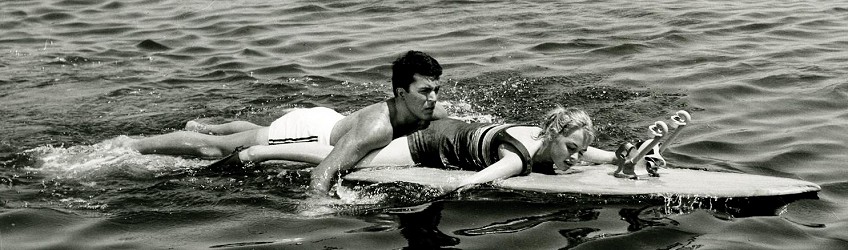
Moondoggie paddles Gidget back to the
beach, from the 1959 film.
Paddleboard, #2.
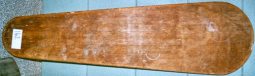
n Victoria, a
flat-water surf ski derivative became extremely popular for use
on bays, rivers and lakes during the 1950s.
A large number of
these "Paddleboards" are still in existence and it is
likely they ranged from commercial models manufactured by
professional boat building companies to back-yard models by
home-builders.
The later were
possibly based on plans available in contemporary sporting
magazines, similar to the Seacraft surfboard and surf ski plans
available from Sydney in 1948.
When
traded, these craft are regularly accompanied by a two bladded
paddle and are occassionally, but probably innocently,
mis-represented (surf ski or even surfboard).
Approximate
dimensions are 8 to 9 feet long, about 23 inches wide and 5
inches thick.
Using
(the now common) hollow timber board construction, they are a
plywood skin over a timber frame, often with a bung, and many
examples have either painted decor or are fully coloured.
The template has
a wide square nose and tail with a slight curve in the rail
outline.
The deck and
bottom are almost flat with very little rocker and the rails
square.
There are no deck
mountings such as splash guards of footstraps, which were not
required for flat-water use, but some examples feature a
shallow long-based keel.
Victorian
surfriding historian, Bob Smith, reported:
"The
paddle boards you mentioned were very popular as ocean craft
on Port Phillip bay.
I used to
holiday on the bay at Rye and Rosebud as a kid and these
paddle boards were very popular, used for paddling, fishing
and a bit of exercise.
They were
also popular at ocean towns where there was a river meeting
the sea eg Anglesea, Barwon Heads.
Some had a
long keel type 'fin' but most had no fin."
- email
correspondence from Bob Smith, in reply to an enquiry to Jeff
Arkinstall at Surfworld Museum, Torquay, Victoria, November
2007.
Thanks to Bob and
Jeff for their contribution.
Paipo
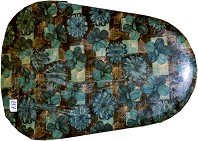
| A wide tailed, short
bellyboard made from solid timber or, more usually,
plywood with definite nose lift (dished), no fins
and ridden prone, usually with
flippers or swim fins..
The design is not noted in
any pre-contact Hawaiian terminology or in existing
ancient examples.
The design does not appear to
be used in the first half of the 20th century and only
came to prominance in the early 1960s.
|
 |
Earliest use of the term was probably
by Wally Foreisth who manufactured the Hawaiian Pai Po
board, circa 1958.
Later used commerically by Val
Valentine at Val Surf for a range of boards produced in
Hawaii.
Later the term was adopted by
Californian foam and fibreglass prone and knee board
manufacturers, notably Newport Paipo Boards (adjacent to
The Wedge, an extreme bodysurfing location who produced the El
Paipo, a deeply spooned deck board) and the House of
Paipo at Huntington Beach.
Subsequently, the term has been
used (inaccurately, including surfresearch.com.au) to describe a
wide variety of prone and kneeling craft.
A precursor to balsa or foam and
fibreglass bellyboards and Tom Morey’s Boogie Board.
paraffin wax
1. Principle component of surf
wax.
2. Additive to
filler/gel/sand/hot coat polyester resin,
Pattie Tail
a chamfered diamond tail, commonly
found on Vee bottoms, 1967-1968.
New Zealand term named after transom
tail of Australia’s America’s cup entry, Dame Pattie.
Also Gretel tail.
phase
one design component (bottom, rails
deck) in order longitudinally from nose to tail.
Hence phases, a number of various
design components .
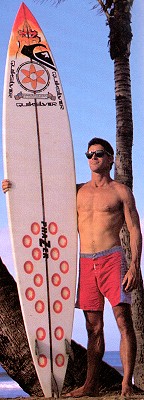
Phaser Bottom
/ Phazer Bottom / Dimpled Bottom
small dish-like concave
features in the bottom, most commonly in the back half in
front of the fin/s.
First prominent use by Wills
Brothers (Hawaii) 1991.
Design theory based on
‘dimpled’ outer surface of a golf ball.
Image right:
Milton Willis and
Phazer bottom, circa 1990.
Photograph by John Callaghan
(cropped).
Martin, Andy : Walking On
Water.
John Murray (Publishers)
Ltd 9
0 Albermarle Street, London
WIX 4BD, 1991, facing page 119.
|
 |
Phazer
1998 Stinger/Thruster adaptation ( 3
similar fins with 2 small Bonzer D-Fins) by Rusty Priessendorfer
for Rusty Surfboards (USA).
Pig (board)
1. Original design by
Velzy-Jacobs 1957 with a narrow semi pin nose, a negative wide
point and full tail .
2. Model by Weber Surfboards
(USA), circa 1972.
Some versions with early tri-fin set
up.
3. Any plan shape with a
negative wide point.
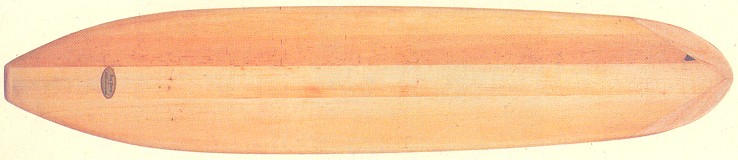
1958 Velzy Pig : Surfboards by Velzy
and Jacobs
pigment
resin colour additive that produces
opaque or solid colour, can be added to laminate, filler coat and
pre 1973 to external gel coats, e.g. pinlines.
Largely replaced by acrylic spray paint
by the mid 1970’s.
Compare tint.
pinlines
fine pigmented resin (pre 1975)or paint
lines commonly covering the rail overlap or outlining décor
features.
Pin
1. Nose- any nose shape that
ends as a point..
2. Tail -any tail shape that
ends as as point.
3. Metal bar at one end of a fin
base that hinges in standard (Barnfield) fin box.
4. Stainless steel bar in
plastic molded legrope plug.
Pin Vee
early 1968 template change of the Vee
bottom / Stubby design, usually stringerless with a
Greenough stage 3 fin.
Some similarities to Dick Brewer’s Mini
gun (Hawaii).
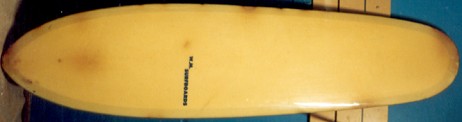
Pipeliner
model name for a refined pintail
Hawaiian design by Dick Brewer for Hobie Surfboards, circa 1697.
Precursor to Dick Brewer’s Mini-gun,
1968 and Pocket Rocket, 1969.
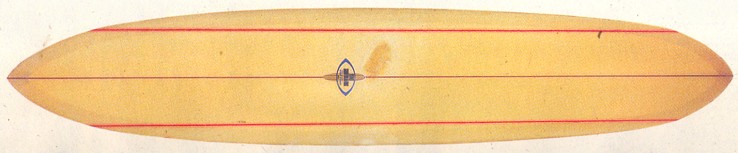
1967 Pipeliner by Richard Brewer :
Bing Surfboards
plane
shape/outline/template
see template.
Plank
1. (derogatory -early
1940's) solid timber boards, precedents to Blake's Hollow board
2. (derogatory-early 1960’s) a longer
and or older designed board than the current standard craft, often
referring to the (perceived) lack of nose lift.
Note that no designer has yet claimed
credit for the introduction of the ‘down turned nose’.
Plasti-bond
a two part resin product with a
thickening agent, marketed during the 1960's in surf magazines as
a board repair kit.
Finished a brown colour.
polyurethane
type of plastic foam used to produce
surfboard billets-blanks.
plug
1. original shaped board or fin
around which a two-part mould is cast
2. fitting in hollow boards and
mats to drain water out or regulate air pressure
3. leg-rope plug
4. fin plug, e.g. FCS system,
1994.
Plywood
Pocket Rocket
circa 1969 shortened (+7ft), usually
pintail, gun template (see Mini –Gun, 1968) by Dick Brewer (USA).
pod (the
tail)
1. The measurement of
the two points of extremity in the last 2 to 6 inches of
the tail; for example a square, diamond, fish, or swallow
tail.
Not applicable to round or pin
tails, where the pod = 0".
Distinct from the tail
width, measured 12 inches from the rear extremity.
See
Specifications
2. Generally, the shape of the rear 12 inches
of the surfboard, that is the tail.
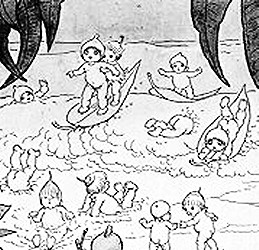
3. One of the early
names for the first Malibu boards in Australia, circa
1957.
See Bob
McTavish : Pods for Primates
4. The Pod
- brand name of a moulded 12'' hand-board, circa 1989.
May Gibbs : At the Seaside, 1918
(cropped)
Watercolour
from Snugglepot and Cuddlepie, Sydney,
1918,
Mitchell
Library Collection, Sydney,
Reprinted
in Geoffrey
Dutton:
Sun, Sea, Surf and
Sand - The Myth of the Beach (1985) page
116.
|
 |
Pop Out
generally, a cheap mass produced board
with little handwork.
1. circa 1962 USA, economy model
(manufactured with low cost materials/techniques/labour) to meet
demand in the early 1960’s boom. See Zipper.
2. circa 1964, standard
boards made usually by apprentices, with decals for major chain
stores. E.g. ‘Waltons’ and ‘Nock and Kirbys’ by Scott Dillon,
‘Mick Simmons’ by xxx. ‘Pacific Star by Dunlop’ by xxx ?.
3.1970 sub 6 ft economy model
characterized by marble gel coat and inserted fin (no rovings)
The blanks were blown very close to the
finished shape and only required minimal shaping.
Since this retained much of the high
density outer core, the construction method was very strong and
many surviving examples are in excellent condition.
Manufacturers included Shane, Wallace and Farrelly.
4.1974 Wave Hollow, USA . Hollow
with molded honeycomb sandwich skin, available in a range of sizes
and designs. A Karl Pope (USA) project.
5. 1976 Morey Doyle Soft
Surfboard (USA)
6.1977 plastic molded board,
probably by Shane Surfboards, usually white with adhesive
‘decals’. Board plug by Simon Anderson, kneeboard slab by Peter
Crawford.
7.1993 Pro Circuit. epoxy molded
board, developed by Bob McTavish from European sailboard
technology. Range of designs (plugs based on several current
pro-surfers’ boards) and colours with molded ‘markings’ and/or
adhesive ‘decals’
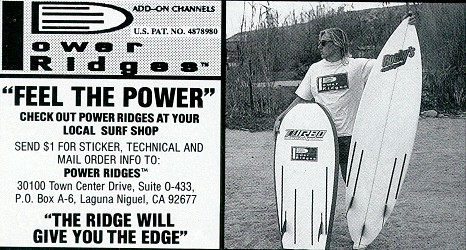
Power Ridges
circa 1990.
US. patent # 4878980
Adhesive plastic ridges to
apply to the bottom of surfboards and boogie boards.
Short lived.
Image
Surfing Magazine July
1990
Volume 26 Number 7 page 40.
|
 |
Pro Circuit Board
circa 1993, epoxy molded board,
developed by Bob McTavish from European sailboard technology.
Range of designs (plugs based on
several current pro-surfers’ boards) and colours with molded
‘markings’ and/or adhesive ‘decals’
Prone board
A board designed to be ridden in a prone
position, it is usually smaller than the rider.
Originally a simple piece of timber, they are the earliest surf
craft and are a basic tool for acquiring surf skills, particularly
for juvenile surfriders.
[To be updated: See olo board, kioe (small
surfboard), Handboard, Paipo, Lamaroo,
Empire board, Surf-o-plane, Coolite, Surf-Mat, Boogie, etc.]
Various designs include the Surf-o-plane, the Bellyboard, the Coolite,
the Mat
and the Booggie
Board.
Several designers have enhanced the
safety aspect of prone boards by producing their designs in a
“soft” format, for example inflatable mats and the Boogie board.
Since the 1960’s many prone riders
use extensions (flippers) to increase paddle power and riding
control.
The prone board has the advantage of
applying extra power by paddling and/or kicking (the most
effective) when the wave face becomes less critical.
This option is not readily available
to standup riders.
Prone boarders, by virtue of their
proximity to the board, have more control in extreme situations,
which substantially improves safety.
Contrast and compare this with
standup boards.
It also helped to enhhance
performance levels, for example it allowed them to ride deeper
in the wave with confidence and to feature at breaks were
wipeouts were potentially board destroying.
This factor was significantly
modified with the introduction of the leg rope, circa 1973.
The biggest determining factor in
surfing performance appears to be the rider’s skill, and
although ‘designed’ to be ridden prone, the earliest experiments
at stand up surfing were probably on ‘prone’ boards.
Special Note
The locomotion of prone craft is
particularly historically significant – prone board paddling
became the basis for Polynesian swimming, incorporating a
vertical over-arm stroke of the arms and scissors-like kick by
the legs.
“Shooting on a board and
in a canoe must have started further back than body
shooting”.
- Duke Kahanamoku, Interview by W. F.
Corbett,
The Sun, Sydney, Australia,
Friday 8th January 1914.
At the start of the 20th century, the
Polynesian or Native style (often mis-labeled the Australian
Crawl) was becoming the dominant competitive swimming style,
superceding the European horizontally based Breast stroke and the
developing Trudgeon stroke
Pro-tech
clear acrylic-based spray paint used as
a replacement for the gloss coat to reduce weight (heavily
promoted) and reduce cost (not promoted).
First credited use Terry Fiztgerarld
(Hot Buttered Surfboards) and Phil Byrne (Byrne Surfboards) circa
1988.
surfresearch.com.au
Geoff Cater (1999-2020) :
Appendix : Glossary : P
http://www.surfresearch.com.au/agp.html