pods
for primates : a catalogue of surfboards in australia since 1900
 |
surfresearch.com.au
glossary
: f
|
|
fabric laminate
printed fabric, usually fine cotton, used
as decoration laminated on a board (commonly nose patch) or inside a fin.
First use probably early 1960’s.
fairing
the blending of the contours of a board.
flare
widened portion of the tail of a board,
characteristic of Hot Dog boards, 1960’s.
Features
non-quantified aspects of a board’s shape
e.g. nose / tail shape, bottom variations, rail profile.
fibreglass/glass
spun glass either as rovings, chopped
strand mat (boat glass) or as woven cloth.
Forms a hard brittle shell when impregnated
with resin.
Cloth is rated according to weight per
square yard, e.g. 4 oz., 6 oz.
Early fibreglassed boards used weights
up to 20 oz.
The chopped strand is stronger due to
the multidirectional fibres, however cloth has been the preferred component
since 1960 due to its ease of use, uniform resin application (by squeegee)
and quality of finish. Chopped mat has had some application in fin construction,
notably in the mid 1960’s and is often used with epoxy resin in molded
boards.
Originally invented 1836 in a textile
mill, Paris, France; term first used 1936.
filler coat /hot coat
/ gel coat/sand coat
waxy resin applied after laminating that
seals the laminate resin from the air (allowing 100% curing) and cures
as a smooth hard surface.
Films
/
Movies / Videos
Significant historical resources, imported
surf movies were first shown in Australia in 1958?
Bob Evans produced home product about
1961.
A major influence in the dissemination
of design and technique, low production values meant a relatively short
lag time in the early years but this increased to in excess of 12 months
as production values escalated through the 1970’s.
Lag times were substantially decreased
with the use of video technology in the late 1980’s.
These comments are not applicable to Hollywood
surf movies.
fin / skeg
See Fin Catalogue
A stabilizing wing attached to the bottom
of the board, usually at the tail.
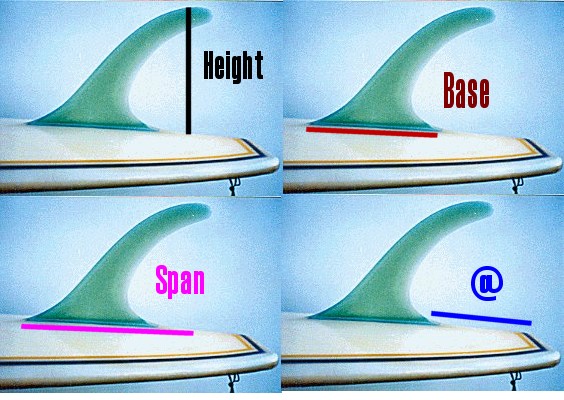
Dimensions are length (height / depth),
base, span and distance set from the tail.
Other rarely considered specifications
are surface area (often noted on sailboard fins). thickness and the foil
or cord.
It is important
to note that while a surfboard is a planning hull as described by Lindsay
Lord, the submerged fin/s performs according to displacement hull
principles.
First use credited to Tom Blake (Hawaii)
1934.
Some commentators also recognize the contribution
of Woody Brown and George Downing (USA).
 |
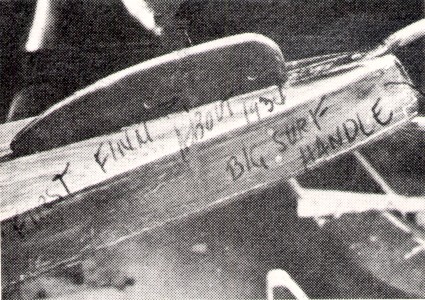
circa 1934
Tom Blake's Nub - Keel Fin
solid timber
2 x 12 b @ 4 inches (Approximation)
Tom Blake's first fin with Big Surf Handle
Photograph and hand written caption
by Tom Blake.
Surfer Magazine,
March 1981, Volume 22, Number 3,
page 37.
See Fin Catalogue |
fin area
surface of the fin, usually one side only,
rarely quantified for surfboards but often calculated on modern sailboard
fins.
fin base
length where the fin intersects with the
board.
fin dimensions
 |
HEIGHT
(INCHES)
BASE
(INCHES)
SPAN
(INCHES)
@
(INCHES) FROM TAIL |
fin box
A fabricated structure inserted into the
board that allows fin replacement.
Some models allow the fin position to
be adjusted.
Apparently there was some experimentation
was during the solid wood era. but the most significant application were
experiments in the mid-1940's by George Downing and Wally Froiseth in Hawaii.
They made a test board with a removable
fin slot and rode it with different fin designs in different positions,
and
without a fin.
Their conclusion was that the finned board
had superior performance, virtually regardless of fin design.
(Kelly,
page 121)
The first production models appeared in
the early 1960’s in the USA.
Since many boxes were limited to the manufacturers'
sole fin design, the impetus to manufacture boxed boards was enhanced by
the cost advantages in freighting finless surfboards.
This was certainly a consideration for
the larger Californian manufacturers in the mid-1960's, for whom the East
coast was a major market.
At first fins were not universally interchangeable
as each manufacturer used a different locking system, but in in 1965 Tom
Morey at Morey-Pope Surfboards developed the TRAF system of
molded fins, available to a small number of Northern California board makers.
In 1966 the design was improved by the
introduction of thr Wonder Bolt system, again by Tom Morey.
In February 1968 Morey introduced the
Waveset box and a range of molded fins for general use.
This design was essentially copied by
the Safe Set system.
The most popular and significant fin designs
were by George Greenough who
produced three models for Waveset - Stage I, III and IV.
In the late 1960's, continuing reductions in board dimensions saw extensive
fin design experimentation, with some designers focusing on sideslipping,
note Skipp Frye's New-e-free fins, circa 1969.
The original Waveset box was too bulky relative to the smaller boards
and circa 1970 it was updated with a male notched fin base slotting and
locking into a molded female box.
This design was replicated by Guidance Fin System and other
manufacturers.
In 1971 Bill Bahne (USA) introduced his
Fins Unlimited fin box, that by 1974 was to become universally adopted
and replicated.
It is still in current use.
It's huge success was a direct result
of the box's ability to accept laminated fibreglass fins of a multitude
of designs.
Note that ...
- many riders considered the fibreglass
fins superior in performance to molded plastic.
- the fibreglass fins could be manufactured
by any experienced laminator.
- the fibreglass fins could be easily
reshaped and repaired.
- they were interchangable with boards
from different manufacturers.
In Australia in the early 1970's Bahne's
design was manufactured in fibreglass (see #83),
but this was shortlived as the large scale production of molded boxes substantially
reduced the unit price.
In 1974 an Australian company, Wakefield
Surfboards, unsuccessfully attempted to
market an aluminium model.
With an expanding number of fin designs
in the late 1970's for kneeboards, waveskis and the twin-tin surfboard,
boxes were available in a variety of lengths to either fit small based
fins or allow maximum variation in fin placement.
Many Thruster designs of the early1980's
featured two fixed side fins and a short centre fin box to allow the rider
some variation in fin selection and placement.
In the 1980's the fin box was an important
feature of sailboard design.
They allowed extensive fin experimentation
and were also fitted into the deck as the mast track.
As surfboards became finer and thinner
in the late 1980's the use of fin boxes in shortboards almost disappeared,
but in the early 1990's a fin plug system for surfboards.was developed
(initially by FCS, subsequently by others).
Further developments in the 1990’s include
bolt-through boxes for sailboards (Tuttle, USA and others).
Revised and updated May 2006, thanks to
Nick Van Bruggen.
fin cam
finbox screw, hinged with a finger grip
and fitted with a rubber grommet that allows fin adjustment by hand, as
opposed to the normal method with a screwdriver.
fin height
the length of the fin measured perpendicular
to the bottom of the board.
Fin index
Tom Blake Keel, Bob Simons Round/Radius,
Simons Twin, Matt Kevlin Raked Round/Gun, (Dale) Velzy-(Hap) Jacobs Dee-fin,
Velzy Vee/Butterfly, Square/Angular, Phil (Edwards)/Reverse/Pixie, Nose-fin,
Dave Sweet High-drift, Ski and Dive Tunnel/Tunnel Hustler,(George)
Greenough Stage I (?),Dave Sweet Bat-fin, White Owl Flow-Thru, Mike Hynson
Dol-fin, (Donald) Takyama Blade, Greenough Stage II, (Reynolds) Yater,
Dewy Weber Hatchet, Greenough Stage III, Migdet Farrelly Cutaway, Richard
Harvey F-fin, Greek Surfboards Tiger Tail, Skip Frye New-E-Free, Gordon
and Smith Hy-Performance, Rick (Stoner) UFO, Greenough Stage IV, Mike Eaton
Twin Fin #1, Steve Lis Fish (twin), Tri-fin, Pat Morgan (Australia)/D.
Barnham (USA) Keel, Malcom and Duncan Campbell Bonzer Keel, Jeff Ho Straight
Back Radial-cut Flex, Michael Cundith Radial-cut Flex, (Dick) Brewer Wide
Base, (George) Downing Trailing Edge, Mark Richards Twin Fin #2, Boomerang,
Bob McTavish Fence, Wave-ski Cutaway, Simon Anderson Thruster, (Cheyne)
Horan/(Ben) Lexan Keel/Winged Keel/Star, Jimmy Lewis Cutaway, Canard, Glen
Winton Four-fin/Quad, Bobby Owens Football, Slot-fin, 757-fin,
fin placement
measured as the distance from the rear
of the fin base to the tail or back of the board.
During the Short/transition board period,
1967 to 1969, an important component of design experimentation was the
increase in fin rake and its movement forward. Not only was board
length substantially reduced, but advancing the fin further enhanced maneuverability.
Early Malibu boards often had the fin
base fixed at the tail with the rake trailing behind.
During the early 1960’s fin designs were
varied and placement 3 to 6 inches from the tail, but by 1967 the Greenough
(Stage II and III) was considered standard and placement moved up the board
to 10 inches.
This fin/placement was carried over in
the Pin-vee and Double-ender models, and placement reached an extreme of
12 inches from the tail on the Tracker, all 1968.
Continued length reduction during 1969
saw fin placement return to the more conventional 5 to 6 inches.
These comments refer specifically to single
fin boards up to 1969.
In the early 1970's fin placement experimentation
was available to the rider with the introduction of standardized fin boxes.
Fin placement was varied with the Stinger
design,1974, and has been critical in the refinement of the twin fin and
three fin.
See Fin box, Twin fin, Tri-fin, Thruster
.
fin plug
fin span
The distance from the front of the fin base to a point on the board
that is directly below the fin tip.
fins
1.
Multiple fins on the bottom
of the board
2. Flippers
Fins Unlimited/Barnfield
Finboxes :
Fish (Design)
circa 1970, short and wide split tail
design, classically with twin long base fins.
Rounded template inside split tail, as
opposed to the straight line inside template of the swallow tail.
Originally a kneeboard design by Steve
Lis (USA), it has had several revivals and adaptations, most notably by
Mark Richards, Twin fin #2, 1977.
Revived as a surfboard design 1998.
Fish tail
Rounded template inside split tail, as
opposed to the straight line inside template of the swallow tail.
See Fish.
flex
ability to bend and return to original
shape, e.g. flex fin, flex tail.
An integral part of surfboard theory in
the late 1960’s, especially George Greenough (USA), and in the design of
the Boogie board, 1974.
flippers / fins
broad rubber blades worn on the feet to
assist swimming / paddling.
Used for body surfing or with personal
craft where the rider does not stand.
First developed by the US Navy during
WW II.
flutes
small channels in the bottom, starting
near the stringer and leading out to the rails at the tail of the board,
usually aligning with flyers or wings.
flyers / wings -
extremities, usually at the tail, in the
template that greatly reduce width over a short distance.
First adapted from rail side fins on a
bellyboard by Bunker Spreckles circa 1972.
Flyers normally retain the rail thickness
– compare wings.
foam
generally, a polyurethane blank blown
in a mold to a specified density.
Sometimes refers to polystyrene.
The first foam board was in polystyrene
by Bob Simmons (USA) circa 1948 - the Simmons' Laminate
Polyurethane first used by Lorrin Harrison
in 1955, further developed by Dave Sweet in 1956.
See Dave Sweet article at http://www.davesweetsurfboards.com/SweetHistory.htm
Successful production application by Hobie
Alter and Gordon ‘Grubby’ Clark in June 1958.
Clark formed the first specialist foam
blank company in 1961 – Clark Foam.
See Edwards,
page 96.
foam filled fin
circa 1983, a shaped foam fin laminated with a thin layer of fibreglass.
Usually on Thruster, post 1981, boards.
A desperate attempt at weight reduction.
Often made by the board builder, at some stage were offered as sell
through item by fin companies.
foam stringer
a block of foam inserted into a foam blank
as an alternative for a timber stringer.
The foam is usually coloured, said to
be high density and enhanced by coloured resin glue lines.
Used mostly circa 1966 to 1968 "to reduce
weight", as inspired by the development of the Stringerless design.
foil
1. Template shape.
2. Rocker/Deck profile.
3. fin cross section.
Foil, The
Model name of Keith Paull design for Bing
Surfboards (USA), 1968-9.
Designed by Keith Paull, circa 1968 - 1970
Usually 7 to 8 ft, pin nose, round tail.
Commonly Waveset fin box and moulded plastic fin.
Commonly Australia theme logo |
 |
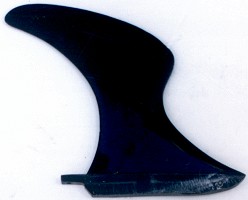
Football fin
S-shaped fin with a narrow base, originally
a sailboard fin design, circa 1983. Surfboard adaptation credited to Bobby
Owens (Hawaii). |
 |
free-lap- laminating
overlapped fibreglass without trimming the edges, common practice since
available alternatives to Volan glass, circa 1973.
Functional
A surfing style with emphasis on wave
positioning and maximum board control.
Typified by Phil Edwards (USA), and in
Australia, Midget Farrelly. See also New Era.
surfresearch.com.au