pods
for primates : a catalogue of surfboards in australia since 1900
 |
surfresearch.com.au
glossary
: r
|
|
Rabbit Ear fin
see Butterfly fin.
Racing 16
Australian name for Tom Blake’s timber
and plywood hollow board design, circa 1934.
rail lap
1. darker section on the rail of
a board glassed with Volan fibreglass, commonly 1960 to 1975.
The overlapping fibreglass (from bottom
onto the deck and the reverse) was trimmed with a blade, often scaring
the blank (lap cut).
Addition of pigment or tint to the laminate
coat resulted in the common rail overlap design that retained popularity
even when spray colour became the dominant décor method.
2. post Volan overlapping of fibreglass
on the rails, usually not detectable. See free-lap.
rails
the left and right edges of the board’s
template, usually described in cross –section.
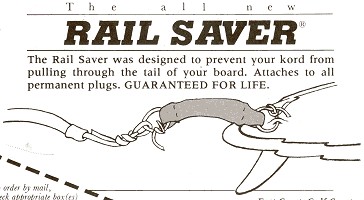
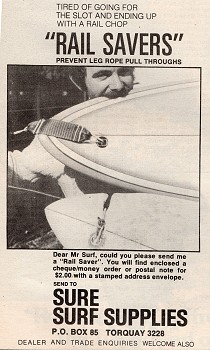
rail saver
6” webbing strap between board and leg
rope that prevents rope snagging around fin and seriously damaging the
rail of the board.
First use circa 1978.
Image right :
Cropped from advertisment for
Kong Cord by Newport Surf and Sport, California.
Surfing Magazine, April - May 1978
Volume 14 Number 2 Page 12 |
 |
rake
the curve of a fin in relation to the
base.
Measurement indicated by the span - the distance from front
of base to a point on the bottom that aligns with the fin tip.
References
Order forms, receipts, photographs, magazines,
books, film/video, web sites, museums, collections.
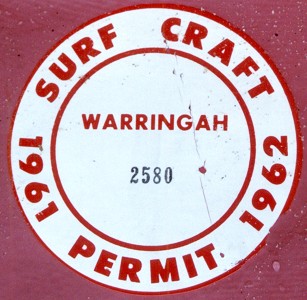
Registration sticker /
Surf Permit :
A circular vinyl sticker usually white
and one colour, to indicate the year.
Printed text includes the council area
and year validated by an individually stamped serial number.
These were issued by Sydney beach side
councils 1962 – 1968 as a reaction to public concerns about safety. A
similar system was in use in the US at this time.
Valid only for the beaches of the issuing
council and policed by beach inspectors and surf club members (sometimes
resulting in confiscation), the system was reviled by boardriders.
Perversely, the stickers are now highly
prized by surfboard collectors and modern reproductions are available.
While an original
registration sticker may not strictly indicate the year of a board's production
(it may be somewhat earlier) importantly for research purposes, it obviously
cannot be later.
Since the registration
was only valid for one summer, riders would often remove the previous year's
sticker and replace it with the current one.
|
|
|
|
Warringah 1961-1962
|
Waverly 1964-1965
Image contributed by
Lisa Stevens, March 2009.
|
|
|
|
|
Sutherland 1967-1968
Image contributed by
Fred M., April 2009.
|
Randwick 1967-1968
Also No. 1540 on
Shane Malibu #120.
|
|
|
Great Britain Surf Life Saving
Association 1971-1972
Image contributed by
Mandy S., August 2009.
|
reshape
see cut down and Backyard Butchery
resin
polymerized liquid derived from oil that
forms a hard plastic after an exothermic reaction induced by the addition
of a catalyst.
First use on surfboards credited to Bob
Simmons (USA)
Reverse T Band Stringer
a thin central stringer laminated between
two thicker stringers.
reverse vee
post 1981 : bottom vee is forward of the
fin(s) as opposed to at or rear of the fin(s).
Also spiral vee. ?
Both descriptions are clumbsy and misleading
terminology.
Rhino/Rhino chaser/Rhino-chaser
Gun
see Gun, later derivative of ‘Elephant
Gun’.
rocker / Bottom curve
the bottom of the board described in profile,
from nose to tail.
There is no recognized univesal method
of measuring rocker.
For example James Kinstle in Surfboard
Design and Construction, 1975 pages 47 to 49, notes...
Since most surfboards have little
or no rocker or lift int he tail, it is a good idea to use the tail as
a primary point of reference.
Moving from the tail along the bottom
center line, the rocker curve will deviate away from a straight line as
it curves upward toward the nose.
This may be of use for a small proportion
of surfboards, but is generally next to useless.
In fairness, he does qualify this ...
Some surfboards have so much lift
in the tail that by the time you get to the nose, deviations
away from the straight edge are so large that is almost impossible to measure
them.
However, the proposed solution is not
much better...
In cases like this, choose a primary
refernce point that is two feet from the tail and hold a straight edge
against the bottom at that point.
Also banana, camber, lift, scoop, spoon,
Gordon
'Grubby' Clarke : Rocker History, 2003.
Gordon Clark was
one of the earliest figures in the development of of foam surfboard blanks
and his company was the world's largest blank producer until it's closure
in early 2006.
Surfboard
rocker has evolved from a dependence on the way a tree grew to the modern,
close tolerance blank where the rocker is very dependent on the blank manufacturer.
Rocker, and
especially bottom rocker, is very difficult to measure by eye.
Therefore
shapers historically have focused on outline, rails, deck shape, bottom
shape, thickness, and other board features that are easy to see and measure.
(Editor's Note :
I would strongly dispute the contention that "rails ... are easy to
see and measure" ).
The first
clue to the real importance of rocker was the so-called "magic board".
The definition
of a "magic board" is a board that looks and measures just like other boards
but performs a lot better than its copies.
As advanced
shapers began developing tools for measuring rocker and experimenting with
different rockers the biggest mystery of the "magic board" was solved.
Beginning
in the late 1970's there was a clear increase in interest in precision
rocker adjustments and bottom rocker measuring tools.
In the 1980's
there was a dramatic increase in the number of rockers used for individual
blanks.
With the development
of very high strength, close tolerance blanks in the early 1990's the majority
of rocker responsibility shifted to the stringer gluing process, as there
was less foam available to adjust rocker.
This again
increased the demand for rocker adjustments.
In 2003 the
rocker template accounting system at CLARK FOAM was put on our large computer
using custom software.
This was done
because the number of templates required to meet the demand for custom
rockers became too great to maintain manually.
http://www.clarkfoam.com/Seabase%20Clark%20Foam%20Catalogue.pdf
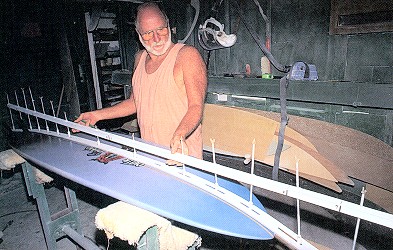
"Cooper
and rocker machine in his bay, 1997."
Photograph : Aitionn
or Bob Cooper Collection.
Australian Surfers
Journal
Volume 3 Number
Two,
Autumn 2000.
Page 75.
|
 |
An extensive discussion forum
on rocker, of varying quality, is online at the Swaylocks site.
http://www.swaylocks.com/
Search for "measuring surfboard rocker"
or try this URL ...
http://www.swaylocks.com/forum/gforum.cgi?do=search_results&search_forum
=all&search_fields=sb&search_type=AND&search_string=measure%20rocker%20method
Many methods are discussed, ranging from
...
"It seems Roger Brucker(cleanlines),
Jim Phillips and Rich Harbour feel it's simply impossible to measure rocker
accurately." - MaraboutSlim
to emphatic assertions of a definitive
solution(s).
I actually think that one of the correspondents
has the best analysis, but fails to fully explain the concept.
roto-molded
round / rounded
convex in profile,
Descriptive of...
bottom / deck / nose / rail / tail / fin
/ other.
routed
sections cut out of the board to allow
for the inclusion of fin boxes, legrope plugs etc.
roving rail
reinforcement strips set in the blank
parallel to the rail line (circa 1995).
rovings
parallel glass fibres, usually laminated
at the base of the fin for structural strength.
Other applications are...
glass bead on wooden fins,
legrope bridges (circa 1974), and
surfresearch.com.au
Notes
on Glossary