 |
surfresearch.com.au
the catalogue #64 |
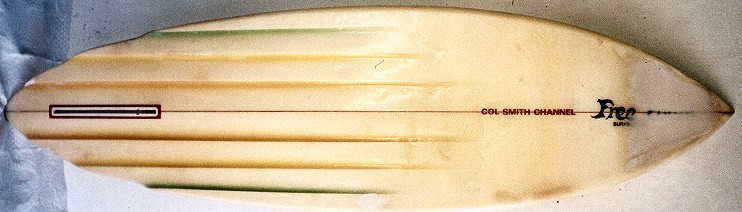
| 1979 Freeflight, Col Smith Channel 5ft 11'' | #64 |
MANUFACTURE
MANUFACTURER: Free Flight Surfboards
SHAPER: Phil Myers
DESIGN: Col Smith Channel Designs, Double Flyer Channel Bottom (Bee tail)
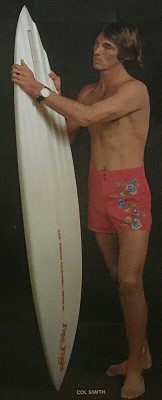
DESIGNER: Col Smith(Newcastle)/Jim Pollard
SPECIFICATIONS
CONSTRUCTION: Fiberglassed foam blank, 1/8'' redwood stringer, spray, Multifins fin box, r/h plug
DIMENSIONS
FEATURES
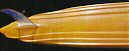
Nose: Semi pin
Tail: pin, three flyers/wings (Bee tail?)
Deck: flat
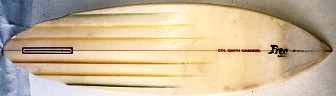
Bottom: flat with 3 channels parrallel to the stringer, starting behind wide point and exiting at flyers
Rails: Soft down, hard in nose and tail.
Rocker: Smooth,
FIN
7 1/4''x 5''
Yellow laminated fibreglass, fitted to Multifins fin box.
MANUFACTURER: Free Flight Surfboards
SHAPER: Phil Myers
DESIGN: Col Smith Channel Designs, Double Flyer Channel Bottom (Bee tail)
DESIGNER: Col Smith(Newcastle)/Jim Pollard
SPECIFICATIONS
CONSTRUCTION: Fiberglassed foam blank, 1/8'' redwood stringer, spray, Multifins fin box, r/h plug
DIMENSIONS
|
Length :
|
5 | ft | 11 | inches | L2: | |
|
Width :
|
19 1/2 |
inches |
Wide Point :
|
+ve 2 1/2 |
inches | |
|
Nose :
|
13 1/2 |
inches |
Tail :
|
13 | inches | |
|
Thickness :
|
2 1/2 | inches |
Pod :
|
0 | inches | |
|
Nose Lift :
|
4 1/2 | inches |
Tail Lift :
|
2 1/2 | inches | |
|
Weight :
|
kilos |
Volume :
|
litres | |||
|
Flyers :
|
3 - 8 1/2 - 16 |
inches |
FEATURES
Nose: Semi pin
Tail: pin, three flyers/wings (Bee tail?)
Deck: flat
Bottom: flat with 3 channels parrallel to the stringer, starting behind wide point and exiting at flyers
Rails: Soft down, hard in nose and tail.
Rocker: Smooth,
FIN
7 1/4''x 5''
Yellow laminated fibreglass, fitted to Multifins fin box.
| DECOR
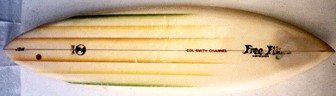
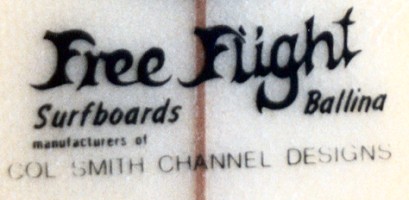
DECALS Deck 1. 'Free Flight Surfboards' script/text black, nose 2. 'Col Smith Channel' red text, below 3. Double F circle logo and 'Free Flight Surfboards, Ballina. Manufacturers of Col Smith Channel Designs' script/text, all black, rear sweet spot 4. 'Handshaped by Phil Myers' script, tail |
 |
Bottom
1. 'Free Flight Surfboards' script/text black, nose
2. 'Col Smith Channel' red text, below
MARKINGS
Deck: ' 5' 11'' ' pencil, tail
Bottom:
COLOUR
Deck:
three symmetric sprayed colour panels (green, yellow, orange - at centre), repeating bottom design, but starts further up the board.
Bottom:
three symmetric sprayed colour panels (green, yellow, orange - at centre) high lighting channel
1. 'Free Flight Surfboards' script/text black, nose
2. 'Col Smith Channel' red text, below
MARKINGS
Deck: ' 5' 11'' ' pencil, tail
Bottom:
COLOUR
Deck:
three symmetric sprayed colour panels (green, yellow, orange - at centre), repeating bottom design, but starts further up the board.
Bottom:
three symmetric sprayed colour panels (green, yellow, orange - at centre) high lighting channel