Hawaii,
from 1874.
These
numerous and varied newspaper reports between 1860 and 1908
confirm Patrick Moser's assessment:
"The more
we look into the traditional Dark Ages of surf history
—the period between missionary Hiram Bingham’s departure
in 1840 and the Ford/London arrival in 1907— the more
evidence we find that surfing endured in native Hawaiian
communities and among whites attracted to the sport."
- Patrick
Moser: Revival, Kurungabaa. Posted on
February 25, 2011 by Clifton Evers, viewed 24 June 2012.
http://kurungabaa.net/2011/02/25/revival-by-patrick-moser/
After
observing local native surfers at Kailua on the large island
in December 1874, two visiting Americans, Professor Forbes
and Charles Lambert, borrowed surfboards from Simon Kaai,
the local Sheriff.
This was
apparently not an unusual request, however, in this case,
Lambert drowned while surf riding, and his death was widely
reported by the press.
In June 1877
Kamehameha Day was to celebrated at Waikiki with displays of
surfriding, unfortunately the waves failed to cooperate and
the event was cancelled.
Surfriding
requires surfable waves, the result of a complex combination
of meteorological events, and the ephemeral nature of good
waves both fascinates and exasperates surf riders.
To
illustrate, on the same day at Lahania, on Maui, the
celebrations were blessed with rideable surf and four board
riders competed, including the highly favoured Poepoe
and Nakooko, the eventual winner.
Nakooko was a
mature woman: "past her youth, yet ... of a comely
form."
Like a
template for future surfing contests, it was held over a
specified time and judged subjectively by an experienced
elder.
Also note
that the four riders who presented for the public contest
probably were the most skilled representatives of a much
larger group of recreational surfers.
Subsequent
successful surf riding dislays were reported at Waikiki
(1887) and Hilo (1893) and during this period the local
press also noted particular high surf
events at these locations.
In New Zealand, the Christchurch
Swimming Club's carnival of December1890 included a high
diving event and an "African surf-board race."
The contest was probably held at the West
Christchurch School bath, where two years later the
surf-board race was won D. H. Cashbolt
by a yard from E. Sneddon, with G. Gray and A. H.
White also competing.
Perhaps the most unusual and culturally
interesting is Edward Townsend's 1893 article, Waikiki
... where ... laziness is an art.
Townsend describes the members of a
white privileged class succumbing to a mellifluous "native"
or Polynesian lifestyle, augmented with the latest
technology (in this case the telephone), where deemed
useful.
There is an implication that the "native
servants" actively (and sometimes, like their
masters, less actively) share in many of the benefits of
living at Waikiki.
Of particular
importance are the visits of Hawaiian surfers to demonstrate
their skills in California.
While three
Hawaiian princes attending school in California in 1885 are
known to have surfed at Santa Cruz, in the summer of 1893 a
native of Kona, Hawaii, John Ahia, was employed by the La
Jolla Park Hotel to give "surf riding shows."
In a letter
to friends in Hawai'i, dated 1st September 1893 and later
published in Ka Nupepa Kuokoa, an Hawai'ian
language newspaper, Ahia wrote of his work as a fisherman
and surfer in California.
[Translated
by John Clarke, September 2012, with many thanks.]
Headed "A
True Hawaiian in a Foreign Land," the article
reproduced the printed header, "La Jolla Park Hotel,
Johnson and Ritchie, Proprietors," from the hotel's
notepaper of the original letter.
Ahia, perhaps
with some sense of pride, indicates that this formal address
identifies his employers and the hotel as his residence.
The La Jolla
Park Hotel was constructed in 1888, but, apparently due to
local injunctions, it did not open under the management of
Howard Johnson and Charles. H. Ritchie until 1st January
1893.
It closed in
February 1896 and, four months later, the vacant building
was burnt to the ground.
John Ahia is
known to be in Honolulu in April 1889 and in April 1893 he
turned up in San Francisco with three other Hawai'ians after
an aborted lobster fishing expedition to St Nicholas Island,
off the California coast.
Soon after
this he made contact with Johnson and Richie who employed
him pricipally as a fisherman at the rate of $25 per month
and the relatively substantial fee "for surfing is $10
for each day."
Presumably,
this was initially for the summer months when there were
most hotel patrons and day vistitors; the surfing
demonstrations were probably only given on weekends or
holidays and, of course, dependent on conducive weather and
swell conditions.
Ahia notes
his previous acquaintance with Johnson and Ritchie in
Honolulu in their role as the managers of the Hawaiian
Hotel, Honolulu.
Located on the corner of Hotel and
Richard streets, it was opened in early 1872 by Allen Herbert.
Howard Johnson was manager by
October 1891, and around this period it was re-named the Royal
Hawaiian Hotel.
In September 1892 the management
secured a lease on a bathhouse and three cottages on the
beachfront at Waikiki, where "the
sea bathing being unsurpassed on the Island."
Known as Waikiki
Villa
since 1889, the new venture was re-named the Hotel
Park Annex.
The site was
later purchased by the Matson Navagation Co. for the
construction of the present Royal Hawaiian Hotel,
which opened on 1st February 1927.
Given his fishing experience, it is
most likely that John Ahia made contact with, and was possibly employed by, Johnson and
Ritchie at the Waikiki Annex.
Modest
about his surfing abilities, Ahia is "the
most unskilled" in Hawai'i, however, in California he
is "number one."
It is unclear
if he is number one by definition (that is, the only local
boardrider) or that he is significantly more skilled than
the local enthusiasts.
The letter
has social elements of particular interest to the newspapers
readership.
He is
impressed with the unanimity with which he is treated in
California and also expresses an enviromental awareness,
noting that "even the birds are protected by law here,
which is the ultimate."
Ahia
leaves the reader in anticipation as he promises
that an account of the "wanderings that led me
here ... will come later."
Intending
to remain in La Jolla for the next six months, his
future plans include a possible visit "to
the east to New York."
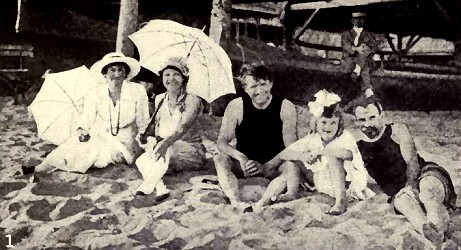
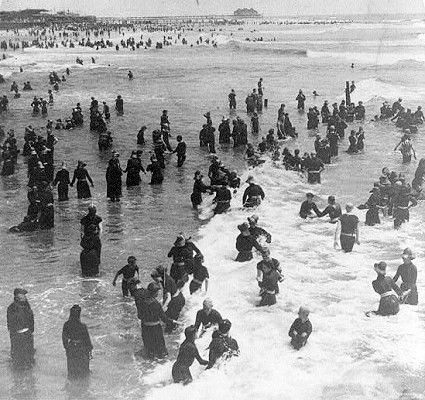
The
popularity of surf-bathing at Atlantic City at the
end of the 19th century is illustrated by the
(cropped) photograph, right.
Jarvis:
A Delightful Surf, Atlantic
City, N.J., U.S.A.,
c1891 Oct. 19.
http://hdl.loc.gov/loc.pnp/cph.3b05367
John
Ahia's travels (and those of Johnson and Ritchie)
exemplify historian Matt K.Matsuda's concept of "trans-localism"
in his definitive Pacific Worlds (2012).
The
letter was translated and paraphrased by the Hawaiian
Gazette on 3rd October, and a brief
summary, without mentioning Ahia by name, was
printed in the Hawaiian Star on the 23rd
November, 1893.
|
 |
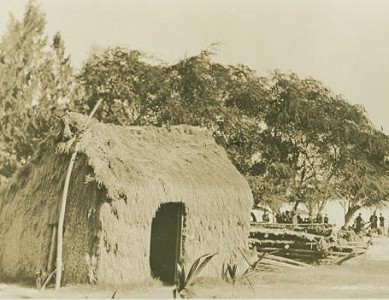
In 1894 a
large contingent travelled to San Francisco to present the
Hawaiian exhibit at the 1894 MidWinter Fair comprising a
replica village, aquarium, and a wide range of products and
handicrafts, including outrigger canoes and "an
old-fashioned surf-board."
Later, there
would be recurring calls to construct a similar attraction
in Hawaii.
The party
included a group of hula performers and two surfers, James
Apu and Kapahee, who were to give board riding exhibitions.
Interviewed
by the San Franciso press, Apu noted that his custom
surfboard was of constructed from redwood, which " is
preferable to koa, being so much lighter."
At Redondo
Beach in 1895, the local hotel presented the Hawaiian
National Band as one of their summer attractions.
In addition
to their musical performance, band members were also
scheduled to demonstrate high diving and surf riding.
Whereas the
diving (variously from 80 to 150 feet) by John Inea and Sam
Kaaua was a success, a letter home from a band member notes
that "they could not do some surf-riding there being no
surf."
After
California, the band was expecting to travel for engagements
in New York.
A four page
booklet promoting the US mainland tour by the Royal Hawaiian
Military Band and Hawaiian Glee Club, published in late
1895, recorded performances at Kansas City, San
Francisco, Boston, and Los Angeles, with a projected
appearance at Wagner's Opera House, Loraine, Ohio, Monday
Evening, Dec. 16.
It included a
history of the Band and the Glee Club, and noted that the
ensemble consisted of forty musicians and that the Glee Club
was "Traveling in their own Car, en Route on a Tour of the
World."
The
popularity of Hawai'ian music was furthered in 1895 with the
publication of Charles E. King's collection of indigenous
hula melodies, King's Book Of Hawaiian Melodies.
The Hawaiian
National Band appear to had some residual impact at Redondo,
three years later the locals celebrated the summer with "boat
races through the surf, high diving exhibition and
swimming races."
Hawaiian
Gazette correspondent,James K., wrote in July,
1896 that "Kalahale, the ablest surf-rider on Molokai,
is still living in Halawa Valley and at the very advanced
age of over seventy years," .
Whereas
Kalahale (presumably) recalled "it was a craze among,
the youth of those days," the reporter noted that"that
branch of acquatic sports now almost unknown to the rising
generation of Hawaiians."
To ride "standing
in
various attitudes," Kalahale advised that "practice
makes perfect."
Although now
lacking strength and agility of his youth, for him
his
surfriding feats were an enduring memory, and his "most
wonderful and graceful feats" were confirmed by elder
Halawa locals.
In the late
1890s, images of surf riding become regular features of
Hawaiian promotional material for the tourist trade,
initially by the shipping companies.
Before the
turn of the century, images of surfriding were of varying
quality and accuracy and most artists struggled with
presenting its essential dynamics
With
beginnings of surf photography in 1890, illustrators adapted
photographs to produce far more realistic representations.
Prof. John R.
Mustek's Hawaii - Our New Possesion was published
in 1897 with an illustration of " a native on a surf
board" on the cover.
In the late
1890s, Burton Holmes' commenced his touring Illustrated
Lecture on the Hawaiian Islands, which included motion
pictures of surf riding in native canoes.
On the 5th
January 1897, Frank Davey arrived in Honolulu on the Australia
, to begin work as a photographer.
He was
responsible for several early photographs of surf riders
before departing Hawaii in 1901.
At an exhibit
of postal cards in Paris in 1900, Honolulu photographer,
Davey, received awards for "artistically colored
pictures of surf riding and the lei women."
The surf
riding image was possibly of an outrigger canoe at Waikiki,
included in Davey's personal album dated April 1898.
Stock number
248,
titled Surf Riding, Waikiki, Honolulu, H.I.,
illustrates two natives surfriding in an outrigger canoe
with Diamond Head in the background.
With the
formation in 1897 of the Hui Pakaka Nalu by native canoe
owners, under the management of W. W. Dimond, canoe surfing
became an enduring emblem of Waikiki Beach.
In 1910,
another Waikiki surfing club would use a variation of name,
the Hui Nalu.
Previously,
the enjoyment of a canoe shoot was limited to canoe owners,
their family and friends; but now, for $1.00 an hour, the
hui offered the pleasure of canoe surfing to all.
The Hui
Pukaka Nalu advertised in the local press and was a
significant presence on the beach, with up to eight canoes
regularly in action.
Following an
accident in "moderately high" surf at Waikiki,
Harry Kapulu and P.L. Kumukahi defended their reputation as
skilled surf riders in a letter to the press in 1899,
and identified some of their experienced colleagues as
Marshall Brown, Leslie Scott, Ed Macfarlane, and Willie
Dimond.
The
attraction was widely reported in the local and
national (mainland) press over the next couple of years and
canoe surfing was automatically penciled in on the
itinerary for every visiting dignitary and military
serviceman to Oahu.
An
enthusiastic account by one visiting officer was published
in 1898 under the heading "Royal Sport of Surfing" -
a description that would thereafter regularly appear in
print.
Hawaii, 1900.
In April 1900
heavy north swells caused the suspension of the local
steamer services and the foreshore was threatened at Hilo
Bay.
There, the
day after the peak of the swell, a "considerable number
of young Hawaiians" were seen surf-riding.
Despite some
reports of the decline of surfing at Hilo, these surfers
were sufficiently skilled and experienced to appreciate the
challenge of what was probably the biggest day of the year.
That year, "a
large Hawaiian made canoe" was offered at auction and
work commenced on the Moana Hotel, the prospectus noting
that the location "is ideal ... being at a point
that faces the only place available for surf riding."
A'a, the first racing canoe of the modern
era, built for Prince Kuhio. ????
The next
year, concern was expressed for the depletion of the sands
of Waikiki Beach, large sections then being mined by the
building industry.
At the
Waikiki Regatta that year an extensive program included
canoe and swimming races.
Canoe surfing
franchises expanded, operating from the Long Branch Baths
and in 1901 the Wakiki Inn advertised canoe riding at 50
cents per session.
Images of
canoe or board surfing continued to feature in print such as
the brochure for the Royal Hawaiian Hotel (1903) and
Emma Metcalf Nakuina's Hawaii, Its People and Their
Legends (1904).
The later was
booklet for published by the Promotion Committee and was
widely distributed with local hotels providing complimentary
copies to their patrons.
The
introduction noted that "for the purposes of
reproduction in magazine or newspaper, the copyright on
the contents of of this volume is waived."
One page,
captioned "Surf Boating and Riding at Waikiki," has
a photograph of canoe surfing, one of several prone of
boardridrers, and one of a lone standing surfer.
The images
are accredited to Rice and Perkins, the page design by
Julian Greenwood.
The three
images were also reproduced around this time on a
hand-coloured postcard with the caption "Surf Riding at
Waikiki,Honolulu" and the standing surfer photograph
was later reprinted by several newspapers.
Surf-riding
was given official sanction in July 1905 when a design
incorporating Diamond Head and a surfing canoe was adopted
as the county seal of Oahu.
In April
1904, Winfield S. Crouch, visiting from New York, drowned
while board surfing at Waikiki.
Two months
later Jack London, the novelist on his first visit to
Hawaii, benefiting his status, was taken for a canoe ride.
London was
far more impressed with surfing three years later, at this
point in a letter to his future wife he merely noted that he
had bathed at Waikiki.
During the
year the Tourist Promotion Committee encouraged as many
people as possible to help in the photographing of beach
scenes and a proposal was considered for the construction of
a replica native village "where canoeing, surf riding and
fishing would be features."
Isobel Strong
published her novel, The Girl from Home - A Story
of Honolulu, in April 1905.
The
step-daughter of Robert Louis Stephenson, she resided in
Honolulu with her husband Joseph Strong from 1882 to 1890,
where she was a drawing teacher in the public schools was
was known in the local art scene for her drawings and
cartoons.
The novel, set
during her stay, contains one chapter centred around
a night surfing party held at Waikiki by the then king, David
Kalakaua.
Night surfing
parties were known to be held to coincide with the full
moon.
The guests are treated to sumptuous
meal, during which the conversation includes a discussion of
the ancient sport of hill-sliding.
"Old
Kaipo," who the king describes as "the only one
left who can come in standing" on a surfboard,
announces that the surfing conditions are suitable, and the
guests are taken for canoe rides.
Here, Strong's description shares similar elements to Hawaii's
Royal Pastime, attritbuted to "O.K.D.," printed
in New York's The Sun in 1898.
After they return to the beach,
Kalakaua summons Kaipo to
give an exhibition of surfboard riding.
The character
old "old Kaipo" is possibly based on "Kalahale,
the ablest surf-rider on Molokai, is still living in
Halawa Valley and at the very advanced age of over seventy
years," as reported by James K. in The Hawaiian
Gazette of July 28, 1896.
Although
popular in Hawai'i and widely promoted by the local press,
the book was initially given a poor review by the Honolulu's
Evening Bulletin in August 1905.
The 1912
edition was promoted with large advertisements in the
Honolulu press, at $1.00 a copy, for the next two years.
The first
recorded headstand, considered by some the ultimate
demonstration of skill, was at the 1905 Waikiki Regatta and
at the end of the year the discovery of a cache of
antiquities, including a sled and a surf board, made the
front page of the Honolulu press.
Also making
front page news was the president's daughter, Alice
Roosevelt, and her obligatory "first experience as a surf
rider" in a canoe.
In 1906,
photography would make a substantial impact at Waikiki.
A dramatic
water shot of an outrigger canoe shooting past Diamond Head
was published in the New York Tribune and Mr. Bonine, of the
Edison Moving Picture Company, secured film of surf riding
at Waikiki.
George Freeth, Alexander Hume Ford and Jack London,
Waikiki, 1907.
On June 23, 1907, the Honolulu press published an article by
Alexander Hume Ford detailing George Freeth's intention of taking his surf
board to ride the
waves at Atlantic City, on the American East coast .
Claiming that
Freeth was the only man living who has ever surfed
on the Atlantic coast, Ford relates how Freeth stowed away on
a steamer for the East Coast, went to
Philadelphia and on vacation at Atlantic City shaped
a surf-board from a stolen slab off
a woodpile with a hatchet and
jack-knife, traded insults with some
life-savers in a row-boat while riding on his head,
zigzagged between the pier legs, and on
leaving the water had the whole beach police
laying for him.
Like most of Ford's work, the article was
not short on hyperbole; however, as Freeth is known to
have been in Philadelphia in 1904, it is possible that he
did ride a
surfboard at Atlantic City and, given that city's
life-saving brigades were firmly established by this
time, that his efforts would likely have made the
life-savers mad..
George D.
Freeth was born on Ohau in 1883, his father, variously
named Captain or Governor George
D. Freeth, traversed the Pacific principally
engaged in exploiting guano deposits.
His mother, Elizabeth K. Freeth,
was the descended
from
a long established local family, with some
Hawaiian blood.
The family socialised with
the upper echelons of Hawaiian society; in February, 1892.they attended her Majesty Queen Liliuokalani's fancy
dress Children's Ball at the Royal Palace.
George, aged 9, was a very proud soldier-like Zouave
in a red jacket and yellow trousers and his brothers,
Willie and Charley, dressed as the two Princes
in the Tower.
On the other hand, the family
was also involved in Captain Freeth's Pacific enterprises.
In May, 1894, Captain Jameson, the
British brig L'Avenier, reported the death of Hans
Holstein, a German,who was employed on Laysan Island
by Captain Freath.(sic).
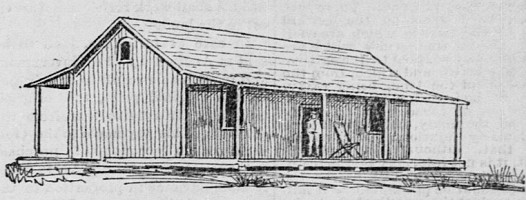
The article included a sketch of a house which is usually
occupied by Captain Freeth and his family when they
are on the island.
Then, as now, it must have been a rare treat for a young
boy to have his own Treasure Island.
The
family connection with Philadelphia dates
from 1897; at the beginning of October
George's older brother, Charles, left
Honolulu aboard the Miowera
for Philadelphia where he has received
an appointment In the Charles Hillman Ship
Building Company, and by July 1900
Charlie had secured an enviable position in
Cramp's ship yard.
In Honolulu, two months after his
parents separation in February, 1900,
George, aged 17, appeared at the second
annual gymnasium exhibition of the Young
Men's Christian Association; a junior
competitor was Ernest Kopke who would
later vie with Freeth for swimming
honours.
A student
of the lolani College, George was listed
as one of the sub-editors.of first
edition of The Ioiani College
Magazine, published
in August 1900, and in November he
played as goal-keeper for the
College's:(Asociation) Football team; a
journalist noting that Freeth is
improving but does not appear to know
the game..
At
the end of the month he played as a forward for the Iolani's,
Ah Hun replacing him in goal.
The next
year, Freeth was listed as an oarsman in
the Freshman
barge competing for the Mrytles, one of Honolulu's
premier boat clubs, at Regatta Day on
the harbour.
By Independence
Day, 1903, George was on the mainland's East Coast.
In Chester, Pennsylvania, George
Freeth, a Honolulu boy, the son of
Mrs. E. K. Freeth of Emma street,
and a lineman of one or the
telephone companies, won
the prize for fancy and high
diving, and also swam 100 yards in
one minute and six seconds, beating
all competitors.
No doubt
visiting with his older brother
in Philadelphia, it is during his
time that it is
possible that George Freeth did
ride a
surfboard, even if only a small prone-board,
at Atlantic City.
Jack London arrived in
Hawaii in 1904 for the first time and at
the end of June, like all visitors of
renown, at Waikiki was given his first
experience with a (canoe) surf-ride.
By October of that year, George Freeth
was back in Honolulu, named as a
member of the Healani Boat Club's
swimming team to challenge the
Myrtles.
In Hawaii during this period, team
loyalty appears to be extremely
flexible with members often moving
between clubs.
After
leaving college, George Freeth
excelled in athletics and
water-sports.
In April 1905 he completed an
80-foot dive into Pearl
Harbor, the
distance was so great
and the lights so
tantalizing that water
had to be thrown on the
surface to stir it so
that Freeth could see it
distinctly before making
the leap.
GEORGE
FREETH, WHO WILL MAKE THE
80-FOOT LEAP., April 1905
Apart from regularly appearing
in swimming and diving
competitions, Freeth was appointed
the swimming instructor at the
Healani Boat Club and competed
for them in boat
races.
In November, 1906, he was
chosen as captain of the newly
formed Hawaiian Swimming Club.
On
land, in October 1905 he made
a home run for the Diamond
Heads to beat the Makikis in
baseball; he played
quarterback for Maile in
gridiron, and starred as a
forward when the same team
played Association football (Socker).
Freeth's surfing skills appear
to be first recognised in the
local press on October 2,
1906, when many witnessed him
performing in the surf, at
the Moana, on Sunday.
However, while
at the end of the year Freeth
is listed
in the swimming team of
the Diamond Head Athletic
Club for
the second Waikiki Regatta,
his name is noticeably absent
in the entries for Surf-riding
on Boards. .
|
|
Organised by Jack
Atkinson,
many expert board riders had
entered; including Harry
Steiner, Curtis Hustace, Dan
Keawemahi, Duke Kahanamoku, William
Dole, Keanu, Dudy Miller, Atherton
Gilman, Lane Webster, and James
McCandless.
A lack of swell saw the
Regatta postponed from New Year's Day
until March 17, 1907, where the skills of Harry Steiner
and James McCandless were
praised.and the event
won by Harold Hustace, who stood
on the board, head up and head down
and as an extra turned a somersault
or two.
A
week later Alexander
Hume Ford
arrived
from San Francisco
aboard the Alameda and
booked into
the Hawaiian Hotel
in Honolulu.
Ford was a
widely travelled
professional journalist who, like Jack
London, had previously
visited Hawaii, and had published
articles based on his
travels to China, Japan and
Paris.
It appears he had planned an
short stay in Hawaii before
sailing for Australia, and he
may, or may not, have been
aware of the impending visit
by a party of Congressmen to
the islands.
Assuming he spent much of the
first week in making himself
familiar with the local
dignities, politicians and
press, Ford was probably
delighted to read on May 2
that the celebrated
novelist Jack
London had
left Oakland,
California, on
board his
yacht the Snark.on
April 22, for
his much
publicised
voyage across
the Pacific
And
it is likely he first became aware
of George Freeth from an
article published
the following day in
Honolulu's Evening
Bulletin.
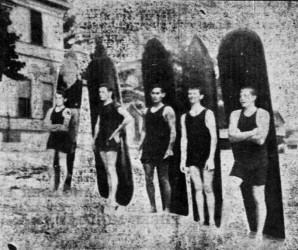
|
Outrigger Surfboard
Riders, June 1908.
Possibly
Atherton Gilman,
Lane Webster, Harold
and Curtis Hustace.
|
Freeth had prosed that he and "Dudy" Miller
travel to Southern California, with a surfing canoe and
surf boards, to give exhibitions of
their skill.
As
this would be one of the best
advertisements which Hawaii could
possibly have, ideally
the Hawaiian Promotion Committee could
help them with the cost of passage and
the transportation of their canoe and
boards.
Ford and Freeth may have
met during that week, but their paths
undoubtedly crossed after the arrival
of the Congressional party aboard the
US
Army transport Buford, late
on May 7.
While most stayed at the
Royal Hawaiian or the Young Hotels in
Honolulu, one
Congressmen,
W. P. Hepburn, was
booked into the Moana Hotel at Waikiki..
The next morning, at the suggestion of Secretary
Jack Atkinson, the Promotion Committee quickly arranged for
two or three canoes at Waikiki, in the charge of expert
swimmers, kept at the disposal of the visitors.
Initially requesting two days to recuperate from the
voyage, the visiting Congressmen all expressed great
eagerness to visit Waikiki beach and after lunch Sam
Parker and Jack Atkinson took a regular
band-wagon of committeemen to
the beach by the street-cars and automobiles.
They congregated at the Moana Hotel and
three and four surfing canoes were kept filled, including
some of the lady visitors,
all the afternoon.
The boys were also out riding surf-boards so that
all hands were treated to an exhibition of sport to which
canoe surf-riding is second only.
The journalist observed that the grave and
reverend legislators of the Nation and the Territory became
boys again- you can't help it when the surf is like that of
yesterday.
At Waikiki the next day, May 10, a number stayed most of
the morning to try the surf riding.
It was probably during this week, sometime between
May 8-12, that Ford had
his introduction to surfing and George Freeth was photographed at
Waikiki.
Three of these were later published before the end of
the year in Ernest F. Acheson's Congressional
Party in Hawaii Souvenir,
May, 1907.
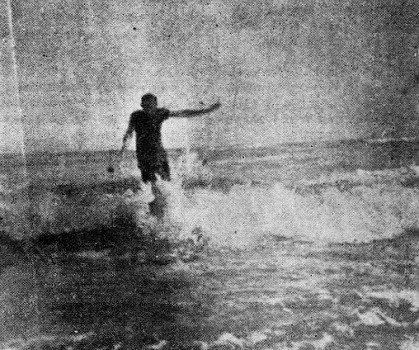
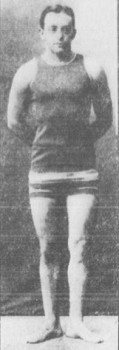
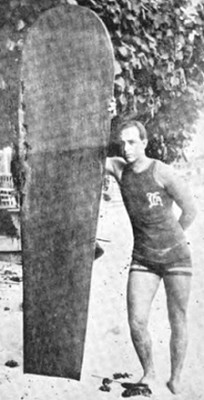
,Captioned Champion Surfboard
Rider,
Freeth is shown wave riding, prone and standing,
and alongside his board on the Waikiki shore line.
This board's
template is distinctive in tapering from a wide
rounded nose, similar to some prone boards of the
era.
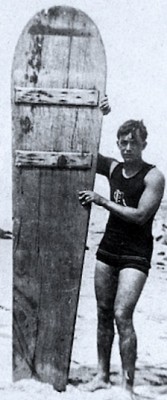
Freeth used almost identical design when he
travelled to California, as shown in a photograph
taken at Rendondo Beach, circa 1910.
The West coast board is poor condition with several cross-battens affixed to repair substantial
vertical cracks in the nose of the board.
To compare and
contrast contemporary designs, see Board Portraits.
On May 13, some
members of the Congressional party left Honolulu to visit Kauai, accompanied by George Freeth and A.H. Ford, who were probably by now well acquainted.
Apparently,
Freeth was aboard as a life-guard to assist the visitors
in water-sports
|
Waikiki,
1907.
Rendondo Beach, 1910.
|
and he and Ford continued
to accompany the visiting statesman on their tours of the
large island of Hawaii, and then Maui.
The Snark was off Waikiki by the morning of May 20 and anchored in Pearl Lochs, west of Honolulu, by the afternoon.
This was a disappointment for many locals
who had hoped the famous author would have a far more
public presence by mooring at the Honolulu docks.
Beginning on the morning of
March 21, Charmian London's Diary, published
in 1917, records that Jack had already planned to moor
the Snark in Pearl Lochs, with use of an
cottage adjoining the home of Albert Waterhouse.
The London's spent their
first days ashore recovering from the voyage,
organising repairs to the Snark, and reading
a range of Hawaiian related literature.
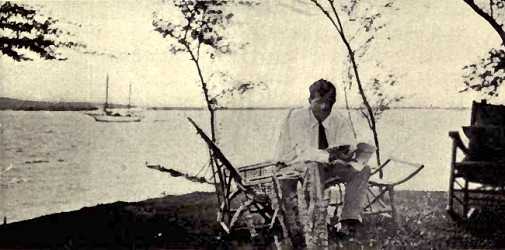
|
The Snark
moored in Pearl
Lochs with Jack
London ashore, 1907.
|
Ford, and presumably
Freeth, did not return to Oahu until the 25th, arriving
on the
steamer Kirau
from Hilo and way ports.
On May 27, Jack and Charmian travelled to the
city by rail, lunched at the roof-top cafe in the Young Hotel
and after obtaining two little bay mares from Mr. Roswell,
rode back to Pearl Lochs.
Incidentally, Charmian confidently
rode astride on her Australian saddle,
assured in the knowledge that the style had been readily
adopted by local female equestrians, unlike civilised ladies
who rode side-saddle.
Following the London's attendance,
along with three thousand other
guests, at a Royal engagement for the departing Congressional
Party at the home of Princess Kalanianaole
at Waikiki on the evening of May 29, the next morning
the couple retuned to Waikiki on horse-back.
That evening they dined at the Royal Hawaiian Hotel in
Honolulu where Alexander
Hume Ford introduced himself and, after being invited to join
their table, dominated the conversation for the next two
hours.
Probably invigorated by his recent exploits with George
Freeth, he talked at length of his most recent enthusiasm, reviving the old Hawaiian sport of
surf-boarding.
Ford's vision of himself as the saviour of
the ancient art is embedded in surfing history.
In fact, interest in surfing in canoes and on boards at
Waikiki had been steadily growing since the formation of the Hui Pakaka Nalu in 1897.
Crewed by
native owners, managed by W. W. Dimond, a fleet of eight canoes offered the
pleasure of canoe surfing to all. for $1.00
an hour.
By the turn of the
century illustrations and photographs of
surfing were regularly used to promote Hawaii tourism and appeared in books and
newspapers around the world.
The first
modern surfing competition at Waikiki was held in
March 1905, Bonine filmed surfing for
the Edison Company in 1906, and Ford
arrived a month after Harold
Hustace, from
a field of at
least ten
other skilled
competitors,
won the surfboard riding event.at the second Waikiki
Regatta.
There, Hustace, like virtually all the
accounts of surfboard riders since the mid-1890s, was
observed to ride standing.
Aware
that the London's had taken
a cottage at the Seaside at Waikiki, Ford arranged to visit and show us
how to use a board.
Ford provided a large board and after one day of instruction, both
Jack and Charmian successfully
rode prone on several waves.
Jack's enthusiasm,however, resulted in a severe case of
sunburn and by June 4 he was confined to bed where he
immediately began, with Charmian taking dictation, his landmark
article, A Royal Sport.
Initially published under the title
Riding the South Sea
Surf, this
first edition included a quotation by Mark Twain, none but
natives ever master the art of surf-bathing thoroughly, as a preface
Now fifty years
later, London writes in
glowing terms of the local natives' skill and style on
the large waves breaking on the outer
reefs of Waikiki.
Integrating
science and art, his explanation of wave
motion theory, well known in
scientific circles by 1867,
has been
replicated, usually as chapter one, in numerous surfing
books and is the foundation of modern surf forecasting
services.
However, London's insightful
analysis of the basic dynamics of surfboard riding has only
been reprised very
occasionally, and usually with little further inspection.
London relates how, with Ford's assistance, he learns to catch small waves on an inside
reef close to the beach at Waikiki, and ride prone
using his legs to steer.
Impressed, and envious, of the local
experts who ride standing on the larger waves breaking on
the outer reefs, the following day he and Ford venture out
to a larger break, accompanied by George Freeth.
Whereas London accredits Ford with
mastering surfboard riding in a matter of weeks and
without the benefits of instruction, Ford later wrote
that he learned from the small boys of Waikiki and
that it took four hours a day to the sport for
nearly three months.
Jack successfully rides prone on some larger waves, but now suffering from
severe sunburn, the article concludes with him
dictating from his bed and resolving to ride standing,
like Ford and Freeth, before leaving Hawaii
While Jack
London was dictating from his bed, it was announced that George Freeth was available for swimming and
surfing lessons at the Seaside Hotel every day between 8:30
am.and 6 pm.
Meanwhile, Ford had a letter published in the local press,
an early contribution in his promotion of
the delights of Hawaii to the world:
After
thoroughly canvassing the subject among the
members of the Congressional party during the
interisland trip, and consulting since
the return with haoles, kamnnlnas
and malilnnls like myself, I am firmly
convinced that the time Is ripe for the formation
of a Hawaiian Friendly to be composed of those who
love these islands and live here and of those who
also love them and are not so fortunate.
Most of the Congressional party
embarked for home aboard the transport Sherman
on June 1 and the next day, although not identified by
name, Ford himself was the subject of a report in the Honolulu
press.
Following an
account mostly detailing the works in Jack London's library
aboard the Snark, was reference to another well known magazine
writer in Honolulu just at present, preparing
articles for Outing magazine on ... surfing.
This was undoubtedly
A.H.Ford, who, to illustrate his work, had a series of photographs taken of George Freeth
on a surfboard.
Tim DeLaVega
(2011) suggests the photographer was probably Edward P. Urwin.
Freeth's
second appearance surfing for the camera, these can only be shot in the days following
Ford's return to Honolulu from Hilo.on May 25, and it was ,
the first being two weeks earlier for the visiting
Congressmen.
Ford was also reported as saying he
was going to advocate is the
introduction of surfing at Atlantic City, and had a picture
of himself ... to show
how easy it is.
However,
the reporter noted that although the camera tells no lie, it
failed to show the half-drowned Freeth under
the board holding it steady while the bold
and skilful rider balanced in a pose long
enough for the photo to be taken.
Three weeks
later, rwo of these
photographs would appear in the Honolulu
press, illustrating Ford's first article about surf riding.
By June 11, Jack London had recovered enough to visit the Ewa
plantation with his wife and Ford and then all three embarked
on an extended tour of Oahu by automobile and a round of
social events including Jack's attendance at a boxing match.
From his arrival, Ford was aware of George Freeth's
desire to relocate to California to pursue his
career as swimmer, diver, surf-board rider,
lifeguard, and as an instructor in all; and his first surfing article, apparently, advanced
Freeth's cause.
Titled Freeth Will
Ride Atlantic Rollers!, it appeared
in the Pacific Commercial Advertiser on June
23, with two
photographs shot at the end of May, and was reprinted five days later by the Hawaiian
Gazette.
Ford
claimed that George Freeth was the only
man Iiving who has ever surfed on the Atlantic coast,
who was now
planning a return visit.
As discussed above, it is possible that George Freeth did
ride a board at Atlantic City around 1904, and if so, it
was then highly probable that he would have mentioned it
to Ford, who had only recently announced his intention to advocate
the introduction of surfing at Atlantic City.
However, in his re-telling of Freeth's adventures, Ford
concocted a series of events that, especially for any
local readers with some surfing experience, appears almost
fanciful; or, perhaps, even
comic, in an attempt to
emulate the style of his hero, MarkTwain.
Ford relates how George stowed away on a steamer to Atlantic
City, shaped a surfboard from a woodpile when the
cook wasn't looking, taunted the
local life-savers as he rode
standing on his head, surfed between the piers, and,
for his efforts was apprehended by the police.
But now, George Freeth had
the support of some of
the biggest athletic clubs of New York, the Hawaii
Promotion Committee, Jack
London and
Alexander
Hume Ford, who has made George the central
figure in the articles he has written for Outing
magazine on
"Surfing, the King of Sports."
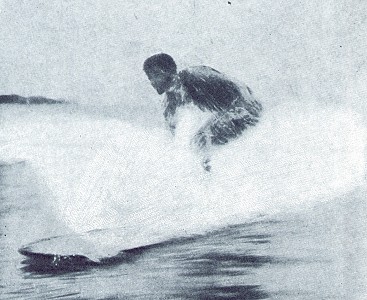
Ford also stated that he had sent this photograph of
George surfing, along with his article, to Outing
Magazine. .
Copyrighted
by Alexander H. Ford it had been pronounced
the very best photograph ever taken of a
surfer in action; Ford having stood up to his neck
among the breakers for days in order
that he might be able to get a series
of such photographs.
This
was most probably one of photographs, likely
by Edward P. Urwin,
that Ford
arranged to be taken
of George Freeth at Waikiki sometime
after May
25, around the time of his first
meeting with the London's in Honolulu,
and before being noted in the local
press on June 2.
GEORGE FREETH,
SPINNING IN ON A SWIFT ONE
As
surfing photographs had been in circulation
since Dr. Henry Bolton first
snapped surf riders on Niihau in
1890, not to mention the Waikiki footage
filmed for the Edison Company by Bonine
in 1906-7, the very
best photograph ever taken
of a surfer
was a bold claim.
|
|
The
projected
article and the
photograph of Freeth never appeared in Outing
Magazine, although it did
appear, along with some of George taken
earlier, in Ford's A Boy's Paradise
in the Pacific, published (all with
different captions) in St. Nicholas Magazine in August 1908.
The second photograph, titled Surf rider
balancing on the crest of a breaker, appearing
with the article, invites speculation that it
is possibly one
Ford commissioned of himself to show how easy it is.
Certainly,
given his involvement with the Congressional
Party, by the beginning of June 1907 Ford
could only have been riding a surfboard for
less than a month, perhaps
giving some credence to the reporter's
assertion that it failed to show the
half-drowned Freeth under the board holding
it steady.
However, a
far more likely candidate is Keeping
just behind the breaker, published the next year
in St.
Nicholas Magazine.
While the
rider appears to be probably standing on a
board, he cannot be said to be riding a wave.
SURF RIDER BALANCING ON THE
CREST
OF A BREAKER
Pacific
Commercial Advertiser,
June 23 1907.
|
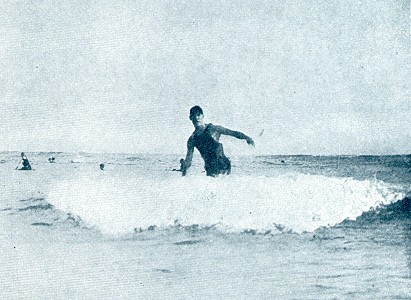 KEEPING JUST BEHIND THE
BREAKER.
St. Nicholas
Magazine, 1908.
KEEPING JUST BEHIND THE
BREAKER.
St. Nicholas
Magazine, 1908.
|
On June 30 it was reported that that
the London's were back
at Waikiki.where
Mr.
London has become quite an expert on
the surf board. However,
while it was said that they will remain
there for the remainder of their stay in
Honolulu, the next day they departed for
the leper colony on Molokai, returning
to the grounds of the Seaside Hotel on
the July 7.
A week after Ford
had intimated that George
Freeth intended to demonstrate
surfing on the Atlantic coast,
the press reported on July 2 that George, now
designated probably
the most expert surf
board rider in the world,
had sailed aboard the Alameda
to give swimming and
surf riding exhibitions on the Pacific
coast.
Whereas Freeth had indicted earlier that he
and "Dudy"
Miller would
travel to Southern
California, with
a surfing
canoe and surf
boards, he was
instead,
equipped
with a supply of surf boards
and
accompanied by
Kenneth Winter.
After less than a month in California, Kenneth Winter
returned on August 8,
1907, and by mid-1908 he was
elected the first captain of the
Outrigger Canoe Club.
He later shared
a controversial
victory
with Sam Wight at that year's
Waikiki Regatta; riding long,
heavy boards, they won easily; defeating the
1907 champion, Harold
Hustace, who turned in vain on his diminutive
board.
As a result of the victory, the
journalist predicted that the fashion in boards
will now turn to something long, thick and narrow.
On his departure, Freeth was said to
have probably done more to revive the
wonderful art of the ancient Hawaiians here at
home than any other one person, a title
already coveted by A.H. Ford.
|
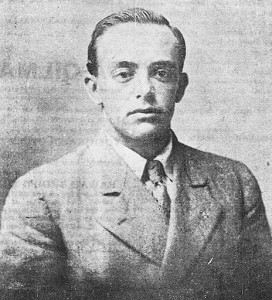
George
Freeth
Honolulu, July 1907.
|
While he was
undoubtedly an outstanding athlete, swimmer,
diver and surfer, there may have been some
long-term locals who quietly questioned George
Freeth's
recent promotion as the most
expert
surfer at
Waikiki.
The
London's visit to Molokai was followed
by visits to some of the other islands
by inter-island steamer, the Snark
undergoing substantial repairs, but they
returned to Waikiki in late July, and
several days later dined with Mr and Mrs. Nicholas
Longworth
Mrs. Nicholson was
better known then as Alice
Roosevelt, daughter of the
serving President, Theodore Roosevelt,
Her husband was a
Republican party leader,Speaker of
the U.S. House of Representatives,
and fourteen years her senior.
Staying for a month in the largest of the
cottages at the Seaside, at the
start of August the couple went canoe-surfing
with Secretary
Atkinson, with crowds of
spectators on the beach watching the canoe
riding the crest of the waves.
This was not a new experience; they had both
ridden in outrigger canoes courtesy of Mr.
Atkinson during their visit as part if the Taft
party in July 1905; Atkinson mailing
a fine collection of pictures of Miss Alice
Roosevelt to the President, with an.expectation
that there will be lots of them
published all over the country.
However,
despite Atkinson's best efforts to promote
surfing at Waikiki, it appears none were ever
published; Alice recalling Mr.Taft pleading with photographers not to
take photographs of me in my bathing suit.
It was considered just a little indelicate, the idea
that they might be taken and published.
And a bathing suit was a silk or mohair dress, not at
all short, high-necked and with sleeves, and, of course,
long black stockings!
At the end of July 1905, the Chicago Tribune
attempted to avoid offending the President by publishing an
extremely modest illustration, from a photograph,
featuring the young lady's back and one bare arm.
One photograph from 1905, a panorama of Diamond Head with
several canoes sporting in the surf where it is impossible to
identify anybody, is held in the archives of the Smithsonian Institution.
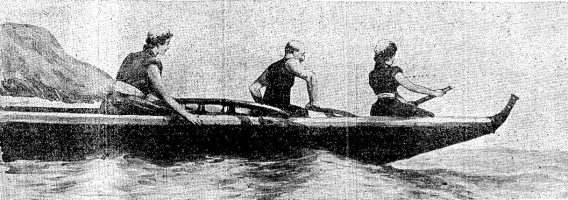
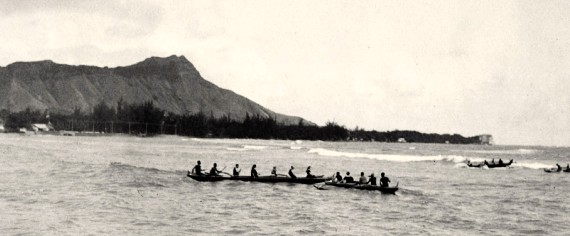
|
Alice
Roosevelt Enjoying the Surf in
Hawaii on Her Way to the
Orient.
(From a photograph)
Miss
Roosevelt wielding a paddle while surf riding.
She is at the end of the
canoe, on the right.
Chicago
Tribune
July 30, 1905.
Canoes in the Surf, Waikiki , July 1905.
Alice in
Asia: The 1905 Taft Mission to Asia
Freer Gallery of Art
and Arthur M. Sackler Galleries Smithsonian
Institution
http://www.asia.si.edu/research/archives/alice/
|
Secretary Atkinson was
also a guest the dinner given
by Mr. and Mrs. Frederic J. Church in the Turkish room of the Seaside for Mr. and Mrs. Longworth and Mr. and Mrs.
London in August 1907, the later now the guests of Mr. and Mrs. Lorrin A.Thurston
until the sailing of the Snark for the south.
On August 8, 1907, the Hawaii Promotion
Committee was pleased to hear that Jack London's article on surf bathing in
Hawaii would probably appear in the October number of
the Woman's Home Companion,
with a circulation in excess
of half a million.
Three days later, Alexander Hume Ford's extended
account of the Hawaiian tour of the Congressional party
appeared in The World Today.
Repairs were
completed and the and the Snark
provisioned before Jack,
Charmian and a new crew sailed
for Maui
on August
15.
Ford's impact at Waikiki was recognised on
August 26 in a glowing assessment of his achievements; in
three months he had become a proficient surfer, to a very
considerable extent, and had imparted his enthusiasm
to the community.
Just as importantly, he had formulated instruction in it:
teaching others how to teach the acquisition of the art.
This success would be even more impressive if the reader
accepted the journalist's contention that two or three years ago
the feat of standing
upon the surf board survived only in the
power of two or three in the whole
community.
Neither George
Freeth, Jack London or Alexander
Hume Ford were on Oahu when Ford's
efforts were highly praised in the
Honolulu press; since mid-August
he had left Hawaii and had been
cruising among the Fiji Islands.
There he surfed with the natives
on Taveuni Island, although
they merely hold a small
board in their hands, and
have never heard of anyone
standing on the board.
Travelling by inter-island
steamer, he sailed on to
New Zealand.and was in
Australia by the end of October,
1907.
After
visiting several of the Hawaiian
islands, the
Snark sailed from Hilo for the Marquesas Islands on
October 7, on the
same day
the
Hawaiian Star announced
Jack London Tells Of Surfing,
heralding the
publication, along with
some excerpts, of his
eagerly anticipated
surfing article.
The question posed by
the reporter, Did he stick to
his intention to ride a surf board
standing before he left in the
Snark?, remains unanswered.
Initially appearing in The Woman's Home Companion under the title Riding the South Sea
Surf, the following year it was reprinted in England as The Joys of the Surf-Rider, with an illustration by P.F.S. Spence; by Pall Mall, and then extracts appeared in newspapers around the world.
In 1911 it was appeared as Chapter 7 in a collection of London's writings from the Pacific,The
Voyage of the
Snark,
under the
heading A
Royal Sport,
by which the
article is now
most commonly
known.
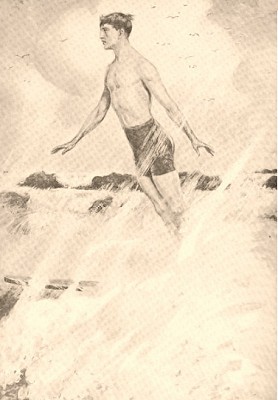 |
P.F.S. Spence:
A
young god bronzed with sunburn.
in
Nakuina, Emma Metcalf:
Hawaii, Its People
and Their Legends.
Hawaiian
Promotion Committee,
Honolulu, H.T., 1904.
Reprinted with Jack London's
The Joys of the
Surf-Rider
Pall
Mall
November, 1908.
|
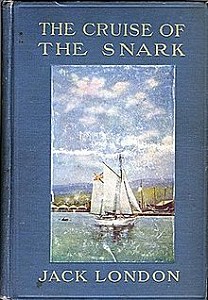
London, Jack:
The Cruise of the Snark.
Macmillan
and Company, New York, 1911 |
Never a stranger to controversy,
stories Jack London stories continued to appear in the
local press, one of the crew on the trip from Honolulu
to Hilo questioned
his seamanship in observing that everyone acted as captain, occasionally the cook, but most of
the time it was Mrs. London in bloomers.
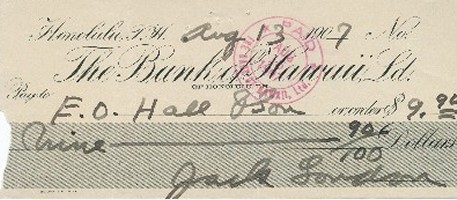
And from Hilo came news that Jack London's checks given to
local merchants in payment of bills, were
being returned from his Oakland
bank, endorsed not sufficient
funds.
It was generally
supposed that the bad checks
were a simple mistake in his
calculations, but there was
sympathy for the Hilo men with the
missing coin.
Bank of Hawaii
Ltd., Honolulu,13 August 1907
Cheque for $9.96, endorsed
Jack London
|
|
Alexander
Hume Ford was the first to return to Hawaii, arriving on
March 3, 1908, from Australia.
His awareness of the Sydney surf life-saving clubs agitating
for their club-house to be erected with prime beach front
access probably prompted his enthusiasm for a similar
development at Waikiki, the Outrigger Canoe Club.
George Freeth was rumoured to be returning
in 1909, but arrived on September 28, 1910, and competed in
water polo and swimming
competitions.
Although A.H. Ford made a case for
keeping the skilled surfer-lifeguard in Hawaii, he soon
returned to California.
Jack and Charmian London did not return to
Waikiki until 1915 when they were welcomed by Ford to the
now world-renowned Outrigger Canoe Club.
Waikiki, 1915. Mr and Mrs. London
(center), A.H. Ford (right).
https://en.wikipedia.org/wiki/The_Cruise_of_the_Snark
Hawaii,
1907.
The Waikiki
Regatta of 1907 featured surfriding events for boards and
canoes.
The nominated
entrants in the surfboard contest were Harry Steiner,
Curtis Hustace, Dan Keawemahi, Duke Kahanamoku, William
Dole, Keanu, Dudy Miller, Atherton Gilman, Lane Webster, and
James McCandless.
(George
Freeth is listed in the swimming team for the Diamond Head
Athletic Club.)
The event was
postponed and rescheduled for March where the board
and surf canoe entries were "to be made at the judges'
stand."
Before "the
biggest crowd ever known at this beach", the judges, J. E.
P. Law, C. W. Macfarlane, and Olaf Sorenson, awarded first
place in the board competition to Harold Hustace and the
canoe event to the Hanakeoke.
Hustace
"stood on the board, head up and head down and as an extra
turned a somersault or two," and the performances of Harry
Steiner and James McCandless were also praised.
Alexander
Hume Ford arrived in Waikiki sometime in May 1907, followed
by the novelist Jack London and his wife, Charmian. aboard
the Snark in June.
Ford was a
widely travelled professional journalist who, like London,
had previously visited Hawai'i.
His published
articles included The Chinese Eastern Railway (McClure's
Magazine, c.1899-1900), Home Life in Japan (Outlook
Magazine, 1901), and The Americanization of Paris
(unknown magazine, 1906).
On this visit
London was more enthusiastic about surfing, Ford was
enthusiastic about everything.
Their stays
were brief, but their impact was huge with both promoting
surf-riding in widely circulated articles.
Central in
their writing was George Freeth, lauded as "probably the
most expert surf board rider in the world" and who "has
probably done more to revive the wonderful art of the
ancient Hawaiians here at home than any other one person."
In an article
printed in 28 June 1907, either written by or initiated by
Ford and probably fictitious, George Freeth is said to be "the
only man Iiving who has ever surfed on the Atlantic
coast."
It is claimed
that he had stowed away on a steamer to Atlantic City
(without the knowledge of friends, relatives, or the press),
shaped a surfboard there from a local "woodpile when the
cook wasn't looking", surfed standing on his head and
rode between the piers, taunted the local life-savers, and,
for his efforts was arrested and assaulted by the police.
It is
unlikely that Freeth actually did any of this.
However, the
story may have been based on the knowledge that someone from
Hawaii had previously ridden at surfboard at Atlantic City,
to the concern of local officials.
Maybe the
Royal Hawaiian Band surfers did make it to the East coast in
the late 1890s, and in 1912 it was reported that
the "City Commission forbids the use of boards in
the ocean."
The article
was accompanied by "a snapshot of of Freeth riding
the breakers, the picture being pronounced. the very best
photograph ever taken of a surfer in action ... by Mr.
Ford, who stood up to his neck among the breakers for days
in order that he might be able to get a series of such
photographs."
The article
was probably published to boost Freeth's profile before his
departure to the mainland to demonstrate surf riding.
Alternatively,
it may had been intended to cement the negotiations with
potential East and/or West coast promoters for his
appearance; if so, this goal was achieved.
It is
difficult to speculate on what the local surfers thought of
the article; some may have believed it, some may have seen
it as a comic hoax on Freeth's West coast sponsors, some
were perhaps glad that Freeth was leaving Waikiki.
Five days
later Freeth departed on the Alameda for Southern
California to introduce "the royal Hawaiian sport".
[Repeated in
America]
By August
1907, Freeth and Kenneth Winter were in California, but
found the surf at Long Beach unsuitable.
Freeth was
more successful at Venice Beach, his exhibitions "drawing
immense crowds along the beach and on the piers."
At the end of
the month the Venice lifeguard service launched its first
lifeboat, imaginatively named Veince, captained by
P. M. Grant, "an expert swimmer" and in the five crew,
George Freeth.
Freeth would
later appear at Redondo Beach, which had previously hosted
the surfers of the Royal Hawaiian Band in 1895.
Ford returned
to Honolulu on the 1st October after a two week trip to
Fiji, before arranging for his departure to Australia.
A week later,
as the Snark was about to leave from Hilo, Kenneth
Winter returned from California.
London 's
landmark article, "Riding the South Sea Surf",
appeared in the October 1907 edition of the widely
circulated A Woman's Home Companion, .
Although a
Honolulu paper announced the article's publication and
printed excepts on 7th October, the Snark had
reportedly left from Hilo on that same day and it is
possible that London did not see it in print until he
returned to San Francisco.
In England,
the article was reprinted in Pall Mall magazine the
following year and in 1911 it appeared in a collection of
London's writings from the Pacfic, Voyage of the the Snark,
under the chapter heading "A Royal Sport", by which
the article is now commonly known.
The article
was written in the first weeks of June, several months
before publication, and London's copy was probably already
on its way to the Home Companion editor before
Freeth was profiled in the Honolulu press at the end of the
month.
It begins "That
is
what it is, a royal sport for the natural kings of the
earth."
Here, "royal"
appears to imply "regal" or "stately", and the article does
not specifically denote the role of the ancient Hawai'ian
royalty in surfing's heritage.
London
locates himself of the shores of Waikiki, a scene dominated
by the "majestic surf," where a native Hawa'iian, a
"Kanaka," rides a breaker for a quarter of a mile to
the beach.
In a
flamboyant description, this surfboard rider is "a
Mercury" who has "mastered matter and the brutes
and lorded it over creation," more an Olympic god
than an earthly king, a role that London himself seeks to
emulate.
The next
paragraphs detail a scientific explanation of the motion of
ocean waves and an explanation of the dynamics of surf
riding.
The concept
that the water in an ocean wave does not move but rather is
the result of a circular motion, which when interrrupted
results in breaking surf, was probably enlightening to the
general reader, but the scientific community had been
studying this phenomena for a century
The first
wave theory was proposed by Franz Gerstner of Czehoslovakia
in 1802, followed by experiments in Germany with the first
wave tank by the Weber brothers in 1825.
By 1867 wave
motion theory was noted in books about water sports, one
such work a likely source for London.
He also
describes waves of translation, broken waves where the water
does move shoreward, and the difficulties they pose to the
surfrider.
The analysis
of the dynamics of surfing is insightful in attempting to
describe the concept of triming, where the board's position
relative to the wave face appears both stationary and moving
- "you keep on sliding and you'll never reach the
bottom."
He suggests
that board speed equals wave speed.
While this is
a necessary, or minimal, condition for successful wave
riding, London does not consider one of surfriding's
exciting attractions - that surfboards often travel faster
than wave speed.
London
records his first attempts at prone surfing with a small
board at Waikiki, unsuccessfully attempting to emulate a
number of juvenile natives, before taking instruction from
Alexander Hume Ford.
Ford is a
recently arrived surf-riding enthusiast, by implication "a
strong swimmer" who London credits with prodigious
athletic ability.
In a matter
of weeks since arriving on Oahu and without the benefits of
instruction, Ford has mastered prone surfing and, after
purchasing a "man's sized" board, is now riding
standing and sharing waves on the outer reefs with George
Freeth.
Ford lends
his large board to London for a prone surfing lesson, and in
half an hour he is successfully catching waves and has
advanced to "leg-steering" to change the board's direction,
particularly useful in avoiding other bathers.
The next day
Ford takes London to the "blue water " of the outer
reefs where he is introduced to George Freeth and rides
prone on his "first big wave."
Evidently,
London had no difficulty in previously obtaining a small
board and Ford is, likewise, able to procure another
suitable large board for the second day's surfing.
While Freeth
is clearly experienced and willing to offer useful advice,
London does not otherwise directly assess his surfing skill.
London's
enthusiasm gets the better of him and four hours later he
returns to the beach with a severe case of sunburn.
The Honolulu
press suggests this was in the first week of June.
The article
concludes with London writing from his bed and resolving to
ride standing, like Ford and Freeth, before leaving Hawai'i.
.
Before the
end of the year Freeth was in California, and Ford and the London's
had departed for Australia, where Jack would
cover the Tommy
Burns versus Jack Johnson World Heavyweight Boxing
Championship, Sydney, 26 December 1908, for several
newspapers.
This is a check from The Bank of Hawaii, Ld. of
Honolulu, made out by Jack London to Hawaiian...Co for $1.75.
- See more at:
https://www.schulsonautographs.com/pages/books/1353/jack-london/printed-and-autograph-document-signed-oblong-8vo-honolulu-hawaii-august-13-1907#sthash.k68I5Bxs.dpuf
Hawaii, 1908.
"the
report of my death was an exaggeration"- Mark
Twain, May 1897.
Ford returned
to Honolulu from Australia on the 3rd March 1908, stating "I
have come back to Hawaii because I am homesick."
(His previous
period of "residence" was less than six months.)
Two
days later, identified as "the writer and surf-board
expert", Ford publicly announced his vision of "some
sort of a canoeing club, with headquarters at a club-house
on the beach."
The initial
motivation was to "develop ... the greatest sport a man
can find", although this would later have various
additions and adjustments.
The idea of a
canoe-surfing cub was hardly radical, and no doubt the
concept had been discussed previously, if not acted upon.
The Waikiki
Regatta Committee provided a competitive model, having
successfully presented a series of vigorously contested
canoe and surfboard events, and there was the precedent from
ten years earlier with the introduction of the Hui Pukaka
Nalu.
The important
concept was the acquisition of coastal property, giving the
club a tangible identity.
The premises
would provide a centre for administrative, competitive and
social activities in addition to beach front storage for
surfboards and/or access to an extensive range of surf
craft, probably the most important function for active
members.
Ford was
possibly influenced by Sydney's fledging surf lifesaving
clubs on his visit there in 1907-1908.
To
consolidate their public status, the clubs were actively
petitioning their local councils for the provision of beach
front property, ostensibly in recognition of their voluntary
community service.
During 1907,
a precedent (one of many) was set by the Bondi Surf Bathers'
Lifesaving Club when it was granted permission to construct
premises in the beach front park by Waverly Council.
The council
also contributed substantial funds, and the first Bondi
clubhouse was operational by October.
At Waikiki,
Ford would substitute voluntary community service with a
variety of ideals, including to enjoy and develop
surfriding, the conservation of a traditional art, the
provision regular surfing competitions, to presevere and
promote Pacific maritime culture, the promotion of Hawai'i
as an international tourist attraction, and, in the face of
rapidly increasing restrictions, to preserve beach access
for future generations; as the Outriggers' raison d'être.
On the 14th
March, eleven days after Ford's initial press release,
Honolulu's Evening Bulletin announced that the
manager, Mr. Stout, and the proprietor of the Seaside Hotel
had allocated a site a clubhouse "at Waikiki for
surf-boarders, and ... canoe surfing."
This
arrangement was "at the request of Alexander Hume Ford
... and 'Jack' Atkinson has promised to promote and
organise the club."
The previous
day Burton Holmes and Ford had toured the beach front lanai,
taking photographs and expounding various expansive plans
for the future.
These
comprised a combination of several existing ideas; the club
buildings would replicate traditional Hawaiian contraction
and promote native arts (essentially a tourist native
village, circa San Francisco 1894, the concept revived in
1904), regular contests (the Waikiki Regattas), and the
collection of other Pacific craft (echoes of Ford's concept
of a Pan-Pacfic Union).
A range of
membership fees was suggested ($10 for men, $5 for
boys) and, having inspected the site, the stabilization of
the lagoon and the provision of anchorage was considered.
A potential
tourist boon for the islands, it was also suggested that the
adjacent Seaside and Moana Hotels were likely to benefit
financially from the patronage of club members and their
guests.
The formation
of the club had the support of the poet Mrs. Ella W.
Wilcox and, in absentia, novelist Jack London.
Mark Twain
was to be honoured with "a special chair and corner of
the Outrigger Club's lanai."
Compounding
the impression that the acquisition of the site was a
formality, the article included a photograph of Waikiki
beach captioned "Outrigger Club Headquarters".
At this point
the Outrigger Club had four members, 'Jack' Atkinson
and Alexander Hume Ford plus non-resident members
Burton Holmes and R. K. Bonine, and, apparently, a
significant block of waterfront property.
It later
transpired that the property was controlled by the the
trustee of the Queen Emma Estate, Mr. Bruce Cartwright, and
without further documentation, the role of Mr. Stout and the
Seaside Hotel is unclear.
Stout's name
later appears on an early list of Outrigger Club members and
he competed as the captain of the Kamaapake,
one of two canoes owned by the Seaside Hotel.
Furthermore
the announcement was perhaps somewhat premature as any
development was likely to require, at least in-spirit if not
official, consent of the neighbouring land holders.
Subsequently,
the property negotiations proceeded behind closed doors.
[For an
account of the property negotiations, lease agreement and
early membership, see Yorst, Harold: The Outrigger Canoe
Club, 1971, Chapter 3.
Additional
information may be available in Barbara Del Piano's Outrigger
Canoe Club- The First Hundred Years, 1907-2007,
Outrigger Canoe Club, Honolulu, 2007. (unsighted)]
This bold
announcement, before support was canvassed or endorsed at a
public meeting, was possibly germinated on the 6th March
when all four "members" and the guest of honour, Ella W.
Wilcox, were present at the Kululani School in celebrations
in memory of the death of Princess Kaiulani.
Ford's
initial announcement had appeared the day before, and it was
likely that it was enthusiastically discussed among the
official party.
The property
negotiations were probably facilitated by the connections of
A. L. C. Atkinson, who, as the Territorial Secretary, was
the top government official in Hawaii.
Furthermore,
at canoe surfing Atkinson was noted as "an expert at the
business", he was a member of the Regatta Committee,
had his own team of female paddlers, on Regatta Day was the
starter for the canoe races, and he assisted Bonine in
shooting his surfing films.
He was also
the president of the Healani Boat Club, which may have been
considered a conflict of interest.
As there were
already several functioning clubs who had teams competing at
the Waikiki Regattas, there may have been some concern that
the new club may prove attractive to their membership.
Ford's
multitude of "original" ideas for the benefit of
Hawaii was humorously critiqued by the Hawaiian Star
a week later, concluding: "Ford is full or ideas and by
the way, Honolulu does not recognize an idea until a
malihini (visitor) springs it."
Ford was not
the only target of cynics, and the acclaim for Jack London's
"A Royal Sport" was not universal.
On the 14th
April one correspondent commented on the claims in the
current edition of the Woman's Home Companion:
"All of
which may advertise Jack London but which is pretty poor
promotion stuff for Hawaii.
"London
did not force himself into the settlement (the leper
colony at Molokai), as everyone here well knows, but went
under official escort, and as for the risk he took with
his neck at Waikiki, it is the same risk that every
ten-year-old boy in the Islands takes and enjoys."
This was the
only time that an embellished account of the leper colony
caused friction.
In October
1908, R. K. Bonine revealed to the press that in a recent
letter Burton Holmes apologised for a similar story recently
published in the Ladies' Home Journal, "intimating
that he related the 'incident' under the influence of
Alexander Hume Ford."
The Outrigger
Club promoters' announcement initiated action, and reaction.
On the 16th
April, Ford was reported to be in conciliatory negotiations
with H. L. Herbert, representing the interests of those who
used canoes for fishing at Waikiki.
"A
call, setting forth the objects of the Club" was
circulated, signed by J. F. Morgan, A. H. Ford, James A.
Wilder, Wm. R. Castle, J. A, Gilman, Richard H. Trent, J.
Waterhouse, J. A. McCandless, H. P. Wood, A. M. Brown and A.
L. C. Atkinson.
[An existing
typed copy of "the call", and signed in the
exact order as above, is dated a week earlier, April 7,
1908, and the title is the Outrigger Canoe and Surfboard
Club; reproduced in Yorst: The Outrigger Canoe Club
(1971), page 38.]
Mr. H. P.
Wood was the secretary of Hawaii Promotion Committee,
and in regular contact with Alexander Hume Ford.
Richard H.
Trent was the President of the Trent Trust Company
with offices in Honolulu.
Apart from
Atkinson, several of the signatories had beach connections
and/or were active in competitive surfing.
Wm. R. Castle
and A. M. Brown held waterfront property at Waikiki, the
later the owner of the large outrigger Alabama.
J. A.
McCandless was a competitive board rider and A. A.
Wilder (son of James A.???), like Atkinson, was a member of
the Regatta Committee and a starter for the canoe races.
The article
repeated the claim that the club would build on property
adjacent to the Seaside Hotel, the schedule of fees, and
added that "about one hundred members have been
secured."
The same
edition noted that Atkinison, in his role as president, had
called an meeting of the Healani Boat Club on an unspecified
day of that week and on unspecified matter.
A week later,
on the 22nd April, the press carried an announcement that a
"meeting of persons interested in organizing the
Outrigger club will be held next Friday afternoon in the
rooms of the Promotion Committee for the purpose of
completing the organization of the club."
This meeting
was postponed, and another was scheduled for the 24th, this
time under the title of the "Outrigger and Fishing Club."
The
adjustment to the name may have been a concession to H. L.
Herbert and his fishing devotees, and/or an move to increase
the membership.
The "first"
Outrigger Club (now without the "and Fishing"
tag) meeting on the 24th, was chaired by Acting Governor E.
A. Mott-Smith, a temporary board was elected (Ford, Trent
and Wood), and a working committee appointed, although there
was some variation in identifying the members.
One newspaper
reported the meeting was attended by "quite a large
number of surfing enthusiasts ", conversely another
noted "a rather small number were present".
During April,
the National Geographic Magazine published a full
page advertisement for the Hawaii Promotion Committee
designed by Gr. Noetzel.
Titled
Winter Sport in Hawaii, it featured palm trees, a
large central image of a surfboard rider, and a single
outrigger canoe rider framed by Diamond Head.
At the next
meeting on the 1st May, the official positions were filled
and A. H. Ford was now formally President.
L. H. (sic)
Herbert was elected Vice -President, perhaps
facilitating the inclusion of some of the Waikiki fishermen.
However five
days later, Ford was still unsure of the name (or names)
when he commented "When we get through with the
Outrigger and Fishing Clubs, there'll be something to do
along the line of reviving the ancient sports of Hawaii."
On May 15th,
the press perceived a lack of activity, suggesting that the
" only one that seems to take any interest at all in the
sports is the one who started the club."
While
apparently in limbo, the behind the scenes negotiations had
produced a pivotal achievement.
Four days
later (Before the end of the week ??) it was announced that
the Outrigger Canoe Club had "secured its leases from
the Queen Emma Estate."
Thanks were
extended to Mr. Bruce Cartwright, among others, but
only for assistance with legal processing and there was no
mention of Mr. Stout or the Seaside Hotel.
Less
accurately, the article noted that the lease was for twenty
years and the club had 200 members.
Compounding
the mystery surrounding the property arrangements between
the Outrigger Club and the Queen Emma Estate, over six
months later, a brief item in the press stated that the "grounds
were yesterday (28th December, 1908) leased ...
to three members ot the club for fifty years at a rental
of five dollars per year."
Alexander
Hume Ford was unlikely to be one of these three members,
having already departed Hawaii before this date.
The agenda
for the next meeting included the erection of a lanai,
the procurement of canoes and surfboards, and preparations
to entertain the soon-to-be visiting US fleet.
Later known
as the Great White Fleet, its arrival was eagerly
anticipated by the islands' commercial, social and sporting
bodies.
At the next
meeting on 21st May the purchase of canoes and surfboards
was authorised "for the members who have paid their
dues."
The fees were
apparently set at the previously suggested $10 full
and $5 junior membership.
("The
call" of 7th April indicated $10 for full members,
who were able to invite guests, and $5 for "actual
surfers" and junior members)
While it is
difficult to assess what a disincentive the fees were to
membership, note that the $5 was two and a half times the
price of a new surfboard.
It is
impossible to determine how many new boards, if any, were
purchased.
The number of
registered members was substantially less than the 200 as
previously claimed, the number of paid up members was likely
to be smaller still.
The statement
of intention indicates that there were experienced shapers
and suitable timber billets available to supply these
boards, if required.
As for the
canoes, Ford would later write that some "long
forgotten" native canoes were located and restored by
club members, but new koa-wood boats were only available
from the big island Hawaii.
In July 1908,
a report on a recently opened koa mill noted that "it is
not unusual to have logs that are six feet in diameter,
and eighteen to twenty feet in length," certainly
suitable dimensions for building a substantial canoe.
However,
before the end of the year, a canoe was being built on the
club grounds by ???
A building
committee, one of several, was instituted and plans for the
visiting fleet comprised "placing the boards and
canoes unrestrictedly at their service at all times on the
day."
Three days
later, the club acquired ownership of two authentic grass
houses, " built by old-time natives brought from Maui,
Kauai, and Hawaii", at the recently defunct Kaimuki
Zoo.
It is unclear
to what extent this was at the instigation of, or endorsed
by, the newly formed building committee.
Before the
end of the month they had been dismantled, transported to
Waikiki and were being re-erected on site.
With the
establishment of the clubhouse buildings, the Outrigger Club
was now more than just an idea and over the following months
the press noticed an "great number of canoes and boards"
at Waikiki, which it attributed to the activity of the club.
It may have
also been particularly good summer for surf.
The end of
June saw a visit from Secretary of the Interior, James R.
Garfield, include the standard canoe surf at Waikiki and at
the beginning of the next month the Hawaiian Gazette
reported that Ruth Soper was capable of catching her own
wave and a week earlier "stood on her board, but not in
the big surf."
The reporter
also noted the efforts of Mr. A. B. Leckenby who "learned
in three lessons to stand upon the surfboard."
Mr. Leckenby
was seventy years old.
At the other
end of the spectrum, "little" Margaret Restarick,
with the assistance of Kenneth Winter as her starter, rode
standing from "the cornucopia surf to the beach."
Kenneth
Winter had previously accompanied George Freeth to
California in August 1907 and was now "the captain of
the Outrigger Club".
By mid July
the Regatta Committee released its program and prize list
for the upcoming festivities for the entertainment of the
fleet.
The entrants
for the sixth event, "Surfboard Contest In Big Surf",
were Sam Wight, Curtis Hustace, Arthur Gilman, Atherton
Gilman, Lane Webster, Harold Hustace, Harry Steiner, David
Center, T. J. Carter, Ted Carter, all of the Outrigger Club;
Jimmy Keolanui, Major Keaweamahi, Herman Mahi.
Most of these
competitors also crewed in the numerous canoe events.
Members of
the Outrigger Club had "decided to ask for cups in place
of money prizes."
This was
probably a concern about maintaining amateur status, a
potential issue if competing in athletics or swimming.
Three months
later, the Pacific Amateur Athletic association of the
Amateur Athletic Union of the United States disqualified
George Freeth from its swimming events because his
employment as a lifeguard at Venice beach.
The sixteenth
event was a "Beginners' Surf board Race in Small Surf",
the prize a cup, followed by a "Surfboard and Surfboat
Contest in Canoe Surf" as a finale.
There were
two opposing schools of thought of surfriding at Waikiki
in the summer of 1908 - a division between short boarders
and long boarders.
(To be
technically precise, the distinction is between low volume
and high volume boards.)
For the
surfboard shapers at Waikiki in 1908, design was not
static.
In the
program, some junior members of the Outrigger Club
submitted several rules and guides for judging board
surfing.
The first
rule stated "No wave caught after it has broken shall
count."
While these
events were usually scheduled as "Races", clearly
this was a judged on wave riding performance, and the
take-off should be on the green swell.
The second
was an interference rule, "the man knocked off gets
credit" and "the man that fouls another is
discredited."
There were
three suggested criteria for judging- wave size ("big
waves are harder to start on than a small one");
critical positioning ("surfing in the middle is harder
than on the sides"); and the length of ride.
Here the
junior members demonstrated their support for the
short board school, noting that "distance depends on
the size of the board" they sought to minimize this
advantage by stating "distance covered after the wave
has stopped breaking shows no skill."
The dispute
would continue.
The judges
were to be A. A. Wilder, S. M. Kanakanui, and Robt.
Atkinson.
The Evening
Bulletin published Alexander Hume Ford's first
extensive article on surfriding, "Riding Breakers",
on 17th July 1908.
The brief
introduction; at school in South Carolina, an illustration
in his geography book invokes dreams of surfriding; almost
reads like fantasy.
In Surfing
in Hawaii (2011, pages 18-19), Tim DeLaVaga
reproduces an etching of a Polynesian beach scene from
William Swinton's Grammar School Geography,
published in 1880.
That year
Ford would have been about twelve years old and probably was
in school.
It does not
illustrate Ford's recollection of "Hawaiian men and
women (in impossible attitudes) ... standing on the
tiniest of boards,... upon the crest of monster rollers."
It does show
a woman and child swimming, a double canoe with a sail and
six crew riding a swell towards the shore and a bare
breasted woman poised on a surfboard, submerged just below
the surface and heading out to sea.
Assuming this
last element of the illustration is meant to represent
surfboard riding; it is unrealistic, confusing and
counter-intuitive.
If Ford did
see the book at school in the 1880s, his initial interest
may have, like that of his classmates, rather focused on the
bare breasts.
Significantly,
the illustration also depicts Polynesians in repose on the
beach in front of two grass houses, with a large mountain in
the distance.
Photographs
of the first buildings on the Outrigger site at Waikiki bear
a remarkable similarity.
The
introduction is followed by details of the various surfing
breaks of Waikiki and a description of the elements of
surfboard riding.
These
passages are probably based on Ford's personal experience,
however as a journalist he also may have collated material
from experienced surfers.
He certainly
had information, if not inspiration, from one inexperienced
surfer, Jack London.
Ford had
returned with a canoe from the Hebrides, which probably was
the outrigger named Liola which competed in
six-paddle races at Waikiki in mid 1908.
Captained by
Curtis Hustace, with Ford listed as the owner, she also
competed in the "Old Style" canoe sailing with Ford
at the helm.
The second
half of the article is essentially Ford's first history of
the Outrigger Club.
Here he
presents two similar, but not identical, motivations for the
club's creation.
Initially, he
writes that surfing's future, personified in "the small
boy of Honolulu," was threatened by restricted
surfing access due to coastal development at Waikiki.
This was a
recent threat, in the past three ("several") years,
and has been arrested with the formation of the Outrigger
Club.
More
succinctly, less poetically, and from a slightly different
perspective; the closing paragraph states "The Outrigger
Canoe Club has been organized solely to revive and
popularize the Hawaiian water sports that have made these
islands famous the world over."
While this is a relatively straightforward statement of values,
the first implies an air of local urgency where the acquisition
of beachfront property is a necessary solution.
According to
Ford, the enthusiasm of the Outrigger Club members was not
confined to the beach, they "ransacked" Honolulu
for "long forgotten" native canoes.
He
writes that surfing "has come down to the 'haole,' from
the old Hawaiian Kings of Hawaii", not only confirming
surfing's royal Hawai'ian heritage, but perhaps also
invoking St. Paul preaching to the gentiles.
While
praising the skills of the native helmsmen, "there are
white boys fully as expert as any Hawaiian youths, both in
the canoe and on the surfboard."
This is
further qualified- a white man was the first to win a
surfing contest and a "half white" (presumably
George Freeth) is the best, at everything.
The members'
social areas with change (and sanitary?) rooms, and the
storage facilities, located in the "finest specimens" of
native grass houses, are all noted.
Half the
amount previously stated, full membership fees are now said
to be $5.
The claims of
a membership of 200 and the twenty year lease are repeated.
Finally, the
club successfully introduced new enthusiasts to the sport,
in particular young women, and there were plans for a
women's auxiliary, to be situated on land courtesy of the
Seaside Hotel management, again.
The waves and
wind provided excellent conditions for the July Regatta,
and, boosted by the crews of the visiting fleet, the
attendance was estimated as between four and five thousand,
"the largest crowd ... ever"
Even with the
addition of the visiting sailors, the majority of the
spectators and competitors were Hawaiians and during the
afternoon there were up to fifty outrigger canoes and sixty
surf board riders in the waves.
There was
some debate as to which was the most exciting event; some
thought it was the four-paddle canoe race while others were
enthusiastic about the race between three canoes "manned
by buxom Hawaiian women".
Overall, it
was probably the surfboard riding that was judged the
most impressive.
About twenty
competitors vied for honours, and the contest featured
representatives of the two schools of board design.
Outrigger
captain, Kenneth Winter, and Sam Wight rode the "longest
and thickest boards known to Waikiki."
Short board
devotee and the previous years champion, Harold Hustace,
demonstrated all his skills, but on the day the performance
of the long boards, critically in length of ride, saw Winter
and Wight declared joint winners.
The junior
competition was also a tie, between Lane Webster and Harry
Steiner.
Despite
Hustace's dismissal of the long boards as "canoes",
one reporter predicted that they had "come to stay."
This dispute
would continue.
Where
previously the Moana Hotel was the focus for the regattas,
the grass houses of the Outrigger Club now became the
contest headquarters and the location of the gallery- a
group of fellow competitors, supporters and experienced
elders who commented freely on the action, with particular
appreciation expressed for the wipe-outs.
The Outrigger
Club was now a significant, and enduring, presence on
Waikiki Beach.
In August,
Ford had a second surfriding article published, this time by
the mainland press, in St. Nicholas magazine.
Titled "A
Boys' Paradise in the Pacific" it was specially
tailored for the magazine's family readership and was
primarily focused on surf board riding, with some comments
on body and canoe surfing.
He notes that
surfing is practised by both genders, has a regal Hawai'ian
heritage, and has been successfully adopted by "white"
residents.
The other
major racial groups in Hawai'i; the Japanese, Chinese and
Portuguese; were, according to Ford, either less proficient
or had little interest in surfing.
While the
relative canoe surfing skills of the whites and natives are
debatable, he concedes that the native helmsman is superior
when "there are large waves to encounter."
Whereas, Jack
London reported in 1907 that Ford had accomplished standing
surfing in a matter of weeks and without the benefits of
instruction, here Ford recalls that he "learned the from
the small boys of Waikiki" and that it took
"four hours a day to the sport for nearly three months."
Body surfing
is, for Ford, a "difficult feat, and one which I
succeeded in accomplishing but once."
The majority
of the accompanying photographs, some presumably by the
author, are of surfing and one, "Coasting Down a Wave,"
was previoulsy printed by the Hawaiian Gazette
in June 1907, where it was titled "George Freeth" with
copyright by Alexander H. Ford.
It is of
superior quality compared to the earlier newspaper
reproduction.
Also
discussed and illustrated are a variey of juvenile pastimes
such as mountain climbing, sliding on ti leaves,"foot-diving,"
horse riding ("Paa-u races"), raising ducks,
swimming, flume riding, and diving for coins.
The Outrigger
Club administration responded to the demand for a ladies'
auxiliary in September, noted by Ford in two months earlier,
and indicated that work would start on their building, once
one hundred women members were enrolled.
The Regatta
Committee may have been inconvenienced by the sudden
departure of Jack Atkinson to the large island Hawaii, as
they prepared a slightly shorter program for a second fleet
regatta.
It included
surfing contests for boards, outrigger canoes, and outrigger
canoes manned by visiting sailors, although in this event
each crew was augmented with a Hawaiian helmsman.
Whereas
almost all the canoe events carried cash prizes, the
surfboard competition was for a cup.
As at the
previous regatta, the judges were A. A. Wilder, S. M.
Kanakanui and Robt. Atkinson.
In the
conflict between the two schools of design, the short board
lobby appeared to have a significant victory.
The rules now
stipulated that "Surf Board Contest Boards not to be
over 8 ft. long."
The waves for
the October Regatta were perhaps even better than in July,
and the numbers in attendance comparable.
A solid swell
and a brisk offshore wind was excellent for the surf riders,
but created difficulties in the sailing events.
The swell
added drama to all the paddling races and the skills in
negotiating the break, including those of the women
paddlers, were highly praised.
One reporter
noted that while some results settled on a technicality, the
judges' decision was accepted in good spirits by all the
competitors.
The surf
board contest was won by Vincent Genoves with [Guy] Rothwell
in second place.
The first
Outrigger Canoe Club Carnival was planned for November with
some events in the surf and others on the lagoon adjacent to
the clubhouse.
Admission was
free, but tickets at 50 cents were required for the dances
held at the Seaside and Moana Hotels.
Kenneth
Atkinson (relation of A. L. C. Atkinson?) had replaced
Kenneth Winter as the club captain.
The program
featured a number of surf riding events; surfboard contests
for men and girls, bodysurfing, and canoe surfing.
The first
event of the day was a men's' surfboard riding contest, in
three disciplines- a long distance race, a
relay, and finally "Fancy stunts in canoe surf."
The women's'
competitors included Ruth Soper, who also captained a canoe,
and five year old Kinau Wilder.
The daylight
program included a novelty event, "Spear-tilting on
surfboards", and ended with swimming and body-surfing.
After dark,
several events enhanced by "illumination" were to be
held on the lagoon and in the surf, including "electric
surfboarding."
The Outrigger
Club postponed the competitive regatta to the 5th December,
but proceeded with the social carnival on the 7th November.
Some members
had commitments at the Castle Home Fair and others to a
yachting cruise, and there was some disquiet that the
aquatic and social activities were not compatible.
Apparently
the illuminated events on the lagoon and in the surf were
completed.
Canoes were
to be illuminated by "torches of bamboo, filled with
oakum and benzine", while, at this point, it was
intended that the surfboards use onboard "storage
batteries" while ridden in the surf.
This system
was developed by Kenneth Atkinson, however later reports
suggest that, after further experimentation, the light
source was "acetylene".
In the days
leading up to the carnival one reporter praised Ford's
vision in reviving a sport "which was fast dying out," probably
a reference to Ford's "Riding Breakers" published in
mid July.
The article
noted that "the nucleus (of this little club) ...
was ... Alexander Hume Ford, Dr. F. H. Humphries, Judge
Ballou, Mr. James Wilder and Mr. Guy Rothwell."
The program
for the December regatta largely replicated the events
proposed for November, and detailed the course, presiding
officials and the prizes.
The first
event was the men's competition over three disciplines.
A long
distance race from Outrigger beach to canoe surf and
back, followed by a relay from judges' stand to point
opposite the Seaside Hotel and return, and finishing with "Fancy
stunts in canoe surf."
The committee
was Ben Genoves, Harold Hustace, and Kenneth Atkinson.
The prizes
for first and second place was a surfboard, third place was
awarded club membership for 1909.
The sixth
event was "Spear throwing from surfboards", requiring
contestants to spear a balloon tethered in the surf while
standing on their boards.
The committee
was Harold Hustace, Marston Campbell, and Arthur Gilman,
with a surfboard as the prize.
This was
immediately followed by the women's' competition,
where Ruth Soper was the chairman.
First place
went to the girl "standing best and longest" on her
board for three waves, second place to the "one coming
in farthest without paddling."
Not
previously identified (but surely assumed) is the judging
criteria of style- "standing best".
Length of
ride was the other criteria and this is the first
report of scoring a specified number of waves.
The prizes
were items of jewellery.
Another
surfboard riding event was scheduled for late
in the afternoon, the course from the buoys to beyond canoe
surf to the beach.
The committee
for this event was Arthur Gilman, James McCandless, and
Chas. Brenham, and the prize a koa steering paddle.
The evening
program was to feature illuminated displays similar to those
held during the previous month.
Kenneth Brown
was the chairman and a "koa surfboard offered as a prize
to the most strikingly illuminated canoe."
Most reports
of surfboards do not indicate the timber, while the paddles
offered as prizes are said to be koa this is a rare
reference to a new koa surfboard in this era.
The press
reported that leading up to the regatta, members were
enthusiastically practising in the surf and all the club's
craft were in daily demand.
On the site,
a caretaker [Pat O'Brien] had been appointed, the
grass houses repaired, and some new buildings erected.
In addition
to the numerous press articles promoting the regatta, a
number of "handsome" posters were displayed,
"depicting members.. indulging in aquatic sports".
To speculate,
some of the posters were possibly souveniered by eager young
surf enthusiasts the day after the regatta, if not before.
Unfortunately
articles confirming the results of the regatta are as yet to
be located, however two later reports indicate that it was a
success.
In a letter
to the editor in December, George Osbourne recalled that the
day was as impressive as the previous regattas held during
the visit of the Great White Fleet, and the illuminated
events were "a grand display".
A similar
assessment was expressed by Mr. H. L. Herbert,
vice-president of the Club, several days later when
interviewed while visiting Sydney.
Ford had a
third surfing article, Aquatic Sports,
published in the December edition of Paradise of the
Pacific magazine and before the end of the year, Jack
London’s "Riding the South Sea Surf" was
reprinted in England's Pall Mall magazine and
Burton Holmes, was touring his Illustrated Hawaiian
Lectures in the mid-West of America.
Reminiscent
of the Mid-winter Fair of 1894, Guy Rothwell suggested that
outrigger canoes be included in the Hawaiian exhibit,
to operate on Lake Washington, Seattle, at the Alaska-Yukon
Exposition of 1909.
Only days
after first Outrigger Club carnival, Alexander Hume Ford
announced to the press on the 8th December that he was
departing immediately for British Columbia, the
beginning of a World tour.
Inconveniently,
Mr. H. L. Herbert had already left Honolulu to sail to
Australia, leaving the club without a President and Vice
President.
Ford revealed
that the tour had been arranged several weeks earlier, but
he had delayed it until the completion ot the new Outrigger
Club buildings.
Described as
"an expert oarsman and trained athlete", Ford's
interview incorporated an updated history of the Outrigger
Club.
He started it
to prevent surfing "falling into oblivion",
membership was approaching 300, he leased the site for
twenty years, the first building was a grass house purchased
on a neighbouring island (incorrect, the zoo was on Oahu).
Since then
new buildings were erected, most recently a dancing lanai
over the lagoon (just in time for the carnival), a caretaker
appointed, and there were arrangements for "serving
meats."
Everything
was "shipshape."
Not
surpassingly, some were less positive about the achievements
and the future of the club, and one was distinctly
displeased.
The following
day, the sports editor of the Evening Bulletin wished
the club success following the departure of Ford.
In the
article he implied that the mainland had no equivalent
surfing conditions, probably an understandable
misapprehension in 1908.
More
accurately, he predicted that "in time, sportsmen may
flock here in large numbers" for the surf.
Some might
have thought the were enough surfers at Waikiki already.
In a letter
of the 18th December to the Hawaiian Star , George
Osbourne expressed concern for the clubs' future.
While he
congratulated Ford and the club's recent regatta, he
suggested the club was "not everything one could wish."
Osbourne was
less than enthusiastic about Ford's grass house-Hawaiian
village concept, he regarded the current facilities as
inadequate and noted that many members would have preferred
a modern clubhouse, the site required substantial
landscaping, and the recently installed dancing floor was in
urgent need of a roof.
He also
thought that the use of Outrigger Club canoes and
surfboards required regulation, apparently these were being
ridden by some unscrupulous non-members.
Pat O'Brien
was distinctly displeased.
In an
interview published in January 1909, Pat O'Brien was
described as "Ford's right hand man about the precincts
of the Outrigger Club"- he was the manager referred
to by Ford, and others.
O'Brien used
the term "muckinmuck".
He claimed
that he was employed by Ford at $20 a month, and took the
job on a promise that Ford would arrange a vendor's license
and supply the equipment and stock for O'Brien to sell iced
soda and ham sandwiches (Ford's "serving meats"), to
Outrigger members and guests.
The license,
equipment and stock failed to materialize.
With Ford's
sudden departure, O'Brien resigned after a failed attempt to
have Allan Herbert and Mr.Trent clarify his situation,
and was hoping for, at the least, steerage passage home to "America."
Hawaii, 1909.
Despite
leaving Honolulu with the Outrigger Club in a less than
ideal situation, in early January Alexander Hume Ford cabled
news from the mainland of the forthcoming Polynesian Olympia
in Honolulu in 1911.
Clearly a
Pacific version of the modern Olympic Games recently
held in Paris
in 1908, these would include native Americans from the West
coast, Japanese, Australian aborigines, Soamans, Fijiians
and, of course, native Hawai'ians.
Apparently,
none of these potental participants were otherwise informed
of Ford's plans.
Aware that
this would require some extensive organisation, he
confidently stated "I am certain that the Outrigger Club
is now strong enough to handle the proposition."
Later that
month the Hawaiian Star published an article
praising the work of the Outrigger Club.
Perhaps
coincidentally, four days later a follow up article made a
case for the club to be assisted financially by the
Promotion Committee.
At the end of
January, the Evening Bulletin published a letter
from Frank C. Clark announcing donatation of two four
silver cups to be competed for at surf-board and outrigger
canoe competitions.
The contests
were to be held in conjunction with arrival of Clark's
cruise ship the Arabic on two visits to Honolulu on
the23rd January and 12th February, 1910.
Ford's
inference that suitable waves would be available for
contests at Waikiki on these specific dates was, at best,
optimistic.
The tone of
the letter was casual; the donation of the cups was in
response to "a very pleasant call" from Alexander
Hume Ford stating he was organising the contests, the cups
could be made in Honolulu to whatever design was
appropriate, and "advise me of the approximate cost."
Clark appears
unfamiliar with the club's name- two cups were to be
engraved to " the Canoe Club," the other two
for "the Surf-Board Club."
In February
1909, the Los Angeles branch of the A. A. U. banned
George Freeth from amateur swimming competition for "having
taken money for fancy diving exhibitions and services on
the life saving crew."
The status of
amateur and professional sportsmen would be a regular topic
of dispute in the early years of the century, and Freeth did
not get amateur accreditation until August 1911.
With the
approach of summer there were more "would-be Freeths" in
the surf and by April the Outrigger Club, now with "a
fine lot of officials are in charge," had completed
the ladies' annex building in preparation for the season.
Meanwhile,
Alexander Hume Ford was diligently doing his utmost to
promote the club and Hawai'i, even if he was now located in
New York.
In a letter
published in Honolulu in May, he cited a list of (his)
achievements and important contacts.
These
included the establishment of Clark contests with their
silver cups, unprecedented exposure in booklets advertising
the Clark cruises, securing a supply of superior fireworks
for use on surfboards at night, and an upcoming article
(with photographs) to be printed in Collier's
magazine and "a handsome color cover" for Travel
magazine.
Ford's
article Riding in the Surf, with three photographs
by A.R. Gurrey Jr., was published in Collier's National
Weekly in August 1909, however, the colour cover for
June's Travel did not eventuate (surfboard riding
finally made the cover in 1937).
Most
importantly, Ford reported that the response to the Polynesian
Olympia concept was enthusiastic, even if it was now to be
held in "the summer of 1912 or 1913."
Previously
expressing confidence in the Outrigger Club as capable of
organising the event, Ford now considered it may require his
expertise and suggested that a recent supporter, David
Walker, an editor of Cosmopolitan, "may run over
with me to help promote this."
He had also
made contact with and "the best motion picture
and color slide artist in America," Howard Kemp, who
he would bring with him on his next, as yet unspecified,
homecoming.
Ford
recognised his work at Waikiki was not complete, stating "I
wish to remain in Honolulu long enough to really put the
Outrigger Club on its feet."
At the same
time, early May, the Alameda was preparing to
leave Honolulu with a party of bound for Seattle with
exhibits for the Alaska-Yukon Exposition of 1909.
The exhibits
included a koa outrigger canoe, intended for use on Lake
Washington under the supervision of Guy Rothwell, and
surfing films by M. Bonine.
Among a
variety of bands and displays, the Elks-Parade in Los
Angeles in July, the "Hawaiian float depicted a
surfriding scene and a quartet of Hawaiian singers rode in
the surf boat and sang their native songs."
At Waikiki,
the press noted a number of days of quality surf during the
summer, and a number of injuries.
On one
occasion, two solid swells from different directions created
unsual surfing conditions, forming "an angle at which
the riders coming from Ewa and Waikiki directions met."
A reporter
commented that the board riders had recently encroached on
almost every part of the beach, apparently "with the
idea of 'showing off' the stunts which some are learning."
In the first
week of August, Alexander Hume Ford notified Honolulu that
he about to leave New York for Hawaii, although travelling
by via Europe and Asia, his arrival was likely to be
somewhat delayed.
Despite his
absence, the Outrigger Club was said to be "going along
with a swing.,"
Ford's one
page article about surfing, with three photographs
attributed to the author (but possibly by A. J. Gurrey), Riding
the Surf in Hawaii, was published in August edition of
Collier's Outdoor America magazine (alternatively Collier's
National Weekly).
It saw Ford's
influence spread to Florida.
Inspired by
the Riding the Surf article, Eugene Johnson
immediately acquired "what is called a surf board" and,
with his wife, spent an "afternoon riding the waves" at
Daytona Beach.
The Hawaiian
Star announced the publication of Dr V. E. Collins's Sea
Bathing in Hawaii in September 1909.
An
illustrated booklet, its chapters included Certain
Special Features ot Honolulu as a Bathing Resort, Bathing
for Pleasure, Bathing for Health, Sun
Baths and Sand Baths, Honolulu as a Winter Bathing
Resort, and Surf Riding.
The last, by
Alexander Hume Ford, is a reprint of his Riding the
Breakers article of July 1908 in the Evening
Bulletin.
A review by
the Bulletin in February 1910 commented "Taken all
together Dr. Collins' book is a valuable additon to the
literature on Hawaii."
Ford
confirmed in late September from New York that he
would be back in Honolulu for the first of the Clark Cups in
January 1910, and enquired "how is the club
progressing.''
In October
the Outrigger Club presented a number ofsurfing films and
the vocal group, the Outrigger Club quintet, at a local
theatre, the proceeds for the building fund.
During the
month, in preparation for the upcoming round-the-world the
Clarke cruise aboard the Cleveland, departing New
York on 16 October, 1909, Frank C. Clark Co. published a 64
page guide with a double-page map and numerous halftones,
including one of surfboard riding at Waikiki.
Walter H.
Biddell, a member of the Bronte Life Saving Club, was on
Oahu in November where he gave life-saving
demonstrations at the Healani Boat Club and the Outrigger
Club, where he was assisted by George Osborne.
Apart from
his "expert"instruction, he also demonstrated "Dr.
Lee's'Torpedo-shaped Life Buoy."
In Sydney,
Biddell's numerous innovations were ignored, in particular
the torpedo buoy was rejected in favour of the Bondi club's
belt and reel.
It would be
adopted by Califonian lifeguards and subesquently become a
universal standard life saving device, eventually replacing
the belt and reel in Australia.
Biddell was
not the only Australian to visit Ohau during 1909.
"Bob"
mailed a postcard from Honolulu to a Miss Nell Lewis
at 33 Hunter Street, Hobart, Tasmania, on the 14th
September,1909, with the imaginative message, "Here is
the card I promised you."
The coloured
postcard, titled "95. Famous Surf Riders. Hawaiian
Islands," was distributed by Jas. Steiner at The
Island Curio Company, Honolulu.
James
Steiner's sons were active Outrigger Canoe Club members and
the eldest, Harry, was a renowned board rider.
(Item detailed at ebay.com, viewed 14 September 2012.)
Hawaii, 1910.
In January,
Alexander Hume Ford returned to Honolulu, the press
predicting "the Outrigger Club of today won't be seen
for dust when he gets to work on some of the plans he
intends to carry out in the future."
It is
unlikely that he came via Euope and Asia, as he had
indicated earlier.
Before the
end of the week, Ford had unveiled his latest idea - a "glass-bottomed
canoe for use on the reefs."
He noted that
similar tourist attractions were available in Bermuda and
California, and was sure it would be a success at Waikiki
(and Fiji and the New Hebrides), just as soon as "the
Outrigger club boys find an attractive marine garden."
In the lead
up to the Clark Cup Contests, a "chowder" was
attended by about fifty Outrigger Club members, despite the
bad weather.
The "spread"
was provided by Kenneth Brown, who, along with Alexander
Hume Ford, Mr. Scudde and others, spoke after the meal.
The Clark
silver cups, said to be worth $100, were to to held for a
year and could be secured by a competitor after three
consecutive victories.
Several
Waikiki riders had mastered the headstand and some were now
riding tandem- "in some cases two individuals mount the
same board and come in together."
The first
Clark contest, on 23rd January, was plagued by a small swell
and a brisk off-shore wind and the surf riding competitions
postponed.
Once aware of
the poor conditions, many local spectators returned home,
but the vistors provided a large crowd and the organisers
arranged some alternative events.
Fifteen
competitors lined up for a surfboard paddling race, which
was won by Vincent Genoves.
Generally the
tourists appeared entertained, and despite the lack of waves
they enjoyed the canoe rides, bathing and the board riding
efforts, especially those of "Miss Pratt and her girl
friends- Misses Ruth Soper and Coral Low."
As the
afternoon wore on, boredom got the better of two young
members and they "got up a poi fight at the clubhouse,"
to the amusement of the visitors.
The second
Clark Cup was scheduled for 12th February and preparations
included the constuction of an Outrigger Club float for the
Floral Parade by Horomoto, the carpenter, and "Charley," the
caretaker, and the arrival of another film crew, led
by M. Bonvillain of Pathe Freres, Paris
Galvanized
iron piping for the erection of a stand in the surf from
which Bonvillain was to shoot film of the contest was
provided by K.O. Hall & Son.
Bonvillain
shot some preliminary scenes of junior Outrigger members
collecting their boards from the grass houses and paddling
out next to the Moana pier, these included Lionel Steiner,
Harold Hustace, Marston Campbell Jr. and "Duke."
The later was
presumably Duke Kahanamoku.
One the day
of the contest, "Duke Paua" was listed as a
crew member of one of two Outrigger Club canoes (the B team,
the "Strawberry crew") competing in the six paddle
canoe race.
Harold
Hustace issued an open challenge for a short course race
between any single canoe and his surfboard.
The surfing
judges were to be Watson Ballentyne, Kenneth Winter and Guy
Macfarlane.
With the
postponement of the first Clake cup events, at the second,
the four cups were now to to be awarded in seperate
categories- canoes and on surfboards to "the ones doing
the best surfing stunts, to the girl, boy or man."
This
abandoned the original format of two cups, one for canoe and
one for board surfing, coninciding with the arrival of the
two Clark's cruise ships.
The rule
previously advantaging the short board lobby was now
overturned and the competition was open to "every kind
of surfboard."
Recognising
the failure of the first contest due to the lack of swell,
the press reported that "the man in charge of the tides"
was confident that conditions would be favourable.
A week before
the annual general meeting, those standing for positions in
the Ourtrigger Club were noted and the adgenda included the
adoption of a constitution and by-laws.
The main body
of the membership were adult members from town who supplied
the majority of the dues, but the organisers made an
attempt to represent different interest groups in the
membership.
"Ten of
the twenty-two juniors under sixteen years of age are
represented by a father on the proposed board of
directors.
The dozen
army members are represented ... by Major Hart, and the
eight Waikiki members by Kenneth Brown, as captain, while
the nine members from Punahou College, three of whom are
Waikiki boys, are represented by the club collector,
Alfred Young."
The new bath
house had cost $800, but this was largely covered with
contributions of $200 from the Ladies' Auxiliary, $90 from
winning crews of the Outrigger Club, $137 from Bonine's
films, $50 from Allan Herbert, and the ongoing sale
of lockers at $5.
The evening before the contest
the 24ft steel structure was ferried out to the reef
on the largest available canoe, the crew , with
their "hair parted in the middle," accutely
aware of the need to maintain balance.
Through
design or accident, a wave upset the load and the
scaffold was deposited at "in the midst of the
big breakers."
Unfortunately,
it slipped sideways on the reef and only with great
effort was Kenneth Brown and his crew, particularly
Neut Peterson, able to secure it correctly.
In
addition to the large platform on the reef errected
for Bonvillain, a small one was to be placed in
front of the Moana Hotel.
One platform,
probably the large one, is visible in the accompanying
postcard, to the right of the Moana Pier,
Surf Boat
Riding, Waikiki, Honolulu
Aloha
Nui - Hawaiian Islands.
Island
Curio Store, Honolulu, 1910.
The February contest was also to include a swimming
race between the teams of the Outrigger Club and the
Diamond Head Althetic Club will be
participated in by the following: |
 |
The Outrigger
team was Ben Vincent, Alfred Young, Cooper, Harry Steiner,
Evans and "Rusty Brown, captain.
The D. H. A.
C. was represented by D. Center, Glirdler,
Duke, L. Cunha, C. Oss, and Archie Robertson, captain.
Note that the
same report lists David Center and Duke Paua as crews of
Outrigger canoes in the six paddle race.
At this time,
club membership appears flexible, with some competitiors
changing from club to club or holding multiple memberships.
If the swell
was small for the first of the scheduled Clark contests, in
February "the Pacific Ocean absolutely refused to roll a
wave of any size at all."
Worse, the
Outrigger laggoon had recently broke its banks, pouring
polluted fresh water into the surf.
The canoe
races were held and one Clark cup was awarded to the
Outrigger Club A-team for their win in the six-paddle race,
and not for canoe surfing as originally stipulated.
Captained by
Kenneth Brown, the press notes that the crew were "all
haoles and they did remarkably good work in defeating the
Kams (Kamehameha Aquatic Club)."
Aware of the
disappointment, if not cynicism, of the visitors, A. H. Ford
suggested they view Bonine's surfing stunts films, then
showing in town.
At the least,
the films were suitable evidence that surfriding was not a
case of "you should have been here last week."
At the AGM on
15th February, Judge S. B. Dole was elected Outrigger club
president; Alexander Hume Ford, first vice president; Judge
P. L. Weaver, second vice president; and Kenneth Brown,
captain.
Other
committee members included Alan Herbert, Ed. Dekum,
Charles Hustace and D. ("Dad") Center.
A proposal to
allow the payment of juniors for providing canoe surfing
services was firmly rejected; in the discussion some
members, no doubt, refered to George Freeth's difficulties
in California.
While the
local press praised club's endorsement of the purity of
amateur competition, it alienated those members whose major
source of income was working for the various beach
concessions and probably initiated the formation of the
fiercely competitive Hui Nalu in 1911.
Not long
after the Clark cruise had left Honolulu, a new party
arrived from Columbia Park on the West coast and were
welcomed at Waikiki and initiated to canoe and surfboard
riding.
Upon
returning home, a member of the party noted "We did not
have much success at it, but it was great sport."
The Outrigger
Club now had over a hundred lockers and another grass house,
previously used in the Floral Parade, was converted into a
bathouse for the girls.
At the end of
February, the Outrigger Club announced a surfing contest for
"next Sunday" (? March), to award the outstanding
Clark cups.
On the 1st
March, Mon. Bonvillain and Alexander Hume Ford left to
film the active volcano, Kilauea, on the big island of
Hawaii .
Ford was
certain that their efforts would surpass all previous
footage.
On returning
to Waikiki, Mr. Ford was to complete arrangements for a
special surf riding exhibition to be filmed by Mons.
Bonvillain, to be shot only "when weather and sea are
perfect."
In
mid-March, H. P. Wood and other representatives of the
Hawaii Promotion Committee departed for Atlantic City to
present an "Hawaiian bazaar" on the resort's famous
board walk.
Stopping
first at Los Angeles, Mr. Wood intended to take George
Freeth, and some surf boards, to Atlantic City to give
exhibitions in life saving and surf riding.
In April,
Burton Holmes presented his Our Own Hawaii lectures
in California, augmented with Bonine's surf riding films.
On the 10th
June the Outrigger club presented a summer carnival
comprising a chowder, stage performances, dances and
illuminated canoe and surfboard riding.
A regatta in
the afternoon would include competition for the Clark cups.
In the
"young ladies" board riding contest, Josephine Pratt
and Caroll Low shared favoritism; both had performed
admirably at the first Clarke cup event back in February.
Three days
later, in a brief report, the press noted "Miss
Josephine Pratt won the surf board contest and one of the
Clark cups."
The silver
cup with antler handles is inscribed "The Finest Amateur
Girl Surfboard Rider in the Outrigger Club.
Winner for
1910 - Josephine C. Pratt."
Meanwhile, H.
P. Wood wrote from Atlantic City, noting that the Hawaiian
bazaar, featuring a "huge surf board of heavy wood",
was very popular, especially "the new pineapple juice."
The New
York Tribune reported that theHawaiians would ride
the board at Atlantic City beach, when the water became more
temperate.
At a
presentation for the Atlantic City Business League, Wood
showed films of Hawai'i, interspersed with musical numbers
by quintet of musicians and soloists.
The footage
of surf riding attracted particular attention and John
Peterson, leader of the Hawaii quintet, suggested to
interested business men that a delegation should visit
Hawaii and acquire a supply of boards.
At a meeting
of a number of local athletic clubs on 27th June, James H.
Fiddes, president of the Hawaiian Association Football
League, was delegated as the representive to the Amateur
Athletic Union conference in New York.
Those present
included H. Tuttle, of the Outrigger Club, and Alexander
Hume Ford, representing the Ocean Club and the Trail and
Mountain Club.
Another
Outrigger carnival was planned fot the 4th July, with
another attempt to successfully hold the Clark cups
but now with an additional award, the.Sperlight (spelling?)
cup, for a six paddle canoe race.
As at the
Great White Fleet regatta of 1908, crews of visiting ships
were invited to compete, in this case from the Chattanooga,
the Cleveland and "the Belgian training ship."
The paddling
races, including between the visiting crews, were completed,
but when it came to competing for the Clark Cups, whereas
previous contests had suffered from a lack of swell, at this
carnival there was "a surf running that is
seldom equalled at Waikiki."
The officials
attempted to run the canoe contest, but most canoes were
swamped and only Marston Campbell, Jr., successfully rode
one wave.
As the rules
stipulated that the contest was scored on three waves, this,
and the boardriding events, were again postponed.
In August,
the Promotion Committee considered several poster designs
for the upcoming floral parade.
The submitted
works were considered inappropriate, the press in stronger
words, described them as "the three atrocities."
One member
suggested an alternate design based on the image of a surf
rider, "which has been displayed here as an
advertisement," which was well received by the
committee.
This was,
presumably, the photograph of Duke Kahanamoku, taken and by
A. R. Gurrey Jr. and used in promoting his photographic
studio, see below.
At the end of
August, the Honolulu press anounced that George Freeth had
recently received a medal from Congress in honor of
saving the lives of seven Japanese fishermen off the coast
of California on 16th December 1908.
The report
stated that his mother and sisters received "the
congratulations of their many friends" and since
working as a life-guard at Venice "he had nearly fifty
lives to his credit."
A.new 20 foot
koa canoe arrived at Waikiki from Kona in September 1910.
Purchased by
the Magoon boys, it was "deftly constructed without a
nail, koa pegs having been substituted."
In mid
September, George Freeth arrived back in Honolulu and he
took a water polo team, variously his "combination" or
his "seals," to play a team of soldiers at
Fort Shafter, winning 7-0.
A. R. Gurrey
Jr. published his widely reproduced company logo featuring
Duke Kahanamoku surfing at Waikiki in the Evening
Bulletin of 23rd November, and two weeks later
the newspaper announced the release of Alexander Hume Ford's
Mid-Pacific Magazine.
On 164 glossy
pages with halftone photographs, it represented a "high
standard in the printer's art" and it was claimed
that it would appear simultaneously in London, Boston, New
York, San Francisco and Sydney.
During 1910
Ella Wheeler Wilcox published The New Hawaiian Girl;
a short play in verse set in Hawai'i with colour plates by
John Prendergast
Mrs. Ella W.
Wilcox was noted as one of the earliest supporters of the
Outrigger Club (Evening Bulletin, 14th March 1908).
Illustration
2 featured two surfboard riders.
1911
In May, the Hawaiian
Gazette's commentator, The By Stander, wrote a
humorous overview of Alexander Hume Ford's activitities,
focusing on his current voyage to Maui.
A sample:
"Crossing
the Equator Club is formed with Ford as the Grand Equinox.
He says
the equator is an imaginary line and may just as well be
imagined here as anywhere else.
Announces
a magazine story entitled 'Lines I Have Crossed,' by that
eminent writer H. F. Alexander."
In H. M.
Ayres' poem, The lid is off at Waikiki,
published in the Hawaiian Star on 16th May ,
"Surf-boards are now in large demand."
At Waikiki in
July, Ted Cooper introduced aquaplaning, being towed on his
surf-board by a line from the Heideman boys' launch.
At the end of
the month, Ira Canfield donated another silver cup to the
Outrigger Club, for surf-boarding novices.
Around the
same time, the Hui Nalu, described as "Waiklki rowers
and swimmers, composed chiefly of Hawalians," was
admitted to the local branch of the A.A.U.
This new club was largely an offshoot or a faction of the
Outrigger Club, those previously identified as Outrigger members
included Duke Kahanamoku,
Vincent Genoves, Kenneth
Winter and Curtis Hustace.
On the 5th
August, the Hui Nalu added twelve new members, making a
total of 27.
E. K. Miller,
W. H. King and R. W. Foster were elected as their delegates
to the A.A.U.
The
establishment of the Outrigger Club, with its prime focus on
contests in the surf at Waikiki, allowed the wide program of
events that previously comprised the earlier Waikiki
Regattas to be diversified.
The rowing
and sailing races moved to the more suitable flat water of
the habour and the swimming events, now under the auspices
of the A.A.U., to the slips between the docks where
the length of the course could be effectively measured.
The program
for the upcoming aquatic meet was released on the 8th
August, initially to be at the Bishop slip.
As the dock
was being used commercially on the day of the event, it was
moved to the Alakea slip.
.
Entrants from
the various clubs included Geo. Freeth and L. Cunha
(Healani); D. Center (Myrtle); and D. P. Kahanamoku and
Vincent Genoves (Hui Nalu).
Freeth's
eligibility was questioned, but after meeting with John
Soper, his application to join the A.A.U. was accepted.
The program
did not include a swimming team from the Outrigger Club, one
reporter suggesting that "the members got cold feet as
soon as the entry list of the Hui Nalus was scanned."
It later
transpired that the club had intended to enter a team, but
due to misadventure, if not "treachery", the correct
documents were not lodged before the official closing time.
Circumstantial
evidence suggested the involvement of the Hui Nalu in the
matter.
While the
press report suggested that disgruntled Outrigger members
might console themsleves with that evening's moonlight dance
in the club's lanai, elsewhere on the same page it was noted
that the Hui Nalu club was "at present giving more
attention to swimming than dancing."
Any questionable pre-contest manourves by the
Hui Nalu proved to be unnecessary, and the club emphatically
dominated the swimming races on the 12th August.
In excellent
conditions, the "water was as calm as a mill pond," Vincent
Genoves won the 440, the 880 yards and one mile and
Duke Kahanamoku won the 50, 100 and 220 yards events.
In addition,
Kahanamoku broke world record times for the 50 and 100
yards.
In a sudden
leap to international fame, the press noted that at the time
Duke was "not well known among the people of Honolulu,
but is remembered by many tourists who have visited Hawaii
and taken a dip in the surf of Waikiki."
As Hawai'i's
first event sanctioned by the A.A.U., considerable care was
taken to correctly measure the course before the carnival
and the events were timed by several officials.
Due to some
cynicism as to the validity of these record breaking swims,
the course was re-measured the following day by a surveyor.
It was later
reported that it was, in fact, longer by one and a half
feet; however the records were not officially recognised at
the time.
In an
entertaining display, George Freeth won the Fancy Diving in
a tight competition with B.K. Fuller.
In a regular
column, Honolulu Newsletter published in the Maui
News in August, Oscar Brenton reviewed the failure of
the Outrigger Club to enter a team in the recent swim meet.
He implied
that the club, under the direction of Ford, had alienated a
number of junior members with its rigorous interpretation of
amateur status.
This probably
stemed from the rejection of a motion to allow the payment
of juniors for providing canoe surfing services, passed at
the AGM on 15th February 1910.
As Duke
Kahanamoku "happens to get his livelihood making
surfboards and occassionally taking tourists canoing at so
much a head", under the rule he was unable to compete
"for the Clark cups, or anything else under the auspices
of the Outriggers."
It is likely
that this dispute over the definition of amateur status
within the Outrigger Club significantly contributed to the
formation of the Hui Nalu in mid 1911.
Twelve months
later, the reasons for the defection of some Outrigger
members, notably Duke Kahanamoku, to the Hui Nalu were still
considered a mystery by most in Honolulu.
In July
1912, a reporter for the Honolulu Star-Bulletin stated
"many know, but more do not and the writer of this is
with the latter."
With an
element of regret, the article noted that it "would have
been a good thing from the point of view of the promoter
of tourist travel to the islands" for the
international reputations of Duke and the Outrigger Club to
have been combined.
In eary
September, Charles Allbright and A. J. Stout rescued
two men from drowning with their "Hawaiian surf boards"
at Long Beach, California.
The press
claimed that this was the "first time in ... history" such
a rescue was completed in California.
Visiting from
Hawai'i, Allbright was a Honolulu newspaperman and Stout was
formerly the manager of the Seaside Hotel at Waikiki and
identified in the earliest report of the acquistion of the
Outrigger Club site in 1908.
They were
entertaining a crowd of beach-goers with their surfing
skills when they were alerted to two bathers in difficulty.
Their koa
wood surfboards were "much larger than those used on
this coast being six feet long, three inches thick
and eighteen inches wide," suggesting that some
locals were surf riding with small prone boards.
The regatta
day planned for the 12th September was to take place in
Honolulu harbour for a series of races for barges, ship's
boats, shore boats, whaleboats, and modern and old canoes.
There were
also sailing races for boats and canoes.
A barge race
was competed by groups of local government workers as
Federal, Territorial, or County Employees.
Visitng crews
included those of the Resolute, the Patterson,
and the Robert Searle.
Competing
clubs included the Healani Boat Club, the Myrtle Boat
Club, the Puunene Athletic Club, the K. A. C. Seniors,
the Outrigger Club, and the Hui Nalu.
The Hui Nalu
secured the A, Prince Kuhio's canoe,
previously used by the Kona paddlers, to compete in the six
and four-paddle canoe races.
Crew members
included lngworth, Duke Kahanamoku, O'Sullivan, Archie
Robertson, and Vincent Genoves.
They won both
canoe events, placing ahead of the Kamehameha's and the
Outrigger in the six paddle, and beating the K. A. C.
Seniors in the four-paddle race.
The event was
well attended with most support for the Healanis and
the Myrtles, but there were also a significant presence of
the "black and gold" for the Puunene Athletic Club
and the "blue" of the Hui Nalu.
Towards the
end of September, the Outrigger Club announced plans for
fundraising carnival to include contests in the surf for the
Clark trophies and the Canfield Malihini Cup.
This contest
may have been postponed, and another event was planned for
4th November.
Prizes for
the November contest were to included cups, dance tickets,
steering paddles and surfboards.
The paddles
were rated in value; koa, spruce, pine, and then "N. W."
Similarly,
boards were awarded in order of spruce for first place, then
pine, "N. W. board, fancy," and "plain."
It is unclear
what "N.W." indicates.
The Clark cup
contestants were to be taken "out to the big surf with
their boards" in a six-paddle canoe manned by
committee members.
Senor Igancio
de Arena, the recently appointed Spanish consul, arrived in
Honolulu at the end at of September.
de Arena
spent several years in Hawai'i before returning to Spain,
reportedly with an Hawai'ian surfboard and a copy of A.J.
Gurrey Jr.'s The Surfriders of Hawaii.
Each book
comprised a varied selection of hand printed photographs and
some text, published in conjunction with Gurrey's
photographic studio in Honolulu, circa 1911-1914.
Results for
the Outriggers' November carnival noted that the "surfboard
race" was won by Malcolm Tuttle, followed by Elbert
Tuttle and Frank Winter.
All the
entries appear to be confined to Outrigger members and there
is no mention of the awarding of the Clark or the Canfield
cups.
The autumn of
1911 provided large waves at Waikiki.
At the end of
September canoe and board riders rode surf, said by
experienced elders, to be "higher today than at any time
in the last nine years."
Another
substantial swell arrived in November, which persisted for
several days and at one point was large enough to keep the
local fishing fleet at home.
1912
The New Year
saw steps to secure funds to send Duke Kahanamoku to
the mainland to take part in the Olympic trials.
About $230
was already collected but the trip would require at least
$1000, and "an extra five hundred wouldn't hurt a little
bit."
The reporter
noted the need of a manager/coach to
avoid "the wiles and wrinkles of important amateur
athletic competitions" and warned that suggestions by
George Freeth that Duke seek employment in California may
prove detrimental to his amateur status.
In January
1912, "Breastsroke", the swimming correspondent for
Wellinton's (NZ) Evening Post, commented on "a
number of photographs in one of the New Zealand
illustrated papers showing bathers using surf boards at
New Brighton beach."
The surfers
were said to ride "lying, kneeling, standing" and
the reporter emphasised the potential danger of "a board
about five feet long, and an inch thick, weighted with an
eleven-stone man, hurtling down towards the small of some
unwary bather's back."
The article
also noted that in Sydney, several bathers had beeen "badly
bruised by careless breaker-shooters" and "members
of the lifesaving clubs check the practice as far as
possible."
The "New
Zealand illustrated paper" article is yet to be
located.
The Hui Nalu
Club arranged a dance on Saturday, January 27, at the Young
roof garden
Tickets were
$4 each, the proceeds going to the Duke traveling fund.
At the time
swimming was the club's main focus, the press noting the "Hui
Nalu is not a rowing club at present."
Meanwhile the promotion Committee
confirmed that 1913 poster for the Foral parade will
incorporate "a surf board rider coming in on the crest of a
wave."
In the first
week of February, Frederick Shaffer, a crewman of the
visiting cruiser Colorado, drowned at Waikiki while
attempting to rescue a woman in difficulties.
Shaffer's
companion and the woman were in turn rescued by the
Outrigger's youngest and most recent member,
thirteen-year-old Ralph Williams, Alexander Hume Ford
and Duke Kahanamoku.
Williams and
Kahanamoku used their surfboards and Ford had grabbed in the
smallest outrigger canoe available.
Despite an
extensive search by Hui Nalu members and a search party
raised from the Colorado, Shaffer's body was not
recovered that day.
Ford later
noted that the Waikiki boys had regularly performed rescues,
" the Hustace boys with a score of life savings."
During the
following week, Duke Kahanamoku and Vincent Genoves
gave a free swimming exhibition in the Bishop slip before
about 200 (?) spectators.
Although neither produced record breaking times, they gave
respectable performances under less than ideal conditions.
At Waikiki,
in a reponse to calls for an improvements to beach
safety, The Outrigger Club announced its members would man a
patrol during the tourist season.
Duke
Kahanamoku and Vincent Genoves, accompanined by Lew G.
Henderson and "Dude" Miller departed Honolulu on the 7th
February to compete in the U.S. trials for the 1912 Olympic
games.
At the
dockside, members of "the Hui Nalu gave their
club yell, a quintette club sang 'Aloha Oe,' Berger's band
struck up 'Auld Lang Syne.'"
In February,
the liner Cleveland visted Honolulu and the
passengers entertained by the Promotion Committee, the
Public Service Association and the Outrigger Club at
Waikiki.
Arrangements
for Ell Crawford to bring a native group from Kailhi to
populate the grass hosues and demonstrate surf sports failed
to materialise, but an urgent call to the Oahu College saw
Marston Campbell Jr. and his fellow students present a
suitable exhibition.
The swell was
large enough to discourage the Kamehameha Aquatic Club
boys from bringing their canoes around from Kalihi,
but " the Outrigger youngsters made nothing of toying
with the biggest waves in sight with their smallest
surfboards."
Music was
provided by Ernest Kant's quintet and Crawford oversaw the
preparation traditional poi, taro and pig.
The press
anounced that Theophilus, "the revenue cutter Thetis'
pet bear," would appear at the Waikiki Inn on the 2nd
March.
A remarkable
list of promised feats included riding on a surf-board,
saying his prayers, chewing tobacco and putting "on and
.. off his own bathing drawers!"
The bear,
probably obtained during the cutter's service in the
Northern Pacific, was also said to "catch and devour a
live chicken" and "play with the children."
The Hawaiian
Star printed a letter on 12th March from Dr. A. E.
Friesel to his brother, a local athlete, with an account of
the Olympic trials in Chicago.
He noted that
Genoves was severely disadvantaged by the short course tank
which required numerous turns, losing "one and one-half
to two yards on every turn," and failed to qualify.
The tank was
less of a problem for Duke Kahanamoku, in "the finals he
won the fifty yards and the 100 yards by about two feet
each" and he was selected for the U.S.A. team to swim
in Stockholm.
Emphasizing
Hawai'i's status as a U.S. territory, "Duke was brought
out wrapped in the American flag."
Friesel
requested that his brother send him an autographed copy
of "one of those large photos showing him (Duke)
standing on his head on a surf board" to be framed
for his office.
On the same
day the newspaper also noted the initial court proceedings
in the case of Mrs. Grace A. Fendler versus Richard Tully.
In a long
running action, she claimed Tully's successful play The
Bird of Paradise had copied plot elements,
including surfboard riding, from her manuscript, In
Hawaii.
Initially
settled in Fendler's favour, the case was later reversed on
appeal.
The touring
production of The Bird of Paradise was
noted for popularisng Hawai'ian ukelele music on the
mainland, and Tully's play was subsequently filmed, with
brief surfing sequences, in 1932 and 1951.
On the
mainland, Kahanamoku competed in a series of competitions
and, as of 22nd March, he had won every race he entered,
with the exception of one event at the Pittsburgh Athletic
Club where he retired from the race with cramps,
Described as
21 years old, six foot and 185 pounds, in particular, the
press noted "his style is different from anything ever
seen before in this country."
In interviews
Duke accredited his swimming success to his surf riding
experience at Waikiki.
Despite the
years of strenuous publicity by A.H. Ford to give the
Outrigger Club an international profile, its fame was now
rivaled by "the Hui Nalu ('Ocean Wave' Club) of Hawaii."
At a meeting
of the Hawaiian board of A.A.U. met on the 25th March
to discuss the upcoming swimming championships.
The report
identified the Healanis, Myrtles, Puunenes and Hui Nalu as
interested clubs, apparently the Outrigger Club was not
considered as currently operating as a swimming club.
The Thetis
bear was scheduled for a second appearance in the Waikiki
surf on the 11th May, the spectators "requested to equip
themselves with a plentiful supply of peanuts."
In mid May,
Waikiki experienced a large swell and "an unusually
large number of surf board riders were in evidence," while
on shore, a benefit dance was arranged by the Hui
Nalu Club to raise funds for Duke Kahanamoku's trip to the
Olympic Games in Stockholm.
Set for
Saturday, May 25, it was to be held at the Outrigger Club "and
tickets will be sold at 50 cents each."
The Honolulu
branch of the Y.M.C.A. offered handicraft
classes for local boys in June 1912; projects included
making "boats, surf boards, aeroplane models and useful
articles."
Vincent
Genoves had returned to Honolulu by the 13th June, where he
won three races at the second annual A.A.U. swimming meet.
Although
considered a successful event with about a thousand
spectators, "no world records were smashed."
Other well
known surfer-swimmers included Marston Campbell. Jr.,
Curtis Hustace, D. Center, and Lawrence and George Cunha.
The teams
competition was won by the Hui Nalu, followed by the
Henlauis, the Myrtles, and Punahou.
As expected,
the Outrigger Club was not represented.
After a
complex series of events and negotiations, Duke Kahanamoku
won the 100 meters swimming finals at Stockholm on the 10th
July, 1912.
After setting an Olympic record of 62 2-5 seconds in the
heats (ratified after a protest from Germany), Kahanamoku and
the other American qualifiers, failed to appear for their
semi-final due to confusion about the schedule.
After meetings with the Olympic officials and the consent of the
qualified competitors from Australasia
(a combined team
from Australia and New Zealand) and Germany,
a repercharge heat was run and two Americans, Duke and
Kenneth Hustagh,
advanced to the final.
Kahanamoku
placed first with Cecil Healy, representing Australasia,
second; Hustagh was third, followed by Germany's K. Bretting
and W. Ramme.
Australia's
champion, William Longworth, although qualifying for
the final, was too ill to compete.
The
complications in running the event were compounded by
difficulties in communication and it wasn't until six days
later that the Honolulu Star-Bulletin was able to
announce Duke's victory and world record.
Apart from an
outstanding athletic performance, Duke's "style" also made
an impression.
During the
games, James H. Randall, the San Francisco Call's
correspondent in Stockholm observed that he was " the
talk of the town today, not only for what he does, but for
the easy, nonchalant way in which he does it."
Furthermore,
the generous approval by the Australasian and German
competitors to a rescheduling of the semi-finals was
highlighted by Dagens Nyheter, the Olympic Games'
special paper.
On 10th July,
it stated "the whole world of sport will ring with
applause for your sporting action in permitting the
semi-flnal of the 100 metres to be re-swum."
Apart from
Cecil Healy's extensive career as a competitive swimmer he
was also a leading member of the Manly Surf Club, one of the
four clubs then operating on Manly Beach, Sydney's closest
equivalent to Waikiki.
Healy was, no
doubt, aware of the surfboarding exploits of Tommy Walker of
the neighbouring Seagulls Club and of Duke's surfing
reputation..
As such, he
had a bond with Kahanamoku that was rare in Stockholm, and
later was one of the principal figures in issuing an
invitation for Duke to tour of Australia.
In the
southern summer of 1941-1915, he reported on the Kahanamoku
tour as a journalist for The Referee and was
directly involved in the Sydney surfboard riding
exhibitions.
Following his
success at Stockholm, the Hawaiian Gazette reported
on the19th July that Duke Kahanamoku would tour Europe and
the United States, before a scheduled return to Hawai'i on
the 23rd August.
Meanwhile,
preparations were underway to honour him, "the gift
probably to take the form of a house and lot, in addition
to a purse."
It printed
selected excerpts from some of Duke's letters back home and
suggested that he would return via "Atlantic City where
the crowds will see him on the surf board."
Duke
Kahanamoku arrived in Atlantic City on 10th August, New
York's The Evening World reporting that "he
brought with him two of the surf riding boards used by the
Hawaiians."
The boards
were forewarded from Honolulu directly to the East coast,
possibly to the care of George Macfarlane or the Henderson
family, awaiting his arrival.
The article
also noted that "the City Commisson forbids the use of
boards in the ocean, but has granted him permission to
employ the surf runners two hours a day."
Atlantic City
was not the only civic authority to restrict surfboard use;
in March 1912, the NSW Government enacted an ordinance
giving local inspectors power "to
order bathers to refrain from surf shooting, whether
with or without a surfboard, where the practice was likely
to endanger or inconvenience other bathers."
Both cases
indicate that these regulations were in response to the
activities of local surfboard enthusiasts.
Furthermore,
another report of Duke surfing at Atlantic City noted that
his board was "longer than the boards seen here."
Of course,
this was not the first appearance of Hawai'ian surfboard
riders on the East coast.
Kahanamoku
was preceeded by a group of surfing musicians, "the
Hawaiian quintette", who were booked to perform at
Atlantic City and Ashbury Park, N.J., in July 1910.
At Ashbury
Park, their board riding, "skimming on the crest of a
wave for hundreds of feet", was admired and copied by
some locals, with limited success.
Duke later
wrote to his father that he was "having a great time ...
riding the surf ... thousands of people were on the
Million Dollar Pier."
The New
York Herald of 16th August reported that his
appearances in Atlantic City had immediate impact.
It noted that
"amateur surf riders here ... have provided themselves
with surf boards," presumably larger designs than
those previously used, and "a new impetus has been
given to surf ridlng and boys and men may be seen
at any hour of the day when the tide is just right for the
fun trying their skill striding in with the waves."
His
upcoming itinerary included appearances at Ocean City,
New York, Philadelphia, and San Francisco.
Interviewed
at the end of September, following his return to
Sydney from the 1912 Olympic Games, the manager of the
swimming team, Mr. A. C. W. Hill, raised the prospect of a
tour of Australia by "the brilliant American sprint
swimmer Duke Paoa Kahanamoku."
This was only one of the numerous invitations to Duke following
his Olympic success and the Australian tour would not eventuate
until the southern summer of 1914-1915.
Edward
Rayment, the director of the New South Wales Immigration and
Tourist Bureau, visited Hawai'i in October 1912 on his way
to London to relieve Percy Hunter, who was to return to
Sydney, via Honolulu, "arriving here during February and
remaining for carnival week."
He was given
the standard tourist treatment including an "afternoon
surfing in canoes and watching the Hawaiian boys and
Outrigger members disporting themselves on the
surfboards."
At the
Outrigger Club, Rayment met with Duke Kahanamoku and
reiterated Hill's invitation to visit to Australia.
Later that
month in Sydney, Hill reported to a meeting of the NSW
Association that he had approached several international
champions in Stockholm about their availability to tour
Australia, and Duke Kahanamoku was the most enthusiastic.
The
association resolved to apply to the Australian Swimming
Union for power to extend a formal invitation.
Although the
invitation was for a series of swimming exhibitions, "Merman,"
the natatorial correspondent for the Daily Telegraph,
commented:
"Should
Kahanamoku come to Sydney (he is claimed to be the world
champion surf-shooter in Honolulu), he will surely
astonish local surfers with his evolutions in the
breakers."
A group of
cabinet members from Washington visited Hawai'i in early
October to observe the completion of dredging works in the
construction of Pearl Harbor.
Their
itinerary included the regular visit to Waikiki and canoe
ride, unfortunately marred on this occassion by a lack of
swell.
Meanwhile,
the Promotion Committee approved the design of a German
poster artist for 1913 Mid Pacific Carnival and Eighth
Annual Floral Parade.
It
represented "a powerful Hawaiian riding the surf
... the power and curl of the wave is force fully
expressed."
The theme was
consistent with "the surf-riding reputation which Duke
Kahanamoku has made world renowned."
There were
two sizes, small cards with the surf-riding figure and a
limited number larger posters with a picture of Kahanamoku.
A reporter
confidently predicted that "they are of an artistic
merit that assures their being kept as souvenirs."
In November,
the Hopkinsville Kentuckian detailed the contents of
that month's edition of Wide World Magazine,
including one titled The Surfboard Riders of Hawaii.
The article was said to describe surfing as
"the king of
summer sports" and reported that "the white man
has taken to it with enthusiasm and bids fair to beat the
native at his own game."
Similar in title to
A.J. Gurrey Jr.'s The Surfriders of
Hawaii, published around this time, the article was accredited
to
H. J.
Shepstone.
In March
1913, New Zealand's Otautau Standard and Wallace County
Chronicle reprinted selections from Shepstone's
article, subtitled A Sport That Beats Flying,
however not containing the quotes as related by the HopkinsvilleKentuckian.
As yet, no
copy of this edition of the magazine is known to have been
located, although a copy of the article is currently being
prepared.
In the same
month, San Francisco's The Argonaut, published a
story by H.W. Miller titled A Futile Struggle- The
Tragedy of a Voyage Under a Tropical Sun.
It opens as
an ill or injured "haole" is paddled by two "Kanakas"
in an outrigger canoe towards Ohau.
Meanwhile at
Waikiki, the "usual Sunday crowd of bathers
assembled at Waikiki ... the sky was a flawless blue ...
sea was as clear as crystal."
The
"surf
had never been better" and was enjoyed
by many canoe and surfboard riders, some performing head or
hand stands.
They included
the"eel-like Harold Hustace, as brown as any Hawaiian,
... with his surf-board, and that bronze Apollo, Duke
Kahanamoku, later to win enduring fame at Stockholm for
his prowess in the water."
Despite the
efforts of the crew in the outrigger canoe, the Waikiki
locals fail to recognise their difficulty, and when the
canoe is swamped in the surf, the three men perish.
The story,
lightly edited, was reprinted under the title Three
Black Dots by Northern Star (Lismore, NSW) in
late July 1913 and Queensland's Chronicle and North
Coast Advertiser a week later.
Preparations were well under way in Honolulu in December for the
Mid-Winter
Carnival, the program was to feature "the Landing of
Kamehameha the Great", accompanied by a large fleet of
canoes, at Waikiki.
He was to
arrive on a traditional double war-canoe, requiring Prince
Kalanianaole's canoe and one other to be brought from
Kailua, Hawaii.
At Waikiki,
they were to be "lashed together by a Hawaiian who did
the same for those in the Bishop Museum."
Other events
included surf riding and canoe races, in particular "Duke
Kahanamoku will be a star attraction la the surfing and
swimming performances."
(The station
chose August to begin honoring James Matthias Jordan Jr.'s
introduction of surfing to the Atlantic coast. He received a
surfboard from an uncle in 1912.)
1913
On 29th
January 1913, the Honolulu Star-Bulletin was quick
to pour scorn on a recent story in the oppostion Advertiser,
later widely repeated, proported to record "Duke
Kahanamoku's terrific battle with a high-powered,
man-eating eel."
Under the
sub-heading "Quick, Officer, the Padded Cell,"
the HS-B reporter interviewed the Duke who confirmed
that there was a confrontation, that is "Duke was nipped
by a small eel when he stuck a finger into a crevice in
the coral."
The original
story was repeated in the Long Beach Press on 29
January, 1913.
The HS-B
also included an interview from the San Francisco Call
of the recent return from Hawai'i of "the winner of the
Call's girl wage earner beauty contest," who included
Duke Kahanamoku amoungst several gentlemen with whom she was
romantically linked.
At the
beginning of February The Salt Lake Tribune
published an extensive and flambouyant article on Duke
Kahanamoku who "Made the Fastest Swimmers of the World
Look Foolish at the Stockholm Olmypiad, Was Reared in the
Surf of His Island Home and as a Boy Dodged Sharks for
Sport."
It was
accredited to Jim Nasium, "Copyright by The Philadelphia.
Inquirer Co.", and was reproduced in several other mainland
papers.
Accompanied
by two photographs of Duke, there was also a dramatic
surfboard riding illustration, copied from the cover of John
R. Mustek's Hawaii - Our New Possesion, published in
1897.
Two weeks
later the Honolulu Star-Bulletin reproduced
selections from the Nasium article, identifying it as "a
Sunday story in the Philadelphia Enquirer," and made
light of the stories of shark dodging, the headline reading
"Hold on tight, This story makes Duke Kahanamoku's giant
eel look like a bait worm."
On the 21st
February, the Mid-winter Carnival celebrations featured "the
Landing of Kamehameha" at Waikiki beach, although, due
the the late arrival of a party of tourists aboard the Mongolia,
the floatilla's arrival was somewhat delayed.
The day was
an declared an "undoubted success" and the crowd
numbered in the thousands, however the other sports planned
for the celebrations were abandonded as "the crush of
people was so great, the policing: facilities so
inadequate."
Despite the
best efforts of John Wise, the pagent organiser, a large
number of participants failed to arrive and their role were
hurredly filled by the Hui Nalu who manned seventeen
canoes and the Outrigger members, "with a coating of
grease paint, a malo and a flashing paddles," provided
a further twelve canoes for the flotilla that numbered about
forty craft.
There was a
considerable swell running that morning, and four of the
smaller canoes were swamped in "the big breakers" on
the outside the reef.
In March
1913, New Zealand's Otautau Standard and Wallace County
Chronicle reprinted selections from The
Surfboard-Riders of Hawaii by H. J. Shepstone,
from the November 1914 edition of Wide World Magazine.
Towards the
end of May, at the request of a visiting team of Australian
cricketers, Duke Kahanamoku gave his first swimming
exhibition since his return to Honolulu.
Held off the
Moana Hotel pier, the event was a casual affair with no
starters or timers, Duke demonstrating his style and skill
in company of a number of locals.
Before
starting, he posed for more than half an hour at the request
of tourists and local photographers.
Afterwards
Duke took some of the visitors from "Kangarooland" into
the surf in one of three large canoes manned by the Hui
Nalu, while other club members gave exhibitions of surf
riding.
The
cricketers expressed a desire to see the champion swimmer
compete in Australia, a prospect that was regularly
canvassed in their national press.
In Honolulu
on the 17th June, a morning paper (The Adveriser
?) reported that Duke Kahanamoku was considering
an offer to appear in vaudeville, reputedly at $1000 a week.
The claims
were emphatically rejected by Duke in the afternoon edition
of the Honolulu Star-Bulletin, and he made it clear
that there was no prospect of him turning professional.
He indicated that his prime focus was on the upcoming swimming
events in California, and the day before he had collected
"his special
surfing board" from Waikiki
in
anticipation of riding it at Long Beach.
Duke also
expressed an ambition to surf on the beaches of Florida, but
noted few people visit the resorts there "in the baking
hot summer months and the big hotels are virtually closed
until late in the fall."
In a review
for the Honolulu Star-Bulletin on 18th June, Ernest
N. Smith was scathing about the many inaccuracies and
misrepresentations in "a moving picture panorama of the
Hawaiian Islands" recently shown in San Francisco.
In
particular, Smith, clearly knowledgable about surfboard
riding, noted:
"The
Bonine pictures of the natives surfing were among the most
interesting and best-llked, and I discovered the surfing
trips were much longer than in the old days, the natives
'riding the boards in from two or three miles off shore.'
The
surf-riding on boards was described as being very
dangerous and many were kilied at the sport."
On the same
day, a team of seven Hawaiian swimmers, including Duke
Kahanamoku, left for San Francisco on the Wilhelmina
to compete at the Sutro Baths on the 4th July.
Led by
William T.Rawlins, their arrival was eagerly anticipated and
there were suggestions that further swimming events may be
arranged in Los Angles and surf riding at Long Beach, "where
the breakers usually are heavy and suitable for this kind
of sport."
Before competing at the
Los Angeles Athletic Club on
the evening of the 11th July, at
the invitation of Pete Lenz, captain of the
Long Beach high school swimming team, the visiting Hui Nalu
squad spent several hours at Long Beach.
Here, "they
couldn't resist the surf and the Duke gave a thrilling
exhibition of surfboard riding" before a crowd of
"thousands."
After the
day's surfing, Kahanamoku easily won his swimming events
that night.
On "one
of the most beautiful days of summer," two excursion
trains organised by the Tacoma Elks and containing nearly
1,400 persons, traveled to Moclips on the 20th July for an "afternoon
on the soft, velvety sands of the ocean beach."
"The
raptures of the ocean surf carried away the crowds with
frank enthusiasm" and "the Quinault Indians gave
an exhibition of surf riding in a big Indian canoe."
Manager
Rawlins and the majority of the Hui Nalu team; H. W. D.
King, Lukelai Kaupiko, D. Keaweamahi, H. Kahele, C. W.
Hustace, Frederick Wilhelmn and J. B. Lightfoot; returned to
Honolulu from California aboard the Sierra on the
21st July.
Duke
Kahanamoku was to return "in about a week" and
Robert Kaawa was reported to have "yielded to the lure
of the footlights and will go into vaudeville."
Rawlins
detailed Duke Kahanamoku's success in California to the
local press.
Apart from
his expected victories, he won the the fifty-yard
breast-stroke " though he has never practiced that
style" and in a race against California's Ludy Langer
over three-quarters of a mile, despite not contesting the
distance before, he bested Langer's record by two and a half
minutes.
During the
tour, Curtis Hustace and Duke gave a surfriding exhibition
at Venice where "Hustace came in on the surf -board
standing on his head about twenty times, and twenty
thousand people went wild."
The San
Francisco Call adveritised Duke Kahanamokus's final
mainland appearances would be at the Casino Natatorium,
Santa Cruz, on the 26th and 27thJuly .
The event was
said to include "all the crack swimmers and divers of
the coast, in races, high and fancy diving, surf riding."
A lightly
edited version of H.W. Miller's story A Futile Struggle-
The Tragedy of a Voyage Under a Tropical Sun, first
published in San Francisco's The Argonaut in
November 1912, was reprinted under the title Three
Black Dots by Northern Star (Lismore, NSW) in
late July 1913 and Queensland's Chronicle and North
Coast Advertiser a week later.
The Maui
News of the 9th August reported another invitation for
Duke Kahanamoku to tour Australia with an offer "to pay
the expenses of Duke, his manager and trainer."
It was
suggested that a tour could start with within a month.
Furthermore,
the article commented on the swimming skills of the Solomon
Islanders, "where the great Wickman came from,"
particularly the women, of whom it was said "would
swim circles around anything Honolulu has so far
produced."
Crucially,
demonstrating the dispersion of the "crawl" style across the
Pacific, they noted "the famous Duke kick is native, not
to say indiginous (sic), to that section of the
world and the women all use it."
The "great
Wickam" was Alick Wickham, originally from the British
Solomon islands, who was a leading competitor in the Sydney
swimming fraternity and was often accredited with developing
the "Australian Crawl" with the Cavill family in the late
1890s.
In 1949,
Wickham was accredited by C.B. Maxwell with shaping the
first surfboard in Australia around the turn of the century.
She noted
that the board was not a success- it was hand carved from a
piece of driftwood found on Curl Curl beach and sank.
During 1903
he set a world record for 50 yards and equalled the
Australian record for 100 yards at Farmer's Rushcutter Bay
Baths, Sydney.
In 1905
Wickham led the "Manly Ducks", a team that "performed
exhibitions of fancy diving and swimming," the other
members were A. Rosenthall, L. Murray, H. Baker, and C.
Smith.
Harold Baker
later identified Wickham, along with "(Cecil) Healy,
the Martins, Colquhoun-Thompson, Read, F. C.
('Freddie') Williams, and (Charlie) Bell",
as one of "our best (surf) shooters" (bodysurfers).
Healy and
Wickham were both members of the Manly Surf Club, and
Wickham was one of Cecil Healy's strongest competitors in
the lead up to his selection to the Australasian team for
the 1912 Olympic Games.
In 1918,
Wickham, then aged 33 and appearing under the name "Prince
Wickyama," set a the still-standing world's
record by diving from a height of 205ft 9in. into the Yarra
River at Deep Rock Baths, Melbourne.
The feat was
nearly fatal, and Wickham was hospitalised for several days.
Wickham was
not the first, or the last, Pacific islander to have a
significant influence on Australian swimming and surfriding.
Bodysurfing
was introduced at Sydneys' Manly Beach in the 1890s by Tommy
Tana, a native of the island of Tana in Vanuatu (then the
New Hebrides).
His style was
studied and copied by Manly swimmers, notably Eric Moore,
Arthur Lowe and Freddie Williams, who was considered to be
the first local to master the sport.
On the 18th
September, Mr. W. W. Hill, the Australian Swimming Union
secretary, announced that Duke Kahanamoku would visit
Australia to compete in Sydney and Brisbane at the 1913-1914
national championships
W. T.
Rawlins, president of the Hui Nalu Club, had recently
written to Hill confirming Duke's enthusiasm to tour and
noted that on the recent San Francisco trip "he broke
many records, among them the 100yds record held by your
Wickham."
Rawlins wrote
that, following another visit to California in October, "we
will start for Sydney the first week in November."
This tour was
formally cancelled in a cable to the the A.S.U. on the 4th
December.
Another call
for the development of a traditional Hawai'ian village, "located
preferably at the public baths beach at Waikiki," as a
tourist attraction was made by John T. Warren of the
Honolulu Photo Supply, at the beginning of October.
Warren cited
the establishment of the Outrigger Club as a precedent, it
had "revived the ancient surf-ridng and canoeing sport"
and the "tourists are crazy about it."
He was
confident that if "a family of Hawaiians, who can be
depended upon ... which is sober and upright", were
in residence in the village, they "can make the thing a
success."
Mr. W. W.
Hill, in his role as secretary of the New South Wales Rugby
Union, was invited to referee several games in California
during October 1913.
These
included an annual match between the University of
California and Stanford University, and matches played by
the touring New Zealand "All Blacks" against the
All-American team and California University.
Returning via
Honolulu in December, he contacted Duke Kahanamoku "in
regard to a visit to Australia," however, Duke was
currently unavailable due to "private business" committments.
While at
Waikiki, Hill "mastered the art of surf-board riding,
and canoeing in front of the wave."
Hill noted
that "the Hawaiian Athletic Union wants to send a team
to Australia next season."
At the end of
December, the Washington Herald reprinted a
"humorous" anecdote from South Africa's Cape Argus,
wherein a couple engaged in banter while they "started off
on their Muizenberg run for a gambol with the merry surf
boards."
On the last
day of the year, the Sydney Morning Herald published
an extensive article on Waikiki and Duke Kahanamoku,
apparently based on a recent interview by a visiting
Australian, perhaps W.W. Hill.
It detailed
the Waikiki beachfront, the surfing conditions, and board
and canoe riding, followed by a brief description and
biography of Duke with a list of his five current
world records.
While he was
always willing to demonstrate his swimming technique, "when
asked how he 'kicked,' Duke was quite at a loss to
explain; and he finally gave it up, and said he did not
know, but just kept going naturally."
Informed of
the nature of the harbour pools in Sydney, Kahanamoku "was
surprised to hear of the enclosed baths, as, like
all the natives, he has no fear of sharks."
Indicating
that an Australian tour was confirmed for the next December
(1914), the journalist suggested that the climate, the water
temperature, and the 100 metres staightaway course of the
Domain baths would see Duke swim times "even faster in
Sydney than he has done hitherto."
1914
The
Commemorative Pageant is rechristened the Mid-Pacific
Carnival. ???
America, to 1912.
The earliest
and most obscure report is from Union County Star and
Lewisburg Chronicle of 17 January 1862,
Apparently
(the document is barely legible), it records the sinking of
a Union vessel and subsequent rescue of some of the crew,
one supported by the wheel (as flotsom) and "three clinging
to the surf-boards."
Of particluar
importance are the visits of Hawaiian surfers to demonstrate
their skills in California.
While three
Hawaiian princes attending school in California in 1885 are
known to have surfed at Santa Cruz, in November 1893 a group
of native Hawaiians went to La Jolla, probably sponsored by
the La Jolla Park Hotel, specifically to give "surf riding
shows", although it is possible they provided an assortment
of entertainments.
In 1894 a
large contingent travelled to San Francisco to present the
Hawaiian exhibit at the 1894 MidWinter Fair comprising a
replica village, aquarium, and a wide range of products and
handicafts, including outrigger canoes and "an old-fashioned
surf-board."
The party
included a group of hula performers and two surfers, James
Apu and Kapahee, who were to give board riding exhibitions.
At Redondo
Beach in 1895, the local hotel presented the Hawaiian
National Band amoungst their summer attractions.
In addition
to their musical performance, band members were also
scheduled to demonstrate high diving and surf riding.
Whereas the
diving (from eighty feet) by John Inea and Sam Kaaua was a
success, a letter home from a band member notes that "they
could not do some surf-riding there being no surf."
After the
Californian engagements the band was expecting to travel to
New York, but is unknown if they and their surfboards
travelled to the East coast.
An all too
brief report from Ocean City, Maryland, in 1900 notes that
"Messrs Carter and Cooper are skilled in surf riding."
Apart from
the early date for surf riding on the Atlantic coast, it
should be noted that Carter and Cooper were Afro-Americans.
[Repeated in
Hawaii]
In an article
printed in 28 June 1907, either written by or initiated by
Ford and probably fictitious, George Freeth is said to be
"the only man Iiving who has ever surfed on the Atlantic
coast."
It is claimed
that he had stowed away on a steamer to Atlantic City
(without the knowledge of friends, relatives, or the press),
shaped a surfboard there from a local "woodpile when the
cook wasn't looking", surfed standing on his head and rode
between the piers, taunted the local life-savers, and, for
his efforts was arrested and assaulted by the police.
It is
unlikely that Freeth actually did any of this.
However, the
story may have been based on the knowledge that someone from
Hawaii had previously ridden at surfboard at Atlantic City,
to the concern of local officials.
Maybe the
Royal Hawaiian Band surfers did make it to the East coast in
the late 1890s, and in 1912 it was reported that
the "City Commission forbids the use of boards in the
ocean."
The article
was accompanied by "a snapshot of of Freeth riding the
breakers, the picture being pronounced. the very best
photograph ever taken of a surfer in action ... by Mr. Ford,
who stood up to his neck among the breakers for days in
order that he might be able to get a series of such
photographs.".
The article
was probably published to boost Freeth's profile before his
departure to the West coast to demonstrate surf riding.
Alternatively,
it may had been intended to cement the negotiations for his
appearance; if so, this goal was achieved.
It is
difficult to speculate on what the local surfers thought of
the article; some may have believed it, some may have seen
it as a comic hoax on Freeth's West coast sponsors, some
were perhaps glad that Freeth was leaving Waikiki.
Five days
later Freeth departed on the Alameda for Southern
California to introduce "the royal Hawaiian sport".
In July, the
Los Angles press reported that the organisers of the Venice
Water carnival had invited "surf board riders from
all over Southern California" to participate.
Freeth, and
possibly his predecessors, efforts appear to have a foothold
for local surfers in California.
In August
1907, Freeth and Kenneth Winter were in California, but
found the surf at Long Beach unsuitable.
Freeth was
more successful at Venice Beach, his exhibitions "drawing
immense crowds along the beach and on the piers."
At the end of
the month the Vience lifeguard service launched its first
lifeboat, imaginatively named Vience, captained by
P. M. Grant, "an expert swimmer" and in the five
crew, George Freeth.
That summer
he would also appear at Redondo Beach, which had previously
hosted the surfers of the Royal Hawaiian Band in 1895.
In the
second week of October 1907, Kenneth Winter returned
to Honolulu from California.
He reported
that George Freeth had plans to demonstrate surfriding at
Atlantic City during the next summer, but was
currently working as a diver off the coast of South America.
This was
misleading, at the same time the Los Angles press reported
that George Freeth was in a party of fishermen aboard the
launch Swastika, for "several days fishing up the
coast near Malibu."
In early
January 1908, plans for an athletic club at Redondo were
announced, the instructor was to be George Freeth, "the
Hawaiian lifeguard who last summer delighted and amazed
audiences at Venice by his antics in the surf."
The program
for the festivities at Venice at the beginning of August
included "surf board riding by George Freeth, the
Hawaiian boy and life saver, now of Venice."
He was also
listed in the "fancy diving and high diving" event.
In mid
October 1908, the Pacific Amateur Athletic association
of the Amateur Athletic Union of the United States
disqualified George Freeth and Louis Hammel from their
swimming events.
Freeth and
Hammel's amateur status was revoked because of their
employment by the Abbot Kinney company at the Venice bath
house.
George Freeth
was acknowledged as the Captain of the United States
Volunteer Life Saving crew at Venice in November.
In a severe
storm and extremely high seas on 20th, he fell and broke his
leg while attempting to secure a broken sewer pipe on the
Center street pier.
The recently
reorganized club was preparing teams for contests with other
beach lifesaving organizations, including a team for the
"Water Basketball league" (Waterpolo).
George Freeth
was on the front page Los Angeles Herald in
December1908 for his heroic rescue of seven fisherman of
Venice beach.
The crew
effected eleven recues in total, the press reported that
"the waves dashed twenty feet or more over the piers along
the beach."
In the following weeks, calls were made to publicly honour
Freeth for his bravery.
On the east
coast, inspired by Alexander Hume-Ford's Riding the Surf
in Hawaii, published in Colliers National Weekly in
August 1909, .Eugene Johnson immediately acquired "what is
called a surf board" and, with his wife, spent an "afternoon
riding the waves" at Daytona Beach, Florida.
It was
suggested that the "fine sport ... is taking well with
surf bathers.
In April
1910, Burton Holmes presented his Our Own Hawaii lectures
in California, augmented with Bonine's surf riding films.
Like
the Royal Hawaiian Band surfers who performed on the
West coast at Redondo Beach in 1895, a group of surfing
musicians, "the Hawaiian quintette", were booked at Atlantic
City and at Ashbury Park N.J. in July 1910.
At Ashbury
Park, their board riding, "skimming on the crest of a wave
for hundreds of feet", was admired and copied by some
locals, with limited success.
At the end of
August, the Honolulu press anounced that George Freeth had
recently received a medal from Congress in honor of
saving the lives of seven Japanese fishermen off the coast
of California on 16th December 1908.
The report
stated that his mother and sisters received "the
congratulations of their many friends" and since
working as a life-guard at Venice "he had nearly fifty
lives to his credit."
Meanwhile at
Redondo Beach, George Freeth was outclassing his rivals in
water sports by returning a man in a weighted diving suit to
the surface from "nearly forty feet down."
Following
this feat, he "delighted the crowds with a
prolonged exhibition on the surf board."
In eary
September, Charles Allbright and A. J. Stout rescued
two men from drowning with their "Hawaiian surf boards"
at Long Beach California
The press
claimed that this was "the first time in ... history" such
a rescue was completed in California.
Visiting from
Hawai'i, Allbright was a Honolulu newspaperman and Stout was
formerly the manager of the Seaside Hotel and identified in
the earliest report of the acquistion of the Outrigger Club
site in 1908.
They were
entertaining a crowd of beach-goers with their surfing
skills when the two bathers got into difficulty.
Their koa
wood surfboards were "much larger than those used on
this coast being six feet long, three inches thick
and eighteen inches wide," suggesting that some
locals were surf riding with small prone boards.
By the end of
September 1910, George Freeth was back in Honolulu and he
took a water polo team, variously his "combination" or
his "seals," to play a team of soldiers at
Fort Shafter, winning 7-0.
On 26th
August 1912, the Tacoma Times reported a group of
day-vistitors traveled on theNorthern Pacific Railway to
Moclips Beach in Washington where the various
entertainments included "surf riding by the Quinalt (sic)
Indians."
The Quinault
Indians had developed a high degree of skill with canoes
carved from cedar trees in a variety of specialized designs
adapted to rivers, estuaries, and the sea.
Moclips may
be a variation of the Quinault No-mo-Klopish,
meaning “people of the turbulent water.”
Skipper,
Thanks, I have noted/adjusted the date for Bridgers, 1910 .
A disclaimer:
surfresearch.com.au is still, as Matt Warshaw noted:
a
messy, cut-rate, hard-to-use site.
(However, I did disagree a bit with the last comment)
It is cut-rate because it is fully self funded- no advertising,
no academic grants of funds.
It is messy because it has a lot of information, but this is
scattered across different menus/sections and much of it is not
consistently formatted.
Also, I only update the site about every 3-5 months, so what's
online is always several months behind the work in my hard
drive.
And sometimes, due to my filing errors, some of the online pages
can be defective or not appear.
Lastly, in taking a expansive perspective of the subject, my
focus is constantly changing depending on takes my interest at
the time.
Thus, everything is
a work in progress.