 |
surfresearch.com.au
duke
kahanamoku : january 1915
|
Duke Paoa Kahanamoku in Australia.
Newspaper Extracts : January 1915.
| home | catalogue | history | references | appendix |
|
surfresearch.com.au
duke
kahanamoku : january 1915
|
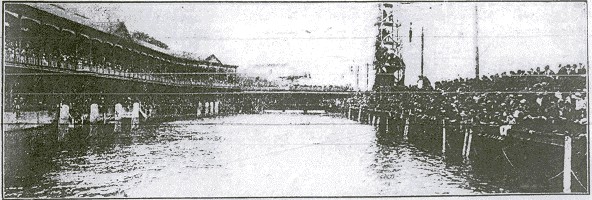
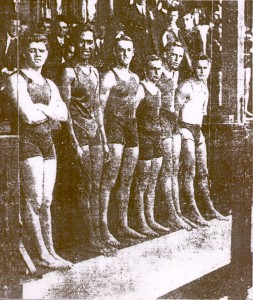 |
Reading from the left: W. Longworth, Duke Kahanamoku, I. Steedman, B. G. Page, A. W. Barry, G. Cuhna. |
THE KAHANAMOKU KICK
53 4/5sec : Duke Kahanamoku Creates a New
World's 100 Yards Record
Cunha and Barry also show Brillant Form :
William Longworth unable to Swim in the Mile : Record
Crowd, and Gate over £600 : By CECIL
HEALY
One hundred
yards in 53 4-5 seconds!
And over a
straight-away course too!
"What do you
think of the Duke?" one swimmer has impetuously questioned
of another, as if eager to anticipate the query he knew
instinctively was on the tip of his fellow enthusiast's
tongue, when meeting for the first time since the decision
of the 100yds State championshiop on Saturday afternoon.
Invariably the person addressed has paused momentarialy before replying, in order to search his mind for some superlative calulated to do justice to his feelings of wonder and admiration aroused by the performance of the Hawaiian.
"But it is
beyond comprehension!"
Well might
such an ejaculation be excused, nay, even expected, of those
who were not actual eyewitnesses of the feat.
However,
when one comes to think of it, followers of natation should
be getting use to having their established theories as to
the limitations of human cabalities in the element, exploded
in startling fashion.
A little
more than a decade ago the topical conjecture was as to
whether the distance would ever be negotiated in a minute.
When Fred
Lane, as it were, answered that surmise in the affirmative,
he was popularly supposed to have set a standard for all
time.
Then Dick
Cavill, employing the "crawl" stroke for the first time in
competition, advanced the indicator on the speedometer by
jumps and starts. The movements successfully shocked the
natatorial world.
It was just
recovering its equilibrium when the American C. M. Daniels
emerged from obscurity.
He thereupon
commenced what culminated in a long series of disturbances
amongst records it was hitherto believed were destined to be
mumified.
In the
process the swimming community was once more subject to
agitation. On his becoming a benedict and his virtual
retirement foreshadowed, it was considered that that
eventuality would signalise a many years' cessation of
hostilities as far as the world's best sprint swim figures
were concerned.
The Duke is Discovered
Perhaps it
would have been so, had not Mr R. T. Rawlins migrated from
the United States to Honolulu, and had he not been cutely
observent, after the manner of his countrymen.
Many people
had watched and applauded the exceptional skill displayed by
the Duke when indulging in the old Hawaiian pastime of surf
board riding.
No doubt
thousands had seen him "crawl" after his board as he played
about with it, kitten like, in the transparent waters that
wash the tropical isle.
They
probably remarked that he was very much at home in the
element, but beyond that did not detect anything unusual
about him.
It did not
occur to them that there was anything extrodinary in the way
he glided backwards and forwards.
That
discovery was reserved for Mr. Rawlins.
His
divination was more than confirmed by results of tests he
submitted the Duke to over properly measured courses.
These trials
were then forwarded on to the late Mr. Sullivan for
recognition, but that great official was just as incredulous
about their authenticity as the world at large, his
scepticism drawing forth the now famous comment that
"world's records are broken by fractions, not seconds."
As the
Duke's romantic story has never ben related in this column,
I might go on to mention that subsequently arrangements were
made for him to be tried out in the United States.
He made his
debut in a race held in a freshwater tank.
Naturally,
everyone connected with the sport was tremendously curious
to see if he could make good the amazing rumours that had
preceded him.
The Duke had
no previous experience in the lighter water.
This
resulted in his swallowing a mouthful soon after the contest
started.
It nearly
chocked him, and the Duke had no alternative but to quit.
This
happening caused convulsive laughter in swimming circles.
The American
sportsmen fondly imagined a joke had been put up on them,
but the mirth was none the less hearty on that account.
Their
awakening, however, was as sudden as it was effective.
The Duke had
another oppurtunity of showing prowess very soon after, when
he promptly, in Yankee parlance, cleaned all the local
champions up.
A GREAT SURF SHOOTER
KAHANAMOKU TALKS.
METHODS AND CONDITIONS
( BY W. F. CORBETT.) (2.)
Kahanamoku
talked very interestingly to me yesterday about shooting the
surf with and without the board. (3.)
"Surf
shooting is a new pastime here," said he.
"With us it
is old - as old as the hills, perhaps. (4.)
Shooting on
a board and in a canoe must have started further back than
body shooting. (5.)
There are
surf boards in the Honolulu Museum which saw service ever so
many years ago, but they wouldn't do today. (6.)
We have, as
you wrote in the Sun a week or two back, improved our boards
a bit, though they may look crude enough. (7.)
The length,
the width, and the balance caused by nicely-judged
distribution of weight, are the results of the study of
cause and effect as well as experience." (8.)
Surf
shooting is indeed new in Australia.
We do not
need to go to the oldest inhabitant for information
regarding how or when it began.
Men who
could supply all the particlars are yet young.
Somewhere
about twenty-two years since (9.), as the result of a long
and vigorous fight for the privilege by several residents of
Manly, peole who desired to do so were allowed to bathe in
the surf at any time and all times throughout the day, and
their number multiplied remarkably from year to year. (10.)
SURF
SHOOTING'S BEGINNINGS
We had surf
shooting four or five years before surf bathing became
general. (11.)
Mr Fred C.
Williams, that inimitable handler of the megaphone at all
Sydney's important swiming carnivals, was the pioneer.
He picked up
the art from a South Sea Islander, and spread knowldge of it
amoung the surfers on the favored beaches of the time -
Freshwater, Curl Curl and Maroubra. (12.)
Mr. Williams
was then the best exponent of cavorting the breakers, and he
still stands out in that respect beyond all others.
This
enthusiast will tell you of surf shooters of the early days
of the game who suprised their fellows by the clever
manner in which they used the force of the breaker.
I have heard
of him mention Monty Fuller, Douglas Walker, Frank Bell,
Harald Baker (the Stadium referee), Jack Thompson, Morman
Martin (Maroubra), Arthur Rosenthal, Clive Smith, and Co.,
as wonderfully adept at taking the wave and never leaving it
till it exhausted itself.
Proceeding,
Kahanamoku said : "You have hundreds more surf shooters at
work in one day around Sydney than we see in a week, or
perhaps a much longer stretch of time, at Honolulu, but I
think the old island has the pastime at greater perfection,
which is only to be expected considering its antiquity with
us. (13.)
We race each
other in on a breaker, and the desire to excel sets us all
thinking hard and practising constantly.
THE
DIFFERENCE.
"You catch
the wave as it curls. We take it earlier, perhaps half a
dozen yards away from the point of turning, and accumulate
speed by scooping the water with the right hand and using
the left in the ordinary way, putting in the while at least
the speed you saw me finish my world record in last saturday
afternoon.
Then the
velocity of the shoot is materially increased and its
duration rendered greater.
We begin on
our sides and find we get more control over the effort, then
we turn on our backs or breasts as fancy suggests.
You are
apparently content with one position.
Two or more
of your beaches I have seen where dozens of bathers were
shooting or trying to shoot are not suitable.
The best
performers amoung the people patronising those places would
do a great deal better if assisted by more favorable
conditions. (14.)
Holes and
channels created by the water's action are against the best
results in surf shooting.
We believe
there is not another place in the world equal of
Waikiki - that little cove lying in the shelter
of Diamond Head - for surf shooting purposes, and thousands
of travellers who call at picturesque island every year
endorse that opinion.
It has
a big curve protected by a large coral reef about half a
mile from the shore.
There is
absolutely no undertow. (15.)
SURF BOARD
AND CANOE.
"There the
facscinating sports of surf-canoeing and surf-board riding
are indulged in by man, woman, and child, who insist that
they have the most exhiarating and fascinating pastime
known.
The canoe is
cunningly turned before a breaker near the edge of the
reef till it is picked up like a feather on the inclined
plane of the front of the wave, and borne with
remarkable speed - frequently right to shore.
The
board is worked on the same principle, but its control
calls for much greater skill.
"There are
numbers of high class surf-shooters in Honolulu, and some
white people amoung them, but, as with every other game, a
few can do better than the great majority.
It was with
the few I delighted to be. (16.)
You ask me
if I held the championship as a surf shooter!
I did not,
because we had no competitions, but I do not mind telling
you that there were none around Honolulu whom I knew
anything about able to shape better than me (17.), and the
full-blooded Hawaiian population is something between 25,000
and 30,000.
"You must get suitable days here to achieve the best results, and we, at Honolulu, also need suitable days, but more of them occur at Waikiki Beach than on this country's ocean front. (18.)
FAVORABLE
CONDITIONS REQUIRED. (19.)
"Take
Freshwater, for instance.
I was
promised a long roll there the day I gave that exhibition on
the board, and perhaps such a state of affairs may be more
often experienced at Freshwater than at Manly, Coogee or
Bondi, but I found a short roll and a sea otherwise which
needed some managing. (20.)
With
everything favorable one can show one's best , and the more
frequently condiions are right the more practice the
shooter gets.
"Your
surfers do wonderfully well, all things considered.
But
not every man can become an expert.
All people
are not built the right way.
The greater
the bouyancy the easier the task.
There are
men who can never float properly.
Their legs
will insist on dropping down."
THE EAR
TROUBLE. (21.)
Questioned
regarding his ear trouble, and asked if it was prevalent
amoung Honolulu's surf shooters, Kahanamoku said he never
heard of many people suffering.
Occassionally
there
were cases more serious than others, but considering the
number of people who entered the surf, the percentage was
very small.
Three or
four toimes he had to seek medical attention to relieve him
of pain, and found filling his ears with rubber plugs, which
are procurable in Sydney, or using wadding saturated with
oil, every time he swam till a cure was effected, helped him
a great deal.
Before
starting for the 100 yards championship of New South Wales
last Sunday afternoon
Kahanamoku could only plug one ear.
It would not
have paid to be deaf to the starter's signals.
2. The
reporter, W. F. Corbett joined The Referee, (a Sydney
sporting paper) in 1888, where he reported boxing, swimming,
lawn bowls and both codes of rugby.
He moved to the
Sydney Sun in 1913. (Source -Rabbitoh Warren)
After a
journalistic career of 37 years, he died in 1923, aged 67.
(Source -the
Bulletin, Sydney, 1 November, 1923)
3. Sydney's surfing enthusiasts were as interested in Duke Kahanamoku's body surfing skills, as well as his ability on a suirfboard..
4. The ancient origins of surf riding are noted.
5. I suggest this contention is open to further discussion.
6. The
boards reported as held by the Bishop Museum probably refers
to those ridden at Wakiki in the 1830's by high chief Abner
Paki and eventually restored by Tom Blake in the late 1920's.
See #502
7. Duke Kahanamoku was aware of his own press coverage.
8. That surfboard design has a history (experience) and is also in continuous development (study of cause and effect).
9. circa 1893
10. Legalised daylight bathing is credited to Manly residents and there is no mention of the often credited William Goucher.
11. Hard core suring enthusiasts preceeded the growth of popular surf bathing.
12. Circa
1895,
South Sea Islander, Tommy Tana, a youth employed as a houseboy
in the Manly district, introduced body surfing to Australia.
From the
Pacific island of Tana, (New Hebrides, now Vanuatu) he amazed
onlookers at Manly Beach with his skill at using the power of
a wave to ride back to the beach.
His style was
studied and copied by Manly swimmers, notably Eric Moore,
Arthur Lowe and Freddie Williams, considered the first local
to master the sport.
Enthusiasm for
surf riding expanded such that Manly surfers were invited to
demonstrate the technique at other metropolitan beaches,
ultimately including Newcastle and Wollongong.
13. Notes the immense popularity of surf riding in Australia at this time.
14. The importance of suitable surf conditons, futher expanded upon later in the interview.
15. The suitability of Wakikiki for surf riding - given the frequency, number of breaks, favorable wind direction and tropical air and water temperatures - is unique.
16. While aware of his own abilities, Duke Kahanamoku indicates that his skills are not unique, and are attainable by others.
17. Can
only refer to surfboard shaping?
If so, it would
firmly cement Duke Kahanamoku's postion as the founder of
modern surfboard design.
It would also
account for the importance and revence accorded to Duke's
designs and construction technics by Australian surfers.
18. Given the restricted geographic mobility of the period.
19. Further comments on the importance of suitable surf conditons, expanded intial observations, see 14.
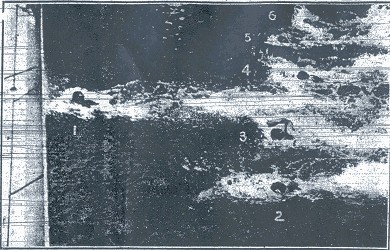
20. Probably
refers
to a uneven swell or even choppy surface conditions, as
indicated by photograph by the Daily Telegraph, 25th
December, 1914.
Image below.
21. Ear
problems are a common complaint for surfers, exotosis is
commonly called "Surfer's Ear".
The use of ear
plugs is the most practical preventative.
.
20. There
is
no discussion of wave height.or mention of tandem riding.
KAHANAMOKU IN THE SURF.
DISPLAY AT MANLY.
THE SWIMMERS.
HAWAIIANS ENTERTAINED.
KAHANAMOKU'S RHETORIC.
KAHANAMOKU IN THE SURF.
STATUS OF THE HAWIIAN
FINANCING HIS VISIT
BY W. CORBETT
KAHANAMOKU
GONE NORTH.
A change was
made in the Australian itinerary arranged for Kahanamoku who
is now well on his way to delight Queen8land folk.
He left by
the Brisbane express yes-terday afternoon to fufill eight
engagements, which include shows at Allora and Rockhampton.
OTHER
ENGAGEMENTS.
Due to reach
Sydney again on the 4th proximo, Kahanamoku will appear at
the Dee Why Surt Club's carnival on the 6th prox., the
Cronulla carnival on the 7th, Drummoyne Baths on the 8th,
and Newcastle on the 10th.
The 11th
will see him hurried off to Melbourne for exhibitions on the
15th and 18th of February, and coming back to Sydney he will
step off the train at Goulburn, where preparations are being
made for a good time.
Just exactly
when we may see the last ot the "Duke" is not, at the
moment, certain.
If the
original plan were adhered to he would leave for New Zealand
about the middle ot February, but the swimming authorities
of that part ot the continent are apparently not ready to
receive him.
They have
cabled the local governing body to delay his visit a few
days it possible.
THE
PATRIOTIC CARNIVAL.
The
N.S.W.A.S.A. is now hopetul that their guest's services may
be available tor a big patriotic carnival to be held in the
Municipal Baths, Domain, on the 20th proximo, when the great
attraction will probably be a meeting between Kahanamoku and
Billy Longworth, who was prevented, through illness, from
competing at the recent State championshlp meeting after the
first day.
FINANCING
THE HAWAIIAN'S VISIT.
A
correspondent -Bona-fide Amateur- writes asking information
regardlng the conditions under which Kahanamoku is here, and
expressed the opinlon that "The border- line of amateurism
must be dangerously threatened by the liberty of the
expenses allowed him."
Bona-fide
Amateur did not believe a man like Kahanamoku wouJd come so
far a way from his home unless he was liberally remunerated.
I made
Inquiries of Mr. Scott, hon. secretary. and others
connnected with the management of the Swimming Assoclation
and learned that neither Kahanamoku nor anyone of the two
visitors accompanying him received a penny.
They were
guaranteed first-class travelling to and hotel expenses from
Honolulu to Honolulu, and promised a tour through Australia
in so far as it could be arranged.
The A.A.U.
of the United States vouched for Kahanamoku's status, and
cabled the Sydney controllers of his trip for an undertaking
that he would not be allowed to compete with professionals.
That was given.
During the
Queensland, Melbourne and New Zealand visits the New South
Wales Association is to receive £25 for each show taklng
place.
It is
expected that the venture will result in a substantlal
addition to this States swimming exchequer, but it may
not prove the very profttable thing some people appear to
imagine.
Over and
above the expenses of the visitors there is the cost of
advertising, the renting of the Municipal Baths, &c.
It 1s much
the greatest risk the association has ever shouldered.
AMATEURS
AND EXPENSES.
Probably
Kahamoku's trip to Australia is a matter such as the English
Amateur Swimming Asociation would have refused to
countenance had that body been in a position of power
regarding it.
It will be
remembered by the older swimming officials of to-day that
whenever the motherland was approached with the idea of
securing a visit by an English champion to Australia we
would be told, a.ter a lot of formality had been gone
through, and the Invitation passed from the Southern
Counties' Association to the Association proper, or from the
latter to the former and back again, that the
suggestion,
because of the expense necessitated, savored too much. of
professionalism.
And all the
tIme we were sending our top-notches to the old country and
they were drawing blg gates to swell the coffers of
England's clubs and her governing body.
I remember
one London writer working hlmself up to an hystertcal
condltion almost when he heard that Son (we used to call him
then) Baker had gone all the way to New Zealand, and no
sooner returned to Sydney than he wheeled round and hurried
oft to Rockhampton.
"Sureley",
said the English scribe, "there Is somethlng here that
should receive attention.
Baker may
have pald his own expenses and he may have only received
within a penny of the amount needed to land him at his
destination, but what was the object of It all?
Nothing more
or less than to provide a big line for the invitlng club's
bill."
That writer
did not know, or could not see, that Baker's tour was in
furtherance of a scheme which all Australian swimming
associations had at heart for the purpose of popularising
the game and spreading it.
THE BEAM IN
THE MOTHERLAND'S EYE
The
motherland should have seen to the beam in her own, than
troubling about the mote in Australia's eye.
Nuttall, in
his amateur days, also Tyers and Jarvis, were up to their
eyes In engagements of the nature indicated, but never a
hand did the ruling bodt lift to stop it, desplte the fact
of most people being aware that at least two of the trio had
no money for such trips, and valiable trophies, in the form
of high priced pianos and the like were proudly pointed to
as evidences of their owner's superiority.
KAHANAMOKU'S
SWIMMING
As evidence
of how poor a swimmwer, comparatively, Kahanamoku is beyond
110 yards, at which he holds the world record, the following
reference may be interesting.
One of the
official time-keepers, Mr. T. C. Roberts, specially clocked
the Hawiian's first half of the 220 yards swim last Saturday
afternoon as 1 min. 8 2-5 sec, which is not at all fast.
The second
lap occupied the difference betwen that and 2 min. 32 2-5
sec.
It seems
hardly possible for a first clas swimmer's power to peter
out to such an extent, but it did.
HAWAIIANS' SUCCESS.
ALLORA
(Q.), Wednesday.
Tho Allora
Swimming Club held a carnival to-day, at which George Cunha
and Duke Paoa Kahanamoku took part.
Cunha won
the 100 yards handicap from scratch in 50 1/2s.
Kahanamoku
won the 400 yards from scratch in 5m 31s.
SWIMMING.
RIVER TRIP TO KAHANAMOKU.
The members
of the Hawaiian swimming team were entertained at a
delightful trip up the river on Sunday afternoon by the
Commercial Amateur Swimming Club, in the motor launch
Darryl.
About 70
participated in the outing.
Amongst the
invited guests were Messrs. Duke Kahanamoku, Francis Evans,
D. S. Carter, president Q.A.S.A., A J. Wilkins, treasurer
Q.A.S.A , and the following vice presidents of the club:-
Dr. Shaw, Messrs. J. Casey, F. Hepburn, C. W. R. Just,
M. J. Kirwan, M.L.A., B. H. Hart, and S Davison
(lhandicapper).
Amongst
others were Messrs. Parkes and Fitzgerald, Warwick, several
members of the Commercial Club, and members of the Toowong,
Vallev, and South Brisbane clubs.
On reaching
the destination a large number enjoyed a delightful swim,
which was enlivened by the use of a polo ball.
The
remainderenjoyed themselves with a football on the flat.
The "Duke"
preferred the latter pastime, at which he is no mean adept:
.
A shower of
rain caused a leturn to the boat, vvhere refreshments were
served by E. C. Eachenhagen.
Before
leaving a few toasts were proposed.
"The
Visitors" was given by M. J. Kirwan. M L.A. (vice
president), and responded to by Messrs. F. Evans and Duke
Kahanamoku.
"The
Q.A.S.A." was proposed by Dr Shaw (vice president), and
appropriately responded to by Mr D. S. Carter (president
Q.A.S.A)
Mr. Carter
proposed the toast of "The Commerial Swimming Club,"
wihich was responded to by Mr. J. Dunning (hon. secretary).
A start was
made for town shortly after 6.
The trip was
enlivened by Mr. A. Bragg's musical ubllltiea (?) and vocal
items from several members.
WARWICK VISIT ABANDONED.
WARWICK,
January 20.
The Warwick
Amateur Swimming Club, which had invited Duke Kahanamoku,
the famous Hawaiian swimmer, and George Cunha, to give an
exhibition at Warwick on thair return from Brisbane, has
been advised that they will proceed to Sydney by steamer.
Duke
Kahanamoku states that he expects to make another tour of
Australia next year, and that he will then visit Warwick.
THE KAHANAMOKU TOUR.
The
following fixtures have been arranged for Kahanamoku mokti
and party on their return from Brisbane: Arrive Sydney,
February 4 Surf display at Deewhy Club's Carnival on ...
Cronulla Surf Club on February and Drummoyne Club's Carnival
on 6th; Newcastle club's Gala, l0th; visit ... 154 words
KAHANAMOKU CARNIVALS.
THE FINAL STAGE.
A NEW QUEENSLAND RECORD.
SOME SPLENDID SWIMMING.
Fortune was
doubly unkind to the Queensland Amateur Swimming Association
in respect to the third and final stage of the Kahanamoku
Carnivals, which were held on Saturday afternoon.
Firstly, it
was ascertained during the week that the Dock, where the
first two stages were held with success, would not be
available, so recourse had to be made to the South Brisbane
Baths, with its shorter course and lessor accomodation for
spectators.
The second
misfortune was the uncertain weather, though it brightened
somewhat in the afternoon.
Not
withstanding these disadvantages, the association and its
officiers indefatigably worked for and achieved a thoroughly
successful carnival.
The various
events were keenly contested, and tha performances of Duke
Kahanamoku, the famous Hawaiian, were interesting and
appreciated.
His swimming
partner, George Cunha, was regrettably unable to appear, as
he was suffering from disentery.
He is in the
hands of Dr. Hopkins.
As at the
other stages of the canival, there were many ladies present,
and there were altogether abot 800 spectators.
The receipts
amounted to £23/13/.
The Railway
Band gave pleasure with its bright musical selections.
An offset
against George Cunha's non-appearance the "Duke" gave a fine
exhibition of various strokes, comparing the American with
the Australian style, and was loudly applauded.
ln the 100
yards Invitation Handicap the "Duke" swam splendidly, his
time being only one second outside the world record put up
by himself in Sydney on January 2.
SWIMMING
KAHANAMOKU v LONGWORTH
The
executive had practically arranged another of raising a sum
for patriotic purposes for Friday 19th, at which the
Hawaiian party were to be made the means of adding to the
price of admission by auctioning several surf boards made by
themselves; but the departure of the Wellington boat on
Friday, 19th February, instead of Saturday the 20th, has
also made this impossible.
However the
executive still has the matter of a patriotic function in
hand, and will make a definitive answer later.
...
DEE WHY SURF BATHING CLUB.
Kahanamoku
will appear at the Dee Why Lifesaving and Surf Club's
carnivalon Saturday February
At this
gathering the Surf Bathing Association's ??? for rescue and
rescusitation drill will be decided.
NEW SWIM RECORD.
Duke Kahanamoku Does 100 Yards in Sydney in 53
3-5 Seconds.
Special
cable to the New York Times.
San
Francisco, Cal, Jan. 25 - A new mark for the 100 yard swim
has been set by Duke Kahanamoku, the Honolulu champion,
according to word received here today from Sydney, N.S.W
The Duke
swam the distance in 0:53 3-5 seconds which beat all former
records.
The best
previous time was that of C. M. Daniels, who in four turns
in a freshwater tank, made the distance in 0:54 4-5 Seconds.
SURF SPLASHES
On Sunay
afternoon, February 7th, at about 3 in the afternoon, Duke
Kahanamoku, the world's natatorial marvel will be seen at
Cronulla beach.
He is
accepting the hospitality of the Cronulla boys in the form
of a day's outing around the beauty spots of the Shire, and
will swim in the afternoon as mentioned.
FINAL APPEARANCE OF KAHANAMOKU.
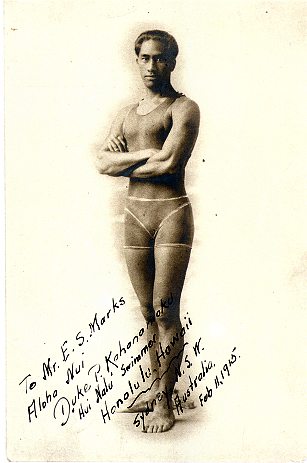 |
E. S. Marks was prominant in Sydney sports. Sydney's premier athletic track is named The E.S. Marks Field. Postcard reproduced from private collection. |
| home | catalogue | history | references | appendix |