pods for primates : a catatogue of surfboards in australia since 1900
home catalogue history references appendix

surfresearch.com.au 
newspapers : surfing, 1950 
Newspapers : Surfing, 1950-1955.

Extracts from
The Sunday Herald, The Sydney Morning Herald and The Australian Womens' Weekly.
1950, 1951, 1952, 1954.

Introduction.
Selected articles include a 1951 profile of Judge Adrian Curlewis, one of the early surfboard riders at Palm Beach and long-time President of the SSLSA, and an overview of surfing in Sydney in 1952 by Craig McGregor.
McGregor would later co-write Midget Farrelly's This Surfing Life (1965) and Nat Young's The History 0f Surfing (1983).
Army News (Darwin, NT

Sunday 11 March 1945, page 4.

Unusual Surfboard.

Flight-Sergeant Jack Keen will race in. Sydney surfboard events this sea son on a board made from the belly tank of a plane shot down in New Guinea.
Keen .was in many operational flights over Japanese territory.
Shot down in Geelwink Bay, he bailed out.. and was adrift for 49 hours in a dinghy.
He was rescued six miles off the coast by an American corvette.
"I built the surfboard in New Guinea, where it helped to save *many lives," says Keen.
The Sydney Morning Herald

Friday 6 April 1945, page 9.
Life-savers Place Ban On Surfboard Events

An application by the Australian Surf Board Association for affiliation has been refused by the Surf Life-saving Association.

Because of the increasing interest being shown by its members in surf-board racing, a special investigation is being made by the Surf Life-saving Association into the situation.

The object ls to have life-saving clubs cater to a greater degree for their members who require surfboard racing.
A committee will report to next months' meeting of the association.

The secretary of the Life-saving Association, Mr. G. Millar, said last night the application for affiliation had been refused because the S.L.S.A. constitution provided that affiliation could be granted only to surf life-saving clubs.

He added that pending the committee's report the association had decided not to allow its members to compete in events conducted by an unaffiliated organisation.


The Sunday Herald
Sunday 24 September 1950, page 5.

Surfboard Duo
(Photograph)

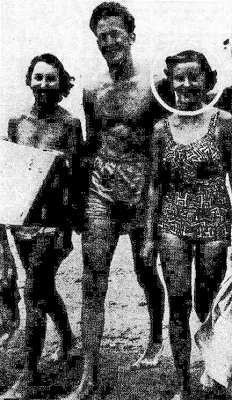
Katrina Schenken, of Killara, and Peter Wakefield, of North Bondi, took advantage of yesterday's sunshine to "shoot" a few waves at Bondi Beach on a surf-board.
But soon after this picture was taken a storm drove everybody from the beach.


The Australian Women's Weekly
Saturday 3 February 1951, page 17.

Judge Curlewis has grown up with the century
He is a "Federation baby" who has lived 50 eventful years.
By HELEN FRIZELL, staff reporter

In January, 1901, most Australians were resolutely celebrating Federation.
Ahead lay one hundred unspoiled years, full of promise for an infant Commonwealth.
But for Mr. and Mrs. Herbert Curlewis, of Mosman, N.S.W., January, 1901, meant not only the birth of a nation, but the birth of their son Adrian.

ADRIAN CURLEWIS has grown up with the century.
He is one of those who have
seen the horse replaced by cars and aeroplanes, the old fuel stove superseded by pressure cookers hissing over electricity or gas.
Gone is the plentiful supply of domestic help in the home, and the days are vanished when no gentle- woman would wear lipstick.
The new century marked the end of an era and brought two world wars, the great depression, and the atomic age.

In 1951, the Jubilee of Federation, Judge Adrian Curlewis, who has just celebrated his 50th birthday, looks back at his life.
To-day he is straight-backed and suntanned from his favorite relaxation- surfing.
A caricaturist drawing his face would show a sharply defined nose, crinkly hair, and a high forehead.
In the evenings Judge Curlewis leaves the New South Wales District Court in the City of Sydney, picks up his car, and drives over the Harbor Bridge on his way home, thankful that the slow ferry to North Sydney has been replaced.
Nearing home he calls in to say good-night to his mother, who is known to and loved by Australian
children as the novelist Ethel Turner.
Tiny, white-haired Mrs. Curlewis, widow of Judge Herbert Curlewis, still lives in the rambling slate roofed house where her son grew up.
Adrian Curlewis and his family live a mile away, in a modern cream house which overlooks the sparkling waters of Middle Harbor and the white sand of Chinaman's Beach.

District changes

MRS. ADRIAN CURLEWIS, 18 year-old Philippa, and 21-year old Ian have heard Judge Curlewis speak of the changes in the district where he grew up.

In 1907, when he was six, Adrian Curlewis used to walk down to the beach (where he still swims before breakfast) among wildflowers and gumtrees.
His parents' house was the only one standing.
Now it is just one of many large homes perched on the hillside.
"I learnt to swim at Chinaman's Beach and the Spit Baths," says Judge Curlewis, now president of thc Surf Life Saving Association of Australia.
"My sister Jean, who died in 1930, and I used to dog-paddle from one end of the baths to the other."
Surfing was not then a popular sport, but devotees were conquering prejudice.
The first Life Saving Clubs had just been formed.

Having an authoress for a mother did not seem a novelty to the young Curlewis'.
"I think we took the books for granted," says Adrian Curlewis.
"I remember mother giving Jean and me 5/- each when she finished a book.
It was a sort of celebration, and reward for good behaviour on our part."
In those days 5/- was wealth to a child.
For a penny or ha'penny you could buy enough sweets to keep chewing for hours.
Like other local boys, Adrian Curlewis enjoyed riding in the milk-man's cart, and meeting the electric tram which ran once an hour to the Spit.

Later on Adrian Curlewis went to the Mosman Preparatory School, then to Sydney Church of England Grammar School (Shore).
At Shore young Adrian Curlewis went on to stroke the First Four, captain the Rugby Union Firsts, and to win the Headmaster's Cup for all-round sportsmanship.
He also became Senior Prefect in the middle of World War I.

"The war made a great impression on us all," says Judge Curlewis.
"Every morning there was a chapel service for old boys killed in action.
Many of these soldiers had been at school only a few years before, and we knew them well.
As a prefect I took my turn at reading the lesson from the Bible, and felt moved at the solemn and very beautiful service taking place "
The thoughts that these services conjured up in the mind of the young Curlewis were later to take on harsh reality when, as a captain in the 8th Division, he was taken prisoner by the Japanese in Malaya.
Adrian Curlewis wanted to enlist in World War I, but his parents would not give their consent until he was 18.
By then the war was nearly over, so he went to Sydney University to do Law.
During the strike of 1917, with hundreds of other schoolboys, he took an emergency job as an engine cleaner.
He was forced to give it up when his father became Presiding Judge at the Arbitration Court.

Curlewis the undergraduate was a young man with plenty of enthusiasm.
His interests included playing the flute in the University orchestra, hockey, rowing, and swimming.
He revived the University Law Society and enjoyed himself riotously on Commem. Day.
Up to 1921 the Sydney Town Hall had been the place where Blues were presented, where undergraduates shouted their faculty songs, where mothers and the girls of the moment came along to watch the celebrations.
"We were not allowed to use the Town Hall after '21," says the Judge Curlewis of to-day.
"Something happened to the Town Hall organ, and the undergraduates footed the bill.
Flour bombs were hurled down from the galleries, and hundreds of the cane chairs were broken.
"We weren't to blame for the chairs.
The women did that when they stood on the chairs in their high heels."
In the 1921 procession law students of Adrian Curlewis' year satirised the Sydney Telephone Exchange.
On top of a float a "telephone girl (alias Curlewis) worked frenziedly at a switchboard, in company with the present Mr. Justice Mansfield, Mr. Justice Herron, and Judge Holt.

In January of the previous year Adrian Curlewis had decided to become a life-saver after seeing a drowning fatality while on holiday at Palm Beach, New South Wales.
Palm Beach then was not the luxury resort it is to-day, but an informal bush settlement where a cluster of doctors' holiday homes marked Pill Hill.
Adrian Curlewis started the Palm Beach Life Saving Club with the late Len Palmer.
Since then he has seen many changes in life-saving methods.
"The patient used to be carried from the water face up, and the limbs were rubbed to restore circulation," Judge Curlewis says.
(To-day life-savers carry patients face downwards, and the rubbing method is obsolete.)
"'With other old-timers, I prefer the original surfboats," says Judge Curlewis.
"The Johnny Walker class surfboats were more solidly built, and were capnble of tackling seas which would swamp the light, fast boats of to-day."
Adrian Curlewis learned surf- board riding from John Ralston, who had the first surfboard at Palm
Beach.
Later he bought his own surfboard for £5.
"It had belonged to Manly swimmer Claude West, who put an ad. in the paper reading: 'Surfboard for sale.
Owner in hospital through using same'," Judge Curlewis told me.
(Surfboard riding was only six years old in 1920.
The Hawaiian Duke Kahanamoku had introduced it to Australia in 1914.)

Surfboard virtuoso

AFTER mastering the surfboard and being able to ride it on either feet or head, Adrian Curlewis started teaching pretty Betty Carr, whom he had met at a Palm Beach house-party.
Betty, who came from Kalgoorlie, Western Australia, learned surfboard riding quickly.
Before Adrian Curlewis was through Law they were engaged, and were married at St. Philip's, Church Hill, in December, 1928.
Up to date with the fashions, the bride was photographed wearing a short wedding dress, with her hair caught up in a bandeau.

A week before Australia entered World War II, Adrian Curlewis enlisted.
In January, 1941, he sailed for Malaya in the Queen Mary.
When Singapore fell the future Judge Curlewis, with thousands of other Australians, was captured and was sent to Changi.
He was put to work on the wharves, and in April, 1943, was sent to the dreaded Thailand railway.
In the New Year, on January 26, 1946, Captain Curlewis was discharged from the Army.
He is proud of the fact that he became a civilian at 4 o'clock and was in his chambers half an hour later with a brief for the next day.
He was appointed a District Court Judge in 1948.

Judge Curlewis is a typical family man.
Son Ian is now doing second year Law and is keenly interested in life-saving.
Daughter Philippa has just left school after winning the All Schools' Senior Swimming Championship last year.
Judge Curlewis is a man of wide civic interests.
They make quite a
list:
He is president of the Surf Life Saving Association, chairman of the National Fitness Council of N.S.W., and chairman of the Red Cross Appeals Committee.
Keeping in touch with old school and Army friends, Judge Curlewis is on the Shore Council and the 8th Division Council.

(Photographs)
THE BOY
ADRIAN CURLEWIS at the age of nine.
This picture was taken in London when Adrian was travelling with his family.
In 1910 nearly all small boys were dressed in sailor suits by their mothers.

IN SCHOOL BLAZER, Adrian Curlewis posed for group picture of Shore's rowing four.
The year was 1919, when boys wore serious expressions and long fringed scarves with their blazers.

THE MAN
IN 1945 Captain Curlewis returned home after three years in Changi and on
the Thailand railway as a member of the 8th Division.

TO-DAY, at the age of 50, Adrian Curlewis is a judge of the New South Wales District Court.

He has a fine record of achievement.
The Sunday Herald

Sunday 25 March 1951, Sports Section page 9.

Byron Bay Surfer Takes Belt Title In Rousing Finish.

PERTH, Saturday.
- Byron Bay surfer G. Timperley won the Australian belt championship in a desperate finish at Scarborough to-day.
Timperley beat a powerful field which included national belt champion Don Morrison, of Western Australia, and N.S.W. champion, Alan Williams, of Queenscliff.
The Byron Bay swimmer was only second N.S.W. nominee for the event.
Moreover, he had had a swim in the qualifying heat, unlike his four opponents in the final.
The four leaders in the final -Timperley, Morrison, Williams, and Wilkes, of Queensland-remained in line for almost the whole of the swim, finishing in that order.
They touched almost together.

N.S.W. competitors filled the first three places in the national surfboard championship.
Winner was R. Callan (Coogee), with K. Hurst (North Bondi), second, and D. Trumper (Coogee), third.
Spectators who saw surfboard racing for the first time were amazed at the expert handling by N.S.W. and Queensland entrants.

The flat surf at Scarborough disappointed competitors.
In qualifying heats swimmers found conditions slow, but despite the flat water, a heavy swell made swimmers disappear at times.
A choppier sea later made referee V. Besemo order the buoys to be brought closer to shore.

Beach sprint: Montgomery (NSW), 1; Moir (NSW), 2; Scott (WA), 3.
Surf ski: Okulich (NSW), 1; Whyte (NSW), 2; Lazarus (NSW), 3.
Boat race: First heat, Freshwater; second heat, Cronulla; third heat, Swansea-Belmont; fourth heat, South Curl. (sic)
Boat race: Cronulla, 1; South Curl Curl, 2; Swansea-Belmont, 3. Curl (sic)
Opes Surf Teams: North Wollongong, 1; Freshwater, 2; Cottesloe (WA), 3.
March Past: South Narrabeen, 1; Scarborough (WA), 2; City of Perth (W A ), 3.
Open Surf Championship: S. Wilkes (Qld), 1; G. Timperley (NSW), 2; R. Hartley (WA), 3.
Double surf ski: NSW, 1.
Belt race, final: G. Timperley (Byron Bay, NSW), 1; D. Morrison (WA), 2; A. Williams (Queenscliff, NSW), 3.
Surfboard race, final: R. Callan (Coogee), 1; K. Hurst (North Bondi), 2; D. Trumper (Coogee), 3.
JUNIOR EVENTS
Rescue and resuscitation: Bondi, 1; Queensland, 2; North WoIIongong, 3.
Surf race: McPhee (NSW) 1, Hounslow (WA), 2; Mooney (NSW), 3.
Surf teams: North Bondi, 1; Merewether, 2.


The Sydney Morning Herald
Saturday 27 September 1952, page 9.

Best Surf In The World
By Craig McGregor

With the surfing season officially opening next Wednesday, hundreds of thousands of Australians will soon be visiting beaches to enjoy Australia's national pastime surfing.

It may seem an immodest claim, but there is little doubt that Australia has the best beaches and the best surf in the world.
Only Australia, New Zealand, South Africa, Ceylon, the southern States of U.S. and some Pacific islands have a surf at all.
At this time of the year especially, we should pay tribute to a Sydneysider, Mr. W. H. Gocher, who, 50 years ago, won for Australians the right to all-day surfing.
Australians had, of course, been surfing long before Mr. Gocher breasted the waves, although no one seems to know when or with whom it began.

At all events, by 1880 many young Australians were bathing regularly at Sydney's near-deserted beaches.
But surfing in those days was a clandestine affair- something to be indulged in early in the morning before too many people were about.
For the law expressly forbade (and still forbids) public bathing between 6 a.m. and 8 p.m.

In 1902, Gocher, a journalist, announced that at noon on the following Sunday he would defy the law and publicly bathe at Manly beach.
True to his word, and before a large crowd of onlookers, Gocher carried out his promise.
He was not arrested, and since then Australians have surfed during the forbidden hours without interference.

Perhaps the most famous feature of Australian surfing are our Iifesavers.
The Australian voluntary system of surf lifesaving is unique, and the tanned lifesaver with his bright club, cap, who pays an average of 15/- a year for the privilege of saving your life, is as much a product of Australia as the kangaroo and kookaburra.
Since they began formal operations, surf Iifesavers have saved the lives of more than 80,000 people. To-day, there are more than 165 surf lifesaving clubs in Australia with a total membership of about 12,500.

Surf-lifesaving has come a long way sjnce the days of 1907, when á few youngsters formed lifesaving clubs at some Sydney beaches "just for the fun of it."
Two years later, representatives of these clubs met to form the Surf Bathing Association of New
South Wales.
The movement spread rapidly, and clubs were formed in Victoria, Western Australia, Queensland and New Zealand.
In 1920, the association changed its name to the Surf Life Saving Association of N.S.W., and three years later it adopted its present name of Surf Life Saving Association of Australia.

SYDNEY TO-DAY
- Slightly in advance of the official opening of our surf season, Sydney's 18-footer sailing skiffs are out, lending colour and personality to the harbour's blue waters.
Above, a crew prepares its skiff at Double Bay for an afternoon's racing.

To-day, there are Surf Life Saving clubs in every State except the Northern Territory.
Australians have developed many unique contrivances to meet the demands of the surf.
Our first surfboat was designed by Fred Notting, a Manly club member, who gave it distinctive high ends and a curved keel.
Manly was the first club to use a surfboat; it proved such a success that all the other clubs adopted the idea as soon as they could raise the money.
The lifesaving reel and belt, the surf ski, and the rubber surfoplane all originated in Australia.
The Eve resuscitation rocker used on beaches here is an Australian adaptation of an English invention.
The flippers used by surfers to-day were developed from the type of flippers used by frogmen in World War II.
The original surfboard was not Australian; it was introduced here by Duke Kahanamoku, a visiting Hawaiian swimmer, in 1914.
Australian surfboard riders, however, soon modified the short, broad boards of the Hawaiians, which were constructed of solid wood.
By 1925, we had developed the hollow surfboard, which is much faster than solid boards.
The Australian surfboard today is a long, narrow board with pointed ends and continuously curved sides, and is completely hollow.
The art of "body shooting," or catching a wave so that it carries the surfer with it for hundreds of yards, is almost exclusively Australian.
Since its development early in the century, Australian surfers have introduced many improvements on the original body-shooting style.
The art of shooting waves with arms by the sides, reducing the force of the break by bringing the arms over, and dipping the shoulders and lifting the legs to keep the surfer on the wave are features of the present style.
Other refinements developed by Australian surfers include "cork- screwing" while racing down the front of the wave at 30 miles an hour and shooting the waves on one's back.
With surfing so popular here, it is not surprising that Australians have developed their own surfing language.
A surfer "catches," "shoots" or "cracks" a wave.
A waye which carries the surfer, right to the beach is called a "beacher," and an unusually big or fast wave is a "screamer."
The most feared of all waves is the "dumper," which instead of breaking gradually builds up into a tremendous wall of water and then suddenly "dumps" tons of water from heights of up to 30 feet. Any surfer who is unfortunate enough to be caught by a dumper is said to go "down the
mine" and other surfers have to "scrape him up."
A "mocking bird" (a variation on "galah") is anyone who gets in the way of a surfer "coming in" on a wave and into whom the surfer crashes.
The surfer then tells his mate that "my head stopped and my shoulders kept on going."
Our Iifesavers have also developed their own terminology.
The" "sweep" is the-lifesaver who mans the steering oar of a surf- boat.
The "beltman" is a man who swims out with the belt to anyone in distress, the "linesmen" those who pay out the line, and the "reelman" the man who works the reel.
One of the greatest contributtions of Australian swimmers to the world has been the swimming stroke known as the "Australian crawl."
The common swimming stroke in use all over the world before the development of the Australian crawl was the trudgen (named after J. Trudgen).
This stroke utilised a frog-like kicking action which considerably reduced the speed of the swimmer.
According to the records, towards the end of the 19th century, a 12-year-old boy named Alick Wickham swam in a championship race at Bronte baths using a stroke which later became known as the Australian crawl.
Alick swam with his face submerged, taking breaths at long intervals, with his legs threshing straight up and down and with his arms moving rapidly.
Australia's swimmers soon adopted and modified the revolutionary new stroke, astonishing swimmers in other countries with its speed.
In 1910, the Australian swimmer, Frank F. Beaurepaire, using the crawl stroke, won every English title from 100 yards to a mile.
Competing in Scotland, Sweden, Finland, Belgium, France, Germany, Hungary, South Africa, New Zealand, Canada and Hawaii, he was undefeated in 41 events and established five world records.
To-day the Australian crawl, or modifications of it, is used all over the world.
Swimmers recognise it as "the fastest of all swimming strokes".


The Australian Women's Weekly
Wednesday 19 November 1952, pages 6 and 7.

Page 6

Surf team to show skill in Hawaii.

Seven surf lifesavers will fly to Honolulu on January 10 to show Hawaiians Australian methods of
surf rescue.
The men will be selected by the Surf Life Savin« Association to represent all States.
Pictures on these two pages show the fine types of young men who will be eligible for selection.
The names of the members of the team to represent the Commonwealth will be announced on December 13.

(Photographs)
ABOVE: Coogee crew take their boat out over the breakers at North Wollongong, where one of the oldest New South Wales clubs is established.

BELOW: Parade of teams in a March Past Championship: Tasmania (left); Queensland; Henley, South Australia; New South Wales; and Western Auttralia.

On page 7

BrflE iV» RESUSCITATION.
Merv Butterfield, chief instructor of South Australia
BJ;,, ttntre (in shorts), watches the Burleigh Heads, Queensland, team winning its heat.
Tasmanian team is on the right.
STALWART AUSTRALIANS.
Standard-bearers on the dais.
Alex Prior, superintendent of W.A. Surf Life Saving Association, is in foreground.
líji^" ^^^T.
Wollongong (foreground) and Bulli in the march past at North Wollongong Surf Carnival.
Teams consist of 12 men with reel and flag.
Bondi's standard on the right.
Ampol Petroleum Ltd. will pay all the fares on the Hawaiian trip.
PARADE-GROUND PRECISION.
Bondi team takes part in a march past with Maroubra and Bulli.
The members of the team to go abroad will be picked for their ability to act as ambassadors for Australia, as well as for their lifesaving skill and surf prowess.
JUDGING.
Members of the Burleigh Heads team give a rescue and resuscitation demonstration.
Judges are Myles Black, of Bondi (left), Andy Frizelle, Queensland (centre), and Alan Paterson, of Newcastle.
The Schaeffer method of resuscitation is used.
POLISHING SURF SKIS.
Supporters help leam members at a surf carnival.
The Australian voluntary system of beach patrols has received much praise abroad.
Two men will be chosen from N.S.W. for the Hawaiian trip, and one from each other State.


The Sydney Morning Herald
Monday 2 November 1953, page 9.

SPORT DETAILS
SURFING
MANLY.-
Handicap four-a-slde relay race: M. Riddington, H. Young, C. Rayner, P. Barry, 1: Ct. Morton, D. Keogh, R, Nisbet, J. Mitchell, 2; K. Jones, L. Crum, R. Clissold, T. Begg, 3.
Handicap surfboard race: W. Melville, 1; L. Wheaton, 2; G. Hughes. 3.

MONA VALE.
Handicap surf race: D. Jenkin, 1; V. Riley, 2; H. Parkes, 3.

TAMARAMA.-
Handicap surf race: D. Marrott, 1; T. Elwood, 2; H. Bingham. 3.
Surfboard race: D. Marrot, 1; G. Ferris, 2; B. Marrot, 3.
Ski race: G. Van Dyke, 1; G. Ferris, 2; R. Muller, 3.
Beach sprint: B. Henry, 1; J. Shand, 2; R. Buist, 3.
Musical flags: B. Ferguson. 1; B. Henry, 2; R. Buist, 3.

NORTH CRONULLA.-
Surf race:
RV?A"U l! s- Du(T' 2¡ N- Fisher, 3. I

NORTH BONDI.-
A Grade Surf Race: K. Wilkie, 1; B. Parsons, 2.
B Grade Surf Race: K. Burgess, 1; G. Williams, 2.
Board Race: P. Rowlands, 1; A. Woods, 2.
Surf Ski Race: K. Howell deadheated with B. Ashcroft, 1; P. Coles, 3.

CLOVELLY.-
Beach Sprint: F. Grover, 1; T. Corbett. 2; D. Stewart, 3.
Beach Relay: G. Smith's ' team, 1; D. Harrison, 2; R. Allen, 3.
Surf Relay: B. Brown, J. Whiteman, 1; B. Waters, J. Schull, 2; D. Stewart, T. Corbett, 3.

MALABAR-
Surf Race: C. Kli- nt nstcr. 1; K. J'ennlngton, 2; E. Niall, 3.
Beach Sprint: K. Locket, I: K. Carley. 2; H. Mossman, 3;
Surf Board: J. Anderson, I; B. Chcnhall, 2; R. Firkin. 3.

BONDI-
Handicap Surf Race: A: A. Cooke, 1; J. Fisher, 2; J. Robson, 3.
B: R. Woods, 1; R. Andrews, 2; R. Proudfoot, 3.
Cadet Surf Race: E. Ashenden, 1; L. Hutchings, 2; R. Cooke. 3.

CRONULLA-
Hep. Surf Race, Senior: B. Regan, 1; K. Manton, 2; V. Bllbow, 3.
Junior: W. Eady, 1; R. Laws, 2; B. Henderson, 3.
Cadet: B. Storey, 1; W. Salmon, 2; B. Banister, 3.
Hep. Board Race: H. Regan, 1; N. Stenhouse, 2; S. Jordan, 3.
Round the Island Ski Race: J. Yates, 1; M. Bourke, 2; R. Barton, 3.

BILGOLA-
Surf Race: B. Parker, 1; J. Bain, 2; A. Dawes, 3.
Ski Race: D. Howe, 1; P. Howe, 2; D. Lyall, 3.
Board Race: K. Monro, 1; T. Parker. 2; I. Rolle, 3.

COLLAROY-
Surf Race, A grade: Richard Twight, 1; T. Farrer, 2; N. Twight, 3.
B grade: J. Howland, 1; D. Woods, 2; D. Boyle, 3.
Cadet: B. West, 1; Roger Twight, 2; K. Lloyd, 3.

Warriewood Beach-
Handicap surf race: J. Eyers, 1; G. Atherton, 2; G. Gardner. 3.


The Sydney Morning Herald
Saturday 16 January 1954, page 13.

(ADVERTISING)
LAUNCHES, YACHTS, MARINE ENGINES ETC.

SURFBOARD 16ft built by Wallace
one season. new condition £17
Phone FM4400
...
SURF BOARD 15ft new never used £25
28 King St Ashbury


The Sydney Morning Herald
Monday 18 January 1954, page 1.

Surfmen's Mass Rescue Of 34 From Manly Rip

Using reels, surf skis and a surf boat, surf club members brought in 34 persons in a mass rescue at Manly yesterday morning.
Club members were lined up on the beach for the start of a surf race, when 34 were carried out in a rip.
Six beltmen immediately started swimming to the rescue.
The club lifeboat waiting at the buoys headed for the scene and picked up a load of swimmers.
These were taken ashore and then the boat returned for another load.
All were brought ashore safely.
Only one, Dawn Clarke, of Brisbane, needed artificial resuscitation.

SWIMMERS MOVED

Two other rescues were made at Manly during the morning.
After the mass rescue, surf club officials moved the swimmers well away from the channel, and no one else got into difficulties.
At SOUTH CURL CURL, a man was saved by the team-work of club members.
John Bolton was thrown from his surf board into the treacherous currents at the south end of the beach.
He attempted to swim back to shore but could make no head-way against the powerful rip.
At this moment, the surf-boat was swamped by a heavy sea and could not go to his rescue.
Bolton was rapidly becoming exhausted when club member Andrew Brown dived from the rocks and swam to his aid.

FIVE ON BOARDS

Another club member, A. Barnes, swam to the lost surf-board, and paddled it out to where Brown was supporting
Bolton.
Then Brown's brother, L. Brown, who received the Royal Humane Society's silver medal in 1947 for his part in rescuing the crew of the launch Billie, took another board out.
By this time another club member, Allan Nunney, was swimming to the scene with a line.
About 250 yards ot line had been paid out, when it suddenly tangled round the rocks.
Nunney slipped the belt and swam on without it.
He was the fifth man to cling to the two surfboards.
By this time, the surfboat was seaworthy again, and the crew rowed out and picked up the five.

RACED AMONG SHARKS

At BRONTE, club members made six rescues during the day.
In addition there were two shark alarms.
The second was sounded about 3.15 while a surf race was in progress.
Four of the scratch men failed to hear the alarm and kept on swimming.
The surf boat crew chased them and hauled them into the boat.
COOGEE had four shark alarms during the day.
At SOUTH NARRABEEN, 11 rescues were made, including six together in the morning.
Patrol captain L. Barraclough brought in three of them.
MAROUBRA reported 30 minor rescues, mostly of poor swimmers, from comparatively shallow water.

UNCONSCIOUS

QUEENSCLIFF reported six rescues in a particularly treacherous surf.
Surf club members at CRONULLA brought in 16 during the morning and another 23 in the afternoon.
One, Jack Petcher, of the Commonwealth Bank, Homebush, was unconscious when picked up.
Ashore he failed to respond to artificial resuscitation until Sutherland ambulance men had pumped oxygen into him for about 15 minutes.
He was admitted to St. George Hospital.
A mass rescue ot six people, in addition to 10 individual rescues, was made at LONG REEF beach.
The six were carried out when a sandbank collapsed under the heavy seas.
A total of 25 rescues were made at TAMARAMA beach during the day.


The Sydney Morning Herald
Sunday 31 January 1954, page 30.

Manly Surf Carnival Marred By Seas
EVENTS CANCELLED

Treacherous seas forced the cancellation of two events and marred others at the Manly surf carnival yesterday.
Officials cancelled the cadet surf race and the junior rescue and resuscitation competition.
Boat races were the most affected by the seas.
There was not one in which a boat was not swamped.
One crew man, John Howland, of Collaroy, was taken to Manly Hospital with suspected concussion.
John Griffiths (Cronulla) sustained an injured leg and George Terry (North Steyne) hurt an ankle.

Broke Oars
In one boat event, Freshwater broke two oars and a sweep oar, while Collaroy also broke a sweep oar.
The fifth heat senior A boats brought interference into the senior R. and R.
Collaroy, which had swamped, drifted across the lines of three beltmen.
One club official said afterwards that all the lines were hopelessly tangled.
Freshwater beltman John Mills came in with his belt almost undone and ready to be cast off.
Freshwater won the R. and R.
North Curl Curl won the senior A Boat final after filling up twice.
It swamped first in its heat and later in the final.
Officials declared a dead heat for second between Maroubra and Malabar.
Each boat was outside the area with the crews trying to push them over the finishing line.
Queenscliff crew was forced to push its boat over the finishing line after it had swamped on the way back to beat North Bondi in the junior boat race.
Cronulla's Malcolm Smith won the junior surf race by almost two minutes.
Australian, New South Wales, and Maroubra surfboard champion, Ross Hazelton, Graham Nicholls (Queenscliff) and Serge Denman (Bronte) were disqualified after filling the places in the board event.

Disqualified
They were disqualified for paddling in the water before they were waist deep and not entering the water in front of them to take the shortest route to the buoy.
The event was awarded to D. Boyle (Collaroy).
North Narrabeen and North Bondi were disqualified in the beach relay, won by Manly.
North Narrabeen was disqualified for interference when a Maroubra runner had been injured in a collision after crowding in the third of the four runs.
North Bondi was disqualified for breaking.

March past; Maroubra and Freshwater (8 points), dead-heat, 1; North Cronulla (10.4). 3; North Bondi (13), 4.
Senior R. and R.: Freshwater (8 4), 1; Manly (13 9.2), 2; North Cronulla (18 6.3), 3.
Open surf race: J. Forrest (Manly), 1; B. Lumsdaine (Freshwater), 2; D. Marrott (Bronte), 3.
Junior surf race: M. Smith (Cronulla), 1; R. Filbee (Maroubra), 2; R. Brown (Cronulla), 3.
Novice surf race:- Heat 1: K. McLachlan (North Steyne), 1: N. Stenhouse (Cronulla), 2; T. Dalton (Deewhy), 3.
Heat 2: J. Jenkins (South Narrabeen), 1; K. Jarvis (Cronulla), 2; B. Walker (Bronte), 3.
Surf board race: D. Boyle (Collaroy), 1; O. Ramsey (Whale Beach), 2; A. Spenser (Cronulla), 3.
Beach sprint: J. Bliss (North Narrabeen), 1: P. Manning (Maroubra), 2; W. Squires (Maroubra), 3.
Beach relay: Manly, 1. (North Narrabeen was first over line but was disqualified after a protest from a Maroubra runner.)
Senior boat-A crews: North Curl Curl, 1; Maroubra and Malabar, dead-heat, 2.
B crews: South Curl Curl, 1.
Junior boat race: Queenscliff, 1; North Bondi, 2.
Double ski: W. Srown-D. Green (Maroubra), 1; W. Carrs-K. Elliott (Maroubra), 2; J. Leetham-J. Durrington (Maroubra), 3.


The Argus (Melbourne)
Monday 1 February 1954, page 19.

N.Z. surf team shows out.

Geelong, Sunday
New Zealand surf lifesaving team trounced southern Australian States at Torquay surf carnival today.
In a lifeless surf the New Zealanders built up an aggregate of nine, five points more than their nearest rivals, South Australia.
Victoria gained four points and Tasmania two.
In warm sunshine a crowd of about 15,000 saw the New Zealanders give classic displays in the junior and senior, surf and belt races.
Outstanding Kiwi junior Chris Billings (16) won the beach sprint from T. Byers (Torquay).
The New Zealanders will defend their challenge cup before the Queen and Duke of Edinburgh at the Australian surf championships at Bondi on February 6.
Tasmania today won its first interstate march-past title when it defeated 12 mainland teams.
The rescue and resuscitation cahmpion ship went to New Zealand, with South Australia second and Victoria third.
Torquay surfers were unbeatable in the ski and surf- board races with Vic. Tantau, Victorian champion for two years, clearly outclassing other contestants.
About 3,000 cars travelled to Torquay for the championships, and there was a big pile-up of traffic on the road to Geelong tonight.


The Australian Women's Weekly
Wednesday 31 March 1954 , page 13.

Pioneer woman of the surf

First person in Australia ever to ride the modern type surfboard was Miss Isabel Latham, who received her lessons from the famous Hawaiian, Duke Kahanamoku, when he visited this country in 1915.

From her present home in Foam Street, Harbord, N.S.W., Miss Latham can glimpse the beach, then known as Fresh-water, where the Duke put her on his board and paddled out through huge seas.

"I was really frightened," she told us, "but the Duke took me by the scruff of the neck, stood me before him, and we took the shoot."

Thirty-nine years ago, when most young women wore cumbersome bathing suits and long black stockings into the breakers, Miss Latham dressed in a light, two-piece swimsuit, which she says "proved rather shocking to the more conservative."

The second person to learn from the Duke was well-known swimmer Claude West, later Australian surfboard champion from 1915 to 1925.

"He obtained Kahanamoku's board," said Miss Latham, "and I used to practise on it, though my father thought the sport dangerous, and wasn't at all pleased at my taking it up.
If he saw me out with the board, he was usually rather annoyed.
There would have been a deadlock over this but for the fact that I arranged for a lookout at the Freshwater Life Saving Clubhouse to ring the shark bell when father came in sight over the hill."

Miss Latham holds another record - being the first person to aquaplane upon Sydney Harbor.
She has now given up surfing, but Mr. West, a sinewy, grey-haired man, is still keen.
Each week-end he paddles his board from South Steyne to Harbord Beach.


The Sydney Morning Herald
Monday 30 August 1954, page 4.

SURFBOARD WORKING PARTY
(Photograph)

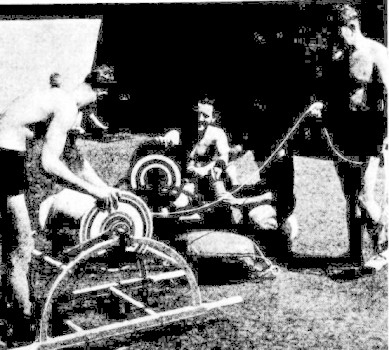
Bronte lifesavers (left to right) Vic Callaghan, Bronte, George Hulbert, Belmore, and Barry Hurt, Bronte, line up surfboards for overhauling and painting in readiness for the swimming season.


The Sydney Morning Herald
Wednesday 25 August 1954, page 3.

Sydney Lifesavers On B.B.C, Television
From Our Staff Correspondent.

LONDON, Aug 24 -
Four million television viewers in Britain next Saturday and Sunday will see Australian lifesavers demonstrate the techniques of surfing and surf rescues.
An Australia House official, Mr Allan Kennedy, a former Queensland and northern New South Wales lifesaver, has organised a team of 10 Australian surfers to give the demonstration at the beach at Bude, Cornwall.
Six Sydney surfers are in the team which will demonstrate surfboard and skiing, rescue work, body shooting, and how to pick a "shoot" from a "dumper "
They are: Col Hendy (North Bondi), Heaton Walsh (Freshwater), Ted Renshaw and Barry Cribb (Coogee), Harry Huck (Bronte), and Keith Perry (Bilgola).
Other members of the team are Maz Mainbridge (Western Austialia), Johnny Stubbs and Ken Sutherland (Queensland) and Gordon Rose (South Australia).
Two Sydney gills, Elizabeth Robeits, of Palm Beach, and Joan Leslie, of Coogee, will also take part in the demonstration.


The Sunday Herald, The Sydney Morning Herald and The Australian Womens' Weekly.
1950, 1951, 1952, 1954.

Return to Surfer Bio menu
surfresearch.com.au
home catalogue history references appendix

Geoff Cater (2011) : Newspapers : Surfing, 1950.
http://www.surfresearch.com.au/1950_Newspapers.html