newspapers : 1912
| home | catalogue | history | references | appendix |
|
surfresearch.com.au
newspapers : 1912 |
|
|
|
|
|
|
|
|
|
|
|
|
|
|
|
|
|
|
|
SWIMMING
NORTH STEYNE SURF CARNIVAL,
HEAVY SEAS.
WATER EVENTS POSTPONED.
With a
black north-easter blowing, rain falling and the sea
becoming rougher and rougher, the North Steyne Surf and
Life-saving Club was unfortunate in connection with its
fifth annual gala.
Despite the
conditions, however, about 1000 people paid for admission to
the carnival on the beach, and there were many more outside
the enclosure.
Whilst the
fourth event was in progress rain fell, and most of the
spectators left.
At this
stage it became necessary to postpone the water events as a
strong current was sweeping from north to south along the
beach at a very fast rate, and in the rescue drill, great
difficulty was experienced by the swimmers in making the
buoy.
The current
took them a good deal out of their way, and unless they were
fortunate enough to reach it at the first attempt, there was
no possiblity of again getting there.
All the
beach sports, however, were carried out, and the
arrangements generally were complete.
Events were ahead of schedule time in the majority of instances, results and happenings were clearly announced by megaphone, and the result board was placed in a most prominent position.
In the adverse circumstances the club did well to make a success of the gala.
The officials were:- Director, O. G. H. Merrett; assistant director, L. V. Hind; referee. J. Lord; starter L. W. Abel; check starter, R. D. Doyle; time keepers, F. C. Williams, G. Cohen, A. A. Watson; judges for water events, C. D. Patterson, I. Hayden, D. Slyer, S. Fullwood; judges for beach sports, C. Martin, L. C. Ormsby, W. Kellam; megaphone operator, E. H. Reeve; result steward, W. C. Fisher; ??? secretary, E. M. V. Shorewell.
Results:
Grand parade
and march past of surf clubs in costume, and with all
lifesaving gear and appliances. Five teams turned out, and
both North Steyne at Manly Life-saving clubs made a very
effective display.
The judges
awarded first prize to the former and second to the latter.
Junior Alarm
Reel Race (under 16 years of age).-
The reels
were placed some distance up the beach, and the teams
mustered at water's edge.
At the
starting signal the teams rushed to the reel, and the
beltman was required to swim to buoy anchored about 20 yards
out.
Two teams
competed- North Steyne and Manly Seagulls.
At the first
attempt neither beltman reached the buoy, and, as the
current was rapidly sweeping both farther away, the effort
had to be abandoned.
At the
second attempt, however, Manly Seagulls' representative
reached the buoy, and thus won.
Fancy Dress
Parade.-
Eight
characters paraded, the award of the judges went to R. O.
Farrell (clown).
Rescue and
Resuscitation Competition for Begg's Shield.-
Owing to the
heavy current running from north to south, the reels had to
be placed at the extreme north of the beach, whilst the
buoy, at which the rescue had to be made was anchored at the
southern end.
Only two
heats were disposed of, and it was then decided, owing to
the heavy and dangerous seas, to postpone the final until a
future date.
As this is
one of the most important surf competitions of the year, it
is regrettable that the conditions were such as to make this
course necessary.
First heat:
North Steyne (holders of shield), North Bondi, 2.
Second heat:
Freshwater, 1; Coogee Surf and Manly Life-saving, dead
heat, 2.
Wheelbarrow
Race.- A. F. Davis and W. Allison (North Steyne), 1; W. R.
Davis and R. T. Beale (North
Steyne), 2.
300 yds
Beach Relay Race.-
First heat:
J. W. Wilkins, W. Morgan, E. Nicholls, H. Nicholls (North
Steyne), 1; S. M'Kelvey, K. G. Childers, R. Miller, F.
Lancellen (Manly L.S.C.), 2.
Second heat:
S. C. Wright, A. Wright, J. B. Westwood. V. Rowlands (Manly
L.S.C), 1; A. Kelly, W. H. Allison, F. Bruce, H. Taubmaan
(North Steyne), 2.
Third heat:
A. F. Davis, H. Davis, H. J. Filschie (?), C. Hind (North
Steyne), 1; C. G. R. Wilson, G. M'Kay, R. T. Beale, G. H.
Betts (North Steyne), 2.
Fourth beat:
F. H. Falls, P. Thompson, N. Holmes, W. P. Pigott (Manly
L.S.C.), I; P. Piddington, H. Crispe, C. Michelson. H.
Skinner (Manly Seagulls), 2.
Final: JF.
W. Wilkins, W. Morgan, E. Nicholls, H. Nicholls (North
Steyne), 1; S. C. Wright, A. Wright, J. B. Westwood. V.
Rowlands (Manly L.S.C), 2; C. G. R. Wilson, G. M'Kay, R. T.
Beale, G. H. Betts (North Steyne), 3.
The surf
boat display by Mr. Fred Notting in the 'Big Risk' canoe,
and the display by Mr. T. Walker on the Hawaiian surf board
had to be abandoned, owing to the unsuitable weather.
Mr. Notting
rowed his boat from South Steyne, but, in attempting to come
in on a wave, was upset, and he seemed at one time to be in
difficulties.
The North
Steyne team prepared to go to his assistance, but Mr.
Notting reached the shore unaided by clever use of the
current.
A display,
however, was out of the question.
Obstacle
Race.- H. Davis (North Steyne), 1; J. W. Morgan (Manly
L.S.C.), 2.
Pillow
Fight.- B. Kirke (Manly L.S.C.) and F. A. Davis (North
Steyne), tie.
Tug of War.-
North Steyne defeated South Steyne.
The alarm
reel race and the surf and beach race had to be abandoned,
but several prominent surf swimmers gave an exhibition of
shooting the waves.
SHALL KAHANAMOKU BE SENT TO SWIM IN OLYMPIC TRIALS?
It looks,
from present indications,that unless some steps are taken at
once to secure funds to send Duke Kahanamoku, Jr., to the
Coast to take part in the Olympic trials next month the
project will fall through.
There is
about $230, the proceeds of a benefit sporting event, to the
credit of the fund, and the Hui Nalu are thinking of giving
a benefit performance of some kind in the near future.
George
Freeth is also trying to get Duke to the Coast to fill a
position in connection with one of the California baths.
It would be
a good thing for Hawail from an advertising standpoint if
Kahanamoku were sent to San Francisco to take part in the
trials.
Win or lose,
he can be relied on to make a creditable showing.
If he goes
up, however, a manager must accompany him, who will look
after his interests and put him next to the wiles and
wrinkles of important amateur athletic competitions as
conducted on the mainland.
In the
coming trials competition will be as keen as mustard, and a
little Intelligent coaching by one who knows is apt to make
all the difference between winning and losing on the
Hawaiian's part.
A trick of
the game overlooked might put the local man in the
background instead of in the limelight, where many think
that he rightly belongs.
Kahanamoku's
coach would have to see that his charge in no way violated
his amateur status, a thing which, on account of his
practical ignorance of the game, he might very easily do,
and with the best intentions in the world.
George
Freeth undoubtedly means well by offering to take Duke under
his wing, but it is a safe bet that he would be classed as a
professional within a month after his arrival in California.
Freeth sees
a chance for the native to make a nice piece of money in
California aquatics and incidentally an opportunity to
profit
himself
through intelligent exploitation of Duke.
Of course,
from a professional stand point, this is all well and good,
but if Kahanamoku is to go to San Francisco and
perhaps later to Stockholm on an amateur errand he must
leave Hawaii under proper auspices.
There is
reason for believing that W. T. Rawlins, an old Yale man, an
admirer and believer in Kahanamoku, and one well versed in
every phase of amateur athletics, contemplates a trip to the
Coast shortly.
It would be
an excellent thing, providing the financial obstacles were
overcome and Mr. Rawlins were willing to have him take
Kahanamoku under his wing and esquire him while away.
A thousand
dollars is needed to send Duke away and to bring him back
again.
An extra
five hundred wouldn't hurt a little bit.
If
Kahanamoku would make a proposition to swim a trial hundred
yards before the best dockers in town, and succeeded in
coming reasonably near to his recent record-breaking
figures, there is no doubt that the necessary funds could be
raised within a week.
Chronicling America
The
Hawaiian star. (Honolulu [Oahu]) 1893-1912, January 04,
1912, SECOND EDITION, Image 3
Image and text
provided by University of Hawaii at Manoa; Honolulu, HI
Persistent
link: http://chroniclingamerica.loc.gov/lccn/sn82015415/1912-01-04/ed-1/seq-3/
PROMOTION COMMITTEE HEARS RESULTS OF ITS GOOD WORK
Swimming Carnival
Football.
FIXTURES FOR TODAY
Centrals v.
Railway Workers, at Grafton Oval, to-day:
...
Centrals
will be represented by: ... C. Walker,
1912
'Football.', Clarence and Richmond Examiner (Grafton, NSW :
1889 - 1915), 15 June, p. 11, viewed 9 June, 2012,
http://nla.gov.au/nla.news-article61659958
And:
Tho
following is the list of further donations received in aid
of St. Mary's now church up to, and including Friday, 23 rd
May:-
...
Mr. C.
Walker, sen. 16 - 6- 6.
1913 'St.
MARY'S CHURCH.', Clarence and Richmond Examiner (Grafton, NSW
: 1889 - 1915), 27 May, p. 2, viewed 9 June, 2012,
http://nla.gov.au/nla.news-article62063540
And:
Fire at Dorrigo.
Last week
at Dorrigo, a building known as, the Shack, evidently the
abode of a number of voung bachelors, and owned by. H Mr. F.
Harrigan, was burned to the ground.
Mr. C.
Walker was the sole occupant of the building when the fire
was noticed (about 3 a.m.), by Mr. Spratt. and the sleeper
was quickly aroused.
About
£70 worth of wearing apparel was lost, also £20 in notes,
some silver, beds, bedding, tables, chairs, crockery, gun,
School of Arts secretary's books; etc.
Besidès
this, Mr. Chas. Walker, local officer in connection, with
the forestry Department, lost valuable forestry books and
papers. The building was insured, but the bachelors are
mourning their losses.
1913 'Fire at
Dorrigo.', Clarence and Richmond Examiner (Grafton, NSW : 1889
- 1915), 21 June, p. 4, viewed 9 June, 2012,
http://nla.gov.au/nla.news-article62065107
And:
Kyogle, 702
tons; Capt. Farrell, crossed the bar at 6 a.m. yesterday.
Passengers -
..., C. Walker,
1913
'SHIPPING.', Clarence and Richmond Examiner (Grafton, NSW :
1889 - 1915), 12 August, p. 4, viewed 9 June, 2012,
http://nla.gov.au/nla.news-article62068026
And:
The monthly
meeting of committee was held at the Club shed last evening,
Mr. C. G. Norrls, (hon. treasurer) presiding.
...
The
following new members were elected : Active, H. C. Makinson,
F. J. Barnard and J. Anderson. Honorary, C. Walker and E.
Syer.
1913
'CRICKET.', Clarence and Richmond Examiner (Grafton, NSW :
1889 - 1915), 2 December, p. 8, viewed 9 June, 2012,
http://nla.gov.au/nla.news-article62073960
And:
... and C. Walker was transferred from the honorary to the active list.
Trove
1914 'Grafton Rowing Club.', Clarence and Richmond Examiner
(Grafton, NSW : 1889 - 1915), 6 January, p. 7, viewed 9 June,
2012, http://nla.gov.au/nla.news-article61622650
GRAFTON DISTRICT
Electors of the Clarence have subscribed a New Year's gift of £180 for Mr J. McFarlane, M.L.A., in appreciation of services rendered by him in the capacity of Parliamentary representative for 27 years.
Owing to the absence ot rain, the early maize crops on the Clarence have been greatly depreciated, and in places are being cut down for stock.
Copmanhurst Shire Council have levied a rate of 2d in the £- on unimproved values, and Grafton Municipal Council a rate of 4d in the £.
The
lighthouse keepers on South Solitary Island, near
Woolgoolga, have presented Mr. C. S. McKay with a surfing
canoe as a surfing gift tor Christmas, in recognition of his
services in furnishing them with information by means of the
Morse flashlight svstem.
The
islanders are seven miles from the land on almost
unapproachable rock, and are very much isolated, so that
news communicated to them in any form is greatly
appreciated.
KAHANAMQKU
IS
NOW
OPENED
Tho Public
Service Association
places today
at tho disposal of the
comltteo for
raising funds to send
DukeKahanamoku
East,
resk room
and a
stenographer.
In addition,
it is sending out a re
quest to
each of tho allied organiza
tions of tho
public service that they
make
appropriations.
It is
practically certain that tho
Trail and
Mountain Club, the Outrig
ger Club,
the Boy Scouts, tho Hands
Around the
Pacific Club, tho 100,000
Club, nnd
possibly tho Civic Federa
tion will
ench contribute a specified
sum.
Members of
the allied organizations
will also be
aBked to contribute. Fran
cis Bodge",
who Joined the Trail and
Mountain
Club ns a junior member,
has started
tho ball rolling in that
organization
with a five-dollar sub
scription,
and Mr. Dickey of the Civic
Federation
has sent his check for a
larger
amount. The Trail and Moun
n
tain Club
will probably make Its ap
propriation
today, as will the 100,000
Club. The
directors of tho Outrigger
Club meet
Wednesday when tho mat
ter will bo
brought up.
Anyone
wishing to phono encour
agement can
do so by calling up 330C
or calling
In person nt the Public
Service
rooms on King street.
John Sopor,
of the A. A. U., B. von
Damni of the
Promotion Committee,
and A. Q.
Marcallno, of the Hut Nalu,
will receive
and solicit subscriptions.
"There is
somo talk of sending
'Dude'
Lemon, the ex-champion surfer, with Duke to tho coast," said
Alex
ander Hume
Ford this morning.
" 'Dudo' Is
still tho most skilful canoe I
man nt
Walklkl, and one of thebcst
swimmers nnd
trainers In the islands;
moreover, ho
has uphold the reputa
tion of
Hawaii many times in tho
states as a
marksman In rifle contests.
His services
can be secured as ho is
the constant
chum of Duke, and he is
an efficient
trainer."
Chronicling America
The
Hawaiian star. (Honolulu [Oahu]) 1893-1912, January 15,
1912, SECOND EDITION, Image 3
Image and text
provided by University of Hawaii at Manoa; Honolulu, HI
Persistent
link:http://chroniclingamerica.loc.gov/lccn/sn82015415/1912-01-15/ed-1/seq-3/
HUI NALU CLUB'S DANCE FOR JAN. 27
SWIMMING.
(By "Breaststroke")
The New
Zealand Swimming Championships, beginning on 15th February,
and continuing over four days, are apparently going to be
every bit the suncess they deserve to be.
The
Christchurch centre, which has, of course, the management of
the tourney is hard at work with the many arrangements to be
made.
The
programme for the entertainment of the visitors will be a
varied and comprehensive one, and will include driving
picnics, harbour excursion, visits to Sumner, New Brighton,
Belfast, Kaiapoi Woollen Mills, Islington, Riccarton
Racecourse, and several of the sporting stables at
Yaldhurst, with a theatre party, and probably a cricket
match and "social."
...
One of the
most pleasing as well as instructive items at a recent
Kaiapoi carnival was "the exhibition of life-saving given by
six members of the Christchurch Ladies' Life-Saving Club.
The methods
of release and rescue of drowning persons were thoroughly
depicted, and the rescued and rescuers were loudly cheered
at the conclusion of the display. .
The team was
under the command of Mr. G. E. Billson, instructor in
life-saving.
This week
there appeared a number of photographs in one of the New
Zealand illustrated papers showing bathers using surf boards
at New Brighton beach.
Perhaps a
word of warning would not be out of place.
Some
swimmers have imagined themselves in a very heaven of
surfing lying, kneeling, standing on surf -boards and flying
before the long low combers toward the beach.
And all this
the experienced surfer can accomplish without danger.
In the hands
of a tyro, however, the surf-board becomes an engine of
destruction.
Imagine a
board about five feet long, and an inch thick, weighted with
an eleven-stone man, hurtling down towards the small of some
unwary bather's back, and it is not difficult to understand
wherein the trouble lies.
Only last
week Sydney Sun had a word or two to say on the subject:
"Notwithstanding repeated cautions, a number of surfers will
persist: in using surf -boards, and a few instances have
occurred recently where people have been badly bruised by
careless breaker-shooters.
The
offenders usually choose a time when the police are away
from the beach.
The members
of the lifesaving clubs check the practice as far as
possible.
Let's hope
they'll "keep off the grass" in Wellington.
Arrangements
are well forward in connection with the combined carnival of
the Worser Bay Swimming Club and the Seatoun Athletic Club,
to be held at Worser Bay on Anniversary Day.
The entries
for the swimming events are very satisfactory, and include
several well- known swimmers from the town clubs.
During the
afternoon an exhibition of life-saving will be given.
The
foundation stone of the swimming club's new shed will be
laid by Mr. W. H. D. Bell, M.P.
A week ago
last Tuesday there was a mock sensation at Coogee, and the
few people on the beach witnessed what they at first thought
to be a surf tragedy, but which afterwards turned out to be
merely a thrilling incident in a biograph picture.
A well-known
city moving' picture company was busy preparing a big film,
in which a surf; tragedy is one of the features, and in
order that the acting would be done properly the services of
four of the members of the Coogee Surf Club were
requisitioned.
Shortly
after 4 o'oclock Messrs. Frank Baker, Jim Slattery, Arthur
White, and Jim Hughes went into the burf in a fishing boat,
which was capsized close to the rocks under the Surf Club.
There were
cries from the beach, and as the quartette played the parts
of drowning men a good deal of apprehension was felt on
shore as to their safety.
But while
they were still struggling in the breakers the biograph man
shut off his camera and the surfers climbed on to the rocks
without any trouble.
There they
stretched themselves out, and as the waves splashed on to
them the moving picture operator turned his handle again.
The incident
caused a sensation, at the outset, but the excited
spectators were quick to realise what was going on in front
of them, and afterwards enjoyed the acting that was
neceseary to complete the picture.
(Freshwater Carnival)
FRESHWATER SURF CARNIVAL.
LIFE-SAVING EXHIBITIONS.
The annual
Freshwater surf and life-saving carnival was held at
Freshwater Bay yesterday.
The event
was a decided success, and some excellent life-saving
exhibitions were given by the various clubs
The starting point of the carnival was the Manly Pier, where a fancy dress procession was drawn up prior to marching through Manly to the beach at Freshwater.
A large
crowd assembled to witness the carnival, its cliffs and
hills overlooking the beach being thronged.
The various
events were keenly contested and some fine feats were
performed by the visiting surf clubs.
The
competition for the Begg's Whisky Shield was decided and on
this occasion the trophv went to Bondi.
North Steyne
Life Saving Club were the previous holders of the shield.
A fine
exhibition of surf-shooting was given by Mr. Fred Notting in
the canoe "The Big Risk."
A programme
of music by the band of the First Australian Contingent was
rendered during the evening.
The results
of the competitions were: -
Fancy dress
parade: Indian Troupe 1; Best costume "The Rajah"; Best
sustained character J. Walker. wal»" Grand parade of surf
clubs: Manlv Life Savining, 1; North Steyne Life Saving
Club, 2; Freshwater Surf Club, 3.
Treacle
Apple race - E. Reddy (Freshwater), 1; Nicholls (N.S.), 2.
Rescue and
Resuscitation Competition - Bondi, 1 (Team T. Walker, G.
Lindsay, K. Grieve, J. Hunter, A. McPherson, J. J. Brown, A.
M. Langon), Manly A team, 2; Manly B team, 3.
Carry-your-chum
Race-
R. Bowden and C. Neilson (North Steyne), 1; W. Allison and
A. Davis (North Steyne), 2.
Obstacle
Race-
A. F. Davis (N. S.), 1; V. Allison (N.S.), 2.
Alarm Reel
Race - Manly No. 1 team, 1 (A. Wright, K. Childers, N.
McMillan, S. McCauliff) vii! <T->
Manly No. 2
team, 2; North Steyne No. 1 team, 3.
Cockfighting
on Back- Weiks and W. Walker (North Bondi), 1; A. F. Davis
and W. Allison (North Steyne), 2.
Pillow
Fight- A. F. Davis
Surf Race-
L. A. Hind (Norlh Steyne), 1; C. D. Bell (North Stevne), 2.
Twent seven
entered the competition for the surf race which the winner
succeeeded in pulling off with a good margin.
Pushball
Competition - Freshwater No. 1 team, 1; North Steyne No. 2,
2, North Steyne No. 3, 3.
VIC'S PICTURES IN PERTH.
QUEEN'S
HALL REOPENED.
LITTLE RALPH
WILLIAMS PERFORMS ACT OF HEROISM IN THE WAIKIKI SURF
You go and dive
for my father, low water Was reached at last and
ho Is drowning,
I'll tako the woman
In."
Thcso wore tho
words of little ftalph
Williams, tho
nowest member of the
Outrigger club
as ho strove to savo
tho life of
Mrs. Carlson at Waiklkl
beach Saturday
afternoon while ho
pleaded with
his companion to savo
the life of a
man who had sunk be
neath tho
waters and whom ho be
lieved wan his
father.
It was a
dramatic rescue from start
to -finish.
Thrco months ago young
Baluh Williams,
the son of the new
Episcopal
rector of St. Clements,
could not swim
a stroke. Lately ho
has been ono of
the Outrigger young
sters who go
out dally to battle the
waves. Ralph
had Jiwt come In at
sundown from
the big surf nnd was
dragging his
board up on tho beach,
when from far
out came cries for help.
Tho boy thought
someono was playing
In tho surf.
Alexander Hume
ford was also on
tho beach In
his bathing suit nnd,
seizing tho
smallest canoe on tho
beach by Its
outriggers, ho ran down
tho strand with
It and plunged into
the water.
Calling to young Williams
Duke Kahannmoku
came up and took
tho woman on
his board until he could
lift her In his
arms and wado to the
beach, tho man
In tho meantime seek
ing to caro for
himself, but tired out
ho was seized
with cramps and again
tho little
ennoo had to go to his res
cue Finally
both tho drowning people
were Enfely
brought to the beach and
the native boys
were sent out In a
canoe to noarch
for tho missing body
of tho drowned
man, who It was learn
ed from White,
who was rescued, -was
bugler Shaffer
from tho Colorado. Tho
two men from
the Colorado were In
swimming and
heard tho cry of a wom
an In distress.
They put out In her di
rection and
found Mrs. Carlson strug
gling in tho
waves far beyond her
depth. White
wns the better swim
mer and took
chnrge of tho woman,
lie know his
ch'um was drowning, but
could not let
tho woman go. He called
for help, but
tho place was far out and
It Is probable
that tho first cries were
not heard.
The natlvo boys
searched for the
body In a
canoe, but on account of
the muddlness
of tho water believed
to follow on
his board he paddled for, tQ and
it.n l An .In
Hint linlUinM 1111 ntlfl ' c
tho two heads
that bobbed up and
down at sea.
It was seen
now, by those ashore,
that there were
three drowning peo
ple, two men
and a woman. From
everywhero
people now hurried to the
beach. The
little canoe and the board
raced for the
drowning trio. Tho ca
noe reached ono
man and the woman
as the man' had
given up and wis
going down
while the woman floated
for a moment
nnd sunk. Ford suc
ceeded In
supporting the man ani
woman by
holding on to the canoo
until Ralph
Wllllums arrived with the
board, when
placing the unconscious
woman on tho
board ho turned to the
man.
"Never mind
about me," cried tho
feel along the
bottom. A patrol was
sent from Uie
Colorado to search for
tho body, but
up to thto morning It
had not been
recovered.
Speaking of the
rescue this morning
Alexander Hume
Fora said: "To re-
. allze that a
thirteen-year-old boy could
display the
true grit and bravery
shown by young
Williams must make
every member of
tho Outrigger club
feel proud or
th0 organization that
develops sucb
youngsters. The little
chap believed
that his father was
drowning, but
he had been given the
duty of saving
tho life of a woman
and he stuck to
it. Alone for at lec.it
five minutes
this little fellow In water
beyond his
depth kept an unconscious
woman on his
surf board, while a
drowning man.
"I'll try to hold on to (lrownlng nlnn aiso clung to the
little
tno uoara, out
mere s a man out mere, rlnnk an(1 he (lrovo that 1)oard wlth
ho's gone
down."
"My father is
out there, there Is no
ono else,"
cried young Williams. "Yon
go
tho woman in."
Ford know that
ho could leave both
tho man and tho
woman to such a boy,
so ho clambered
Into the cockle shell
canoo and
paddled out to dive for the
man who had
given his life In an at
tempt to save a
woman. But the water
was murky, and
after, ono leap in the
its human
freight toward shore and
reached shallow
water before any
crown ncrson
was succc.isiui in
and dive for my
father, I'll tako u out t0 glvo a hand It ls some.
thing for a
small boy to have to his
credit that,
now to the ocean, he has
saved two human
lives, but, come to
think of it, it
has invariably been the
small boys at
Waikiki that have done
the life
saving. There aro the Hus
taco boys with
a score of life savings
in thAlr
credit, and none of them twen-
water Ford
found that, where it had ty years of nR0 yet nt j takc off my
hnt tn voiinn
Italnh Williams. He be-
been
.-shoulder deep a fow weeks ago,
an ocean
current had washed away
tho sand until
It. was beyond his depth.
Onco more ho
got Into' the canoe nnd
paddled back,
to secure the native div
ing boys. Ho
found young Williams
still handling
tho two drowning peo
ple, tho woman
on his board and tho
man clinging to
It, tho boy pushing thP
board forward
as hard as ho could
through water
beyond h'.i depth. Shal-
lieved his
father was drowning but did
not tor a
moment desert tho woman
under his
charge or swerve a second
from his dutv.
I am proud of the Out
rigger club and
tho manly boys it
develops."
Chronicling America
The
Hawaiian star. (Honolulu [Oahu]) 1893-1912, February 05,
1912, SECOND EDITION, Image 6
Image and text
provided by University of Hawaii at Manoa; Honolulu, HI
Persistent
link: http://chroniclingamerica.loc.gov/lccn/sn82015415/1912-02-05/ed-1/seq-6/
SWIMMERS MAY GET AWAY TOMORROW
No cable
relative to the dates of the Olympic Games swimming trials
is received by the local A. A. U. officials today.
Duke
Kahanamoku and Vincent Genoves will leave for the mainland
by U. S. S. Sierra sailing tomorrow morning.
Now that the
money for their expenses has been subscribed the Hui Nalu
members are strongly in favor of getting the swimmers away
tomorrow in order that no chances may be taken on missing
the dates of the try outs.
The A. A.
U. people at this end are up in the air as far as definite
information as to the dates of the Olympic trials is
concerned.
They cabled
for the dates of the "swimming championships" and have
received them.
Now the
question that is agitatlong them is whether the Olympic
trials will be combined with the annual A. A. U.
championships or will be a separate competition.
If the
former is the case Kahanamoku and Genoves will be out of the
Pittsburg events on February 22, which will consist of the
220 and 500 yards.
Entries for
these races may be in a week ahead and this puts the local
boys out of it good and effectually.
In Chicago
on the 28 inst will be contested the 50 and 100 yards
events.
Kahanamoku
will be able to swim in these events but there will be
nothing for Genoves except to keep Duke company and cheer
him up.
W. T.
Rawlins will accompany the swimmers and he is busy today
purchasing seasonable clothes for them and other necessary
supplies.
LONGWORTH IS FAST SWIMMER
At a
swimming carnival held last month In Sydney for the benefit
of a fund for the purpose of sending a team of Australian
swimmers to Stockholm to compete in the Olympic Games in
July, some fine performances were put on record.
W. Longworth
won the 440-yards championship of New South Wales in 5: 26
2-5.
His
time is only 2 3-0 seconds outside Frank Beaurepaire's
world's record, equaled T. S. Battersby's English record and
was some seconds better than the American record held by C.
M. Daniels.
In the mile
race, Longworth won again his time being
24minutes 45 seconds.
The
Australian record is to the late "Barney" Keirnan's credit
at 23 minutes 16 4-5 seconds.
The 220-yard
race was also won by Longworth.
Time 2: 27
2-5.
This
constitutes an Australian record.
In the
100-yard championship Longworth swam the distance in 56 2-5
seconds, setting a new Australian record for the distance.
SWIMMERS IN PUBLIC TRY OUT
In the
presence of about 2000 persons Duke kahanamoku and Vincent
Genoves gave a free swimming exhibition in the Bishop slip
yesterday.
Duke swam
100 yards in 57 2-5 seconds and fifty and fifty yards in
twenty-five seconds.
Vincent swam
half a mile in 14:56 1-2.
The
following figures will be interestlng for purposes of
comparison:
100 Yards
Kahanamoku's
record
...
55
2-5.
Yesterday's
time
...
57
2-5.
American
amateur record, in tank ... 56.
50 Yards.
Kahanamoku's
record
...
24
1-5.
Yesterday's
time
...
25.
American
amateur record, in tank ... 25 4-5.
Half-Mlle.
Genovos'
record
...
13.36
1-5.
Yesterday's
time
...
14:56
1-2.
American
amateur record, in tank ... 11:44 4-5.
The timers
were Messrs. Chilton, Hollinger, Hustace, Farron, Mayne,
Lightfoot and Johnson.
The
exhibition was conducted under the auspices of the Hui Nalu.
Major Hill
of tbo U. S. S. California acted as starter.
H.
Blackstone of the S. S. Kukui presided at the finish and
John C. Anderson was the announcer.
...
Colorado Seaman Drowns at Walkiki in Effort to
Save Woman From Same Fate.
COMRADE BARELY ESCAPES
Volunteers From Fleet Search All Night for
Body, but Without Success.
(From
Sunday's Advertiser.)
In an
effort to rescue a woman from drowning before their eyes
late yesterdayafternoon, one seaman of the Colorado was
drowned off the Moana Hotel and another came so closo to
death that for n time it looked as though he, too, was to
die.
The dead man
is Frederick Shaffer, aged 26, a bugler on the cruiser, and
his mate, who risked his life to aid him, is E. Wright,
another bugler of the same ship.
The woman
whoso danger led Shaffer to his end is Mrs. Carlson.
Late last
night she was reported to be recovering from the shock to
her nerves and the sea water she swallowed.
Although a
patrol party of twenty men, under the command of Midshipman
Esling, sent out to patrol tho beach from the Seaside Hotel
to the Inn, stripped and swam and dove all over the section
ot water between tnose two points inside the reef the body
of Shaffer bad not been recovered at the time of going to
press.
The work of
the patrol lasted for hours under the light of the early
moon, and will be resumed again this morning.
Screams for Help.
Mrs.
Carlson's screams for help and her frantic efforts to lift
herself out of the water when she found herself going down
attracted the attention of a large crowd at the beach
shortly after five o'clock.
Shaffer nnd
Wright were nearest to the sinking woman and without
hesitation they dashed into the sea.
She was then
about one hundred yards off the end of the concrete wall
that runs into the sea.
A number of
other bathers also nuiflo for the woman but Shaffer
and Wright reached her first.
Neither or
the men were good swimmers apparently, for hardly had they
got their hands upon her when they all three sank.
Wright, the
stronger, managed to struggle to the surface, still clinging
to the woman, just as Alexander Hume Ford in an outrigger
canoe, came surging up beside him.
Ford sjiranc
out of his canoe into the wnter and swimming an overhand
stroke, reached Wright and his burden in time to keep the
bugler from sinking a second time.
Boy to the Rescue
When he
left the shore at the first alarm Ford had had presence of
mind enough to call out to Ralph Williams, a boy who had
been a member of the Outrigger Club but a month, to come out
with a surfboard.
Williams
obeyed and paddled out to the struggling trio just as Ford
was himself becoming exhausted with his efforts to support
the other two.
Mrs. Carlson
was still struggling wildly with her rescuers and it was
with dtfflculty that young Master Williams and Ford managed
to get her on the surf board.
Then, while
Williams and Wright paddled slowly back to shore Ford began
the search for Shaffer's body.
Even in the
excitement of the moment Wright did not forget his companion
and begged Ford to save Shaffer.
In the
meantime Duke Kahanamoku had been summoned from the
bathhouse where he had been changing his clothes, and
arrived at the beach in time to aid Williams and Wright,
almost spent, struggling in towards shore.
He went Into
the water and helped them ashore with their load.
He picked up
the unconscious woman and carried her into the hotel where
she was at once taken upstairs to a room and cared for by
the housekeeper.
Later in the
evening she was brought into town.
No Trace of Shaffer.
Duke, after
leaving the woman in good hands, went back to where Ford and
a number of other bathers were busy trying to find the body
of Shaffer, who had never shown his head above water after
the fatal last time down.
Other
Hawaiian swimmers joined in the search, but do what they
could they could not discover a trace of the body.
As soon as
the accident was reported on the Colorado, volunteers were
asked for to patrol the beach, and twenty men were selected
of the crowd that came forward.
They did not
know what they were going for, but volunteers were asked and
every man of them was ready for work of any kind.
Esling In Command.
Midshipman
Esling took command of the party, which arrived at the beach
before soven o 'clock, and started in their gruesome work.
Men were
detailed in twos to patrol duty, others were told to wade
out as far as they could, and still others, the best
swimmers, went out farther and by diving tried to locate
Shaffer's body.
For two
hours they kept up the diving work, and then patroled the
beach for five hundred ynrds in each direction for hours
watching for the first glimpse of the body to be given up by
the waves.
Shaffer was
born in Wilkesbarre.
He had
served in the navy for three years and seven months and was
a bugler on board the cruiser.
It is
expected that the body will be found today and burial will
take place in the narval plot in Nuuanu cemetery.
Chronicling America
The
Hawaiian gazette. (Honolulu [Oahu, Hawaii]) 1865-1918,
February 06, 1912, Image 3
Image and text
provided by University of Hawaii at Manoa; Honolulu, HI
Persistent
link:
http://chroniclingamerica.loc.gov/lccn/sn83025121/1912-02-06/ed-1/seq-3/
KAHANAMOKU TELLS OF SHARE IN RESCUE
Serious
criticism has been aimed at young Duke Kahanamoku for an
alleged refusal on his part to dive for the body of Roderick
Shaffer, the navy bugler drowned at Waikikl Saturday, when
there was still a possible chance that the man's life could
be saved.
Statements
havo been freely made that young Duko based his refusal on
the ground that the water was too muddy and that he would be
unable to see.
Duke's
statement was taken yesterday.
He says:
"I was, in
the Moana dressing to go downtown," said Duke, yesterday,
"when some one rushed in and said that there was a woman
drowning, asking me to come out and 'get' her, I went
outside and saw her struggling in the water and at once
rushed in and put my tights on, got my surf board and
started out after her.
"I reached
the spot at the same time that Ford and Ralph Williams did.
I got the
woman's arms around my neck and was helped in with her by
the others.
They were
slow and she was becoming unconscious as I finally got her
to the bath-house.
Some one
dressed her and I was asked to carry her up to a room in the
Moana which I did.
Then I went
out again and I heard there was a man missing.
I and other
Hui Nalu boys saw two sailors on surfboards a long way out
and drifting out to sea.
They were
unable to get back and so I and the others went out and
brought them back.
"I was asked
to dive for the other man as I was carrying the woman in.
The water
was very muddy and I knew that nothing in it could be seen,
and as I went I told the other Hui Nalu boys who were on the
beach to keep a watch all over and look for any commotion
anywhere.
Thrre -were
plenty of other people on the beach."
Chronicling America
The
Hawaiian gazette. (Honolulu [Oahu, Hawaii]) 1865-1918,
February 06, 1912, Image 5
Image and text
provided by University of Hawaii at Manoa; Honolulu, HI
Persistent
link: http://chroniclingamerica.loc.gov/lccn/sn83025121/1912-02-06/ed-1/seq-5/
MILLER WILL ACCOMPANY SWIMMERS
Duke
Kahanamoku, Jr., and Vincent Genoves will leave for the
mainland by the S. S. Honolulan sailing tonight.
They will be
accompanied by Lew G. Henderson and "Dude" Miller.
It was
decided at the Iast moment to send Miller along.
He knows the
boys intimately and can talk Hawaiian, a fact which should
be of great help to the expedition as far as Kahanamoku is
concerned.
Miller is
president of the Hui Nalu, under whose auspices the two
local boys are being sent to the mainland.
Entries
were cabled last night by John Soper as follows:
Kahanamoku
50, 100 and 220 yards.
Genoves 500
yards and 800 yards should there be a race at the latter
distance
Henderson
and Miller will have their expenses paid, but will receive
no remuneration in the way of salary
The
following subscriptions to the expense fund were received
yesterday:
Morris
Rosenbledt, $10; Good Friend, $20; Woman's Auxiliary of the
Outrigger Club, $25.
While there has been some rather pointed discussion as to whom should accompany tho swimmers to the mainland and some little criticism, it should be remembered that the boys are being sent away by public subscriptlon and that they are going under the auspices of the HUI NALU, to whom the fund will be turned over, and NOT under the auspices of any local promotion body.
Chronicling America
The
Hawaiian star. (Honolulu [Oahu]) 1893-1912, February 07,
1912, SECOND EDITION, Image 3
Image and text
provided by University of Hawaii at Manoa; Honolulu, HI
Persistent
link: http://chroniclingamerica.loc.gov/lccn/sn82015415/1912-02-07/ed-1/seq-3/
THE DEPARTING OF THE SWIMMERS
The Hui Nalu and several hundred of the general public were present at the Matson wharf yesterday afternoon when the S. S. Honolulan pulled out for San Francisco with the Olympic games swimming expedition aboard.
Duke Kahanamoku and Vincent Gonoves were literally smothered with leis and were the recipients of countless good wishes from friends and well-wishers.
Lew G. Henderson and "Dude" Miller went with the swimmers in the capacity of guides, philosophers and friends.
Duke and "Zen" promised the crowd that they would do their best and Henderson said that he would see to it that they did, in as far as lay in his power.
The Hui Nalu gave their club yell, a quintette club sang "Aloha Oe,'' Berger's band struck up "Auld Lang Syne," and it was off and away with the speedy water artists on whom the Territory is banking to bring her much fame and advertisement.
Chronicling America
The
Hawaiian star. (Honolulu [Oahu]) 1893-1912, February 08,
1912, SECOND EDITION, Image 3
Image and text
provided by University of Hawaii at Manoa; Honolulu, HI
Persistent
link: http://chroniclingamerica.loc.gov/lccn/sn82015415/1912-02-08/ed-1/seq-3/
Note.
The party also
included a "paid" journalist from the Hawaiian Star.
OUTRGGER CLUB
ITS SHARE
With tho
assistance of tho ProniO'
Hon Committee
and the Public Serv
Ice Association
the Outrigger Club"dTd
its sharo In
entertaining tho Clevc-
landers.
Arrangements were mads
with Ell
Crawford to bring a village
full of his
Kallhl canoeists and their
families to
populate tho grass houses
at tho
Outrigger grounds and pull oft
all kinds of
native canoe races, but
Ell fell down
on his part of the pro
gram and It was
necessary to send a
hurry call to
Oahu College for young
Mnrston
Campbell and his cohorts to
come' down and
operate their surf
boards and
canoes In the waves.
Crawford did,
however, work per
sonally like a
Trojan, and later in tho
day several of
his standbys sauntered
down to tho
club grounds to help him
prepare and eat
the pig and pol. Ern
est Kant sent
his famous quintet, and
when tho
Clevolanders finished their
round of the
city at noon they were
landed at
Walklki Jn time to so Craw.
ford put the
finishing touches on lils
Imu and bury
tho taro with tho hot
stones under
the sand. After lunch
the pig was put
In tho bed of hot
stones and
sand-was piled over Mr.
Pig on his bed
of leaves.
While the pig
was being baked un
derground the
youngsters on tho club
got out their
canoes and surfboards
and did stunts
In tho surf. The Kn
mehameha
Aquatic Club boys were
afraid to bring
their canoes around
from Kallhl,
but the Outrigger young
sters made
nothing of toying with the
biggest waves
in sight with their
smallest
surfboards.
J When It came
to digging up the taro
pondlng It into
pol with tho old
. inntlve stone
pounders, the Cleveland-
to taking the
pig out of the imu, every
photographer
from the big cruiser
seemed to be
present. Everyone had
a taste of the
pig, and everyone de
clared that
never was there such a
pig. Many tried
pol but there were
I more frequent
comebacks for the pig.
Ernest Kaal's
quintet bethought them
of playing and
singing dance music
on the big
lanal, and the Clevolanders
'took to the
Idea with a vim. In the
SURF CARNIVAL.
"SEAGULLS" AT SOUTH STEYNE.
The fourth
carnival of the Manly season was held at South Steyne on
Saturday afternoon when the Manly Seagulls held their first
meeting.
A big crowd
witnessed the events, and the competitors had a very rough
time owing to the heavy sea breaking in at the southern end
of the beach.
Several
visiting surf club teams competed.
The beach
had been roped off with the permission of the local council.
The surf
race provided some very good swimming, and considering the
heavy rollers coming in, the competitors put up a splendid
performance.
S. Wright
(Manly Surf Club) won the event with L. V. Hind (North
Steyne) a close second.
The ground
parade and march past was a striking feature of the carnival
evoking applause from the spectarors.
The comic
element was largely introduced into the proceedings.
The winners
of the first prize in the fancy dress procession had a
tableau entitled "Caught 'pinching' in the Surf Club sheds."
The
submarine explosion conducted by the Royal Australian
Engineers was a decided novelty and passed off very
successfulIy.
Results :-
...
THETIS BEAR WILL BATHE
The revenue
cutter Thetis' pet bear will take the water at the Waikiki
Inn tomorrow afternoon.
By this be
it known that he will take the sea water and at anything in
the aerated line, thank you.
The bear,
whose name is Theophilus, named after the most excellent
Theophilus, is chiefly responsible for any measure of fame
which may attend the Thetis outside of Sailor Jenson, who
challenges.
It will ride
on a surf-board tomorrow, catch and devour a live chicken on
the silvery, sllvery sand, play with the children, say its
prayers, chew tobacco and perform a number of other
interesting feats.
Come early
and stay all the afternoon watching the instructive and
diverting antics of the only bear in Christendom who puts on
and takes off his own bathing drawers!
Chronicling America
The
Hawaiian star. (Honolulu [Oahu]) 1893-1912, March 01, 1912,
SECOND EDITION, Image 3
Image and text
provided by University of Hawaii at Manoa; Honolulu, HI
Persistent
link:
http://chroniclingamerica.loc.gov/lccn/sn82015415/1912-03-01/ed-1/seq-3/
Notes.
wikikpedia.org
http://en.wikipedia.org/wiki/USS_Thetis_%281881%29
McMaster
University
http://digitalcollections.mcmaster.ca/case-study/charles-bertram-jones-and-hms-marlborough
Tigerfriends.com
http://www.tigerfriends.com/bears.html
The station chose August to begin honoring James Matthias Jordan Jr.'s introduction of surfing to the Atlantic coast. He received a surfboard from an uncle in 1912.
The Virginian-Pilot ( http://bit.ly/NejQ1S) reports an exhibit at the station includes old photos, surfboards and images of some of Virginia Beach's surfing legends.
The exhibit
opens Tuesday and runs through Oct. 14. It costs $4 for
adults, $3 for seniors and military members, and $2 for
children under 18. It's free for children under 6.
CHICAGO TESTS NEXT THURSDAY
According to Lew G. Henderson, manager of the Hawaiian swimming expedition, Secretary Levy of the 1915 exposition states that he will put on an exhibition of surf-riding, canoe surfing, body surfing and diving and swimming during the fair and that an expert team from Honolulu will be invited to visit the Coast to take part in these aquatics.
The reason
why Kahanamoku and Genoves will swim in Chicago on March 12
and 13, is that President E. C. Brown announced that the
Chicago tests for the Olympic swimming team would be held on
March 12.
This
announcement caused Manager Henderson change plans to have
his man in Chicago on that date to compete.
Chronicling America
The
Hawaiian star. (Honolulu [Oahu]) 1893-1912, March 06, 1912,
SECOND EDITION, Image 3
Image and text
provided by University of Hawaii at Manoa; Honolulu, HI
Persistent
link:
http://chroniclingamerica.loc.gov/lccn/sn82015415/1912-03-06/ed-1/seq-3/
GENOVES
M. Frlotcls,
tho
record holder,
is
local athlcto
in receipt of
, tho folIowinB
letter from his brother,
Dr. H. E.
Frlcscl of Pittsburg, dated
February 20:
I
I Denr trank:
Messrs. Henderson,
didn't look mo
up, so I had Charlie
i Miller, who
is now director of nth
letlcs at the
University of Pittsburgh
land who was
referee at the races
country.
He swam well
with them but lost
ono and
one-half to two yards on
every turn. Ho
would swim up to the
wall, then a
yard along the wall anil
than out.
Ho was beaten
about twenty-five
yards in lite
heat, but as there were a
good many turns
you can see where
he lost out.
Also the officials missed
the count and
uis heat ran eleven
trips, instead
of ton. I kept count
myself and was
probably the only one
horo who knew
of the error.
l talked to
Duko on Friday night
nnd told Mr.
Henderson how to watch
him on his
enting especially when ho
is getting
strango cooking every day.
Advised him to
cut his rations In half.
I guess It must
hnvo helped his con
dition some as
he certainly mado
good Saturday
night, by winning his
heat in tho
fifty yards by four yards
In tho finals
he won the fifty yards
and tho 100
yards by about two feet
each. He was
swimming against a
Chicago
Athletic Club man who, I un
derstand, holds
the A. A. U. record at
fifty yards.
The place was
filled with a nice
crowd of
spectators, and Duko was
brought out
wrapped in tho American
flag and
introduced by A. R. Hamil
ton. He had the
crowd with him from
tho start, and
he certainly can swim.
Ho only did
fnlr on tho turns but
mado up on tho
straight-nway. The
Chicago man was
awful close to him,
however.
We invited the
whole party over to
Asplnwall for
dinner on Sunday, but
as Mr.
Henderson was anxious to take
them to
Philadelphia, and wanted to
make a daylight
trip of it, we didn't
have the
pleasure of entertaining
them ns we
would have liked.
Duke showed mo
his picture album.
When he gets
homo I want you to
have him
autograph ono of those
large photos
showing him standing on
his head on a
surf board, and send it
to me so I can
frame it for the of
fice. Your
brother,
DR. A. E.
FRIESEL.
Chronicling America
The
Hawaiian star. (Honolulu [Oahu]) 1893-1912, March 12, 1912,
SECOND EDITION, Image 3
Image and text
provided by University of Hawaii at Manoa; Honolulu, HI
Persistent
link:
http://chroniclingamerica.loc.gov/lccn/sn82015415/1912-03-12/ed-1/seq-3/
SHE ACCUSES TULLY OF STEALING HER HAWAIIAN IDEAS FOR PLAY
Chronicling America
Evening
bulletin. (Honolulu [Oahu, Hawaii) 1895-1912, March 12,
1912, 3:30 EDITION, Image 6
Image and text
provided by University of Hawaii at Manoa; Honolulu, HI
Persistent
link:
http://chroniclingamerica.loc.gov/lccn/sn82016413/1912-03-12/ed-1/seq-6/
http://www.ukulelia.com/2006/12/uncle-jack-and-bird-of-paradise.html
EXHIBITION SWIMS
Duke and
Genoves Remain for a Few Days - Henderson on Honolulan.
Lew Henderson,
manager of the Hawaiian swimming exhibition mhln.i to
John Soper yesterday that he is coming home.
Lew apparently
is passing up no more bots in the matter of cabling the
important things regarding the trip!
His brief
message, dated San Francisco, follows:
"Henderson
returning Honolulan
Duke Zon next
Lurhuc.'
This
information also arrived in Honolulu on Monday's mail through
a postal card addressed to A. Q. from Philadelphia!
it is supposed
that Duke and Genoves
have some
exhibition races on in San Francisco, and that they have
remained several days longer to add still further laurels to
those already won by the expedition, Genoves had a arrangement
for a swim with 'oinroy, the Olympic Club expert, and Duke
also probably has hit up an
arrangement for
competition with some of the Coast short distance men.
There isn't
any place in America now that hasn't heard of Hawnii's
world-beating swlmmor, and challengers will be legion.
This is the way
the press heralded the appronch of Duke in Chicago, after his
races in the west:
"Duke
Kahanamoku, the Hawaiian swimmer, accompanied by his manager,
Lew Q. Henderson, E. K. Miller; president or the Hui Nau
("Ocean Wave" Club) of Hawaii and Vincent Genoves, a distance
swimmer, arrived in Chicago yesterday. will practise nightly
in the new C. A. A. tank for the 100 and 50 yards
National A. A. U. swims in which he will compete, March
13.
"Kahanamoku,
is considered one of the best swimmers in the world and his
style is different from anything ever seen before in this
country. Unaccustomed to indoor swimming, which differs
considerably from that of outdoor, the dusky Hawaiian has won
every race which he entered in since his arrival in this
country, with the exception of a 220-yard swim at the
Pittsburgh Athletic Club, Feb. 22.
On this
occasion he was taken with cramps in the nun lap and quit, in
an invitation meet, Feb. 25, he led the spocdioU of the
Pittsburgh swimmers to the tapo in tho nnd tho 100-yard
dashos, making
0:25 and 0:57 2-5 respectively.
In a Tnca with
Goodwin
and Frizdllo at
tho City Athletic Club
meet in JNcw
York no won tlio 100-yard
swim in 0.57
2-5.
' ' An idea of
what the Hawaiian wonder can do in a straightaway race may bo
obtained by what he accomplished in an Invitation meet at the
University of Pennsylvania tank Feb. 27.
This tank is
100 foot long and in a match with Shyrock, the eastern uiu
ciitiuiiuuu, nu swam mo iirsc 1UU
foot in 0:1'4
1-5 and won tho raco With
a mnrk .of 0.50
2-s.
"Kahnnamoku'8
first raeo tigninst
timo wns Aug.
12 at Honolulu. Until
that timo tho
swarthy natator was
satisfied to
surf rldo with tho natives
and swim
occasional match races
against thorn.
Although ho is pear of
tlio Hawaiian
swimmers thoro aro, according
to hia
ninnugor, ninny moro in
Hawaii who
could comparo favorably
with tho best
in America,
Surf riding
is the national sport, and it is to early practise at the
game that Kahanamoku attributes his skill in the water.
From
earliest youth the natives of these islands swim in the surf
and thus acquire phenomenal skill as swimmers, canoe
paddlers and divers.
"Duko
Kalmnamoku is not a nativo
nobjo ns is
generally supposed, Dako
being his first
name. Ho is 21 years
old, six foot
tall and weighs 185
pound. It is
thh intention' of his manager,
to ontor him in
tho National A.
A. U. contests
with tho object of
sending him to
Stockholm with tho
American Olmpic
team to compete, (n
tho fifty and
100-yard swim evunts
"E. K.
Miller has promised S. Levi of the 1915 San Francisco Panama
Exposition committee, to bring over a number of the
representative divers, swimmers, surf riders and canoe
riders from Hawaii for exhibitions and contests with the
native 'waterdogs.' "
Chronicling America
The
Hawaiian gazette. (Honolulu [Oahu, Hawaii]) 1865-1918, March
22, 1912, Image 5
Image and text
provided by University of Hawaii at Manoa; Honolulu, HI
Persistent
link: http://chroniclingamerica.loc.gov/lccn/sn83025121/1912-03-22/ed-1/seq-5/
JUNE ELEVENTH
The A. A.
U.'s board of governors met yesterday afternoon and
discussed the date for this year's swimming championships.
June 11 has
been favorably considered as a date for the natatorial
competitions.
Representatives
of
the Healanis, Myrtles, Puunenes and Hui Nalu will get
together in a few days to make definite arrangements with
regard to the meet.
The rowing
championship will be decided as usual in September.
Last year's
swimming championships were held in August.
Chronicling America
The
Hawaiian star. (Honolulu [Oahu]) 1893-1912, March 26, 1912,
SECOND EDITION, Image 3
Image and text
provided by University of Hawaii at Manoa; Honolulu, HI
Persistent
link:
http://chroniclingamerica.loc.gov/lccn/sn82015415/1912-03-26/ed-1/seq-3/
NEW SURFING REGULATIONS.
The
Government has gazetted an ordinance relating to public
baths and bathing-places, but the only new feature is that
which governs surf shooting.
Clause 10
reads as follows: "Where any inspector considers that the
practiceof surf shooting (I.e.. riding on the crest of the
breaking wave), whether with or with-out a surf board, is
likely to endanger or inconvenience other bathers, such
inspector may order bathers to refrain from such practice or
to remove to a place where such practice will not cause
danger or inconvenience.
Bathers
shall comply with such orders.
Any
inspector may take possession of any surf board used in
contravention of his or another inspector's orders, and
retain it until the bather from whom it was taken resumes
his ordinary dress, or until such inspector considers that
surf boards may again be used without endangering or
inconveniencing the public."
Trove
1912 'NEW SURFING REGULATIONS.', The Sydney
Morning Herald (NSW : 1842 - 1954), 28 March, p. 10. , viewed
05 Nov 2016, http://nla.gov.au/nla.news-article15321075
SURF-BATHING NEEDS
The already
large nod constantly increasIng public interested In our
ocean beahes should welcome the bathing regulations gazetted
this week.
They cover a
good deal of ground, and, what is more important, in doing
so they touch most of the defects arising from lax
supervision of the benches.
Many of the
prohibitions are merely those which have long been
operating- in respest of public baths.
But, very
properly, the expansion ot the public bath into the national
recreation of surfing has been regarded as giving suftlclent
reason for extending those rules of the bath to the open
beaches.
Other of the
regulatIons are quite new, and as to those it is
satlsfactory to find that an embargo has been laid upon the
offensive surf-shooter.
While and
wherever surf-shooting is practised in an open bathing
space, collisions wilI sometimes be unavoidable.
The breakers
are no respecters or persons, and are not by any means to be
handled by government regulatlon.
Very otten
it is the sheer sportiveness of the incoming wave that
projects the shooter upon his unwary victim.
But
occasionally it is malice aforethought that sends a swimmer
hurtling upon the crest of a wave
straight and
swift to collision.
It is right
that a watch should be kept upon the practice.
As to the
use ot the surf board, it should not be allowed at all where
a number of bathers are congregated.
It was never
intended for crowded beaches, and its use by skilled native
swimmers as at Honolulu, Is safeguarded in the first place
by their skIll, and in the second place by the fact that
there are no such crowds to be negotiated as is the case
here.
Useful
provisions are to be noted also in regard to costumes,
sun-basklng, and the privacy
of
enclosures.
The
regulations repeat certain well recognised rules of
behaviour in public bathing places.
As to that,
perhaps the most frequent source or complaint now existing
is due to the presence or a rough element in the sheds and
enclocures.
It should be
made an important functIon of bath supervision to handle any
offensiveness so arising with summary vigour and despatch.
Surf-bathing
is much too valuable a recreation to be spoiled by the
hoodlums who are, after all, in a large minority by
comparison ith the beach-using public.
Many things
remain to be done, or course, before our surf-bathing can be
regarded as more than primitive in its establishment.
We have
ideal beaches, splendid water, and unsurpassed natural
surroundings generally.
What we lack
is the enterprise to turn them to best account.
The beach
provision in the continent of Europe and Amerlca would
astonish the municipal authorities of our ocean suburbs.
With
scarcely any of our natural provision to work upon,
enterprise and organisation have established in the thousand
places in other countries waterside resorts or superb
attractiveness. With us, Manly and Coogee and Bondi
remain very largely in their natural state, or, what is far
worse,
are
disfigured by the gross vandalism of the sheds that are the
only beach structures we appear to have thought of.
A seawall
cannot equip a beach as a recreation resort while there
remain above and beyond it desolate wastes ot rock and sand,
or unlovely lines of weatherboard shop fronts and
fragmentary trees.
We badly
need a landscape gardener for the beautification of many
aspects of Sydney.
Our beaches
in particular would provide him with a great opportunIty.
But their
worst need, at present, is an enlightened municipal control,
far-seeing enough to discern in them the possibilities that
have been so finely utilised in other beaches on other
oceans.
- Noted in S&G Champion: Drowning, Bathing and Life Saving (2000) page 179.
HUI NULA IS FLOURISHING
The Hui
Nalu, made famous by reason of the membership of Duke
Kahanamoku, intends to branch out in the near future.
It intends
to foster in the near future swimming, canoeing, rowing and
athletic sports generally.
At a recent
meeting the following officers were elected:
President,
W. T. Rawlins; vice-president, Lew G. Henderton; secretary,
William King; treasurer, Alex. May.
The club has
decided to look after the expenses of Duke Kahanamoku out of
its own treasury and will not appeal to the public again for
funds unless such becomes absolutely necessary.
There will
be a meeting of the club tomorrow night.
The club
intends to play a strong hand in the coming water carnival
at which the A. A. U. swimming championships will be decided
and expects to uncover another Kahanmoku in the sprint
events.
Chronicling America
The
Hawaiian star. (Honolulu [Oahu]) 1893-1912, May 07, 1912,
SECOND EDITION, Image 3
Image and text
provided by University of Hawaii at Manoa; Honolulu, HI
Persistent
link: http://chroniclingamerica.loc.gov/lccn/sn82015415/1912-05-07/ed-1/seq-3/
BEAR AT WAIKIKI.
The bear
mascot from the Thetis who afforded so much amusement to the
onlookers at the beach several weeks ago is scheuled to make
a second appearance in front of the Waiklki Inn at one
o'clock tomorrow afternoon, from which time until four he
will bathe in the surf, ride the breakers and otherwise
prove his entertaining qualities.
Visitors are
requested to equip themselves with a plentiful supply of
peanuts.
Chronicling America
The
Hawaiian star. (Honolulu [Oahu]) 1893-1912, May 10, 1912,
SECOND EDITION, Image 8
Image and text
provided by University of Hawaii at Manoa; Honolulu, HI
Persistent
link: http://chroniclingamerica.loc.gov/lccn/sn82015415/1912-05-10/ed-1/seq-8/
HUI NALU BENEFIT DANCE FOR MAY 25
The night
of Saturday, May 25, is the time finally set by the Hui Nalu
Club for the benefit dance which it is to give to raise
further funds for Duke Kahanamoku's trip to Stockholm.
The affair
is to be held at the Outrigger Club, and tickets will be
sold at 50 cents each.
W. T.
Rawlins, Lew Henderson, Alex. May and E. K. Miller form the
committee that has been attending to the arrangements.
Chronicling America
Evening
bulletin. (Honolulu [Oahu, Hawaii) 1895-1912, May 15, 1912,
3:30 EDITION, Image 5
Image and text
provided by University of Hawaii at Manoa; Honolulu, HI
Persistent
link:
http://chroniclingamerica.loc.gov/lccn/sn82016413/1912-05-15/ed-1/seq-5/
An
unusually large number of surf board riders were in evidence
at Waikiki yesterday
The surf was
running very high.
Evening
bulletin. (Honolulu [Oahu, Hawaii) 1895-1912, May 16, 1912,
3:30 EDITION, Image 5
Image and text
provided by University of Hawaii at Manoa; Honolulu, HI
Persistent
link:
http://chroniclingamerica.loc.gov/lccn/sn82016413/1912-05-16/ed-1/seq-5/
Trove
1912 'PERSONAL.', The Sydney Morning Herald (NSW : 1842
- 1954), 24 May, p. 8, viewed 30 August, 2013,
http://nla.gov.au/nla.news-article15350607
HUI NALU THANKS COMMITTEE FOR DUKE
CRAFTSMAN CLUB WILL BE FORMED
CROKERS RETURN FROM HONOLULU
Stockholm Olympic Games
Jim Thorpe, Indian, Wins Pentathlon; Donahue
of Los Angeles Stands Third
JAMES H.
RANDALL
Yankees Qualify 9 More Men In Day's Olympic
Trial Heats
George Bonhag Cheered to Victory in 5,000
Meter; McClure of Portland Scores Honors
JAMES H.
RANDALL
[Special
Cable to The Call]
STOCKHOLM.
July 9.—The American team qualified nine men for the semi
finals in the trial heats contested to day, two being placed
in the 5.000 and seven in the 1,500 meters.
The strong
lead of the United States was maintained.
...
In the
fourth heat of the women's 100 meter swimming race. Miss
Fanny Durack, the Australian, finished in 1 minute, 19 4-5
seconds, a new record for women.
...
The
committee arranged a compromise in the matter of the
semifinals of the 100 meter swimming competition which was
accepted in a sportsmanlike manner.
The
Americans, by a misunderstanding, had failed to appear for
the semi finals, which were contested on Sunday.
The
international Jury declared this morning that an extra heat,
consisting of the three Americans, "Duke" Kahanamoku,
Kenneth Hustagh, Perry McGillivray, and Massa of
Italy, should be contested this evening, and if they beat
the arbitrary standard of 1 minute 6 1-5 seconds the first
two men should qualify for the final.
The
Hawaiian, Kahanamoku, was easily first in 1 minute 2 2-5
seconds, which equals the world's record he made in winning
his trial heat.
He led all
the way.
Huszagh beat
McGillivray by a few feet and qualified for the final.
There has been some criticism as to whether the Hawaiian should compete as an American, but it is pointed out that he is in the same position as the Indian, Ranji, who for years represented England in cricket.
Chronicling America
The
San Francisco call. (San Francisco [Calif.]) 1895-1913, July
10, 1912, Image 13
Image and text
provided by University of California, Riverside; Riverside, CA
Persistent
link:
http://chroniclingamerica.loc.gov/lccn/sn85066387/1912-07-10/ed-1/seq-13/
KAHANAMOKU AGAIN PROVES HIMSELF THE MASTER OF
THE WORLD IN SWIMMING.
(Photograph)
After a
Record
Snapshot
of Duke Kahanamoku, taken just before he left for the
mainland and Stockholm. Note his wake.
A. J. Gignoux, of the Merchants' Association, stated yesterday that the members feel that this is an admirable way to advertise Honolulu in connection with the general promotion work being carried on.
Chronicling America
The
Hawaiian gazette. (Honolulu [Oahu, Hawaii]) 1865-1918, July
12, 1912, Image 2
Image and text
provided by University of Hawaii at Manoa; Honolulu, HI
Persistent
link:
http://chroniclingamerica.loc.gov/lccn/sn83025121/1912-07-12/ed-1/seq-2/
IN THE WOMEN'S WORLD
OUTRIGGER CLUB INVITATI0N TO WIVES AND SISTERS
PLANED
A most
Worthy step and one enouiu prove coined, is the on
which the Outrigger club in contemplating in the mat- corous
dances are passing out and K A. w J a. a. a a J Vr
:tr of
caring for the wives and slaters ci members who a.iiot jfar
enough il. the lis of aphcunts' for 'membership in the
Ladies' Auxiliary to have
...
Hai Nalu and Outrigger.
Girls who
patronize the sea which dabbles abound the beach at Walkiki
remember with kindest feedings all that Duke Kahanamoku has
done for them in teaching them how to swim, how to surf with
board and with canoe.
The reason
for his absence from membership of the Outrigger Club has
never been made public, and will not be on this occassion.
That there
was a reason for so many good swimmers remaining out many
know, but more do not and the writer of this is with the
latter.
It would
seem to most Honolulu residents that to have had him a
member of the canoe club would have been a good thing from
the point of view of the promoter of tourist travel to the
islands.
The
Outrigger Club now has a wide reputatlon.
It may be
presumed that this is international and to have it
known that this young son of Hawaii, and best of all a
pure Hawaiian type, is a member of the club, would be good
advertising for Outrigger without in any way detracting from
the boy himself.
The
movement apparently started on Maui to give Duke a memorial
of some character is a good one.
It is said
that the Greek who won a marathon race in Greece was made
independently wealthy by his government, or the people.
...
Will Hawaii
make a showing for Duke?
Here is an
oppurtunity for the people to show their spirit.
Chronicling America
Honolulu
star-bulletin. (Honolulu [Oahu, Hawaii) 1912-current, July
12, 1912, 2:30 Edition, Image 5
Image and text
provided by University of Hawaii at Manoa; Honolulu, HI
Persistent
link:
http://chroniclingamerica.loc.gov/lccn/sn82014682/1912-07-12/ed-1/seq-5/
HAWAII BOOSTER TO VISIT HALEAKALA
Walter G.
Smith, the publicity agent and lecturer of the promotion
committee, will ascend Haloakea, the largest extinct volcano
in the world.
Mr, Smith
has witnessed the activity of Kilauoa and is desirous of
seeing the greatest iload volcano, before he departs from
the islands in order to have comparative data.
The films
which Mr. Smith will use on his lecture tour will include
pictures of "A Trip to the Volcano," surf riding and a
number of interesting scenes in and out of Honolulu, and
will be displayed a few evenings before he leaves on the
Sierra.
The
promotion committee has prepared a upoclnl letter
which it will hand out by thousands, to ronldenU of the
ritle he is to visit.
Those
letters will be sent out not only by the promotion committee
but by business men, clergymen and all who are interested in
Mr. Smith's tour.
Chronicling America
The
Hawaiian gazette. (Honolulu [Oahu, Hawaii]) 1865-1918, July
12, 1912, Image 6
Image and text
provided by University of Hawaii at Manoa; Honolulu, HI
Persistent
link: http://chroniclingamerica.loc.gov/lccn/sn83025121/1912-07-12/ed-1/seq-6/
DUKE IS WORLD'S CHAMPION SWIMMER
FINALS OF SWIM ON JULY 10
Associated
Press Cables That Kahanamoku Won in 63 and 2-5 Seconds.
San
Francisco, Cal., July 16.
Star-Bulletin,
Honolulu:
Duke won
July 10. Time, 1 minute 3 2-5 seconds.
ASSOCIATED
PRESS.
Duke
Kahanamoku Jr. is champion swimmer of the world.
He won the
title on July 10, when he finished first in the 100 meter
swim at the Swedish Olympic games at Stockholm.
The
Star-Buletin ascertained this today by cabling to the
Associated Press, at San Francisco.
On the
morning of July 11, the morning paper carried an alleged
cablegram to the effect that Duke was ''brought into the
stadium to hear the announcement of the result Of the
swimming heats," and that the announcer gave Duke as the
winner of the heat.
On account
of the mix-up earlier in the games, when-Duke, after winning
the 100 meters, was compelled to reswim it, and the
uncertainty whether Duke on July 10 had won the
preliminaries, semifinals or finals, the Hawaiian lad's
friends here have been very much up in the air.
This morning
the news was published that the American team, after winning
the meet, was to sail homeward,
Nothing was
said about the swimming finals.
So the
Star-Bulletin, to clear up the uncertainty, cabled the
Associated Press at San Francisco as follows:
"Did Duke
win 100-meter final Stockholm?"
A few hours
later the Associated Press cabled to this paper the message
given above.
It would
appear that the cabled news on the night of July 10 was
misinterpreted or incomplete.
At any rate,
Duke is the champion sprint swimmer of the world.
He has met
the best the world could send against him, and he has
distanced them all.
His record,
made in a preliminary heat of 62 2-5 seconds for the hundred
meters, may stand.
This will
not be known until later on.
Steadily
the fund for a gift for Duke Kahanamoku is growing.
Today W. T.
Rawlins, who has been in charge of 'the special fund to pay
Duke's. expenses at Stockholm and on hisVreturn trip,
including a visit to Atlantic City, reported that all the
subscriptions for this purpose were in, and that, with $50
yet to come from the promotion committee.
Duke's
expenses are fully paid back to the United States. and right
to Hawaii.
This clears the boards for the fund to buy Duke a modest house and lot out near the beach or somewhere else and present it to him as a token of Hawaii's appreciation for the great work he has done.
The
committee that will handle this fund, and to which the
Star-Bulletin will turn over the subscriptions it is
receiving, will be announced within a day or two.
So, far, no
effort has been made to organize a campaign because of the
other fund that was to be completed, but now that is taken
care of and Hawaii can get busy on the gift.
Mayor Fern
is handling one of the subscription lists himself and said
this morning that the city hall is going to do its share.
"Duke
deserves a $5,000 house and lot," said the mayor.
"Maybe we
can't raise that much, but we can raise a good deal."
The board of
health employes have started a subscription list.
It was
started today, and several others are ready to be started at
once.
This morning
a gentleman dropped into the Star-Bulletin office and held
out $5.
"Just put
this on the Duke fund," he said, and when asked if he wished
any name to be given, said: "No, just mark it 'Sport.
That's what
it's for, clean sport."
This is the
spirit in which the Duke fund has been started and is
proving popular with everyone.
The
Star-Bulletin is receiving subscriptions.
Those mailed
should be addressed "Duke Kahanamoku Fund, Care
Star-Bulletin, Honolulu, T. H."
Chronicling America
Honolulu
star-bulletin. (Honolulu [Oahu, Hawaii) 1912-current, July
16, 1912, 2:30 Edition, Image 1
Image and text
provided by University of Hawaii at Manoa; Honolulu, HI
Persistent
link:
http://chroniclingamerica.loc.gov/lccn/sn82014682/1912-07-16/ed-1/seq-1/
DUKE TO RETURN ON THE LURLINE
Duke
Kahanamoku will return to Honolulu August 23 on the
steamship Lurline, and will be given an ovation in which his
club, the Hui Nalu, will take a leading part.
A "Duke
Kahanamoku Fund" committee was organized by the
Star-Bulletin yesterday to receive contributions to the fund
which is being raised in Honolulu to be presented to the
champion swimmer of the world, the gift probably to take the
form of a house and lot, in addition to a purse.
The
committee is composed of the following:: W. T. Rawlins,
chairman; J. Kuhio Kalaniannole, Delegnte to congress; Mayor
Joseph T. Pom, A. L. O. Atkinson. A. L. Castle, Chas. F.
Chillingworth, Arthur A. Wilder, Alexander Hay and Lew G.
Henderson.
A meeting
of the committee will be held at four o'clock this afternoon
in the office of Mr. Rawlins, Judd Building, to select a
secretary and treasurer and to lay out a definite plan of
subscription lists will be prepared and placed all over the
city in the hands of competent hustlers, and the campain for
funds will go on merrily.
As Duke will
not be here for about six weeks the committee believes it
can raise a very substantial fund.
liana, Maui,
admirers
of the "Duke" suggest that the hookupu be reserved until the
very last when the house and lot are ready and the will be
used to furnish the house in the good old Hawaiian way.
Here are a
few samples from postals received yesterday;
"Here at
sea, having a good time and all well aboard.
Rained this
morning quite a lot but it's over now.
Have been
swimming in a little tank (aboard).
Some
traveling, Daddy!
Bought a
little camera in New York.
Hope results
will be good throughout.
Fine bunch
of athletes.
Sang Aloha
Oe for Colonel Thompson on last night on board.
He
appreciated it very much and shook hands with us.
The boys
also appreciated my singing.
Aloha all
and regards to the boys.
Duke."
On the
reverse side of the card were the autograph signatures of
"the boys," including Duke's in full, as follows:
Duke P.
Kahanamoku, Otto Wahle, James H. Reilly, T. Nerich, M.
McDermitt, Ken Huzagh, Harry Hebner, Perry McGillivray,
Arthur
McAleeman
Jr. and O. W. Gaidzik.
On a postal
dated June 20, also to his fathier, the world champion
swimmer says:
"Arrived at
Antwerp at 10 a.m.
Went all
round the city.
Had a swim
in a tank swam 100 meters in 00 -1-5.
Will sail
for Stockholm on Wednesday.
All well.
Best regards
to all.
Aloha nui.
'Duke.' "
In still
another postal Duke says that he met George Macfarlane in
New York and he was glad to see me.
So was I to
see him, you bet!"
To his
mother he writes: "I am anxious to get into the water."
To his
sister he says that they were eight days out from New York.
Duke will
probably visit Germany, France and England before starting
on the way home.
He will go
to Atlantic City where the crowds will see him on the surf
board, something he likes and on which he is a past master.
Chronicling America
The
Hawaiian gazette. (Honolulu [Oahu, Hawaii]) 1865-1918, July
19, 1912, Image 3
Image and text
provided by University of Hawaii at Manoa; Honolulu, HI
Persistent
link: http://chroniclingamerica.loc.gov/lccn/sn83025121/1912-07-19/ed-1/seq-3/
Duke's Pictures
To help
the ''Duke Fund, we are selling hand-painted Postals of
'"Duke" in some of his swimming and surf-riding stunts.
10c Each
Entire
proceeds to bo turned over to the fund.
Honolulu Photo Supply Co.,
'Everything
Photographic"
Chronicling America
Honolulu
star-bulletin. (Honolulu [Oahu, Hawaii) 1912-current, July
19, 1912, 2:30 Edition, Image 3
Image and text
provided by University of Hawaii at Manoa; Honolulu, HI
Persistent
link:
http://chroniclingamerica.loc.gov/lccn/sn82014682/1912-07-19/ed-1/seq-3/
Note.
These
advertisements ran for abot the next two weeks.
Californian
Girls Learn Art of Hawaiian Surfboard Riding
George Freeth, Former Honoluluan, Is Busy With
Redondo Nymphs.
REDONDO
BEACH, July 13.
The exciting
Hawaiian sport, surf-board riding, so easy for the native
Hawaiian, and so difficult for the American, has been taken
up by some of the summer girls here ; and judging by their
preseverance they mean to master the feat or die in the
attempt.
These girls
are probably the only women in the country who ride the surf
board and but a few men have learned the art of handling the
board.
Miss Dolly Mings, Miss Birdene Packson and Mrs. Hattie Whitney are the young women, and may be seen almost any mornlng learning the tricks of the sport under the instruction of George Freeth, the Hawaiian swimming instructor.
Miss
Packson, a pretty blonde, who came here recently from San
Franciso descrbes surf-boarding as the "best sport" she
knows of.
She says
"you feel just as though you were riding through the air in
an aircraft when you are riding the breakers."
Miss Packson
has heen swimming but three months, but in that time has
learned to do no end of things in the swimming line.
She swims
well, does high and fancy diving and has become adept at
swinging through the air on the rings in the plunge, a feat
of which she is most proud, as she is the only girl among
the swimmers who does this.
Miss Mings
who holds the Pacific Coast and Southern Californian women's
championship fifty yards, is the best and strongest swimmer
here and her fancy diving is equalled by none of the other
swimmers.
Surf-board
riding is the latest accomplishment. acquired by this
attractive little swimmer, who keeps up her swimming winter
and summer.
Mrs.
Whitney has so far proven the most expert with the surf
board, as she has given the most time to it .
All of the
girls agree that the sport is difficult to learn, but very
delightful.
Requires
Nerve.
George
Freeth, the instructor, says: "Surf-board riding requires
unlimited nerve, and is much like mastering a bucking
broncho.
You never
know just what will happen.
But the only
really difficult or dangerous thing about It is when you
attempt to ride the board standing, after the manner of the
Hawaiians." .
When you
hear Freeth describe how to ride a surf board you feel as
though you could do it, whether you are a swimmer or not,
but the girls
who have
tried it say it is quite different when, lying on the board
which appears to be determined to throw one.
At any
rate, here are Freeth's methods as described by him:
First, when
leaving the beach you carry the board until beyond you
(sic) depth, but hold the board off to one side, headed
into the breakers, otherwise the breaker may catch .the
board and send you sprawling.
Second, lie
flat on the board with the feet just hooking over the end
and paddle with the arms as if they were oars.
At the sime
time balance the board by pressing down with the chest on
whichever side the board should be directed.
Third, start
to paddle about twenty feet from the breaker, and keep
paddling until you have fully caught the breaker.
Then slide
backward off the board until the end of it strikes bettween
the knees and hips to remove the weight from the front of
the board to prevent it from running Into the sand.
As the board
rides over the breakers and up to the beach use the feet as
a rudder with which to steer it, and as you are carried into
shore hold to the board with both hands.
There are
just four things to avoid to prevent danger according to
Freeth.
"First, the
rider must never get between the breaker and the board, or
there is danger of being hit by the heavy board
Another
thing to watch is that you paddle until fully up to the
breaker.
Above all
things the rider should remember not to slide off the board
too far when taking the breaker; that is, the foot of the
board should touch the legs of the swimmer between the hips
and. the knees; otherwise the board might strike the
swimmer; in the body.
The last
thing, but mosl important to remember, is never to let go of
the board.
The surf
boards used by Freeth and his pupils are of redwood and
weigh about forty pounds.
The
dimensions are eight feet long, twenty-four inches in width
and two inches thick.
Athletic
Girls.
Although not
many of the girls at the beach have been brave enough to
attempt the surf board yet the majority this year are
ambitious swimmers or divers and each one seems to have some
particular stunt in aquatics in which she excels.
No one seems
content merely, to jump the breakers and lounge on the sand
in a stunning bathing suit .
It may be
that the girls are eager to vie with the different holders
of championships In their swimming stunts, of whom: there
are several here.
Lady Langer
(sic), holder of the 220, 440 and 880 Championship for
Southern Californio (sic); Cliff Bowers, Pacific
Coast champion diver; Tommy Witt, champion child diver, are
all here this year.
Among the girls who do fancy diving stunts, distance: or fast swimming are Miss Dolly Connolly, a pretty Redondo Beach High School girl; Miss Pearl Hutchinson of Los Angeles, Miss Norman Bennett and Mrs. T. B. Bassett.
The art of
riding the surf board in a standing position, which is done
by balancing the body on the board, was revived by Freeth in
Honolulu in 1900.
Although
Hawailans generally rode the surf board; up to that time
they rode only by lying on the board although they knew that
their early ancestors had ridden in a standing position.
Freeth, who
now has one of the old surf boards, given him by a native
prince which had been handed down from the early days, as a
boy persisted in trying to ride the breakers in a standing
position as he had heard of from the old natives stories.
The board given him by the prince was sixteen feet; long and about four inches thick and after many falls and calculations, Freeth figured out that his board was too long for the breakers, as it couldn't take the curve of the combers.
He finally
worked out the dimensions that are used now in the boards in
Hawaii, eight feet long, and twenty four inches, by four
inches thick.
Now, many of
the Hawaiians ride the surf board standing and carry a
second person on their shoulders.
Chronicling
America
Honolulu
star-bulletin. (Honolulu [Oahu, Hawaii) 1912-current, August
03, 1912, 3:30 Edition, Image 16
Image and text
provided by University of Hawaii at Manoa; Honolulu, HI
Persistent
link: http://chroniclingamerica.loc.gov/lccn/sn82014682/1912-08-03/ed-1/seq-16/
HAWAII HAS AN IDEAL CLIMATE
Soft Winds From the Sea Temper the Heat of the
Sun on the Islands
This is the
climate which is to make Hawaii the mecca for all persons in
the world who would free themselves of the thralldom of the
fogs of London or the snows of winter in New York, who would
seek a larger region than Florida affords, who would join to
the temperateness of the sun a warm sea where bathing is a
delight and a joy, with no dlsasterous chill to follow a dip
in the surf.
This is the
land which will, when the Panama canal Is open and the ships
of Europe and the Atlantic seaboard of America can pass
directly from their own sea to the Pacific, this is the
land, be it said, which will draw the tourist who loves the
sun and the simple processes of nature.
...
The bathing
beach at Waikiki, five miles to the south of Honolulu, is
world famed for its beauty, the even temperature of its
water and the unique sports there indulged, surf boating and
surf board riding.
The
temperature of the water is close to 78 degrees the year
round.
The beach is
almost entirely free from inequalities, running out slowly
to deep water.
There is no
undertow, so bathers are absolutely safe.
From the
outer reef to the shore surf boating forms the principal
sport.
The sharp
outrigger canoes of the Ha waiian natives, guided by an
expert, are so turned in front of a breaker that the wave
furnishes the impetus which drives the canoe straight toward
the shore, the breaking roller tumbling beneath the stern,
the prow tossing a cloud of spray high in the air.
Includes:
Photograph,
top: Village of Waiuku...
Quotation from
Mark Twain.
Photograph,
bottom: Swimming is the national and international
sport of the islands(Waikiki Beach).
Chronicling America
The
San Francisco call. (San Francisco [Calif.]) 1895-1913,
August 14, 1912, Image 7
Image and text
provided by University of California, Riverside; Riverside, CA
Persistent
link:
http://chroniclingamerica.loc.gov/lccn/sn85066387/1912-08-14/ed-1/seq-7/
Duke Coasts Atop Breakers
Chronicling
America
The evening
world. (New York, N.Y.) 1887-1931, August 16, 1912, Final
Edition-Extra, Image 9
Image and text
provided by The New York Public Library, Astor, Lenox and
Tilden Foundation
Persistent
link: http://chroniclingamerica.loc.gov/lccn/sn83030193/1912-08-16/ed-1/seq-9/
100 METRES OLYMPIC RACE.
HEALY'S
SPORTSMANSHIP.
Australian
sportsmanship is highly praised in the "Dagens Nyheter," the
special paper, at the Olympic Games, published at Stockholm.
In the issue
of July 8 a difficulty in regard to the swimming of the
semi-flnal of the 100 metres race is referred to.
A
misunderstanding on the part of the Americans as to when
they were to compete led to their missing the qualifying
round.
The
Americans, Kahanamoku, Huszagh, and McGillivray, who had
swum at noon, understood that they had passed through the
semi-final, and they consequently adjourned until the
evening for the final.
The
misunderstanding was caused by thé difference in two
programmes, the one that they saw scheduling the final for
the night.
Therefore,
when the call was given for the semi-final none of the
Americans were there, nor was the Italian, Mario Massa.
Healy
refused to accept the victory, and asked that the heat be
swum over again.
The paper
further stated that it was hoped the matter would be
straightened out, but that the Americans would abide by the
officials' decision.
If, however,
it was decided not to swim it off, it would be a severe blow
to the team, as they were counting on Kahanamoku for a sure
first, and the others for possible places.
On the next
day the "Dagens Nyheter" stated that the final of the 100
metres had been postponed, and it was understood that the
International Jury had left it to Germany, and Australasia,
as the nations with competitors in the semi-finals, to agree
to a re-swim, at the same time exonerating the Swedish
officials from any blame in the matter.
At that
stage it was not known whereof, Germany would agree, but the
Australasians had given their consent to a re-swlm.
Eventually a
compromise was effected, it being arranged that the three
Americans and Marlo Massa, the Italian, contest a special
semi-final on condition that the two first be allowed to
start in the final if they swam the distance in less than 66
seconds.
Kahanamoku
did 62 1-5s, but the others failed to beat 66s, so did not
qualify.
The final
thus gave Duke Kahanamoku (U.S.A.), Cecil Healy
(Australasia), K. Bretting and W. Ramme (Germany) a chance
for the title, Longworth being too ill to start.
The American
won, with Healy second.
On July 10
the paper congratulates both Australasian and German
swimmers in the following terms:-
"Not only
Stockholm, but the whole world of sport will ring with
applause for your sporting action in permitting the
semi-flnal of the 100 metres to be re-swum.
You, as well
as anyhody, realise the prowess of the swimmers you have
voluntarily admitted to the final contest.
You will
have done more than win an olymplc event; you will have
shown an unsurpassable example of sportsmanship for other
olympians to emulate."
Sports
Now that
the time for the return of Duke Kahanamoku is getting so
close, it is up to the public spirited citizens of Maui to
come through with their donations.
Duke has
done some wonderful advertising for the Hawaiian Islands,
and he is a world's champion at swimming.
It is no
small thing to be proud of a world's championship and the
lad who is bringing it back to Hawaii is deserving of
recognition
by the
people of the islands.
Get busy
with a donation.
Chronicling America
The
Maui news. (Wailuku, Maui, H.I.) 1900-current, August 24,
1912, Image 2
Image and text
provided by University of Hawaii at Manoa; Honolulu, HI
Persistent
link:
http://chroniclingamerica.loc.gov/lccn/sn82014689/1912-08-24/ed-1/seq-2/
EXCURSION TRIP WAS A SUCCESS
Loaded to
capacity with timid but joyous excursionists, the Northern
Pacific train pulled in at the depot last night without a
single accident having marred the pleasure of the day at
Moclips beach.
Surf riding
by the Quinalt (sic) Indians was one of the
entertainments of the day at the beach.
Dancing and
other picnic sports occupied the day.
Another trip
for next Sunday may be arranged.
Chronicling America
The
Tacoma times. (Tacoma, Wash.) 1903-1949, August 26, 1912,
Image 7
Image and text
provided by Washington State Library; Olympia, WA
Persistent
link:
http://chroniclingamerica.loc.gov/lccn/sn88085187/1912-08-26/ed-1/seq-7/
Note.
1.
Quinalt is now spelt Quinault.
2.
wikikipedia.org
http://en.wikipedia.org/wiki/Moclips,_Washington
"The area's
indigenous people lived in permanent villages along rivers and
lakes.
Water defined
their economic and cultural lives.
They harvested
salmon as they swam upstream to spawn, as well as whales and
seals along the coast. In the summers, hunters ranged inland
and into the Olympic Mountains for game and to trade with
other tribal groups.
The Indians
developed a high degree of skill with canoes carved from cedar
trees in a variety of specialized designs adapted to
swift-flowing rivers, broad estuaries, and the sea.
...
Although
settled earlier by homesteaders such as Steve Grover in 1862,
Moclips was not incorporated until 1905 with the completion of
the Northern Pacific Railway and the first Moclips Beach Hotel
built by Dr. Edward Lycan.
The hotel was a
two story, 150 room beachside resort. It burned down in 1905,
just months after it was completed.
Dr. Lycan then
had a new, larger hotel built on the same site.
It was three
stories high, a block long, it loomed from the dunes.
This Moclips
Beach Hotel was completed in 1907 and advertised as having 270
“outside” rooms, with 2,000 ft (610 m) of 10 ft (3.0 m)
covered veranda, and a perfect view of the Pacific Ocean,
reported to be just 12 feet (3.7 m) from the hotel grounds.
This close
proximity to the ocean, however, would prove its undoing.
...
Back then
Moclips was publicized as a healthy get away from the toil and
trouble of city life.
It was a health
resort.
The moist salt
air and bathing in the surf was touted as very medicinal.
A promotional
pamphlet of the time purports Moclips’ climate to be 'simply
perfect'.
Dr. Lycan
believed that Moclips was the Mecca for health and pleasure of
the Northwest.
Moclips grew
into a sizable town with restaurants, hotels, a candy store,
theater, canneries, and the M.R. Smith Lumber and Shingle
Mill.
Many hotels,
schools, canneries and shingle mills were quickly built.
Four schools
once taught children from Taholah to Ocean Shores. Class
schedules for the local schools were based on the clamming
tides.
Two of these
buildings exist today.
In 1911
Moclips was struck by a series of fatal storms, eventually
washing much of the town away.
Moclips Beach
Hotel stood in pieces.
By the end of
1913, there was nothing left of the hotel.
Fires destroyed
much of Moclips along the beach."
3. Olympic
Penisular Community Museum
http://content.lib.washington.edu/cdm-cmp/item_viewer.php?CISOROOT=/nmai&CISOPTR=318&CISOBOX=1&REC=18
4. Quinault
Canoe Society.
http://www.quinaultcanoesociety.com/history.htm
5. First
People.
http://www.firstpeople.us/canoe/the-mouth-of-the-quinault-river.html
6. Garry
Trent Photography Canada
http://whazit2u.multiply.com/photos/album/173/EDWARD-CURTIS-The-Pacific-Northwest-Coast-Indian-...-PART-THREE?&show
Also
http://whazit2u.multiply.com/photos/album/337/The-HISTORY-of-the-BATHING-SUIT#
7. Library
of Congress
http://www.loc.gov/wiseguide/dec09/vets.html
8. Northern
Pacific,
Tacoma Division
research.nprha.org/.../Grays%20Harbor%20Line.doc
"Moclips
Moclips is
located near the mouth of Moclips Creek, between Sunset Beach
and Taholah.
Founded by Dr
Lycan and Mr. Chabot and platted on September 25, 1902.
The post office
opened on April 19, 1905.
It was once a
center of cedar shingle and shake manufacturing.
The word
Moclips is Quinault meaning “quiet waters”.
Or is it a
variation of the Quinault No-mo-Klopish, meaning “people of
the turbulent water”.
The town was
serviced by the Northern Pacific Railroad Company.
The M R Smith
Lumber and Shingle Company was its biggest customer, along
with the likes of the Hobi Timber Company.
The line
between Aloha and Moclips was abandoned in 1978.
The line to
Taholah had been abandoned prior to 1978.
In 1920, the
town was to serve as the southern terminus of The Gray’s
Harbor Northern Railway Company, a Northern Pacific Railroad
Company subsidiary that was never built.
Also, the
Olympic Peninsula Railway Company, another a Northern Pacific
Railroad Company subsidiary that was never built.
Grays
Harbor (S8, T20N, R12W) Tacoma Grays Harbor Line
16 WA Saint Clair 100.5"
"OUR DUKE" WRITES OF OF HIS TRIUMPHS AT ATLANTIC CITY
In short and breezy postals, Duke Kahanamoku keeps his family and friends here posted constantly as to what's doing where he happens to find himself.
One thing
stands out prominently in all his writing and this is the
absence of any attempt to "blow" himself.
He is
certainly the most modest athlete with a world record to his
credit, one can find these days of the big "L"
Duke was in
Atlantic City August 11 where he met the Henderson family,
which has been most solicitous toward the young Hawaiian.
He says they
were all having a great time riding the surf.
His
surfriding stunts were witnessed by thousands of people who
crowded the "million dollar" pier in Atlantic City.
Says he, in
a late postal to his father, Captain Kahanamoku:
"Having a
great time here in Atlantic City riding the surf.
The
Henderson family is also down here and all of us are haying
a good time, and enjoying the surfriding stunts.
Thousands of
people were on the Million Dollar Pier.
I was also
down to Ocean City the other day and will be in New York on
Friday (August 23) on the way for the big time at
Philadelphia, August 20.
All well
with us.
Best aloha
to all and don't forget the boys.''
Duke is expected here about the end of the coming month and on the way home he will stop a few days in San Francisco and will possibly take in the great water sports the Bay City people are trying to arrange so as to see him and the Australian swimmiers in action.
Chronicling
America
The Hawaiian
gazette. (Honolulu [Oahu, Hawaii]) 1865-1918, August 30,
1912, Image 8
Image and text
provided by University of Hawaii at Manoa; Honolulu, HI
Persistent
link:
http://chroniclingamerica.loc.gov/lccn/sn83025121/1912-08-30/ed-1/seq-8/
DUKE SAYS HE WAS DOUBLE-CROSSED
Chronicling America
Honolulu
star-bulletin. (Honolulu [Oahu, Hawaii) 1912-current,
September 07, 1912, 3:30 Edition, SPORTS, Image 9
Image and text
provided by University of Hawaii at Manoa; Honolulu, HI
Persistent
link:
http://chroniclingamerica.loc.gov/lccn/sn82014682/1912-09-07/ed-1/seq-9/
DUKE'S SURFING MAKES BIG HIT
Duke
Kahanamoku is giving Atlantic City a touch of Waikiki class.
Ever since
two surf boards were shipped east for the Hawaiian swimming
champion, people here have been anxiously awaiting news of
his exploits.
The
following in the New York Herald of August 16, under
Atlantic City date line tells the story:
Thursday,
Amateur surf
riders here are having a chance to learn points of the sport
from an Hawaiian expert who is giving daily exhibitions at
the beach adjoining Young's Pier.
Many of the
bathers have provided themselves with surf boards and have
displayed skill in riding the huge combers, but their spirit
seems enough compared with the dexterity with which the
Sandwich Island man glides on the crest of the breakers.
The expert
is Kahanamoku, of Honolulu, a member of the American
team which took part in the Olympic games at Stockholm.
He has
brought his own his own surf board, made after the pattern
liked in his native land.
It is longer
than the boards seen here.
This
skillful surf rider sits on the board while he propels
himself seaward, but when be is ready for the return he
gives interesting and unusual exhibitions of fancy riding.
Sometimes he
stands upright, balancing himself on the slender craft,
while he varies his rides by going through athletic
movements.
Since the Hawaii's appearance a new impetus has been given to surf ridlng and boys and men may be seen at any hour of the day when the tide is just right for the fun trying their skill striding in with the waves.
Chronicling America
Honolulu
star-bulletin. (Honolulu [Oahu, Hawaii) 1912-current,
September 09, 1912, 2:30 Edition, Image 7
Image and text
provided by University of Hawaii at Manoa; Honolulu, HI
Persistent
link:
http://chroniclingamerica.loc.gov/lccn/sn82014682/1912-09-09/ed-1/seq-7/
DUKE KAHANAMOKU.
MAY VISIT AUSTRALIA.
Speaking to a Herald representative yesterday, Mr. A. C. W. Hill, the swimming manager at the Olympic Games, said:—"There is a possibility of the brilliant American sprint swimmer Duke Paoa Kahanamoku visiting Australia at au ... 238 words
This
decision allowed Kahanamoku to
wla the raco
and give another Amer
' ."lean a
chance to, win third. -If it had
. not been for
the fairness of , the Aus
, trallan
swimmers In Joining with the
. Americans in
asking for the re-swim
- Kahanamoku
and his trip to Stock
" holm would
have been naught -UZ'-Pralts
Canadian. .' i
' ;; ...
' The Hawaiian
said that the Austra
lian swimmers
did not Impress him
.with-their
greatness, as beeipected
greater things
from them, but he had
only-the
highest compliments to pay
to ilowdEon.
the Canadian youth, who
wou the 1.C0O
metre race. This boy
Is the best
distance swimmer Kahana
Tomorrow the
Duke will go to
AtlanUcXClty.
He will take with him
one of Ws surf
riding boards. Surf
riding ia Wat
sport in Hawaii. The
board Is
twenty-three Inches wide and
nlne,fecttln
length. Surf 'riding has
never ben tried
in America and the
Hawaiian thinks
that the element of
danger U the
sport will appeal to
American!;
Chronicling America
Honolulu
star-bulletin. (Honolulu [Oahu, Hawaii) 1912-current,
September 07, 1912, 3:30 Edition, SPORTS, Image 9
Image and text
provided by University of Hawaii at Manoa; Honolulu, HI
Persistent
link:
http://chroniclingamerica.loc.gov/lccn/sn82014682/1912-09-07/ed-1/seq-9/
Hawaiian Lecture
Walter
Clifford-Smith, representing the Hawaii Promotion Company,
will lecture Wednesday evening, October 2, at the First
Christian
Church, South 6th and X streets, on "The Hawaiian
Wonderland."
One hundred
and twenty slides will be shown and
3000 Feet of
Moving Picture Film.
The motion
pictures will include the opening of Pearl Harbor by the U.
S. armored cruiser California; a passenger steamer leaving
the port of Honolulu; shark fishing; surf-riding at the
famous Waikiki beach; the annual floral carnival, the
Kilauea volcano in action.
The San
Francisco Chronicle of August 24 pronounced this volcano
picture "the most wonderful thing ever seen" in that city.
The lecture
will begin at 8 o'clock p. m.
Admission
Free.
A cordial
invitation extended to all.
Come and see
and listen, adv.
Chronicling America
The
Tacoma times. (Tacoma, Wash.) 1903-1949, October 01, 1912,
Image 6
Image and text
provided by Washington State Library; Olympia, WA
Persistent
link:
http://chroniclingamerica.loc.gov/lccn/sn88085187/1912-10-01/ed-1/seq-6/
Members of Cabinet Go Out on Tug Navajo To Look Over Work
Pearl
Harbor is the Knox-Fisher program for this afternoon, when
the two cabinet officers will together view Uncle Sam's
Pacific naval strong hold, and see for themselves where and
how the millions appropriated by Congress are being
expended.
...
Knox Tries
Surf.
Waikiki
beach behaved like a spoiled child yesterday afternoon,
refusing to "act up" for the benefit of the Knox party, who
tested the pleasures and excitement of surf riding.
The
Secretary, Mrs. Knox and Mr.: Miller got only a taste of the
real thing, how ever, for the surf was running very
(Continue on
Page 2)
Page 2
(Contlnued
from Page 1)
sluggishly
over the reef, and the waves that carried the canoe shorward
were of tiny proportions.
The rush at
express train speed in a smother of spume and flying spray
that makes surfing at its best the most thrilling of
experiences for tte malihini was lacking, much to the
disappointment of the habitues, who were just as anxious for
action as the visitors them selves were.
However,
the Knox party thoroughly enjoyed themselves and went to
their dressing rooms after an hour on the water well pleased
with the afternoon's sport.
While in
Honolulu on the outward voyage Secretary Knox watched
surfing parties with great interest, and expressed a desire
to
take a hand
in the new game.
So yesterday
came a wireiess from the Maryland engaging a canoe for 4
o'clock,
Everything
was ready but the surf, and, as above mentioned, that acted
in a very sulky and ungracious manner.
Page 4
Posters for
the 1913 Mid Pacific Carnival and Eighth Annual Floral
Parade were received this morning by the Promotion Committee
from the Honolulu Star-Bulletin.
The new
poster for the carnival season is one of the most effective
that has ever been issued by the Promotion Committee and
fits in with the surf-riding reputation which Duke
Kahanamoku has made world renowned.
The design
finally accepted was that of a German poster artist, and
represents a powerful Hawaiian riding the surf.
The figure
gives the true atmosphere of surfing action, and thepower
and curl of the wave is force fully expressed.
Cards to be
sent out carry on one side the surf-riding figure in colors,
and the larger cards have a picture of Duke Kahanamoku, the
champion short-distance swimmer of the world, with an
appropriate text on the climate of Hawaii under the title,
"Why Duke Kahanamoku? Climate."
The smaller
cards carry a strong Argument for visiting Hawaii this
winter, appear under the title "See America First."
Unfortunately
the
limited means of the Promotion Committee has allowed only a
limited number of the larger posters, but a fair quantity of
the postcards.
These,
besides being good advertising, because attracting immediate
attention, are certain to have a splendid pulling power, as
they are of an artistic merit that assures their being kept
as souvenirs.
Chronicling America
Honolulu
star-bulletin. (Honolulu [Oahu, Hawaii) 1912-current,
October 02, 1912, 2:30 Edition, Image 1
Image and text
provided by University of Hawaii at Manoa; Honolulu, HI
Persistent
link:
http://chroniclingamerica.loc.gov/lccn/sn82014682/1912-10-02/ed-1/seq-1/
Honolulu
star-bulletin. (Honolulu [Oahu, Hawaii) 1912-current,
October 02, 1912, 2:30 Edition, Image 2
Image and text
provided by University of Hawaii at Manoa; Honolulu, HI
Persistent
link:
http://chroniclingamerica.loc.gov/lccn/sn82014682/1912-10-02/ed-1/seq-2/
Honolulu
star-bulletin. (Honolulu [Oahu, Hawaii) 1912-current,
October 02, 1912, 3:30 Edition, Image 4
Image and text
provided by University of Hawaii at Manoa; Honolulu, HI
Persistent
link:
http://chroniclingamerica.loc.gov/lccn/sn82014682/1912-10-02/ed-2/seq-4/
The moment
Duke landed he was taken up on the shoulders of a bunch of
husky and stalwart fellow-members nftlic 11m Nam and carried
through tho
wharf to n
waiting automobile where his I
mother wa
given her first ehitnco to '
greet him,
though tho lady had been '
right at
tlio loot ol tho gangway wnea
Hawaii's
favored son again touched
bis nntlvo
soil.
In tho
automobile Duho shook the
bands of
those nearest him and as noon
na tho
machine could get away ho -was
driven to
his homo nt Wuikiki.
Duke Oil
Waikikl Early.
Tho good
steamer Wilhehninn was off
port bright
and early yesterday morning
and laid off
quite inshore of Waikikl
for a
considerablo lenetb of time Tho
nnd
locomotives on tho Haiiroau
wharves,
joined in tho noisy wolcomo
with tho
luctory whistles of tho city.
Aloha Oe and
Hawaii PonoL
As tho
steamer wont alongsido tho
dock tho
Hnwaiinn Band played Aloha
60 liko no
other band in tho world can
piny it and
tears came to Duko's eyes
'in grateful
recognition of Honolulu's
wolcomo.
Hawaii Fonoi followed and
"Duko '8 hat
was tho first removed out
of respect
to Hawaii's old-time anthem.
The wharf
was crowded and it was
with
dilliculty that one could move
about. Duho
wns tho first passenger
ashore nnd
tho moment ho reached tho
foot of tho
landing cheer upon cheer
broko loo'O
from tho crowd and tho
young world
champion was caught up
nnd carried
on tho shoulders of his waiting
fellow Hid
Nalu members. A tall
mid husky
Hawaiian foot policeman
forgot
everything else, deserted his post
nf ilntv.
nnd wan soon in tho middle of
tho Duke
bearers. His arms held tho
island boy
tho highest
After having
spent n fow hours nt
homo with
his folks, Duko camo back
into town
and it was with illiucuity
that ho was
shanghaied into Attornoy
l!"t W. T.
I!n wlin's oflico whero
.-! 1.1...
lllll.. rtlmt
per men
uwaiivu mm ui .. i...u v
Thanks
People of Hawaii.
"Tell the
pcpplo of Hawaii, for mo,
that I feci
more than I can express,
my gratitude
to all for their kindness
during these
months and their
warm welcome
aloha given mo today
on my return
to dear old Honolulu nnd
my native
Hawaii," said Kahanamoku.
"It was too
bad that I was ulono
over in
Europo for many peoplo would
ask me any
amount of questions about
this city
and tho Islands and it was
impossible
for mo to nuswer everything
and
everybody.
"Say, but it
feels good to get uacK
to Hawaii
again. I had a pleasant
timo every
moment sinco I left homo
eight months
ago nnd everybody
treated mo
well."
"Do you wnnt
to go to tho next
Olympic
meetf" wns asked him.
"Yen, if 1
may. I want to do that
and I will
keep in trim until that timo
comes, but.
before that, I want to
havo a relay
team of Hawaiian swimmers
and some
divers for tho creut
water
carnival which will tako jdaco
in Kan
Francisco nt thu timo of tho
1015
exposition. Hawaii can havo n
team thoro
which will beat tho world.'
Pol and
Royalty.
"Pol!" mid
Duko gulped, "Well, I
had thu
first t.iste of real pol nt homo
this morning
after 1 Inndod. 1 tasted
tomcthiiig
liko poi in Now York when
J camo
across Denny Jones ami tho
Mlird of
Paradise' people 0110 owning,
but it was u
tamo article alongsido tho
lonl thing."
From pel,
tho reporter skipped to
royalty Mini
asked Duke how many
crowned
bonds he had mitt over in old
J.uropo,
"Oh, wiill,
l iut two or three feliiKf
mill crown
priiicw. I miii turn mm
was a klnir
wud Mouther a (iuwiiii mm
oUht wtw a
itiowu uriure nf hwio
where, but l
forget of what," win th
uuulTitnd
und attunUhiiiK rply of
th lud
y,iuut th myuhy had takvn
y ilia limn)
aim iwiiiir.! miii, in
The course
had been measured thrco
was a'ro
taken by ofllccrs of tho U.
S. cruisers
then in port and found to
bo correct
and coinciding with that
taken by
others.
But tho
imtion.il branch of tho A.
A. U., was
astonished and refuted to
bdiovo the
story when it was flushed
across to
the mainland.
It wns then
decided to send Duko
to tho
mainland where he could provo
his swimming
ability. William T.
ltnwlins,
now president of tho Hui
Nalu and
chairman of tho Duko Kahanamoku
Fund, u's
well its tho probable
next
prrshlont of tho local branch
of tho A. A.
U.. took tho matter up
burg, he
again swam and
record,
Travels in
Old and New World.
"I went with
tho American team
011 tho
Finland which loft' from New
York," said
Duko, yesterday. "Wo
stopped nt
Antwerp nud from thoro
wont to
Stockholm. After tho Olympic
moot a
number of us went over to
Hnmburg
whero I swnm again and
broko my own
rocord. From Hnmburg
I . ...
IVUnt... n.l.H n..n Wn-.a
Hitiu Mwlly
and always with uu i
on tht unitt
man Iu tho final liut
two in hit
utty Into un uf thu worM'n at Stwkl.oliu Ibikc tutu l.u nrmi
anil
llii.al
lavslml athletic lltln legs lo iti uu bun rni.l it Has
altogether
different from that used by
all others
whom ho swam against. Ho
has a clean
cut-away swish motion of
tho arms
which hardly ripples tho water
while tho
others splash so much that
they m'ako
progress but slowly.
Chairman
Rawlins yesterday asked
Duho how
would he like a trip to Maui
and Hawaii.
"Just what I havo been
wishing for
a long while, nothing better,
1 am sure,"
was Duko's quick response
and right
then und there it was
fixed that
Rawlins will accompany
Duko at an
early dato on a visit to
Maui and
Hilo, where tho world's
times boiorc
the race and It was again chnmninn -will fivo a few
exhibition
noiso tho
like o which has not boon measured tho day lifter nnd tho
stunts and in porson thank tho good
board here,
passenger iiuicu juunu xuo wnicuca island people lor their
generous
and tramps,
coasting steamers, .v. ere tested again and found to bo'
port
. .. .: . ,
-I zx:.. .. I. . a. . . . . w no.... . . a .iiv ... . 1 r. .
j .... ..
launches of
nil sires and descriptions,
MUlltlU 111
Jll'lll'b Ullli;! .ItlU L1IV1U tWIO
no question
us to tho timers who officiated
for tho A.
A. U., as tho timo
At Puuncno
thero is a fino swimming
tank nnd nt
Hilo tho Wailuku river is
just tho
ideal placo for a
dnsh.
After tho
European trip Duko visited
Atlantic
City whero tho fino surfboard
sent from
hero awaited him. Ho says
his
surfboard water stunts took everybody
by tho car
and thousands woro
out ovory
timo ho surfed, to watch his
work.
Gcorgo
Preeth Sonic Diver.
In regard to
diving stunts tho Island
lud does not
think much of what ho
saw along
this lino on tho mainland
nnd ho
thinks floorgo Freeth can givo
them cards
and spades and heat nil of
thorn in
fancy and othor diving. Freoth
is now at
Coronndo Beach, California,
and was ably
seconded by A. Q. Mar-1 but is willing to represent Hawaii
at
cnllino,
Charles F. Cliilliugnorth, any timo ho is called upon to do
so.
Charles
B.irron, and a fow others. What Duko is now particularly
inter-The
Oalm League
camo bravely to the osted in is to tako in hand a relay
front and,
through some exhibition I team of Island swimmers nnd
iircnaro
games of
baeball, started tho ball them for 1015. "It'll bo easy to
beat
ing and
contributed fivo hundred nnd. nil comers nt tho exposition,"
is what
fiftj
dollars to tho fund necessary to 'Duko iya in this respect,
send Duho
away to the States. I Asked if he trained down to too fino
ICnliananinkii
went
and his success ' a point, Duko said ho did not think
011 tho
mninland, and how ho made tho so. He had somo littlo
dilliculty at tho
American
Olympic team, is n matter start to master 1110 turns in lanu
.swim-
of lccciit
hUtory too well known and ming. This he was novor called
upon
not
necessary to be repeated here. to negotiate nt Wnihiki and,
in tho
Duko mndo nt
Stockholm nnd ' ginning, it puzzled him. but ho soon
established
a now world record In tho ' Gt it down pat. Bo did not
complain
hundred
metro raco and later, at Ham-1 about tho temperaturo of tho
water at
broko his
own , btocKliolni. There, when tho races
enmo off, it
was from four to six do
grecs lower
than nt wnikiki,
Samo Old
Duke.
Duko
Kahaiiniuoku looks tho snmo ns
when ho loft
Hnwaii in
not a dnv
older,
twenty-two,
i tCMb IU
V.VIUKHU. I.IVU VillllU iUlfP . I .. .. I"..!.. 4..1.... ..
1 1 1.
1 1 1.. I
l..f f (....: . lB ilinu i unity us 111) un uiuuru I1D
Soutlmmi.lou
und hero I nm. ! 8'l'edn couple of records over a year
"I was only
three days in San Fran-
Ono very
noticeable nnd pleasing
I thing
nbout tho hid is that all of his
lato
successes have not turned his head.
Ho is tho
samo unassuming and rctir...
After
the European trip Duke visited Atlantic City where the fine
surfboard sent from here awaited him.
He says his
surfboard water stunts took everybody by the car and
thousands were out every time he surfed, to watch his work.
...
ago in tlio
local harbor.
Tll "l Nn,
l'd char ot iho
oYiTl stay1
Cisco tloy
wanted mo to
fe W e'
un'm,tThorwant mc;''Uu,;i ''" rousing luau,
l,rt,i,nra
,0" for, wl,ic1', wcru ln ,cllarK
back,
hoMover. I arrived there Sun-'
"hole week
advance under the
1 ff in
day,
September 22, and left iC8.
day
September 25. While in tho city oia 0Lw,?.i?J ".
U,S8.8l,orttll' Antona hnoo tho
I swam two
exhibition
races and
mndo them in 59 Hut each." """t1!"" " '""I 'B Jintauco
Kuhaunmoku
thinks if ho had a full t'hnmpion.
Hawaiian
relay team ho would havo i
a nnnn mnn
A GOOD
..,. RULE,
i I.. i. ..-
i... i
nun mill
itiiu in iiiu oiui niiuiiii iui iiiu i ,. . t. . , , ,
Mho ta rillo
of homo
American..
Ho swnm tho last bin 111 your to keep
i i.i. ..,iv
w i i. i... ,... .i,.. i..,i Chaiiinerlnlirs Colic, Cholera
nnd
tho opposing
nlmincr hud, in half, tho '"'' V,"'1"", ,n afeBunrd
.n..... ...7
. i.. .' i.i... .L ,. ngalnst bowel comidniuts. For snlo by
UIBIMllVU ,,
ll.U nuui I UI nun U 'U t .. c...i,i. c. n lil ,. . -
able to
owrtuku the other man. For '""' "'""" "K""1" ,ut
tho American
relay toam 1'orry "nw""'
livary wns t
no iirt man to start oil
and no was
about a vnrd nhoad of his
.....,..
..n....,..m.... it i .t.
iiruirpi i
(iui.i:ii BWlllll liiu . i. ,,
APPRECIATED.
' ' Yntl Kit
mil in n tnv hut tirnlnr'n
second lup
nud fliiikhed about oven with i ,, x., ii , ' "wt,ro'' ., ,
, ,
the oppoilng
man but llarrv Horner.1. 1W'"' ' " ilnvotoa
who tm'k (ho
third I.. Imt gVound and , ", , 1ll,neh ?I
mo!f. But
that
Mklnr
go.itlo.
flm.bml
about uiur Urunds T after th
winner of
(hi. Ip, or about ten yard,, ZhV'uXLlll filar "'"" '
Duko wont iu
for tit fourth and last '"" ' """"'"Bton bUr.
lap but,
though ho eut the lend of the "
other
HWliiiiiior In hulf, bo eouhl not lit)
Uh fir.t.
Chronicling
America
The Hawaiian
gazette. (Honolulu [Oahu, Hawaii]) 1865-1918, October 04,
1912, Image 2
Image and text
provided by University of Hawaii at Manoa; Honolulu, HI
Persistent
link: http://chroniclingamerica.loc.gov/lccn/sn83025121/1912-10-04/ed-1/seq-2/
SAN FRANCISCO SPORTSMAN TREAT DUKE RIGHT
ROYALLY
Local Swimmer Made Friends Everywhere, but San
Franciscans Outdid Themselves at the Time of His
Last Visit - Was Fornunate in Living with Lew
Henderson's People During Stay in Philadelphia.
Duke
Kahanamoku made a host ot friends everywhere, he went during
his mainland wanderings, but San Francisco seems to have
given him an especially warm welcome, and he left there with
the understanding that be could cross the Pacific and hang
his
hat in the
Bay City any old time he felt like it.
Most of the time that Duke spent in America was put in at Phlladeiphia, where he had the good luck to live with Lew G. Henderson's family and a great deal of his early success is undoubtedly due to the pleasant home surroundings which enabled him to forget his homesickness, and throw himself heart and soul into the task of perfecting his swimming style.
But it was
on the Coast, just before his return, that things were cut
loose for Duke's benefit.
The papers
all gave him plenty of space, and some of the sport writers
spread themselves on his past history and future
prospects.
The
following story about Duke written by F. J. Mannlx, of the
San Francisco Bulletin, is of considerable local interest:
...
All of
which, however, goes by way of of prefacing the
announcement of the few facts that the duke, who has been in
town for the last four or five days, consented yesterday to
talk for the brief space of ten minutes about himself
and his art, and left this noon for his his home in
Honolulu.
...
The duke
will be remembered by American enthusiasts who followed the
progress of the world's games at Stockholm a
short while
ago as one of the brightest of the Olympic stars.
So bright
was he, and is he , that he holds a mark of 55 2-5 second
for the 100 yard distance.
In addition
he swam the 100 meters at Stockholm in the phenomenal time
of 1:02.2 and a few weeks later, at Hamburgh, chopped it
down to 1:01.1.
From this it
will be seen that there is hardly any need of saying that
his reputation is pretty well established - foreign mermen
are
only too
anxious to concede the point.
One of the
Duke's most striking characteristics is his modesty.
He is loath
to expatiate on his prowess, and it is only by the closest
kind of questioning that he can be drawn out and made to
talk about his wonderful career, which is as brilliant as it
is short.
Up until
August of last year Duke had never participated in any sort
of a swimming competition, and contented himself with riding
the surf in the vicinity of his native Honolulu.
...
Duke - no
one ever attempts to pronounce the last name - judged even
from an Aryan viewpoint of physical pulchritude, borders on
perfection.
...
Uses Crawl Stroke
Duke uses
the "crawl stroke" almost exclusively.
He says he
finds that with it the amount of power with the minmum
amount of work is obtained.
He has not
regard for any other method when there is any real work to
be done although at times he uses the "trudgeon" and a
number of other systems of similar ilk.
The Duke has
a way of using his feet using his feet altogether new to
this part of the globe.
Instead of
kicking them like most swimmers in an effort see botw much
water they can disturb, the Hawaiian Adonis moves them in a
sort of propeller fashion, which he demonstrated last night,
is sufficient to give more headway without the aid of his
(Continued on Page 16)
Page 16.
arms than the average swimmer can secure with the use of all members.
Just to
show that he has not retrograded since his appearance in
Stockholm, last night, at the Olympic Club he chopped a
second off the Coast record for the 100 yards held by Scott
Leary, making; the distance in 59 seconds with the utmost
ease and without anyone to sress him.
At the
conclusion of the Olympiad, Duke, in company with three
other members of the American swimming team, made a tour of
all the big European cities, and in every place was accorded
a magnificent reception.
On his
arrival in America again he spent three weeks at Atlantic
City surf riding, to the edification of some thousands of
admiring spectators. Society gave him an open-armed
reception, and he was every bit as much the idol with the
fair four hundred misses as the raggedest little urchin that
stared open-mouthed In admiration at what he would like to
be when he grew up.
Swimmer to Return.
The Duke is
in love with America, and particularly with California.
Although up
until a few months ago he had spent all of his twenty-two
years in his island home, his experiences in this country
have infused him with a strong desire to make his permanent
residence here.
He has been
away from home for close on to eight months, and outside of
his wish to see the "old folks," as he put it last night, he
has no wish to return.
On his
departure this morning a large delegation of local athletic
lights accompanied him down to the pier.
He was
plainly affected by the hospitality shown him, and expressed
his thanks in a quivering voice.
As the
steamer backed away from the wharf he leaned over the rail
and cried out that he would be back at the first
opportunity.
"I can't
wait until 1915 boys.
I'm coming
back just as soon as I can, and that is going to he sooner
than you think."
As the liner
turned up the bay he was still shading his eyes with his
hands and gazing on one little group at the wharf.
Chronicling America
Honolulu
star-bulletin. (Honolulu [Oahu, Hawaii) 1912-current,
October 05, 1912, 3:30 Edition, Image 9
Image and text
provided by University of Hawaii at Manoa; Honolulu, HI
Persistent
link:
http://chroniclingamerica.loc.gov/lccn/sn82014682/1912-10-05/ed-1/seq-9/
Honolulu
star-bulletin. (Honolulu [Oahu, Hawaii) 1912-current,
October 05, 1912, 3:30 Edition, Image 16
Image and text
provided by University of Hawaii at Manoa; Honolulu, HI
Persistent
link:
http://chroniclingamerica.loc.gov/lccn/sn82014682/1912-10-05/ed-1/seq-16/
TWO DISTINGUISHED GUESTS ENTERTAINED
Promotion
Committee Host for Editor Noyes and for Mr. Rayment
(From
Wednesday's Advertiser)
The
promotion committee entertained two distinguished visitors
yesterday, Edward Rayment, present director of the New South
Wales Immigration and Tourist Bureau, and Theodore William
Noyes, editor of the Washington Star.
Mr. Rayment
has been performing Percy Hunter's duties in Australia
during Hunter's absence in Europe, and now Mr. Rayment goes
to the great metropolis for a three years sojourn to
represent Australia, while Hunter returns to Sydney, via
Honolulu, arriving here during February and remaining for
carnival week.
It was
Hunter's praises of Honolulu that determined Mr. Rayment to
go to London via Hawaii.
He was
charmed with his stay in the city.
...
After lunch
the visitors were taken out to the Pali, and then around
Diamond Head and to the aquarium.
The wind-up
was made at the Outrigger Club, where Duke Pauoa Kahanamoku
held a conference with Mr. Raymont (about?) a visit of the
Hawaiian swimming champion to Australia.
Both of the
visitors spent the afternoon surfing in canoes and watching
the Hawaiian boys and Outrigger members disporting
themselves on the surfboards.
Neither of
them wished to leave Honolulu.
They will
both be great promotionists for the Islands hereafter.
Chronicling
America
The Hawaiian
gazette. (Honolulu [Oahu, Hawaii]) 1865-1918, October 11,
1912, Image 7
Image and text
provided by University of Hawaii at Manoa; Honolulu, HI
Persistent
link:
http://chroniclingamerica.loc.gov/lccn/sn83025121/1912-10-11/ed-1/seq-7/
Judge , A.
A. Wilder announced this morning that $2600 has
already been raised for the fund to send the Hawaiian polo
team to California early next spring for the big polo series
there.
He is very
much gratified with the public response that is being
made.
Judge
Wilder's activity in helping raise this fund follows close
on the heels of the successful canvass he made for the Duke
Kahanamoku fund, as the result of which the $2500 to buy
Duke a house and lot has been practically all raised.
Chronicling America
Honolulu
star-bulletin. (Honolulu [Oahu, Hawaii) 1912-current,
October 16, 1912, 2:30 Edition, Image 1
Image and text
provided by University of Hawaii at Manoa; Honolulu, HI
Persistent
link:
http://chroniclingamerica.loc.gov/lccn/sn82014682/1912-10-16/ed-1/seq-1/
"Our Duke" Made Good
Duke
Kahanamoku has well repaid his friends on Maui by giving
three good swimming exhibitions.
All those
who donated money to the Duke Fund, and many others who did
not give anything, have had an opportunity of seeing the
World's Champion in action.
On Wednesday
evening Duke swam and illustrated his strokes at Puunene.
There was a
big crowd present, and the sport was enjoyed.
On Thursday
afternoon Duke gave un exhibition in the Kahului Harbor.
He swam one
hundred yards against two men in relays and beat them.
There were
several hundred people congregated along the wharves and
beach.
Duke got a
great reception and was cheered for his performance.
It was at
last night's exhibition in at the Puunene tank, however,
that Duke put up the best showing of the present Maui tour.
The youth
was like a fish in the water, and he, propelled himself as
if he were motor launch.
The speed
that he initiated in one of his wonderful.
Duke now
makes the "turns" in a tank in true style.
He has
mastered the art thoroughly.
There was a
large and select crowd there last night and everyone managed
to get a view of the exhibition.
W.T.
Rawlins, Duke's manager, looked after things.
The party of
swimmers spent yesterday at Mr. Searby's beach house.
REPUBLICAN BOOSTERS HOLD MANY MEETINGS
Chronicling America
The
Maui news. (Wailuku, Maui, H.I.) 1900-current, October 19,
1912, Image 1
Image and text
provided by University of Hawaii at Manoa; Honolulu, HI
Persistent
link:
http://chroniclingamerica.loc.gov/lccn/sn82014689/1912-10-19/ed-1/seq-1/
DUKE'S TOUR ENDS IN GLORY
Hilo was
out in force to welcome the swimmer when Duke and his party
arrived there Sunday morning on the Claudine.
The party
was in charge of William Rawlins and consisted of Duke, Dude
Miller, Kaupiko, Kaawa and Hustace.
A
committee of the Hiio Board of Trade met them at the wharf,
which took the party to the Hilo Hotel in a machine.
During
Sunday afternoon the party was taken to the volcano by
Kealoha and his Hawaiian friends, who also entertained them
at luncheon the following afternoon.
Duke's
numerous medals and other trophies were brought along and
these were displayed at the Hilo Emporium by Mr. Vicars, who
provided an attractive setting for them.
The main
event of the day was an exhibition race in the afternoon on
the railroad wharf.
The course
was laid out in the morning and the start was made from a
scow which had been placed at the disposal of the world
champion by D. E. Metzger, as well as a launch and crew.
The weather
for the occasion was not of the best, but nevertheless a
surprisingly large crowd turned out and crowded the wharf
and the nearby boats.
The first
event was a relay race between the champion and three of the
best fifty-yard swimmers in the Islands.
This race
was declared a dead heat by referee Rawlins.
No time was
taken.
In the
afternoon an other exhibition was given by Duke in the
Wailuku river.
Conditions
were not as good here as the water was fresh and icy cold.
A race was
pulled off in which Duke swam across the river against a
relay composed of Kaupiko and Kaawa.
It was an
impromptu affair without start or finish marks, but was
intensely interesting as an exhibition.
The Duke
party returned yesterday.
Chronicling America
Honolulu
star-bulletin. (Honolulu [Oahu, Hawaii) 1912-current,
October 23, 1912, 2:30 Edition, Image 9
Image and text
provided by University of Hawaii at Manoa; Honolulu, HI
Persistent
link:
http://chroniclingamerica.loc.gov/lccn/sn82014682/1912-10-23/ed-1/seq-9/
He is not
really a duke.
Duke is his
christian name.
He is the
world's champion sprint swimmer, and is wanted in Australia
- in Sydney.
Duke Paoa Kahanamoku is the greatest "speed merchant" the world has ever seen over 100 metres.
"We want the duke (sic)," said delegates in chorus at last week's meeting of the Amateur Swimming Association, when the question of inviting championship swimmers from overseas was being discussed.
Mr. A.C.W.
Hill. manager of the Australian swimmers at the late Olympic
Games, and late hon. secretary of the local association, was
in the chair.
He explaned
how when at Stockholm he had approached Kahanamoku, who
entered the water for America; G. Hodgson (Canada), who won
the world's distance championships at the games; and G.
Hatfield (England), who has been clocked to do some fine
times in England recently.
Hodgson and
Hatfield could not ome to Australia, as already been
explained in these columns.
But
Kahanamoku - yes; he was willing to come, indeed anxious to
make the trip to Australia.
It was only
necessary, it seemed to him, to invite Kahanamoku, and he
would come across.
Mr. "Cliff"
Jones (Rose Bay), and hon. treasurer of the association,
ever with an eye to the financial side of the question,
pointed out that a flyer such as Kahanamoku would be sure to
prove a great draw, and on his motion they have decided to
ask Duke to pay us a call.
There is
every probability that the invitation will be accepted, and
local swimming fans can prepare themselves for the greatest
swiming treat that has to date been served up in the Domain
Baths.
DUKE POETIC.
The home of
Duke is Honolulu.
He is
Hawaiian pure blooded.
Never did an
athlete have such a welcome home as Duke when he returned to
Honolulu in October.
His words,
"This is my own native land," made him the most popular man
in all Hawaii.
He is only a
young man, barely out of his teens.
He is big
built and tall, he has a a very broad expanse of shoulders,
and every inch of his body and limbs show that rounded
muscular development so characteristic of a
throughly-trained swimmer.
Yet withall
he is slim.
Naturally
long armed, he makes the best use of this feature of his
build that nature has accorded him.
"He has
abnormally big feet" - that is the impression he gave the
Australian champion, W. Longworth.
All the
Hawaiians swim.
They are
fine swimmers, too.
They are not
confined to baths, but swim far out into the Pacific.
They have no
fear of sharks.
The
Hawaiians are amoung the most accomplished surf-shooters in
the world.
They have
splendid breakers off their coast.
Should
Kahanamoku come to Sydney (he is claimed to be the world
champion surf-shooter in Honolulu), he will surely astonish
local surfers with is (sic, his) evolutions in the
breakers.
FIRST LEAP INTO FAME
Kahanamoku's
leap into prominance was almost as sudden as that of
Longworth's.
The first
heard concerning him outside Honolulu was when he was
credited with covering 100yds. in 55 2-5sec., which equalled
the world record of the American, C. M. Daniel's.
Honolulu
officials immediately applied to the body that controls
American swimming - the A.A.U. - to have the record
chronicled.
Doubts were
cast on the authenticity of the performance.
The watches
were wrong.
The
measurements of the course were incorrect.
Hawaii was
highly indignant.
The Games
were approaching.
A
subscription list opened which was readily responded to.
Sufficient
funds were quickly available to send Duke to the mainland to
compete in the American national championships and tests for
representation at Olympia.
His first
appearance suprised swimming America, and the suprise grew
to wonderment.
No longer
was his record doubted, for he equalled it, and beat it,
though not under championship conditions.
He went to
Stockholm the hope of America.
America did
not draw the colour line in this instance.
Duke is a
coloured boy.
America
wanted him, and shut her eyes to that fact.
A MASTER OF STYLE
Everyone in
Sydney knows the Australian crawl - the regular arm work and
neat, deliberate movement of the legs, which "plomp, plomp"
in and out of the water in a vertical direction,
sychronising with the arm movements.
But few have
seen the American crawl - the Daniels crawl.
It is a
stroke similar in many respects to the local style when
mastered, but when seen for the first time rather unusual.
Here is seen
the rapid double kick, and this is the great difference.
This double
kick is very hard to master, and the majority of the front
rank Americans have adopted its use.
But of them
all Kahanamoku is the "king pin" of style.
High out of
the water he swims and his legs twinkle up and down under
the surface at an astonishing rate.
His is a
continuous rapid vertical movement which is quite
independent of his arm action and as for his arms he moves
them in a comparatively deliberate and leisurely manner, and
he makes his stroke by slipping the arms into the water with
the hands turned sideways.
He glides
along the surface at a speed that is said to be amazing, but
as sustained action of this kind is very exhausting is seen
to slow down considerably after negotiating 50 yards or
more.
LIKE AN EEL.
Kahamamoku's
arm action is perhaps the most noticeable variation from the
Cavill crawl to the close student of the art of swimming.
In the
Cavill method the arms are brought over with with a snap,
bent at the elbow.
In the
"ducal" style the arms are brought over more slowly and
extended practically to their limit for their plough through
the water.
Then he
changes his arms with a slower roll than did the Cavills.
Once under
way, the duke (sic) rushes through the water at a great
clip, slashing the brine into a turmoil and shovelling it
back of him into a conglomeration of suds.
His leg
action is the Cavill style down to the minutest detail,
though if anything, the leg chop is closer to the surface.
The legs are
worked fast, and he gets about twice as much action out of
them as he does out of the arms.
He has
acquired the art of turning nicely, and sneaks around the
ends of the tank like an eel.
WELL EDUCATED
A
well-educated young fellow is Kahanamoku.
He has been
through the college course at Honolulu and he can speak
several languages.
In manner he
is free, easy and companionable, reminding me of Alex.
Wickham.
He is of
modest disposition.
With his
great reputation he would, without doubt, draw great crowds
to all the baths here in which he appeared.
WHO IS GOING TO TEST HIM.
The
proposal is to get Kahanamoku here in time to compete in the
State championship carnivals.
The question
now arises, Will there be any swimmer in Australia capable
of giving him anything like a race?
It looks as
if there will be a dearth of real first-class sprinters this
year.
A visit of a
champion swimmer is just what is needed here to make the
sport boom, and all swimmers will echo the sentiment
expressed at the championship meeting of the association,
"We want the duke (sic)."
...
The council
concluded the meeting with a discussion on the question of
inviting a foreign swimmer to Australia during the season,
and as the only swimmer likely to accept an invitation was
the 100 metres Olympic champion, Duke Paoa Kahanamoku, it
was decided to invite him.
The control
of international visits, however, is in the hands of the
Australian Swimming Union with power to delegate same, and
the hon. secretary was accordingly instructed to ask the
union for power to extend the invitation.
If it is
desired to have Duke here in time for the State
championship, no time should be wasted, as the consent of
the Amateur Athletic Union of the United States will have to
be obtained.
His presence
would undoubtedly prove a great attraction, and stimulate
public interest in swimming in the achievements of this
human flying fish.
The
returned Olympic swimmers report that, in addition to being
a phenomeon in the water, Kahanamoku, like the majority of
Americans, is a fine fellow.
Besides
being a marvellous performer over the shorter distances, the
Hawaiian was also the fastest of the American team over 200
metres, and in salt water, with the long lap, would be on
equal terms with our swimmers over that distance.
This document
was provided courtesy of Ray Moran at the Australian Surfing
Museum and Manly SLSC.
|
"DUKE" KAHANAMOKU The Hawaiian Swimmer World record holder 100 metres, Time 1 min. 2 3/5 secs. |
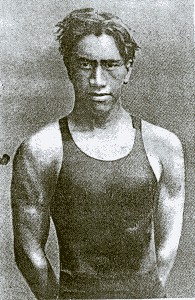 |
The November Wide World Magazine.
One of the
most interesting articles in the November Wide World
Magazine is "The Surfboard Riders of Hawaii."
The author
calls it "the king of summer sports" and few people reading
his account of its delights and thrills will be inclined to
cavil at the description.
Surf-riding
is one of the most ancient pastimes of the Hawaiians, but
the white man has taken to it with enthusiasm and bids fair
to beat the native at his own game.
Another
interesting article is "In Pursuit of Sllver-Tips," which
recounts how a party of cow-punchers went after a couple of
silver-tipped bears with their ropes and an old revolver
minus a sight.
Nothing more
exching than the sequel has ever happened in Wyoming.
Other
articles which will be widely read are "With a Camera in
Egypt," "To Menelik With a Motor," "The Pirates of the
Neuvra Tigre" and "In the Heart of South America."
Chronicling America
Hopkinsville
Kentuckian. (Hopkinsville, Ky.) 1889-1918, November 12,
1912, Image 2
Image and text
provided by University of Kentucky, Lexington, KY
Persistent
link:
http://chroniclingamerica.loc.gov/lccn/sn86069395/1912-11-12/ed-1/seq-2/
Duke
Kahanamoku has been invited to swim in Australia
That's easy.
Now if he
had been invited to swim to Australia, it would have been
something worth "the Duke's" effort.
Chronicling
America
Honolulu
star-bulletin. (Honolulu [Oahu, Hawaii) 1912-current,
November 14, 1912, 2:30 Edition, Image 4
Image and text
provided by University of Hawaii at Manoa; Honolulu, HI
Persistent
link:
http://chroniclingamerica.loc.gov/lccn/sn82014682/1912-11-14/ed-1/seq-4/
The North
Steyne Surf-bathers' Life-saving Club successfully held its
sixth annual carnival at Manly on saturday.
It was
estimated that 15,000 people witnessed the proceedings.
Every point
of vantage overlooking the surf at North Steyne was
occupied.
The Manly
Band rendered selections during the afternoon.
Great
interest was centred in the rescue and resusicitation
competition for the Begg's Shield (valued at 100 guineas),
which is to be won three times before coming the property of
any club.
In 1911
North Steyne won, and in 1912 Bondi was successful.
The latter
(A and B teams) were again victorious on Saturday, scoring
first and second places with 54 and 52 points respectively;
North Steyne being third with 49 points.
The winners
hold the shield for 12 months.
The alarm
race was also an exciting event, Dr. C.N. smith (North
Steyne) defeating Cecil Healy (Manly Surf Club) by about 2s.
The grand
parade and march past of clubs, with full life saving
equipment, was a splendid display.
Bronte,
Freshwater, Manly, North Steyne, Newcastle, Manly
Life-saving Club, Bondi, Coogee and North Bondi were
represented, the lattter winning the prize.
A special
attraction was a team of a dozen Ellice islanders, who were
picturesquely clad.
Their songs
and war dances were performed admist much merriment.
Subsequently
they gave displays in a surf boat.
Mr. Fred
Notting also gave interesting displays in his well-known
canoe Big Risk.
- Noted in S&G Champion: Drowning, Bathing and Life Saving (2000) page 177.
Duke
Kahanamoku's Honolulu
Records Are
Finally
Accepted. .
J
mm 1 fl
DR. LUTHEE
HALSEY QULIOK
Who
congratulates Hawaii on Duke's
victories Dr.
Luther was born in Honolulu,
December l,
1803, forty-seven
years ago
yesterday.
,It tool,
almost a year and n half, but,
after all, tho
A. A. U. has finally recognized
Duke
Kahanamoku's time in tho
fifty nnd
hundred yards straightaway
swimming dashes
made iu iu Honolulu
harbor August
12, 1011, when ho broke
tho world's
recoids for both distances.
It was tho then
refusal of tho organization
to accept
Duke's timo in these
two water
sprints which got local
sportsmen
warmed up to tho extent of
tending
Hawaii's champion to the mainland
to prove over
again what ho had
accomplished at
home. He did this nnd
more, for ,he
was chosen a member of
the American
swimming team, and at
Stockholm
carried tho American colorB
to victory In
tho hundred meters race.
At its recent
meeting in" Now York tho
American
Athletic Union of tlio Unitod
States named
tho official amateur records
established
during 1012 nnd
the two
disputed records of Duko
Kihanmnoku mado
in 1911 here in Honolulu.
Thcso nro final
nnd
and were
sanctioned by tho A. A.
tf. only nftcr
each case had been investigated.
Tho list this
year is a long
ono and
contains, for tho first timo, of
I course, tlio
name of n Hawaiian Duko
rVUUUMlllUUKU,
Lorrlrl
Andrews, secretary of the
otal branch of
the national body of
he A. A. U.,
received yesterday from
Dr. Luther II.
Oulick, of New York, a
litter of
congratulation together with
rortlflrd
copits of the ncceptol record
which, beside
DukoV Stockholm victory,
lncln.lo tho
local records made
August IS, 1UU.
Dr. Luther II.
Onlick's letter is as
HUSSKL SAOi:
INUNDATION
Popnrtment of
CHILD HYOTHNE
00 Metropolitan
Tower, Now York Cfly,
November 20,
1012.
Mr. lorrtn
Andrew, Honolulu, Hawaii.
D6ar Mr,
Andrews: T enclose a slip
giving tho new
swimming records. I
want to
congratulate you upon tho
wholo
proceeding. It was a splendid
record,
excellent not only in its phys
ical
attainment, but excellent also in
tho impression
which ho hns
mndo ns a
sportsman. With very best
vrisiics, I am
Sincerely
yours.
LUTHEIt II.
GULICK
The swimminR
records nbovo referred
to nro ns
follows
CO yards, bath,
two turns. 0:2S 3-5
Kenneth
Hiis74igl, C. A. A., Illinois A
C. bnth,
Chicago, Mnrch 12, 1012.
(50 yards
straightaway, tidal salt
writ or, 0s24
1-5 Duke P. Knbanamoku,
H. S. C,
Honolulu, H. T., August 12,
1011 (made nt
high tido, not aided by
current.
1U0 yards
straightaway, tidal salt
water. 0:i."5
2-!5 Duko P. Kahnnnmoku.
il, a. u.,
Honolulu, ll. T., August J",
1011 (mado at
high tido, not aided by
current).
220 yards, open
still wntcr, ono turn,
2:40 Duke P.
Knhanamoku, II. 8. 0.,
Verona Lake,
Montclair, New Jersoy,
dune 11, 1012.
1
440 yards,
bnth, 21 turns, 5:23 2-C
Porry
McGillivray, Illinois A. C, Illinois
A. O. bath,
Chicago, October 31, 1012.
One mile, open,
still salt water, 21
turns, 25:30
l-i L. IJ. Goodwin, N. Y.
A. C,
Stecplcchaso Tark uatatoriiim,
Coney Island,
New York, September IP,
1012. (
HnclvRtroke,
150 yards, bath, 7 turns,!
1:5211. .7.
Hebncr, Illinois A. C. bath,1
I'liicngo,
Febiuary 15, 1012.
Ureaststrolto,
200 yards, bath, 0 turns,
2:38 4-5
Michael JlcDermott, O. A. A.,
Chicago A. A.
bath, Chicago, Illinois,
.March 13,
1012.
Itelny racing,
400 yards, four men, 100
yards each, 20
yard bath, 3:51 2-5 Illinois
A. C. team (T.
W. Wiuans, 1:00
2-5; A. C.
Itaithel, 0:58 1-5; H. J.
0:55 4-5; Perry
McOlllivrny, 0:57),
Illinois A. 0.
hath, Chicago, Illinois,
April 27, 1012.
Holny racing,
500 yards,
lenm, 100 yards
each, 20-yard bath,
1:52 3-5
Illinois A. C. team (abovo,
and Itobert
Foster. 1:01 1-5), Illinois A.
( bath,
Chicngo, Illinois, April 27, 1012.
100 meters,
backstroke, opon water.
straightaway,
l':20 1-5 Hamburg, July
22, 1012.
Plunging,
one-minute, time limit, bnth,
30 feet F. D.
Wills, University of
Pennsylvania,
U. of P. bath
phia,
Pennsylvania, March 9, 1912.
100 meters,
open, fresh water straight-
awav. 1:01 3-5
Duko Kahanamoku.
Hamhurc.
Germany. July 21, 1912.
Olympic
Records, Stockholm, 1912,
100 motors,
opon, fresh wnter,
comin
Mid-Pacific Carnival, which is
. . , ., . , ,
. ,
, w"ld P
Pobrunty 22 in a blaze of
' glory and
whatnot, n movement is be-
straightnway,
1:02 2-5 Duko Kahana-. Thero was nn awnkening among
Stockholm,
1912. len Bwiminors when littlo KuthWayson
100 meters,
backstroke, fresh water, stacker dofeated Mrs. Terio Desch in
straightaway,
1:20 4-5 Harry J. Hib- a thirty-yard swim horo Homo months
ner, Stockholm,
191B. Il(,0) ,lIuj sinco then quito a number of
tho ceiitlo sex
have been getting into
Chronicling America
The
Hawaiian gazette. (Honolulu [Oahu, Hawaii]) 1865-1918,
December 06, 1912, Image 7
Image and text
provided by University of Hawaii at Manoa; Honolulu, HI
Persistent
link:
http://chroniclingamerica.loc.gov/lccn/sn83025121/1912-12-06/ed-1/seq-7/
The
-work of preparing for the big
Mid-Winter
Carnival la now practi
cally
completed, and if the plans go
not awry, the
parade this year will be
far and away
the- finest ever shown
here;.. tSo
smuch became evident - yes
terday'
afternoon,"" at the meeting of
the special
finance committee, of
which Fred L.
Waldron is the chair
roan, and the '
promotion committee
yesterday
afternoon.:. Director-General
:
Chillingworth, has outlined his
plans for a
four-day celebration, wind
ing up with,
the "Landing of Kame
bameba the ;
Great" at -t Walkiki
beach,
Washington's Birthday. ?. ;
- Kamehameba
will be represented by
Palenapa, . who
is , considerably over
six feet In
height and weighs nearlr
three hundred
pounds, but splendidly
proportioned.;-
Wearing 2 the feather
cloalc and
helmet vof , his t rank,. the
monarch wiU
Jand on the shore be
tween the
Seaside and Moana hotels,
where he will
be received by the peo
ple of Oabn.:.
A Hawaiian hookupu o:
gift ceremony
will be., shown, when he
will be
presented with fruits and taro
and pigs.-; -
v. w -i f-i- ': ' -i
i There will be
native houses and Ha
walians seen
making - mats, ,tP8
pounding poi
and living as Hawaiians
did one hundred
years, ago.
-r All this is
to be staged under the
direction of W
Adam k. so: that the
entire .scene
vwill . be .witnessed . from
afar nd the
entire, setting wiU stand
out clearly
.and; not be - marred . by
cloee. lines of
spectators. In. order to
have, the
double war: canoe. Prince
Kalanianaole's
.canoe now at Kallua,
and 'another
wUi be .brought . here
from Kallua.
Hawaii, and lashed to
gether.;by a
Hawaiian 1. who did the
same, for
those, in the Bishop Museum,
'U There are
also to he aquatic sports,
consisting of
surf riding,' canoe races
and many
stunts. Duke Kahanamoku
will be a star
attraction la the surfing
and swimming
performances.
Chronicling America
Honolulu
star-bulletin. (Honolulu [Oahu, Hawaii) 1912-current,
December 21, 1912, 3:30 Edition, Image 10
Image and text
provided by University of Hawaii at Manoa; Honolulu, HI
Persistent
link:
http://chroniclingamerica.loc.gov/lccn/sn82014682/1912-12-21/ed-1/seq-10/
ENTHUSIASM IS NOW IN FULL
SWING
Arranqements
Near Completion
for Great
Mid-Winter
Carnival.
FOUR DAYS OF
FESTIVITIES
Landing of
Kamehameha Will Be
. Great
Spectacle Other
Features.
If enthusiasm
counts for anything
the coming
Mid-Pacific Carnival to bo
held in tho
Washington Birthday week
in Tcbruary
will bo ono of tho groatest
spectacles from
first to Inst that has
ever been
attempted in tho Hawaiian
Islands, not
only as an attraction for
Islanders, but
for tourists from all
pnrts of tbo
world.
Director-General
Chillingworth,
appearing
before tho
special finance committee,
of which Prcd
L. Waldron is
chairman, and
tho promotion committee,
yesterday
aftornoon, explained along
general linos
what ho proposed to offer
inr n fnnr
flnva' annnt.ir.ln tlin nrntirn.
ine event being
the glorification of old-
time
personalities which nmdo Hawaii,
a hundred ana
more years ago, a key
to tho affairs
of tho Pacific,
The "Landing of
Kamehameha the
Great," at
"Waikiki beach on Wellington's
Birthday, will
be a spcctaclo
which will call
for tho most caroful
of staging and
will show tho great
Napoleon of tho
Pacific skirting tho
shore of Onhu
around Diamond Head
in his great
doublo war-canoe, followed
by a largo
number of canoes fillod with
chiefs,
paddlcrs and warriors.
Great Pageant.
Kamehameha will
bo represented by
a magnificent
typo of Hawaiian, such
a typo as
Kamehameha was, in tho person
of Pnlenapa,
who is considerably
over six feet
in height and weighs
ucnrly thrco
hundred pounds, but
proportioned.
Wearing tho feather
cloak and
helmet of his rank and
surrounded by
chiefs armed with spears
and by his two
whito advisors, the,
monarch will
land on tho shoro between
the Seaside and
Moana hotels whore he
will bo
received by tho people of Oahu.
A Hawaiian
hookupu or gift ceremony
will bo shown,
whon ho will bo presented
with fruits,
.taro and pigs.
There will bo
native houses and
seen making
mats, tapa, pounding
poi nnd living
as Hnwaiians did ono
hundred years
ngo. All these features,
whilo in
general chargo of Mr. Chilling,
worth, aro
directly in charge of W. T.
Rawlins, who
will bo assisted by a
in which will
bo Duke
tho world's
champion swimmor.
All this is to
bo staged under tho
direction of W.
D. Adams, so that tho
cntiro scene
will bo witnessod from
nfnr nnd tho
cntiro Betting will stand
out clearly and
not bo marred by close
lines of
spectators. In order to havo
the doublo
war-canoe, Prince
canoe, now at
Kailun, and another,
will bo brought
hero from
Hawaii, and
lashed togcthor by a
Hawniinn who
did tho samo for those
in tho Bishop
Wusoum.
There aro also
to bo aquatic sports,
consisting of
surf riding, ennoo races
nnd many
stunts. Duke Kahanamoku
will bo a stnr
attraction in tho surfing
and Bwimmiug
performances.
Volcano in
Eruption.
Ono evening
will bo dovotod to an
eruption of
Punchbowl, which is to
bo handled by
11. A. Lyon. This will
bo a
rcnllsticvexhibition nnd it will bo
so nrrnnged
thnt Punchbowl will appear
to bo nctually
in eruption, with
lava pouring
over tho rim down a
toward tho
city.
The floral
parade feature will bo historic,
for Hawaiian
traditions aro to
bo exemplified
in floats. Various societies
may look after
tho various
floats. Ono
will represent Knpiolani
defying l'elo.
Mrs. Nnkuina, an authority
on Hawaiian
matters, is working
out a themo for
n float, whilo
and l.aio aro
oxpcctcd to provide
floats telling
some tradition of their districts.
Tho float which
mado such a hit
in Inst year's
parado, that of
will bo
repeated next February.
John Hughes has
chargo of, tho
floats.
Tho Island
Princess section will bo
repeated. As
this has bcconio ono of
the most
attractive features of each
year's
carnival, It will by givon a
prominent placo
in tho colobration
again.
Orond Boll
Wlndup.
There will bo a
grand ball, this to
conclude tho
carnival, Tho Mooso organization
will
pnrtlcipnte in some part
of tho carnival
and will appear as a
uniformed
contingent.
Thu finance
committee nekod for a
maximum
cstlmnto of expense which,
.Mr,
(Jlillllngworth was unable to givo
although It Is
known the committee will
huo to look n
round for nt least seven
or eight
thousand dollars, Another
meeting will bo
held eurly In the weak,
when Mr
Chillingworth, after going
Into details
with thu heads of his
will bit li bin
to urnku n report.
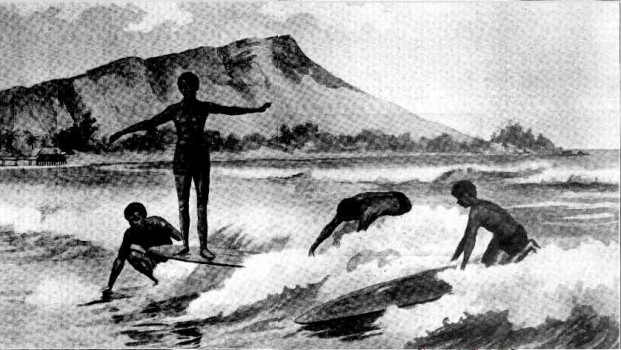
YAMBA, Friday.
The pleasures of Boxing Day at Yamba were sadly brought to a terrible carlye (?) in the afternoon by the xxx(?) escape of several surfers from drowning, one of whom, after continuous efforts at resuscitation, succumbed.
The first
occurrence happened at a quarter to one, when Mr. George
Mitchell, of Harwood, was carried out on thc outer breaker.
For some time he was ably supported by Mr. Sailor
Fitzgibbon, of Grafton, who had gone to his assistance, but
it was noticed from the shore that the rescuer was tiring.
At this time
Messrs. O. B. Notely and C. J. Englert, of Maclean, both
members of the Club, arrived at the scene, and quickly
proceeded to assist in the work of rescue with the line.
Prior to
this Captain Redman, went out after Mitchell without the
line, and on arrival at the spot found him struggling
feebly, and succeeded in holding him up until the beltman
arrived, who then, brought him ashore.
The rescued
man was quite conscious, and after being attended to soon
recovered the shock.
Shortly
after dinner William Murphy and J. Banney went into the
surf, the former being abouty 100 yards out, ànd the latter
20 yards.
The current
at this time was running out at the rate of about seven
miles per hour.
The crowd on
the beach soon realised that both were in difficulties, and
Messrs. Notely and Englert were soon in the surf to effect a
rescue.
Notely
jumped in from the rocks on the southern side, and swam to
Banney, and succeeded, in bringing him to the rocks.
Excitement was intense, for at this moment a wave separated
them, but Notely went after him again and, this time was
successful in bringing him to the rocks, where he was
assisted by Mr. A. Graham, of Maclean.
In the
meantime C. J. Englert swam out from the rock's to Murphy,
and for fully quarter of an hour succeeded in holding him.
The line was
quickly run out, and Mr. E. White proceeded out as beltman,
with Notely as first linesman.
When the
beltman was about ten yards from Murphy, who was still being
supported by Englert, the crowd thinking that he had reached
him started to pull.
The mistake
was soon noticed, and the line released, and the beltman
once more proceeded to the rescue, but again the line was
pulled in too soon by the public.
White again
demonstrated his bravery and once more attempted to reach
the men.
This time he
was successful.
By this time
J. Unwin and T. Walker (members) arrived, and took charge of
the line, but being unable to keep thc crowd from the line,
the men were drawn towards the beach for too fast, with the
result that both were underwater most of the time.
Englert was
pretty well exhausted through the suspended struggle of
supporting Murphy; and lost the line.
From the
inner breaker Murphy was carried ashore by Messrs. Unwin,
Walker and Notely.
They
instantly endeavoured to restore animation,using the
Schaffer method.
Englert, in
the meantime- the hero of the day finding the current too
strong to swim directly to the .rocks, proceeded south with
the current with the hopes of reaching the rocks lower down.
R. Miller,
with the belt of No. 2 reel, which was in readiness on the
beach, went to his assistance by means of a powerful swim,
and both were eventually drawn to the beach.
The members
of the Brigade demonstrated, their knowledge of "life work"
in magnificent fashion.
After work
had been in progress for three-quarters of an hour in the
endeavour to restore Murphy, Dr. Macartney, Grafton, arrived
on the scene, and rendered medical assistance.
Treatment
was kept up for three hours; and after every effort had been
utilised the Dr. pronounced life to be extinct.
The body was
taken-charge-of by the police, and taken to the hotel.
The
greatest praise, is due C. Englert for his splendid work of
rescuing White.
He also
showed great pluck in making a third attempt to reach
Murphy.
Both
bathers, said Captain Redman, were bathing outside danger
signals, which were placed in position by him early in the
morning.
On account of the sad fatality the Brigade postponed their social, which was to have taken place that evening.
Trove
1912 'FATALITY
AT YAMBA.', Clarence and Richmond Examiner (Grafton, NSW :
1889 - 1915), 28 December, p. 4, viewed 9 June, 2012, http://nla.gov.au/nla.news-article61669830
|
1 January 1912 :
8 January 1912 : 11 January 1912 : 12 January 1912 : 27 January 1912 : 27 January 1912 : 29 January 1912 : 26 February 1912 : 28 March 1912 : 29 March 1912 : 3 August 1912 : 16 August 1912 : 21 August 1912 : 30 August 1912 : 28 September 1912 : 4 October 1912 : 11 October 1912 : 30 October 1912 : 14 November 1912 : 1 December 1912 : 28 December 1912 : |
Big Seas
Postpone Carnival Exhibition, North Steyne.
Inagural Carnival, Manly LSC. Swimming Carnival, Grafton. C. S. McKay Presented With Surfing Canoe, Woolgoolga NSW. Tommy Walker Surfboard Exhibition, Freshwater. Fred Notting Surf Canoe Exhibition, Freshwater. Manly Surf Bathing Film, Perth. Manly Seagulls Lifesaving Carnival, South Steyne. Surfboard Regulations, Sydney. Surfboard Regulations, Sydney. George Freeth Instructs Californian Girls, Redondo Beach. Duke Surfs Atlantic City. Duke and Cecil Healy Compete, Stockholm. Duke Writes of Surfing Atlantic City. Duke May Visit Australia, Sydney. Duke Sent Surfboard, Atlantic City. Vistors Surf in Canoes, Waikiki. Duke Profile, Sydney. Duke Invited to Australia, Honolulu. Ellice Islanders at Surf Carnival, North Steyne. Rescues and Surf Fatality, Yamba. |
|
|
|
|
|
|
|
|
|
|
|
|
|
|
|
|
|
|
|

| home | catalogue | history | references | appendix |
Michael Walker.
Coastal memories : Muizenberg, St. James, Kalk Bay 1870-1920
St. James : M. Walker, 1999.
v, 275 p. : ill., maps, ports. ; 24 cm.
Muizenberg, Kalk Bay and St. James [Cape Town] : an ideal all
the year holiday resort
Cape Peninsula Publicity Association. [1913]
40 p. : ill. ; 21 cm.
Cape Town General Collection
A.Dup.22467
916.821 @@