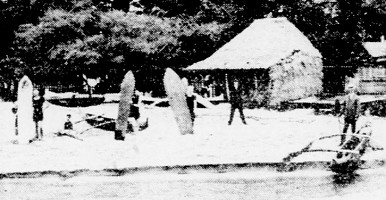
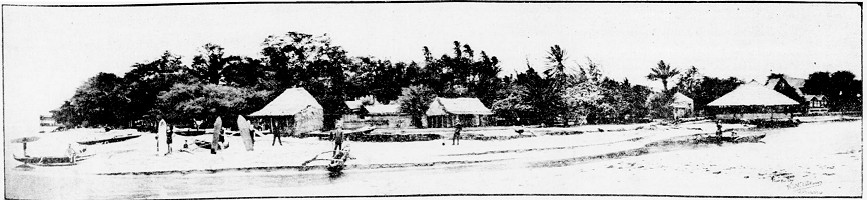
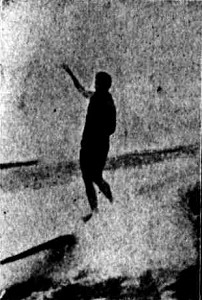
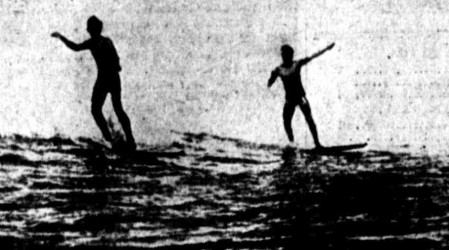
AMONGST THE
BREAKERS. Jottings from the surf beaches. Dangerous surf shooting. (By C.S.C.)
... Shooting the breakers is a most fascinating sport, but
there arc times when it is exceedingly dangerous, nnd steps
should be taken to regulate the practise. Sundays and holidays especially are days upon
which this exciting pleasure should be restricted.
At times there are
thousands in the surf, including ladies and small children,
who are continually knocked about and seared by the "surf
shooter," who, rising on a huge wave some hundred yards out,
"shoots" among them with lightning speed, carrying all
before him.
There is plenty of room
for the expert "shooter" to indulge his fancies without
crowding in among the general body of bathers.
For every one surfite. capable of shooting the waves there
are twenty who cannot, and it is a most dangerous .practice
to he carried by the rollers with head down among a lot of
helpless bathers.
Only on Monday a gentleman came into violent
collision with another bather in this manner, with the result
that his head was badly lacerated, and had to have several
stitches inserted.
This happened at Freshwater Beach.
Trove
1910 'SPORT AND PASTIME.', The Star (Sydney, NSW : 1909 -
1910), 6 January, p. 2. (LATEST EDITION), viewed 10 Dec
2016, http://nla.gov.au/nla.news-article228316973
Evening
Bulletin. Honolulu, January 7, 1910, page 1.
HUME FORD IS BACK HOME Brings Many Ideas Interests of Promotion In Hawaii.
Alexander Hume
Ford has arrived. Mr. Ford Hume
in on the Alameda this morning, absolutely unchanged as
regards his enthusiasm for beautiful Hawaii and the great
opportunities. Having
relieved himself of the chronic sunburn that came from hours
on the beach at the Outrigger Club, he gives the impression of
having grown good looking, but he promises to wipe out that
idea. Just as soon
as it is possible for him to get to the beach and into his old
bathlng suit.
New
propositions galore are bulging from Mr. Ford's two heavy
grlps. One of them is
a big banana proposition that involves the possibility of
fruit steamships being put on the run to Honolulu by the
Southern Steamship, and Development Company and the Southern
Banana company that handles the banana trade centering about
Texas and Mexico and Central America. "Should these
people come here," says Ford, "they will pay cash for the
bananas on the dock."
Since
leaving the islands Ford has been writing of them in
magazines and getting queries from all kinds of people with
all kinds of money. He believes
that he will get Mr. Clark of the Clark's tours as a ualAant
nf 1 Tsinnlnlti ulv mntttha in the year. Clark tells
Ford that it to the in at a ninl stirrrtiitwt f ntru nrn
and surroundings are one-half what he claims for them, he
can't think of living anywhere else on earth. Recently
magazine work has taken Ford to Mexico. A short time
ago he signed a contract with Hampton's Magazine to write a
series of articles on immigration. This series
has entailed an investigation that has taken him three times
around the United States. And Ford
admits he is tired. But there
isn't time in one morning for Alexander Hume Ford to tell
...
(Continued on
Page 3)
HUME FORD IS BACK HOME.
(Continued
From Page 1) ... all the
things he has done, moving in the usual rate and under the
influence of the lively surroundings of the great metropolis. The principal
thought is that Ford has lost none of his enthusiasm for
Honolulu, and the Outrigger Club of today won't be seen for
dust when he gets to work on some of the plans he intends to
carry out in thefuture.
Chronicling
America Evening bulletin. (Honolulu [Oahu,
Hawaii) 1895-1912, January 07, 1910, 3:30 EDITION, Image 3
Image and text
provided by University of Hawaii at Manoa; Honolulu, HI
Persistent link:
http://chroniclingamerica.loc.gov/lccn/sn82016413/1910-01-07/ed-1/seq-3/
Evening
Bulletin
Honolulu, January 8, 1910, page 7.
Outrigger
Club Notes And News
The Outrigger Club will begin work next week on its new big
bath house, and the work will be rushed to completion.
Several informal meetings were held on the grounds yesterday
afternoon and today.
Officers and members of the club discussed plans for the
coming Clark cruise regattas, and It was decided to limit
the
events to five, making the surfboarding and surfboating the
big events for which the cups will be given.
There will be probably one six-paddle race, a sailing-canoe
race, and a four-paddle race.
The native crews of Kalihl will be invited to participate
and the grass houses placed at their disposal and plenty of
poi provided.
The Clark cruisers will be treated to real Hawaiian sports
and real Inhabited Hawaiian village.
Captain Kenneth Brown is engineering a social chowder for
club members only, to be held In the lagoon lanni next
Saturday.
Ths tickets are to be placed at 25 cents each, and It Is
hoped that all the members of the club will be present to
become better acquainted and discuss among themselves and
suggest plans tor the improvement of the club.
The annual election is soon due. and It Is hoped that a club
spirit will be aroused that will result In the placing in
office of a lively, hustling board of directors..
With the construction of the new bathhouse, an energetic
collector will be appointed to go around with the 1910 cards
of membership in the Outrigger Club.
It is intended to have the ladles take a larger part In the
club work.
The members are waking up to the fact that the auxiliary Is
the best part of the club.
Chronicling America Evening bulletin. (Honolulu [Oahu,
Hawaii) 1895-1912, January 08, 1910, 3:30 EDITION, Image 7
Image and text provided by University of Hawaii at Manoa;
Honolulu, HI
Persistent link: http://chroniclingamerica.loc.gov/lccn/sn82016413/1910-01-08/ed-1/seq-7/Evening Bulletin. Honolulu, January 12, 1910, page 4.
Alexander Hume
Ford is not Hailey's comet. He is merely
one of those live wires that keeps going some.
Chronicling
America Evening
bulletin. (Honolulu [Oahu, Hawaii) 1895-1912, January 12,
1910, 3:30 EDITION, Image 4
Image and text
provided by University of Hawaii at Manoa; Honolulu, HI
Persistent link:
http://chroniclingamerica.loc.gov/lccn/sn82016413/1910-01-12/ed-1/seq-4/ The
Sydney Morning Herald Thursday 13 January 1910 page 10.
SURF-BATHING. MR. W. H. BIDDELL IN HONOLULU. INSTRUCTS IN AUSTRALIAN RESCUE METHODS.
Mr Walter H.
Biddell the well known surf enthusiast of Bronte was in
Honolulu last month and there lectured on lifesaving methods
and excited the Hawaiians' keen interest in the work in
particular what their local press described as "finished
exhibitions of the noble art of lifesaving." Honolulu has a
population of 45,000 and is the home of surf bathing, which
its tropical climate renders popular all year round. Shooting the
breakers in outrigger canoes and riding the rollers on surf
board, about 10ft long there provides exhilarating sport, with
occasional drowning accidents. Large numbers
assembled to witness the Sydney lifesaver's public
demonstration which General Soper, Dr. Ramus (?), the U.S.
Government Medical Officer, and others induced Mr Biddell to
give. The display
corrected the mistaken idea that the R.L.S.S. methods of
rescue and release were applicable only to smooth water
conditions. The great
pains taken to demonstrate their effectiveness under all
conditions evoked hearty appreciation. Various
movements were explained immediately before the instructor
entered the water, and shown under most difficult
circumstances in the water. Dr. Ramus, who
acted the part of a drowning subject, responded vigorously to
the rescuer's direction that he should endeavour to break
away, and in every way try to foil the rescuer's efforts, so
that the methods might be severely tried. They were
proved effective, however, and the doctor was expeditiously
landed and promptly resuscitated by the new shafer method,
then introduced for the first time at Honolulu. The Honolulu
press made life saving the leading topic during Mr Biddell's
visit with the result that widespread interest in the work of
the work of the Royal Life-saving Society was aroused. Dr. Ramus
formed a large class of candidates anxious to learn the
society's methods, and many Hawaiian surf bathers are now the
better prepared for emergencies. The Hawaiian Star. Honolulu, January 13, 1910, page 1.
OPENING NEW SIGHTS FOR TOURISTS - - THE GARDENS
OF THE SEA
The Outrigger
Club is to have a glass-bottomed canoe for use on the reefs. The recently
returned president of the organization has the canoe and the
plans, and work will be rushed forward so that if any very
remarkable marine gardens are discovered near Waikiki in time
they will be shown for the benefit of the Clark cruisers. The president
of the Outrigger Club acted as a commltteee of one during his
trip away from Hawaii and visited both Bermuda, in the
Atlantic and Catalina Island off the coast of California, both
of which places are famous for their marine gardens and
glass-bottomed boats. At Catalina
George Freeth stated that he knew submarine gardens near
Castle point that surpassed those of the California coast. If this is
true, and the Outrigger Club means to investigate, an entirely
new tourist Industry may be built up here.
From Bermuda a
commodious steamer goes out to the reefs daily, towing
sometimes as many as a dozen spacious glass-bottomed boats and
tens of thousands of dollars are earned annually by these
boats. The Pacific
marine gardens are infinitely more beautiful than those of the
Atlantic.
All about Fiji
and the New Hebrides there are miles upon miles of submarine
coral forests of many hues, in which swarm gorgeous fish of
every kind and description. At Catalina
there are wonderful gold colored flsh, that are protected by
law. Off Waikiki
there are places where the natives feed the flsh regularly and
sometimes catch them, but the most important fact is that flsh
will congregate where they are fed and protected.
If the
Outrigger club boys find an attractive marine garden the
legislature will be appealed to set it aside as a public park. The advantage
of the glass-bottomed boat is that several people at a time
may enjoy the novelty of looking down at the bed of the sea
and all between. Fish may be
seen swimming over the coral, and where there is a marine
growth, the effect is indescribable, for the glass makes everything
visible. It would be
possible to see fish sixty feet below the glass bottom off the
reefs of Waikiki, and as these appear magnified, they would
seem to stand out boldly.
The results of
the search of the Outrigger Club for submarine gardens in
Hawaiian waters will be watched with interest.
Chronicling
America The Hawaiian
star. (Honolulu [Oahu]) 1893-1912, January 13, 1910, SECOND
EDITION, Image 1
Image and text
provided by University of Hawaii at Manoa; Honolulu, HI
Persistent link:
http://chroniclingamerica.loc.gov/lccn/sn82015415/1910-01-13/ed-1/seq-1/ Evening Bulletin. Honolulu, January 13, 1910, page 7.
Aquatic Sports Are Being Arranged
Now that A H.
F. has refurned to Honolulu, the Outrigger Club and I ' fart, all the
unattached surfboard and canoe enthusiasts, are getting busy
with their stunts. A. H. F.
stands for Alexander Hume Ford, us everyone knows, and he is
feeling just as much at home as he did a couple of years ago
when he first tackled the surf board abt. Outside of
Freeth. there were no surfboard experts till Ford started the
crase. Now all sizes
and descriptions of boys can come flying in on their boards on
their feet or heads as they feel inclined. Girls also
have mastered the art, but most of them are content with
keeping their pedal extremities on the supporting board. The Outrigger
Club will soon be provided with a fine bathing house and the
members will then be able to dress in comfort and have plenty
of room. Work will be
started on the building in the near future, and the energetic
Ford will be seen to be on hand to watch the "dirt fly." By the time
the Clark bunch of tourists arrive, the program of aquatic
sports that is being arranged for their edification will be
all made up, and the visitors will see some stunts that they
have not seen in any of their travels so far.
Chronicling
America Evening
bulletin. (Honolulu [Oahu, Hawaii) 1895-1912, January 13,
1910, 3:30 EDITION, Image 7
Image and text
provided by University of Hawaii at Manoa; Honolulu, HI
Persistent link:
http://chroniclingamerica.loc.gov/lccn/sn82016413/1910-01-13/ed-1/seq-7/ The Hawaiian Star. Honolulu, January 15, 1910, page 9.
Alexander Hume
Ford and Alfred Finley Thayer would make a splendid team ;
but, alas, Thayer's gone to Manila and Ford's still here.
Chronicling
America The Hawaiian
star. (Honolulu [Oahu]) 1893-1912, January 15, 1910, SECOND
EDITION, 2nd Section, Image 9
Image and text
provided by University of Hawaii at Manoa; Honolulu, HI
Persistent link:
http://chroniclingamerica.loc.gov/lccn/sn82015415/1910-01-15/ed-1/seq-9/
Evening Bulletin. Honolulu, January 17, 1910, page 6.
Outrigger Club Going Full Blast
On Saturday
the Outrigger Club's chowder, which was held at the club
house, turned out to be a great success, notwithstanding the
bad weather. Some fifty
members sat down to the feast, and everything edible
disappeared in short order. Tables were
set up in the dancing lanai and a sail was hung to keep the
wind and rain from coming in at one end.
Kenneth Brown
was in charge of things, and he certainly had a fine spread
tor the members. Alexander Hume
Ford was in evidence, and he made a few remarks that were much
appreciated by the surfboard enthusiast. Brown also had
something to say and he told of how the club was booming. The new
bathhouse is rapidly assuming the look of a fine building, and
the floor is laid already. Within a few
days the Outrigger Club will have a splendid place to which to
prepare to swim, and afterwards to have a shower in.
Next Sunday
the competitions for the Clark cups will take place, and a
large number of entries are expected for the different events. All kinds of
surfboard stunts will be performed, and the canoes will also
be out on the job. Cups will be
given to the boys who bring their canoe in the furthest on a
wave, and for the surf boards there will also be cups donated,
for trick-surfing on the planks. Some of the
boys are experts at coming in standing on their heads, and in
some cases two individuals mount the same board and come in
together.
On Saturday,
February 12, the canoe races and general regatta will take
place, as well as a repetition of the surfing contests. The big
hundred-dollar silver cups will be contested for, and the
winners can hold them for a year. The cups must
be won three times before they become the property of any boy
or man. All members
wishing to enter for the different events are requested to do
so at once. Someone can be
found at the clubhouse, every afternoon to take entries, and
it would be well for those who contemplate going in for the
events to signify their intention as soon as possible.
Chronicling
America Evening
bulletin. (Honolulu [Oahu, Hawaii) 1895-1912, January 17,
1910, 3:30 EDITION, Image 6
Image and text
provided by University of Hawaii at Manoa; Honolulu, HI
Persistent link:
http://chroniclingamerica.loc.gov/lccn/sn82016413/1910-01-17/ed-1/seq-6/ The Hawaiian Star. Honolulu, January 17, 1910, page 6.
OUTRGGERITES HAVE A BLOWOUT
The chowder at
the headquarters of the Outrigger Club Saturday night was a
success in every way and will be long remembered by all those
in attendance. Despite the
fact that the weather was bad, about fifty persons enjoyed the
function. The Outrigger
Club's home was brilliantly decked for the occasion. Following the
first sections of the spread, speeches were made by Alexander
Hume Ford, the surf board enthusiast; Mr. Scudder, Kenneth
Brown and others. The remarks
and the applause with which they were greeted showed plainly
the enthusiasm existing within the club, and suggested a most
prosperous future for the organization. Improvements
in the accommodations at the club's headquarters are now under
way. A new
bathhouse is being put in among other conveniences.
Chronicling
America The Hawaiian
star. (Honolulu [Oahu]) 1893-1912, January 17, 1910, SECOND
EDITION, Image 6
Image and text
provided by University of Hawaii at Manoa; Honolulu, HI
Persistent link:
http://chroniclingamerica.loc.gov/lccn/sn82015415/1910-01-17/ed-1/seq-6/ Evening News. Sydney, Monday 17 January 1910, page 1.
Brevities
... Leslie White, 25,
residing at 636 Crown-street, city; collided with
another young man in thesurf
at Coogee on Sunday, and was rendered unconscious. He was taken to St.
Vincent's Hospital, suffering
from internal injuries.
Trove 1910
'BREVITIES.', Evening News (Sydney, NSW : 1869 - 1931),
17 January, p. 1, viewed 15 August, 2013, http://nla.gov.au/nla.news-article116053437 The
Hawaiian Star, January 19, 1910, page 6.
Entries for
the surf-board events at Waikiki beach Sunday afternoon are
being received by Harry Steiner, Kenneth Brown and C. Hustace. All persons
wishing to participate should notify the committee at once as
the time is getting shorter every day. Up to date
about twenty entries have been received. This is a fair
start, but it is hoped that there will be many more. The Cleveland
tourists are looking forward to the surfing events as a
leading feature of the local program for their entertainment.
W. W. Dimond
& Co., Ltd., received a letter from Dresden, Germany,
addressed to "Honolulu. Hawai, Australien." The Hawaii
Promotion Committee might do well to send a copy of the
Honolulu directory to the Dresden chamber of commerce with a
note stating that Australia is several doors south and
Honolulans the French Ispcau do not.
.........
Chronicling
America The Hawaiian
star. (Honolulu [Oahu]) 1893-1912, January 21, 1910, SECOND
EDITION, Image 5
Image and text
provided by University of Hawaii at Manoa; Honolulu, HI
Persistent link:
http://chroniclingamerica.loc.gov/lccn/sn82015415/1910-01-21/ed-1/seq-5/
The Hawaiian Star
Honolulu, January 22, 1910, page 6.
MYRTLE CREWS TO START ON MONDAY
The Healani
oarsmen were down yesterday afternoon for practice andwill have
n tryout again this afternoon. Some
of the Myrtle men wilI be downthis afternoon
also, but will likely nothave any crew work.
The Healanisare straightenlng
out gradually to thebig task of getting
in training, and Itwill probably be a
week or more before
results show. The
Myrtie crews will begin trainingMonday afternoon.
Work this afternoon will be
voluntary and tomorrowafternoon there
will be nothing doingon account of the
surfing events at Waikiki.
But Monday the start willbe made with a
whoop and will bekept up with all
energy until the dayof the races. The
crews to start inMonday are junior
shell, freshmenpair oar and the
"strawberry" crew. For
tomorrow it is planned that everybody go to
Waikiki.
All the surfers will be there and the oarsmenwill go to
look at them.
The kids withtheir small yachts
will sall out toWaikiki, and come
in to the beach atthe Moana Hotel,
where they will have a
fine view of the surfing events.
Chronicling
America
The Hawaiian star. (Honolulu
[Oahu]) 1893-1912, January 22, 1910, SECOND EDITION, Image 6
Image and text
provided by University of Hawaii at Manoa; Honolulu, HI
Persistent link:
http://chroniclingamerica.loc.gov/lccn/sn82015415/1910-01-22/ed-1/seq-6/ The Pacific
Commercial Advertiser
Honolulu, January 23, 1910, page 1.
Outrigger Club Sports.
In the afternoon the Outrigger Club will give an aquatic
exhibition ar Waikiki beach, aid it is expected that most of the
CI" elanders wll be present.
Although the sun is not up to an churches, built in 3 S4 of coral
rock
carried by hand from the reef to the
site of the building, Oahu Young Peo
ple's I'nion: Mass meeting of the
Voting People's Societies of the city,
representing at least a doen different
members of the Scottish Thistle Club,
assembled at the W'averb-y Hall last
night, some echo of the election ex
citement of the Old Couutrv should
a line of two hundred dollar
It i- further state. 1 that for eve'-y
r a--eiiger landed at San Francisco or
aiiv ioa-r port, the fine of two luin- they w i
oied dollais will be imposed. Club.
This dispatch from the depaitment of The Chri-tian Endeavor
societies will
coi crce and labor, as indicated in t lie meet Father Clark,
founder of the
above v . reed vi. il ves'er.hiv ill llo- i hri.tian Endeavor
movement and all
1 1 . 1 1 . lai :in,l : -ire!i-s me-s'ie.' i.iinfiiill- ntiii'r
olldoa Vorel's oil board
the information, was sent vesterdav wharf, when' leis will be
placed upon ,
P. the tour manager aboard the olTen-i- theni.
h-.i ves-,d. which is due this morning. The Hawaiian band will be
taken
The malter was presented at Wash- on'-ide the harbor aboard the
tug ln-
ingto.. about the middle of December trepid. and will give the
travelers a
crop in.
It did. It was all serene while the
assembled guests were singing "(iod
Save the King.'' even unto the third
standard since the bad weather began. stanza, and wime the chip
menipers
vet it is expect,-,! that the exhibit ion j and their guests were
toasting the
will lie of great interest. Surfboard ; President of the United
States, but
..;.r,.,.r i.-m l... ...... ..f the features and I there was a
division of opinion when
ail the young experts will be o-.i hand.
There will be canoe races and many
Dr. Clark Wires.
Pr. Francis Clark wireles-ed rn from
H,,. ! the Cleveland yesterday to VY. A. How-
en that he would be glad to spea.i m
The Pacific
Commercial Advertiser
Honolulu, January 23, 1910, page 2.
OUTRIGGER
YOUTHS READY TO RACE UPON BILLOWS Big Surtboards Will Bear Riders;
Upon Waves at Waikiki Beach.
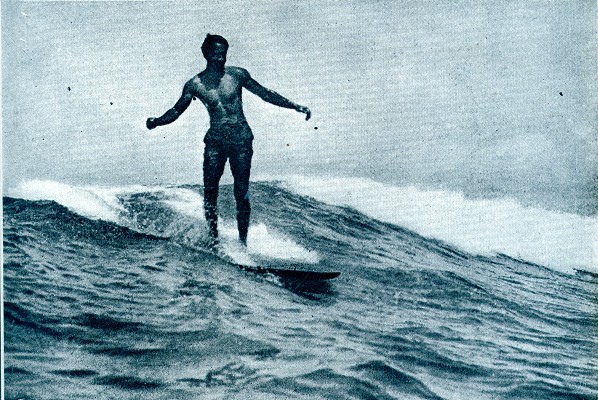
AN EXPERT
SURFBOARD RIDER.
Aloha Cleveland Tourists
(Continued from page one.)
In Mark Twain's Day.
The present world-tour recalls Mark Twain in more ways than one,
first of all Mark Twain went :abroad a few decades ago on a widely
advertised visit to the Holy Land, the ship :i n t
cruise being in marked contract to the
pilgrims. not how to enable him to ratify the desire to travel
through Solomon country.
For years Clark remained with a well-known tourist firm, jiainino,
knowledge until lie knew Egypt
and the Holv Land from end to end.
In addition to the public rooms mentioned, there are also a
gymnasium, equipped with Zander electrical apparatus, electric
light baths, photographers' dark room, library, book stall and
information bureau.
Throughout all sections light and ventilation have been provided
according to the most advanced ideas.
The following will describe the size, construction and technical
equipment of these vessels.
Their length is tiOS feet; beam, feet, and height from water-line
to upper dock, 55 feet.
They are equipped
This afternoon the visitors from the Cleveland will have an
opportunity to . witness the peculiarly Hawaiian sport of surf
riding.
Out at Waikiki. where the long shelf of coral makes shoalwater and
the big rollers of the Pacific come foaming in for nearly a mile
from the edge of the reef right up to
the shore, dozens of young athletes
will demonstrate the apparently ea-y,
but really very difuciiit art of stand
ing on a llat board and being carried
at- express tram speed on the slope of
a f nam i ouped wave.
Unfortunately the surf has Hot been
very regular of late. With the more
expert mlers the higher the wave and
the more the force with which it.
break:-, the better for the surfer. Hut
since Thur.-day the surf has shown .
signs of increasing and indications point- i
to a very passable surf this afternoon. I
Unless' one has tried it and has learn- j
ed how to manipulate the elusive board, j
it is imposs,ble to understand the " j AN EXPERT SURFBOARD RIDER.
ous exhilaration inai minis a sum .
when once the board, is started before
and ar last having saved a few thon
saiol iloiiais lie determined to test the ; Willi twmscrews. and
power is supplied
I rii-c 111:1 c V- lit" tw -in, I iMto n t h -i t t.emil l.- tote
..t' ..iTiilrin.trt nvTi-inuidii -n.
ilatiai liner and earth-girdling feat j ...,, .'.,,,.1. tn t,;
fi,,K- 1' ,, 1 ' ti,w i ..., ';,-;., ti ..' ,-.Lu '., nf
; ef t liousa mis. In 1 !.l he cliartered I about Hi knots. For
the safety of the
;; steamship for a cruise to the Med iter- vessel and its
passengers ail th.e latest
lanean. I'lark placed the educational ! appliances have been
provided, includ
t'eature of :he oriental cruise before his! inr mi automatic
livdraulic system fur
fellow Knights Templar, chartered a i dosing the water-tight doors
separa:-
of the t'lark tourists. Tn the secona
place Mark Twain visited Hawaii
manv years ago, and the summing up
of his impressions will no doubt interest the Cleveland's
globetrotters. He
wrote:
The Pacific commercial advertiser.
(Honolulu, Hawaiian Islands) 1885-1921, January 23, 1910, Image
2
Image and text provided by University of Hawaii at Manoa;
Honolulu, HI
Persistent link: http://chroniclingamerica.loc.gov/lccn/sn85047084/1910-01-23/ed-1/seq-2/ Evening
Bulletin. Honolulu January 24, 1910, page 7.
(Sports, by V. L. Stevenson.) Smooth Sea Spoils
Surfing Stunts
Out at Waikiki
the Outrigger Club tried to do its best yesterday in the way
of entertaining the Clark bunch of tourists. Unfortunately;
the surf was not good, and the high wind off shore kept the
small waves that did start in, from amounting to much.
A tremendous
crowd lined the beach from the Seaside Hotel to the Waikiki
Inn. The gathering
was probably larger than has ever been seen on the beach
before.
The crowd was
very dense around the immediate vicinity of the Moana Hotel,
and it was hard work to get anywhere near the bandstand, where
Captain Berger and his musicians played all the afternoon.
All of Clark's
excursionists appeared to take the greatest interest in the
various shows that were pulled off, and much admiration was
shown for the feats performed by Miss Pratt and her girl
friends- Misses Ruth Soper and Coral Low.
There were
many surfers out, and they did their best in the small surf. The exhibition
was a poor one except in some places where the surf did run
high for a short distance.
The Clark cups
were not competed for, as it would have been absurd to have
any of the events run off in the slight surf that existed. Some of the
outrigger canoes went out and time after time tried to catch a
wave. Only in a
couple of instances were there any long runs made. The Kamehameha
Aquatic Club turned out in force, and at the Outrigger
clubhouse, gave exhibitions at poi-maklng and Hawaiian cooking
that interested the visitors greatly.
Many of the
Clark people went out in canoes, and had a try at surfing. There was
nothing much doing in that line; still, the tourists appeared
to enjoy the fun of even a short run. Dozens of
others donned bathing suits and splashed into the water, and
the way they stayed and refused to get out when their friends
called them, was a tribute to the seductions of bathing at
Waikiki.
Cameras were
to be seen every where, and the number of films exposed must
have been tremendous. Bonine took
moving pictures of the whole layout, and he must have got some
really good ones.
After a weary
wait it was seen that no surf events could be pulled off, and
it was decided to have at least the surfboard paddling race. The boys, to
the number of fifteen, all stood on the beach with their
surfboards alongside of them, and at a signal all dashed for
the water and, throwing themselves on the boards, paddled away
at their very best speed.
Zen (sic,
Vincent) Genoveswon the paddling contest, and
he certainly got through the water in great style. The rest of
the bunch were not far behind, and taking it altogether it was
a good race. The Clark
bunch took the greatest interest in everything, and many were
the remarks made on the beauty of the scene at Waikiki. Some of the
tourists remarked that they had seen outrigger canoes at
Ceylon, but that the surfboard stunts here were wonderful.
When the
return Clark excursion comes through Honolulu, the Clark cups
will be competed for, and it is to be hoped that there is more
surf than there was yesterday. It was really
hard luck that the waves were so small, as the visitors could
not get any idea of what the sport is really like on a day
when the big green waves come roaring in and, perched on the
top are to be seen a dozen or so surfboard riders, who
continue their wild career right up to the very beach.
Yesterday's
exhibition of canoe and surfboard riding is not to be
considered as the real thing. There was no
surf, and as soon as the town people got out to the beach they
saw that there would be nothing doing. There was a
lot of delay in getting things started, but what was the use
of hurrying- there was no chance of doing anythlng much, and
soon the local people began to wend their way homeward. All the
members of the Outrigger Club did their best to get things
going, and it was not their fault that the waves would not
materialize. Nearly all day
the canoe and surfboard men hung around the clubhouse and
prayed for the sea to get up and do things. But there was
no response, and quite a number of the canoes remained on the
beach and were not even put into the water.
A fleet of
small boats sailed around from the harbor to Waikiki, and
amoung them were noticed the Viking, Ivy and Pearl. The young
yachtsmen handle their boats in good shape, and they presented
a pretty sight as they slipped their moorings and sailed away
for the harbor.
Two boys got
up a poi fight at the clubhouse, and the way they covered each
other with that delicacy made the visitors laugh more than was
good for them. The subsequent
removal of the poi was a hard job, and the operation was also
watched with great Interest by the malihinis. To sum up the
afternoon's fun, is to say that everything and everybody was
ready for the show, but the waves would not come, and that
spoiled the whole business.
Chronicling
America Evening
bulletin. (Honolulu [Oahu, Hawaii) 1895-1912, January 24,
1910, 3:30 EDITION, Image 7
Image and text
provided by University of Hawaii at Manoa; Honolulu, HI
Persistent link:
http://chroniclingamerica.loc.gov/lccn/sn82016413/1910-01-24/ed-1/seq-7/ The Hawaiian Star. Honolulu, January 29, 1910, page 5.
FISHERMEN ARE ALL SAFE
The three
Hawaiian fishermen supposed to have lost their lives last
night off Waianae are safe in Honolulu harbor, having arrived
this morning. There were
five in a party of fishermen who left Waianae at midnight,
Thursday, for Honolulu, two in a whaleboat and three in locked
canoes. Those rowing
the whaleboat lost track of tho men in the lashed canoes, and
thought them lost, but today all are safe in the harbor, the
canoes passing the whaleboat while the latter was looking for
them.
Chronicling
America The Hawaiian
star. (Honolulu [Oahu]) 1893-1912, January 29, 1910, SECOND
EDITION, Image 5
Image and text
provided by University of Hawaii at Manoa; Honolulu, HI
Persistent link:
http://chroniclingamerica.loc.gov/lccn/sn82015415/1910-01-29/ed-1/seq-5/ Daily
Commercial News and Shipping List Sydney, 31 January 1910, page 5.
Trove
1910 'Expected at Sydney.', Daily Commercial News and Shipping
List (Sydney, NSW : 1891 - 1954), 31 January, p. 5. , viewed 17
Nov 2016, http://nla.gov.au/nla.news-article158416189
Note
The Poltalloch
was identified by Tommy Walker as the vessel on which he
visited Hawaii in 1909 and purchased his first surfboard.
The
Pacific Commercial Advertiser
Honolulu, February 1, 1910, page 3.
Surf Is Better.
The ?r.rf has been better than it '
wa men tin' ueveiaim nr ,.- . m . i ., small l,.,v invited the
occin.ants of
I I. Ill il 1 " ' 1 I . . I ..." I .Ui.in.tli.U ; I
e'I I . . . , .. . . I 41
M l..,., , . (alley tiie ear to i.nv T lie nuanii ..i.-i-
Xo.al
T-rc fcir.'. More nialihinis than
ar Varn'me to ride the e'.r.sive wave
ard !tiost i.f the surfboards are in ciu- .
ir.i.i.in ilnring the atterno.m. i r.on i
tv jr.,0.1 cia -Biiiy Kougi. witi.jENNIS OFFICERS ELECTED
w'th all a! out the Paris trouble.
There has been talk of s,,.,ie basket
ball in trie M, A. A. latelv. It is very
.roliab!e that I ,ieiit ena n t I'hiltou. of
.'orf Shaffer, will get up a team to play
me icnms ,,. nas ciece,, ,. N;l,illM;i (;11:,rd. This will not
( erne, oil' until the ib'et has left, but
will be .a keen i'V. uf when it happens.
)N raw! rig and f erf v-hersepower ga-- j
l,eW-.w down to" Curtis II. face's STAM-'oKM CXI V KK'SITV. Jan.
th will find sn:ne mirf next tnne th.
x.'iirii.'iists prime, here and w d! maki
tl exhii.iitiiin worthy of Hawaii.
ST. YVES TO RUN
Chronicling
America The Pacific commercial advertiser. (Honolulu,
Hawaiian Islands) 1885-1921, February 01, 1910, Image 3
Image and text provided by University of Hawaii at Manoa;
Honolulu, HI
Persistent link: http://chroniclingamerica.loc.gov/lccn/sn85047084/1910-02-01/ed-1/seq-3/ The Pacific
Commercial Advertiser Honolulu, February 1, 1910, SECOND SECTION, page 11.
VISITOR TELLS
OF IMPRESSIONS Vancouver Newspaperman Makes Some
Suggestions About Improvements. By II. Ronald Keiivyn of the Vancouver
Daily Province.
Might Improve Beach.
At Waikiki the beach does not come
up to our expectations. Jt has been
boomed as one of the world's best
athing beaches, but there has been
apparently little or no attempt to utilize
this asset, and the condition of the
beach does not tend to make the visitor
regard with admiration the methods of
the authorities. At Vancouver we have
in English Hay an example of how a
splendid bathing beach, Iree from
rocks, can be created bv active work
on the part of the park board. Koeks
and obstructions have been removed,
sand has been brought in where neces
sary, and the result is that Vancouver-
ites have a most delightful bathing
place. At Waikiki the visitor rushes
in where the resident fears to tread
and cuts his feet on coral. Why can
not the promotion committee, a body
which 1 understand is supposed to look
after these sort of things, expend some
of its funds in clearing at least a sec
tion of the beach of that coral? The
.Mnana and Seaside hotels would con
tribute to this work if the managements
are looking for tourist trade, and then
visitors could enjoy their swim without
hobbling with slow and painful steps
over coral patches. The situation of
Waikiki beach makes it a natural asset
which should have seen some remark
able improvements, and then there
would be no complaint from those who
have read in advert i.-iug pamphlets of
the glories of this bay.
Missed the Surfboards.
There is one more little matter, tri
lling perhaps, but which has been a
subject of comment from tourists. In
the advertising matter which tinds its
way to the mainland we are told of
the glories of surfing at Waikiki but
there are no surfboards to be obtained
at the beach. Jt the bathhouses pro
vided a dozen boards for the ne of
the customers the malihinis could bruise
t her rn.s until turtinT or-iers ana i uere
would be no murmurs. Hut when nue
is anxious to trv tin- iy. t s'irt rid
ing and can not g''t a board tin- .nh
nary individual J.esiiris to growl and the
matter is rest 1 1 v so small tl.ar a hi tie
thought in this direction w.mld add
to the attractions of Waikiki.
Chronicling America The Pacific commercial advertiser.
(Honolulu, Hawaiian Islands) 1885-1921, February 01, 1910,
SECOND SECTION, Image 11
Image and text provided by University of Hawaii at Manoa;
Honolulu, HI
Persistent link: http://chroniclingamerica.loc.gov/lccn/sn85047084/1910-02-01/ed-1/seq-11/ The Hawaiian Gazette. Honolulu, February 1, 1910, page 2.
THREE HAWAIIAN FISHERMEN BELIEVED TO HAVE LOST
THEIR LIVES BY DROWNING
Three of the finest fishermen on the
islands, so far as can be learned up to the time of going
to press, have lost their lives in comparatively . smooth
water, somewhere between Waianae and Barber's Point.
Late on
Thursday night, just before midnight, to be more exact, five
left Waianae for Honolulu. Two of them
were in a whale- boat, rowing and three of them were in locked
canoes. Two outrigger
canoes were lashed together, making a practically uncapsizable
catamaran and a well-known expert fisherman of Lahaina. loana and
Moke, the two best of Mayor rcrn's fish company
experts, started to paddle the two canoes round the end of the
island and into Honolulu harbor.
In the whale
boat were Kalua and a man whose nickname is Opunui, a cousin
of Joe Fern. The latter
rowed along peacefully enough until they got off Barber's
point just before sunrise yesterday morning. As the sun
boomed up over the mountains they began to look round for the
canoes. They were
nowhere in sight. Paddling is
slower than rowing over long distance and so the men in the
whale boat thought that they would wait awhile. They waited
for nearly an hour and still saw no signs of their friends. So they put
back for Waianae. They kept a
sharp lookout on the way back but could not get a sight of any
canoe. They put into
Waianae expecting that the canoes had returned, but there was
no news there of their missing comrades.
A search party
was organized right away and several boats and canoes started
out to find the missing men. But they all
returned without result. Each of the
three men in the canoes was an expert swimmer and under
ordinary conditions could easily have swum three or four miles
to land, if the canoes had started to leak and swamped, but
inquiry along the coast yesterday resulted in no news of the
missing men. Several
theories have been advanced by kamaninas of the coast, but the
one most in favor is that the canoes bumped together so hard
in the swell, in spite of the lashings, that both of them
opened up and swamped. Then, when the
three started to swim to shore, they were either overwhelmed
by breakers, or attacked by sharks.
Poepoe, one of
the missing men, is a well-known character in Hawaii. He has fished
off Lahaina for years and is looked on as the pastmaster
expert in canoing and fishing. There is still
a possibility that the men have landed at some uninhabited
spot, but no news of it has come to hand as yet and it is
possible that their disappearance will remain one of those
unsolved mysteries that arise everywhere where men go fishing
in small boats.
Note.
Poepoe may be the
Poepoe who competed in the surfriding competition at Lahaina on
Kamehameha Day in June 1877. Evening Bulletin. Honolulu, February 1, 1910, page 7.
Moving Pictures Of Surf Rider:
Mons.
Bonvillain , the representative of Pathe Freres, the famous
Parisian motion picture concerrn has been captured,
by the Outrigger Club and will work with this organization,
the members of which will aid him in every way to secure a
series of island films, the club to have the use of these
films for two weeks. It goes
without saying that M. Bonvillain will be on hand on Sunday,
the 12th, at the Outrigger Club to secure good motion pictures
of the Hawiians preparing the taro and pig for Governor Frear
and Frank Clark. He will also
secure films of the canoe races and the surfing contests for
the Clark cups. M.
Bonvillain is particularly pleased with Outrigger grass
houses for his background effects. 110,1 here
for
Hawaiian pictures.
Several of the
Outrigger leaders have already volunteered their services to
Pathe's man, whlle here as guides or assistants, as he needs
them. With the
president of the club he visited yesterday morning the
Kalulani School and was so impressed with the wonderful charm
of the hundreds of children of all nationalities there, that
he will take a series of motion pictures of the fire and flag
drills. The Outrigger
boys are requested to aid M. Bonvillain, both ashore and
float, to secure the pictures he desires. They will have
the use of these for a fortnight to project for the
delectation of themselves and the friends of the club.
Clark
Tourists Will Enjoy Surfing
Preparations
are being made by the members of the Outrigger Club for the
big surfing show they are going to give when the Cleveland
tourists are here next week. All the boys
and girls are practising hard and many new stunts will be
pulled off. The Clark cups
will be competed for, and as the surf shows every indication
of being good, some fine exhibitions of surfboardlng should be
given. The new
bathhouse Is a great acquisition, and alI ready the fifty
lockers that were provided are all taken, and some of the new
members have to go without a place to keep their clothes. However, that
difficulty will soon be remedied and additional lockers will
be provided. The club is
shy of funds, but still there is no hesitation about going
ahead with improvements, and it is planned to get money by
giving chowders and shows of all kinds. A. H. Ford is
hard at work on the proposition of the Clark ...
[incomplete]
Chronicling
America Evening
bulletin. (Honolulu [Oahu, Hawaii) 1895-1912, February 01,
1910, 3:30 EDITION, Image 7
Image and text
provided by University of Hawaii at Manoa; Honolulu, HI
Persistent link:
http://chroniclingamerica.loc.gov/lccn/sn82016413/1910-02-01/ed-1/seq-7/
The Hawaiian Star. Honolulu, February 2, 1910, page 6.
SURFING PROGRAM
The surfing
program to be offered at the next Cleveland party less than
two weeks hence will be .far more elaborate than the one
attempted for the crowd coming via the Orient. The
experiences of the former attempt taught the participants a
number of things, and the next time they will be prepared for
the real business.
Mr. Ford is in
charge of the program and Is working it up in such way that it
cannot be a failure. He is being
ably assisted by the members of the Outrigger Club, who are
better .prepared than ever for a showy series of events. As before, the
contests will be for the Clark cups. Other prizes
will also be put up with a view to making the events the more
exciting. It is stated
that Mons. Bonvillain, who is here representing Pathe Freres,
the famous French motion picture company, is deeply interested
in the subject of surfing and will take a number of films for
display in foreign lands. He will take
pictures on ordinary occasions and also on the day of the
special program for the Clevelanders. The Outrigger
Club will have the use ot these pictures for a while before
they are taken away.
Chronicling
America The Hawaiian
star. (Honolulu [Oahu]) 1893-1912, February 02, 1910, SECOND
EDITION, Image 6
Image and text
provided by University of Hawaii at Manoa; Honolulu, HI
Persistent link:
http://chroniclingamerica.loc.gov/lccn/sn82015415/1910-02-02/ed-1/seq-6/ Evening
Bulletin. Honolulu, February 3, 1910, page 7.
(Sports, by V. L. Stevenson.) Outrigger Club Shows and Stunts
The Outrigger
boys are getting ready for Frank Clark and his 750 cruisers. There will be
a great day on the 12th for both Clark and Pathe Freres of
Paris. The
representative of the famous French motion-picture firm began
yesterday his preliminary work or securing films of the big event of the
12th. With his
motion machine M. Bonvillain caught a number of events about
the grass houses at Waikiki. He had the
surf-boarders perform all their shore stunts and go through
the preliminaries of starting out to sea.
K. O. Hall
& Son will lend the Outrigger Club sufficient galvanized
iron piping to erect a stand out in the big surf, and from
this M. Bonvillain will take pictures in motion of the surfing
contests for the Clark cups. The stand will
be kept In position until there is at least one monster surf
running, when telephone messages will be sent around town for the
boys to hurry to the beach and get ready to go out on their
boards.
Pathe Freres
wishes a film of surfing that will go down to posterity as an
historical document, and the Outrigger Club will help the good
work along.
The story or
surfboardlng was told yesterday before the films by three
Outrigger youngsters Harold Hustace, Marston Campbell Jr. and
"Duke." There was a
rush of the boys to get their boards from the grass houses,
the rush to the beach and the swim out, and a dash out ward by the
Monna pier but at this juncture one or the youngsters
renigged. Master Harold
Hustacehad been bewitched by a fair young wahine on the beach
and would not part from her. His arm which
was injured by an auto some months ago began to pain
fearfully, so much so that this splendid surfing expert will probably have
to act as judge of the surfing contest on the 12th instead of
taking the leading part as the cup-winner.
Young Lionel
Steiner was at last prevailed upon to don a suit of the same
hue and build as that of the Hustace lad, and it is hoped that
the continuity of the picture story will not be entirely
broken.
The mauku boys
will be given the next opportunity to show what they can do,
and the girl members will also be asked to handle their canoes
and boards before the fleeting film.
Kenneth Brown
and his crew of Outrigger paddlers- that has never yet met
defeat- will also appear before the film in practise. All these
films, as well as those of the Clark carnival, will be shown
by the club to the friends of the Outriggerites.
M. Bonvillain
is delighted with Honolulu, and his first roll of films
showing the Outrigger boys will leave for Paris today, via the
Makura and Vancouver.
Chronicling
America Evening
bulletin. (Honolulu [Oahu, Hawaii) 1895-1912, February 03,
1910, 3:30 EDITION, Image 7
Image and text
provided by University of Hawaii at Manoa; Honolulu, HI
Persistent link:
http://chroniclingamerica.loc.gov/lccn/sn82016413/1910-02-03/ed-1/seq-7/
Evening Bulletin. Honolulu, February 5, 1910, page 9.
More OutRigger Dope!
The Outrigger
Club is getting in position to take a new lead in amateur
canoeing and surfing sports. She will have
two of her own crews entered for the six-paddle races for the
Clark cups next Saturday, and perhaps a third. The club can
always put three or more four-paddle canoes in an, event, and
a dozen one paddle canoes. Sailing canoes
are to be built soon, and the club will be in a position to
pull off eyery kind of Hawaiian water sport without going
outside of its own membership for entries.
Bonvillain,
the Pathe Freres man, is out daily with the Outrigger boys,
getting motion pictures. The new
bathhouse is now completed and the second coat of paint
drying. There Is still
a debt of $300 to be paid on the building, but as the members
are coming forward to take the new lockers at $5 for five
years, paid in advance into the building fund, it is quite
probable that a few days may see the debt wiped out, and the
club making other needed improvements. A small
bathhouse for the very little boys will be built immediately,
and the ladies are constructing a rain-proof lanai under the
big hau tree near the lagoon. They will also
enlarge their bathhouse. Horomoto, the
carpenter, and "Charley," the caretaker, are busy preparing
the foundation for the Outrigger float in the Floral Parade.
Judge Dole was
one of the interested spectators of the boys' stunts in the
surf yesterday, and the French motion-picture man explained
the intricacies of the Pathe machine to the ex-President of
the Republic, demonstrating the ease of operation by taking a
quick motion picture of two passing small boys in a canoe
racing against a larger boy on a surfboard. The boy on the
board won. This stunt
repeated, by the way, and the three girls standing on boards
in the surf, contesting for a Clark cup, will doubtless prove
fascinating features of the water carnival in honor of the
visitors next Saturday.
Chronicling
America Evening
bulletin. (Honolulu [Oahu, Hawaii) 1895-1912, February 05,
1910, 3:30 EDITION, Image 9
Image and text
provided by University of Hawaii at Manoa; Honolulu, HI
Persistent link:
http://chroniclingamerica.loc.gov/lccn/sn82016413/1910-02-05/ed-1/seq-9/ The Hawaiian Star. Honolulu February 9, 1910, page 6.
SURFING STUNTS TO BE REPEATED
The Outrigger
Club has completed its plans for the surfing stunts at Wakiki
beach next Saturday afternoon, to be given for the pleasure of
the tourists arriving that day per the Cleveland. A canoe race
program will precede the surfing feature. A feature of
the day, aside from the water specialties, will be a luau for
some of the visitors at the Outrigger Club. Arrangements
for this are only partially under way. It is also
planned to erect a platform in the surf from which M.
Bouvillain will take films for a moving picture reproduction
of the races, etc. Last time the
tide refused to work properly and the program out at the beach
was much of a failure. According to
the man in charge of the tides, however, everything will be
all right this time.
Chronicling
America The Hawaiian
star. (Honolulu [Oahu]) 1893-1912, February 09, 1910, Image 6
Image and text
provided by University of Hawaii at Manoa; Honolulu, HI
Persistent link:
http://chroniclingamerica.loc.gov/lccn/sn82015415/1910-02-09/ed-1/seq-6/
Evening Bulletin. Honolulu, February 10, 1910, page 7.
Alfred Rogers
of San Francisco has had vatrwirdeft Jwr.tusWB-o "btntk Wrid. two of
shellpara placed with mm, ana ly is
expcfctea mat uerore long the
articles wilt be in use at the club. The race with
the Healanis on February 20 is being worked up in good style,
and there is every prospect of a fine day's sport, on the
water. The Healani
boys are hard at work, and they are also getting ready for
their heavyweight and lightweight race on next Sunday. The winner, of
that race will be hard to pick, as both crews will be much
stronger, than, when last they met.
SURFING. CLARK TOURISTS WILL HAVE FUN ALL
ARRANGEMENTS ARE COMPLETE FOR SATURDAY Outrigger
Club Is Going Strong and New House Is Almost Paid
For - Annual Meeting; on Tuesday Next.
The Outrigger
Club will give the Clark tourists a splendid time at Waikiki's
Saturday afternoon regattas, luaus, surfing stunts and motion pictures. Then it will
turn its attention to real business. At 1 o'clock
on February the annual meeting of the Outrigger Club
will be held at the Commercial Club rooms, a large number
being ???? constitution
and bylaws will be adopted and the officers for the coming
year elected. Much thought
has been given by the club members as to the makeup of the new
board, Messrs. Kenneth at Aala Park Brown, Harry
Steiner and Curtis Husiace, all of Waikiki, made the first
slate of directors, which has been accepted by the nominating
committee with no further change than the
substitution of one or two names in place of those declining
to run for office, and in naming a house committee. The nominating
committee is made up of Richard it. Trent, J. R. Gait, W. W.
Hall, C. D. Wright and A. Meyers, all active club workers and
helpers. The following
is the completed slate made up by the nomination committee: Trustees: J.
R. Gait, J. L. Cooke, H. Macfarlane. Officers
President, Sanford H. Dole; first vice-president, A. H.
Ford; second vice-president, E. T. Simpson; secretary, O. M.
Tuttle; treasurer, T. P. Waterhouse; auditor,
Ralph Lyon. Captain of
crews Kenneth Brown. House
Committee A. H. Ford, Major W. F. Hart, Fred Lamb, C.
D. Wright, Ed. Dekum. Ten of the
twenty-two juniors under sixteen years of age are represented
by a father on the proposed board of directors. The dozen army
members are represented on the house committee by Major Hart,
and the eight Waikiki members by Kenneth Brown, as captain,
while the nine members from Punaliou College, three
of whom are Waikiki boys, are represented by the club
collector, Alfred Young. The other
proposed officers represent the adult members scattered about
town who make the club a possibility by the payment of their
dues and liberal subscriptions from time to time. The club is
now in a nourishing condition. The new bath
house has been completed at a cost of $800. To this fund
the Ladles' Auxiliary was the largest single contributor, Its donation
being $200, or one fourth of the total. The winning
crews of the Outrigger Club contributed a fund of ninety
dollars, and the Bonine entertainment turned in one hundred
and thirty-seven dollars more; while the ??? dollars to the
fund, from club dues, and as much more has been raised from
the sale of lockers fiive year- Jnjtdvance to
members willing to put up five dollars each. Allan Herbert
has also contributed fifty dollars to this fund, so that a
very little more than one hundred dollars remains to be raised
to clear the debt, and much of this is promised.
The big steel
tripod, 24 feet high, will be erected this afternoon on the
reef, and from the platform above the waves M. Bonvillain will
take his motion pictures of the surfing contest on Saturday. The Moana
Hotel will put up a small platform upon the reef in front of
its grounds, from which the pictures will be made of the canoe
races, with the Moana and Outrigger buildings in the
background.
Chronicling
America
Evening bulletin. (Honolulu
[Oahu, Hawaii) 1895-1912, February 10, 1910, 3:30 EDITION,
Image 7
Image and text
provided by University of Hawaii at Manoa; Honolulu, HI
Persistent link:
http://chroniclingamerica.loc.gov/lccn/sn82016413/1910-02-10/ed-1/seq-7/ Evening Bulletin. Honolulu, February 11, 1910, page 7.
ERECTING TRIPOD IS REAL HARD JOB MOVING PICTURE STAND CAUSES MUCH FUN
atriTfefirbcl.?k,Lnl5r
Uo't.-JohnDefeat.RiceUWterGood
Go TMngsfor Clark
Bunch of Tour-r n w.riir t.a ,,. isti
Big Show Assured for Tomorrow.
There was an
exciting time in the surf last night when the two Outrigger
crews attempted to launch and erect the big steel-tower that,
planted in the surf, is to act as the stand from which
Bonvillain makes his motion pictures of all the stunts that
are to win the four Clark Cruise trophy cups. First the
twenty-four-foot steel frame had to be put together, then the
immense tripod lifted by a dozen huskies and carried down to
the beach, where it was balanced on the biggest canoe
obtainable, twelve feet of steel hung over the water on either
side of the big canoe. It was dusk
when the start was made, each man in the canoe with his hair
parted in the middle and balancing like- a gymnast. As the surf
was reached the boys held their breath, watched the outrigger,
ready to dive for it if the upset came and it did come at
last, but at the right spot. Right in the
midst of the big breakers, where they are best, the canoe
tilted before a wave, the outrigger went up in the air, and
the three sprawling legs of the big tripod went down into the
water. There was a
mighty splash and the steel frame, instead of standing upright
like a well-behaved tripod, slipped sideways to the reef and
then the work began. Dusk became
darkness, and still Kenneth Brown and his crew worked. If you think
it was all fun, ask Neut Peterson the mighty. Neut is husky,
but he had a touch of nervous premonition when he reached the
beach late last night. It is reported
that Neut was sent down to the reef to lift the head of the
big tripod on his shoulder and stand on coral like Atlas
supporting the world until the other Hercules boys could get a
grip. Neut says it
took a long time, and that standing in eight feet of water
with a tripod on the shoulder is not a pastime that even an
Outrigger boy can indulge in for any length of time without
wanting to come up for a breath. However, the
stand is up now, and this afternoon Bonvillain will try it to
see that everything is secure for the Clark stunts tomorrow. Besides the
surfboard stunts, for both boys and girls, there will be
surfboating before the waves and a regatta. The Kamehameha
aquatic sports will come down from Kallbi with, their
women crews of paddlers and their Hawaiian sailing canoes. Not only that,
but they will turn the Outrigger grounds into a real Hawaiian
village, and luau, taro, fish in ti leaves, and a real pig
for'the Clark cruisers, will
be on hand. The Royal
Hawaiian Band will perform in the big lanai, and
Governor Frear will present the Clark cups to the winners.
Chronicling
America
Evening bulletin. (Honolulu
[Oahu, Hawaii) 1895-1912, February 11, 1910, 3:30 EDITION,
Image 7
Image and text
provided by University of Hawaii at Manoa; Honolulu, HI
Persistent link:
http://chroniclingamerica.loc.gov/lccn/sn82016413/1910-02-11/ed-1/seq-7/
The Hawaiian Star. Honolulu, February 11, 1910, page 6.
The big steel
tripod, 24 feet high, from which motion pictures of the
surfing contests tomorrow will be taken by M. Bonvillain has
been set up, and a platform has been set up on the reef
opposite the Moana hotel from which pictures will be taken of
the canoe and other races, the pictures to be taken will show
the hotels and beach in the back ground, together with the
crowds at the various resorts. The annual
meeting of the Outrigger Club will be held at the Commercial
Club next Tuesday evening, at which reports will be read and
officers chosen for the ensuing year. It is
understood that the finances of the organization will be shown
to be in good shape, a number of substantial contributions
having been received to offset expenditures made and to be
made. The ?? may get
the greatest possible good from publicity, your ??? must be
attractive
The following
is said to be the slate for new officers: Trustees: J.
R. Galt, J. P. Cooke, H. Macfarlane. Regular
Officers: , Sanford H. Dole, president; A. H. Ford,
first vice-president; E. T. Simpson, second vice-president; G.
M. Tuttle, secretary; F. T. P. Waterhouse, treasurer; Ralph
Lyon, auditor. Captain of
crews: Kenneth Brown. House
Committee: A. H. Ford, Major W. H. Hart, Fred Lamb, C. D.
Wright, Ed. Dekum.
The
arrangement of officers is such that memebers from different
parts of the city, or different schools will have
representation. The army posts
are represented by Major Hart.
Chronicling
America
The Hawaiian star. (Honolulu
[Oahu]) 1893-1912, February 11, 1910, SECOND EDITION, Image 6
Image and text
provided by University of Hawaii at Manoa; Honolulu, HI
Persistent link:
http://chroniclingamerica.loc.gov/lccn/sn82015415/1910-02-11/ed-1/seq-6/
Evening Bulletin. Honolulu, February 12, 1910, page 10.
??? an methods
of cooking taro. pig and other delicacies. The visitors
will be able to see exactly how things are propared for a
luau, and there is no doubt that they will be agreeably
surprised if they get a taste of the various dishes. Governor
Frear, ex-president Dole and the officers of the Outrigger
Club and Ladles' Auxiliary have been invited to welcome the
Cleveland. The oeonlo
at the big lanai of the club, the ?? Moving
pictures will be taken of the scene, and the different events
will all be snapped by Patho Freres representative M.
Bonvlllain. The Hawaiian
band will play during the afternoon at the Outrigger Club and,
taking everything together, a most enjoyable time should be
spent at the beach.
Chronicling
America
Evening bulletin. (Honolulu
[Oahu, Hawaii) 1895-1912, February 12, 1910, 3:30 EDITION,
Image 10
Image and text
provided by University of Hawaii at Manoa; Honolulu, HI
Persistent link:
http://chroniclingamerica.loc.gov/lccn/sn82016413/1910-02-12/ed-1/seq-10/ Evening Bulletin.
Honolulu, February 12, 1910, page 12.
their efforts
to provide entertainment to the visitors on the Cleveland, who
have arrived in Honolulu, and whose stopover privilege will be
limited, a form of entertainment, both unique and
exhilarating. The dexterlous
manner In which the Club members handle a surf boat, or use
the board to ride the waves, will be a revelation to those who
have never seen, or experienced the sport, ... one great
feature win do the pictures taken on the platform erected on
the reef for the placing of the moving picture machine, and as
the surfers rush by, it will be a scene not soon forgotten. Cups, will be
awarded to the ones doing the best surfing stunts, to the
girl, boy or man. The Kamehameha
Aquatic Club will send its women crews of paddlers; six
paddling canoes and sailing canoes. The Hawaiian
men, wome and children of the Club will prepare poi, Hawaiian
style, and a pig will be luaued, in honor of Frank Clark and
Governor Frear, who will present the cups to the successful
surfers. Surely no more
seemly entertainment could be offered to the globe-trotters
who nros in search of amusement, and are encircling
the world to find it.
Chronicling
America
Evening bulletin. (Honolulu
[Oahu, Hawaii) 1895-1912, February 12, 1910, 3:30 EDITION,
Image 12
Image and text
provided by University of Hawaii at Manoa; Honolulu, HI
Persistent link:
http://chroniclingamerica.loc.gov/lccn/sn82016413/1910-02-12/ed-1/seq-12/ The
Hawaiian Star. Honolulu, February 12, 1910, 2nd Section, page 12
SURFING PROGRAM
The surfing
program of the Outrigger Club at Waikiki this afternoon will
start at 3 o'clock. Following is
the program complete: Six paddle
canoe race- From the Monna pier to Brown's and return, passing
the Outrigger grounds twice, start and finish.
A race between
a canoe and a surfboard. Harold Hustace
will race his surfboard before the full frontage of the
Outrigger Club against any boy in a Hawaiian canoe.
A sailing race
between a number of modern Hawaiian sailing canoes. These will
start out from the Outrigger beach and sail a mile to sea and
come in coasting on the big waves, all sails spread.
A two paddle
canoe race, over the regular course. The women's
canoe race.
A four paddle
canoe race.
And then - The surfing
contests for the Clark cups.
There will be
surfing of every kind on every kind of surfboard, and the
handsomest of the Clark cups will be awarded to the most
skilful surfers, The judges
will be Watson Ballentyne, Kenneth Winter and Guy Macfarlane.
There will be
two crews of Outrigger boys in the great six paddle race. The regular
unconquered Outrigger crew, composed of K. Brown, Vincent
Genovis, David Center, Edmund H. Melanphy, Wm. Cottrell and
Harry Steiner, and the Strawberry crew, made up by Alfred
Young, Eaton Magoon, Duke Paua, Elmer Evans, Kenneth Winter
and Ted Cooper.
R. B. Rietow
will act as starter for the races.
The swimming
race between the teams of the Outrigger Club and the Diamond
Heads will be participated in by the following: Outriggers-
Ben Vincent, Alfred Young, Cooper, Harry Steiner, Evans and
"Rusty Brown, captain. D. H. A. C.-
D. Center, Glirdler, Duke, L. Cunha. C. Oss, and Archie
Robertson, captain.
Chronicling
America The Hawaiian
star. (Honolulu [Oahu]) 1893-1912, February 12, 1910, SECOND
EDITION, 2nd Section, Image 12
Image and text
provided by University of Hawaii at Manoa; Honolulu, HI
Persistent link:
http://chroniclingamerica.loc.gov/lccn/sn82015415/1910-02-12/ed-1/seq-12/
Evening Bulletin. Honolulu, February 14, 1910, page 4.
OUTRIGGER CLUB
The chair was
occupied by Mrs. F. M. Swnnzy. The motion was
put by Mrs. Simpson, and seconded by Mrs. Holloway, that the
sum of $150 be spent in putting down a cement floor for their
clubhouse at Waikiki. Mrs. Swanzy
was appointed chairman of a committee to look after this work. The question
was asked whether the club had sufficient funds on hand to
meet this debt of additional expendliture, Mrs. L. McCandless
stated that the club had ample funds at their disposal and
that there would still be a good balance ??? of after this
$150 had been expended.
Chronicling
America
Evening bulletin. (Honolulu
[Oahu, Hawaii) 1895-1912, February 14, 1910, 3:30 EDITION,
Image 4
Image and text
provided by University of Hawaii at Manoa; Honolulu, HI
Persistent link:
http://chroniclingamerica.loc.gov/lccn/sn82016413/1910-02-14/ed-1/seq-4/ Evening Bulletin. Honolulu, February 14, page 7.
CLEVLAND PEOPLE HAVE BAD LUCK
ger Strawberries
faced the starter.
When the pistol
was fired, all three crews started off at a high rate of speed.
The Kama hit up a
slightly higher rate of stroke than the others, but Brown's
Outrigger boys
When they were
here a few weeks
It mi tho
hl.nr.nt fi..ka in th. nri,i 'certainly seeaied, that there was
no surf to speak of.
Although it was
impossible to
'Why, we wouldn't
have another day like this in five years." was the remark
drummed into the visitor's ears by Honolulu folk.
"Walt till the
Cleveland returns from San Fancisco, and then you'll see what
real surfing means." l
The greaiesi
nieresi was snown
Well, the
Cleveland returned on time, and it has to be admitted that the
Pacific Ocean absolutely refused to roll a wave of any size at
all on
to Walklkl Beach.
A calmer day
could not be imagined, and the water was more like the Inner
lagoon of some Pacific Island .than anything else.
Not a ripple
.except those caused by the racing canoes disturbed the
pondlike surface of the ocean
And, to make
things worse, the fresh .water stream that flows between the
Moana and Seaside hotels had broken through its barriers of sand
and had polluted the whole of Waikiki.
The,dUcoored
waW'worrl'edHo-'fore. k . -
Honolulu-people
even more than. the absence of surf.
The-mud carried
sWfttl'ifor
later in front of
the beach look like to have to
wui-uia na,uf
B1B0 lur ynw 1 ,Bl.. iiuusu,p,"i
It was, a pretty
race tip to the turn, when the Strawberries lost a lot of way.
From the turn
back. to the finish it was nip and tuck between, the Kama and
Brown's boys, but the latter won out by a small margin.. -Time,
4 min. 6 1-5 sec.
Brown's boys are
all haoles, and they did remarkably good work in defeating the
Kams.
It will be
remembered that the white lads also won out in the canoe race
held last Regatta Day,
The Clark cup
goes to the Outrigger Club through their win on Saturday,
The four-naddle
canoe race also went to the Outrigger regular crew
They won from the
Kallhl Aquatic Club by one. canoe length.
The outrigger
nrwnsrry crawwa biu
lling canoe race
was a good
Punahou, was the
first to cross the l
flnlflhlnir Una
with n rnnnn nwnArl '
by Keola, second.
The-Plllkla,
handled by Alex Smith, got third place.
All the surfboard
experts of both sexes were on hand ready to perform, if there
was any sign of a surf, but there was nothing doing in that
line, worse luck.
A. H. Ford was
much in evidence, and he did the best he could under the
circumstances.
His suggestion
that the tourists could see the real thing in surfing stunts at
Bonine's show was availed of later in the evening by many of the
Clevelanders.
Yes, it was a
good job that Bonine had the real goods to deliver, or otherwise
our visitors might have thought it was another case of "you
should have been
here last week."
Chronicling
America
Evening bulletin. (Honolulu
[Oahu, Hawaii) 1895-1912, February 14, 1910, 3:30 EDITION,
Image 7
Image and text
provided by University of Hawaii at Manoa; Honolulu, HI
Persistent link:
http://chroniclingamerica.loc.gov/lccn/sn82016413/1910-02-14/ed-1/seq-7/
Evening
Bulletin
Honolulu, February 14, 1910, page 9.
Excursionist
Manager and "Wife Join
- the, Outriggers
;Bridge'''tfnd
Breakwater io ne
uuiii .at. umo
house."" -T ' ' "
"' ',
Manager' Frank
.Clark of the
Cleveland
excursion party did a very
thoughtful and
'graceful act before
tho big steamer
putted' out from Ho
nolulu. He hfid
noticed', how the
Btrenm between
tho Mana and Sea
side had 'broken
through the sand
bank and
discolored the ocean, and
lie at once
offered to present, $100
to
Vlco-Presldent, Ford of the Out
rigger Club- for
a: bridge over "tho
creek. ' '
On betnc Informed
that the. club
meant, to go'
ahead at onco: arid' build
a cocoanui
bridge, iur. vmriuasKeu
that he and his
wife be allowed to
A congenial'
party, the
liccnmu llfo
members of the club, and
nt tho same time
paid ISO each as
fees.
Thero will bo n
meeting of the
members" of the
Outrigger Club to
morrow at tho
Commercial Club,
where, after
lunch, tho election of
officers and
reading of reports will
bo carried out.
Mnny Improvements
aro .planned In
connection with
the Outrigger Club.
A breakwater will
be built nlo'ng-tho
stream near the
lanal of the club.,Kuaol" ueieaiea uio rniani.i
house, and It Is
also. Intended to
makn n wnlk alone
thn henrli for
some distance.
Chronicling
America
Evening bulletin. (Honolulu
[Oahu, Hawaii) 1895-1912, February 14, 1910, 3:30 EDITION,
Image 9
Image and text
provided by University of Hawaii at Manoa; Honolulu, HI
Persistent link:
http://chroniclingamerica.loc.gov/lccn/sn82016413/1910-02-14/ed-1/seq-9/
The Hawaiian Star
Honolulu, February 14, 1910, page 6.
The surf-riding
section or the program at Waikiki Saturday afternoon
The nrrntn n
fnlllira r V 1 n fr 4 n tllO flh
sence of a tide;
but the other features were good and made up
a first rate entertainment.
The weather was odeal and a very large
crowd turned out to witness the sports perhaps a half of
the Cleveland's
big party being among
the number.
M. Bonvillaln was disappointed in not getting a set ot surt-riding pictures, but
he took a number showing other features, which will
form interesting
displays locally and abroad later on.
The Clark
tourists arrived at the beach in special cars
and straightaway began an inspection of the hotels and
the aquarium, all
of which were ot particular interest to the visitors.
The Malkal Fine,
Mrs. Kaliu. took first honors in the paddle canoe race.
The Lanaklla,
Mrs. Kipi. was a close second.
Another boat commanded by Mrs. Helela was a bad
third.
For the
slx-paddle race tht entries were the Outriggers,
Kamehameha Aquatic Club and Outrigger Strawberries.
As was expected by a great many the Outriggers
won, although they were crowded by the Kamenamehas.
Time, 4.05 1-5.
Crew of winnlng boat K. Brown, captain; Vincent
Genovla, David
Center, Edward Melanphy .William Cottrell and Harry
Steiner.
There were four
entries for the sailing race, and the results were as .follows:
Kiokalanl, sailed by Punahou, first; Noname, Keola,
second; Kamehameha, Kewlki, third; Pllikia, Alex
Smith, fourth.
The final boating
event was the four paddle canoe race between the Outrigger regular crew
and the Kallhl Aquatic Club.
This event was quite close and exciting, the Outriggers win-
Chronicling
America
The Hawaiian star. (Honolulu
[Oahu]) 1893-1912, February 14, 1910, SECOND EDITION, Image 6
Image and text
provided by University of Hawaii at Manoa; Honolulu, HI
Persistent link:
http://chroniclingamerica.loc.gov/lccn/sn82015415/1910-02-14/ed-1/seq-6/ The
Sydney Morning Herald Monday 14 February 1910 page 3.
TIVOLI THEATRE.
Mdlle. De Dio
and the Brothers Martine between them still give the best
items in the Tivoli programme, the former by her illusion and
the latter by their almost marvellous acrobatic feats. A new
attraction was however staged on Saturday- the Surf Nymph. The lady uses
the biograph to produce the illusion of the surf breaking on
the shore but she herself appears in front of the sheet and by
the aid of mechanical effects produces the effect to the
beholders of actually sporting in the long rollers that come
in. Her gliding
motion gives the idea of swimming, her momentary
disappearances behind subsiduary screens at the physcological
moments gave the illusion that she becomes covered by the
waves, and her reappearances also as the psychological moments
keep up the illusion. The fault,
however, was that the turn was altogether too short. Miss Olga Grey
with her mimicry; Miss Lillie Langtry with her songs; Happ Tom
Parker and several others in the variety part of the
entertainment keep up the interest to the end. Evening bulletin
Honolulu, February 15, 1910, page 2.
OUTRIGGER CLUB ELECTS
OFFICERS
There was a
well attended meetingof tho Outrigger
Club, at the Conimerclal club rooms at
noon today and theelection of
officers took place.
The followong were elected: Stanford B.Dole,
president; A. H. Ford, first vice president; P. L.
Weaver, second vlce president; F, T. P.
Wnterhouse, treasurer, Ralph Lyon,
auditor: G..H. Tuttle, secretary;
"Rusty" Brown, captain. The house
committee was also elected, and the
following gentlemen werethose voted Into
ofllco:
A. H. Ford, chairman; Allan
Herbert, Ej Dckum,C. Hustace and D.
Center. , "
The rles and by-laws were readand adopted, and a
discussion as to allowing some of the
Junior members totake money from
tourists whom, theytook put in the
canoes, followed.
MrMcCandless strongly objected to linybucIi proposal
and said that if thatsort of thing was
to start the clubmight just as well
disband as it, would soon develop into a
money-makingconcern.
Chronicling
America
Evening bulletin. (Honolulu
[Oahu, Hawaii) 1895-1912, February 15, 1910, 3:30 EDITION,
Image 2
Image and text
provided by University of Hawaii at Manoa; Honolulu, HI
Persistent link:
http://chroniclingamerica.loc.gov/lccn/sn82016413/1910-02-15/ed-1/seq-2/ The Hawaiian Star. Honolulu, February 16, 1910, page 6.
At the meeting
of the Outrigger club held yesterday the following officers
were elected for the ensuing year: Judge S. B.
Dole, president; Alexander Hume Ford, first vice president;
Judge P. L. Weaver, second vice president; F. T. P.
Waterhouse, treasurer; G. H. Tuttle, secretary; Ralph Lyons,
auditor; Kenneth Brown, captain. House
committee A. H. Ford, chairman; Alan Herbert, Ed. Dekum,
Charles Hustace and D. Center. Reports read
showed the club to be in a very satisfactory state in all
particulars. The rules and
by-laws were read and adopted, but not until a proposal to
allow the juniors to take money when offered for taking
tourists out in canoes, was quashed. A majority of
the members desired that nothing like money making be allowed
to creep in to the sports or plans of the organization.
Chronicling
America The Hawaiian
star. (Honolulu [Oahu]) 1893-1912, February 16, 1910, SECOND
EDITION, Image 6
Image and text
provided by University of Hawaii at Manoa; Honolulu, HI
Persistent link:
http://chroniclingamerica.loc.gov/lccn/sn82015415/1910-02-16/ed-1/seq-6/ Evening Bulletin. Honolulu, February 17, 1910, page 7.
AMATEURISM. OUTRIGGER CLUB FOR CLEAN
SPORT MEMBERS WILL STICK TO THE SLOGAN
For years to
come amateur sports in Honolulu will probably have cause to
speak respectfully of John A. McCandless, and the splendid
stand he took for the cause at the Outrigger meeting. Already the
words of McCandless are bearing fruit down at Waikiki,
the tide is turning to sport for sport's sake in the
surf, the Hustace boys will never again take the tourist out,
save as a courtesy, and, the Outrigger Club has no more valued
and unobtrusive members than these Hustace boys.
There has been
rebellion, tod on the part of some of the mauka boys who
have been learning to paddle and with the expectation of
turning their accomplishment to profit. They
have come out openly against the few who still
vigorously hold out for paddling for profit.
There are
perhaps in the Outrlgger Club a dozen or less boys who paddle
for profits. Some of these
believe as firmly as does Mr. McCandless that the pay paddler
should have no right to vote or hold office, as his interests
must necessarily be biased when it comes to the management of
an amateur canoe club. The boys
generally have come to see the danger Mr. McCandless so
truthfully and graphically pointed out- that pay peddlers
allowed to vote must necessarily form among themselves and
fight for control, and until they did gain control there would
be a constant run nine fliht and
dlssenslnn instead nfnno. The peace and
progress along the .lines on fistic. which
the club was organised.
They got
John-AtfKJk'naliand; the ma-, the Seniors to. wltbis two
points of majority of
the Outrigger members have sounded the note of Reform in
amateur sports in Honolulu, they have been promised the
support of other boating clubs that have had their troubles
with the semi-professional cliques, and it is to be hoped that
every true lover of' sports for health.and pleasure will help
the new movement along. Success to
McCandless, clean sports, and the Outrigger Club.
Outrigger
Notes. PEOPLE who likeVisitors Will First Tackle g' and
ho,P'table Inn:
There is new
life at the Outrigger Club, and, much of it is among the older
members. George Osborne
was out in a canoe yesterday learning to steer. A number' of
the middle-aged members have begun coming down, and
arrangements are being made to have all who wish to learn,
taught to steer canoes through the breakers. All the
canoes, large and small, are now in commission, arid a dozen
surfboards will be made by the club carpenter for members who
have no boards, this nas been a crying need for a long time. The boys, too,
are getting busy, new canoe crews are being organised, and it
is expected that in the near future the club will have
at least three races and frequent club contests held to
determine which Is the best crew, hence the need of
instructors in the art of steerlng- a monopoly once held
at Waiklkl, but now becoming the common property of the
mauka boys as well.
The musical
members are organizlng a double Instrumental quartet, and some
interesting dance parties - nn iha t.i-
im.i ... in .s. m llovs will run course, the
half Jlt-the double' quartet will, dance while tho other half
provides the music, and there will be regular turns about. The new
house committee is also getting busy. Ed Dekura has
returned from a European tour with some valuable ideas
and Artist Hitchcock and the Rev. Osborne. whose fame as a
landscape artist has spread beyond Honolulu, will also
aid with general hints as to plans, which Allan Herbert is
adept in carrying out. . Young, old and
middle-aged men In tho
nyttrltrirar "!.. I. n-o nn.u nnrbi Ing together
In harmony;
Chronicling
America
Evening bulletin. (Honolulu
[Oahu, Hawaii) 1895-1912, February 17, 1910, 3:30 EDITION,
Image 7
Image and text
provided by University of Hawaii at Manoa; Honolulu, HI
Persistent link:
http://chroniclingamerica.loc.gov/lccn/sn82016413/1910-02-17/ed-1/seq-7/ The Sunday Sun
Sydney, 20 February 1910, p. 6.
NORTH STEYNE SURF CARNIVAL.
The third annual carnival if The North Steyne Club was held
yesterday in the piuscncc of about 20,000 spectators. During the afternoon collection boxes were taken round,
£21 7s 7d being gathered in. Miss L. Nash was most successful with £3 10s 5d. Following are the results:— ... Surf Shooting by Lady Surf Bathers.— Miss Lewis 1, Miss
J. Sly 2. Trove
1910 'SWIMMING.', The Sunday Sun (Sydney, NSW : 1903 - 1910), 20
February, p. 6. , viewed 05 Nov 2016, http://nla.gov.au/nla.news-article226880317
Evening Bulletin. Honolulu, February 21, 1910, page 7.
The Columbia
boys had a great tlme out at the Outrigger Club yesterday
afternoon and they paddled about in canoes, swam and tried
surf-board stunts to their heart's content. The house
committee entertained the boys well, and Harold Hustace was
cheered for the invitation he had extended to the lads.
Chronicling
America Evening
bulletin. (Honolulu [Oahu, Hawaii) 1895-1912, February 21,
1910, 3:30 EDITION, Image 7
Image and text
provided by University of Hawaii at Manoa; Honolulu, HI
Persistent link:
http://chroniclingamerica.loc.gov/lccn/sn82016413/1910-02-21/ed-1/seq-7/ The
Sydney Morning Herald Monday 21 February 1910, page 5.
NORTH STEYNE SURF CARNIVAL.
The North
Steyne Surf Club held its third annual carnival at Manly on
Saturday afternoon before a large attendence in excellent
weather. The following
were the results:- Pyjama and
Kimono Parade. - H. J. Farrell, 1; O. Blackwell, 2. Egg and Spoon
Race - A. J. Cohen (Bondi) Cockfight -
Coghill and Challis. Alarm Reel
Race - Maroubra (H. W. Baker, J. I. Duff, S. Brown, N. T.
Lucas, N. Broyvn, F. J. Fitzgerald). Sack Race. -
Brown. Tug-of-War -
Little Coogee, 1; North Steyne, 2. Surf-shooting
by Lady Surf-shooters - Miss Lewis, 1; Miss J. Sly, 2. Pillow Fight -
Hind. Surf Race - S.
Wright. During the
afternoon collection boxes were handed round, with the result
that £21 7s 7d was gathered in, Mrs. L. Naan being the
most successful collector with £3 16s 5d.
The Outrigger
Club is booming along In style, and no less than 102 lockers
are now available for members. At least fifty
more are required, and they will be provided in the near
future
.......
The grass
house that was used in the Floral Parade is now fixed up at
Waikiki as a boathouse for the girls, it comes in very handy
for the fair-ones and they are delighted with it. Chronicling America
Evening bulletin. (Honolulu
[Oahu, Hawaii) 1895-1912, February 25, 1910, 3:30 EDITION,
Image 7
Image and text
provided by University of Hawaii at Manoa; Honolulu, HI
Persistent link:
http://chroniclingamerica.loc.gov/lccn/sn82016413/1910-02-25/ed-1/seq-7/ Evening Bulletin. Honolulu, February 26, 1910, page 3.
HOW TO BATHE
Dr T. W.
Collins, recently of London, but now practising in Honolulu,
has just issued a most interesting and instructive booklet,
entitled "Sea Bathing in Hawaii." The booklet is
well illustrated and contains a number of very interesting
chapters. Not only is
this book of value to the tourist and visitor but it is
something that should be in every home, especially where there
are children, for it tells how the waters ao waikiki are to be
taken; just which bodily troubles they benefit most and how to
accustom yourself by degrees to taking baths, hours in length,
with only benefit derived therefrom. Sun baths and
sand baths are treated at length in a chapter and the final
portion of the booklet is given over to a chapter on
surf-riding by Alexander Hume Ford. This chapter
was published first as a special feature in the Fleet Edition
of the Evening Bulletin. It tells the
malihini just how to handle the illusive board and would
probably save the beginner several weeks of experimenting
before he could ride on the bit of wood among the rollers. Taken all
together Dr. Collins' book is a valuable additon to the
literature on Hawaii. He gives his
excuse for placing the book before the public the following
preface: "The fact that
many people have failed to gain all the possible benefits from
the unique sea bathing of these islands is due, in my opinion,
to a want of information as to the best methods of taking sea
baths. This little
book is an attempt to supply this want."
Note.
Ford's article
was first published by the Evening Bulletin on 27 July
1908.
Collin's booklet
was first released in September 1908, by the Hawaiian Star press.
Evening Bulletin
Honolulu, February 28, 1910, page 7.
DOTS AND DASHES FROM SPORTING CENTERS.
The Outrigger Club Is planning asurfing contest for
next Sunday, next. If
the waves are any good there shouldbe some fine stunts
pulled off at Waikiki.
The Clark cups will to competed for and they are
well worth winning,
Chronicling
America
Evening bulletin. (Honolulu
[Oahu, Hawaii) 1895-1912, February 28, 1910, 3:30 EDITION,
Image 7
Image and text
provided by University of Hawaii at Manoa; Honolulu, HI
Persistent link:
http://chroniclingamerica.loc.gov/lccn/sn82016413/1910-02-28/ed-1/seq-7/ The
Hawaiian Star. Honolulu, March 1, 1910, page 7.
EXPERTS TO CATCH PELE IN ACTION
Mon.
Bonvillain, the representative of Pathe's manufactory of
moving picture films, left today for Hawaii on a somewhat
unusual and daring mission. Although
neither Mr. Jesse Buffum nor Joseph Buffum are mentioned in
connection with the exploit, Mr. Bonvlllaln will not go
unaccompanied. With him went
Alexander Hume Ford, arch promoter of surf riding exhibitions
and other things for the good of Hawaii.
The two
experts in their respective spheres plan no less than to take
an elaborate series of moving pictures from a point very close
to the edge of the lava of Kilauea. Mr. Ford is
certain that he will obtain pictures at the volcano of more
far-reaching interest and important than any hitherto prepared
in the islands. Upon returning
to Honolulu, Mr. Ford will perfect arrangements for a special
surf riding exhibition for the beniflt of Mons. Bonvillain. The program
will be pulled on an afternoon when weather and sea are
perfect.
Chronicling
America The Hawaiian
star. (Honolulu [Oahu]) 1893-1912, March 01, 1910, SECOND
EDITION, Image 7
Image and text
provided by University of Hawaii at Manoa; Honolulu, HI
Persistent link:
http://chroniclingamerica.loc.gov/lccn/sn82015415/1910-03-01/ed-1/seq-7/ Daily
Commercial News and Shipping List
Sydney, 1 March 1910, page 13.
MORE BRITISH SAILING
VESSELS SOLD.
Notification of the disposal of several more well-known British
sailing vessels to foreign buyers has come to hand by the mail. Among the vessels sold is the ship Scottish Minstrel, an
iron vessel of 1511 tons net and 1572 tons gross register, and a
one-time frequent visitor to Australian ports. She was built by Richardson, Duck and Co. at Stockton, in
1877 and was secured by Italians for. £2150.. Another is the iron ship Desdemona, which- was built in
1875 by Messrs. W. H. Potter and Co., and is of 1406 tons net
and.1564 tons gross register. Foreign buyers offered £2000 for her and it is understood
she will end her days as a. hulk. The third to. change.owners was the steel four-masted
barque Poltalloch, which was disposed of at Portland, O., by
order of. the Court, and brought £3500 under the
hammer. It is also rumoured that the ship Riverdale has been sold,
but the, report has not been confirmed. These four vessels were in their day practically regular
visitors to the Commonwealth, and are to be credited with some
very fair sailing performances. Trove
1910 'MORE BRITISH SAILING VESSELS SOLD.', Daily Commercial
News and Shipping List (Sydney, NSW : 1891 - 1954), 1 March,
p. 13. , viewed 17 Nov 2016, http://nla.gov.au/nla.news-article158416579
Note
The Poltalloch
was identified by Tommy Walker as the vessel on which he
visited Hawaii in 1909 and purchased his first surfboard.
This report confirms that the vessel was a regular visitor(s) to the Commonwealth
(Australia) up to this date.
The
Hawaiian Star. Honolulu, March 4, 1910, page 8.
HAWAII IN HOLTVILLE
The citizens
of Holtville will have the opportunity in a few weeks of
enjoying a rare treat in the moving picture show line, and at
small cost. A. J. McLeod,
a brother of our resident contractor and builder, Geo.O.
McLeod, who has resided in the Hawaiian Islands for many
years, and nearly all the time in sight of the Hawaiian
wonderful volcanoes, has secured at great expense a collection
of moving and stereopticon pictures, showing true to life the
lakes of molten lava surging against the walls of the crater
like the breakers of angry sea dashing against the rocks. This has been
caught by the camera in all its different phrases, and as
depicted in the pictures is awe-inspiring, as well as giving
the spectator an idea of a real Dante Inferno, engaged in
repairing breaks in the levees, as the mad, rushing river of
lava rushes a gainst the walls of the main pit.
Mr. McLeod has
about ten thousand feet of films, showing the industries,
streets and water scene, and ports, including the famous surf
board riding at Walkikl beach, Honolulu. Also royal
funeral processions, floral Shrlner parade in Honolulu, etc.,
the Atlantic fleet at Honolulu and the Settlement.
These pictures
will never be put on the cheap moving picture show circuits as
Mr. McLeod is arranging a series of illustrated lectures of
the Islands, and will not visit small cities. Mr. McLeod in
visiting his brother here, will will give our citizens the
advantage of seeing some high class moving pictures that
otherwise we would never have an opportunity to see here. Arrangements
to secure the hall will be made, and Mr. McLeod will probably
be here the first week In March direct from the islands,
announcement of which will be made later. - Holtville
Tribune.
Chronicling
America The Hawaiian
star. (Honolulu [Oahu]) 1893-1912, March 04, 1910, SECOND
EDITION, Image 8
Image and text
provided by University of Hawaii at Manoa; Honolulu, HI
Persistent link:
http://chroniclingamerica.loc.gov/lccn/sn82015415/1910-03-04/ed-1/seq-8/
The Hawaiian Star. Honolulu, March 15, 1910, page 5.
WOOD AND PARTY LEAVE FOR EAST
H. P. Wood,
Mrs. Wood and Lloyd Childs, representing the Hawaii Promotion
Committee will get away at u o'clock this evening for Atlantic
City where they will open the Hawaiian bazaar on the board
walk. That part of
the exhibit which must travel fast has been shipped by the
Virginian and will be at the noted resort by time the Hawaiian
party arrives.
Mr. Wood
stated today.that he would proceed first to Los Angeles where
he would consult with Mrs. Headlee regarding her departure
from there for the north and the arrangement of new
headquarters in Seattle. Upon his
return Mr. Wood will come via Vancouver and Seattle, and will
then get some idea or the progress of the work up there.
At Los Angeles
Mr. Wood will meet George Freeth, the Hawaiian swimming
expert, and will take him to Atlantic City for the purpose of
giving exhibitions in life saving. Surf boards
wll also be taken along and exhibitions in surf riding given.
Among the
notable articles taken along with the exhibition is
Hitchcock's famous, $2,000 painting or Kilauea. This will be
given a proper setting and will doubtless prove a great card.
Chronicling
America The Hawaiian
star. (Honolulu [Oahu]) 1893-1912, March 15, 1910, SECOND
EDITION, Image 5
Image and text
provided by University of Hawaii at Manoa; Honolulu, HI
Persistent link:
http://chroniclingamerica.loc.gov/lccn/sn82015415/1910-03-15/ed-1/seq-5/ Evening News
Sydney, 15 March 1910, page 5.
THE MANLY SURF CARNIVAL
At a meeting sf the Manly Surf Club's Carnival Committee, on
Monday night, a letter was received from the Inspector-General
ol police, stating that on the occasion of the third surf
carnival held by the club next Saturday, mounted police would
assist in regard to the procession through Manly; also, a
number of constables would be present on the beach during the
carnival.
...
It was announced that splendid entries had been received for
all the events, including teams from Bellambi, Newcastle,
Maroubra, Thlrroul, Cronulla, Litte Coogee, Coogee, Bondi. and
North Steyne; also, many of the best swimmers had been
entered, Including Cecil Healy, Alec Wickham, L. Solomons,
Harold Baker, S. Wright, and Allan Wright.
The Manly Surf Club's crew will give a number of exhibitions
of shooting the breakers in the surf boat, and, if a good sea
Is running, these exhibitions will be worth going to see
alone.
Also, a team of young ladles of the Manly Surf Club, who
recently passed the examinations of the Royal Life Saving
Society, will give an exhibition of life saving in the surf.
Messrs. Frank Bell, F. C. Williams, M'Eelvey, F. Notting; C.
D. Bell, and J. Holland will give a display of surf shooting;
and
the Misses Sly will emulate the sterner sex in this art.
Trove 1910 'THE MANLY SURF CARNIVAL.', Evening News (Sydney, NSW :
1869 - 1931), 15 March, p. 5. , viewed 05 Nov 2016, http://nla.gov.au/nla.news-article116050379
The
San Francisco Call. San Francisco, March 18, 1910, page 3.
THE AUSTRALIAN TRIP OF THE COLUMBIA PARK BOYS FRANK B.
CLIFF
(Retuning to
California, the Columbia Park Boys visit Ohau after travelling
to Tahiti, Rarotonga, Fiji, New Zealand and Australia.)
Honolulu we
found different from any other place at which we touched, for
although the natives were similar to the other islanders we
had seen, they dressed and lived very much the same as we do. ... About the
greatest sport which we had here was riding the surf boards at
Waikiki beach. We did not
have much success at it, but it was great sport in the
breakers.
Chronicling
America The San Francisco call. (San
Francisco [Calif.]) 1895-1913, March 18, 1910, Image 3
Image and text provided by University
of California, Riverside; Riverside, CA
Persistent link: http://chroniclingamerica.loc.gov/lccn/sn85066387/1910-03-18/ed-1/seq-3/
The Sydney Morning Herald Monday 21 March 1910, page 10.
MANLY SURF CARNIVAL. REALISTIC DISPLAYS. A GREAT CONCOURSE.
Manly was en
fete on Saturday's afternoon on the occasion of the third
annual carnival of the Manly Surf Club. In the morning
people flocked down to The Village and early in the afternoon
the accommodation of the ferry steamers was taxed to their
utmost capacity. An enormous
crowd assembled at the scene of the carnival. The whole
affair was a great success from every point of view, the surf
conditions were good and it was a beautifully fine day to
spend by the sea. Early in the
morning parties took up positions on the hills overlooking the
surf and picnicked there to be sure of their view point. The
proceedings commenced with a procession, which started from
the pier. Led by a body
of mounted police, they marched through the Corso and several
of the main streets before arriving at the beach. There was a
display supposed to represent the arrival of Lieutenant
Shackleton and party at the South Pole and it included the
party in costume, icebergs, walruses, seals, penguins and
bears and the Pole itself. The Amateur
Fishermen's Assoclatlon had also an excellent displays, but
Mr. Leslie Curnow won the group prize with a group
representing the goddess of health surrounded by a number of
little girls in bathing costumes lying about as though on the
beach, in background being presented showing a picture of the
sea and surf and sunrise. There were
other first-class groups representing the "Early Settlers'
Camp" and "The Nark." Several bands
took part including the Manly Band and the Newtown Scottish
Rifles Band who aftewards took up position on the beach and
played some inspiring airs. The life
saving clubs also marched with their reels and life lines and
created a noticeable impression on the thousands of spectators
who cheered them heartily as they passed. A large number
of humorous characters were in evidence and the prize for the
best sustained character was awarded to Mr George Bell (of the
"Sydney Mail") who appeared as Professor David, a special
prize being given to "Naughty Tottie", a young surf bather
from Newcastle who appeared in a fashionable lady's costume. The white
creamy ponies and carriages of Manly took up the van of the
procession and were occupied by Mr F. W. J. Donovan
(president), Mr A. W. Relph (secretary) and the committee of
the club. Mr. A. E. P.
Gurdon obtained the prize for the best decorated vehicle, a
motor car which was handsomely decorated with flowers.
On arriving at
the beach the competitions began. The hills and
beach were covered with a concourse of people, including some
hundreds of invited guests who occupied seats in Mr. J. P.
Wrights grounds overlooking the surf. The
competitions were contested with a keenness that is
characteristic of the surf clubs and the interest of the
spectators was aroused from start to finish, the events being
run off without a moments delay ,sometimes two or more taking
place at once.
Some excellent
surf shooting was given by Messrs. Frank Bell, F. C. Williams,
J. Holland and R. McKelvey and also by Misses Jessie and Agnes
SIy and Miss Lewers. The surf boat
gave a number of exhibitions of shooting the breakers and was
manned by Captain Stan Jones, A.A. Watson, Alf W. Bye, V.
Rowlands and W.A. Kellam. A spectacular
event was the arrival of a raft from the sea manned by
supposed survivors of a shipwreck. As they came
in on the surf, they were attacked by a band of cannibals from
the beach and just in the nick of time were rescued bv a
man-o-war crew in the surf boat. There was much
firing of guns and several of the niggers dropped as though
shot. The
proceedings were -julie (?) realistic and the event brought
forth rounds of cheers from the spectators.
During the
afternoon a fine exhibition of life saving was given by a team
of ladies. The
proceedings were carried out under the direction of Alderman
F. W. T. Donovan and Mr. A. W. Relph. Those managing
the procession and displays were Mr. W. Tonge and Mr. G.
Owens. Others who
helped considerably to make the carnival a success were
Messrs. C. D. Pilcher, N. Ilcily, T. E. U. Smith and T.
Gunning. The ladies of
Manly under Mrs. Sheridan's management made a collection and
took up nearly £40 ?? After pas ment
of expenses it is intended to hand a third of the profit to
the Manly Hospital and a third will be spent on life saving
apparatus on the beach. It Is expected
that a profit of about £50 will result.
The results of
the contests were as follows - Alarm reel
Race - Manly Surf Club 1, North Steyne Club 2, Maroubra Surf
Club 3. Wheelbarrow
Race- Brown and Johnson (Coogee) 1. Surf Race -
Cecil Healy 1, S. S. Smith 2, S. Solomons 3. Rescue and
Resuscitation Competition- North Steyne 1, Bondi Surf-bathers
2, Cooeee Surf Brigade 3. Pillow Fight-
A. G. Mason (Manlv Surf Club) 1. Cock Fight-
Brown and Mendel (Coogee) 1. Rescue and
Resuscitation (Juniors) - Little Coogee- 1, Manly Surf Club 2,
North Steyne 3. Tug-of-War -
Little Coogee Boy Scout Race
- F. Roberts. In the evening
Alderman Donovan entertained the Mayor of Newcastle (Mr. John
Reid) and a number of officers of the Manly Surf Club at
dinner at the Hotel Steyne.
Trove 1910 'MANLY SUEF CAENIVAL.', The Sydney Morning
Herald (NSW : 1842 - 1954), 21 March, p. 10. , viewed 05 Nov
2016, http://nla.gov.au/nla.news-article15159443
Los Angeles Herald. Los Angeles, March 26, 1910, page 14
HAWAIIAN SWIMMER MAY ACCEPT EASTERN OFFER George Freeth Tendered Contract to Give Surf
Board Exhibitions at Coney Island
REDONDO BEACH,
March 25.— George Freeth,
well known athlete and swimmer, has received an offer to go to
Coney Island to give exhibitions of surf-board riding during
the summer. Surf-board
riding, one of the most thrilling sports of the Hawallans, was
only recently introduced on the mainland by Freeth and others
and the local man is considered one of the most expert riders
in the country. It is proposed
to make use of this novel means to advertise the Hawaiian
Islands to settlers. Freeth is a
native Hawaiian. He was
formerly head of the Venice life saving corps.
Chronicling
America Los Angeles
herald. (Los Angeles [Calif.]) 1900-1911, March 26, 1910,
Image 14
Image and text
provided by University of California, Riverside; Riverside, CA
Persistent link:
http://chroniclingamerica.loc.gov/lccn/sn85042462/1910-03-26/ed-1/seq-14/
Evening Bulletin. Honolulu, March 26, 1910, page 12.
Chowder Party.
Mr. and Mrs.
Arthur Brown gave an informal surprise and chowder party in
honor of Mr. and Mrs. Breese, Captain and Mrs. Matson,
and their party. About twenty
guests were present. The paily went
surf riding about four o'clock in the afternoon. The surf was
excellent for the sport, and the visitors enjoyed the novelty
of riding on the crest of the waves. At 6.30 a
delicious chowder was served to the guests, to which full
justice was done, the swimming and surf riding giving the
guests a splendid appetite After supper
bridge whist was indulged in.
Chronicling
America Evening
bulletin. (Honolulu [Oahu, Hawaii) 1895-1912, March 26, 1910,
3:30 EDITION, Image 12
Image and text
provided by University of Hawaii at Manoa; Honolulu, HI
Persistent link:
http://chroniclingamerica.loc.gov/lccn/sn82016413/1910-03-26/ed-1/seq-12/ The Pacific Commercial
Advertiser
Honolulu, April 7, 1910, page 3.
CAROLINA MAN WRITES FOR SURFBOARD INSTRUCTIONS
The illustrated articles on surfboard riding and published in
St. Nicholas and in Collier's Weekly by Alexander Hume Ford are
still attracting attention on the East.
Last summer a number of youngsters living along the Atlantic
Coast attempted to build surfboards, using the pictures in the
St. Nicholas article as models.
None of them, however, learned how to stand on the board.
Collier's Weekly has just forwarded the following letter sent to
them to Ford for his reply.
Collier's Weekly, New York City: —
I was very much interested in your article entitled Riding the
Surfboard, which came out in Collier's Weekly for August 14,
1909. During the past summer, we tried this sport to a very
considerable extent, but did not meet with any great success,
due to the fact that the boards did not have sufficient
supporting ability to carry the weight of a man, except when
reclining at full length on the board.
Of course, in this case the body was more or less submerged and
therefore buoyed up by the water.
I do out know whether this lack of success was due to the type
of board used or the character of the surf on this coast.
Most of the boards used here were made of juniper - a very light
wood - an inch and a half thick, eighteen to twenty inches wide,
and from six to seven feet long,
These hoards would invariably stop and sink in every case where
the passenger attempted to stand upright, although the
balance was frequently maintained.
The most successful effort to coming in erect, were by small
boys under 100 pounds in weight.
The surf on this coast usually breaks within a hundred to a
hundred and fifty yards of the shore, except in storms.
So far no one has been able to force a board out beyond the
breakers in stormy weather.
A pier is now being erected which during the coming will enable
us to obviate this difficulty, and if the waves here are
sufficiently large, or the wave-speed sufficiently fast we
should be able to do ail that can be done in other places.
If you can give me information o the following points, I will
thank you very much:
What is the thickness and the weight of the usual Hawaiian
surfboard?
Are these boards made perfectly straight on the bottom or do
they curve up at the bow and sides?
Has anyone ever come in standing up in this country?
What is the average height and wave-speed in the Hawaiian
Islands?
Are the waves there ridden at all before they break, if so,
generally how far?
Has the experiment of launching these boards from a chute ever
been tried?
Yours very truly, BURKE H. BRIDGERS
Ford is sending on for a juniper board, and is informing the
Wilmington correspondent that the board is just right, although
the Waikiki boys, now go in for boards two inches thick and
eight feet long, pointed at the bow and tapering slightly to the
stern. Anyone who has learned to ride and stand on a board at
Waikiki can perform the same feat elsewhere, but Hawaii is the
only place where rollers form and roll for a quarte of a mile
without breaking.
Dr. V. E. Collins of London and Honolulu has published a book on
"Sea-bathing in Hawaii."
In this he uses a chapter from the pen of Ford.
Identified by J. Skipper
Funderburg, July 6, 2014, with many thanks. The
Star
Sydney,14 April 1910, page 2.
AMONGST
THE BREAKERS.
JOTTINGS FROM THE
SURF BEACHES.
LIFE-SAVING NOTES.
(By C. & C.)
(This Column appears every
Thursday.)
...
Messrs. T. Gunning and Bell,
two prominent surfers at Manly, hare been practising with a
surf-board duringthe past week.
The board, which was
obtained from Honolulu, is fully 9ft. long and over 2ft.
wide.
By its aid the Hawaiians make really wonderful displays in
the surf.
The sea breaking over the coral ring, which encircles the
island sends the surf in foaming rustics nearly a quarter of
a mile to the beach.
Poised in all position on these boards - even standing - the
natives are borne in at express-speed to the beach.
The two Manly experimenters, though few would equal them in
open shooting, are not adepts with the board, but hope later
on to give some displays with it.
They state that with its
aid shooting after a wave has broken is easy, and the pace
is far greater than in ordinary shooting.
The pastime is therefore the more exhilarating.
It is, or course, only possible to use the board at
unfrequented places along the beach, and the danger of its
killing or maiming anyone who was in its path will prevent
it being used more than for spectacular displays.
The Hawaiian Star. Honolulu, April 15, 1910, page 5.
HEAD PROMOTORS HANDLE ROUTINE
Much of the
time of the promotion committee yesterday afternoon was taken
up with discussion of the matter of entertainment for the Los
Angeles party of tourists. The offer of
the Hau Tree to take them at $1 each was talked of, and
mention was made of a proposal of Alexander Hume Ford to give
them a chowder and some surfboard stunts at the Outrigger
Club's headquarters. The plan of
the Commercial Club to entertain the whole bunch free of
charge had not reached the committee and was not considered.
A vote of
thanks was given the Matson Navigation Compdny for a special
passenger rate given the singing boys sent to Atlantic City,
saving the committee $60. It was decided
to furnish Churchill Harvey-Elder lantern slides at a cost of
$30 to be used in connection with lectures on the Islands, to
be delivered by the newspaper man in California. Mr. Elder, who
is at present on the news staff of the Advertiser, is planning
to go east in the very near future.
Chronicling
America The Hawaiian
star. (Honolulu [Oahu]) 1893-1912, April 15, 1910, Image 5
Image and text
provided by University of Hawaii at Manoa; Honolulu, HI
Persistent link:
http://chroniclingamerica.loc.gov/lccn/sn82015415/1910-04-15/ed-1/seq-5/ The Pacific Commercial Advertiser. Honolulu,
April 7, 1910, page 3.
Chronicling
America The Pacific commercial
advertiser. (Honolulu, Hawaiian Islands) 1885-1921, April 07,
1910, Image 3 Image and text provided by University of Hawaii at Manoa;
Honolulu, HI Persistent link: http://chroniclingamerica.loc.gov/lccn/sn85047084/1910-04-07/ed-1/seq-3/ Evening
Bulletin. Honolulu, April 20, 1910, page 10.
ENJOYABLE PICTURE Large Audience Have Treat In Burton Holmes'
Travelogue Entertainment.
S. F.
Chronicle, April 12: The first of the course of Burton Holmes'
Travelogue was delivered last night in the Garrlck Theater
before a large and refined audience by Wright Kramer, Holmes'
fellow-traveler and associate lecturer. "Our Own
Hawaii" was the fascinating, subject, and It proved to be a
genuine treat to the appreciative audience. It was
Illustrated with Duo colored views and motion picture, which
seemed to have the magic of Aladdln's carpet and to transport
the spectator to the isles of the blest in the purple south
seas. The visitor,
in the illustrations, is taken in the railways through the
Sierra in mid winter; thence to San Francisco and thence out
through the Golden Gate and over the azure seas to the coral
reefs, where the shark and the brown Kanaka disport in the
surf. Views of the
public buildings of Honolulu are given, together with the hula
hula dance, the making and eating of poi, a Shinto temple,
famous sea beaches, surf riding and other sports that
entertain the tourist.
In part two
are shown excellent rows of sugar cane plantations, a trip
across the Interlsland channels to Maui, and a night ascent up
the volcano of Haleakala with views of the dead crater,
cascades, and Iava cliffs showing the mighty forces of nature
in a land of sleepy loveliness. The burning
lake in the crater of Kilauea and the abyss of molten lava
were the crowning triumph of the evening's entertainment. Bonine's
motion pictures showed the playing of the fountains by day and
night and cooling of the lava, the molten lava being
photographed by its own light. "Our Hawaii"
will be repeated tonight and tomorrow afternoon.
Chronicling
America Evening
bulletin. (Honolulu [Oahu, Hawaii) 1895-1912, April 20, 1910,
2:30 EDITION, Image 10
Image and text
provided by University of Hawaii at Manoa; Honolulu, HI
Persistent link:
http://chroniclingamerica.loc.gov/lccn/sn82016413/1910-04-20/ed-1/seq-10/ The Hawaiian Star
Honolulu, April 29, 1910, page 6.
FREETH WILL SWIM.
George Freeth one of the fastest swimmers in Hawaii,
will give the people of Atlantic City this summerexhibitions
of siirf riding, swimming, etc., under tho auspices of the HawaiiPromotlpn
committee. Freeth has been absont from the territory for a
number of years, but his friends here who have seen him in
southern California, say that he isfaster
than over.
Chronicling
America The Hawaiian star.
(Honolulu [Oahu]) 1893-1912, April 29, 1910, SECOND EDITION,
Image 6
Image and text provided by University of Hawaii at Manoa;
Honolulu, HI
Persistent link: http://chroniclingamerica.loc.gov/lccn/sn82015415/1910-04-29/ed-1/seq-6/ The Hawaiian Star. Honolulu, April 29, 1910, page 5.
PROMOTERS DO A LOT OF BUSINESS
The promotion
Committee yesterday afternoon decided that after now it would
refer all advertising schemes concerning us to the Commerce
and Merchants' Association, its parent. bodies; leaving these
organizations to wrestle with all such problems. The matter
came up in connection with the case of Kills A. Davis, an
agent for an atlas who sailed unexpectedly on .the S S.
Wilhelraina for the coast, uavis nau neon given a
letter by the acting secretary, which when elaborated upon and
befrilled little, might be mistaken for a Pro motion
Committee endorsement of a book scheme After now,
when approached on any such subject, the Promotion Committee
will simply pass over a card of Jimmie Morgan or F. L
.Waldron and let it go at that.
At the meeting
yesterday Chairman McLean reported that the Cook monument had
been well renovated for the small sum of $3. This monument
belongs to the British government and prior to annexation
was cleaned every year by a British warshlp.which would
come here for the purpose. At the time of
annexation Uncle-Sam assumed this task, with the job of
protecting other British Interests under his flag in the
Hawaiian Islands; but in some way the old man has forgotten
the obligation here and the monument has been given over to
the weeds.
Mr. Hoogs
reported the arrival in Tnlst Co mtg the supplies for
Atlantic City at New York on April 27, from which place they
will be forwarded at once to Secretary Wood. Mr. Osborne
advised the committee that the cost of gettlng out the
surf-riding statuettes would be about $5 apiece. The matter
will be referred to Mr. Wood at Atlantic City. The Committee
was notified that Governor Frear will extend an invitation to
the National Editorial Association to visit Hawaii.
Chronicling
America The Hawaiian
star. (Honolulu [Oahu]) 1893-1912, April 29, 1910, SECOND
EDITION, Image 5
Image and text
provided by University of Hawaii at Manoa; Honolulu, HI
Persistent link:
http://chroniclingamerica.loc.gov/lccn/sn82015415/1910-04-29/ed-1/seq-5/ Evening Bulletin. Honolulu, May 2, 1910, page 9.
Gasoline
launch, two outrigger canoes and fish net for sale cheap. Address P.
Johnson, Honoululu; Phone
4597- tf
Chronicling
America
Evening bulletin. (Honolulu
[Oahu, Hawaii) 1895-1912, May 02, 1910, 3:30 EDITION, Image 9
Image and text
provided by University of Hawaii at Manoa; Honolulu, HI
Persistent link:
http://chroniclingamerica.loc.gov/lccn/sn82016413/1910-05-02/ed-1/seq-9/ The Hawaiian Star. Honolulu, May 4, 1910, page 5.
The Atlantic
City Daily Press, or April 13, contained the first detailed
write-up of the Hawaiian bazaar on the famous Boardwalk thathas been
received here. Several
mistakes in the article, however, show that the writer has
followed his own ideas in some respects. ... The statement
that surf-riding is "the principal sport of the Islands" will
also be accepted as news by quite a few.
Chronicling
America The Hawaiian
star. (Honolulu [Oahu]) 1893-1912, May 04, 1910, SECOND
EDITION, Image 5
Image and text
provided by University of Hawaii at Manoa; Honolulu, HI
Persistent link:
http://chroniclingamerica.loc.gov/lccn/sn82015415/1910-05-04/ed-1/seq-5/
Evening Bulletin
Honolulu, May 17, 1910, page 7.
SOME GREAT DOINGS FOR KAMEHAMEA DAY
Outrigger Club to
Be En Fete on evening of June 10
Illuminated
Canoes in Procession.
The Outrigger
Cihoo Club has captured the McttacH and tho Mcltacs
havo captured tho
club. On Juuo
10, tho day
brfore Kumehamehn
Day, the
Outrigger Club will bo
given oter to
fcust and frolic, tho
Opera Houso will
be closed for that
evening, and the
stock company will
Help the
Outrlggerltes entertain
their frleids.
Thero will be n chow,
dcr and feast on
tho grounds of tho
club, u nurllng
carnival during tho
afternoon, and at
night dances at
tho SouMilu and
Moanu hotels, as
wcll-us oh the
now clghty-by-torty-
foot Outilgger
laual that will ho
completed for tho
occnslon.
Thero will ho a
procession of II
lumlnatcd canocH
and surflug at
night with the
boaid searchlights,
Kenneth Atkinson
having perfected
this device nt
tbo last night surfing
carnival, fomo
six hundred dollars'
worth of the
tickets for tho enter
tainment were
sold last week entire
ly among Jlio
club members, nnd the
ladles are to
tako hold within a tow
days.
The club hopes to
put In n thou
sand dollars'
worth ot Improve
ments on tho
grounds aa a result ot
the
entertainment. It Is proposed to
complete much of
tills work In ad
vame of the
entertainment, so that
those who assist
may enjoy the re
sults of their
efforts. The grounds
will be
brilliantly Illuminated on tho
Hlght" of (he
toiith of June'; there
will be music,
dancing, Mcltacs and
merriment
everywhere, and ovoryone
Is Invited In tho
feast arAl frolic
that la, evorjouo
who haB n dollar
to Invest..
Chronicling
America
Evening bulletin. (Honolulu
[Oahu, Hawaii) 1895-1912, May 17, 1910, 3:30 EDITION, Image 7
Image and text
provided by University of Hawaii at Manoa; Honolulu, HI
Persistent link:
http://chroniclingamerica.loc.gov/lccn/sn82016413/1910-05-17/ed-1/seq-7/
The Hawaiian Star
Honolulu, May 17, 1910, page 6.
OUTRIGGER CLUB PLANS BIG TIME : The
Outrigger Club Is at It again.
That means that there will be a big -
,
- ..... ....
reast ana
entertamriont, with a surr-
;lng carnival
thrown In, at Walklkl, tho
i afternoon and
evening of Juno tenth
being s.3t for
tho OCCasion, the piece
McRao's come very
near owning tho
club after such a
generous offer, there
preparing to take
hold. Tho club
hopes to raise a
thousand dollars for
(Improvements out
of tho entertain-
ment. The McRae's
say this would
bo a good house
for Honolulu, and they
ought to know.
year for 1'unanou
was in tno uox ior)do resistance of which will bo the
Rao Stock
Company, the Opera
house being
closed for that .night and
was 'tho
company assisting the-' Outrlggar
It Is needless to
say that the
The Kame-
hameha team nad
three now men in jsnt a canoe on tho beach that isn't
- heir's for the
taking,
About six hundred
dollars worth of
tickets
have been subscribed for dur
ing the past faw
days by club inembers, and the public will also be en
'are to be
followed by a chowdervq'shr
aud tho
public will also be in
order,
tertalnment and dance. Thero will
bo room for all
as tho Seaside and
MEMBERS TO SHOOT.
Moana hotels have offered their danc-
ing halls and the
big forty by eighty
loot lanal
of tho Outrigger club will
be completed in
time for tho occasion,
A night surfing
carnival Is contem
plated, tho
surfers having at last discovered a light that may be at-
On account of tho
openlug games In tached' successfully to the bow of tho
board and
then tnero will be a pro
cession of
illuminated canoes,
Perhaps the
best features will be
announced later,
as the ladies are now
Chronicling
America
The Hawaiian star. (Honolulu
[Oahu]) 1893-1912, May 17, 1910, SECOND EDITION, Image 6
Image and text
provided by University of Hawaii at Manoa; Honolulu, HI
Persistent link:
http://chroniclingamerica.loc.gov/lccn/sn82015415/1910-05-17/ed-1/seq-6/
Evening
bulletin. (Honolulu [Oahu, Hawaii) 1895-1912, May 21, 1910,
3:30 EDITION, Image 14
Outrigger Colngs.
The nffalr at tho
Outrigger
grounds on tho
nftcrnoon and even
ing of Juno 10 Is
to be & social
cent. Thoro will
bo dancing at
both hotels and
on tho new lnnal of
the club. Tho
ladles of tho women's
auxiliary will
Bwls, nnd a big suc
cess Is nssttrcd.
As planned nt prcs
en, the! ball
will b'e set rolling about
four In tho
nftcr'noon, with a surfing
contest nnd a
regatta. Tho band
will bn there,
nnd at 5 o'clock, ta
bles will bo set
for a thousand In the
old nnd new
Iannis, nnd tho chowder
will bo scrveil.
It Is also hoped that
the joung Indies
In tho women's aux
iliary will
contest for ono of tho
Clark cups, to bo
given to tho bcBt
surfrldor. Miss
Josephlno Pratt and
Miss Carroll 1xw
hao already out
tered for this
contest, which will
make them lato
for tho chowder
hut, then, tlA-
chowder wllF be sorved
from five to
eight, at which hour
tho tables will
he cleared from the
floor and dancing
will begin. There
Is somo talk of a
vaudeville, at tho
Seaside for thoio
who are not dnnc
ers. The McRno
Stock Company will
ho present,
lining generously offer
ed to close the
Opera Hoii.se for that
one tight In
order that they may
nsslfff nt the
Outrigger carnival. It
will probably be
9 o'clock before the
Illuminated canoe
carnival will e
gln. A score or
more of gally-llghted
canoes will be
paddled around tho
bay In
procession, surf In from tho
reef and bo taken
over the bar Into
the lagoon. Ho)s
011 surfboards will
disport In tho
waves with signal
lights fixed to
the bows of their
boards to cast a
ruddy glare on the
Idcrs. The
grounds ot tho Outrig
ger Club, It li
needless to say, will
be billllantly
lighted with tolored
lanterns. "There
will be booths and
bowers
everywhere. The ladles of
tho women's
auxiliary who will havo
charge t this
portion of the enter
tainment nro Mrs.
Soper, Mrs. J. A
tlllman, Mrs. I
L. McCandlcss, Miss
Charlotte Hall,
Mrs. Ebon Low nnd
Mrs. Dr. Hobdy.
Evening
bulletin. (Honolulu [Oahu, Hawaii) 1895-1912, May 21, 1910,
3:30 EDITION, Image 14
Image and text
provided by University of Hawaii at Manoa; Honolulu, HI
Persistent link:
http://chroniclingamerica.loc.gov/lccn/sn82016413/1910-05-21/ed-1/seq-14/ Evening Bulletin. Honolulu, May 24, 1910, page 7.
BRANCH OF AMATEUR UNION STARTED. Enthusiastic
Meeting
Was Held Yesterday Afternoon
There was a
meeting of those interested in the formation of an umatcii;
union held
yesterday at tho olflccs oj
l.orrln Andrews,
who lins lucn In ntn
miiulcatluu Willi
President Sitlliv 'l ni
tho national
organization, and a.
with Major
Pelxolto.
...
The clubs
represented at the meeting yesterday were as follows:
Outrigger Club, Ocean Club, Myrtle Boat Club, Healani Yacht
and Boat Club, Honolulu Cricket Club, Kamehameha Schools and
the Chinese Athletic Club.
The clubs that
have .been invited to send representatives to the next meeting
are as follows, The Hawaiian
Gun Club, the Hawaiian Association Football, the Honolulu
tlne Club, the Honolulu Tennis Club, the Pacific Tennis
Club, the Monoa Tennis Club, the Trail and Mountain Club, the
Hawaii Yacht Club, the Honolulu Yacht Club; the Oahu Country
Club, the Honolulu Golf Club and the tKuiialu Rowing
Club,
Chronicling
America Evening
bulletin. (Honolulu [Oahu, Hawaii) 1895-1912, May 24, 1910,
3:30 EDITION, Image 7
Image and text
provided by University of Hawaii at Manoa; Honolulu, HI
Persistent link:
http://chroniclingamerica.loc.gov/lccn/sn82016413/1910-05-24/ed-1/seq-7/ The Pacific Commercial
Advertiser Honolulu, May 27, 1910, page 6. ral committees to take charge of the
different booths. The dances will ba at the two hotels
and on the floor of the Outrigger lagoon lanai. More than a score of musicians will
be engaged for the occasion. The chowder will be served on the
Outrigger grounds, which will be closed to ail who
are not provided with tickets. The vaudeville entertainment will,
of course, be free to ticket-holders also the
chowder and the dancing privileges on the several
floors. The entertainment tickets are
attracting much attention. The red circular chowder cheek rests
against, a square dance card, and a blue eord binds
them together. Both boys and girls are out in the
surf every afternoon now practising their stunts for
the Clark cup contests on the tenth of June. The
youngsters are also practising for the coming canoe
races, and Jloriinoto, the club canoe carpenter, is
back on duty. There are more than a score of
entries fur the illuminated canoe parade, and surf
boards are being arranged for the surfing on
Kamehameha eve. Jas. W. Pratt
Chronicling America The
Pacific commercial advertiser. (Honolulu, Hawaiian
Islands) 1885-1921, May 27, 1910, Image 6 Image
and text provided by University of Hawaii at Manoa;
Honolulu, HI
Persistent link: http://chroniclingamerica.loc.gov/lccn/sn85047084/1910-05-27/ed-1/seq-6/ The
Hawaiian Star. Honolulu, June 7, 1910, page 6.
GOOD FUN PROMISED.
On Friday
evening at the Outrigger Club, the big doings planed by the
committee will be held. Much interest
is being taken in the aquatic sports in the afternoon, and
judging from the entries some close races should result. Dancing,
vaudeville, chowder and music will help to make the evening
the most successful yet held under the auspices of the club.
Chronicling
America The Hawaiian
star. (Honolulu [Oahu]) 1893-1912, June 07, 1910, SECOND
EDITION, Image 6
Image and text
provided by University of Hawaii at Manoa; Honolulu, HI
Persistent link:
http://chroniclingamerica.loc.gov/lccn/sn82015415/1910-06-07/ed-1/seq-6/ The Hawaiian Star. Honolulu, June 10, 1910, page 5.
OUTRIGGER CLUB STUNTS NOW ON
The Outrigger
stunts are in full swing, and will keep up now until midnight. During the
afternoon the regatta is pulled off and later the Clark cups
are contested for. At night the
illuminated parade of canoes will proceed from Lewers' beach
to the Outrigger lagoon. There will be
a stage performance on the Outrigger grounds, a chowder and a
carnival At the hotels
there will also be Outrigger dances and in the surf
illuminated surfboard riding. The ladies
have been busy all morning decorating the booths and arranging
the big banquet hall for the feast tonight, the boys and girls
have been giving their attention to the decoration of the
canoes that are to take part in the illuminated parade. The Clark cups
will at last be contested for and the most interesting of all
the contests will be that between the young ladies who stand
on the surf board, and the bets are equally divided between
Miss Josephine Pratt and Miss Caroll Low. To the grown
folks it will be the big dance and carnival tonight that will
prove the attraction, but to the youngsters it is the regatta
and surfing contest of this afternoon that is the great event.
Chronicling
America The Hawaiian
star. (Honolulu [Oahu]) 1893-1912, June 10, 1910, SECOND
EDITION, Image 5
Image and text
provided by University of Hawaii at Manoa; Honolulu, HI
Persistent link:
http://chroniclingamerica.loc.gov/lccn/sn82015415/1910-06-10/ed-1/seq-5/ The Pacific
Commercial Advertiser. Honolulu, June 10, 1910, page 6 .
OUTRIGGER
MEMBERS WILL BE HOSTS OF MANY TODAY
The Outriyiii'i" 'lnl) ic-atla will 1h
gin at tli roe Vlu;k this aft ernooii. to
bo fiilliAvo'l 1 y a rhdwiler from five
until citjlit, when the illuniiiiato.l canoe
carnival anil the danri'-. at t!u two
hotels and in the liiy; new lanai of tlie
eluh will b'-yin. ';iuil'' ille turns will
be )ut on at nine ami continue until
nearly inidnilit.
The list of events during the after
noon is:
Sailing race.
Throe-paiiiile race for boys.
One paddle race for hoys.
Fi ve-jiaiblle canoe-surfboard race.
six-addie canoe race.
Jousting in canoes.
Brothers' teams canoe race.
Girls' oiirfboard contest for ("lark Cup.
Surfing in large canoes for ' lark Tup.
Surfing in small canoes for ("lark Cup.
Boys' surfing contest for ( lark Cup.
Surfing polo.
There was a full rehearsal of the
stage events at the Outrigger ground
at the opera house last night. The
Royals will do their act. Nan Aspinwall
will wield the lariat, the Center children will dance,
Kaai will play the nose flute, Spoaight will speak in
his
funny way and a number of other
turns will be given between the dances
on the lanai. Frank Anderson will be
the musical director.
Ernest Kaai and the Royal Hawaiian
Band will furnish the music for the
evening. The tickets admit to the
dance halls of the hotels and also to
tlo- 'ae pemn-malice and the chowder. There will b tlower boot lis. candy coun ters, ice cream parlors, tea and cotl'ee saloon and a soft drink palace. Hun dred of eb'ctrie lights have been in stalled on the grounds for the occasion, and other hundreds of colored lanterns will add to the beauty of the su.' rou n dings. Tin-re has boon no jrreat amount of practising tor the event of today, the three ix paddle erews will be made up largely of boy who have often wanted to belong to an (Jutrigger crew but have never attained the desired profi ciency. There will be no phenomenally expert paddler in the racing events, but there will be a splendid showing of the new bl 1-thaf is in training for the fall, when it is expected that the ( )ut l iggerit es will be able to send three splendid crews down t the harbor to contet for honor on Regatta Day. The Clark cups will be awarded and their record begun, for on the four im mense silver iropnies will be engraved the names of those Outrigger members who show themselves most expert as surfers. On one of the big tankards will be engraved the name of the best girl surfei in these Islands and the world: on another the name of the most expert boy surfboard rider; on the third cup will go the name of the mall boy who shows the greatest skill in bringing his canoe in before the rollers, and on the fourth the name of the young man who most skilfully and fearlessly handles one of the large canoes in the big surf. Of course to the populace at large the big social end of the carnival on the grounds and in the illuminated surf tonight will appeal most strongly, but tlie events of this afternoon promise to lift the Outrigger Club to the plane on which it started two years ago, an ama teur association to perpetuate in Ha waii the native port of riding the surf board and to make outrigger canoeing a clean, manly, health-giving sport. Jas. W. Pratt Chronicling America The Pacific commercial advertiser. (Honolulu,
Hawaiian Islands) 1885-1921, June 10, 1910, Image 6 Image and text
provided by University of Hawaii at Manoa; Honolulu, HI
Persistent link: http://chroniclingamerica.loc.gov/lccn/sn85047084/1910-06-10/ed-1/seq-6/ Evening
bulletin. (Honolulu [Oahu, Hawaii) 1895-1912, June 10, 1910,
2:30 EDITION, Image 15
OUTRIGGER DOINGS
The ovcnlng
events and tlie chow
doratllioOutrigKorcluhn.nydr.iwtlic
big crowd
tonight, but the yiurngslorh
are out In forto
for tho sudius uvunts
this iifternoon.
.
Tho first of tho
ovcnls. slnrtlns nt
3 p. m. Is Iho
nailing raca, Eaton
Jlagoon and Kddlo
Ilutchlnson
tho chief
contcsiontB far henors.
thore will follow
the one nnd two ptd'
die races, tho'
groat six paddlo event
In which threo
canou loads of new
paddlcrs will
take pnrt. I ' "
The most
IntcrcMln;; part of tho
surfing oventB
will ho the canleats fcr,.
the Clark cupa,
MUh Josephine Tratt'
hopes nnd
oxpocttt to win the bl(t hII- t lcr sIMer,
vcr Clark gohlct
for tlia best girl
surfer, hut then
Mlrs Cnroll Uiw will
he out In the
Rtirf too, an.! somo of.
tho bcls nro en
Miss Low. Hui-o.t!
llustaco has won
etirtf' year tifte
mid may again,
but
Marston Campbell
Jr. nnd sov6rnl nth
er youngsters
will ho there this yean
o give llustaco a
race for tho cup. ;
llets are on
Marrlon us the bast
tour canoo
nurlislir, hut then again
hero nro cithers
that have
durlut! tho last
year.
The ladles wcro
bitjy nil tnorn'nt
at the Lowers
place decorating the club with lanterns for'tho lllmmnatol nr
ado tonight, and
en tho Outrigger ter. '
Chronicling
America Evening
bulletin. (Honolulu [Oahu, Hawaii) 1895-1912, June 10, 1910,
2:30 EDITION, Image 15
Image and text
provided by University of Hawaii at Manoa; Honolulu, HI
Persistent link:
http://chroniclingamerica.loc.gov/lccn/sn82016413/1910-06-10/ed-1/seq-15/ The Hawaiian Star. Honolulu, June 13, 1910, page 6.
OUTRIGGER FETE.
By far the
most successful carnival ever held under the auspices of the
Outrigger Club was held on Friday afternoon and evening at the
club's premises at Waiklki. In the
afternoon surfing sports were indulged in, the evening being
taken up with music, dancing, etc. The results of
the races were: Three paddle
canoe race won by canoe Kaluiwa, with Francis Cooper, Babe
Pratt and Willie Harris as crew. Two paddle
canoe race, won by canoe Kauakanui with Marston Campbell, Jr.,
and Frank Winter as crew. Sailing race
was declared no race. Six paddle
canoe race, won by canoe Kona with Eaton Magoon, Frank
Anderson, M. Magoon, K. Reidford, S. Carter and Will Coney as
crew. Miss Josephine
Pratt won the surf board contest and one of the Clark cups. Another
carnival is being talked of for July 4, and judging from the
interest taken in these aquatic events a large crowd will no
doubt be on hand to make the day a success.
Chronicling
America The Hawaiian
star. (Honolulu [Oahu]) 1893-1912, June 13, 1910, SECOND
EDITION, Image 6
Image and text
provided by University of Hawaii at Manoa; Honolulu, HI
Persistent link:
http://chroniclingamerica.loc.gov/lccn/sn82015415/1910-06-13/ed-1/seq-6/ The Hawaiian Gazette. Honolulu, June 14, 1910, page 8.
H. P. Wood Doing Good Work Along the Boardwalk Juice Makes Hit by Itself
Hawaii is the
one big name along the Atlantic City Boardwalk this summer. Secretary Wood
of the promotion committee who is in charge of the Hawaii
bureau there has made good and the Hawaiian products are
selling like hot cakes The new
pineapple juice a side product of the Hawaiian Pineapple
Company is making a great hit and the supply is unequal to the
demand. ...
Surfing Pictures Make Hit
Nearly a
hundred league (Atlantic City Business League) members
thoroughly enjoyed a fascinating display of moving pictures
showing many curious pictures of life in the raciuu
islands interestingly explained by Secretary Wood and made
doubly enjoyable by intermissions with music by the quintet of
musicians and soloists brought to this city for the Hawaii
exhibit on the Boardwalk. Then there
were addresses by Secretary Wood and members of the orchestra
and another Hawaiian visitor who spoke in his native tongue
and to cap the climax Secretary Wood was unaminously elected
on honorary member of the league . ... One of the
most interesting features of the moving picture display had to
do with surf riding the greatest of water sports at Hawaii. Young men swim
out
into the surf a quarter of a mile or so from shore with
boards of curious formation and boarding their curious craft
ride back to shore on the crest of waves with the speed of an
express train. The pictures
convinced the spectators that the sport must be very exciting
and attended by no little danger until the knack is acquired. John Peterson,
leader of the Hawaii quintet, suggested that the business men
should send a delegation of its members to Hawaii to study the
sport, acquire a supply of the riding boards, [incomplete]
Chronicling
America The Hawaiian
gazette. (Honolulu [Oahu, Hawaii]) 1865-1918, June 14, 1910,
Image 8
Image and text
provided by University of Hawaii at Manoa; Honolulu, HI
Persistent link:
http://chroniclingamerica.loc.gov/lccn/sn83025121/1910-06-14/ed-1/seq-8/ The Pacific Commercial Advertiser Honolulu,
June 14, 1910, page 3. The
cornerstone of the Outrigger clubhouse was laid at Waikiki
yesterday afternoon. Secretary
Tuttle, who is in charge of the permanent improvement
plans; Curtis Hustaeeof the housecommittee; lloromoto, the
carpenter. and several
live wires of the club assisted in the ceremony of lifting
the stone and putting it in place. The clubhouse
will adjoin and be a part of the big lagoon lanai. There will be
a mosuuito-proot reading and lounging room, forty by
sixteeu feet, and a canoe room about the same size. Tapers, books
and magazines will be kept ou file, and niches will be
built in the big clubroom for the Clark cups, there being
four of these large trophies. The two Clark
cups for canoe surfing are yet to be contested for, and it
is probable that this event will take place on the
afternoon of July third or fourth. On the evening
of one of these dates the Royals will give a special
performance at the Outrigger lanai, with a dance to
follow. There easilv seat a
thousand persons. The Royals
will have a good supporting company and the club will make
some more money for its permanent improvement fund. Workmen also
began work yesterday at the Outrigger Club tearing down
the coral wall of the roadway leading into the Outrigger
grounds along the lagoon, and moving it further out. that there
will soon be an automobile drive to the beach. "Charley," the
caretaker, has struck for assistance, and a helper will be given him. The fifty-one
new members of last month, and the new ones coming in
every day, has proved too much for the official, so that
w-hen he was in- Enlargements of the accommodations for the women
surfers is also in order after Miss Pratt's splendid work in the
waves last Saturday. It is hoped now that the women
members will go in for the health-giving sport of surf boarding
and that they will organize canoe crews, as was anticipated when
the ladies were asked to form an auxiliary to a club, the sole
object of which was the keeping alive of the native Hawaiian
water sports. Miss Pratt has proposed that
surf boarding is as easily accomplished by women as by men, and
as there is nothing more needful for women in Honolulu than
exercise, the women of the auxiliary could perform no nobler
mission than to encourage the younger members, at least, to get
out in the canoes and on the healthgiving surfboards.
Chronicling
America The
Pacific commercial advertiser. (Honolulu, Hawaiian Islands)
1885-1921, June 14, 1910, Image 3
Image and text
provided by University of Hawaii at Manoa; Honolulu, HI
Persistent link:
http://chroniclingamerica.loc.gov/lccn/sn85047084/1910-06-14/ed-1/seq-3/ The
Sydney Morning Herald Tuesday 14 June 1910, page 8.
A ROUGH PASSAGE.
The four
masted barque Poltalloch, 2139 tons, which arrived at Sydney
yesterday from Portland (Oregon), experienced a rough time
from June 1, when about 100 miles off Sydney Heads, a
strong soultherly gale, with very high seas was encountered,
and for 14 days the vessel was under lower topsails The Poltalloch
has a cargo of over 2,000,000 ft of timber, and the gale
caused some of this to be damaged though none was lost
overboard. Slight damage
to the deck fittings was also caused bv the gale. The barque
anchored in Watson's Bay at 6 o'clock last night.
Note:
The Poltalloch
was identified by Tommy Walker as the vessel on which he
visited Hawaii in 1909 and purchased his first surfboard. Barrier Miner Broken Hill, Friday 17 June 1910 , page 7.
FROM TEXAS TO MANILA. EX-BARRIERITE
ON
HIS TRAVELS A LOOK IN
AT HONOLULU. NO. II
The following
are further extracts from the interesting letter received by
Mr, W. Levy, of Broken Hill, from his brother, Mr. J. Levy,
descriptive of his journey from San Antonio, Texas,
U.S.A., to Manila, the capital of the Philipines: ... One of the
great pleasures at Honolulu is the sea bathing- nothing can
surpass it. The water is
always the right temperature, never chilling cold, yet always
invigorating. The natives
live in the sea. A nationial
amusement indulged in, principally by Hawaiins, and enjoyed by
visitors, is surf riding. The bathers have a broad,
flat board which they take with them to a point just beyond the
surf line, and, watching an opportunity; launch it, and then
gracefully raise themselves to a standing position on the flat
surface. One of the points in the sport is to remain
standing until the board reaches the beach.
Trove
1910 'FROM TEXAS
TO MANILA.', Barrier Miner (Broken Hill, NSW : 1888 - 1954), 17
June, p. 7, viewed 4 June, 2012, http://nla.gov.au/nla.news-article45114916 The Hawaiian Star. Honolulu, June 21, 1910, page 6.
OUTRIGGER PLANS
Plans for the
July 4 carnival at Waikiki under the auspices of the Outrigger
club are being made, and before the end of the week a definite
program will be arranged. Great interest
is being taken among the members of the club in all sorts of
aquatic sports, and, judging from the entries already received
the next surfing contests will bring out the largest list ever
entered by the boys and girls of the cub. Six paddle
races are being thought of in addition to surf board and
swimming races. Charles Royal,
late comedian of the McRae Company, will have charge of the
vaudeville stunts, well worth the price of admission alone. Allan Herbert,
the chowder expert of the club, will have full say over the
culinary part of the entertainment, which is enough to
guarantee a large number of people coming for the chowder
alone. Music,
dancing, vaudeville, chowder and water sports will help make
the day the most successful over held by the club.
Chronicling
America The Hawaiian
star. (Honolulu [Oahu]) 1893-1912, June 21, 1910, SECOND
EDITION, Image 6
Image and text
provided by University of Hawaii at Manoa; Honolulu, HI
Persistent link:
http://chroniclingamerica.loc.gov/lccn/sn82015415/1910-06-21/ed-1/seq-6/
New-York Tribune. New York, June 26, 1910, page 57.
Summer Holds Sway on the Boardwalk.
... The latest
novelty on the Boardwalk is the Hawaiian exhibit, which makes
it possible for Americans to learn something of the territory
of which the executive power is vested in a governor appointed
by the President of the United States. A huge surf
board of heavy wood, on which the Hawaiian boys ride the long,
swelling surf of the Hawaiian beach, will soon be tried on the
Atlantic City beach, the Hawaiian boys, however, preferring to
wait until our cold northern water has acquired Hawaiian
temperature.
At a meeting
held yesterday afternoon at the offices of Lorrin Andrews,
James H. Fiddes, president of the Hawaiian Association
Football League, was delegated to represent the proposed local
branch of the Amateur Athletic Union at a conference in New York with
President Brown and Secretary Sullivan.
A number of
athletic members were present yesterday afternoon at the
meeting, who unanimously selected Mr. Fiddes to represent
Hawaii before the executive body of the A. A. H. (sic)
in New York.
Mr. Fiddes
leaves July 19 for New York and will probably meet A. A.
U. officials before the end of the month.
Among
those present at the meeting yesterday afternoon were: Lorrin
Andrews, chairman and organizer; J. H. Fiddes, representing
the Hawaiian Association Football League; Stanely Livingstone
from the Kamehameha schools; Paul Supper, of the Y.M.C.A.; R.
C. Gault for the Bays Club and Grammar School League; H.
Tuttle, of the Outrigger Club, and Alexander Hume Ford,
representing the Ocean Club and the Trail and Mountain Club.
................................
OUTRIGGER CLUB'S FORTH OF JULY
There will be
big doings at the Outrigger Chib on July Fourth. For the
evening entertainment, Charles Royal and Edith Elliot have
organized a big company of minstrels, vaudeville artists and
actors. The stage is
being duui in the big outrigger lanai and the Art Theater is
lending the scenery. Then two score
of the boys of the Hui Nalu will go out on their surf boards
and show what stunts can be done with fireworks from a rapidly
plunging surfboard
During the
afternoon there will be a regatta and the surfing contest for
the Clark cups. Frank
Sperlight, the Dickens reader, has also added a solid silver
cup to the Outrigger collection and this will be contested for
by the six paddle
canoeists on the Fourth and it is expected that the
Chattanooga, the Cleveland and the Belgian training ship will
each put in a crew for one of the six paddle races. There will be
sport all afternoon at the Outrigger Club on the Fourth and in
the evening the Royal show and a dance.
Chronicling
America The Hawaiian
star. (Honolulu [Oahu]) 1893-1912, June 28, 1910, SECOND
EDITION, Image 6
Image and text
provided by University of Hawaii at Manoa; Honolulu, HI
Persistent link:
http://chroniclingamerica.loc.gov/lccn/sn82015415/1910-06-28/ed-1/seq-6/ Evening
Bulletin. Honolulu, July 2, 1910, page 12.
SOCIETY CHATTER --- HOME TALK
... Miss Venton of
San Francisco has been the guest of Mrs. Emma Lucas and her
daughter at Waikiki. Miss Venton is
an extremely pretty girl of the blonde type. During her
sojourn in Honolulu she was the motif for much
entertainment. Miss Venton is
an expert swimmer and enjoyed the surf riding. Miss Lucas is
one of the few girls in Honolulu that is proficient in this
pastime, being able to ride surf board with great skill.
Chronicling
America Evening
bulletin. (Honolulu [Oahu, Hawaii) 1895-1912, July 02, 1910,
3:30 EDITION, Image 12
Image and text
provided by University of Hawaii at Manoa; Honolulu, HI
Persistent link:
http://chroniclingamerica.loc.gov/lccn/sn82016413/1910-07-02/ed-1/seq-12/
The Hawaiian Star. Honolulu, July 2, 1910, page 6.
OUTRIGGER CARNIVAL.
The flooring
for the new Outrigger Club house is completed and there will
be a big opening Monday evening. Charles Royal
and his company of forty performers present in the theatre
constructed for the occasion, minstrels, vaudeville and a one
act Outrigger play. After the show
there will be dancing on tho floor of the big lanai and at the
Moana hotel. On the
afternoon of the Fourth there will be a regatta and the canoe
surfing contest for the Clark cups. The following
is the program of events, beginning at three p. m. 1. Juniors six
paddle race. 2. Seniors six
paddle race for Spealght cup. 3. Sailor six
paddle race. 4. Boys three
paddle race. 5. Seniors
four paddle race. 6. Two paddle
race for boys and at five p. m. canoe surfing for the Clark
cup. The big lagoon
lanal of the Outrigger club, now completed will be thrown open
as a grand stand during the afternoon and chairs provided for
all who hold tickets to the evenliig entertainment. The entire
course will be visible from the Outrigger lanai, for the
canoes will all follow the now triangular course. The sailor
boys from the Belgian ship, the Chattanooga and the Cleveland
are out practicing and this race promises to be as exciting as
any, except that of the senior crews c tne club for the
Spealght cup. There will be
refreshments served on the grounds, but the evening
enteitainment doesn't begin until eight o'clock when Royal
will ring up the curtain on his minstrel show.
He has written a number of new local songs for the
entertainment and Baby Elliott will sing the most catchy of
these "Oh You Outrigger Kid."
Chronicling
America The Hawaiian
star. (Honolulu [Oahu]) 1893-1912, July 02, 1910, SECOND
EDITION, Image 6
Image and text
provided by University of Hawaii at Manoa; Honolulu, HI
Persistent link:
http://chroniclingamerica.loc.gov/lccn/sn82015415/1910-07-02/ed-1/seq-6/ Evening bulletin. (Honolulu [Oahu, Hawaii)
1895-1912, July 05, 1910, 3:30 EDITION, Image 7
OUTRIGGERS CARNIVAL WAS A BIG SUCCESS
The Outrigger
Club scored two more big successes yesterday.
The fourth of July canoe
race over
wh triangular
Ouulk'iur cuumo
wi ro seen from
start lo IliiUIi i.y a
I'lign crowd .and
In ilia e"iilng tlin'
llcyo! dhow nt
the Outrigyr theater
was packed ,to
the doors, enough
money was taken
In nt the doom In
pay for the new
addition to tho big
dancing lannl,
eighty by sixteen feet,
that was used
last night for the first
tlma as a
promenade.
The event of
the afternoon sports was the complete victory of the Belguim
boys over the Yankee sailors from our gun boats in port. It was a
surprise to everyone savo the Belguims. The Clevelnnd
and Chattanooga boys showed up with muscles in their arms ns
bulky as tlie thighs of any of the Belgians, and the Outrigger
boys placed their bets on those big brawny nruiB, but the
little Belgians got in and not only bent the American tars
over the long course but turned around and challenged them to
try conclusions all over again on the seaward course, bucking
the tremendous surf all the way out and vngatn the Helglah, it
won, hands down. As the winning
crew leaped out on the beach after the second victory some one
yelled out: "This is July Fourth; do that again and we'll
declare Belgium a republic." There were no
more enthusiastic admirers of the Belgians after the race than
the American sailor boys; they all ate chowder together, and
the Yankee tars declared it no disgrace to be licked by such a
little country as Belgium. Belguim was
voted "All right."
More than
fifty members of the Outrigger club probably paddled in the
events of yesterday, and the races over all seen from start to
finish from the Outrigger grounds. The starts
were made from the beach, and the races ended there. The two
prettiest races were the six-paddle canoe races and the
two-paddle race out to the big surf and back, eight or ten
canoes starting from the beach in this latter race and here
was but one swamping notwithstanding the fact that the surf
was the highest of the season. Kenneth
Reidford und Hunter Brown, Jr., won this race. They bucked
the waves going out, the canoe seeming to leap out of the
water at times, and in coming in they caught a giant roller
that sent them shoreward at express speed. Nearly a dozen
of these little cockle shells at a time dancing on the waes
afforded a pleasing spectacle to those on shore and a
thrilling experience to some of the paddlers.
The six-paddle
race for Juniors was the closely contested affair of the
afternoon There were
three entries, two of the canoes, those captained by Ram
Carter and Marston Campbell, Jr., reaching the beach on the
same wave neck 'n neck, but the Carter canoe ran up on the
beach while his opponent's swerved after the bow touched the
strand. These crews
will race over again. The senior
six-paddle race three entries was won by Captain Admiral
Evans, Arthur Brown, Oswald Steens, Knwelo Ashley, William
Itossa and Arhur Myhre, and then the boys went out in the
small canoes to win the Clark surfing cup. There was a
surf running that is seldom equalled at Waikiki. Canoe after
canoe swamped, and only Marston Campbell, Jr., succeeded in
bringing in one of the canoes before a wave, but as the rule
of the contest was that the cup be awarded tothe steerer
bringing in separate canoes before three rollers most
successfully, and no one got beyond the first canoe and the
surf was too high for further effort, the contest was again
postponed, so there are still two of the Clark surfing
cups to be contested for.
he ccnt that
a'truei-M Ihu b,
c .') J was the
opening f tho 0"t'lg
ger theater In
tho evening by the Hoy
als Mid their
complin) It w.is n
splendid show
fromt;i,tu,-t..ti.viinlhi
The energetic
nctor m.iu tin! inrnul
tin- lilt; lannl
Into u voiitu'i'e tli-viei
wlt't scenery and
foot!l;:htH nnd i mi .
for'rMi- chairs
that mm' 'J km. ra'
liui.i'red, while
others fiunt1 hiiiu I'Of?
room tint) The
HoyuM oik-iihI m,Ii
a ir.im.tl el
show nnd it'wui'r. g-od
oio. Itoyal wrote
the ; tgs hinisilf,
the.: tLtre wus
the vaudeville o'lo
madu uj. of
thebest 'aunt la lown,
and u cr.e-oct
burlequo on the Out
rigger club In
which tho entire uui
P'jny toot part
After the show tiieie
wis a cake walk,
the l:ln, Mr and
Mrs. Iloyul know
how to put on, und
then the big hall
was cleared for
dancing and the
rial fun be.iu.
From start to
flnlnh the Outrigger
Club knows how to
glut good enter
tainments, the
organization stands for
clenn nmateur
sport and Its mem
bers hua brought
buck the Hawaiian
w nter sports to
stn The Outrigger
Is more than a
club, it Is nn Institu
tion, and one
thnt Hawaii has reason
to be proud of
RIDING A WAVE
Chronicling
America Evening
bulletin. (Honolulu [Oahu, Hawaii) 1895-1912, July 05, 1910,
3:30 EDITION, Image 7
Image and text
provided by University of Hawaii at Manoa; Honolulu, HI
Persistent link:
http://chroniclingamerica.loc.gov/lccn/sn82016413/1910-07-05/ed-1/seq-7The Hawaiian Star. Honolulu, July 5, 1910, page 6.
BELGIANS WIN RACE.
The future officers of the Belgian
merchant service, defeated the crews from the cruisers
Cleveland and Chattanooga yesterday afternoon in the
six-paddle canoe race at the water carnival under the
auspices of the Outrigger Club.
The Junior
two-paddle canoe race was won by Reidford and Brown. Captain Evans'
crew won the senior paddle canoe race, with Curtis Hustace and
his crew a close second. The Junior
six-paddle race ended in a dead heat and was ordered raced
over again at some future date. On account of
the heavy surf running, the races for the Clark cup were
also postponed.
Chronicling
America The Hawaiian
star. (Honolulu [Oahu]) 1893-1912, July 05, 1910, SECOND
EDITION, Image 6
Image and text
provided by University of Hawaii at Manoa; Honolulu, HI
Persistent link:
http://chroniclingamerica.loc.gov/lccn/sn82015415/1910-07-05/ed-1/seq-6/ The
San Francisco Call. San Francisco, July 6, 1910, page 17.
L.F. Cockroft Returns.
L. F. Cockroft, general passenger agent of the Oceanic
steamship company, returned on the Sierra yesterday from
Honolulu, where his family is spending the summer. He spent only
five days in the island territory, but found time to visit the
volcano. He renewed his
acquaintance with the sport of surfboard riding and came away
convinced that Honolulu is an ideal place for the summer
vacation.
Chronicling
America The San
Francisco call. (San Francisco [Calif.]) 1895-1913, July 06,
1910, Image 17
Image and text
provided by University of California, Riverside; Riverside, CA
Persistent link:
http://chroniclingamerica.loc.gov/lccn/sn85066387/1910-07-06/ed-1/seq-17/ The Hawaiian Star. Honolulu, August 6, 1910, page 5.
HAWAIIAN BOYS MAKE BIG HIT
Although the music of the Hawaiian
quintette rasped the nerves of the "gentle sir" in charge
of the Marlborough-Blenhelm hotel at Atlantic city, the
musicians appear to have met with more favor at Asbury
Park, where they are now playing, as the following from
the Newark, N. J., News of July
14 will show:
ASBURY PARK,
July 14- Asbury Park
and Ocean Grove last night witnessed the most novel
entertainment ever offered in the twin cities, and probably
fifteen thousand persons appreciated it. It was
Hawaiian night on Wesley Lake. Its very
novelty made it a success. It
strengthened the grip of popularity which those jolly
Hawaiians have upon the resort and its summer people. A striking
feature of last night's entertainment was the Americanism
displayed at the close of the fete.
The Hawaiians,
with their instruments, were seated in the grandstand when the
concert began. After several
selections they were rowed to the stand in the lake where the
concert was continued. Then they
divided into two bands and embarked in surf boats, being rowed
in opposite directions about the lake, the while strumming
their guitars as accompaniment to a lively march song,
And then read
this:
Asbury Park,
Monday- The resort was
crowded with over (sic, text missing) Sunday visitors
here in search of rest and recreation. At the various
bathing establishments records of previous seasons were being
surpassed and no mishaps have occurred to mar the sport. The Hawaiians
who are here with an exhibit this summer have attracted much
attention on the beach with their surf boards, which they
handle superbly, skimming on the crest of a wave for hundreds
of feet and making a safe landing. Several
Americans have endeavored to duplicate the feat, but have not
been very successful.
Notes. Library of
Congress Prints and Photographs Division Washington, D.C.
"A delightful
surf, Atlantic City, N.J., c1891 Oct. 19. Crowd of people
in surf; pier in distant background." http://www.loc.gov/pictures/resource/cph.3b05367/
The Hawaiian star. (Honolulu [Oahu])
1893-1912, August 13, 1910, SECOND EDITION, Image 5
THE PROMOTERS
At a meeting of
tho Hawaii Pro
motion Committee
(yesterday, after
noon Secretary
II. P. Wood explained
all About the
order from the manager . this morning, perhaps, than at last
but tho
difference was not
Tho do-
of the
Marlborough-Blenhelm hotel in report,
Atlantic City,
foiulddlnc tho appear- enough to causo comment.
ing of tho
Hawaiian singing boys In
the Hawaiian
exhibit. He stated tho
l eal ground of
the complaint was that
the ringing
attracted people from Iho
h( iol bar, and
the manager Was
afraid it injured
his liquor trade.
bojs frlginally
taken there had beeu
satisfactorily
cared for. As to the
f Utire Mr. Wood
stated that there
were a large
number of Hawaiian t
from here, should
their services be .
required In
future.
, Tlie designs
thus far submitted for ,
a floial parade
poster did not meet ,
with approval,
.being even more
hideous and
unbecoming than the one
of last year. Mr.
Mclnerny offered
a suggestion to
discard the proposals
Iike the
well-known surf board rider
figure for the
design, the work to' be
done here. This
Idea seemed to meet
with favor and
may bo carried out:
A report that the
Inter-island steam
ship people had
raised the rate for
transporting
automobiles to Hilo had
been Inquired
Into and proved to be
not correct.
A great deal of
correspondence and
other loutlne
took up much of the
time of tho
meeting, very little else
of Importance
being done.
Chronicling
America The Hawaiian
star. (Honolulu [Oahu]) 1893-1912, August 13, 1910, SECOND
EDITION, Image 5
Image and text
provided by University of Hawaii at Manoa; Honolulu, HI
Persistent link:
http://chroniclingamerica.loc.gov/lccn/sn82015415/1910-08-13/ed-1/seq-5/
Also note Town
Talk- praise for Ford's efforts.
The Hawaiian
star. (Honolulu [Oahu]), August 13, 1910, SECOND EDITION, 2nd
Section, Image 9 The Pacific
Commercial Advertiser
Honolulu, August 14, 1910, Feature Section, page 13
Surfboard Devotees.
angnage of surfers, taking your
liidoma. A surfer is not a surfer
I until this diploma has once been taken
and no matter li nv experience.! you
become after thai vou are liable to
delightful, though, and when yotf dash
along in the hnge breakers it seems as
though you were lost in the mist with
the sea seething and foaming under
your feet. You .can see nothing, feel
paluzas. or yowlers. Again it is the
queen surf where it is strong and high.
There are two other stages that have
to he passed the caime surf which is in
the middle weight e'ass and then the
surf near the shore which is known as
the cornucopia or malihini surf. There
are a lot of young women who hrflve
the latter every afternoon, hut few so
far have ventured beyond. Miss Pratt
.is quite proud of her achievement and
whiie the hoys who do what they
thought to he reckless stunts on the
boards first felt deep chagrin to find a
girl could master the art as well they
are now quite delighted to have a queen
in their midst and show Miss Pratt
every courtesy which is due to the
young woman who can accomplish the
I feats of men.
Otrier Darers.
Miss I'ratt dues not class any one
as a surfer unless they have taken the
diploma and they have to go out in the
queen surf for that. Miss Carroll Low
and Miss Ruth Soper are the only other
g'r.'s at present at Waikiki who have
spunked up enough to tackle the big
1 ones out on the reef and Miss Low
competed with Miss Pratt for the cham
pionship cup. Miss Ruth Anderson and
Miss Pauline Schaefer are still dallying
in the cornucopia class.
Waikiki beach is the only place in
the world to see this real Hawaiian
sport in its native environments and
while away the bathing hours tramping
down coral, getting face and hands
freckled and tootsies cut on the reefs.
nothing, are int simplv engulfed in one ' , ' . '
. ' : 1 he complexions tnat are tak
Pidin.
A Cup Winner.
Miss I'ratt won the ( lark cup in the
surfing contests last spring- as the be-t
lady rider of the huge waves. she
started from as far out a- could he
seen from the -hore and after selecting
one of the largest and liveliest mount-
that the s,.a ,.
right on tin
stayed right w
Whetl if hvok,:
ild
Im-e slie
a.-k of this roll
:h it aiuio-t to th
and lashed about
i-rclie.l
r and
shore,
her in
its frolics,, nie fury she seemed to fade
like an apparition in the dens,- mist un
til the great monster subsided beneath
her; then she loomed out triumphant,
this om en , ,f the surf.
No Easy Trick.
It is no e:i'
jiion suiter, to
last re. f !,
catch tire wa
got to watch
between wave
as t hey came r
ct heyon,
Pratt exp
re
matter, says th;s cham
. addle out beyond the
ir is iiece--arv to go to
as it forms. ' ' Vou 'ye
.ar chance, pad do- hard
w
; arm sort ot jnmi
hoig until you havi
.IT.- thee break."
en on so
they won't rub off would put the '.Sum
mer girls at seaside resorts in the
States to the blush and make them
wish themselves Hawaiian bred so thev
could get the tan that would sfav.
Chronicling America The Pacific commercial advertiser.
(Honolulu, Hawaiian Islands) 1885-1921, August 14, 1910, Feature
Section, Image 13
Image and text provided by University of Hawaii at Manoa;
Honolulu, HI
Persistent link: http://chroniclingamerica.loc.gov/lccn/sn85047084/1910-08-14/ed-1/seq-13/ The
Hawaiian Gazette
Honolulu, August 16, 1910, page 2.
tlantic City
Quintet Stopped
Bar Receipts Hint
for Tem
perance Men
From Saturdays
Advertiser
What was tho
reason for ordering
tho Hawaiian
singers away from their
place on tho
Boardwalk at Atlantic
City was a
question put to II I
Wood secretary of
tho promotion com
mittee by W II
Mclncrny at yester
days meeting of
tho board tho first
mooting which Mr
Wood has had a
chanco to attend
since his return
It was
intorforing with the bar re
ceipts of tho
hotel was the reply
Secretary Wood
explained that tho How-nil
singers attracted
ncoplo away
from their usual
haunts -to such an ox
tent that tho
hotol bar suffered Tho
Hawaii nuartors
are ronlcd from tho
hotel and
consequently tho hotel man
ager had
authority to order thesiiijue
stopped and ho
did so
During tho
discussion winch i mowed
Mclncrnys
question and in answer to
othor questions
Mr Wood expressed tlo
opinion that
Hawaii would do just as
well at Atlantic
City without the sing
ing Tho returns
had already show -d
that tho cost of
tho quintot club wits
moro than was
lost by reason of ho
singing being
given up Mr Wood iid
ho would not
advise any further efforts
to send singers
from here
If wo should
requiro tho services
of Hawaiian
singers ho said thoro
aro plenty to bo
had in tho summer
months in Now
York or Philadelphia
Thcro would not
bo tho slightest diffi
culty in gotting
a Hawaiian quintot
there.
Secretary Wood
was strong in the opinion that the Atlantic City exhibit
also tho plan
being work by Childs
would bring
results Hawaii is being
woll advertised
at both places Surf Rider Poster Several
designs for a poster for the next floral parade were shown to
the committee. None of them
looked very good. One by Mist
who designed last years poster looked like a party of negroes
on a hay ride in a weirdly colored rig. Secretary
Woods thought this the best of the three which spoke volumes
for the qualities of the other two. The committee
expressed no opinion but Mclnerny offered a suggestion
which may prevent flooding landscapes with any of the three
atrocities. The suggestion
was that the famous figure of a surf rider which has been
displayed here as an advertisement be used as the central
feature of a poster. The picture in
question represents a native standing on a surf board and
riding a wave. The members of
the committee appeared to think that it would make a very
striking poster and it was decided that an investigation
should be made of the chances of having a poster made here
with the surfrider as the main figure. It was
unanimously agreed that the poster should if possible be
produced jn Hawaii. The last one
was made in Germany. Secretary Wood
explained that at the time when it was contracted for it could
not have been produced here. He thought
that the work could now be done in Honolulu and favored having
it done here. Hoogs and
Monerny both declared themselves for giving the work to
a local firm if possible even if at a higher cost.
Chronicling America The Hawaiian
gazette. (Honolulu [Oahu, Hawaii]) 1865-1918, August 16, 1910,
Image 2
Image and text
provided by University of Hawaii at Manoa; Honolulu, HI
Persistent link:
http://chroniclingamerica.loc.gov/lccn/sn83025121/1910-08-16/ed-1/seq-2/ The Pacific Commercial
Advertiser
Honolulu, August 24, 1910, page 4.
"IN THE
BIG SURF" Latest photos at the Hollister Drug Co.
Chronicling
America The Pacific
commercial advertiser. (Honolulu, Hawaiian Islands) 1885-1921,
August 24, 1910, Image 4 Image and text provided by University of Hawaii
at Manoa; Honolulu, HI
Persistent link: http://chroniclingamerica.loc.gov/lccn/sn85047084/1910-08-24/ed-1/seq-4/The Hawaiian Star. Honolulu, August 25, 1910, page 8.
MEDAL FOR FREETH
George Freeth,
one of the best swimmers on the Pacific coast, has recently
received from Congress a medal which was voted him for special
bravery in saving the lives of seven Japanese fishermen from
certain death during a big storm on December 16, 1908. This is the
eleventh medal of its kind awarded by Congress for bravery. Freeth when he
was last here surprised every one by his wonderful feats in
the water. Freeth's
mother and sisters are receiving the congratulations of their
many friends over the honor received by their son and brother. Freeth is at
present employed as a life-guard at Venice, California. Before Freeth
made the brave rescue of the Japanese fishermen, he had nearly
fifty lives to his credit, which he had saved from drowning
along the California coast.
Chronicling
America The Hawaiian
star. (Honolulu [Oahu]) 1893-1912, August 25, 1910, SECOND
EDITION, Image 8
Image and text
provided by University of Hawaii at Manoa; Honolulu, HI
Persistent link:
http://chroniclingamerica.loc.gov/lccn/sn82015415/1910-08-25/ed-1/seq-8/ Evening Bulletin. Honolulu, August 25, 1910, Page 10.
PROMOTION WORK SUCCESS
...
Results From Australia
One result
which can be traced almost exclusively to our work is the
great increase in the number of visitors here arriving from
Australia and New Zealand. Two years ago
it was rare to have more than two or three passengers stop
over from the monthly steamers from the antipodes. Now we seldom
have less than thirty or forty. ... The work of
Mr. Alexander Hume Ford in organizing the Outrigger Club
cannot be too highly commended. The continued
and increased interest in the greatest of all aquatic sports,
surf riding, is largely due to the members of this Club. Chronicling
America Evening
bulletin. (Honolulu [Oahu, Hawaii) 1895-1912, August 25, 1910,
3:30 EDITION, Image 10
Image and text
provided by University of Hawaii at Manoa; Honolulu, HI
Persistent link:
http://chroniclingamerica.loc.gov/lccn/sn82016413/1910-08-25/ed-1/seq-10/
The Pacific Commercial
Advertiser
Honolulu, August 26, 1910, page 4.
The Honolulu Chamber of Commerce might well
follow the example of fheVenice, California,
chamber of commerce, in recognizing deeds of bravery. Through the action of the California body, George Freeth
has secured the thanks of congress for his prowess in saving
life. Honolulu is proud to have two other life savers, the
Hustaee Brothers, whose records are remarkable. It is rather surprising that the Army or Navy officials
have not already seen that the work of these young men has
received official recognition, as among those they have saved
from death from drowning have been both soldiers and sailors,as well as civilians. Chronicling
America
The Pacific commercial advertiser. (Honolulu, Hawaiian
Islands) 1885-1921, August 26, 1910, Image 4
Image and text provided by University of Hawaii at Manoa;
Honolulu, HI
Persistent link: http://chroniclingamerica.loc.gov/lccn/sn85047084/1910-08-26/ed-1/seq-4/ Los Angeles Herald. Los Angeles, August 29, 1910, page 10.
SWIMMER DIVES AND BRINGS UP A DIVER George Freeth Gives Exhibition of Daring at
Redondo
REDONDO BEACH,
Aug. 28.—Not to be outdone by Al Christie, who gave a deep sea
diving exhibition today, George Freeth swam out to where the
exhibition took place, dove down nearly forty feet and
returned to the surface with the man in the diving apparatus
firmly gripped in one hand, the helmet being locked under his
arm.
That the feat
was an extraordinary showing of skill is evidenced from the
fact that in addition to the heavy metal diving apparatus
Christie wore lead shoes weighing twenty-eight pounds and had
on sixty-four pounds of lead for ballast.
After this
spectacular yet daring feat Freeth delighted the crowds with a
prolonged exhibition on the surf board giving illustrations of
how the natives of Honolulu take the big breakers with grace
and ease, standing erect while the board shoots through the
water like a rocket.
Chronicling
America Los Angeles
herald. (Los Angeles [Calif.]) 1900-1911, August 29, 1910,
Image 10
Image and text
provided by University of California, Riverside; Riverside, CA
Persistent link:
http://chroniclingamerica.loc.gov/lccn/sn85042462/1910-08-29/ed-1/seq-10/ The Pacific
Commercial Advertiser. Honolulu, August 29, 1910, page
3.
RIDING SURFBOARD
AT ATLANTIC CITY Honolulu Lad Introduces Hawaiian Sport at
Popular Seaside Resort.
At the request of the manager of the Hawaiian
Exhibit here Alvin D. Keech, of Honolulu, Hawaii, a student here
in this countrv. will give an exhibition of surf board riding,
the famous sport of the Hawaiian Islanders, says the Atlantic
City Daily of July 28. Mr. Keech will give the exhibition at
one of the piers in the early evening, possibly tonight, for at
that time he believes the surf runs best. Only at Waikiki Beach, in Hawaii, one
may witness and partake in this remarkable spurt of surfboard
riding and surf canoeing the exhilarating and fascinating sport
of the Hawaiians. In canoeing one dons a bathing suit,
and in one of the graceful outrigger canoes is paddled by
skillful natives out to the edge of the reef where, when thefrail craft is neatly turned before an incoming breaker
like a feather on the inclined
plane of the front of the wave
and it is hurled shoreward in a cloud of spray at
express train speed, ofttimes to the gleaming sands of the shore
line. Considerable skill is required in
performing this feat on a board instead of a canoe. The surfer lies flat on his board,
propelling it by his hands and amis through the surf waves until
the large swell far out to sea are noticed, and then makes ready
to take the last approaching surf by turning the nose of his
board shoreward and then paddling with all his strength in order
to gain the necessary momentum to take the shot before the
foaming mountain of water like a shot out of a catapult. In a flash, if he is expert enough,
an upright or standing position can be gained and retained, till
the waves has have lost their strength.
"Out in the island at Waikiki we can
always get a standing ride of a quarter or a half mile, and many
times for a much longer distance," says Mr. Keech. "Surfing looks easy to the spectator,
and is in this country where there is no such surf as in the
Hawaiian Islands, but surf riding is not easy, it takes months
of practise, and can not be attempted till one is a good
swimmer, for the surfer never knows just when he will lose his
board and be compelled to swim a great distance in
order to again regain it. Drinking salt water is nothing to the
surfer, for nearly every time that he takes a plunge or a dive
he gets a great deal of it. Surf boards weigh all the way from
ten to one hundred pound, and vary in length. The longer the board the more
dangerous, for anyone can realize what it means if we should
allow the board to get out of our grasp, thus permittingit to strike us. The board used here weighs about
seventy pounds and is made of the rare Hawaiian koa wood, which
is very heavy and almost impossible to splinter."
wikipedia: Banjo Uke The banjolele ... was derived from the
"banjulele-banjo", introduced by Alvin D. Keech in 1917. https://en.wikipedia.org/wiki/Banjo_uke
It is quite
a find these warm days forladies nnd children
to spend manyhours each week at
the Outriggor clubwhere, aftor a swim
or surf riding contest, ton is servod
under the hau trees,now neatly trimmed
and supported onpergolas.
This club, through the efforts of Mr. Ford,
has been greatly improved of Into and
has becomo n tempting
spot for many of our societymaids and matrons
during the late afternoon where a
dozon or moro graceful surfers
standing on thoir boards ridebeautifully In on
the combers.
Twoexperts of this difficult sport are littleFloyd
Graham and Gordon Wakefield, sogreatly resembling
each other thatthey have been
named the "twins." These
little fellows are very clever,and lead all the
grown-ups in theiraquatic maneuvers. One of tho
prettiest and most novelthings ever seen In
Honolulu, andwhich is causing a
great deal of flattering curiosity,
Is the magnificent 20foot new canoe
brought by the Magoonboys from Kona,
which Is made entirely of koa with
paddles of the same,
and deftly constructed without anail, koa pegs
having been substituted,twee their arrival
with this esenlslte canoe,
they have been the hoi- of several
surfing parties, who are allpraise for their
skill In catching thewaves, and the
delicious fudge whlehfor the benefit of
the lady guests, It always
kept In groat qnaNtltles In air tight
Um In the bow.
Evening News
Sydney, Wednesday 21 September 1910, page 2.
SURF BOARDS AT
FRESHWATER.
THEIR USE CONSIDERED DANGEROUS.
At the meeting of the Warringah Shire
Council, a letter was read from the Freshwater Surf Club, which
caused some discussion. The secretary of the club wrote, pointing out
that the police officer stationed at Freshwater, acting undar
the authority of the council, had prohibited the use of surf
boards. The committee of the club thought if
the use of boards were stopped, it would deprive many of the mem
bers and visitors of the full enjoyment of the exhilarating
surf. The writer admitted that the practice of
using boards by 'shooters' in the surf was doubtless attended
with danger if used among ordinary surfers, but if restricted to
one part or corner of the beach there would be practically no
danger. The writer concluded by asking for authority
to regulate the use of surf boards on Freshwater Beach. President Quirk and a number of the
councillors said the use of boards by surf bathers was a danger
to other bathers, and should be discontinued. It was unanimously agreed not to permit the
use of the boards at Freshwater. Trove
1910 'SURF BOARDS AT FRESHWATER.', Evening News
(Sydney, NSW : 1869 - 1931), 21 September, p. 2, viewed 28
October, 2013, http://nla.gov.au/nla.news-article115259630 The Hawaiian Star. Honolulu, September 27, 1910, page 6.
FREETH IN 'FRISCO.
SAN FRANCISCO,
September, 18. Among the
arrivals at the Stewart last evening was George Freeth, the
young Honolulu man who attained fame a few months ago at
Venice, Cal., by saving the lives of seven Japanese fisherman
who were in dire straits. Freeth has in
his possession the gold medal which was presented to him by
the United States Government, and he has also a fine gold
watch which was given him by the Venice life-saving crew for
the same service. Brought up as
he was in Honolulu, young Freeth has been able to swim
expertly since before he can remember, and the feat which
gained him national recognition is one of which he makes light
himself, though he is naturally proud of the reward which is
has properly won.
Chronicling
America The Hawaiian
star. (Honolulu [Oahu]) 1893-1912, September 27, 1910, SECOND
EDITION, Image 6
Image and text
provided by University of Hawaii at Manoa; Honolulu, HI
Persistent link:
http://chroniclingamerica.loc.gov/lccn/sn82015415/1910-09-27/ed-1/seq-6/ The Pacific Commercial Advertiser
Honolulu, September 29, 1910, page 3.
FREETH COMES HOME WITH LAURELS FOR LIFE SAVING Arrives in Morning,
Organizes Water Polo Team in Afternoon and Issues Challenge
to All Comers.
GEORGE FREETH,
HAWAIIAN LAD TO WHOM CONGRESS AWARDED MEDAL FOR LIFE SAVING.
George Freeth, the champion life saver of the United States,
arrived liere on the steamer Lurline yesterday morning and
yesterday afternoon he had a water polo team ready to
challenge any sextet on the -island.
The Healanis 'games won in his play with the breakers.
The medal awarded him by the congress of the United States for
rescuing the Japanese fishermen only specifies seven, because,
he says, he hauled in the other four so easily that he would
have been talking a good deal about ! n,,t permit the full
number to be men
water polo of late nd have suggested !"" e n'lal is made of
ft a water polo league.
...
Freeth was director of acquatic sports at the California
beaches.
He coached the water polo teams in the tanks, taught swimming
and introduced surf board riding.
The surf on the coast,
The medal awarded him by the con-
gress of the United States for rescuing
the Japanese fishermen only specifies
seven, because, he says, he hauled in
the other four so easilv that he would
hare been talking a good deal about ! n,,t permit the full
number to be men
water polo of late nd have suggested !"" e n'lal is made of
ft a water polo league. . ! Ptt. f-, '
1 A. II. Tarlton. an old water nolo ti,-it
thark, has been training a young school I had ever been
awarded and the armv
of Healanis of which Ginger Jlavne
f is captain and as Freeth used to be
a niembei of the Ilealaai Yacht anil
Boat Club it was thought that Freeth
and his water spaniels might siilash
Bp against all the ginger of the raging
ilayne, tuit the captain of the Ilealani
water polo team is just now m training
with his aquatic colleagues on the sur
face of the briny preparatory to pull
ing oil' a series of shell and barge races
and fie said yestenlav that if thev let
lop on the stroke and got into the swim
fit would be all off with the rowing.
If Freeth is only here on a visit.
however, Mavne declared.
and
navv got tour ot ;roem
Not Ons life Lost.
During his two years at Venice not
one life was lost bv drowning, while
J the season before the ocean claimed
seven and the vear after he left eight
persons were drownd in the breakers.
1 He went from Venice to JJedondo Beach.
I where he maintained his remarkable i
record.
i Freeth was director of acpiatie sports
at the I'aufornia beaches. He coached
the water polo teams in the tanks,
taught swimming and introduced surf
boar. 1 riding. The surf on the Toast,
We Haven't
Many Pieces,
Just a Few
for Promotion
I he declared, handle, him roughly for
I .i Ti-Vill. iimtII lio,- in-it- Lull nr idiii'iinloil
It WOUM lTl. ,..,, .,,..,. i ... t, c
, .it . . i. tir in in ii inn i, i -iriiu uu L nr Liu
in anv w.iv enliance the pleasure ot his , ... ., ., . , .. .
,
- 'it u i b i L- ' fiinl t hnvii ttrp Tio vts TO
, start the breakers to rolling. The surf
'onlv extends a short wnv from the
r.
behind him
Stay the ilealani fin artists would ac
(orumodate him with a game of water
polo but they would rather wait until
thev got their races under way.
Freeth is accompanied by two other
life-savers from the Coast, one of
whQ.ru, Louis Hummel, was at Venice,
California, at the time Freoth rescued
the c'ev( n Japanese- fishermen from
drowning in a storm off the California
toH"X which capsized their craft. It
was this daring and arduous feat which
won for the Honolulu lad the congres
sional medal as the champion life-saver
of the United StatVs. L. A. Ouinn is
tt Hiinl ni:iii nf the Tisirfv. Thev had i and
tot been ashore from the Lurlfne long j t rouble. "
when thev betook themselves to Wai- ; He tau;
H kiki bcio-li for a swim. There Freeth in standn;
met several of his old friends who '; there is a
warmed up to him most heartilv. for ; come quit
beach, and the big waves roll in in
rapid succession. There is a strong
back tow, Freeth explained, which
makes surfridi ng very different than,
it is at W'aikiki' When he first tackled
it. he said, the big ones would come
h
nd swallaw him up. ' ' I
wouldn't more than rise to the surface
when another one would land on me
hard, and I had to double up tight to
avoid being pounded to pieces, but
after a while I got used to their ways
could role them without any
e. ' '
lit a lot ot the boys to come
g up on the boards, and now
bunch of them who have be
; expert. Freeth complained
as one of his former companions said, i yesterday that t ne
ocean here was too
"He is the dandy kid.'. I warm, as he had become accustomed to
After a frobe in the surf and a race i a much lower
temperature for swimming,
in from the reefs in which he beat. Alexander Hume Ford says
that Freeth
the I nun- h to the raft and then swam ' is the best Mirf
riding instructor 1-e ever
ashore to greet some more of his old ! saw, and something
ought to be done
Seiuaimaicos who had heard that lie j to make him stay home
and teach a 1
Was back again to his old haunts, the ; (.h,. nialihinis.
sa 1 on picked His water -nolo team i
snl told Tin- Advertiser man he would I
play anv bimcii in the Islands one week
frurn Saturdav. The six men are George
Frfrth. contain : Louis Hammel. Archie!
Roberts'! n. Duko Puua, Jack Watling-
ton ami L. A. Ouinn. I The kid crews of the Ilealani and
KID CREWS TO RACE NEXT
SATURDAY AFTERNOON
. Ford Says Hold Him.
-Now that we've got him
w welcomed
'tractor, "we
T'lc city or ?t
S'Oy (reurgi'
ad Surfboard
iiki Vach.
the Haw a
i ould b,. a "
ork. ' '
It was 3f'e
'".'t th M;
as it -was, ti,.
tie uiost'bv
Fr,th
tlt he .,;
P?arl H:u-! ...
'Wat drvdo .
I he cudd t
Jfk there !
1 again j:
ks like an
. "! t,JT9 the i,,
H Pa of si,,,,:.
Ship..
l waves ,
lBBt the . ,v
1 "fe-saving a,
f 1 1 ons. jj i .
hiin.lred
" 'day.
i fieoi-i.c i", , ,
s in'.l .'
( ... i .
i Myrtle c
ve got mm oacK. i ,-.,,., ,lt-.x
xamler Hume ror.i as
s former surfriding in-
,s have (1
Safurdav
a :
want to keep him here
Territorv ought to em
as the official life-saver
rol.ng instructor of Wai
lle is known all over the
!'i so is surfriding known
i;ai native sport and
;re.it stroke of romotiou
; ward -uggested. however,
c-a Hotel engage Freeth
lete that would benefit
m e-rvices. i
Chronicling America The Pacific commercial advertiser. (Honolulu,
Hawaiian Islands) 1885-1921, September 29, 1910, Image 3
Image and text provided by University of Hawaii at Manoa;
Honolulu, HI
Persistent link: http://chroniclingamerica.loc.gov/lccn/sn85047084/1910-09-29/ed-1/seq-3/ Evening Bulletin Honolulu, October 3, 1910, page 8.
The George
Freeth combination of water polo experts traveled out to Fort
Shafter last Saturday, and there, and then defeated the
soldiers in a game played in the swimming tank. The score was
7 goals to nil, and the Shafters did not have a look in with
the town swimmers.
Chronicling
America Evening
bulletin. (Honolulu [Oahu, Hawaii) 1895-1912, October 03,
1910, 3:30 EDITION, Image 8
Image and text
provided by University of Hawaii at Manoa; Honolulu, HI
Persistent link:
http://chroniclingamerica.loc.gov/lccn/sn82016413/1910-10-03/ed-1/seq-8/ Evening Bulletin
Honolulu, October 4, 1910, page 10.
Water Polo.
Tho first gamo of
water polo at
Fort Shatter was
played on Satur
day aftchioon
last. This novel sport
brought a large
crowd of not only
soldiers, but
civilians, to see the
gamo, and .It was
certainly' worth
going to sco. The
Fort Shatter men
had but little
chance against George
Freeth's seals
but. to show their
gamoncss .to stay
with' It. Private
Drown of Cora pa
p'y a did some hard
ducking, hilt
owing to the lack of
k(iO)Vle(lgo 'of
the game made, but
lit'fle''
headway), Lloutehnnt .Chfltoij,
'tlfe captain
oftho team, played hard
anokeptihls then
on tho go all'thb
time. J '
Good Experience,
'
'i When .Qeorge
Frcoth came out to
ice Lieutenant
Chilton regarding a
'game, the
lleutenapt said .."u'e,:,wa8
ready for
nnythlngj in the1' market
therefore the
gSmer'f Saturday iiftt
ernoon.- This,
gamehds created an
Interest along
this line, and In tho
near future Fort
Shatter will no
doubt be ablo to
pick out a good
team. This Is
th,elr first game, and
they deserve much
credit for the
way they played
It, Corporal Wood
ruff of Company
II did the reforee
lug.
Chronicling
America Evening
bulletin. (Honolulu [Oahu, Hawaii) 1895-1912, October 04,
1910, 3:30 EDITION, Image 10
Image and text
provided by University of Hawaii at Manoa; Honolulu, HI
Persistent link:
http://chroniclingamerica.loc.gov/lccn/sn82016413/1910-10-04/ed-2/seq-10/ The Hawaiian Star. Honolulu, October 7, 1910, page 5.
THE PROMOTERS
...
A number of
surf-riding pictures were examined, the committee desiring to
select some good design for a poster, illustrating that sport.
The
wonder and romance of surfing
in
"the land of the rainbow and palm."
(By
Albert Goldie.)
Surfing
in the supreme sense is a sport that has yet to come to
Sydney.
We do not know it here, but they
know it who bask on the pearl-white
tropic beaches at Waikiki, on the Eden-like
Island of Oahu,the Jewel of Hawaii.
They know
it who loiter
where the feathery palm trees whisper, and who answer the musical
murmuring
of the sea with songs of love, sung to haunting tunes.
They know it who stroll along the sea-shore at
early evening awaiting the blossoming of the
Night Blooming
Cereus that has slept all day on skirting hedges, and opens
under the
moon to yield to the soft, sensuous
atmosphere
a glitter as of liquid sliver that rivals the sparkling of the
smooth Pacific.
To the
Hawaiian the sea is a playmate.
Simple child of Nature that he is he
glories in
the exhilaration of the struggle with the resistless forces. In the
smooth swiftness of the long green
rollers when they race inshore like wild,
white-maned horses at Waikiki, he realises the same
Joy of living
that the highly civilised find in
the motor or the aeroplane.
To him the breakers are a mysterious force that he is ever trying to solve.
It is not sufficient to
him that he should glide
in effortlessly on the
impetus of the wave, as do our bathers.
He seeks to harness the surf, taming it as though it were a mighty foam-white horse.
His saddle is a long surf-board three or four feet long, and little more than a footwide, and with this he performs marvels
of balance and dexterity.
SKIMMING THE SURF
LIKE WATER-BIRDS.
First he heads far out to the birthplace of the breakers.
We see him
grasping his
surf-board, floating on the
scarcely ruffled surface awaiting the
gathering of the wave.
Instinctively,
and us though in perfect sympathy with the vast force
beneath him,
he catches the surge at its inception.
As the impetus gathers he stands
on the board,
and for a moment his body sways like a circus rider as he gets
his balance.
Then with
the fully growing wave he shoots arrow-like athwart the
sea on- on- on with the swelling surf
right to the crash of its magnificent, thunderous
finish.
Or else, paddling a canoe, long and light as a floating leaf, he rides
in on the
majestic shoulders of the billows as easily, as exquisitely, as
effortlessly, as a swimming water-bird.
The surf-board
is most favored by these sportsmen of the sea, and
with the white man's curious tendency to
emulate the habits of the native, many
Europeans indulge in it.
Getting
the balance
Needless to say, however, the dusky surfer
leaves the less amphibious
white far behind on the track.
The Hawaiian performs a variety of feats on his surf-board
while the European is busy keeping his balance, though I have seen some splendid exhibitions, of skill given
by white residents.
Standing on, kneeling
on, and sitting astride
the board are some
varieties of the sport.
To become really proficient requires a great deal of
practice.
Those who wish to experience
an innumerable variety of
tumbles arc recommended to try to stand on a surf-board just as the wave is breaking.
To the native it is like second nature, and one of his
favorite methods of
demonstrating his complete mastery of the art is to balance himself on one foot at the psychological moment of the "shoot."
The white usually
prefers the more
comfortable attitude of lying over his board, using it as a propeller.
Many lady bathers affect the surf-board in the same manner, though few attempt to accomplish the more skilful methods of their
dusky sisters, who are
often as dextrous
as the men.
THE PROFESSION OF SURFING.
To the
native children surfing
is naturally
a great joy.
It is a
delightful sight to see a number of small boys
crowded into a canoe come tumbling over the
breakers
with happy shouts of laughter.
The Hawaiian small boy is probably
the most amphibious
creature in the world.
Having little to fear of sharks he
will dive into the depths of the sea for a
nickel; and by haunting the big steamers
he makes
quite
a considerable income.
He is a merry little fellow full of
good humor and mighty proud of his aquatic
accomplishments.
Shooting the unbroken
wave
The rich blase
American who has dropped
down to the Islands in search of rest and peace, and who has little scope to exercise his spending proclivities, is a
source of continual
revenue to the Hawaiian
small boy.
And, like the
call-boy, he "knows a
thing or two."
The American has not walked
far from the palatial Moana Hotel before the native urchin
has got his measure.
"Aloha!"
The pretty Hawaiian
greeting of welcome always fetches the jaded visitor.
"Dive off
the pier for a nickel, mister?"
When the "mark" proves
a good one the small
boy is equal to the occasion.
He performs the funniest antics conceivable
in the water, doing his
utmost toward his personal
discomfort so as to raise a laugh.
He cares nothing for
admiration of his skill
so long as he can amuse the spectator, for the small boy knows that the American will always pay well for a laugh.
So the nickel soon becomes dimes, and the small boy (who has perhaps gathered in considerable force by this time) next lures
the visitor on to the more
profitable exhibition of
shooting the breakers.
"Two bits (equivalent to a shilling) is now his fee,
and many a dollar have I
seen gone to enrich the
candy or chewing-gum trust in this
manner.
A
SURFING LU-AU.
By the waters of Waikiki on a moonlight night is a scene that in itself
justifies
Hawaii's melodious title "The Paradise of the Pacific."
There
seems to be always a soft glow of warmth in the air
on Honolulu nights.
The climate is much the same all the year round, and surfing
is therefore perpetual.
But
there is no bathe like the evening bathe at
Waikiki, with the low tropic sunset blooming
like a bed of roses behind the palms.
I once went to a lu-au at Waikiki. A lu-au may be a native feast,
where dusky maids,
half-dressed, dance the hula-hula, and everybody gorges themselves
with poi- or,
A Champion
as in this instance (seeing that the term lias been borrowed with the white man's aptitude for using the expressions of the despised black) it may be an American party- the equivalent of a musical evening. This particular lu-au was decidedly original, I thought, though I afterwards discovered that it is a common custom in Honolulu.
Instead of the usual
musical evening,
approved of by the conventions,the guests were invited to surf-bathe.
A number of dressing rooms were provided, and attendants bussed around taking orders for cocktails, ice-cream sodas, gin
fizzes, and other
libations every time they caught a guest on shore.
Most of the ladies
wore a modest skirt
costume, with stockings, while the gentlemen were garbed in Canadians.
When the guests were
not surfing
they were disporting
themselves on the beach, this resort being, fortunately for them, beyond
the jurisdiction of
the Mayor of Waverley.
It was the pleasantest musical evening I ever attended.
Nobody was "a mean
thing" for leaving
their music behind; nobody had bad colds; nobody attempted to get into the
Melba
class with an Alhambra
Music Hallvoice,
and the interminable tenor, who dependeth not on absent music, and is always willing to oblige, was conspicuously absent.
But there was music.
Yes, plenty of it, for at
different times throughout the evening the guests would assemble on the beach and lift their voices in a glorious ensemble,
giving charming effect
to some such masterpiece as that delightful rhapsody by Beethoven— or was it Meyerbeer- ''Somewhere In My Heart I've Got a Feeling for You."
ABDUCTING
PRETTY SURF-BATHERS.
Abducting women from the surf
seems to have
been a favorite sport of the old chiefs of Hawaii.
The story
of Hina, the Helen of Hawaii, is a legend which Is
supposed to
show the conditions that existed on the islands in the early part of
the twelth century.
Hina was
coveted by a bold young buccaneer, who hovered
around the breakers in his canoe while Hina surfed.
The young blood at length seised Hina
as she was poising herself for a
"shoot," carried her in his canoe to a bar go that
lay in wait, and bore her off to another
island.
Hina's
husband,
the abductor's old enemy, searched for her for 15 years, and
then her two sons, grown to manhood,
discovering her whereabouts, led a successful
assault on the island.
But
although the husband of Hina had the satisfaction of spearing
the robber chieftain who had stolen his wife,
he could not regain the love of Ilinu, which
had long since been diverted to her abductor.
Getting
a start
This and other Hawaiian legends prove that surfing was a decidedly risky sport for young married ladies, and should have been confined to
elderly splnsters and
others to whom abduction
would not have had so many terrors.
KELEA,
THE SURF RIDER.
There is another case known to students of Hawaiian lore.
It Is the legend of "Kelea, the Surf
Rider of Maui."
A ballad written of her tells us that
"Wide
is the sea to Kelea.
Swimming in the surf the fair Kelea,
Fairest of all
swimmers,
Fearless in the
swelling waters;
Long the hair of
Kelea, wet on her shoulders;
Bright the eyes of
Kelea, glancing at the sun.
O the wide sea!
O the open ocean!
Sought by many chiefs
is Kelea;
Wedded
to the waves is Kelea."
Lo-Lale, a chief of the island of Kauai, 50 years of age, and unmarried, sent his cousin in a canoe to find a wife for him.
He found Kelea,
"Swimming
out beyond the breakers,
Rolling In the springs
of water.
O, the
open sea!"
And Kelea became the bride of Lo-Lale, who was very proud of her.
But when Kelea came to Ewa, on the coast, she saw a crowd of nobles and retainers in the surf, and her old passion for the water returning, she borrowed a surf-board
and swam out beyond the
breakers," excelling all the other swimmers in the mad race for the shore."
The chief who had abducted her from the island of Maui had fallen In love with Kelea,
and, meeting her in the
surf, he
saw his opportunity.
So as soon as Kelea,
after a daring "shoot"
that excited the admiration of all the nobles and retainers, had touched
the beach he threw a
mantle over her (which in
Hawaii was a token of marriage) and carried her, not unwilling, to his home,
leaving Lo-Eale for
ever lamenting.
NOTES Albert
Goldie After appearing in theatres
in Honolulu in 1903, Albert Goldie began his writing for
the Australian press around 1906, with domestic article
and some from his travels overseas,
After working as the press agent to J. C.
Williamson's Theatre Company, he.toured the East with
international artists as a business manager and agent in
1908, and also married Dulcie
Deame.
Albert Goldie
toured Australia heading a pantomime company of 50 artists
in 1910 and in 1913 he went to London representing a Sydney
multimillionaire, Arthur Rickard,
entrusted with promoting and
installing an Australasian exposition there in 1916.
A Champion
A.R. Gurrey Jr.: Duke Kahanamoku, Waikiki, 1910.
Initially appearing as an advertising logo, it was included in Gurrey's
Surf Riders of
Hawaii. Honolulu,
1911-1914.
Shooting the
unbroken wave Later painted by John
Prendergast as Surfboard Riders, 1910, right.
Printed inThe New Hawaiian Girl, a play by Ella Wilcox, Gay & Hancock, London, 1910.
The Daily Telegraph 3 November 1910, page 5.
THE SURFING SEASON
MANLY'S PREPARATIONS
....
WARNING TO
BATHERS Recently the
Warringah Shire Council received a complaint concerning the
use of surf-boards at Freshwater. The matter was
referred to the police, with a request that action should be
taken as the use of boards in the breakers was considered
dangerous and should be prohibited.
- Noted in
S&G Champion: Drowning,
Bathing and Life Saving (2000) page 131. Evening Bulletin Honolulu, November 19, 1910, page 6.
Credited with the fastest passage of the year from
Australia, the Britishship Poltalloch,
Captain Armstrong arrived at San Francisco on
October 26, fifty-eight days from Newcastle. The Poltalloch sailed from Newcastle August 29 and
had fine weather to the equator, which was crossed twenty
six days out in longitude 167 west. To latitude 25 north, variable winds were encountered
and to 40, north strong southeast to south
west gales. The square rigger was off port three days in
a dense fog.
Chronicling America Evening bulletin. (Honolulu [Oahu, Hawaii)
1895-1912, November 19, 1910, 3:30 EDITION, Image 6
Image and text provided by University of Hawaii at Manoa;
Honolulu, HI
Persistent link: http://chroniclingamerica.loc.gov/lccn/sn82016413/1910-11-19/ed-1/seq-6/ Evening Bulletin. Honolulu, November 23, 1910, page 4.
Chronicling
America Evening
bulletin. (Honolulu [Oahu, Hawaii) 1895-1912, November 23,
1910, 2:30 EDITION, Image 4
Image and text
provided by University of Hawaii at Manoa; Honolulu, HI
Persistent link:
http://chroniclingamerica.loc.gov/lccn/sn82016413/1910-11-23/ed-1/seq-4/ Evening
Bulletin. Honolulu, December 5, 1910, page 4.
The Bulletin
welcomes the Mid-Pacific Magazine as the latest addition to
the publications purposed to benefit Hawaii. Alexander Hume
Ford has brought forth a production of which Hawaii may feel
proud. The January
number contains 164 pages of reading matter and many halftone
cuts illustrative of Hawaii and the Pacific, all on the most
expensive gloss paper. No expense
seems to have been spared to make the Mid-Pacific Magazine an
output of high standard in the printer's art. The
advertisements in the magazine, that support it, run for the
year 1911, so that the Mid-Paclllc Magazine comes with a
certainty of regularity, and as a promotion publication,
outside of its splendid literary qualifications. The
Mid-Pacific.Magazine should be welcomed by every well-wisher
of Hawaii.
Chronicling
America Evening
bulletin. (Honolulu [Oahu, Hawaii) 1895-1912, December 05,
1910, 2:30 EDITION, Image 4
Image and text
provided by University of Hawaii at Manoa; Honolulu, HI
Persistent link:
http://chroniclingamerica.loc.gov/lccn/sn82016413/1910-12-05/ed-1/seq-4/
The Hawaiian Star. Honolulu, December 5, 1910, page 4.
The
Mid-Pacific Magazine is about to appear simultaneously in
London, Boston, New York, San Francisco and Sydney. This new
Hawaiian magazine edited and published by Alexander Hume Ford
is a Honolulu product pure and simple from start to finish,
and it has the best aloha of The Star. It is
something to be proud of that on this little pinpoint in the
Pacific is published a 104-page monthly magazine that vies
with the best. There is
probably no magazine in the world that publishes more
half-tone cuts than does the Mid-Pacific,: and no mainland or
European magazine uses better paper. From beginning
to end the magazine carries forth to the outside world
interesting stories, splendidly illustrated, of things that
happen in Pacific lands. It is
interesting to the home reader because it tells of all the
countries of the Pacific. As promotion
literature for foreign reading the Mid-Pacific Magazine will
stand the best advertisement that Hawaii or any other land has
ever put forth. All success to
Alexander Hume Ford and his ambitious effort to bring Hawaii
before the readers of every English-speaking country on the
globe.
Chronicling
America The Hawaiian
star. (Honolulu [Oahu]) 1893-1912, December 05, 1910, SECOND
EDITION, Image 4
Image and text
provided by University of Hawaii at Manoa; Honolulu, HI
Persistent link:
http://chroniclingamerica.loc.gov/lccn/sn82015415/1910-12-05/ed-1/seq-4/ The Sun
Sydney, 15 December 1910, page 5.
AMONG the BREAKERS JOTTINGS
FROM THE SURF BEACHES.
On Sunday large crowds foregathered at the south and north
ends of the Manly beach, and although the breakers were not as
good as might be, owing to the continuous nor'-easters that
have prevailed, bathers had an enjoyable time.
The beaches at Bondi, Coogee, Freshwater, and Maroubra were
also well patronised.
Early in the season there were numerous complaints from
bathers at Freshwater regarding swimmers using the
surf-shooting board, to the danger of people bathing in their
Immediate neighborhood, and Constable Miller, who controls the
legal destinies of Freshwater, immediately got to work in
drastic style to remedy the evil.
No notice having ben taken of his warnings, the constable took
tho affair into his own hands, and smashed up a whole lot of
the boards.
The boards used were small, square ones, not like those
employed by tho South Sea Islanders.
Trove
1910 'AMONG The BREAKERS', The Sun (Sydney, NSW : 1910 - 1954), 15
December, p. 5. (LATEST EDITION), viewed 05 Nov 2016, http://nla.gov.au/nla.news-article229983289
The Sun
Sydney, 22 December, page 9.
AMONG
The BREAKERS
...
At the South Steyne spectators have been interested during tho
week in the efforts of Mr. J. Gunning to overcome the
difficulties of the surf-shooting board. Tho board used is the same as that employed by the South
Sea Islanders, and the well-known Manly Surf Club member is
confident of riding the breakers upstanding on the board before
very long. At present, lying prone, he managesthe
shoots with great skill and gracefulness. Trove
1910 'AMONG The BREAKERS', The Sun (Sydney, NSW : 1910 - 1954), 22
December, p. 9. (FINAL EXTRA), viewed 05 Nov 2016, http://nla.gov.au/nla.news-article229976700
13 January 1910 : 19 January
1910 :
24
January 1910 :
2
February 1910 :
12
February 1910 :
14
February 1910 :
21
February 1910 :
4 March
1910 :
18
March 1910 :
21
March 1910 :
26
March 1910 :
14 June
1910 :
17 June
1910 :
6 July
1910 :
6
August 1910 :
3
November 1910 :
Library of Congress Prints and Photographs Division
Washington, D.C.
http://www.loc.gov/pictures/resource/ppmsca.27742/
The maid of the summer surf / Leon V. Solon.
Illustration shows a woman wearing a swimsuit, standing on a large
fish that is splashing through waves.