surfresearch.com.au
philadelphia
press - police gazette : sandwich island girl, 1888
Philadelphia
Press - National Police Gazette : Sandwich
Island Girl, 1888.
A Gay
Queen Of The Waves Philadelphia Press: Letter.
circa
late July, 1888, and widely
reprinted.
A Gay
Queen Of The Waves National
Police Gazette
August
18, 1888, pages 1 and 14
Acknowledgement This page was instigated by “Skipper”
Funderburg in July 2010, with ongoing
contributions to 2018.
Many thanks to Skipper for his diligent
research, his notes
are reproduced below. Introduction
In
Search of a Sandwich Island Girl.
On 2nd August 1888,the Chicago
Tribune reprinted an unsigned letter headed A Gay Queen Of
The Waves, purporting to record the recent appearance
of a Sandwich Island Girl
riding a surfboard in the waves of Asbury Park, New Jersey.
Accredited toThe Press of
Philadelphia, located over 60
miles from the Atlantic coast, the letter was presumably
published in late July, at least several days before
appearing in Chicago.
The original publication in Philadelphia has yet to be located; a
copy of which may, but probably would not, reveal the
author.
Following it's appearance in Chicago the letter was
reprinted in St Louis, Nashville, and Omaha, and accredited to Philadelphia's Press.
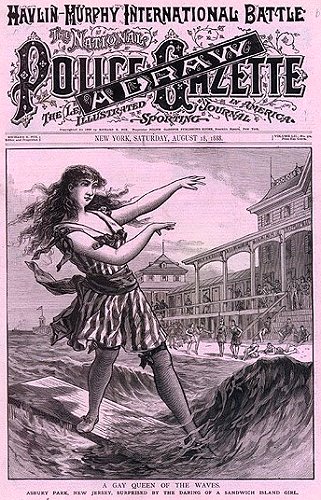
Most dramatically, the letter was reprinted several weeks later, without any accreditation, in New York's infamous National
Police Gazette along with a full page illustration
on the cover.
A confusing confection, derived from
surfing images widely published since 1819, it was likely to
have been prepared in-house by one of the Gazette's
illustrators.
The beach scene afforded the artist an opportunity, within
bounds, to expose their subject's feminine charms; this was
hardly unprecedented as risqué
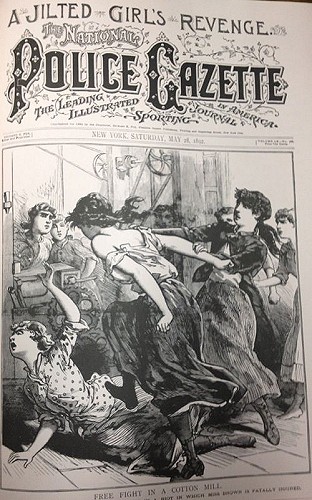
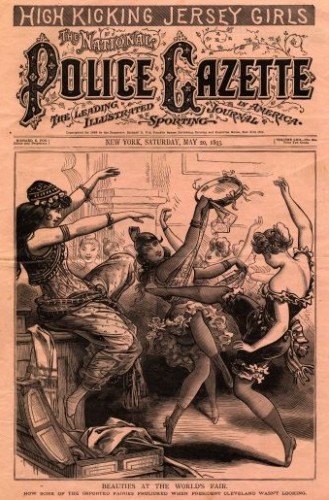
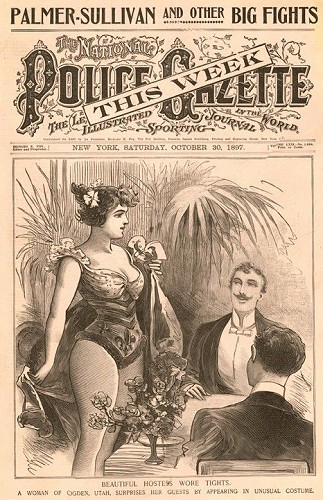
images of women regularly featured on the cover of the Gazette,
see below.
Unsigned
correspondence, then as now, invariably invites scepticism.
Richly infused with flamboyant description, rather than the
work of an enthusiastic Asbury Park local the style suggests a hand
with experience, able to tell a colourful tale while
scrupulously avoiding any hard facts.
Beginning with James Cook's mariners,
there were numerous published accounts of surf-board
riding by visitors to the Hawaiian Islands and in the later
19th century it was not unusual for travel and fiction
writers to incorporate surf-riding in their work, without
actually visiting the Pacific; for example R.M. Ballantyne's The Coral Island (1855).
None of the persons, the Sandwich Island Girl, her enormously
rich planter father, her companions (the family of a wealthy New York importer)
or the fashionablehotel at Asbury Park, are identified by name.
Whereas Skipper
Funderburg has suggested that news reporting
was much different then, (the) papers were less
interested in getting names of participants or attributing
names to quotes, this is not my experience; around the turn of the 19th century, journalists writing
for reputable newspapers seem to
have gone to considerable effort to accurately detail names
and locations in their reports.
The Sandwich Island Girl letter
was seen, and was of particular interest, to Mr. J.L. Graham
of Sea Bright, New Jersey. Not only was Graham living just ten
miles up the coast
from Asbury Park, he was long-time resident of the
Hawaiian Islands, had married into a respected
Honolulu family, and he had undoubtedly observed
surf-riding.
With
his Island
connections, Mr. Graham
could have perhaps
expected some
notification, or
gossip, of such a
distinguished
visitor from home
to the Atlantic
Coast.
Nevertheless, ostensibly
to
enquire about the Sandwich Island Girl's
whereabouts, he called at the office of the
Daily Press (later the Asbury
Park Press) on the 2nd August, 1888, a
couple of days after the Sandwich Island Girl
letter was (probably) published in Philadelphia.
Interestingly,
Graham
claimed that he knew the young lady and
desired to find her.
While
it is highly unlikely, the original Philadelphia
account may have additional information edited
from
the later reprints, or perhaps Mr. Graham was
merely ensuring that his intentions appeared
honourable.
However, given a suspicious lack
of detail, Graham may have been
testing the letter's veracity.
Relocating to Sea Bright from Honolulu in early
1886,from
early 1888 he was a partner
in E. Gogorza & Co., Commission Merchants of
New York City, and thus he was likely to be
aware of manywealthy New York importers,
perhaps even those who's family was said
to be hosting the visiting surf-rider.
(Indeed, as a New
York importer
of considerable
means, Graham and
his family were
eminently qualified
for the role in the
story.) Furthermore,
his business and family connections in
Honolulu made it probable that he would know of the Sandwich Island Girl's enormously
rich planterfather, if not all the members of his extended
family.
And, given account of several
days of surf-riding,
before a significant number of spectators, and the high status of the visitors to
Asbury Park, he (and we) could have reasonably
assumed that the story would be the talk of Asbury
Park and familiar to the local press; even if they
may not have published, or been responsible for, the
letter to Philadelphia.
It
appears that the staff of the Daily
Press had no knowledge of
the Sandwich Island Girl's
activities, aquatic or
otherwise.
Accordingly heplaced an advertisement
asking for her whereabouts, which was published on 6 Augustwith the
reply address as J.L. Graham, Sea Bright, N.J.
Although the report of Graham's visit to their
office in the
Daily Press
was headed Will the Search be Successful?, the question remains
unanswered.
Philadelphia Press:
Letter.
Originally printed late July, 1888. Reprinted on 2, 4, 5, 13, 18 August,
1888.
A Gay Queen Of The Waves
Ashbury Park, New Jersey, surprised by the
daring of a Sandwich Island girl.
A group of
summer loungers on the beach at Asbury Park, N.J., were
watching the extraordinary antics of a dark eyed, bronze-faced
girl in the sea a few mornings ago. The object of
all this interest and solicitude was beyond the line of
breakers and standing on a plank that rose and fell with the
swelling waves. Her bathing
dress was of some dark material, fitting close to the figure,
the skirts reaching scarce to her knee. Her stockings
were of amber hue, adorned with what from the shore seemed to
be vines and roses in colored embroidery. She wore no
hat or cap. Her hair,
bound across the forehead and above the ears by a silver
fillet, tumbled down upon her shoulders or streamed out upon
the wind in black and shining profusion. Her tunic was
quite sleeveless, and one could scarcely fail to observe the
perfect development and grace of her arms. As a wave
larger than those which had gone before slowly lifted the
plank upon its swelling surface, she poised herself daintily
upon the support, her round arms stretched out and her body
swaying to and fro in harmony with the motion of the waters.
As the wave
reached its fullest volume she suddenly, quick as thought, and
with a laugh that rang full into shore, drew herself together,
sprang into the air, and, her hands clasped together and
clearing her a way, plunged into the rolling sea. There was a
little cry from timid feminine watchers on the sand, but the
smiling face was above water again while they cried, and the
daring Triton was up on the plank again in another moment and
waiting for a second high roller. So she has
been amusing herself and interesting the mob for three
mornings. She is as
completely at ease in the sea as you or I on land, and the
broad plank obeys her slightest touch.
When she has had enough of it she will bring
the plank into shore, she riding upon the further and gliding it
like a goddess over the crests and through the foam of the
biggest breakers. She comes from the Sandwich Islands and is
making a tour of the country.
Her father is an enormously rich planter.
She arrived in the Park a week ago with the family of a wealthy
New York importer.
She is at a fashionable hotel and is one of the most charming
dancers at the hotel hops, as well as the most daring swimmer on
the Jersey coast.
She is well educated and accomplished, and, of course, speaks
English perfectly and with a swell British accent that is the
despair of the dudes.
She learned to be the mistress of the waves in her childhood at
her native home by the sea, where she modestly says, all girls
learn swimming as a matter of course, quite as much as girls in
this country learn tennis or croquet.
Yesterday a gentleman called at the Daily
Press office and said he had seen in one of the New York papers
a personal notice of the arrival in Ashbury Park of
a young girl from the Sandwich Islands.
His home was located there- he knew the young lady and desired
to find her, and accordingly placed an advertisement in this
paper asking for her whereabouts.
The undersigned desires to know the
whereabouts of a young lady from the Sandwich Islands who is
stopping in the Park.
Address: J.L. Graham, Sea Bright, N.J.
The National Police Gazette was the
forerunner of the men's
lifestyle magazine, the illustrated sports
weekly, the girlie/pin-up magazine, the
celebrity gossip column, Guinness World
Records-style competitions, and modern
tabloid/sensational journalism. https://en.wikipedia.org/wiki/National_Police_Gazette
A confusing confection,
derived from surfing images
widely published since 1819, the
illustration was
likely to have been prepared
in-house by
one of the Gazette's
illustrators.
The
beach scene afforded the artist an
opportunity to, within bounds, expose their subject's feminine
charms; this was hardly unprecedented as risqué images of women
regularly featured on the cover of the Gazette,
see below.
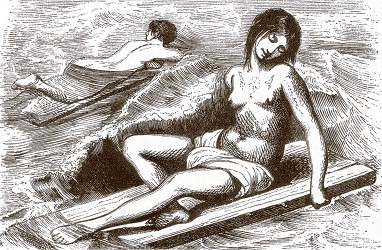
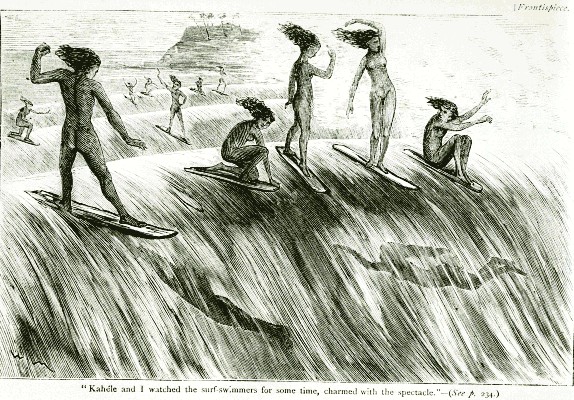
The illustration was undoubtedly
influenced by previously published images:
Jacques Arago: Wahine,
Hawaii, circa 1819.Wallis
McKay: Surf-swimmers, circa 1874.
The header was created by
Henry W. Troy, his signature appearing in
every issue.
Some
of the illustrators working for theNational
Police Gazette in the late
19th century included:
Matt Morgan, Charles Kendrick, Philip G.
Cusacha, George G. White and George E.
McEvoy.
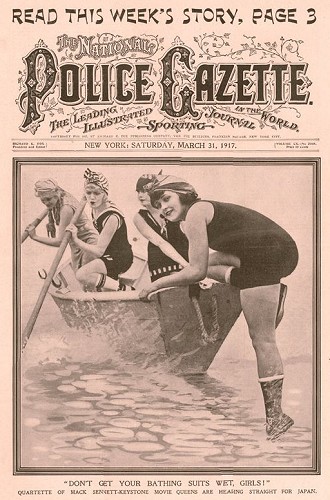
Don't Get your Bathing Suits
Wet, Girls! 5
May 1917
Notes
J.L. Graham-Ellen Coney Ellen's
father, John H. Coney was
appointed Collector
of Customs for the Port and District of Hilo in 1861.
Hilo Bay was a major centre for surfboard riding, said to
rival Waikiki, and there are numerous accounts written 19th
century, that of Charles Nordhoff
published in 1873 featuring an early illustration.
In 18??, John Coney wed Miss Ena,
a beautiful Hawaiian maiden, and the family home was a fine residence
on the corner of Palace Walk and Richards' street,
Honolulu,
He was active in business and following his death in 1880,
Mrs. Coney and
her family were well known in respectable society.
Notably in 1882, Mrs. Coney and one of her daughters were
among the guests at a Royal luau at the King's residence Pualeilani
at Waikiki.
After dancing (the quadrille, the waltz, and the
lancers) the guests sat in the traditional manner
for a sumptuous luau.
Remarkably, when the party returned to the dance floor, their
cab-drivers and staff were pressed with royal
cordial hospitality to partake of the superabundant
bounties that remained.
There were three daughters, "S."
(later Mrs. S. J. Levey), Lizzie and
Ellen.
On a world tour
with her sisters in 1885, Miss Ellen ... who is exceptionally
handsome (with)
pretty shoulders
and beautiful eyes, when interviewed
by the press in Californiacommented that: "To me there is no place on
earth like the Hawaiian Kingdom, where the
enjoyment of lawn tennis and dancing is
always obtainable." Regrettably, but
perhaps understandably, the interviewer did
not venture to ask Miss Ellen about Waikiki.
J.L.Graham
and Ellen Coney wed at the Coney family homein December 1885.
Departing as Kamamas (?), they
relocated to New Jersey from Honolulu in early 1886, and Mr. Graham was made a
partner in an
import agency in New
York City in 1888.
A Gay
Queen of the Waves : Chronology Note that although the newspaper's official
title was The Press, in 1888 it would have
generally be known by its former name, The
Philadelphia Press (1880-1885). Chicago
Tribune, 2 August 1888, page 9. - Philadelphia Press Letter. St Louis Post Despatch,
4 August 1888, page 7. - From the Philadelphia Press Letter. The
Tennesseean, Nashville Tennessee, 5 August
1888, page 8. - (Philadelphia Press Letter) Omaha Daily Bee,
August 13, 1888, page 8. - Philadelphia Press
Letter. Image and text provided by
University of Nebraska-Lincoln Libraries, Lincoln, NE
Persistent link: http://chroniclingamerica.loc.gov/lccn/sn99021999/1888-08-13/ed-1/seq-8/ National
Police Gazette, August 18,
1888, unaccredited Letter on page 14, with front page illustration. http://www.policegazette.us/FromTheMorgue_8-18-1888_SandwichIslandGirl.html For Asbury Park's Daily
Press, see: Dan Radel, Asbury Park Press:
NJ history: Asbury 'Sandwich Island Girl'
clue may upend East Coast surfing history https://www.app.com/story/news/local/culture/2018/08/01/new-clue-hunt-asbury-parks-sandwich-island-girl/796828002/
Other Potential Resources Williams, Rianna M.:Hawaiian Ali'i Women in New
York Society: the Ena-Coney-Vos-Gould
Connection.(2004) I first heard of Kaikilani
Coney Vos in 1991, when I saw a painting of her in the small
Kaua'i Historical Society museum on the grounds of the
Coco Palms Hotel. Hawaiian Journal of
History, Volume 38, 2004.
Polynesian. Honolulu, March 2, 1861, page 3. With the approbation of His Exellency the Minister of
Finance, the Collector General of Custom has appointed JOHN H.
CONEY, Esq., to be Collector of Customs for the Port and
District of Hilo, in place of B. Pitman, Esq., resigned.
Polynesian. (Honolulu [Oahu], Hawaii) 1844-1864, March 02,
1861, Image 3
Image and text provided by University of Hawaii at Manoa;
Honolulu, HI
Persistent link: http://chroniclingamerica.loc.gov/lccn/sn82015408/1861-03-02/ed-1/seq-3/ The
Hawaiian Gazette. Honolulu, January 17, 1877, page 4.
Supreme
Court of the Hawaiian Islands
OCTOBER TERM, 1876.
JOHN H. CONEY vs. JAS. A. D0WSETT.
Opinion of A. Francis Judd.
This is a action in which $10,000 are claimed as damages for the
trespass of the defendant's cattle upon the land " Honnnlinli."
in Ewa, Oahu, the properly of the plaintiff, since Oct. 16th.
1875. The jury returned a verdict for the plaintiff of $200. and
a motion is made to set aside this verdict and grant it new
trial, on the ground that the jury must have mistaken or
disregarded the instructions of the court on the effect of
certain leases under which the defendant justified, or that the
jury misunderstood the evidence. The Hawaiian gazette. (Honolulu [Oahu, Hawaii]) 1865-1918,
January 17, 1877, Image 4
Image and text provided by University of Hawaii at Manoa;
Honolulu, HI
Persistent link: http://chroniclingamerica.loc.gov/lccn/sn83025121/1877-01-17/ed-1/seq-4/ The Hawaiian Gazette. Honolulu, April 21,
1880, page 3.
Last Saturday Mr. Coney's fine residence on the corner of Palace
Walk and Richards' street, had a narrow escape from fire.
Cause, unclean flues.
Ignition had taken place and was discovered only in time to
prevent a serious fire.
The flue was full of soot, which took fire, a not uncommon
occurrence in other countries.
Too much care cannot be taken in guarding against fire.
The Hawaiian gazette. (Honolulu [Oahu, Hawaii]) 1865-1918, April
21, 1880, Image 3 Image and text provided by University of Hawaii at Manoa;
Honolulu, HI
Persistent link: http://chroniclingamerica.loc.gov/lccn/sn83025121/1880-04-21/ed-1/seq-3/ Saturday
Press. Honolulu, October 23, 1880, page 2.
Supreme
Court of the Hawaiian Islands. In Probate. Island of Oahu,
Hawaiian Islands. ss.
In the matter of the estate of JOHN H. CONEY, late of Honolulu,
In the Island of Oahu, deceased. Order appointing time for Probate of will and directing
publication of the same. A document purporting to be the last will and testament of
John H. Coney, deceased, having on the 20th day of October, A.
D. 1880., Saturday press. (Honolulu, H.I.) 1880-1885, October 23,
1880, Image 2
Image and text provided by University of Hawaii at Manoa;
Honolulu, HI
Persistent link: http://chroniclingamerica.loc.gov/lccn/sn82014681/1880-10-23/ed-1/seq-2/ The Pacific Commercial Advertiser. Honolulu, May 27, 1882, page 3. There were three runaways on Monday. Mrs. Coney and her daughter Mrs. Levy were driving up
Beretania street when the horse bolted. The buggy was over-turned at the corner of Punchbowl street
and both ladies thrown out. Mrs. Coney suffered a dislocation of the shoulder. Mrs. Levy fortunately escaped with a few bruises. Mr. J. O. Hayselden left his horse and buggy' standing at
Messrs. E. O. Hall & Son's corner, and the horse being
frightened by a bullock team passing, turned round and in doing
so upset the buggy, which he immediately proceeded to kick to
pieces. The third accident was to an express. The horse ran away and capsized and smashed the carriage at
the corner of Richard and Beretania streets no one hurt. The Pacific commercial advertiser. (Honolulu, Hawaiian
Islands) 1856-1888, May 27, 1882, Image 3
Image and text provided by University of Hawaii at Manoa;
Honolulu, HI
Persistent link: http://chroniclingamerica.loc.gov/lccn/sn82015418/1882-05-27/ed-1/seq-3 The Pacific Commercial Advertiser.
Honolulu, October 7, 1882, page 5.
A Royal
Luau.
The King entertained on Saturday a party of about one hundred
guests at a luau, at his residence Pualeilani, Waikiki.
This place is now become one of the most delightful retreats in
the suburbs of the city.
The ancient ancestral cocoa palms at this time tower above
umbrageous groves of the algeroba, and beneath the light
feathery spray of these groves, the Bermuda grass has covered
the ground with close turf of thickly intermatted herbage so
that guests ramble over broad, green, close sodded, lawns
beneath an inviting shade of beautiful foliage.
Among His Majesty's guests were the Princess Liluokalani, ...
... Mrs. Coney, Miss Coney,
A dancing floor was laid upon a shaded retreat in the lawn, and
overhead was spread a royal Hawaiian standard and a broad ensign
of the American stars and stripes.
When the main portion of the guests had assembled, about 2 p.m.,
His Majesty and Mrs. Wodehouse, Minister Daggett and the
Princess Liliuokalani, and Premier Gibson and Mrs. Hendry led
the way to the dancing floor, and here the assembled company
enlivened by the sweet strains of a cotillion band disported
themselves in the quadrille, the waltz, and the lancers.
After a few sets, the gay party, led again by His Majesty and
Mrs. Wodehouse, adjourned to the luau pavilion.
Here a choice collation was arranged on a long, low platform in
horse shoe form, and only raised about six inches from the
ground and beside which the hundred guests sat on mats in the
recumbent, or cross-legged fashion which the ancient Europeans
must have observed ere the invention of chairs for dining
tables.
On this occasion some long limbed guests found
it difficult to dispose of the superfluous portion of their
extremities, some knees being elevated above the platform, and
some feet were scattered about in promiscuous directions. However, with abundant courtesy, good humor, and jocularity
the guests adjusted themselves and partook heartily of the
Hawaiian luau or cold lunch, in which poi and fish (choice pond
mullet in ki leaves) ohu, chicken salad, roast pig, soft
crabs and other appetizers abounded.
After a bounteous repast which was associated with much
conversational humor, quip and bon mot,; in which Minister
Daggett takes a lively part, the company returned to the dancing
floor. On this occasion another company not formally invited, but
at the same time being there were pressed with royal cordial
hospitality to partake of the superabundant bounties that
remained. This company was composed of the numerous cabbies or
expressmen assembled, and other followers of the occasion. These outside guests toasted the King and his Ministers,
and otherwise expressed their satisfaction at the courteous and
hospitable treatment accorded at a royal luau to those who
usually have to wait outside with empty stomachs on such
occasions.
The dance went on joyously till a late hour in the
afternoon, and not until the sun's low slanting rays began to
throw the whole grounds into shade did the company begin to
disperse. And they went away, we feel assured, full of kindly and
grateful feeling towards a gentlemanly royal host who seeks with
a generous heart to make all who come to partake of his
hospitality enjoy themselves and feel at home. The Pacific commercial advertiser. (Honolulu, Hawaiian
Islands) 1856-1888, October 07, 1882, Image 5
Image and text provided by University of Hawaii at Manoa;
Honolulu, HI
Persistent link: http://chroniclingamerica.loc.gov/lccn/sn82015418/1882-10-07/ed-1/seq-5/ The Pacific Commercial Advertiser. Honolulu, February 3, 1883, page 2.
Audience at
Iolani Palace (Daily January 29)
On Saturday, at noon His Majesty the
King received the Envoy
Extraordinary and Minister Plenipotentiary of Japan to Hawaii at Iolani Palace. ... The Embassy,
accompanied by Colonel Curtis P. Iankea, next proceeded to the
residence of Her Royal Highness Princess Likelike at Waikiki.
The Princess accompanied by the Hon. A. S. Cleghorn, Princess
Kaiulani and her Governess, Miss Barnes, Miss S. Coney, Miss L.
Coney and Miss A. Cleghorn received the Minister and his suite. The Pacific commercial advertiser. (Honolulu, Hawaiian
Islands) 1856-1888, February 03, 1883, Image 2
Image and text provided by University of Hawaii at Manoa;
Honolulu, HI
Persistent link: http://chroniclingamerica.loc.gov/lccn/sn82015418/1883-02-03/ed-1/seq-2/ The Daily Bulletin.
Honolulu, June 26, 1885, page 4.
HAWAIIAN LADIES.
Under this heading the following appears in the society
department of the Alta California of the
25th Inst. :
For several weeks past there has been stopping at the Palace
Hotel a party of distinguished Hawaiian ladies, consisting of
Mrs. S. J. Levey and her sisters, Misses Lizzie
and Ellen Coney, who are the daughters of the late John H.
Coney, at one time a well known capitalist of New York.
Mr. Coney, who died four years ago, was wedded in early days to
Miss Ena, a beautiful Hawaiian
maiden.
His eldest daughter became the bride of S. J. Levey, a Honolulu
merchant.
Since July, 1884, the party referred to has been traveling over
the globe in company with Hon. and Mrs. Samuel Parker, who
returned to Honolulu on the 15th of last month.
T. V. H. Robertson also accompanied them.
Mrs. Levey intended returning to Honolulu several weeks ago, but
was detained here by the illness of her infant child.
Mr. Levey departs for home to-day upon the steamer Alameda.
Her sisters will follow on the 1st proximo.
In conversation with Miss Ellen
Coney one evening last week, the lady, who is exceptionally
handsome, expressed herself as being charmed with the tour of
the world.
When asked if she did not prefer this country to her tropical
home, Miss Coney gave an indifferent shrug to her pretty
shoulders, and, with a wistful look in her beautiful
eyes, stated, "To me there is no place on earth like the
Hawaiian Kingdom, where the enjoyment of lawn tennis and dancing
is always obtainable."
The Daily bulletin.
(Honolulu [Hawaii]) 1882-1895, June 26, 1885, Image 4 Image and text provided by University of Hawaii at Manoa;
Honolulu, HI
Persistent link: http://chroniclingamerica.loc.gov/lccn/sn82016412/1885-06-26/ed-1/seq-4/ The Daily Bulletin. Honolulu, December 18,
1885, page 3.
Last evening Miss Ellen Coney was married at her mother's
residence, to Mr. John L. Graham, of New York, the Rev. J. A.
Cruzan officiating and a pleasant company looking on. A reception and luau were afterward held at the house of
Mr. John Enn. The couple will leave by the Mararoa on their journey to
New York. The Daily bulletin. (Honolulu [Hawaii]) 1882-1895, December
18, 1885, Image 3
Image and text provided by University of Hawaii at Manoa;
Honolulu, HI
Persistent link: http://chroniclingamerica.loc.gov/lccn/sn82016412/1885-12-18/ed-1/seq-3/ Daily Honolulu Press. Honolulu, January 18,
1886, page 3.
PASSENGER
ARRIVALS.
...
From Maui and Hawaii, per steamer Kinau,
Sunday, January 17.
... , J L Graham and wife,
Daily Honolulu press.
(Honolulu, Hawaiian Islands) 1885-1886, January 18, 1886, Image
3 Image and text provided by
University of Hawaii at Manoa; Honolulu, HI
Persistent link: http://chroniclingamerica.loc.gov/lccn/sn85047264/1886-01-18/ed-1/seq-3/The Hawaiian Gazette. Honolulu, February 16, 1886, page 3.
The Mariposa carried away a number of Kamamas. Among then are ... Mr and Mrs Graham (nee Ellen
Coney) ... Bon voyage and safe return.
The Hawaiian gazette. (Honolulu [Oahu, Hawaii]) 1865-1918,
February 16, 1886, Image 3
Image and text provided by University of Hawaii at Manoa;
Honolulu, HI
Persistent link: http://chroniclingamerica.loc.gov/lccn/sn83025121/1886-02-16/ed-1/seq-3/The Daily Bulletin. Honolulu, January 24, 1888, page 3.
Mr. John L. Graham, well known in this city, as having married a
daughter of Mrs. Coney, has been admitted as a partner in the
house of E. Gogorza & Co., Commission Merchants of New York
City.
This firm is widely and honorably known, having been for the
last 25 years connected with the South American trade.
Despite intense research, Skipper was
unable to locate any supporting evidence in the microfilm
reel archives of Asbury Park'sThe Daily
Press, from 1886 to 1889 or those of The Daily
Spray (1886-1889).
Microfilm
reels of The Shore
Press (the Sunday edition of TheDaily Press) are available for 1886,
1887, and 1889, but, unfortunately, there are
no editions from 1888.
Skipper
suggests that there may be a paper collection at New Jersey
Department of Records Management.
J. “Skipper”
Funderburg
June 1,
2010.
Research Paper:Sandwich
Island Girl Hangs Five
A Gay Queen Of The Waves By Joseph “Skipper” Funderburg www.carolinabeach.net
I have been
encouraged to conduct further research on the woodcut
engraving of Sandwich Island Girl (SIG), as published in the
National Police Gazette (NPG), August 18, 1888. Richard Kyle
Fox (Fox) was the Editor and Proprietor of the NPG from 1877
until his death in 1922. Fox perfected the sports page and the
gossip column, as well as the use of large illustrations to
dramatize the stories in his paper. Before Fox, these things
did not exist as we know them today. Fox turned a text heavy
medium into something visually exciting. Even Thomas Edison
was a regular reader. Irving Berlin wrote a song about it: The
Girl on The Police Gazette. Hugely popular, even across the
ocean, the publication made an appearance in James Joyce’s
masterpiece Ulysses.
While SIG’s
publication may be considered an anomaly, her iconic image is
culturally, historically and aesthetically significant to the
world. I am delighted to add to, and alter, the history of
surfing in the United States. SIG’s iconic image is of
profound significance to the surfing community. She exposed
citizens to surfing imagery in 1888 ! The image has rocked the
foundation of surfing history. I agree with DeSoto Brown’s
statement, “Whatever the story, I still think this is a
terrific find to add to surfing’s history.” My research has
reached the point that it is time to present information to
support my point of view.
All this
reminds me of the famous line from the movie Apocalypse Now,
when Colonel Kilgore barks “What do you know about surfing,
major? You’re from darn New Jersey!” I have proved Colonel
Kilgore was wrong!
It might be
noted that news reporting in the 19th century was not like
today. There was no television, no movies, and no radio.
We take many details for granted in a typical news story that
were not considered important back then. Getting the names of
participants, attributing quotes, and other factual details
were often not priorities. The NPG decided what its focus was
and stuck to it. One focus was on women’s appearance and
movements – anything that was sexually titillating for the
time. Who she was and where she came from was of less
importance.
The NPG
certainly was a publication that mixed fact with fiction. But
my feeling is the description in the article is too detailed
to be made up. If it were just the illustration with no
accompanying story, I might be more inclined to accept the
possibility that the incident didn’t happen. Either way, NPG
specialized in depicting women doing manly things…shooting,
fighting, drinking, playing sports…and so surfing is exactly
the type of thing they would have jumped on, even if no other
news outlets would give it a second look. It is a realistic
possibility.
I would also
agree with the discussion regarding whether the activity can
be called surfing. The woodcut engraving appears with the
description that she may just be balancing on the plank, as
the waves roll underneath. In any case, whether it’s surfing
or balancing, this appears to be the first depiction of it on
the American east coast. I have to continue to believe the NPG
is describing a real event.
It must have
been an attraction, because of the way they guarded the beach
in those days with ropes, pilings and surf boats. The imagery
in the background looks conservative, typically the public was
not allowed to swim outside the ropes. As well, there were no
bars or gambling in Asbury, in those days. This makes me think
a surfing display would definitely have been a spectacle and
worthy of an eyewitness writing it down somewhere. Also, at
the time they were known as progressives…all of those
temperance movements to curb drinking, violence, gambling was
progressive legislation.
Asbury Park,
NJ, is located 55 miles south of New York City and 60 miles
away from Philadelphia, PA. Founded in 1871, Asbury Park was
considered a country by the sea destination; boasted a mile
and a quarter beach; is one of about fifty-four seaside cities
on the Jersey Shore; and nestled about halfway along the
hundred mile stretch of coastline between Cape May, NJ, and
Sandy Hook, NJ. More than a half million people a year
vacationed in Asbury Park during the summer season, riding the
railways from the New York City Metropolitan Area.
The more I
research about the history of Asbury Park, the more it seems
like a prime getaway for New Yorkers looking for beach fun, in
the late 19th and early 20th centuries. At that time on the
Jersey Shore, Asbury Park would have been a more religious and
teetotaling clientele than Cape May or Atlantic City. Founded
in 1869, Ocean Grove, NJ, the seat of the Temperance Movement
on the Jersey Shore, is the southern border of Asbury Park. A
visionary Methodist clergyman, Reverend Ellwood H. Stokes,
convinced his congregation to invest in three hundred acres
and one mile of beach front. The community was known as the
Queen of Religious Resorts, and enforced a multitude of strict
rules, including no beach bathing on Sundays. This would have
played into the hands of the NPG editors, who delighted in
exposing hypocritical clergy and tended to scoff at religion
and temperance in general. The NPG editors had great fun at
the institution’s expense. In short, the NPG would have jumped
at the chance to portray something extravagant or un-ladylike
among the straight laced beach goers.
Fox had a
residence in Red Bank, New Jersey, which is a good location
for those interested in boating and a life by the sea. Fox was
certainly wealthy enough to afford whatever hobby he chose,
but he loved the sea, cruising in his yacht, surf bathing and
picnicking. In the June 30, 1888 issue of NPG, I unearthed
Yacht Richard K. Fox, an expensive private ocean going sailing
vessel. Turns out he fancied sailing the Jersey Shore, the
northeast and extending further to the blue chip beaches of
New England and Cape Cod. Fox sponsored many competitive
events--including seafaring ones--such as the trans-Atlantic
rowboat “FOX” in 1896. In fact, Fox created and managed to
include almost every aspect of human activity imaginable under
the category of sports.
Fox wrote a
book in 1883 titled, Coney Island Frolics: How New York’s Gay
Girls and Jolly Boys Enjoy Themselves by the Sea. He
wrote descriptions of women in the surf; various amusements of
the late 19th century; discussed social changes of this era
that made the water based activities possible; and served as
an instructional manual or visual travel guide to the beaches
of the northeast. He described beach and water based
activities on Manhattan Beach, NY, and Brighton Beach, NY.
There is no
question Fox and the NPG were an integral part of the
development of professional women boxers, wrestlers and
strongwomen of the 1880s and 1890s. Though many upper class
Victorians may have viewed these athletic activities as
unfeminine and even demeaning, these female athletes were seen
as competent professionals and, in many ways, the equal of
their male peers. It is important when looking at these women,
however, to keep in mind how limited their professional
options truly were. Fifteen to twenty-five dollars a week,
working for Fox, no doubt proved a powerful incentive for
women whose primary employment option was back-breaking
factory work, sweatshops, kitchens or farm labor. Furthermore,
these women knew that if they became good enough that there
was a realistic chance that they could earn even greater sums
by defying the traditional ideals of Victorian womanhood. As
the owner, Fox had full control of the womens’ activities.
They did as they were told, especially for NPG publicity.
Regarding the
NPG woodcut engravings, Fox was notorious for not giving
credit to his artists and writers. When reading all 26 NPG
issues in volume 52, covering March to September 1888, one
will notice there are virtually no bylines on NPG stories. The
woodcut artists were first class--there are descriptions that
state one couldn’t find better quality in the medium of
woodcut engraving. SIG’s woodcut engraving represents a small
sampling of the NPG’s artistic treasures. Today, William
A. Mays, the current editor and proprietor of the NPG, is on a
mission to properly photograph and catalog the paper images
before the original copies deteriorate. An old history of
American magazines lists Matt Morgan, Charles Kendrick, Philip
G. Cusacha, George G. White and George E. McEvoy as having
done illustrations for the late 19th century NPG. The creator
of the NPG logo is Henry W. Troy. His signature appears in
every issue.
There was also
a world famous wood carver on the beach in Asbury Park.
In the winter of 1888, Palace Amusements was founded in Asbury
Park. Palace provided refined amusements and became famous for
having one of America’s greatest hand-carved wooden carousels.
Charles I.D. Looff was a master carver and builder of
handcrafted wood carousels. Early in his career, he found work
as a wood furniture carver and took wood scraps home, carving
them into wooden carousel animals and more. Looff built the
first carousel at Coney Island, NY, in 1876 and is credited
for creating the Coney Island style of wood carving. The
significance of Looff’s presence in Asbury Park in 1888 is
that there was a wood carver available, on the beach, to carve
a surfboard. Charles I.D. Looff and his son Arthur Looff also
built the Santa Monica Pier in 1909, then the Santa Monica
Looff Hippodrome was built in 1916.
Just off the
coast of New Jersey exists the Gulf Stream, a powerful, warm
and swift Atlantic Ocean current which attracted whaling ships
in search of whales.
It is well
documented that American whaling soon spread from the east
coast to the American colonies in the 19th century. The
early whaling voyages and whaling era had a phenomenal impact
on 19th century America, both east and west coasts. In the
early 1800’s, Hawaii was a favorite destination of whaling
vessels, and their crews were in direct contact with surfers.
It is also well documented some whaling crews jumped ship once
they arrived in the Sandwich (Hawaiian) Islands. Many,
including Herman Melville, jumped ship, apparently without
repercussions. Once the original crew jumped ship, many
Hawaiians were hired to work aboard whaling vessels. It is
well documented that Hawaiian crewman were sailing to the
United States by the early 19th century. It has been said that
sooner or later someone will uncover proof of surfing in the
19th century. While SIG may represent an isolated incident, it
is probable Hawaiian crews were sailing in ports on the east
coast. By about 1840, more passengers and greater tonnage of
cargo came through New York than all other major harbors in
the country combined. By 1900 New York was one of the great
international ports.
The 1888
volume 52 microfilm reel of the NPG was thoroughly researched.
I poured over the 26 issues many, many times. SIG was
published on August 18, 1888. I located a reference to Lena
Merville, Yachting on the Briny Blue, Asbury Park, dated July
7, 1888. The best lead I got was on September 2, 1888, an
article titled How Actresses Swim by Lord Chumley Lewis. Lewis
wrote that the article “refers back to an article a few weeks
ago.” The article describes a group of women on Coney Island,
NY, swimming in the surf. The article goes on to quote, “Lena
Merville is as full of get up and go, plunge down and splash
in the water as she is on the boards.” My interpretation is
the writer is grouping “get up and go, plunge down, and
splash” together and saying Ms. Merville is as full of those
things in the water as she is on the boards. In 1888, plunge
meant diving and on the boards meant on the stage. In
the New York Times, September 12, 1889 issue it was reported
the sprightly soubrette Lena Merville was appearing on stage
in New York City. Lena Merville reminds me of SIG. On July 21,
1888 an article on The Duke of Marlborough’s wife, Mrs. Lilian
Hamersley--the famous American beauty--had been traveling the
world by sea. Also of interest: a February 18, 1888, article
about Miss Ada Web, The Famous Water Queen; a September 15,
1888, article Mermaids of the Sea Shore – Disport in the surf
at high toned watering places; an August 25, 1888, article on
Kate Hart, The Pretty Musical Comedian – Streak ‘O Sunshine;
and Miss Nettie Perkins is advertised as an Artistic Costumer
and Burlesquer.
The Daily
Spray Newspaper, Asbury Park ~ 1886 – 1889 (microfilm reel)
The Ocean
Roller Rink keeps coming up, week in, week out. Miss Nettie
Perkins “Queen of the Rollers” is one of the acts there.
Though she’s roller skating, she reminds me of SIG. Also,
Carrie Perkins is mentioned in NPG advertisements. The
newspaper is chocked full of beach culture, beach drowning,
beach clothing shops, proper attire, swimming tips, swimming
races, fishing reports, schooner posts from party boats, and
hotel arrivals. In an editorial, the author had made the
comment about caricatures being drawn in New York papers
depicting life in Asbury Park. The particular caricature was
of an Asbury Park policeman drawn out of proportion.
The Shore
Press Newspaper, Asbury Park ~ 1886, 1887, 1889 (microfilm
reel)
The newspaper
mentions ship and hotel arrivals, and they wrote about a lot
of beach scenes. Unfortunately, 1888 is missing from the Shore
Press microfilm reel. There may be a paper collection at New
Jersey Department of Records Management.
I am inclined
to defend the philosophic burden of proof, an obligation on me
to provide sufficient evidence that SIG’s three day surfing
exhibition probably occurred in Asbury Park. The logical
possibility, proof and indirect evidence it occurred in Asbury
Park is reasonable. Because of her tie to a historical event,
and the location, her story is believable. Most significantly,
SIG is one of the earliest known surfing illustrations in the
contiguous United States. The fact that her mythic tale is
being told at all allows scholars to use her as commentary
upon cultures that produce and circulate legends. It’s a
tricky domain, but for most of us, her legend and her image
are enough. The daring triton has not been getting the
attention she deserves and I am committed to changing that. I
plan to ballyhoo SIG in a way that is interesting to surfers
and the general public.
Joseph
“Skipper” Funderburg, Author
Acknowledgements
I would like
to acknowledge William A. Mays, current Editor and Proprietor
of the National Police Gazette, for his editing, untiring
devotion and interpretations. I am especially appreciative of
the assistance of Dan Radel, Asbury Park Press. A tip of the
hat to the respected surf historians and writers Malcolm
Gault-Williams, Geoff Cater, DeSoto Brown, Craig Lockwood,
colleagues and others, who participated in a full discussion
about the Sandwich Island Girl image discovery a couple of
years ago. I sincerely appreciate and am grateful to Daniel
Ray Norris, Slapdash Publishing, LLC, Carolina Beach, NC;
Peter Fritzler, Science Librarian, William M. Randall Library,
University of North Carolina Wilmington; Will Lucas, Surf 64
Productions, Melbourne Beach, Fl; and Cecil Lear, Eastern
Surfing Association, Belmar, NJ.
References
The Asbury
Park Press, 3601 Highway 66, Neptune, New Jersey. The Asbury
Park Press is the third-largest daily and Sunday newspaper in
New Jersey. Microfilm reel archive Circa 1876 to circa 1890.
Microfilm reels from circa 1886 to circa 1889 were throughly
researched.
Black Rides
the Surf, New York Times, June 16, 1911.The bird rode a piece
of driftwood in time and again. It’s the lingo used when
writing this little article that caught my eye. The author
even used the phrase “rode the swell” in the article.
Lillian V.
Davenport (1853 – 1878)
Actress Lily
Davenport Vining, younger sister of Fanny Lily Gypsy
Davenport, appeared on the New York stage in the late 1880’s.
The two sisters first performed together in “Surf,” by Olive
Logan, at Daly’s New York theatre in 1870. In 1873 Lily
married Frost Thorne II. Holding a scythe, young Vining poses
in costume as Ceres at the Gurney Studio in New York.
C. S.
Reinhart, 1886 painting, Saints in the Surf and their
pilgrimage.
The Daily
Journal Newspaper, Asbury Park
New Jersey
Department of Archives and Record Management, PO Box 307,
Trenton, New Jersey
The New Jersey
State Archives has the following microfilm reel of the [
Asbury Park ] Shore Press. Unfortunately there are no issues
for 1888.
Shore Press (W)
Reel # 3391 –
Dates: 23 April 1885 to 8 May 1891
[23 Apr. 1885 –
30 Dec. 1887; 4 Jan. 1889 – 8 May 1891]
The published
Directory of New Jersey Newspapers, 1765 – 1970, by Wright
& Stellhorn, does not list any issues of the Shore Press
for 1888 30 Dec. 1887; 4 Jan. 1889 – 8 May 1891]
Future
Research
David H.
Wycliff, published or non published hand written history of
Asbury Park, 1876 – 1896. The document is no short account,
Wycliff went into detail and judging his thought process, if
he knew of it, he would have written it down, because
something like that should have stuck out in his mind.
Belmar Beach
Patrol 1887-1888
The
Illustrator was a magazine of the time period. The publisher
was N.Tibbals and Sons, New York
The Summer
Capitol, Long Branch, New Jersey. A newspaper published during
the same period.
New York
Newspapers that used quotes from the 1888 NPG:
New York Harold
New York Sun
New York Daily
News
New York World
New York Drama
Athletic Club
of New York - Records
Other
published or non published, journals, diaries, etc.
Newspapers and magazines in other communities.
National
Police Gazette
August 18, 1888
A Gay Queen Of
The Waves
Subject of
Illustration
A group of
summer loungers on the beach at Asbury Park, N.J., were
watching the extraordinary antics of a dark eyed, bronze-faced
girl in the sea a few mornings ago. The object of all this
interest and solicitude was beyond the line of breakers and
standing on a plank that rose and fell with the swelling
waves. Her bathing dress was of some dark material, fitting
close to the figure, the skirts reaching scarce to her knee.
Her stockings were of amber hue, adorned with what from the
shore seemed to be vines and roses in colored embroidery. She
wore no hat or cap. Her hair, bound across the forehead and
above the ears by a silver fillet, tumbled down upon her
shoulders or streamed out upon the wind in black and shining
profusion. Her tunic was quite sleeveless, and one could
scarcely fail to observe the perfect development and grace of
her arms. As a wave larger than those which had gone before
slowly lifted the plank upon its swelling surface, she poised
herself daintily upon the support, her round arms stretched
out and her body swaying to and fro in harmony with the motion
of the waters. As the wave reached its fullest volume she
suddenly, quick as thought, and with a laugh that rang full
into shore, drew herself together, sprang into the air, and,
her hands clasped together and clearing her a way, plunged
into the rolling sea. There was a little cry from timid
feminine watchers on the sand, but the smiling face was above
water again while they cried, and the daring Triton was up on
the plank again in another moment and waiting for a second
high roller. So she has been amusing herself and interesting
the mob for three mornings. She is as completely at ease in
the sea as you or I on land, and the broad plank obeys her
slightest touch.
Thank you,
Joseph
“Skipper” Funderburg, Author
June 1, 2010.
J. Skipper Funderburg January 1, 2017
Sandwich Island Girl Amended
I have been encouraged to conduct further research on the woodcut
engraving of Sandwich Island Girl, as published in the National
Police Gazette, August 18, 1888. I documented in my article
Sandwich Island Girl Hangs Five, Legendary Surfers, June 29,
2010. My feeling is the description in the National Police Gazette
article and woodcut illustration are worthy of additional
research. I have recovered a Philadelphia Press Letter release
published in three United States newspapers. They provide
important addition facts, not published in the National Police
Gazette, August 18, 1888 article.
The three articles attached, illustrate her appearance at Asbury
Park, New Jersey a was noteworthy event, as published by
Philadelphia Press Letter.
Exert:
"When she has had enough of it she will bring the plank into
shore, she riding upon the further and gliding it like a goddess
over the crests and through the foam of the biggest breakers. She
comes from the Sandwich Islands and is making a tour of the
country. Her father is an enormously rich planter. She
arrived in the Park a week ago with the family of a wealthy New
York importer. She is at a fashionable hotel and is one of the
most charming dancers at the hotel hops, as well as the most
daring swimmer on the Jersey coast. She is well educated and
accomplished, and, of course, speaks English perfectly and with a
swell British accent that is the despair of the dudes. She learned
to be the mistress of the waves in her childhood at her native
home by the sea, where she modestly says, all girls learn swimming
as a matter of course, quite as much as girls in this country
learn tennis or croquet."
Fortunately, the recovery of three articles confirm this was no
short account and provides additional details that may validate
the event.
While she is still unnamed, I am currently researching records of
family names residing in fashionable hotels during the period.