pods for primates : a catatogue of surfboards in australia since 1900
home catalogue history references appendix

surfresearch.com.au 
nordhoff : hilo surf-riding, 1873 
Charles Nordhoff  : Surf-riding at Hilo, 1873.

Extracted from
Nordhoff, Charles : Northern California, Oregon and the Sandwich Islands
Harpers and Brothers, New York, 1874.
Reprinted
Ten Speed Press
Box 4310 Berkeley, California 94704. 1974. Pages 51 and 52.

Originally printed in
Nordhoff, Charles : "Hawaii Dei"
Harper's New Monthly Magazine, August 1873, Pages 382 to 402 (?).


Introduction.

Page 51
Finally, Hilo is one of the very few places on these islands where you can  see a truly royal sport- the surf-board.
It reqires a rough day and a heavy surf, but wIth a good day It is one of the finest sIghts in the world.

The surf-board is a tough plank about two feet wide and from six to twenty feet long, usually made of the bread-fruit-tree.
Armed with these, a party of tall, muscular natives swim out to the first line of breakers, and, watching their chance to duck under this, make their way finally, by the help of the under- ...

Page 52
... tow, into the smooth water far off beyond all the surf.
Here they bob up and down on the swell like so many ducks, watching their opportunity.

What they seek is a very high swell, before which they place themselves, lying or kneeling on the surf-board.
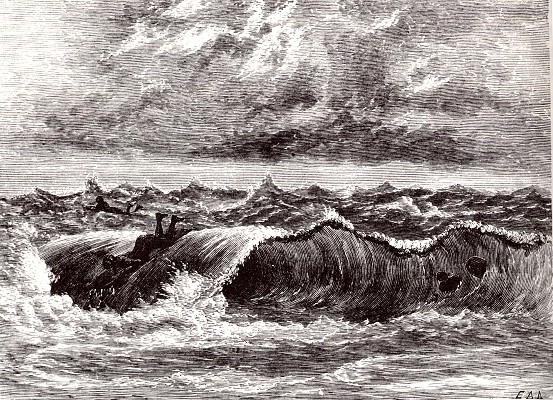
The great wave dashes onward, but as its bottom strikes the ground, the top, unretarded in its speed and force, breaks into a. huge comber, and directly before this the surf-board swimmer is propelled with a speed which we timed and found to exceed forty miles per hour.
In fact, he goes like lightning, always just ahead of the breaker, and apparently downhill, propelled by the vehement impulse of the roaring wave behind him, yet seeming to have a speed and motion of his own.

It is a very surprising sight to see three or four men thus dashed for nearly a mile toward the shore at the speed of an express train, every moment about I to be overwhelmed by a roaring breaker, whose white crest was reared high above and just behind them, but always escaping this ingulfment, and propelled before it.
They look, kneeling or lying on their long sun-boards, more like some curious and swift-swimming fish -like dolphins racing, as it seemed to me- than like men.
Once in a while, by some mischance the cause of which I could not understand, the swimmer 'was' overwhelmed; the great comber overtook him; he was flung over and over like a piece of wreck, but instantly dived, and re-appeared beyond and outside of the wave, ready to take ad vantage of the next. A successful shot launched them quite high and dry on the beach far beyond where we stood to watch.
Occasionally a man would stand erect upon his surf-board, balancing himself in the boiling surf without apparent difficulty.

The surf-board play is one of the ancient sports of Hawaii.
I am told that few of the younger generation are capable of it, and that it is thought to require great nerve and coolness even among these admirable swimmers, and to be not without danger.


Com. William 
Bainbridge Hoff :
"Surf Bathing, 
circa 1873."

Knox (1888) 
page 32.

Considered an unrealistic representation by 
Bolton (1891).

First printing in
Nordhoff, Charles : "Hawaii Dei"
Harper's New Monthly Magazine, August 1873, Pages 382 to 402 (?).
Credited as "Woodblock by Commander William Bainbridge Hoff (of the flagship California)."

The image and the article, without a credit, were reprinted in
Nordhoff, Charles : Northern California, Oregon and the Sandwich Islands
Harpers and Brothers, New York, 1874. Page 52.

The image, without a credit, was subsequently printed in
Knox, Thomas W  :The Boy Travellers in Australasia. (1888)
 Harper & Brothers, New York. 1889. Page 32.
Note the publishers are the same as Nordhoff and they probably sourced the image fom the previous publication.

The scanned image is from Knox (1888) Page 32.

Various resized and/or cropped versions are also printed in
DelaVega (ed, 2004) Page 24.


Digitally collated and formatted from:
Nordhoff, Charles : Northern California, Oregon and the Sandwich Islands
Pages 41 to 43.

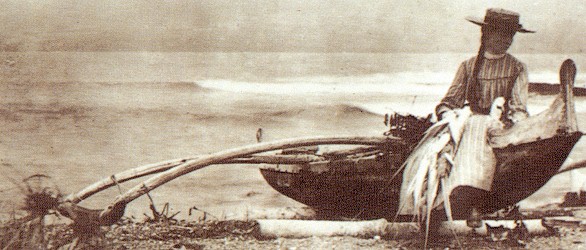
Canoe at Hilo Bay, Hawai'i circa 1890.
Photograph Charles Furneaux, Bishop Museum.
Cropped from Holmes (1993), page 77.
Surfrider's attention will focus on the two waves on the right hand reef in the background.
NOTES
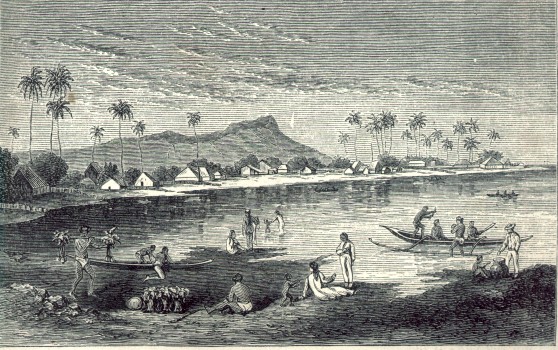
http://explorion.net/ch.nordhoff-northern-california-oregon-sandwich-islands/index.html

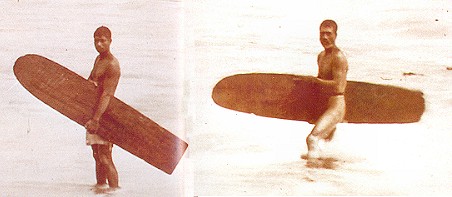
Surfers and Alaia, Hilo Bay, Hawai'i circa 1900.
(Bishop Museum) 
Cropped from Lueras, page 56 and 57

Return to Surfer Bio menu
surfresearch.com.au
home catalogue history references appendix

Geoff Cater (1997-2007) : Charles Nordhoff  : Surf-riding at Hilo, 1873.
http://www.surfresearch.com.au/1873_Nordhoff_Hilo_Surfriding.html
 Finally, Hilo is one of the very few places on these islands where you can  see a truly royal sport- the surf-board.
It reqires a rough day and a heavy surf, but wIth a good day It is one of the finest sIghts in the world.

The surf-board is a tough plank about two feet wide and from six to twenty feet long, usually made of the bread-fruit-tree.
Armed with these, a party of tall, muscular natives swim out to the first line of breakers, and, watching their chance to duck under this, make their way finally, by the help of the under-
Page
tow, into the smooth water far off beyond all the surf.
Here they bob up and down on the swell like so many ducks, watching their opportunity.

 swam out to the first line of breakers, and then diving down were seen no more till they re-appeared as a number of black heads bobbing about like corks in smooth water half a mile from shore.

What they seek is a very high swell, before which they place themselves, lying or kneeling on the surf-board.
What they seek is a very high roller, on the top of which they leap from behind, lying face downwards
on their boards.

The great wave dashes onward, but as its bottom strikes the ground, the top, unretarded in its speed and force, breaks into a huge comber, and directly before this the surf-board swimmer is propelled with a speed which we timed and found to exceed forty miles per hour.
As the wave speeds on, and the bottom strikes the ground, the top breaks into a huge comber.
and
always just ahead of the breaker, carried shorewards by its mighty
impulse at the rate of forty miles an hour,

In fact, he goes like lightning, always just ahead of the breaker, and apparently downhill, propelled by the vehement impulse of the roaring wave behind him, yet seeming to have a speed and motion of his own.
The swimmers appeared posing themselves on its highest edge by dexterous movements of their
hands and feet, keeping just at the top of the curl, but always apparently coming down hill with a
slanting motion.

It is a very surprising sight to see three or four men thus dashed for nearly a mile toward the shore at the speed of an express train, every moment about I to be overwhelmed by a roaring breaker, whose white crest was reared high above and just behind them, but always escaping this ingulfment, and propelled before it.
They look, kneeling or lying on their long sun-boards, more like some curious and swift-swimming fish -like dolphins racing, as it seemed to me- than like men.
Once in a while, by some mischance the cause of which I could not understand, the swimmer 'was' overwhelmed; the great comber overtook him; he was flung over and over like a piece of wreck, but instantly dived, and re-appeared beyond and outside of the wave, ready to take ad vantage of the next. A successful shot launched them quite high and dry on the beach far beyond where we stood to watch.
Occasionally a man would stand erect upon his surf-board, balancing himself in the boiling surf without apparent difficulty.

The surf-board play is one of the ancient sports of Hawaii.
I am told that few of the younger generation are capable of it, and that it is thought to require great nerve and coolness even among these admirable swimmers, and to be not without danger.