 |
surfresearch.com.au
duke kahanamoku : february 1915 |
| home | catalogue | history | references | appendix |
|
SWIMMING.
KAHANAMOKU'S
RETURN.
CARNIVAL
ACTIVITY.
Last
Saturday was a blank day as far as carnivals were concerned,
but next Saturday will be the reverse.
The return
or the Kahanamoku party provides the reason for actlvity In
both surfing and swlmming sectlons of the sport.
The champion
sprinter and surf-board exponent will make hls first public
appearance In the surf at the Dee Why Club's carnival, and
if the waves be at all suitable, his exhibitlon of
board-rldlng in various attitudes should be worth
witnessing.
Kahanamoku
stands upright on the board, and is also at home standing on
his head and balanclng In various positlons as the
board shoots towards the shore.
Another
achievement, so far alone mastered by him, is to take a
passenger on the board with him.
George
Cunha, the travelling companion of Kahanamoku, and one who,
on his performance in the hundred yards championship or the
State may be classed as the fastest white swimmer in Ihe
world, is Iisted to make another appearance at the Domaln
Baths, where he will meet Barry and other speedy local
performers over the 100 metre course in a special handicap
at the Ladies Association championshlp carnival.
Cunha holds
the record for the dlstance, but Barry Is showing such fine
form, that the dlfference between the two in their one
contest was so Ilttle, that both are looking forward to
another meeting.
The Ladies'
Association has also arranged for the troupe of divers, led
by Len. McCarthy, to give an exhibition of high tower
acrobatic diving, a branch of the art which has not so far
been mastered by the fair sex.
Excepting
these two items, the whole of the programme will be confined
to girl swimming, and Miss Fanny Durack will be called upon
to defend her championship titles against the fast-improving
Lottie Fevyer, Marjorie Winn, Aggie Sly, and others.
Miss Mina
Wylie, who has been a very consistent performer for many
years at these galas, will be an absentee owing to an
illness.
A third
carnival—an important one, too— will also be held at
Lavender Bay.
The North
Sydney and Rose Bay Clubs have joined forces for the day.
Two district
champlonships besides the Harris Cup high diving
competition, in which all the leading exponents of the art
are entered as representatives of their respective
districts, will be decided.
Champion
Longworth will make his re-appearance, after his unfortunate
illness, in the 220yds Eastern districts' championship, and
it is predicted by his club-mates that new Australasian
figures will be created.
In the
quarter-mile Northern Suburbs' championship, T. Adrian, the
State champion, will be challenged by club-mate G. Wyld, and
Cotton, the North Sydney rep.
As the
carnival will clash with that of the ladies, it has been
arranged that the divers, and also Barry, Cunha, and others
will appear at both fixtures, and a launch will be utilised
to transfer these competitors from one bath to the other.
On Monday
next D. P. Kahanamoku will make his last swimming appearance
in Sydney, when he will appear at the Drummoyne Club's gala
in a special hundred yards invitation handicap.
The event
will consist of one heat, in which only the best sprinters
will be invited to start.
The bath
provides an ideal course for a fast swim, as, although the
laps are short (33 1-3 yards), the width of the enclosure
minimises the trouble experienced in other small baths of a
jobbled state of water for the scratch man.
Kahanmoku
will give starts to all the men, which means that he will
have to move considerably faster than if he were to meet the
same field in a championship, and, that being so, a new
record should be created.
Besides the
main event, the programme includes no fewer than four
championships.
The Harris
Cup medley event, in which three swimmers from each district
will swim relays of hundred yards by means of the back
stroke, breast stroke, and free style, is new to Sydney.
A few of the
nations are anxious to have such an event included in the
programme of the Olympic Games, so that, from many points of
view, the item will be of considerable interest.
The 500
yards teams championship of the western districts should
provide an even tussle between the Drummoyne and
Rechabite clubs, and both are anxious to gain the
Association's standard time certificate.
The 100
yards club championship and 50 yards junior championship
will also be decided.
Other items
include an exhibition swim by Miss Fanny Durack, world's
lady champion, diving and novelty events, and handicaps.
George
Cunha, the Hawaiian swimmer, will not take part in the
special 100 yards race, but will give a special swim
over a distance to be selected.
The
competitors in the event as opponents of Kahanamoku will be
Barry, Longworth, Boardman, Solomon, Hay, and Page.
A good
proportion of the seating accommodation has already been
sold, so that the success of the venture is practically
assured.
In the polo
competitions, Sydney are leading in the first grade with two
points, and in the second grade Pyrmont and Sydney each have
two points.
Pyrmont
easily defeated Mosman last Saturday, and the meeting
between the two leaders should provide some excellent polo.
Both Manly
and Sydney held 220 yards handicaps last Saturday, a feature
that cannot be too highly valued.
In this
column attention has often been drawn to the too frequent 50
yards events at the "Village" to the detriment of promising
distance talent.
However, the
fact that seven heats were necessary to decide the furlong
event on Saturday shows that the members appreciate a change
to a longer race now and again.
The 220
yards is the most important distance to Australians, in view
of the world's teams' championship being decided in relays
of that length.
Barry has
improved considerably over the distance, and on Saturday put
up 2m 36 2-5s, an improvement of several seconds on his best
previous swim.
A slight
alteration to his stroke is responsible for this.
The sprint
champion deserves every credit for his perseverance in
mastering this distance.
Rose Bay
held heats of its Longworth Cup, 500 yards event, and again
William Longworth qualified for the final by swimming second
in his heat.
The champion
has a very substantial lead in this competition, and looks
all out a winner of the cup presented by his father.
The
Melbourne Club has arranged its programme for the visit of
Kahanamoku on Saturday, February 13, and Monday, February
15.
On the first
day the 100 yards and diving championships of Victoria will
be decided, but as only State residents are eligible to
compete in the championships a special 100- metres event has
been included for the visitors.
This
function will be carried out at St. Kilda Baths, but the
Monday fixture will be held at the City Baths, and a 220
yards race is listed for Kahanamoku.
Newcastle
has arranged a special 150 yards race for the Hawaiian
visitors, who will appear in that city on Wednesday,
February 10.
It is an
effort to secure Longworth and Kahanamoku over a course
likely to make an even contest.
It will be
interesting to note the doings of Kahanamoku over this
distance, and yet another Australian record may go to the
credit of the visiting team after the event.
DEPARTURE OF KAHANAMOKU.
The members
of the Hawaiian party, Duke Kahanamoku, George Cunha, and
Francis Evans (manager) - arrived by yesterday's mail train
from Mt. Morgan and Rockhampton, and spoke
appreciately of the treatment given them.
They
continued their journey south by the Osterley, which left
the New Farm Wharf at 11 o'clock yesterday.
Amoungst
those that bade them farewell were Messrs. D. M. Carter
(Chairman of the Q.A.M.A.), A.J. Wilkins (sec. treasurer),
W. Finnemore (sec. treasurer, Q.C.U.), A. Andersen, and E
Jacobs.
SWIMMING.
KAHANAMOKU'S
TOUR.
NEW
ZEALAND VISIT.
Some time
ago the New Zealand ASA arranged the itinerary to be carried
out by D. P. Kahanamoku in connection with his tour of the
Dominion.
The fixtures
included carnivals up to March 27, but as the members of the
Hawaiian party were booked to leave Auckland ... 168 words
LADIES'
CHAMPIONSHIP CARNIVAL.
...
NEW
RECORDS.
The New
South WaIes Amateur Swimming Association has approved of the
following records established by D. P. Kahanamoku and George
Cunha at the State championship carnivals on January 2 and
6.
-100 yards:
53 4-5s by D. P. Kahanamoku.
100 metres:
63 3-5s, by George Cunha.
Both records
are also Australian best performances, and will be submitted
to the Australian union for recognition as such.
The 100
yards record is also the world's best, and will be forwarded
to the International Federation for recognition.
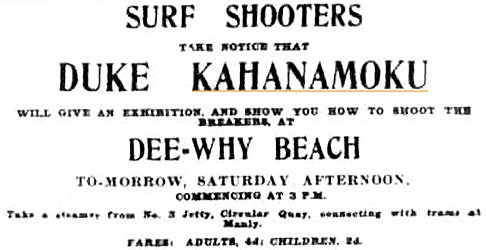
DEEWHY SURF CARNIVAL
The Deewhy
surf and beach carnival will be held tomorrow afternoon, and
will be followed in the evening by an open air concert.
Part of the
afternoon's entertainment will be a surf board display by
Duke Kahanamoku, and many other attractive items have been
provided.
The Surf Expert
Duke
Kahanamoku, the 100 yds. world's champion swimmer, will
visit Cronulla Beach on Sunday afternoon and will give an
exhibition at 3 o'clock.
At the
invitation of the Cronulla Surf Club he will visit the
beauty spots of the Sutherland Shire.
SURF SPLASHES
Duke
Kahanamoku, the World's Champion, at Cronulla on Sunday
afternoon.
A big draw.
The Surf
bathing Association' officials visited Cronulla on Sunday
last to put through a number of members for the
Association's medallions.
The
following were successful: J. Hallet, N. Deacon, F. Postle,
E. Wilshire, L. Newman, S. Short, C. Ray, R. Whipp, W. Duff,
R. Emanuel.
In addition
to these it will be pleasing to know that Capt. Stroud and
Vice-Captain Cutherbertson secured the Association's highest
award - that of Instructor.
SWIMMING.
THREE BIG
CARNIVALS TODAY.
There are
no fewer than three very important carnivals to be held this
afternoon.
The famous
Hawaiian party will endeavour to be represented at all of
these.
DEEWHY SURF CARNIVAL.
Messrs. D.
P. Kahanamoku, George Cunha, and Francis Evans, the Hawaiian
Swimming Team, who have been touring Queensland, returned to
Sydney yesterday morning by the Osterley.
The visitors
report having made an extensive tour of the Northern State,
which they competed at Allora, Brisbane, Rockhampton,
Maryborough, and Mount Morgan.
Owing to the
Queensland rules not allowing other than residents to
compete in the State championships, all the races were
handicaps, in which Kahanamoku and Cunha had to concede long
starts.
However, the
majority of the events were created in every city visited.
SURF CARNIVAL.
KAHANAMOKU AT DEE WHY.
Tho Dce-wby Surf Club held Its aeoond tin nual carelral this
afternoos In dull and pleasant weather. There were about two
spectstors.
Tbe chief attraction waa a display on a surf board by Duke
Knhanomoku, who performed all kinds or tctobiUc oats on the board.
Ue sfterwurds earned a lady passenger.
Altoge ther It ww an Interesting exhibition.
Ano ther attractive featuro vaa a hiunorout rro ctsslon, and
'Rickey's Hobos' provided a lot ot tun. The mnreh-p«st o! tbe
different surt cubs was a tine sight. Resulta: ORAKD PAiRADE OF
OLTJBS.-Dee-Whr. 1: North Sterne, t THRBB-LBOOED HACE.— Nonh
Steynn (H. and r. NlehoUa), 1; Collaroy (N. Blaken and J. Bit), t.
WWle the OanedlBS Highlanders wear kalis, and an «e tit, trcw, aad
tarty as our own Hltnlaaosn, Mr IsOMaCt. It ntneh. What a reeepUen
the* 'wlll h»re tow the Chan »»!. thaw lhtat ponfiaWoitlcM ot
I'Sateete
1915 'SURF CARNIVAL.', Evening News (Sydney, NSW : 1869 - 1931), 6 February, p. 7, viewed 4 February, 2015, http://nla.gov.au/nla.news-article115826398
DEE WHY SURF CARNIVAL
The second
annual carnival of the Dee Why Surf Club was held this
afternoon at Dee Why Beach.
The
attendance was large.
The
principal attraction was a display on the surf board by
Kahanamoku.
He went
through all sorts of acrobatic meats (sic).
Notes
1. "acrobatic
meats" is a printer's error and should be "acrobatic
feats".
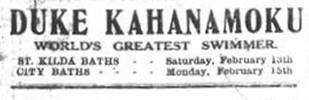
| The Sporting Judge Melbourne, Monday 6 February 1915 page 1. Duke Kahanamoku
World's Greatest Swimmer St Kilda Baths ... Saturday, February 13th City Baths ... Monday,
February 15th
?
Melbourne, Friday 12 February 1915 page ? Kindly
contributed by Craig Baird, Australian
National Surfing Museum,Torquay,
Victoria.
|
  |
DEE WHY SURF CARNIVAL
KAHANAMOKU IN THE SURF.
Duke
Kahanmoku treated something like 4000 persons to a fine
exhibition of surf board shooting at Deewhy on Saturday
afternoon.
The local
club had arranged a surf carnival, and Kahanamoku was asked
to appear and shoot the breakers as the Hawaiians do.
"The Duke"
did all, and more than was expected of him,
Taking a
board something like 10 feet in length, the champion swimmer
made out towards the open sea.
When a
favorable rise presented itself the swimmer's paddling arm
action drove the board ahead, to be eventually carried
shorewards on the crest of a breaker.
When "the
Duke" stood up the sight was grand.
Later
Kahanamoku came in standing on his head, and at another time
carried a lady passenger.
For more
than an hour exhibitions were given.
DEE WHY CARNIVAL.
KAHANAMOKU AND HIS SURF BOARD.
D. P.
Kahanamoku, the famous Hawaiian swimmer, gave an exhibition
on the surf board at the Dee Why surf carnival on Saturday.
The beach
was lined with people, all anxious to obtain a good view.
The various
events were watched with interest, especially the
performance of Kahanamoku.
He came out
with his surf board, plunged into the water and continued to
swim out until those watching from the beach soon wondered
when he would stop.
After
covering nearly half a mile, Kahanamoku turned and prepared
for a roller, which came along a moment after; he caught it,
and as the wave carried him shorewards he performed all
kinds of acrobatic feats on the board, and finally dived
into the water as the roller broke.
The crowd
showed their appreciation in a very hearty manner.
Kahanamoku
remained in the surf for nearly an hour, and he was
accompanied at intervals by Miss Letham, of Freshwater, and
it was a rare sight to watch both swimmers on the surf
board.
The various
surf events under the control of the New South Wales Surf
Bathing Association were well contested.
An open-air
concert at night concluded the day's sport.
Details :—
Grand Parade
of Clubs.—Dee Why, 1 ; North Steyne, 2.
Three-legged
Race.—North Steyne, 1 ; Collaroy, 2.
Pennant
Rescue and Resuscitation Competition.—
Metropolitan Division, third round ; Bondi A, 57.77 points,
1 ; Manly A, 57.47 points, 2 ; Coogee, 56.66 points, 3 ;
North Steyne, 52.03 points, 4.
Novice Surf
Race.—A. V. Rein (Manly), 1 ; C. D. Bell (Manly), 2.
Tug-of-War.—Collaroy,
A.
L. Melrose, capt. ; C. Knight, J. Walton, A. Thew, J. Jack,
J. Bloomfield,
D. Scully),
1.
Beach Relay
Race.—First heat : Collaroy, 1. Second heat :
North Steyne, 1. Third heat : Coogee, 1. Final : Collaroy
(L. Chinchen, T. V. Smith, A. Sheldon, L.
Sheldon), 1 ; North Steyne (E. Goulding, G. Morgan, O. H. G.
Merrett, C .Whitehead), 2.
Alarm Reel
Race.—Manly (H. M. May, belt, O. Mater, H. Buhl, F. Bennett,
D. West), 1 ; North Steyne (L. Hind, belt, F. Nicholls, B.
McEwan, E. Goulding, N. Thompson), 2.
Cock
Fight.—Balmoral ( J. Doudney, C. Walker), 1.
Surf Race
Relay Race.—Manly (J. Brown and N. Smith), 1 ; North Steyne
(C. Healy, L. Solomon), and Bondi (J. G. Brown and H.
Fletcher), dead heat.
Novice Alarm
Reel Race.—First heat : North Steyne, 1 ; North Bondi, 2.
Second heat : Coogee, 1. Third heat : Bondi, 1. Final :
Coogee (J. Leary, H. Mason, H. McClure, R. Harret, M.
Reubenstein), 1.
Wheelbarrow
Race.—North Steyne (H. Nicholls, F. E. Nicholls), 1.
SWIMMING.
SENSATIONAL
SURF RIDING.
BUSY WEEK
END.
The
exhlbltlon of surf board rlding given by D. P. Kahanamoku at
the Deewhy Surf Club's carnival provided the greastest
spectacle that has yet been witnessed in this respect.
The Hawaiian
proved himself a master of the art, and, despite the fact
that the conditions were anything but favourable, fulfilled
his advertised programme.
On one
occasion the board carried him a distance of four hundred
yards, and he balanced on his head while shooting towards
the shore.
On another
occasion, and whilst sitting on the board, he finished the
shoot by coming in broadside on.
He also
carried a lady passenger a distance of a hundred yards.
The
exhibition lasted more than an hour.
There seems
to be no limit to Kahanamoku's work with the board, and at
Cronulla on Sunday he used it he used it to carry him for a
short distance, and then dived into the wave and completed
his trip to the sands with a body shoot.
The Deewhy
carnival was well carried out.
Trove
1915 'DUKE IN THE SURF.', Referee (Sydney, NSW
: 1886 - 1939), 10 February, p. 1, viewed 4 February, 2015,
http://nla.gov.au/nla.news-article129344157
NEWCASTLE SWIMMING CARNIVAL
KAHANAMOKU DEKEATS BARRY
CRONULLA SURFING
The Duke's
party, consisting of Duke Kahanamoku, George Cuhna, Harry
Hay, W. Hill and officials of the Aus. A. S. A.: W. Scott,
Marks, and officals of the N.S.W.A.S.A., and D. McIntyre,
and officials of the Surf B. Assn., altogether a very
representative gathering of Sydney swimming powers that be,
was met at Sutherland station by the following members of
the Cronulla Life Saving Club, with their cars, J. Munro, J.
Halett, D. Bouffier, L. Giddings, and F. Stroud, and whirled
off to Waterfall, returning to National Park via Lady
Carrington's Drive.
Alfesco
luncheon at Audley.
The toast of
the visitors was given by the Club captain, who expressed
the Club's appreciation at being given the opportunity of
entertaining such distinguished members of the swimming
world as Duke and George Cuhna, and hoped that Cronulla's
welcome would bring them an enjoyable day.
The toast
was responded to by the Duke, G. Cuhna, W. Hill, E. Marks
and R. Doyle, brevity being the order of the day, all
thanking the Club for its hospitality.
Mr. Doyle
remarked that if he remembered the day by nothing else, the
run down Lady Carrinton's Drive would never be forgotten and
he registered a debt of gratitude to the Club.
Apropos of
mr. Doyle's remarks, it was extrodinary from the remarks of
other prominent Sydney men, world scourers too, t5hat they
should have missed the beauties of that gully so near sydney
all their lives.
Incidentally,
the
five drivers, local men at that, had not been through before
either, but did not say so.
Lunch over,
the launch was waiting to run the party down the river to
Cronulla, where the beach was gay with bunting and packed
with people.
The party
was met by the Shire president, Mr. Hyman.
Unfortunately,
Jupiter
Pluvius and Father Neptune were in a bad mood and spoilt the
afternoon, the former dumping water where it was not wanted
and the latter would nor stir his up at all.
An alarm
reel race was held, between the Duke, Cunha and Hay, the
linesman being made up of the clubmen.
There was
much guessing as to who the winner would be as the two
Hawaiins (sic)had never been in the belts before, and Hay is
one of the fastest beltmen in the State.
However, the
Duke made good use of his long legs in the wade out and beat
Hay by a yard.
Cuhna could
not get use to the belt and line at all, swimming a crawl
stroke he nearly wrenched his toes off, catching them on the
line.
The Duke
then adjourned to the big beach as there was more roll on
there, and gave an exhibition with his board that will be
long remembered by those who saw him.
Standing
upright, standing on his head, diving off, twisting the
board.
It all
looked so ridiculously easy, and so it was to the Duke, but
local men who tried after came to the conclusion that they
had a lot to learn about the game.
One wants to
try and stand on that unstable piece of wood, even in smooth
water, to appreciate fully the sight of that bronze statue
tearing in through broken and choppy seas.
Tea was held
in the new pavillion and the party adjourned to the
captain's house for a couple of hour's music, the Duke and
George Cuhna rendering an item in Hawaian (sic), the Duke
providing the accompaniment on his eucalalia (sic, ukulele/ukelele).
The visitors
declared themselves delighted with the day, before
leaving.
The two
Hawaians (sic) proved themselves unassuming gentlemanly
fellows, good sports, very much "one of the boys" variety,
who set no hugh (sic, huge) price on their services,
but did all they could without stint.
Altogether
the Committee congatulate itself on the success of the day.
A few
things the Club need not do the next time the Duke & Co.
visit Cronulla.
Prince Henry
Joe needn't bolt from Sutherland and take all the party down
to Audley to start the run through Lady Carrington's Drive.
Jack needn't
make up his mind the Duke's going with him in his car, "Nor
walk" either.
The Captain
needn't break his petrol pipe and try to borrow soap from
every passing car.
Lance
needn't try to shift the gate post with his dash board
again, it hurts.
The
"Waverley" nearly met its "Waterloo".
Jack needn't
try to shift the same post with his rear wing, it also
hurts.
The whole of
the Club needn't take the invitation, when the Duke says
"Pas a 'bernaner,' " one can have too much of a good thing.
Raining
"bernaners" isn't raining manna.
The divers
needn't kid they know every inch of the "Drive" when they
start off by going to the wrong end.
Some members
needn't give exhibition rescues in Port Hacking, the country
has more use for them on the Suez Canal, if they want to
take a risk.
The blubber
needn't be so thick on the big beach.
The Duke
needn't say "Gee, these stingarees are hot."
The captain
needn't look for red marks on the Duke to rub ammonia on
where the blubber stung.
The same
chap needn't try to get twenty on his car when it will take
only neneteen.
KAHANAMOKU KICK LATEST IN SWIMMING
Famous
Hawaiian Amphibian Stirs Australians by His Feats in
Water.
SYDNEY,
Australia, Jan. 6.
The
performances of Kahanamoku, the Hawaiian, in the New South
Wales championship swimming carnival a few days ago,
particularly the Olymplc record holder's lowering of the
world's record for 100 yards of 54 3-5 seconds by four fiths
of a second, has caused a decided stir in Australian
swimming cirles.
Indeed, it
is predicted by sporting authorities here that the
Australlan "crawl" stroke wil have to give way to what is
being called the "Kahanamoku Kick."
It had been
contended ever since "Dick" Cavill first used the
"crawl" in championship races that the leg work did not
materiaIly assist the pace of the swimmer except in keeplng
the body well balanced on the water and thus minimizing the
retarding effects due to the legs and feet sinking.
But this
theory was quite upset by the methods or the "Duke" and his
swimming mate, George Cunha, also of Hawaii, who use the
rapid independent movement or the feet, as against the
Australian fashion of smacking the leg from the knee down
upon the water at every stroke of the arm. The slow, easy
movements of Kahanamoku and Cunha from the hips to the tips
of the fingers was markedly in contrast in the races with
the style which the Australian cracks pitted against them.
The buried
heads of Barry and Longworth of Sydney, who are among
Australia's best, was also in contrast wIth that of the
Hawaiian.
The "Duke"
kept his head well clear of the water and had, what his
competitors did not possess, a clear view of what every
opponent was doing.
"Swim with
the head low so that your legs will float nearer the
surface" has been one of the first instructions given by the
coaches in Australia to racing swimmers; and this has been
followed by injunctIons to work the arms fast and the legs
in unlson with them and to roll the body slightly from
side to side
so that from the hips up it should assist the arms and make
breathing easier.
But all
these requirements, it is pointed out by experts here, are
more than met by the "Kahanamoku" or independent "kick."
According
to these same experts this kick originated in the fresh
water baths of the Eastern United States, where the more
rapid movement of the legs was not necessary to overcome the
Iess buoyant fresh water as against the salt water
baths of Australia, where the "CrawI" was evolved.
But this
opinion seems pretty far fetched when one bears in mind that
Kahanamoku belongs to a race of Islanders who have no
superiors in the world as swimmers and that his prowess is
likely instinctive rather than the result of any artificial
conditions.
However
that may be, the Australian swimmers admit now that they
have seen him race, that the "Duke's" kick serves all the
purposes of the "crawl," and that it is much faster and
needs less exertion than theIr own method of locomotion in
the water.
Before
Kahannmoku came here there was some skepticism about his
achievements, but it vanished after his first performance.
It is only
ten years since the then wonderful feat of swimming 100
yards In a minute was accomplished by the Australian and
world's champion, F.C. Lane, in England.
He was
followed by several other exponents of the "crawl," and at
one stage the Commonwealth claimed the only four men who had
covered that distance in that time - Lane, Cavill, Healy and
Wickham.
But it was
another American, Charles M. Daniels, who upset their
calculations, and, altllough Australia is still the place
par excellence of swimmers, generally speaking, and the
Commonwealth possesses many first-class performers in
the water, it is more than likely that the Honoluluan's
style will be have to be taken up if Australia hopes to keep
up its record.
The popular
view of the Hawaiian's victory - although he has been
beaten by an Australian in one of the three races he has
participated in - is perhaps best expressed by the comment
by a Sydney newspaper:
"Kahanamoku
has justified all that was said of him.
It was not
mere physique that did it, for although his physique is
fine, it is not unsurpassable.
No doubt the
fact that he is practically a waterman, and has lived in the
water ever since soon after he was born, has made a
difference, though some Australians have been watermen in
that sense too.
But his
American training must certainly be counted in.
The
Americans got hold of him early.
They found
the man with the possibilities, and they turned him out a
specialized swimming machine."
As for the "Duke", his sportsman-like actions and good nature have made him very popular here.
TO-NIGHT'S MEETING
Kahanamoku
and Cunha will make their last appearance in Melbourne this
evening when they will take part in competitions at the
Melbourne Swimming Clubs meeting at the City Baths Swanston
street.
Kahanamoku
and Cunha will compete in the in ternational race relay race
against the Victorian and New South Wales swimmers and in
this race Kahanamoku will attack his 100 yards worlds
record- 53 4-5 sec - established in Sydney recently.
Kahanamoku
will again meet the champions G. W. Morris (Vic) and T.
Adrian (NSW) in the 200 yards invitation handicap.
Kahanamoku
will concede Morris 6sec handicap and Adrian 2sec.
Beaurepaire
the ex-amateur champion of Australîa will attempt to lower
the 200 yards world's record.
A programme
of races has been arranged and the programme will conclude
with an interstate water polo match be tween teams
representing New South Wales and Victoria.
The
Melbourne Swimming Club anticipate a record attendance and
visitors are requested to be seated early.
The first
race is timed to start at 6 o'clock.
|
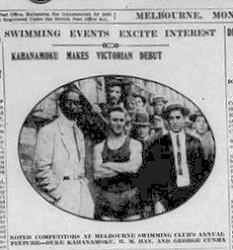
The Herald
Melbourne, Monday 15 February 1915 page 1. SWIMMING EVENTS EXCITE INTEREST KAHANAMOKU MAKES VICTORIAN DEBUT Noted competitors at Melbourne Swimming Club's annual ??? Duke Kahanamoku, H. M. Hay and George Cunha. Kindly contributed by
Craig Baird, Australian National Surfing Museum,Torquay,
Victoria.
|
  |
DUKE IN THE SURF
EXPLOITS ON THE BOARD
Dexterity and Skill Win the Title "Blondin of
the Surf"
(By CECIL
HEALY)
Three
functions competed for the patronage of natatorial
enthusiasts in Sydney on Saturday afternoon, each detracting
more or less from the others, both as regards attendance and
exponents.
The great
majority of prominant swimmers are now connected with
surfing bodies, and a number seized the opportunity of
taking part in the Dee Why Lifesaving Club's carnival, in
order to witness Kahanamoku's first and last public
exhibition of surf-board riding.
The crowd
which put in an appearance exceeded any that had previously
congregated at this out-of-the-way resort.
In view of
the district being only sparsely populated as yet, and its
comparative inaccessability, the local organisation showed
great enterprise and initiative in shouldering the financial
responsibilities to secure the Duke as an attraction.
At the time
the Hawaiian put out to sea with his surf-board, which he
seems to worship almost as much as a child its doll, the
waves, unfortunately, were not particualy good for shooting
purposes, merely an occasional one having any length of run.
The rapidity
with which he took the weighty plank out through the
breakers was not the least amazing feature of the display.
He lay
outstretched upon it, and, used his hands as paddles, one on
either side.
It struck me as I watched him propel himself along in this fashion infinitely faster than any of our expert surfers could move unencumbered, that he must be able to exert tremendous power with those arms of his, and, therein probably is to be found the explanation of his extrodinary capabilities as a sprint swimmer, rather than his particular method of kicking.
On sighting
a likely-looking wave, he commenced to paddle vigorously,
still lying prone as before.
After a few
ineffectual attempts he succeeded in catching one properly.
Instantly
the board seemed to leap forward like a fiery steed when the
spurs are driven into the rowels.
Immediately
afterward the Duke rose upright, and assumed the attitude of
ancient chariot drivers.
And no
sooner had he done so than he appeared to exercise some
subtle influence over the madly careering craft : in fact
just as if he had taken reins in hand.
He altered
its direction so as to steer a course diagonal to the beach.
Although the
prow pranced and bounded over the crest of the onrushing
billow, the Duke stood like an ebony statue, immovable save
for the deft movements of his feet, and remained so until a
few of the shore, when he leisurely dropped off.
It was a
thrilling sight to watch, and such balancing skill and
dexterity entitles him to the designation of a surfing
Blondin.
A young
lady acquaintance then emerged and accompanied the Duke
seawards.
It occured
to me at once if the Duke found it difficult to to get going
by himself with the not-by-any-means good waves at his
disposal, obviously his chances of doing so would be greatly
minimised when hindered by a novice.
Such proved
to be the case.
A
considerable time elapsed before he managed to get a move on
with his partner.
It must be
admitted, however, that the duel (sic, dual) shoot,
when it did come off, was the the more sensational spectacle
of the two while it lasted.
It served to
show more conspicuously the Duke's wonderful facility for
maintaining his equilibrium under these exacting conditions,
as although his passenger was toppling backwards over the
lattter part of their journey, the extra burden failed to
dislodge him until they had negotiated about three-parts of
the distance he covered when alone.
But the
question arises whether the onlookers, many who had come
from distant suburbs, would not have been better pleased to
have been treated to a greater number of performances like
the first, rather than have to submit to the wearying wait
that occurred before the Duke found it possible to bring off
the more difficult stunt.
Another Wonderful Performance by Duke
The largest
crowd of spectators ever contained within the Drummoyne
Baths was present at the local club's carnival on Monday
night, the chief source of attraction being the final
appearance of Duke Kahanamoku and his companion, George
Cunha.
The Duke
figured in a 100yds Invitational Handicap, the other Albert
Barry, Tod Solomons and Harry Hay.
Barry was in
receipt of 2sec, Solomons and Hay 3sec.
The
precaution was taken to despatch the Hawaiian from the word
"go", so that in case of his beating (the) record,
the time would be recognised, which proceedure added to the
severity of his handicap.
A
magnicifent race was the outcome.
The Duke
tore after the vanguard and gained appreciably going down
the first stretch (33yds).
Barry,
however, more than held his own during the progress of the
second.
With a
terrific shove-off at the last turn the Hawaiian lessened
the Sydney Club man's lead, but failed to make further
advancement until more than half the remaining lap had been
disposed of, when he came with a superb burst, which enabled
him to touch down a fraction of a second before Barry, who
similarly anticipated Solomons.
The whole
four competitors seemed to finish practically in a line,
which happening gave rise to an animated scene amoungst the
onlookers.
The Duke's
time was anounced as 55sec dead, which speaks for itself,
and needs no embellishment, suffice to say that it comes
under the category of things marvellous.
George
Cunha gave a 66yds exhibition swim, which arosed much
cheering, as did an exhibition by Miss Fanny Durack over
100yds.
Their times
were respectively 35 9-10sec, and 1min 11sec.
Leslie
Boardman's back-stroke "crawl" was a feature of the 300yds
Harris Cup Medly (sic, Medley) Teams' Race in which
teams of three members competed, one representative
swimmi9ng freestyle, one brest, and the third back stroke.
Boardman was
timed at to negotiate his 100yds relay in a fraction less
than 1min 19sec, which is some 10 sec faster than the
record.
NOTES
1. Blondin,
also
known as Chevalier Blondin, was born as Jean Francois Gravelet
in France in 1824, and gained a world-wide reputation as a
tightrope walker when he successfully crossed Niagara Falls in
June 1859.
In 1874 he made
highly profitable and much acclaimed tour of Australia,
performing in Brisbane, Sydney and Melbourne.
http://www.hat-archive.com/blondin.htm
"We have
had a fine time in Australia," said' theDuke Kahanamoku,
before leaving Sydney for Melbourne, "though I may say that
the programme has been almost too severe a tax
upon us.
I do not say
this in a complaining spirit, but to point out that we did
not expect this tour of pleasure to to marked by so much
hard work."
Nevertheless the Duke did not look as if he had wasted away, but frankly admitted that in the matter of weight he was all there.
"To judge
by the programme I have seen, the task will be harder in New
Zealand, where so much travelling have to done," continued
the Hawaiian.
"I hope they
will be able to make it a little less severe upon us over
there."
Yes, I know
the chmate In New Zealand is not. so hot; but I do not. mind
the climate."
The Duke
looked very fit as he left for Melbourne.
He had just
returned from the surf at Bondi, after some hard battles
with the rough breakers, which he explained, were vastly
different from those of his beloved Honolulu, which roll in
with a long, steady, sweeping roll.
The Duke
likes the surf play here; though it is different to
carvorting on the waves at Honolulu.
The Duke
and his companions will take away with them souveniers of
their visit in the shape of albums, containing photographs
of scenes and races in which they have figured.
These will
include the principal photographs which have appeared in
"The Referee."
He also
takes all copIes of this paper dealing wlth his visit to
Australia, a fact which shows that the visit will rank as no
mere passing hour in the life of the sprinter.
The
Hawaiians will return to Sydney to-morrow, and leave for New
Zealand on Friday.
SWIMMING.
KAHANAMOKU AMONG
RECORDS.
PARTY LEAVES ON FRIDAY.
Melbourne
had a visit from D. P. Kahanamoku and party on Saturday, a
result due more to the pertinacity of Sydney officials than
to any effort on the part of the Victorian A.S.A.
However, the
Melbourne Club undertook the necessary financial risk, with
the result that a very fine success was achieved.
St. Kilda
Baths were calm, and the two appearances of the famous
Hawaiian were responsible for the creation of two new
Victorian records, and a new Australasian 100 metres that
overshadows the previous best.
The visitors
were allowed to swim in the 100 yards championship of
Victoria on condition that the first Victorian past the
winning post should rank as the local champion.
W. B.
Bennett secured fourth place, being beaten by Kahanamoku,
Cunha, and Hay, the battle for second place being a
magnificent tussle, in which Hay was beaten by a touch only.
The time of
the winner was 56s, which is much better than Cecil Healey's
figures, established in the same baths many years ago.
In the
hundred metres event the Hawaiian equalled his own world's
record of 61 3.5s, which, from the point of view of speed,
easily beats any previous swimmer's effort by several
seconds.
A few years
ago the time would have been a 100 yards record, but it now
goes down as the best performance over a distance 10 yards
in excess of that.
It is
pleasing to note that Kahanamoku has proved just as big an
attraction in Melbourne as elsewhere, and that the Southern
City will probably be prepared to undertake international
fixtures in the future.
This is the
farewell week of Kahanamoku.
He will swim
at Goulburn to-night, and return to Sydney to-morrow
morning.
The
opportunity will be taken to say farewell to members of the
party at 5 p.m. at the Sports Club. They will leave Sydney
by Friday's boat for New Zealand, where they will tour until
March 23, and then catch the Niagara from Auckland
to Honolulu.
To say that
the tour has been a success is but a mild statement of the
case.
Financially,
socially, and from a swimming point of view everything
possible has been accomplished, and Australia will readily
welcome the next international visitor on account of the
success of this venture.
Since his
return from Queensland, Kahanamoku has taken part in several
first-class handicaps. Cunha has also started in two of
these events, and in all cases the grouping of the
topnotchers has resulted in very fine races, with everyone
having a good chance of success.
These have
been true international events, and the spectacle of some
competitor with a long start beating all the famous
exponents of the day has been saved.
Kahanamoku
has won every handicap in which he has started in New South
Wales, and Cunha has won every handicap in which he has
competed since his return from Brisbane.
At
Newcastle the local organisation, owing to the wet weather
prevailing on the night of the carnival, and also to the
large expense incurred in the erection of seating
accommodation, netted a loss on the visit.
The incident
was responsible for a fine sporting action on the part of
the Australian champion, Albert Barry, who, in order to help
the Northern Association to make ends meet, decided to
forego the prize coming to him as second in the hard-fought
150 yards race with Kahanamoku.
To-night
two carnivals will be held.
At Drummoyne
Baths the Rechabite Club will carry out its annual function,
and besides the usual interclub and district championships
the Harris Cup polo match, between Metropolitan and the
Western Suburbs will be played.
Coogee
Aquarium Baths will be the scene of the Palace Emporium
Gala, when the Harris Cup race (open only to Palace
Emporium, Newtown, St. George, and South Sydney), will be
contested.
The club has
also hit on a novel prize in connection with 66 yards
interclub event in the form of a reward to the fastest
performer over the distance.
On Saturday
the newly-formed Woolwich Club will hold its first annual
carnival.
The 100
yards Northern Suburbs championship will be decided, and a
water polo Harris Cup game between Northern Suburbs and
Eastern Suburbs will be played.
In club
circles on Saturday the most note-worthy performance was
that accomplished by R. Longworth in the Rose Bay handicap,
when he got so near the minute for the hundred yards that he
may be looked upon as the next swimmer to join this elect
circle.
Longworth
won the final in 60 1.5s.
At Manly and
the surf carnival at Collaroy, the absence of the Manly Life
Saving Club's team at Melbourne depleted the entries to a
large extent, yet enough members were mustered to make the
other clubs envious, in this respect, of the villagers.
The next
race of the Sydney University Club will be on Saturday next,
at the Domain baths, at 10 a.m.
Wellington Cups Carnival
by "Header".
KAHANAMOKU AND CUNHA.
In a letter
to Mr. H. S. Williams, who will pilot the Kahanamoku party
on their tour through the Dominion, Mr. Francis Evans, the
Hawaiian's manager, requests that Cunha and the "Duke"
appear in exhibition races mostly, "with a few handicaps now
and then, say, in the larger cities where the jumps are not
too close and the stops longer.
In the
matter of handicapping may I ask that consideration be taken
of the fact that they are travelling all the while and this,
coupled with the further act of entertaining, all tends, if
anything to keep one out of good condition, and I would
therefore ask that the handicapping be not too stiff.
I would ask
also that the "Duke" and Cunha appear once only in each
carnival, such as is being done throughout the present tour.
We will be
much obliged if you will confine the swims to sprInts only,
say, from 50 upwards to 100yds.
One
appearance may seem short to you, but I would suggest that
in order to lengthen the programme somewhat the "Duke" be
entered in one race and Cunha in another.
This is what
we have been doing all along."
This
information should help the framers of the local programme
for 6th March.
The
programme for the first Kahanamoku carnival in Christchurch,
to be held on 24th February, has been drawn up, and will be
as follows: (1) 100yds Invitation Race; (2) 66yds Interclub
(first class), limited to swimmers doing 35sec; (3) Diving
Competition (fancy, swallow, and running); (4) Relay
Interclub (100yds), teams of three men; (5) 33 1/3yds
Dash Handicap (interclub); (6) exhibItion by Kahanamoku; (7)
Water Polo Competition (time permitting).
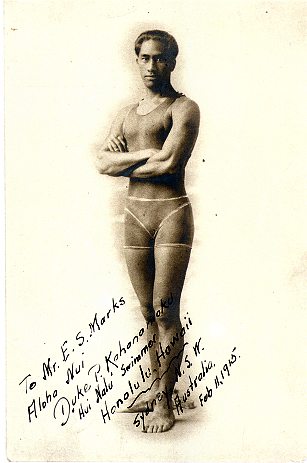 |
E. S. Marks was prominant in Sydney sports. Sydney's premier athletic track is named The E.S. Marks Field. Postcard reproduced from private collection. |
| home | catalogue | history | references | appendix |