surfresearch.com.au
surfing images :
illustrations, 1788 to 1930
| home | catalogue | history | references | appendix |
|
surfresearch.com.au
surfing images :
illustrations, 1788 to 1930
|
|
|
|
|
|
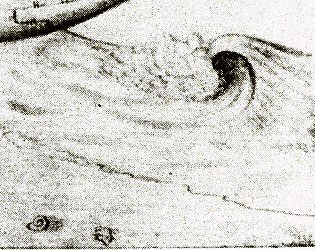 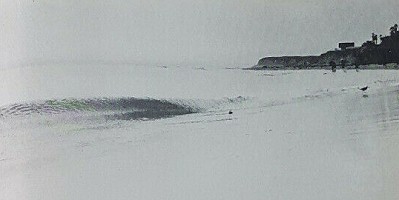 |
Breaking Wave, Matavai Bay,Tahiti, 1769. Detail from Purea's canoe, Tahiti, 1769. British Museum, Add. MS 23921-23a Printed in Sporing in Cook: Voyages (1991), Volume 1, Figure 31, between pages 112-113. This illustration of a breaking wave clearly shows the conical wave face that is integral to the dynamics of surf riding. This would gain international fame when it later appeared in the work of Japanese artists. See: Hokusai : Under the wave, 1825. The Wave in Art It is probable that Sporing was able to capture the wave contours so accurately because there was a consistent , if small, swell running down the beach. The image was thus constructed from many similar waves breaking regularly while he completed the principal image of the canoe. Campus Beach, Santa
Barbara.
When it moves out it is just the same. A long winding wall. Photo: Woody. Surfer
v15 n4 1974 November, page 77. |
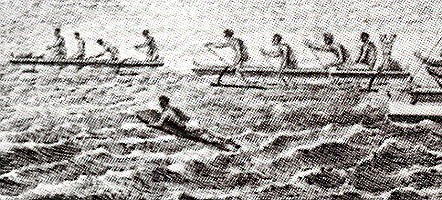 |
Surfboard paddler, Hawaii, 1778. The first known image of a surf board. Detail from John Webber:"A View of KaraKakooa, in Owyhee, 1778." Later printed in Twombly, Alexander S.: Hawaii and Its People Silver, Burdett & Co., 1899, New York, 1899. |
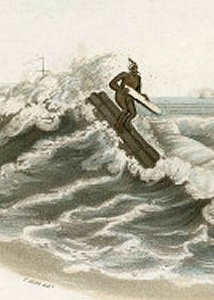 |
Catamaran surfer, Madras, India, 1800. (detail) The earliest known image of surf riding. Colour aquatint on paper Australian National Maritime Museum. Collection Purchased with USA Bicentennial Gift funds.
|
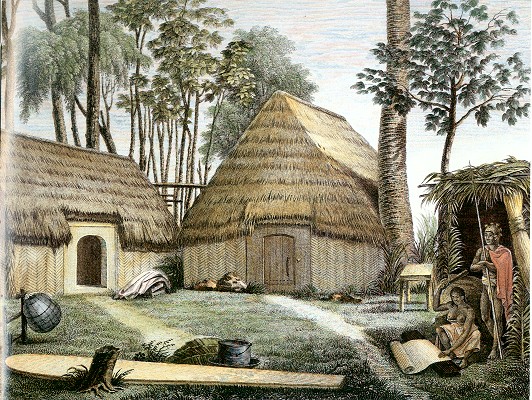 |
The Houses of Kraimokou, circa 1819. Often cited as "First image of an olo surfboard." Published in Freycinet, L : Voyage autour du mode, 1817-1820. (Voyage Around the World,1817-1820.) Chez Pillet aine, Paris, 1825. Volume 2, Part 2, Book 4, Chapter XXVII. Colourised version from the Mr. and Mrs. Severson Collection. Lueras: Surfing (1984) page 35. The sheen on the left hand side is a scanner imperfection. |
 |
"Wahine, Hawaii, circa 1819." Decorative, rather than informative. It may or may not be intended to illustrate surf riding. Possibly printed in Freycinet, L : Voyage autour du mode, 1817-1820. (Voyage Around the World,1817-1820.) Chez Pillet aine, Paris,1825. |
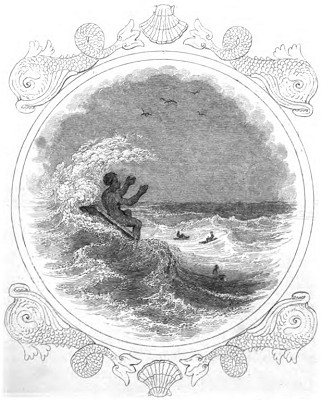 |
Surf Swimmers, (Sandwich Islands), 1830. . The earliest known image of Hawaiian surf riding. Illustration
by
the author from
|
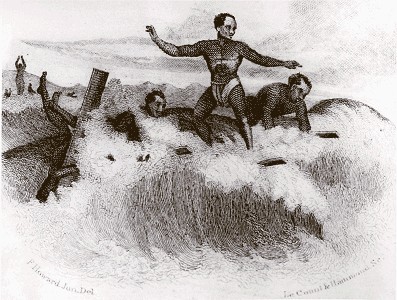 |
Sandwich Island Surf-riders, 1831. Often cited as "The first Western image of surf-riding." It correctly identifies stance. Illustration from Ellis, Rev. William: Polynesian Researches: Hawaii. Fisher, Son and Jackson, London, 1831, frontpiece.
|
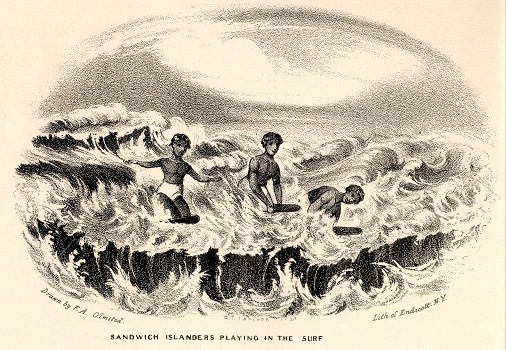 |
Sandwich Islanders Playing in the Surf, 1841. First image of surf riding by the same author and artist. Lithograph by Endicott, New York. Illustration from Olmsted, Francis Allyn: Incidents of a Whaling Voyage. Appleton and Co., NY, 1841, facing page 223.
|
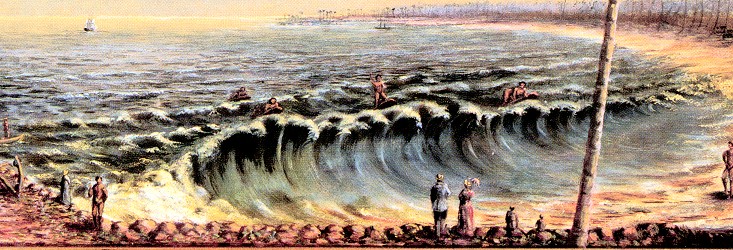 |
Hawaiian Surfing, Hilo Bay, Hawaii, circa 1850. [detail] The painting is reproduced in Lueras : Ultimate Pleasure (1984) page 48. Mr. and Mrs. Don Severson Collection. |
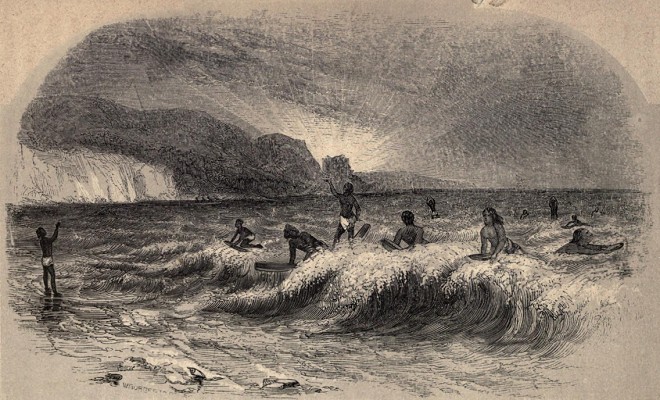 |
Hawaiian Sport of Surf Playing, 1851. First surf riding illustration published in a magazine. Published in Cheever, Rev. Henry T. : "The Sandwich Islands Today" The International Monthly Magazine of Literature, Science and Art. Volume IV, Number III, October 1851. Stringer and Townsend, New York. and Cheever, Rev. Henry T.: Life in the Sandwich Islands. A.S. Barnes and Co. New York, 1851, facing page 68. |
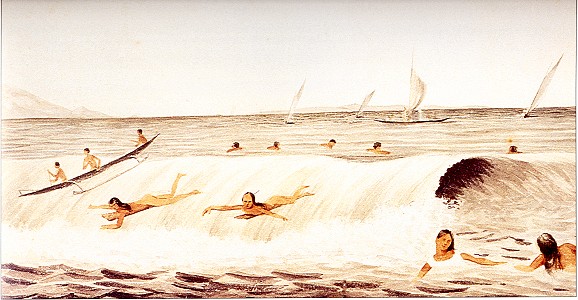 |
Surfboard, a bathing scene, Lahaina, circa 1855. Water colour, National Library of Australia. The painting is reproduced in Thom: Surfmovies (2000) page 5. |
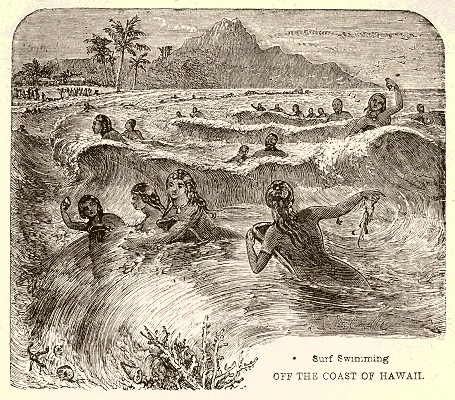 |
Surf Swimming off the Coast of Hawaii, 1863. Woodcut and design by Harden S. Melville. Engraved by Newsom Woods. Printed in Greenwood, James: Curiosities of Savage Life. S.O. Beeton, London, 1863, page 96. |
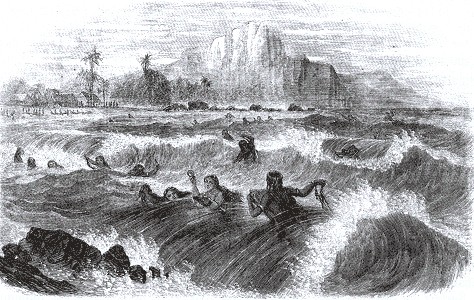 |
Surf swimming at Hawaii, Sandwich Islands, 1866. Most likely a copy of Harden S. Melville's Surf Swimming off the Coast of Hawaii, 1863, above. Printed in Leslie's Illustrated Weely, Arkell Weekly Co., New York 7 April 1866, page 37. |
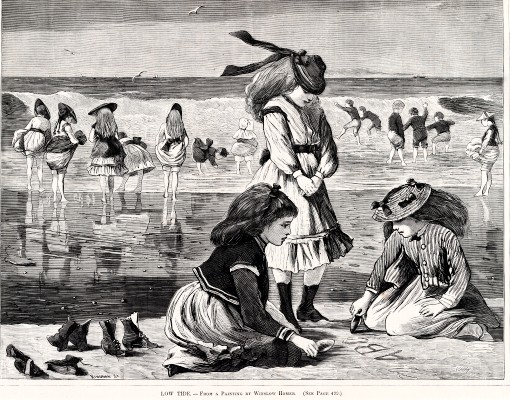 |
(From a painting by) Winslow Homer
:
Low Tide, 1870. Wood engraving by W. H. Kingdon. Published in Every Saturday, Boston, 6th August 1870. Children play at the beach at Eagle Head, Manchester, Massachusetts. See: Brooklyn Museum https://www.brooklynmuseum.org/opencollection/objects/160021 Also see High Tide, 1870: https://www.brooklynmuseum.org/opencollection/objects/2503 “Sea-bathing,” as it was called, was an activity to be approached with caution at this time. Although popular illustrations exploited the titillating aspects of lightly clad females on the beach, Homer’s subject was a daring one for an oil painting. |
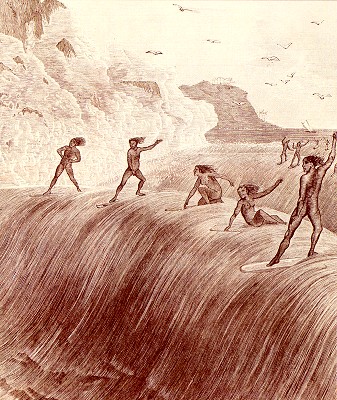 |
Surf-swimmers, 1870. A highly detailed image denoting riding positions, stance, duck-diving, waves in sets, off-shore winds and significant wave height. This is very similar in composition and style to Wallis McKay (1873), see below. Either McKay was responsible for this illustration, or this artist was influenced her work. Printed in Wood, John George: The Uncivilized Races of Men in all Countries of the World. Volume 2 G. Routledge and Sons, London, 1870. First published in 1868 |
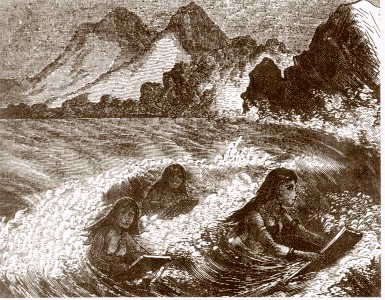 |
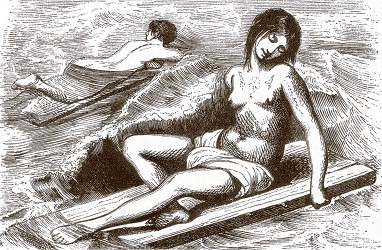
Surf-bathing Success, 1872. One of two illustrations to accompany Mark Twain's account of surf riding in Hawai'i and printed in: Twain, Mark: Roughing It. American Publishing Company, Hartford, 1872. |
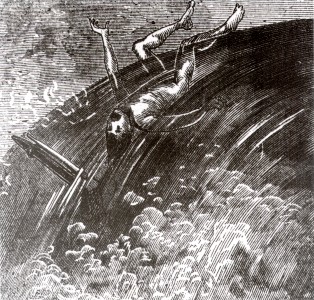 |
Surf-bathing Failure, 1872. Second of two illustrations to accompany Mark Twain's account of surf riding in Hawai'i and printed in: Twain, Mark: Roughing It. American Publishing Company, Hartford, 1872. |
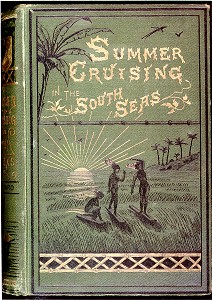 |
Surf Riding, 1873. First book with a surf-riding illustration on the cover. Cover of William Charles Stoddard : Summer Cruising in the South Seas. Chatto and Windus, London. 1873. Although not accredied in the text, the book's illustrations are recognised as by Wallis McKay. See DeLaVega: Surfing Bibliography (2004) page28, and below. |
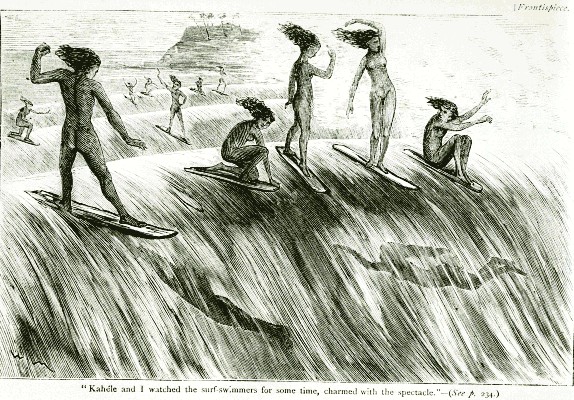 |
Surf-swimmers, circa 1873. Highly detailed image denoting riding positions, (sitting, drop-knee and standing, but not prone) stance, duck-diving, waves in sets, off-shore winds and significant wave height. This etching is initialled W M in the left corner. Published in William Charles Stoddard : Summer Cruising in the South Seas. Chatto and Windus, London. 1873, frontpiece. |
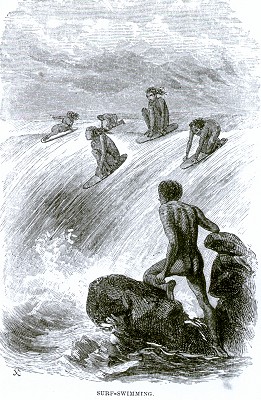 |
Surf-Swimming, Norfolk Island, circa 1873. Published in Yonge, Charlotte Mary: Sketches of the Life of Bishop Patteson in Melanesia. Society for Promoting Christian Knowledge, London, 1873, facing page 64. The image has some similarities to the work of Wallace McKay, see above |
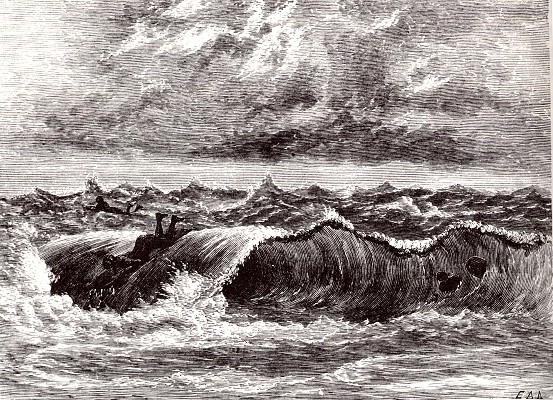 |
Surf Bathing, 1873. First printed in Nordhoff, Charles: Hawaii Dei. Harper's New Monthly Magazine, August 1873. Accredited as "Woodblock by Commander William Bainbridge Hoff (of the flagship California)." The article and the image, but without accreditation, were reprinted in Nordhoff, Charles : Northern California, Oregon and the Sandwich Islands Harpers and Brothers, New York, 1874. Considered an unrealistic representation by Bolton (1891) |
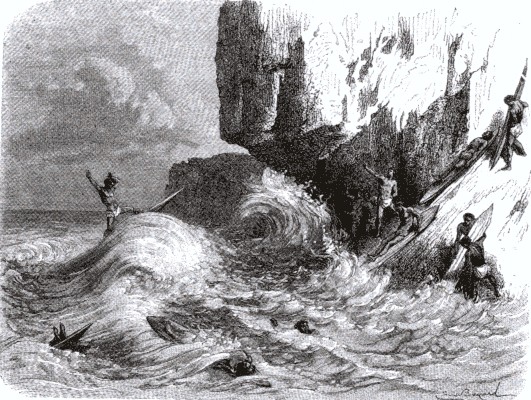 |
"Jeux Havaiens" (Hawaiians playing), 1873. First printed in de Varigny, Charles : "Voyage Aux Iles Sandwich (Iles Havai)" Le Tour du Monde (A French magazine) Volume II, 1873, page 224. .Probably reconstructed from reports or sketches. |
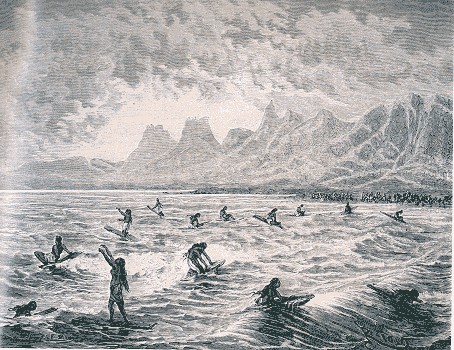 |
"Jeux Havaiens" (Hawaiians playing), 1873. First printed in de Varigny, Charles : "Voyage Aux Iles Sandwich (Iles Havai)" Le Tour du Monde (A French magazine) Volume II, 1873, page 237. Probably reconstructed from reports or sketches. Note that some of the surfers appear to be riding away from the beach.
|
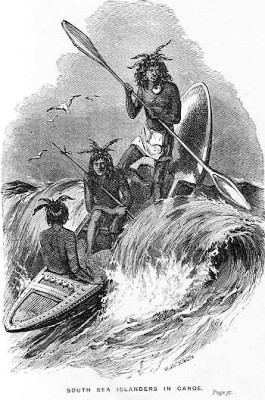 |
R. Richardson: South Sea Islanders in Canoe. Engraving: W. Jackson. Published in Ballantyne, R. M.: Man on the Ocean; A Book about Boats and Ships. London, 1874. Note that this is not, as would be expected, an outrigger canoe. Also note the untypical double bladded paddle and the crew member facing to the rear. |
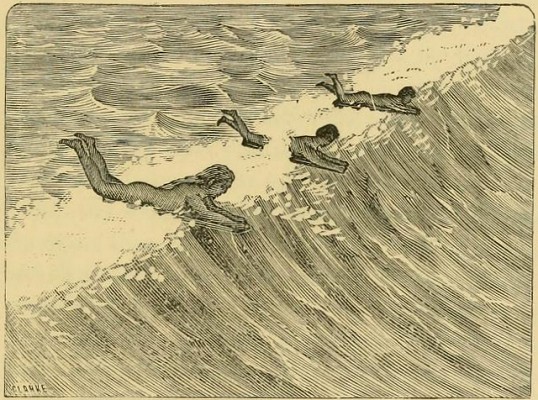 |
Surf-bathing, 1874. Published in Bookwalter, John Wesley: Canyon and Crater; Republic Printing Company, Springfield, Ohio, 1874. From a definitely elevated perspective. |
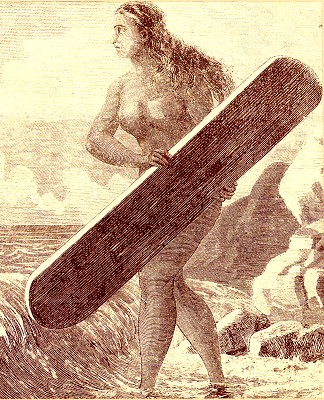 |
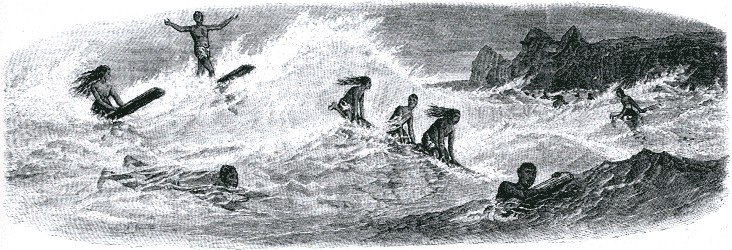
Wahine and surfboard, circa 1875. This important early board portrait image is only preceded by Pellion's The Houses of Kraimokou, (circa 1819), see above. The dating is speculation, and the image is only know to appear in Young: History (1983) page 18. Any further information would be greatly appreciated |
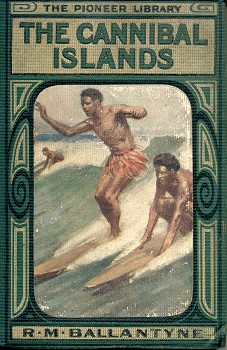 |
The Natives Playing in the Water, 1880. Cover paste down and frontpiece to Ballantyne, R.M.: The Cannibal Islands - Captain Cook's Adventures in the South Seas. Nisbet and Co. Ltd., 22 Berners Street, London, circa 1880. |
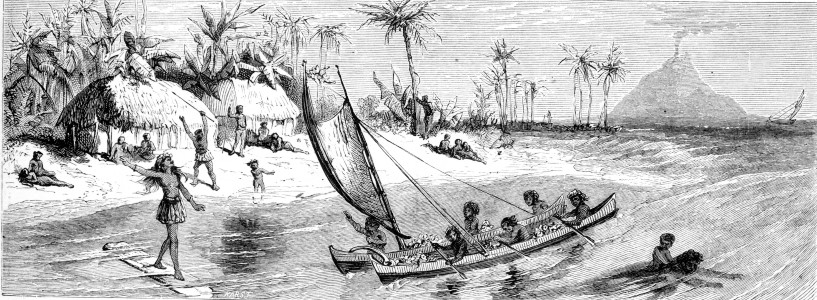 |
Scene in Polynesia, 1881. |
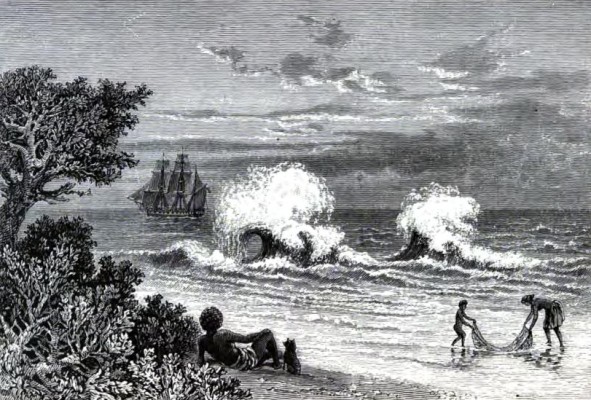 |
A Coral Island in the South Pacific, 1885. While not showing surf riding, this is a very dramatic illustration of large waves breaking on a coral reef. Illustration from: Gill, W. Wyatt: Jottings from the Pacific The Religious Tract Society, [London], 1885. |
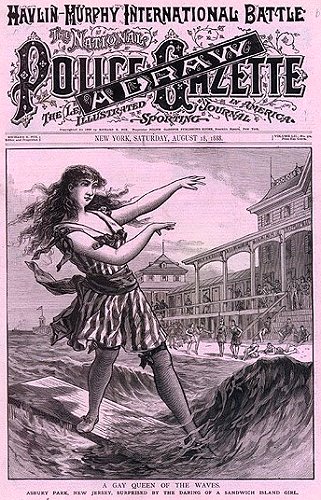 |
A Gay Queen Of The Waves, 1888. Published to illustrate an article, Sandwich Island Girl, by a newspaper renowned for manufacturing content. Also note the similarity to the female surfboard rider in Karst: Scene in Polynesia (1881), above. Front cover of The National Police Gazette August 18, 1888. |
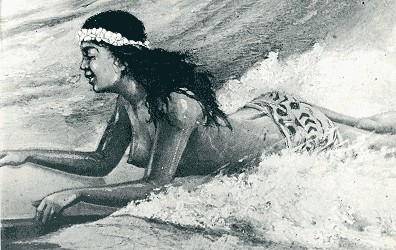 |
Wahine wave-riding, circa 1890. This image, its dating speculation, is only know to appear in Margan and Finney: Pictorial History (1971) page 25. Any further information would be greatly appreciated |
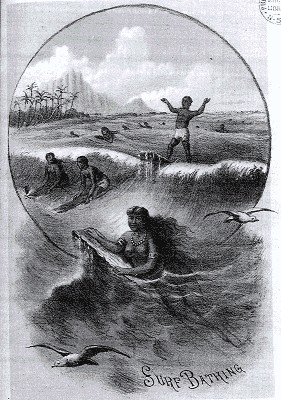 |
"Hawaiian Surf-Bathing", circa 1890. Printed in Stoddard, William Charles : A Trip to Hawaii. Oceanic Steamship Company, San Francisco, 1895, page 35. Probably the original work from which the colour illustration for the same publisher, Surf Riding, Hawaii,1890, was cropped. See below. Note that the large mountains in the background, right, are not evident in the colourized version. For the cover of the 1897 edition of A Trip to Hawaii, see below. Decorative, rather than informative. |
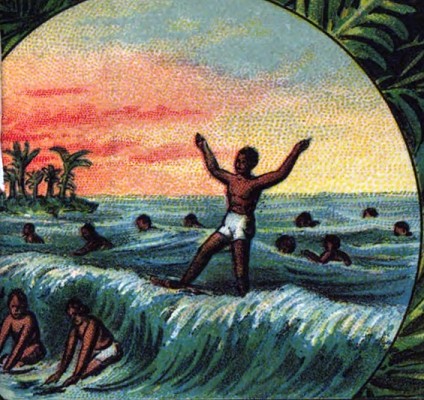 |
Surf Riding, Hawaii, 1890. Detail from a colour advertisement for J. D. Spreckles and Co. and the Oceanic Steamship Company. Cropped and hand-coloured from the black and white illustration for the Oceanic Steamship Company, Hawaiian Surf Bathing, circa 1890. See above. Printed inside the back cover of: Whitney, Henry M. (editor) . The Tourists' Guide through the Hawaiian Islands, The Hawaiian Gazette Co., Honolulu,1890. |
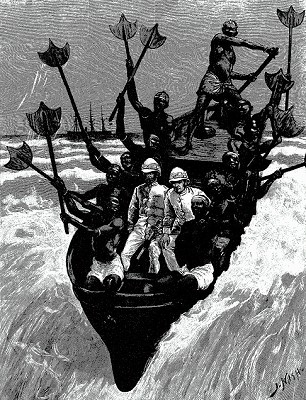 |
Landing in a Surf boat at Accra, 1891. Published in The Graphic London, August 15, 1891. The "engraving is from a sketch by Mr. Fred W. J. Airey, H.M.S. Magpie, Fernando Po." - page 196. |
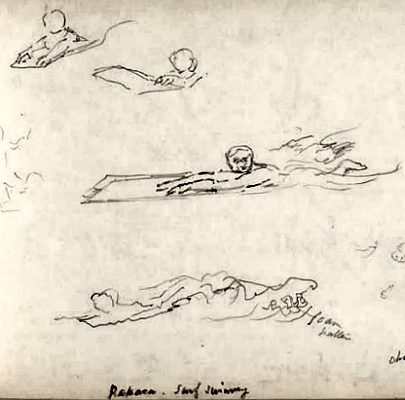 |
Papara - Surf swimming, 1891. La Farge wrote of surfboard riding at Papara, Tahiti, earlier described by Daniel Wheeler in 1835. These sketches of prone surfboard riders were included in La Farge, John: South Seas Sketchbooks 1890-1891. Sketchbook Number 11. Noted by Herve Manificat, The Surf Blurb, 24th February 2013. |
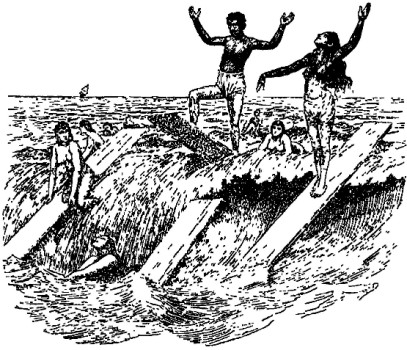 |
Sea Sledging, 1891. In the text the surfboard is called a "sea sledge," and this crude representation has been amalgamated from several earlier illustrations. Printed in Mather, Helen: One Summer in Hawaii. Cassell Publishing Company, New York,1891. |
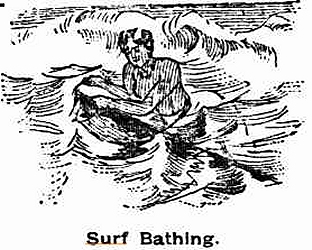 |
Illustration accompanying: Hawaiian Folk Lore Evening News. Sydney, 24 March, 1894, page 3.
|
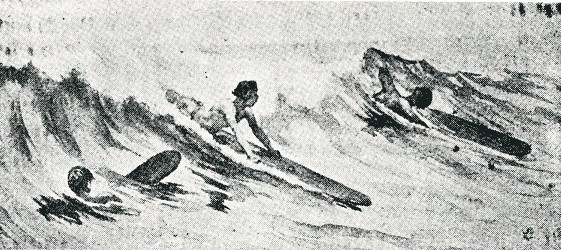 |
Surf-riding, 1896. Header to the article Hawaiian Surf-riding. One of two illustrations, and a photograph of canoe surfing at Waikiki published in Thrum,
Thomas G. (editor) :
|
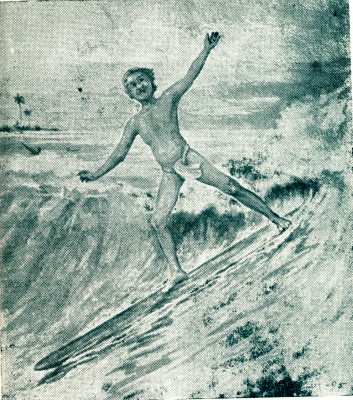 |
Expert Positions, 1896. Second of two illustrations published in Thrum, Thomas G. (editor) : Thrum 's Hawaiian Annual of 1896. Honolulu, 1896. For the photograph of canoe surfing at Waikiki, see: Photography |
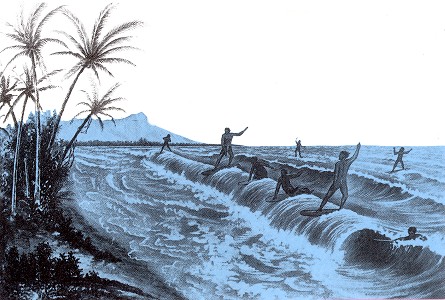 |
"Surf-riders at Waikiki, circa 1890s." George: Surfing (1990) page 20. |
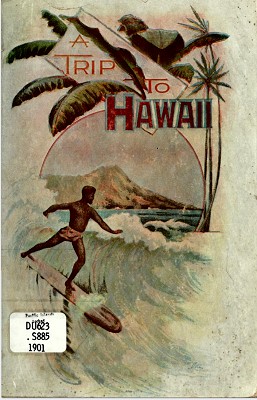 |
A Trip to Hawaii, 1897. Cover for Stoddard, Charles Warren: A Trip to Hawaii. Oceanic Steamship Co., San Francisco, 1897. The frontpiece of the 1901 edition included a photograph by Frank Davey: Native with Surf Board, Waikiki Beach, circa 1898. See: Photography |
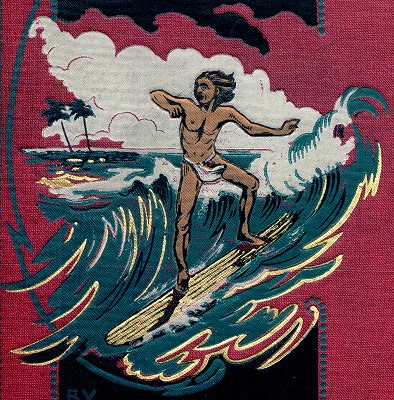 |
Surf Rider, 1898. Cover [detail] of Musick, John R..: Hawaii - Our New Possessions. Funk and Wagnalls, New York, 1898. The image was also reproduced in black and white plate, facing page 72. Impressed by the surfboard riders at Hawaii, Musick wrote: then my thoughts went back to the old pictures in the geography, and I said: "It was true." This possibly refers to Swinton's Grammar School Geography (1881), see above.
|
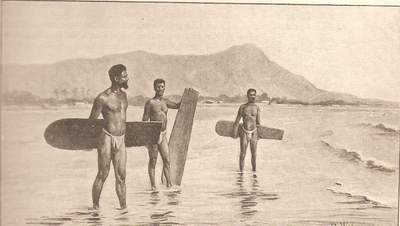 |
Surfers, Waikiki, 1898. Printed in La Nature, Number 1330, November 26th,1898. This image was located by Herve Magnificat and forwarded by email and posted on The Surf Blurb, 24 March 2013. Many thanks to Herve, who notes: Weisser "never went to Hawaii and apparently was inspired (in this case) by Charles Kauha photos." See Photography |
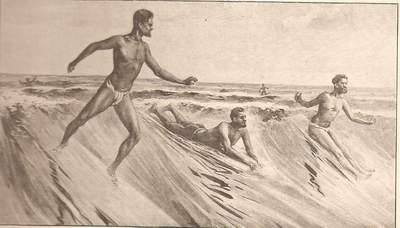 |
Surf Riding, Waikiki, 1898. Printed in La Nature, Number 1330, November 26th,1898. This image was located by Herve Magnificat and forwarded by email and posted on The Surf Blurb, 24 March 2013. Many thanks to Herve, who notes: Weisser "never went to Hawaii and apparently was inspired (in this case) by the 1892 Oceanic steamship brochure A Trip to Hawaii, written by Charles Stoddard," see above. |
 |
Surf-board of hard, blackened wood; length 71 inches, 1899. Printed in Culin, Stewart: Hawaiian Games American Anthropologist Putman, New York, April 1899. |
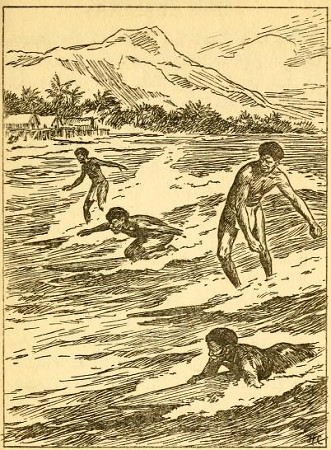 |
John F.
Campbell: The native surf-riders
[Nuie].
Although
the illustration
accompanies text
describing surfriding in Nuie in 1867, it was almost certainly drawn
from an early Hawaiian photograph, with what is clearly
Diamond Head in the background.
Printed in Hall, A. Gratten: James Chalmers George Dorian Company, New York, [1910], page 21. Internet Archive https://archive.org/details/jameschalmers00hall Identified by Herve Magnificat, The Surf Blurb, May 5, 2014. |
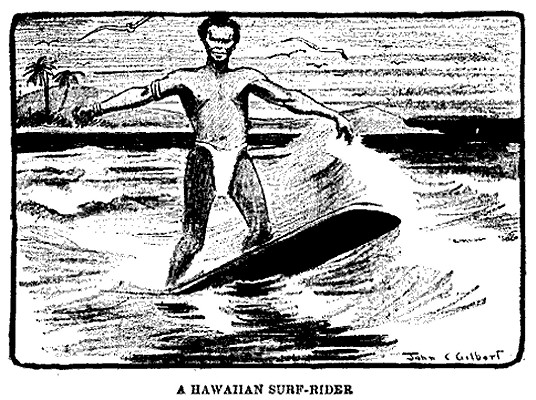 |
A Hawaiian Surf-Rider, 1900. Printed in George, Marian M.: Little Journeys to Hawaii A. Flanagan Company, Chicago, 1900. |
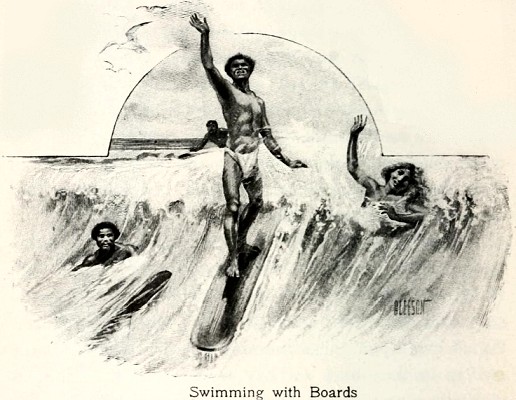 |
Swimming with Boards, 1900. Printed in Krout, Mary H.: Alice's Visit to the Hawaiian Islands. American Book Company, New York, 1900. |
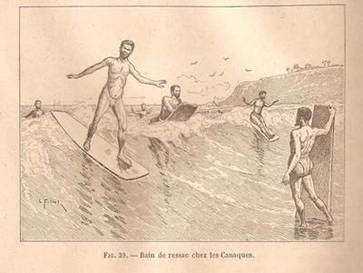 |
Hawaiian Surf-riders, 1905. in Henry Coupin: Les Bizarreries de la Race Humaine Vuibert and Nony, Paris, 1905. Identified by Herve Magnificat and forwarded by email and posted on The Surf Blurb, 24 March 2013. Many thanks to Herve, who notes: "The illustration by Fillol, a French illustrator of popular books, ... is a combination of both Charles Weisser’s pictures shown above." |
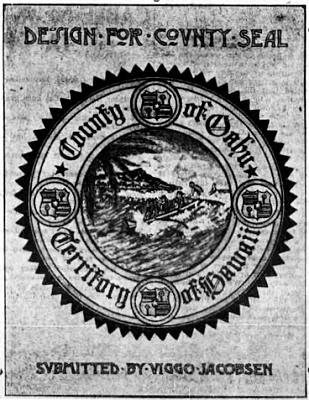 |
Design forCounty of Oahu Seal - Surf-riding at Diamond Head., 1905. Featuring an outrigger canoe surf riding under Diamond Head, this design was adopted by the County Board of Oahu in July 1905. Noted in The Hawaiian Gazette. Honolulu, July 14, 1905, page 2. |
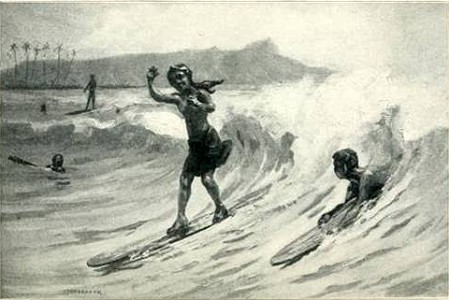 |
The Favorite Sport of Surf-Riding, 1907. Printed in Thrum, T. G.: Hawaiian Folk Tales. Honolulu, 1907, page 131. Identified by Herve Magnificat and posted with notes on The Surf Blurb, 4 June 2013. |
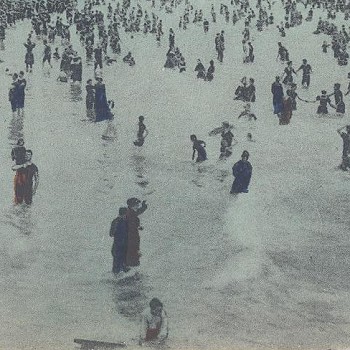 |
???: A sufer photographed sitting astride a surfboard in the foreground amongst a large crowd of beach-goers at Wrightsville Beach, USA. 1907. |
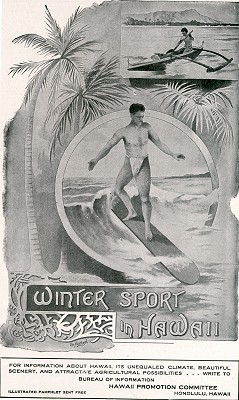 |
Winter Sport in Hawaii, 1908. Advertisement for Hawaii Promotion Committee. Honolulu, Hawaii. Published in National Geographic Magazine April 1908 Vol. XIX No. 4, page 309. |
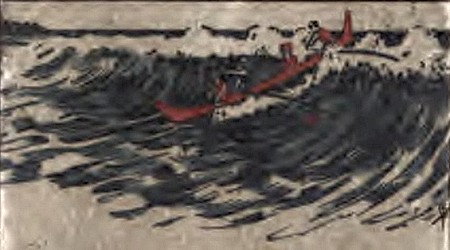 |
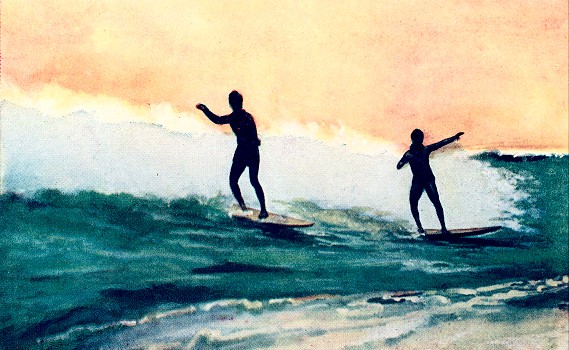
Canoe Surf Riding, 1908. Cover illustration (detail) from Hawaii Promotion Committee: Hawaii- A Primer Hawaii Promotion Committee, Honolulu, 1908, 4th Edition. . |
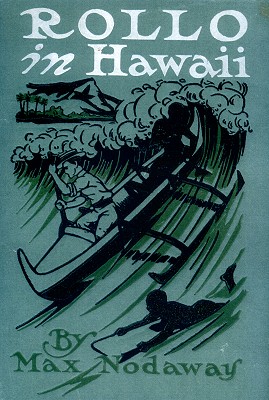 |
Canoe and Board Surf Riding, 1908. Cover illustration (detail) from Noddway, Max: Rollo in Hawaii. Thompson and Thomas, Chicago, 1908. |
 |
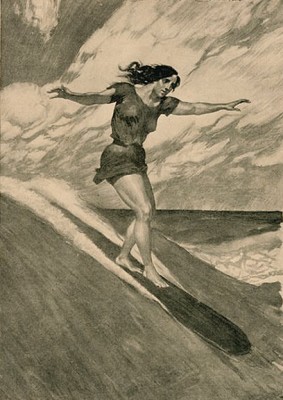
John Prendergast : Surfboard Riders, 1910. Printed in Wilcox, Ella Wheeler, The New Hawaiian Girl; a play. London, Gay & Hancock, 1910. |
 and and  |
The South Pacific Heroine, 1911. Two illustrations accompanying (Ralph Stock): The Recipe for Rubber - A Romance of the South Pacific. The Lone Hand Sydney, 1st June 1911. The surfing illustration was reproduced in Stock's novel published under the same title by Lynwood and Co., London, in 1912 In 1922 it was adapted, with a change to the surfer's gender, for a coloured illustration Surf-riding in Fiji in The Boy's Own Annual. Boy's Own Paper Office, London, 1921-1922. Volume 44, page 215. |
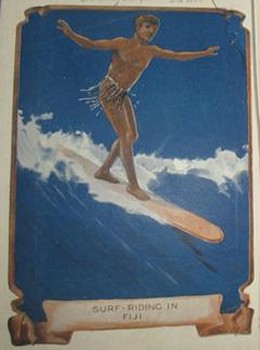 |
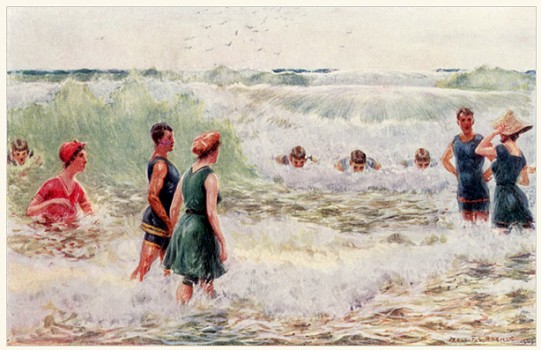 |
Surf Bathing - Shooting the Breakers, 1911. Printed in Fox, Frank: Peeps at Many Lands- Australia Adam and Charles Black, London, 1911. |
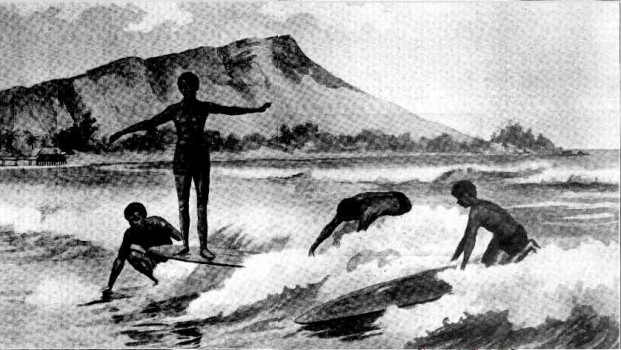 |
Agnes Gardner-King: Riding the Surf at Honolulu, 1912. Sydney Mail 25 December 1912, page 30. http://nla.gov.au/nla.news-article158479458 |
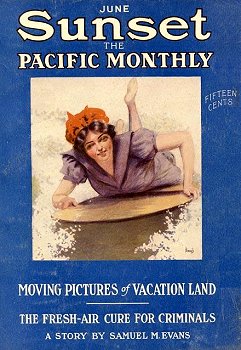 |
A Summer Surf-boarder, 1912. Colour cover illustration of Sunset- The Pacific Monthly. Southern Pacific Railroad, San Francisco, June 1912. Editor: Charles K. Field. by
|
 From > From > 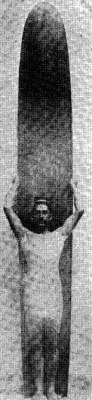 |
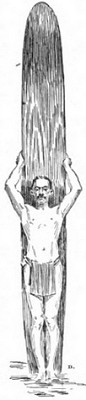
The Surf Board, 1912. The illustration was printed in Alexander, Mary Charlottee: The Story of Hawaii American Book Company, New York, c1912. It is a direct copy of a photograph, attached, and later published in Bernice Pauahi Bishop Museum: Bishop Museum Handbook, Part 1 : the Hawaiian collections. Bishop Museum Press, Honolulu, 1915. |
 |
Surf-rider: "I'm almost sure this
isn't a bit the way its done in the illustrated
papers!"
- "London Punch." The World's News Sydney, Saturday 22 August 1914, page 15. http://nla.gov.au/nla.news-article131500745 |
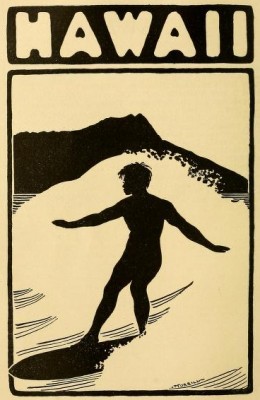 |
Hawaii, 1915. A chapter heading printed in Morrill, G. L.: South Seas Silhouettes Lowell L. Morrill: Illustrator and Photographer M. A. Donohue and Company, Chicago, 1915. |
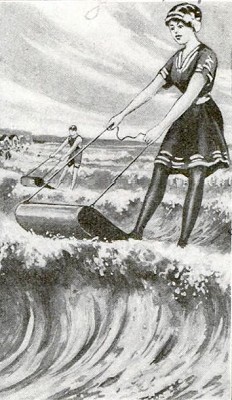 |
Toboggan-shaped Surf Coaster, California, 1915. Printed in Surf Coasters. Popular Mechanics Magazine May 1915, page 671. |
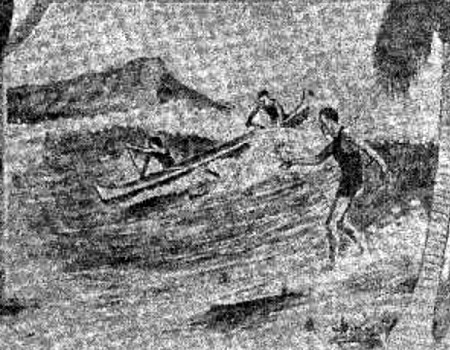 |
Surf Riding at Waikiki, 1919. Detail from the cover of Thrum, Thos. G.: Hawaiian Almanac and Annual for 1919 Thos. G. Thrum, Honolulu,1918. |
 |
Surf-riding on the
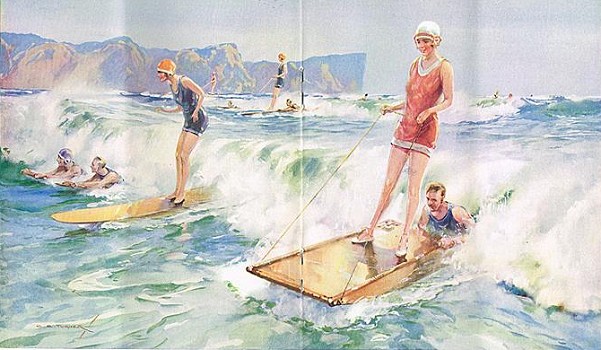
South African Coast. By permission of The Sketch and the High Commissioner for the Union of South Africa, London. In the Track of the Sun Union-Castle Mail Steamship Company, London, [1920], Centrefold Also see: 1930 A.V.N. Jones : Surfing Jigsaws. |
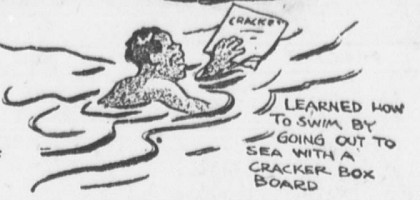 |
NO TRAINING NECESSARY FOR DUKE KAHANAMOKU, AMERICA'S SWIMMING ACE The Evening World.
New York, July 17, 1920, page 8. |
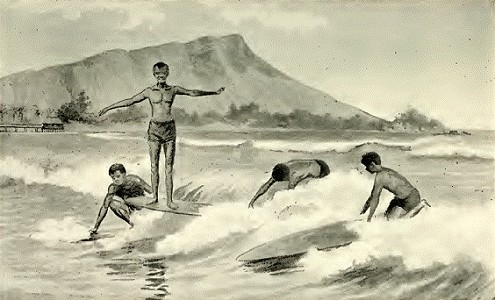 |
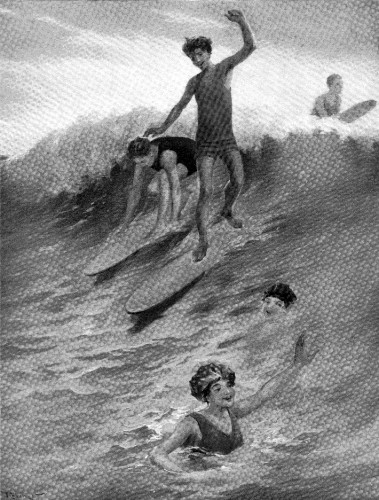
Surf-riding in Honolulu, 1921. Illustration by the author, from Islands Far Away 1921 (2nd edition), Identified by Herve Magnificat, and posted on The Surf Blurb, 4 June 2013. The nose-riding surfer is an abberation, resulting from King's misreading of a hand-coloured photogragh postcard of the era. |
 |
Ski-ing the Waves of Waikiki, 1921. Surfboard riders displaying their skill in the always summery waters of Honolulu's world famous beach resort. Printed in Sabin, Will: Hawaii, U.S.A. A Souvenir of "The Crossroads of the Pacific." [Honolulu], 1921. Hathitrust http://hdl.handle.net/2027/mdp.39015027035784 |
 |
Advertisement for Rogers Peet Company, New York. The Evening World New York,
June 28, 1921, page 17.
|
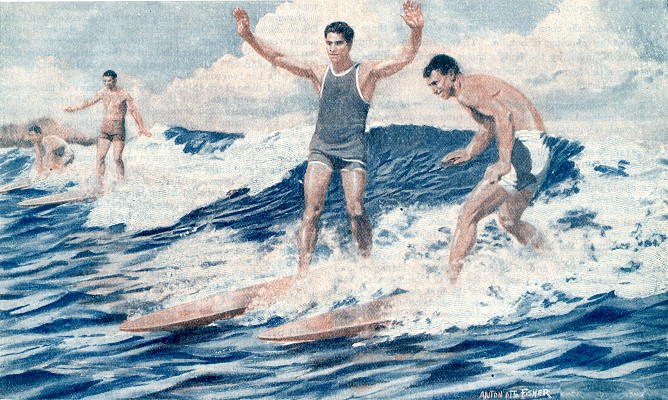 |
Surf Riders, 1922. Valentine and Company: Valspar Varnish Advertisement [featuring Duke Kahanamoku]. Printed in The Literary Digest April 1, 1922, page 45. The advertisement included a widely published board portrait photograh, and was printed in several magazines during 1922. See: Photography |
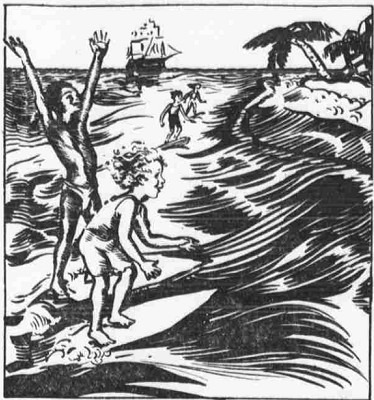 |
South Sea Sport, 1922. Published in Around the World and what Alice Found (Chappter IX) The Evening World. New York, June 10, 1922, page 15.
|
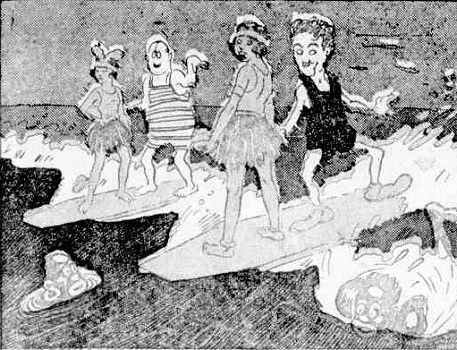 |
Charlie
and Ambrose on the surf
boards
with two damsels at Waikiki. Sunday Times Sydney, Sunday 1 January 1922, page 1. |
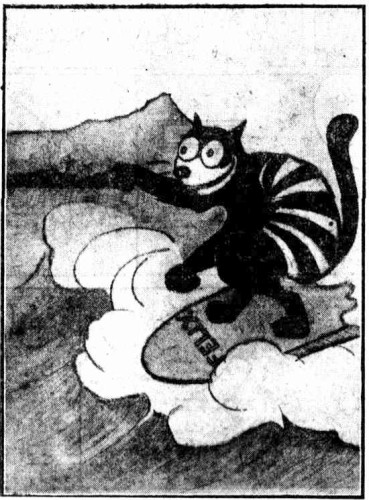 |
Felix
tries the surf-board
at the beach of Waikiki.
Sent in by one of our readers, who attended the Radio Adventure talk at Farmer's recently. Sunday Times Sydney, 22 August 1926, page 2. |
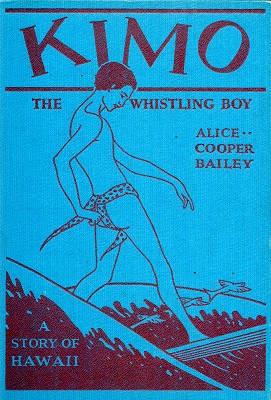 |
Kimo - The Whistling Boy, 1928. Cover illustration for Bailey, Alice Cooper: Kimo - The Whistling Boy Wise-Parslow Company, New York, 1928. Illustrated by Lucille Holling. There are two other surf riding illustrations within the book. |
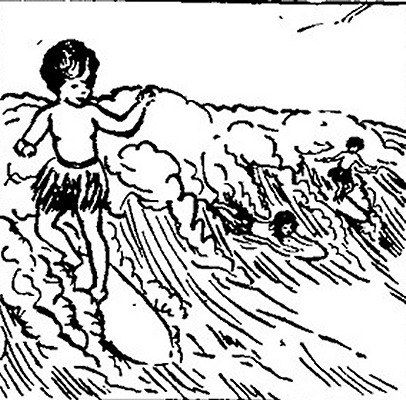 |
Surf Riding, New Zealand, 1929. One panel from The Adventures of Dickey Possum, Chapter IV. Auckland Star Auckland, Volume LX, Issue 93, 20 April 1929, Supplement, page 3. |
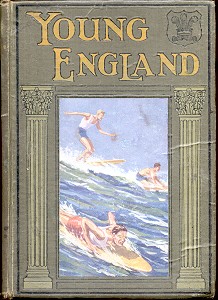 |
Cover of Young England - Fifty-First Annual Volume The Pilgrim Press, 1929. |
 |
Newspaper Column Header. The Sun Sydney, 16 October 1929, page 9. |
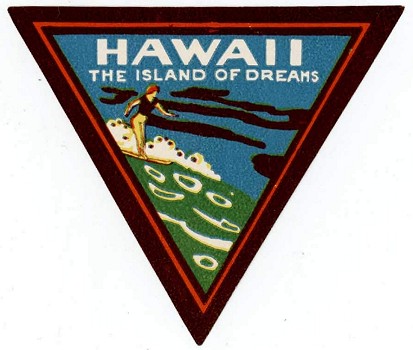 |
Hawaii - The Island of Dreams, circa 1930. Illustrated Luggage Label |
 |
Ida Rentoul Outhwaite : Surf Riding Fairy and Flying Fish, 1930. Australian Children's Literature 1830-1950. http://www.australianchildrensliterature.com/1830-1950.htm |
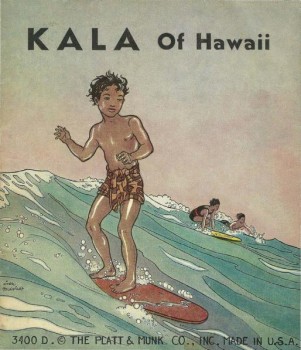 |
Elizabeth F. McCrady: Kala of Hawaii The Platt and Munk Co. Inc., USA, 1936. Internet Archive https://archive.org/details/kala-of-hawaii |
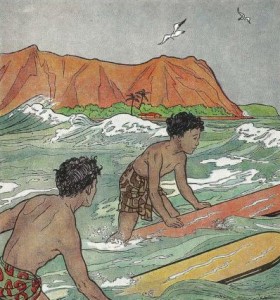 Page 6. |
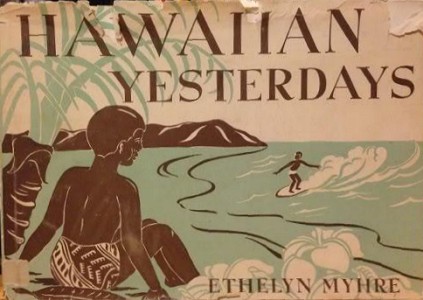 |
Myhre, Ethelyn: Hawaiian Yesterdays Alfred A. Knopf, New York,1942. Woodblock illustrations by the author. |
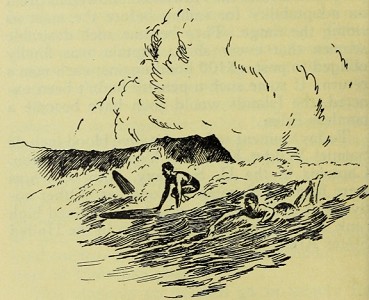 |
Hawaiians find time for play, 1945. Illustration from photograph. Armitage, George T.: Long before Pearl Harbor; Hawaii's Historical Highlights. Honolulu Star-Bulletin, Honolulu,1945, page 36. Hathitrust http://hdl.handle.net/2027/uc2.ark:/13960/t5hb1n65m |
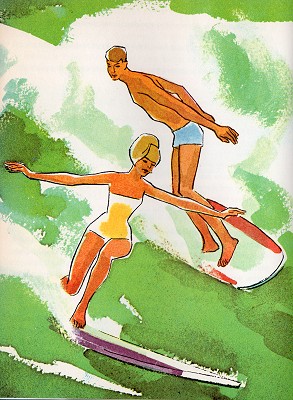 |
Irwin Greenberg: Surfboard Riding. from Spinner, Stephanie: Water Skiing and Surfboarding. A Golden Pocket
Guide
Golden Press, New York, 1968; page 18 |
|
|
|
|
|
The British
Library : Concise History of the British Newspaper in the
Twentieth Century
"1903 -
Nov 2 : Daily Mirror launched by Harmsworth. First daily
illustrated exclusively with photographs."
"1934 -
Oct 18 : Daily Mail publishes the first photograph to be
transmitted by beam radio (from Melbourne to London)."
-
http://www.bl.uk/collections/brit20th.html#from1901
|
|
|
|
|
|
| home | catalogue | history | references | appendix |
HARPER'S WEEKLY. LONG BRANCH: THOMAS NAST BEACH SCENE. An
original 16-inch by 22-inch, hand-colored print- drawn by famous
illustrator Thomas Nast- from the August 26, 1865 issue of
Harper's Weekly magazine. Entitled: "Our Watering-Places- Views
At Long Branch." The double-page engraving depicts seven
separate scenes, among which are the sea side, pavilions, lovers
on the beach, children in the surf or playing, and an evening in
the parlor.