surfresearch.com.au
notes : the wave in
art
| home | catalogue | history | references | appendix |
|
surfresearch.com.au
notes : the wave in
art
|
  |
H.D.
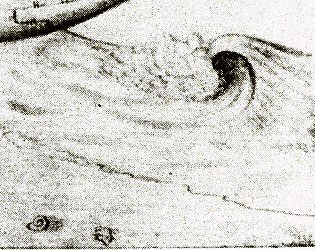
Sporing : Breaking
Wave, Matavai Bay,Tahiti, 1769.
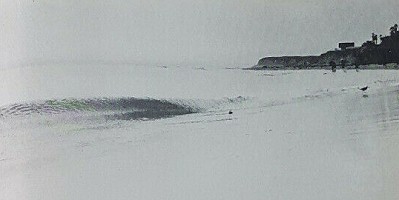
Detail from Purea's canoe, Tahiti, 1769. British Museum, Add. MS 23921-23a Printed in Cook:Voyages (1991), Volume 1, Figure 31, between pages 112-113. This illustration of a breaking wave clearly shows the conical wave face that is integral to the dynamics of surfriding. It is probable that Sporing was able to capture the wave contours so accurately because there was a consistent , if small, swell running down the beach. The image was thus constructed from many similar waves breaking regularly while he completed the principal image of the canoe. Campus Beach, Santa
Barbara.
When it moves out it is just the same. A long winding wall. Photo: Woody. Surfer
v15 n4 1974 November, page 77. |
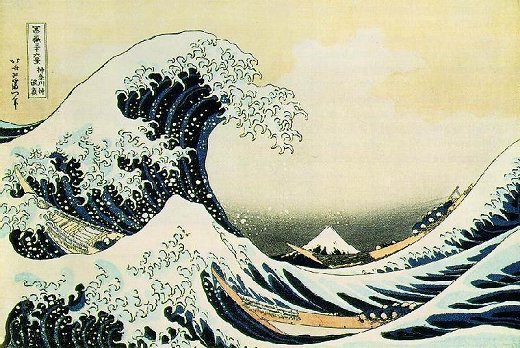 Katsushika Hokusai: Under the wave off Kanagawa c.1825?1831? |
The most
famous wood block
print by Katsushika
Hokusai (1760-1849). One of Thirty-six Views of Mt. Fuji, the image has been used numerous times in the surf media and by surfboard companies. Depicting the drama of man against the sea, a turbulent foreground is centred and mirrored by a distant, and serene, Mt. Fiji. Hokusai pioneered the Japanese use of occidental perspective, a notable feature of thos series. His woodblocks were distinctive by their use of blue, a colour previously unavailable in Japan. A powerful influence in Japan and Europe, Hokusai was participially important to the work of Claude Monet and Ando Hiroshige, see below. The Great Wave by Hokusai: Great Art Explained https://www.youtube.com/watch?v=IBcB_dYtGUg Better Know the Great Wave | The Art Assignment | PBS Digital Studios https://www.youtube.com/watch?v=d1ufFlXIWjA |
 |
Ando Hiroshige:
-
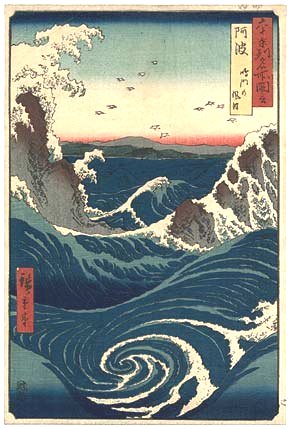
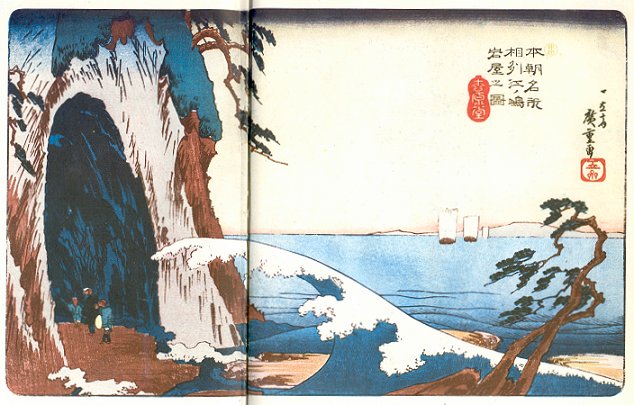
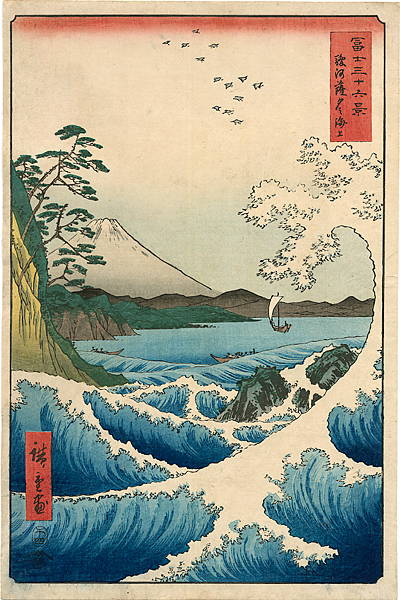
Angry sea at Naruto, Awa province c.1830-31 Wood block print Strongly influenced by Hokusai, Ando Hiroshige (1797-1858) brilliantly captures the fluidity and motion of waves and currents. The work uses the newly available blue ink extensively and is notable for the lack of human figures, it is strictly a seascape. Waves also feature prominently in Hiroshige's The Cave at Enoshima, 1832 (below) The Procession of Women to the Benten Temple on the Island of Enoshima. c.?[ The Sea of Setta, Suruga province c.1852- 53 (below). Like Hokusai, Hiroshige was a important influence in Europe, and was particularly admired by Claude Monet. |
 Ando Hiroshige:
The
Cave at Enoshima c.1832
|
Travellers enter the
shine-grotto of
Enoshima Island as a huge wave beats on the shore. Wood block print |
 |
Ando
Hiroshige (1797-1858) :
The Sea of Setta, Suruga province (Suruga Setta no Kaijo) c.1852- 53 Format : Oban, Tate-e From the series : Thirty-six View of Mount Fuji (Fuji Sanju-Rokkei) Published by Tsutaya Kichizo in 1858 The Great Wave breaking on the coast at Satta Point with a flight of alarmed Chidori making their escape. References for Japanese Art Lane, Richard : Masters of the Japanese Print Thames and Hudson, London, 1962, pages 205 - 296 Hajek, Lubor : Japanese Graphic Art, Octopus Books, UK, 1976, |
 |
Victor Hugo: The
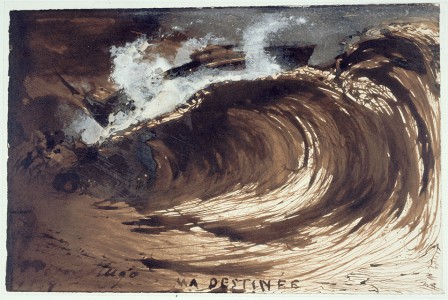
Wave or My Destiny, 1857.
Illustration by Victor Hugo,
the French author of Les Miserables while in exile on
the island of Guernsey.He produced more than 4,000 drawings. Originally pursued as a casual hobby, drawing became more important to Hugo shortly before his exile when he made the decision to stop writing to devote himself to politics. Although unpublished in his lifetime, drawing became his exclusive creative outlet between 1848 and 1851. Public Domain https://www.wikiart.org/en/victor-hugo/the-wave-or-my-destiny-1857 Victor Hugo: The Wave or My Destiny, 1867. 6 3/4 × 10 3/8 in. (17.2 × 26.4 cm), Maisons de Victor Hugo, Paris, 1867. Public Domain https://commons.wikimedia.org/wiki/File:Ma_destin%C3%A9e_(My_Destiny)_by_Victor_Hugo,_1867.jpg |
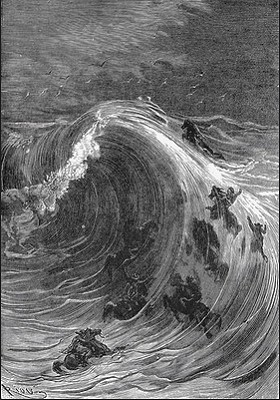 |
Édouard Riou: The Huge
Wave, 1868.
A huge wave, forty feet high, overwhelmed the fugitives with a terrible roar. Men and beasts, everything, disappeared in a whirlpool of foam. A ponderous liquid mass engulfed them in its furious tide. Probably influenced by early 19th century Japanese woodblocks, the illustration appeared as plate 62 in Jules Verne's Les enfants du capitaine Grant, published by Hetzel in 1867–1868, and published in English as In Search of the Castaways. A prolific illustrator, Riou contributed to many of Verne's works, including his next novel, Twenty Thousand Leagues Under the Sea. He is also known for his, less than accurate, illustration of surfing in Hawaii, Jeux Havaiens (Hawaiians playing), 1873. See: Illustrations |
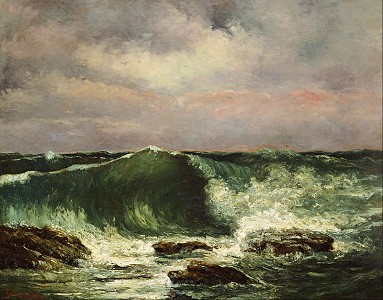 |
Jean Désiré
Gustave Courbet: The Wave [Die Woge], 1869. Jean Désiré Gustave Courbet (1819-1877) was a French painter who led the Realist movement in 19th-century French painting. Committed to painting only what he could see, he rejected academic convention and the Romanticism of the previous generation of visual artists. His independence set an example that was important to later artists, such as the Impressionists and the Cubists. Courbet painted figurative compositions, landscapes, seascapes, and still lifes and was an innovator and as an artist willing to make bold social statements through his work. http://en.wikipedia.org/wiki/Gustave_Courbet |
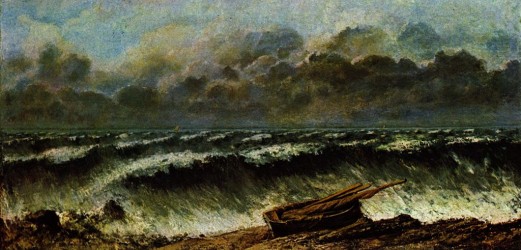 Above: Gustave Courbet: The
Waves, 1869.
Right: Gustave Courbet: The Wave, 1870. |
|
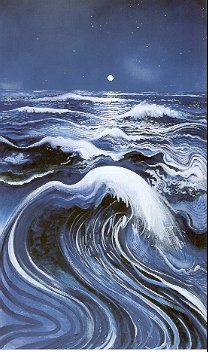 |
Whitely
Brett (1939 - 1992) : Thebes' Revenge (1973 - 82) Oil and collage on board, 203 x 122 cm Private collection The seashore was an significant subject for Whitely, notably a large number of paintings featuring Sydney Harbour from his 1970's residence in Lavender Bay and Bondi Beach. Strongly influenced by the dramatic brush work of van Gough, this work also owes a debt to the favoured blue used in Japanese woodblocks. - Pearce, Barry : Brett Whiteley - Art and Life, The Art Gallery of NSW, Sydney, 1995. |
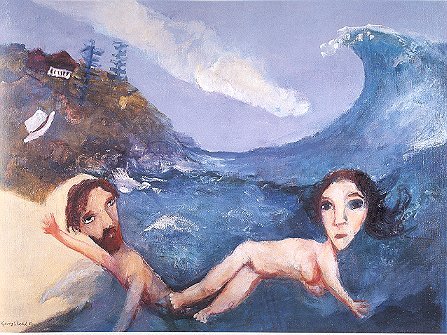 Garry Shead:
The
Wave (1992)
|
Shead, Garry (1942- ) :
The
Wave (1992)
Oil on canvas board, 91 x121 cm Private collection. From The D.H. Lawrence Paintings, a series of works based on D.H. Lawrence's Australian novel Kangaroo (1922?) and his time writing the novel at Thirroul, NSW. One of the other thematic symbols of the series, a large kangaroo, is absent from this work. The Lawrence works were initially encouraged by Shead's contemporary, Brett Whitely, and in 1973 they produced a diptych Portrait of D.H. Lawrence. (see Grishin, page 51 below). Brett Whitley (see above) committed suicide at Thirroul in 1992. The wave image is reminiscent of Hokusai's Under the Wave, Above. |
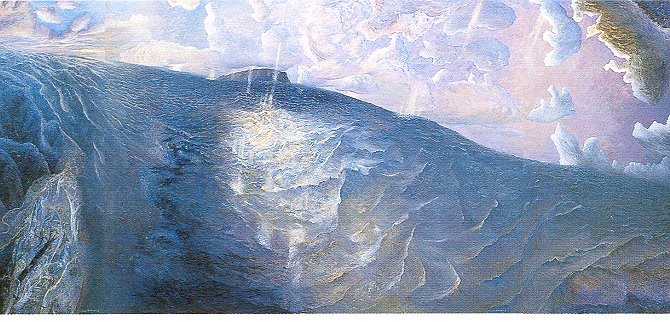 |
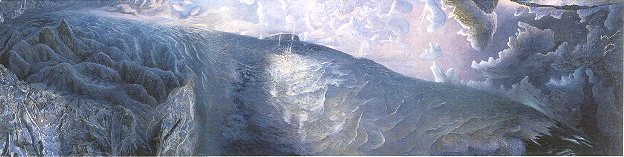
Robinson,
William (19 ) : Creation Landscape : Earth and Sea - detail. (1995) Oil on Canvas, multi panelled, 183 x 730 cm - full image below. Private collection |
| home | catalogue | history | references | appendix |
