surfresearch.com.au
references
: books f
| home | catalogue | history | references | appendix |
|
surfresearch.com.au
references
: books f
|
| a |
|
|
|
|
|
|
|
|
|
|
|
|
|
|
|
|
|
|
|
|
|
|
|
|
|
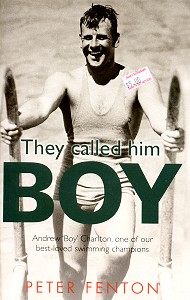
| 2006 Fenton, Peter : They Called Him Boy. Random House Australia Pty Ltd 20 Alfred Street, Milsons Point, NSW 2061, 2006. Soft cover, 258 pages, 40 black and white plates, Acknowledgements. Charles E. Tuttle Company Inc. Review Boy Charlton was one of Australia's most successful swimmers and a regular surf shooter at Manly. In 1928 he competed in the Amsterdam Olympic Games, accompanied by his trainer and fellow Manly surfer, Harry Hay. Two other Manly surfers, Snowy McAllister and Tommy Farrell, travelled to Europe to support Chartlton, McAlister taking a surfboard which he intended to ride on the beaches of Cornwall, England. See Source Documents: 1928 The Daily Mail : Snowy McAlister -Surf-board Riding, Cornwall. |
 |
| 2015
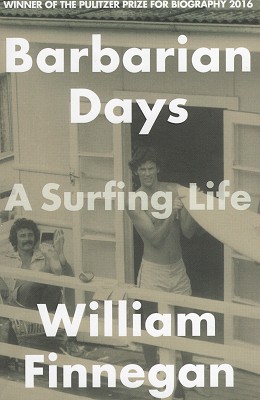
Finnegan, William. : A Surfing Life Penguin Press, USA, Corsair Books, UK, 2015. Soft cover, 499 pages, b/w photographs. Review Extremely interesting book detailing the author's devotion to surfing, while juggling the responsibilities of work and family. Extended accounts of memorable surf sessions and waves on both coasts of America, Hawaii, South Pacific, Australia, Asia, and Africa. Winner of the Pulitzer Prise for Biography 2016 and the 2016 William Hill Sports Book of the Year. |
 |
Also note, a number of early reports identifying juvenile surfriders may be a result of the observer witnessing the activity in benign and relatively common climatic conditions (that is, small surf), whereas adult surfriders are more likely to test their skills in more extreme, and much rarer, swell events.
The other
crucial assumptions that probably deserve further analysis are
the identification of "true surfboards" as essentially based
on length (1996, page 24) and the implication that "true
surfing" is in a standing position (1996, also page 24).
While length is
important, surfboard performance is also function of width and
volume.
By
concentrating on riding in a standing position, certainly the
dominant method in 1966, the analysis does not account for
other indicators of surfriding skill, principally wave size
and critical positioning.
For example, in
the period 1965 to 1969, some commentators consider the
world's best, strictly in terms of surfriding performance, was
Californian kneeboarder, George Greenough.
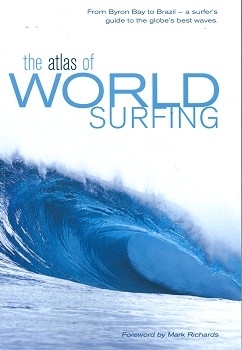
| 2007 Forbes, Scott (Project manager, editor): The Atlas of World Surfing. Harper-Collins Publishers Australia 25 Ryde Road, Pymble sydney NSW 2073, Australia, 2007. 31 View Road, Glenfield, Auckland 10, New Zealand. www.harpercollins.com.au Soft cover, 256 pages, colour maps and photographs, Forward by Mark Richards, Glossary, Web Links, Index, Acknowledgements. Review A global surf guide featuring the most recognised breaks prepared by a vast team of contributors. The authorship of this work is difficult to ascertain, and it is also accredited to Surfrider Foundation, see S |
 |
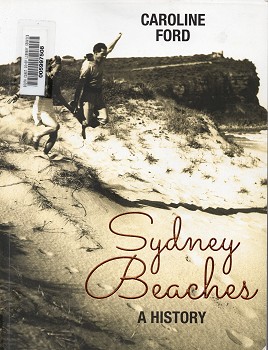
| 2014 Ford, Caroline: Sydney Beaches : A History NewSouth Publishing, Coogee, N.S.W., 2014. Soft cover, 320 pages, 8 pages of plates and illustrations, Acknowledgements, Notes, Bibliography, Index. Review An excellent book covering the development of beach culture in Syney from the mid 19th century. One significant error: "The small figure of the Hawaiian Olympic swimming champion, Duke Kahanamoku, looms large over the history of surfing in Australia," page 196. Duke had an imposing physique and was 6ft (180 cm) tall, hardly a "small figure." |
 |
| 1919 Fornander, Abraham: Fornander Collection of Hawaiian Antiquities and Folk-Lore. With Translations Edited and Illustrated with Notes by Thomas G. Thrum. Bernice Pauahi Bishop Museum Press, Honolulu, Hawaii, 1919. Volume VI, Third Series, Part 1. Hard cover. Review. See
Source Documents: |
 |
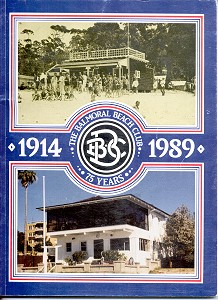
| 1989 Franki, George : The Balmoral Beach Club - 75 Years, 1914-1989. The Balmoral Beach Club The Esplanade, Balmoral NSW, 1989. Review |
 |
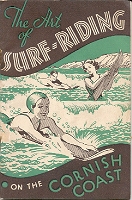
| 1953 Funnell, Ronald S. The Art of Surf-Riding on the Cornish Coast A. Wheaton and Co. Ltd Soft cover, 36 pages, 9 black and white photographs. Review Instructional pamplet-like publication that extolls the virtues and dangers of surf-riding - in this case prone riding on narrow solid wood boards as illustrated by the cover. See Paipo Catalogue. Includes several advertisments for Newquay businesses and for "The New SOLARBO BALSA BOARDS" - see Source Documents Menu. The author also wrote The Art of Surf-riding, 1934 - no other details available. |
 |
| a |
|
|
|
|
|
|
|
|
|
|
|
|
|
|
|
|
|
|
|
|
|
|
|
|
|
| home | catalogue | history | references | appendix |