 |
surfresearch.com.au
rev. john wood : tahiti, hawai'i, 1883 |
| home | catalogue | history | references | appendix |
|
Internet Archive
http://archive.org/details/uncivilizedrace00woodgoog
First edition:
Wood, John George:
The Uncivilized
Races of Men in all Countries of the World
: G. Routledge
and Sons, London. 1868.
| Illustration | Publication | Biography | Extracts | 1870 Edition |
The
Illustration
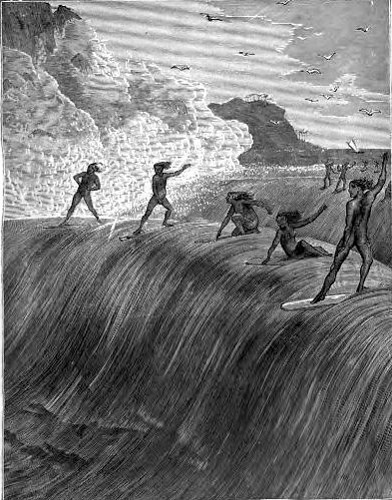
The illustration
Surf
Swimming by Sandwich Island Natives is probably one of the best
and most accurate from the pre-photographic era.
A highly detailed
image, it denotes various riding positions, stance, duck-diving, waves
in sets, off-shore winds and significant wave height.
The artist is unknown,
however the 1870 edition notes on the title page:
"With over 700 fine
illustrations from new designs, by Zwecker, Anoas, Danby, Wolf, Handley,
etc. etc"
The engravings are accredited to The Brothers Dalziel.
"The Brothers Dalziel
were a highly productive firm of Victorian engravers founded in 1839 and
until the advent of photo-mechanical processes, circa 1880, they were pre-eminent
in their trade.
Examples of their
work can be seen in the Victoria and Albert Museum in London."
- The Brothers
Daziel
http://en.wikipedia.org/wiki/Brothers_Dalziel
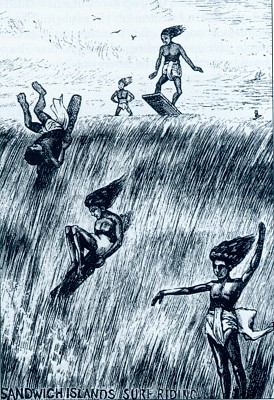
In 1883, a similar, but rather crude, illustration titled Sandwich Islanders Surf Riding, appeared in The Boy's Own Paper, published by the Religious Tract Society, London, and know to have included articles by Rev. John Wood.
- wikipedia.org:
Boy's Own Paper (accessed 10 February 2013)
http://en.wikipedia.org/wiki/Boy's_Own_Paper
- stellabooks.com
(accessed 10 February 2013)
http://www.stellabooks.com/articles/featuredbooks/boys_own.php
For the illustration, see below.
The style and composition of the illustration bares a remarkable similarity to the work of Wallis Mackay, published in by Summer Cruising in the South Seas by Charles Warren Stoddard, published in 1874.
Publication
The first edition, titled Natural
history of Man, was published in two volumes by
G.
Routledge and Sons, London in 1868.
"Profusely illustrated with engravings by the brothers Dalziel," the
illustration Surf Swimming appears in Volume II along with
the Hawai'ian surf riding text on pages 168-169.
- DeLaVega: Surf Literature (2004) page17.
The book was printed
in multiple editions for the next fifteen years.
it was printed in
America and England by various publishers, with some modification of the
title and variations in the formating and pagination.
The 1870 editon
has the Hawai'ian text and the illustration on pages 437-439.
The Hawai'ian text
appears on page 1092 of the 1883
edition, with the illustration following on page 1093.
As the 187onilne
edition has been transcribed from microfilm, the online version of the
1883 edition is far more legible.
See: 1883
Edition
Known Editions
G. Routledge and
Sons, London, 1868.
George Routledge, London, 1870.
American Publishing Co., Hartford, Conneticut, 1870.
J. B. Burr and Company,
Hartford, 1870.
J. B. Burr, Hartford,
Conneticut,
1871.
J.B. Burr and Hyde
Publishers, Hartford, Conneticut (1870),
1872.
J. Brainard &
Company, New York, 1873.
J.B. Burr Publishing Co., Hartford, Conneticut., 1875
J. B. Burr Publishing
Co., 1876.
J. B. Burr Publishing Co, 1877.
J. B. Burr and Company,
Hartford, Conneticut,1878.
J.A. Brainerd &
Co., Cincinnati, Ohio, 1878.
J. A. Brainerd,,
San Francisco:, 1882
J.A. Brainerd &
Company, San Francisco, 1883.
John
George Wood
(1827-1889).
"English writer
and lecturer on natural history, was born in London on the 21st of July
1827.
He was educated
at Ashbourne grammar school and at Merton College, Oxford; and after he
had taken his degree in 1848 he worked for two years in the anatomical
museum at Christ Church under Sir Henry Acland.
In 1852 he was ordained
a deacon of the Church of England, became curate of the parish of St Thomas
the Martyr, Oxford, and also took up the post of chaplain to the Boatmen's
Floating Chapel at Oxford.
He was ordained
priest in 1854, and in that year gave up his curacy to devote himself for
a time to literary work.
In 1858 he accepted
a readership at Christ Church, Newgate Street, and he was assistant-chaplain
to St Bartholomew's Hospital, London, from 1856 until 1862.
Between 1868 and
1876 he held the office of precentor to the Canterbury Diocesan Choral
Union.
After 1876 he devoted
himself to the production of books and to delivering in all parts of the
country lectures on zoology, which he illustrated by drawing on a black-board
or on large sheets of white-paper with colored crayons.
These "sketch lectures,"
as he called them, were very popular, and made his name widely known both
in Great Britain and in the United States.
In 1883-1884 he
delivered the Lowell lectures at Boston."
- "MRS HENRY WOOD."
LoveToKnow 1911 Online Encyclopedia. © 2003, 2004 LoveToKnow.
http://75.1911encyclopedia.org/W/WO/WOOD_MRS_HENRY.htm
"As well as being
editor of 'The Boys Own Magazine', Wood's numerous publications include
'Bees', 'The boy's own book of natural history', 'Animal traits and characteristics',
'The natural history of man', 'Half hours with a naturalist', 'Common British
beetles', 'Illustrated natural history for young people', 'Natural history',
his most important work.
He was most renowned
for the series of books which began with 'Common Objects of the Seashore',
many of which are held in the Whipple Library.
This article incorporates public domain text from: Cousin, John William (1910). A Short Biographical Dictionary of English Literature. London, J.M. Dent & sons; New York, E.P. Dutton."
- http://www.hps.cam.ac.uk/library/wood.html
Page 1062
The amusements
of the Tahitans are much like those of other Polynesians, and therefore
need but little description.
...
One of the most
manly and graceful of these amusements closely resembles the surf swimming
of the Sandwich Islanders, and is thus described by Captain Cook:
" Neither were
they strangers to the soothing effects produced by particular sorts of
motion, which in some cases seem to allay any perturbation of mind with
as much success as music.
Of this I met
with a remarkable instance.
For on walking
one day about Matavai Point, where our tents were erected, I saw a man
paddling in a small canoe so swiflly, and looking about
with such eagerness
on each side, as to command all my attention.
" At first I imagined
that he had stolen something from one of the ships, and was pursued, but
on waiting patiently saw him repeat his amusement.
He went out from
the shore till he was near the place where the swell begins to take its
rise; and watching its first motion very attentively, paddled
before it with
great quickness till he found that it overtook him, and had acquired sufficient
force to carry his canoe before it without passing underneath.
He then sat motionless,
and was carried along at the same swifl rate as the wave, till it landed
him upon the beach, when he started out, emptied his canoe, and went in
search of another swell.
"I could not help concluding that this man felt the most supreme pleasure while he was driven on so fast and so smoothly by the sea, especially as, though the tents and ships were so near, he did not seem in the least to envy, or even to take any notice of the crowds of his countrymen collected to view them as objects which were rare and curious."
" During my stay,
two or three of the natives came up, who seemed to share his felicity,
and always called out when there was an appearance of a favorable swell
as he sometimes missed it by his back being turned and looking about for
it
By this I understood
that this exercise, which is called ...
Page 1063
... ehorooe
was frequent amongst them, and they have probably more amusements of this
sort, which afforded them at k»ast as much pleasure as skating,
which is the only one of ours with whose effects I could compare it."'
[CHAPTER CX : THE SANDWICH ISLANDS, Continued : WAR - SPORT - RELIGION.]
Page 1092
... which the
Sandwich Islanders amuse themselves.
Chief among them
is the sport of surf-swimming.
This is practised
in several of the islands of Polynesia, but in none is it carried out to
such perfection as in the Sandwich group.
The following
spirited account of this sport is given in Captain Cook's Voyages:
" Swimming is
not only a necessary art, in which both the men and women are more expert
than any people we had hitherto seen, but a favorite diversion amongst
them.
One particular
mode in which they sometimes amused themselves with this exercise in Karakakooa
Bay, appeared to us most perilous and extraordinary, and well deserving
a distinct relation.
''The surf, which
breaks on the coast round the bay, extends to the distance of about one
hundred and fifty yards from the shore, within which space the surges of
the sea, accumulated from the shallowness of the water, are dashed against
the beach with prodigious violence.
Whenever from
stormy weather, or any extraordinary swell at sea, the impetuosity of the
surf is increased to its utmost height, they choose that time for this
amusement, which is performed in the following manner:”
" Twenty or thirty
of the natives, taking each a long narrow board, rounded at the ends, set
out together from the shore.
The first wave
they meet they plunge under, and, suflfering it to roll over them, rise
again beyond it, and make the best of their way by swimming out into the
sea.
The second wave
is encountered in the same manner with the first; the great difficulty
consisting in seizing the proper moment of diving under it, which, if missed,
the person is caught by the surf, and driven back again with great violence;
and all his dexterity is then required to prevent himself from being dashed
against the rocks.
As soon as they
have attained, by these repeated efforts, the smootn water beyond tne surf,
they lay themselves at length on their board, and
prepare for their
return.
As the surf consists
of a number of waves, of which every third is remarked to be always much
larger than the others, and to flow higher on the
shore, the rest
breaking in the intermediate space, their first object is to place themselves
on the summit of the largest surge, by which they are driven along with
amazing rapidity toward the shore.
"If by mistake they should place themselves on one of the smaller waves, which breaks up before they reach the land, or should not be able to keep their plank in a proper direction on the top of the swell, they are left exposed to the fury of the next, and, to avoid it, are obliged again to dive and regain the place from which they set out
"Those who succeed
in their object of reaching the shore have still the greatest danger to
encounter.
The coast being
guarded by a chain of rocks, with here and there a small opening between
them, they are obliged to steer their board through one of these, or, in
case of failure, to quit it before they reach the rocks, and, plunging
under the wave, make the best of their way back again. This is reckoned
verv disgraceful, and is also attended with the loss of the board, which
I have often seen, with great terror, dashed to pieces at the verv moment
the islander quitted it.
The boldness
and address with which we saw them perform these difficult and dangerous
manoeuvres was altogether astonishing, and is scarcely to be credited."
These swimmers
used often to pass nearly a mile seaward, in order to enjoy the rapid motion
of their return as long as possible.
Both sexes and
all ranks unite in it, and even the very chiefs themselves, who have attained
to the corpulency which they so much admire, join in the game of surf-swimming
with the meanest of their subjects.
Some of the performers
attain to a wonderful degree or skill, and, not content with lying on the
board, sit, kneel, and even stand on it as they are hurled shoreward by
the giant waves.
The boards are
of various sizes, according to the age and stature of the owner.
For adults they
are about six feet in length.
They are slightly
convex on both sides, and are kept very smooth all surf-swimmers cherishing
a pride in the condition of their boards, and taking care to keep them
well polished and continually rubbed with cocoa-nut oil.
The artist has
finely represented on the following page the marvellous conquest of the
sea by tnese islanders.
Such utter mastery
of the waves can only be obtained by familiarity with the water from earliest
childhood.
A Sandwich Island
child can swim as soon as it can walk, if not sooner, the mothers taking
them from the breast, laying them on the surface of the water and encouraging
them to kick about as if lying on their mats ashore.
One writer mentions
his encounter with an object which he took to be a very large frog, but
which turned out to be a Kanaka (Sandwich Island) baby, which was l^nff
on its back and disporting itself quite at its ease.
Indeed, in the
mind of a Sandwich Islander there seems to be no connection between the
ideas of water and danger, neither does it enter his imagination that any
human being is unable to swim.
Consequently,
there have been several instances where white men have fallen into the
water and have been almost drowned, though in
the presence
of the natives, simply because the idea that any one could be endangered
by falling into the water never occurred to them.
They are equally skilfull in managing ...
| Page 1093
SURF SWIMMING
BY SANDWICH ISLAND NATIVES.
|
 |
[Blank]
Page 1095
... their canoes,
and have a curious mode of extracting amusement out of them.
A number of men
will sometimes paddle a canoe after dressing themselves up m a most ludicrous
fashion.
They take large
empty gourds, and put them over their heads, atter cutting holes in them
corresponding with the eyes and nose, so that the effect is not at air
unlike that of a turnip lantern.
To the upper
part of the gourd is attached a bunch of slender green twigs, which look
at a little distance like a plume of feathers, and to the lower part are
suspended a number of narrow strips of cloth, looking like a long beard.
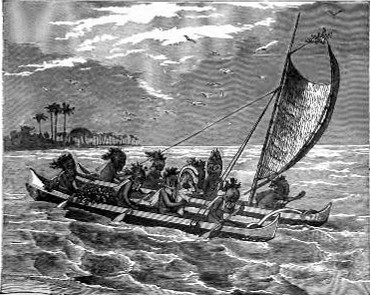
Their appearance
is shown in illustration No. 2, on the 1089th page.(below)
In every case
where these masks were worn, the wearers seemed exceedingly jovial, laughing,
shouting, and playing all kinds of antics.
It was suggested
that these masks were in fact helmets, used to protect the wearers against
the stones slung by their adversaries; but the whole demeanor of those
who wore them was so completely that of mere masqueraders that the helmet
theory seems quite untenable.
| Page 1089
2. MASKED ROWERS
|
 |
|
Sandwich Islands Surf Riding. Published in:
Probably reprinted
in:
Possibly reprinted
in:
Reproduced in
|
 |
 |
Wood, John George: The Uncivilized Races, or, Natural History of Man. Vol. II American Publishing Company, Hartford, Conneticut,1870. Right:
|
 |
| home | catalogue | history | references | appendix |