 |
surfresearch.com.au
history
: before duke
|
| home | catalogue | history | references | appendix |
|
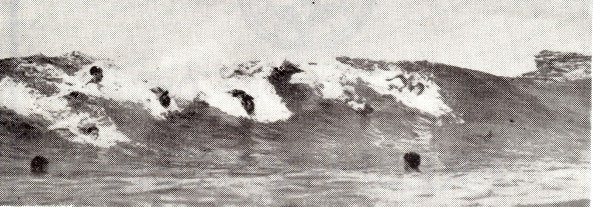
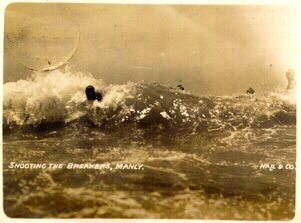 Shooting the Breakers, Manly. Hall & Co. Body surfing at Manly Beach circa 1905 Hall & Co. Postcard, Postmarked February 1908. |
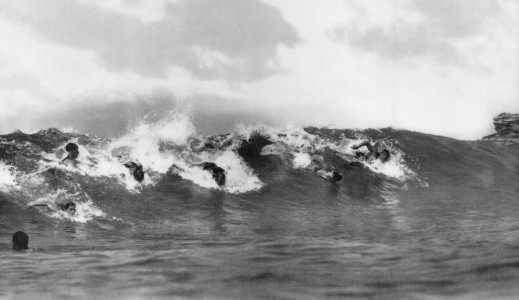
Shooting the Breakers, Bondi
1908.
Stevenson?? |
 |
Secondly, it
differentiatied beach-goers into performers and spectators.
As the number
of surf-bathers grew, so did the beach-side audience and at
Bondi and Manly they were provided for by deck-chair hire
franchises from about 1907.
- On
Bondi Beach, Daily Telegraph, 16 January 1906.
- Widespread
Indignation:
Do Alderman want to Kill Surf-Bathing?, Evening News,
14 October 1907.
- Manly
Council and Surf-Bathing, Daily Telegraph, 28
October 1907.
- all noted by
White, Cameron: 1. Picnicking and Promenading in the
late nineteenth century, page ?The performers
themsleves were also differentiated into two groups; the
common surf-bather and the elite surf-shooter.
Surf bathing
was essentially limited to wading and occassionally immersing
in the surf zone.
Generally the
surf-bather retained contact with the sea bottom, and failure
to do so could be fatal.
Experienced
surf-shooters considered the activity as either an essential
first step, juvenile, unskilled, unadventurous, or a potential
courting situation.
The complex
meterological dynamics evident in the surf-zone require a
significant level of dedicated experience for a successful
performance.
In this arena,
almost without exception, surf-bathers were "tourists"
and the surf-shooters, "locals".
In the first
years of the century, an important and influential sub-group
developed within the elite of experienced surf-shooters.
The
inexperienced surf-bather was the focus of the embryonic
life-saving movement,
Experienced
swimmers have saved the lives of the inexperienced since
before recorded history, possibly in a broader context as part
of the Law of the Sea.
With the large
numbers of bathers and the possibility of rapid and extreme
changes in surf conditions on Sydney's beaches, it was readily
recognised that when bathers were in difficulty it was
expedient to have a system in place to effectively complete a
rescue.
Early methods
featured the use of buoys, lines and boats.
From the
first, the formation of the Sydney surf lifesaving clubs was a
convoluted mix of virtue and self interest.
Above all, club
membership offered the potential for access to beach front
property.
Since it
regularly fell to the most experienced surfriders on the beach
to attempt a rescue, the formation of a club saw life saving
skills improved and responsibility expanded.
Social
cohesion.
Social congress
Financial or
political
Competitive.
Finally,
Vigilance and Service.
After the turn
of the century, Alick Wickham was credited with shaping the
first surfboard in Australia.
Hand carved
from a piece of driftwood found on Curl Curl beach, its
performance capabilities were limited, in fact it sank.
- Maxwell: Surf (1949) page 235.
This indicates that Wickham was probably either acquainted with hand or belly boards and/or had heard reports of full size (that is standing) boards from travellers to Hawaii.
In the 1890's residents Manly and Bondi formed the All Day Surfing Movement, resulting in some relaxation with bathing hours extended to 7.30 am at Manly.
- Thoms: Surfmovies (2000) page 14.
Before 1902,
bathing on open beaches was prohibited between 7.30 am and 6
pm but strong representation from a growing group of
enthusiasts at Bondi, Randwick Council passed by-laws to allow
daylight bathing in November 1902.
Other beach
side suburbs, e.g. Manly, passed similar bylaws.
- Curby: History of Manly (2001) pages
Note that many
accounts credit the lifting of bathing restrictions to William
Gocher, editor of the Manly and North Sydney News.
For example C.
Bede Maxwell reports that Gocher took up the cause and in
November 1903, and after an often facial campaign - he was
finally arrested for illegal bathing on his fourth much
publicized attempt, he was successful in removing
bathing hour restrictions by Manly Council.
- Maxwell: Surf (1949) pages 5 and 6.
Current research by Pauline Curby indicates that the Goucher role may be less than previously thought.The upsurge in
popularity of surf bathing resulted in many tragedies (16 at
Manly in 10 years), and authorities and regular surfers were
aware that the general public would need to be either
regulated or monitored.
This would be
the impetus for the formation of the Surf Life Saving
movement.
The increase
in surf bathing numbers also saw some enthusiasts retreat from
popular beaches, for example Manly locals would 'escape' to
Freshwater, originally pioneered by Freddie Williams.
When the
"suburbanites
found
'Freshie' too .. We used to abuse the living daylights out
of those we brought in (rescued). Put
them off coming back to 'Freshie' pretty often. Suited us!"
- Fred
Notting quoted in Maxwell: Surf(1949)
page 20.
An early
example of surf
rage, circa 1903.
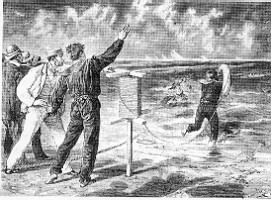
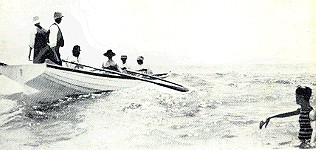
The first surf life-saving demonstration was given by the Sly Brothers (George, Charlie, Tod, Eddie, Joe and relative Neil Norgreen) ) at Manly Beach on 26th December 1903.
- Galton: Gladiators of the Surf (1984) page 13.
The
demonstration featured 'rescues' using their fishing boat and
Freddie Williams and other local swimmers as the
‘victims’.
The boat was
originally a clinker built doubled whaler, converted to a tuck
stern for laying nets, and based at Fairy Bower (Shelly
Beach).
Onlookers 'witnessed.
..
skilful exhibitions of shooting the breakers in their
surfboat'.
- a
contemporary press report quoted in Maxwell: Surf (1949) page
21.
 |
 |
|
Lecek & Bosker: The Beach (1999) page 122. (Bettman Archives) |
Harris: Manly LSC (1961) page 7 |
-
Metherell, Terry: Ashburner Street, Manly: 1877 to 1932/33.
(Revised,
October 2006.)
http://www.manly.nsw.gov.au/downloaddocument.aspx?DocumentID=1725.
The Sly
family had a long association with Manly, with family
members living at various times at Little Manly, in
Addison Road, at Fairy Bower and elsewhere.
The Slys
provided the first life-boat service to Manly’s South
Steyne beach and could lay claim to being Manly’s first,
unofficial ‘life-savers’.
In 1900, Slys lived in Addison Road, near Smedley’s Point (Charles); Darley Road (Charles); Vivian Street (Charles junior and George); Stuart Street (John); and Whistler Street (William).
-
Metherell, Terry: Darley Road, Manly: 1877 to 2000, page
6.
(February
2004.)
http://www.manly.nsw.gov.au/downloaddocument.aspx?DocumentID=246.
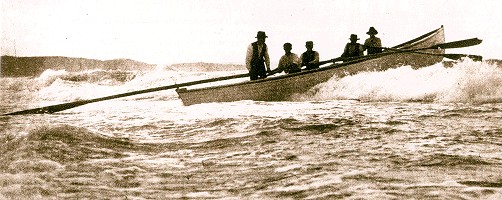 |
circa 1905-1910. Sporting
Life |
- Galton: Gladiators of the Surf(1984) page 13.
At Bronte, local surfers moved the fixed pole to the most populous section of the beach, only to be condemned for vandalism by the press.
- Maxwell: Surf (1949) page 24.
Walter V. H. Biddell an enthusiastic supporter and organizer of surf life saving founded the Bronte Life Saving Brigade in 1903.
- Galton: Gladiators of the Surf(1984) page 12.
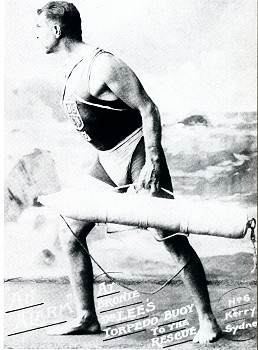
He also was
responsible for the invention of the Torpedo Buoy in 1902, the
Surf King 1906 and a surf boat, the Albatross,
circa 1907.
The Torpedo
Buoy was a kapok filled tube attached to a line, the rescuer
swimming the appliance to the victim. For a time this method
was used as well as the cork filled belt.
 |
Walter
V. H Biddell's Torpedo Buoy circa 1902 - 6 Postcard format, the text reads... "AT
ALARM" Longhurst: Lifesaver(2000) page 9. Note
: |
|
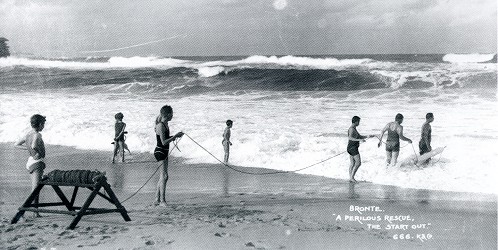
Bronte Beach circa 1906 "A Perilous Rescue, The Start Out." 666. K & Co. Longhurst:
Lifesaver(2000)
|
 |
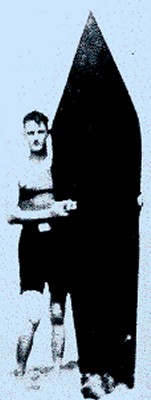
| Jordan, James and Frederick: Virginia Beach Pictorial History Published by Hale Publishing (1975) Page 9 notes "this pictorial history is not intended to be used as a reference book" This is a 1918 photograph of James M. Jordan, Jr. (grandfather of the authors), who has the distinction of being recognized as the first man to ride a surfboard on the east coast. The surfboard, which was a gift from his uncle Walter F. Irvin in 1912, was made in Hawaii, of redwood, stood about nine feet tall, and weighed 110 pounds. It could only be used on larger waves produced by hurricanes or northeasters, and the townspeople as well as the guests of the hotels considered Big Jim's surfing ability an exciting feat of skill. Photo Courtesy of J.M. Jordan, Jr.
-page 109as mentioned ealrier in the book (page 109), surfboard riding was introduced to the east coast at Virginia Beach around 1918. -page 189. |
 |
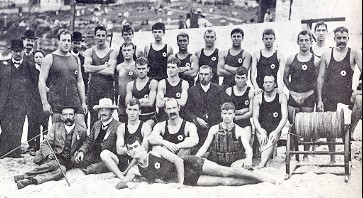 |
Illustrates the newly modified reel and cork filled vest. Compare this with the much cruder model in use with the Torpedo Buoy at Bronte, illustrated above. Margan &Finney: Pictorial History(1970) page 50. |
Town and
Country Journal July 15 1908: 'For Life Saving
: Combined Method of Resuscitation',
Images
and text related to the Bronte Junior Life Saving Brigade,
using new developed methods of resuscitation and the new
torpedo buoys
Includes one
image of Biddell's surfboat, Albatross .
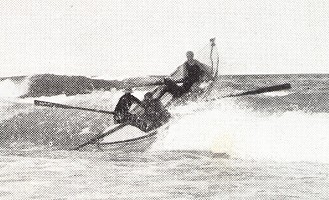
TORPEDO SURF BOAT
|
A four man surfboat with fore and aft buoyancy tanks. Left: Maxwell: Surf (1949) page 81. Below,
a different shot with a line running out
|
 |

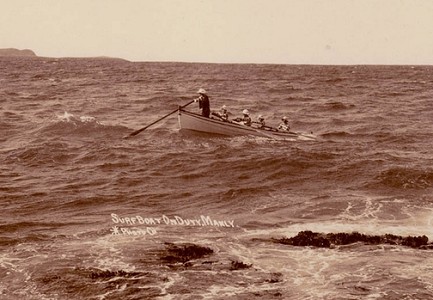
| Surf boat on duty, Manly,
circa 1910. State Library of NSW http://www.acmssearch.sl.nsw.gov.au/search/itemDetailPaged.cgi?itemID=413983 |
 |
- Galton: Gladiators of the Surf (1984) page 13.
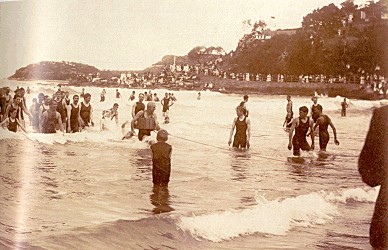 |
a professional lifesaver employed by Manly Life Saving Society, gave lifesaving displays at Manly beach (c1907) (State Library of NSW)" Cardigan: Icon (2008) page 29. |
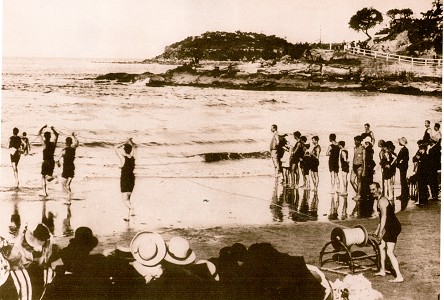 |
Sporting
Life |
The various
Sydney clubs meet on 18th October 1907 to form The Surf
Bathing Association of New South Wales.
Representatives
from nine surf clubs/brigades were present (Manly,
Bondi, Coogee, Bronte, Bondi Surf and Social Club, Tamarama,
Maroubra, Woollahra, United Wanderers), and
representatives from the Royal Life Saving Society and the
N.S.W.. Amateur Swimming Association.
- Galton: Gladiators of the Surf (1984) page 13.
The first Surf
Carnival was held on January 25th 1908 at Manly Beach.
Six clubs
competed and the first surfboat race, with various craft, was
won by Little Coogee (now Clovelly) in their whale boat.
These Carnivals
quickly become a popular method of revenue for the Live Saving
Clubs, the moneys from gate receipts used to purchase gear and
improve facilities.
- Maxwell: Surf (1949) pages 90 and 202-204.
Tamarama Carnival attracted fifteen thousand spectators in February 1908.
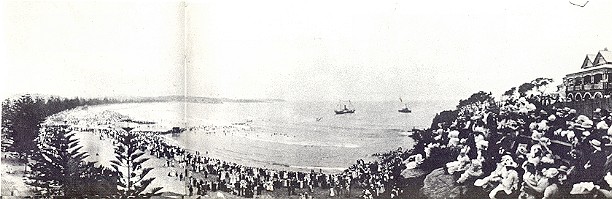
"... on
the 11th February, 1908, a public meeting was held in the
Centennial Hall Helensburgh, with Mr. P. Spiller occupying
the chair.
The
object of the meeting was to form a surf bathers and life
saving club.
Correspondence
at
the meeting was received from the Secretary of the Bondi
Surf Club on this matter, and on the motion of Mr. Thomas
Horan, seconded by Mr. David Jones, and supported by Mr.
A. G. Gilchrist, that a surf bathers and life saving club
be formed, the meeting approved and thus was the
commencement of this club, to operate at the Stanwell Park
beach."
- Thorn:
Stanwell Park
SLSC(1983) page 8.
"Within
ten
days of the inaugural meeting, two delegates, the club
captain, Mr. J. Stewart, and the Secretary, Mr. H. Ogden,
were elected to represent the newly formed club at the N.S.
W. Surf Bathers Association, at which rules were framed for
the regulation of the Association.
On the 20th
February, 1908, ladies were admitted as members of the club
at a subscription of two shillings and sixpence per annum.
This
membership did not, however, permit the ladies to take
active part in surf life saving.
...
In April of
1908, the club gave a display at the Stanwell Park beach
before a large crowd. This was followed on the 2nd May of
that year by a display at the loc21 beach by twelve members
of the Bondi Surf Bathers and Life Saving Club, witnessed by
some three hundred spectators.
The train
and coach fares of the Bondi members were paid by the
Helensburgh-Stanwell Park Club. Refreshments were provided
at the beach, and later that evening, the Bondi personnel
were entertained at a dinner and concert at Helensburgh.
...
Royal Life
Saving Certificates were obtained by members at examinations
held at Bondi Beach on the 17rh May, 1908, and these
certificates were presented at a public meeting held at
Helesnburgh
...
At this
stage the newly formed club had no accommodation at Stanwell
Park and on 7th October, 1908, the club Patron Mr. H. F.
Halloran, who had built a kiosk on the beach, allowed the
club use of one room at no cost.
This
building was of wooden construction and was situated on the
western edge of the beach about one hundred yards north of
the present club building. ft had a flat roof, which
provided a type of shark and watch tower."
- Thorn:
Stanwell Park
SLSC (1983) page 9.
Alexander
Hume Ford visited Manly in 907-1908 and reported:
"I wanted
to try riding the waves on a surf-board, but it is
forbidden"
- 'Australia
Through American eyes', The Red Funnel,
Dunedin, June 1 1908, page 468.
Quoted in -
Thoms: Surfmovies
(2000) page 22.
For selections
from Ford's article, see Source Documents:
1908
Alexander Hume Ford : Beach
Culture in Sydney, Australia.
Alexander Hume
Ford was an enthusiastic promoter of Hawaii and surfriding and
is best known as the instigator of the Outrigger Canoe Club at
Waikiki in 1908.
He wrote more
than half a dozen articles on surfriding between 1908 and
1926, mostly published in Hawaiian, but some mainland US,
magazines.
Ford was a
principal character, along with George Freeth, in Jack
London's celebrated account of surfriding at Waikiki in 1907.
His onshore
activites are further detailed in Chairmain London's Our
Hawaii (1917).
For extracts,
see Charmian London: Surfriding at
Waikiki 1907-1917.
Ford's
significant contribution was initiating the acquisition of
coastal property, giving the Outrigger club a tangible
identity.
The premises
provided a centre for administrative and social activities in
addition to beach front storage for surfboards and/or accesss
to an extensive range of surf craft, probably the most
important function for active members.
Ford was
possibly influenced by Sydney's fledging surf lifesaving clubs
on his visit there in 1907-1908.
To consolidate
their public status, the clubs were actively petitioning their
local councils for the provision of beach front property,
ostensibly in recognition of their voluntary community
service.
During 1907,
the precedent (one of many) was set by the Bondi Surf Bathers'
Lifesaving Club when it was granted permission to construct
premises in the beachfront park by Waverley Council.
The council
also contributed substantial funds, and the first Bondi
clubhouse was operational by October.
At Waikiki,
Ford would substitute voluntary community service with the
conservation of a traditional art, integrated with its
promotion as a tourist attraction, as the Outriggers' raison
d'etre.
Circa 1908
'Fred Notting painted a brace of slabs and named them
Honolulu Queen and Fiji Flyer; gay they were to look at but
they were not surfboards.'
- Maxwell: Surf (1949) page
235.
Newcastle surf lifesaving historian, Chris Conrick writes:
Reports
of surfers using planks of wood on which to ride waves
were not unknown at this time, as evidenced in the
following newspaper report in 1908.:-
"Board
Riding Noted on Town Beach -
Riders
were observed using 10 feet lumps of wood to ride the
waves and in this there appeared an element of danger."
[3] Coffs
Harbour Advocate 22-1-1908.
- Conrick: Northern
Lifesaver (1989) page 95.
Initially noted
by Dave Kelly contributing to realsurf.com.au forum, January
2008.
Without
further information, the Coffs Harbour report is unusual in
not identifying the riders, as may be expected if they were
local residents.
If they were
short-term visitors to the area and were accompanied by their
surfboards, then they almost certainly arrived and departed in
a coastal steamer.
They may be
have been Australian boardriders (possibly with a life saving
club connection) whose steamer had briefly berthed at Coffs on
the way up or down the coast.
Far less
likely, but possible, they were international seamen
travelling with their surfboards, the obvious candidates, no
doubt, of Hawaiian descent.
Unfotunately a
search of newspapers held by the State Library of NSW
indicates the Coffs Harbour Advocate was only
published once a week and there is no actual edition for 22
January 1908.
| In
one of a series of articles in The Referee preceding
the 1939 Pacific Games in Honolulu, Harry Hay wrote:
"What great strides this sport has made in Australia! A few years ago it was hardly known in this country. The Hawaiians introduced us to this exhilarating, thrilling pastime, and to these romantic tropical islanders is due our warmest thanks." - The Referee, 9 February 1939, page 15. In
response, Manly surfer, Tommy Walker wrote a letter
to Hay that was published under the heading
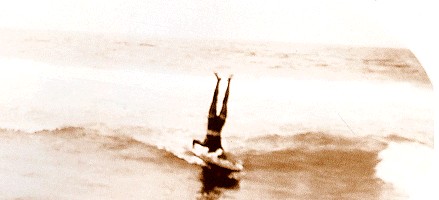
In a letter to Harry M. Hay, Australia's foremost swimmimg and surf coach.- Tommy Walker, one-time surfboard champion at Manly (N.S.W.), writes: "I
saw an article by you in 'The Referee' re
surfboards, so enclose a photo of myself and
surfboard taken in 1909 at Manly (Image
right). |
 |
| Note
that the claim to be the first surfboard in Australia
can only be attributed to the paper's sub-editor, and
not Tommy Walker. This may, or may not, be the Hawaiian surfboard often claimed to be imported by Manly identity, C. D. Paterson, sometime between 1908 to 1912, see below. Walker's
clain to winning a surfboard shooting contest no
doubt refers to the boardriding performance of a Mr.
Walker at the second Freshwater Life Saving
Carnival as reported by The Daily
Telegraph, 27 January 1912, page
21. Image
right: |
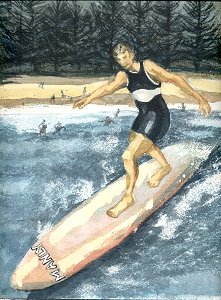 |
|
Tommy Walker, Yamba Beach circa 1911. Photograph by O.B. Notley. Image courtesy of Ray Moran, Manly Life Saving Club Australian Surfing Museum. |
 |
|
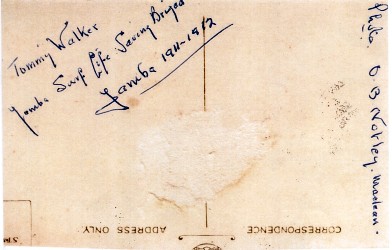
Annotation in handwriting reads: Tommy Walker Yamba Surf Life Saving Brigade Yamba 1911-1912 Photo O.B. Notley. Maclean. Notely was a life member and the club Treasurer in 1916. (Annual report, 12th October 1916) Image
courtesy of Ray Moran,
|
 |
|
Yamba Beach circa 1912. Image courtesy of Ray Moran, Manly Life Saving Club Australian Surfing Museum. |
 |
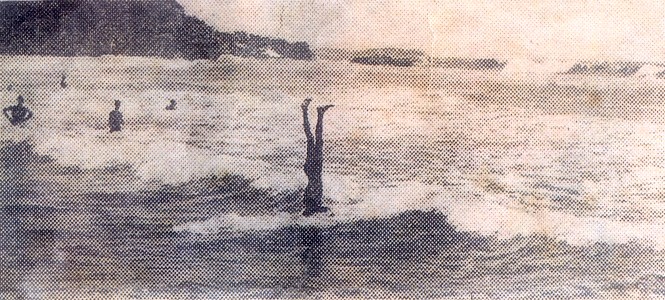
Newspaper clipping courtesy of Ray Moran, Manly Life Saving Club Australian Surfing Museum.
Note: The
photograph was printed Harvey: History Queensland
Surfing (1983) page 8, captioned:
"Clarrie
Englet headstand , Queensland 1920's"
Australian
National Maritime Museum
GPO Box 5131
Sydney
NSW 2001 Australia
Phone: +61 2
9298 3731
Facsimile:
+61
2 9298 3730
gsimpson@anmm.gov.au
The Sydney
Morning Herald
Tuesday 14 June
1910, page 8.
A ROUGH
PASSAGE.
The four
masted barque Poltalloch, 2139 tons, which arrived at Sydney
yesterday from Portland (Oregon), experienced a rough time
from June 1, when about 100 miles off Sydney Heads, a
strong soultherly gale, with very high seas was encountered,
and for 14 days the vessel was under lower topsails
The
Poltalloch has a cargo of over 2,000,000 ft of timber, and
the gale caused some of this to be damaged though none was
lost overboard.
Slight
damage to the deck fittings was also caused bv the gale.
The barque
anchored in Watson's Bay at 6 o'clock last night.
Title
The
'Poltalloch' anchored in an unidentified harbour
Description
The
four masted steel barque 'Potalloch',2254 tons, anchored in an
unidentified harbour.
Description
One
of the ships owned by the Potter Brothers, London.
Description
This
image is from the A.D. Edwardes Collection of about 8,000
photographs, mostly of sailing ships from around the world,
taken between about 1865 and 1920. Mounted in 91 albums, the
photographs are arranged by country of ownership, with some
special volumes such as 'Shipping at Port Adelaide' and 'South
Australian outports'. Additional information, giving the
history of the ships where known, has been provided by
maritime historian, Ron Parsons.
Subject
Poltalloch
(Ship)
Subject
Ships,
Iron and steel
Image number
PRG
1373/5/88
Format
Photograph;,
15.9 cm x 20.8 cm
Managed by
Item
held by the State Library of South Australia
Collection or
series
Is
part of the A.D. Edwardes Collection
Date or place
1900
Rights
Reproduction
rights: State Library of South Australia
New Zealand
Maritime Index Vessel ID: 588881923
A four-masted steel barque built in 1893 by Workman, Clark & Co., Belfast. Dimensions: 86,66×12,80×7,41 meters [284'4"×42'0"×24'4"] and 2254 GRT and 2139 NRT. Rigged with royal sails above double top and topgallant sails.
1893 February
Launched
at the shipyard of Workman, Clark & Co., Belfast, for
Potter Bros., London. Captain J. Connel.
1901
Stranded
at the entrance to Willada, Shoalwater Harbor, WA.
1909
Sold
to Eschen & Minor, Victoria, BC.
1916 January 2
Wrecked
at St Patrick's Causeway, near Harlech, Wales, during towage
from Queenstown to Leith.
http://www.bruzelius.info/Nautica/Ships/Fourmast_ships/Catalogue.html
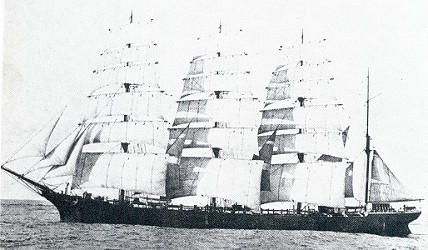
| Image
right: The Poltalloch off the Columbia River, circa 1913.
|
 |
- Gibbs,
Jim Pacific Square-Riggers, Pictorial
History of the Great Windships of Yesteryear
Superior
Publishing Co., Seattle, WA, 1969.
Bonanza
Books, New York,1977.
Schiffer
Publishing, 1987, page 36.
During the 1920's Russell Henry 'Busty' Walker used a canoe to act as a judge at the buoys at Manly Surf Carnivals, one of the precedents to the adoption of the Harry Mclaren's surfski by Sydney surfers in the early 1930s.
-Maxwell: Surf (1949) page 237.
At the end of
the1930s the surf ski made its first excursion outside
Australian waters.
Reciprocating
the gift of the board left with them by Duke Kahanamoku in
1915:
“The
Walker
Brothers sent a surf ski to Duke Kahanamoku at Honolulu
and members of the Australian Pacific Games Team which
visited Honolulu in 1939 say Duke was often seen paddling
around on his ‘ski from Australia’.”
Curlewis,
Adrian: Notes on surfboard riding prepared by S.L.S.A.,
circa 1948 pages 3-4.
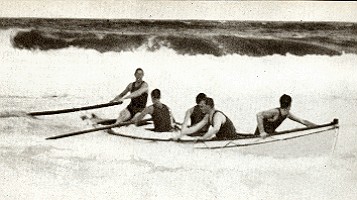
In 1908, a
purpose built surf boat was provided by Manly Council for
Manly Surf Club.
Based on the
previously used whaler design, double ended clinker built with
oars Nos. 2 and 3 rowing side-by-side on the centre thwart.
The designer is
unknown.
- Harris: Manly
LSC (1961) page 44.
|
Crew : Stan Jones (sweep), Bill Kellman, Alf Bye, Alan Wright and Alec W. Watson. This
photograph Newcastle exhibition, March 5, 1910.
|
 |
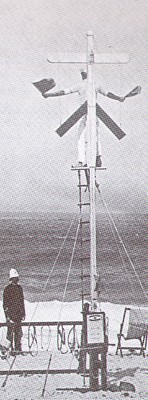
| Amoungst
the many experimental life saving techniques and craft
explored by the Bronte Surf Life Saving Club, circa 1908
an elaborate system of signal flags was trialed.
Beach scene below, signal man in detail, left. Longhurst: Lifesaver(2000) page 54 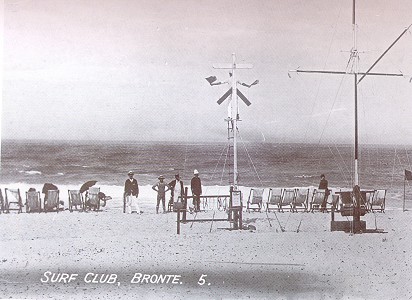 |
 |
|
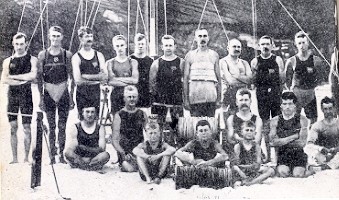
Maxwell: Surf (1949) page 17. Centre is the current 1909 reel, At the front a pre -1906 hand held model. |
 |
West's
Pictures (a production and exhibition company) release the
first newsreel of a surf demonstration, Surf Sports at
Manly in 1909.
Pathe
Animated Gazette featured a
demonstration in Parramatta River, Sydney, by Coogee Surf Life
Saving Club members, circa 1910.
- Thoms: Surfmovies(2000) page 14.
It is impossible to over estimate the impact of such media exposure in this era; the footage would have been shown extensively around the country and possibly screened several times at each venue.
In Western
Australia a club was formed at Cottesloe Beach, circa
1909.
On the East
coast, established clubs travelled for demonstrations to
metropolitan beaches and as far as Tweed Heads (East Coast
Bondi Club).
- Galton: Gladiators of the Surf(1984) page 13.
Alby Thoms
reports that C.D. Paterson of Manly brought the first known
solid wood Hawaiian Alaia to Australia in 1909 on returning
from a world tour.
First
unsuccessfully tested at North Steyne, the board was
eventually retired to the family home at the Spit to be
used as a ironing board.
- Thoms: Surfmovies (2000) page 20.
Chris Conrick implies the board was obtained by Paterson as a gift:
According to Surf Life Saving Assoc. records, the first Hawaiian surfboard to find its way to Australia was by way of a gift to Mr C.D. Paterson, the president of the association in 1909.
-Conrick: Northern
Lifesaver (1989) page 95.
Initially noted
by Dave Kelly contributing to realsurf.com.au forum, January
2008.
Despite considerable efforts by Ray Moran and Ray Peterson at the Australian Surf Museum and Manly L.S.C., the reported Life Saving Association records detailing the arrival of Paterson's board are yet to be located.
Note that
several other commentators date this board as 1912, see below.
This board is
said to be currently held by the Australian
Surf Museum, Manly.
- Clifford Heath, (grand-son), email 6th January 2014.
Clifford notes "I do not have photographic proof."
"At a
Special General Meeting on the 17th November, 1911 it was
decided to purchase a surf life boat, the cost of which
was to be limited to fifty pounds.
Also a
shelter shed for the boat to be constructed, and a set of
parallel bars. A lookout was to be acquired, to cost no
more than two pounds."
- Thorn:
Stanwell Park
SLSC (1983) page 13.
"The
secretary
of the Freshwater Surf Club wrote to Warringah Shire
Council, pointing out that the police officer stationed at
Freshwater, acting under the authority of the council, had
prohibited the use of surf boards.
The
committee of the Club thought if the use of boards were
stopped, it would deprive many of young members and
visitors of the full enjoyment of the exhilarating surf.
The
writer admitted that the practicee of using boards by
"shooters" in the surf was doubtless attended with danger
if used among ordinary surfers, but if restricted to one
part or corner of the beach there would be practically no
danger.
The
writer concluded by asking for authority to regulate the
use of surf boards on Freshwater Beach.
President
Quirk and a number of the councillors said the use of
boards by surf bathers was a danger to other bathers, and
should be discontinued.
It was
unanimously agreed not to permit the use of the boards at
Freshwater.
92.
Warringah Shire Council Minutes 19 September 1910,
Evening News September 1910."
- S&G Champion: Drowning, Bathing and Life Saving (2000) page 131.
"Shortly
afterwards Warringah Shire Council received a complaint
concerning the use of surfboards at Freshwater.
The
matter was referred to the police, with a request that
action be taken, as the use of boards in the breakers was
considered dangerous, and should be prohibited.
93. Daily
Telegraph 3 November 1910."
- S&G Champion: Drowning, Bathing and Life Saving (2000) page 131.
"Preparations
had
been made for the 1910-11 surfing season on Sydney's
northern beaches.
...
A warning
was given to bathers against the use of surfboards at
Freshwater.
108.
Daily Telegraph 3 November 1910."
- S&G Champion: Drowning, Bathing and Life Saving (2000) page 133.
"The
fourth carnival of the Manly Surf Club was held on
Saturday afternoon, 1 April 1911.
...
Mr. Fred
Notting gave a clever exhibition of surf-shooting in 'The
Big Risk' canoe.
154.
Daily Telegraph 3 April 1911, Manly Surf Carnival
programme 1911."
- S&G Champion: Drowning, Bathing and Life Saving (2000) page 144.
"The
North Steyne Club forwared for confirmation to the Surf
Bathing Association a programme for the club's annual
carnival.
Fifteen
life saving clubs would be represented, and an exhibition
of surf-shooting given by Mr. L. Bouffett, of Norfolk
Island.
48.
Sydney Morning Herald 1 December 1911."
- S&G Champion: Drowning, Bathing and Life Saving (2000) page 159.
Mr L. Bouffett
was probably a decendant of John Buffett who arrived
on Pitcairn Island in December, 1823 on the British
whaler, Cyrus.
The Pitcairn
islanders, largely decenced from Bounty mutineers and
Tahitian women, were renowned surfriders.
See Ramsay: Pitcairn Island (1821).
In 1911,
Percy Hunter, Director N.S.W. Govenment Tourist Bureau
(Challis House, Sydney),
1911
Although the
article is essentially a tourist promotion for Australian ski
resorts, in comparing the sport with surfboard riding, Hunter
provides significant information on Australian surfing.
Notably "we
now
have a board or two at Manly beach" (page 12).
It is highly
probable that these boards were those ridden by Tommy Walker
and his relatives at Manly, circa 1909.
The current
Director N.S.W. Govenment Tourist Bureau and an enthusiastic
skier, he indicates a knowledge surfboard riding acquired when
visiting Hawaiia as a tourist sometime before 1911.
Clearly he was
not the only Australian visitor to be exposed to the thrills
of Hawaiian surfboard riding.
Riding is in the standing position for both sports:
"as the surfrider balances on a single board or runner, while coming down the side of Kosciusko we balance on a pair of runners or skis"(page 11).
In a comparision with snow skis, the article implies the surfboard dimensions are substantial:
" 7 feet 6 inches to 9 feet in length" and "five times ... 3 1/2 to 4 1/2 inches wide" (approximately 20 inches, page 11)
The report is one of the few independent sources not directly from the surf life saving movement.
- Hunter,
Percy: July
Skiing in Australia
Mid Pacific
Magazine, January 1911, pages 11-15.
This article
kindly provided by Craig Baird (Surfworld, Torquay) in August
2009, who noted it "came to me via Dr. Garry Osmond
(University of Queensland) after I had forwarded a Surfers
Journal Article about Alexander Hume Ford (that) mentioned
Percy Hunter's articles."
"The Dewar Shield was won by Sydneys for securing the greatest number of points in the State championships for two successive years, and although several members contributed a few points each, the performances of Hardwick really won the club the right to hold the shield. The distance events always provide a means of pushing an individual forward, whilst the club remains in the back ground, and so on, until the clubs, except for providing handicaps for members, might as well not exist."
- The Sydney Morning Herald Wednesday 29 November 1911, page 8.
On the last weekend of 1911, the North Steyne carnival was severely disrupted by extreme weather conditions:
"With a
black north-easter blowing, rain falling and the sea
becoming rougher and rougher, the North Steyne Surf and
Life-saving Club was unfortunate in connection with its
fifth annual gala.
Despite
the conditions, however, about 1000 people paid for
admission to the carnival on the beach, and there were
many more outside the enclosure."
As a result:
"The
surf boat display by Mr. Fred Notting in the 'Big Risk'
canoe, and the display by Mr. T. Walker on the Hawaiian
surf board had to be abandoned, owing to the unsuitable
weather.
Mr.
Notting rowed his boat from South Steyne, but, in
attempting to come in on a wave, was upset, and he seemed
at one time to be in difficulties.
The North
Steyne team prepared to go to his assistance, but Mr.
Notting reached the shore unaided by clever use of the
current.
A
display, however, was out of the question."
However:
"The alarm reel race and the surf and beach race had to be abandoned, but several prominent surf swimmers gave an exhibition of shooting the waves."
-
Unaccredited: North
Steyne Carnival.
The Sydney
Morning Herald, Monday 1 January 1912, page 12.
"Shooting
the breakers was a favourite pastime with many surf
bathers, but it had its dangerous side.
On the
various beaches youths might be seen swimming out with
surfboards about a foot in length, and plunging headlong
among the swimmers, to the danger of children and women.
The Manly
Council's officers were strict in regard to the use of
surfboards, and generally offenders were cautioned and
requested to move to a safe distance from the bathers.
Many
people thought that surfboards should be forbidden on the
main beaches.
Without
boards, a careless surf shooter could inflict a severe
bump upon a bather, while the risk was increased if the
shooter ripped through the water with a piece of wood in
front of him.
54. Daily
Telegraph 19 January 1912."
- S&G
Champion: Drowning,
Bathing and Life Saving (2000) page 160.
Clifford Heath noted in December, 2015:
John S.R. Heath (b 1893), whose family were all keen swimmers
and surfers, spent their holidays at Torquay around the
turn of the 1900's. According to members of the family, "it is
known that he surfed at Torquay using a 14' pine plank for
a board as early as 1911."
http://cjh.polyplex.org/family/jsrh0.htm
The Telegraph report of the Freshwater club’s second annual carnival on the 26th January 1912 stated:
"A
clever exhibition of surf board shooting was given by Mr.
Walker, of the Manly Seagulls Surf Club.
With his
Hawaiian surf board he drew much applause for his clever
feats, coming in on the breaker standing balanced on his
feet or his head."
- The Telegraph, 27th January 1912, page 21.
"A
momentous day in the life of the Helensburgh-Stanwell Park
Surf Life Saving Club and most rertainly in the Illawarra
Branch and the S.L.S.A. itself, occurred on Saturday, 17th
February, 1912.
This was
the occasion of the official launching of the club's first
surf boat, the first in the Illawarra Branch and one of
the few then in existence in the whole of the Surf Life
Saving movement.
Local
Council Officers, two representatives from the Illawarra
Branch, two each from the Coogee and Manly surf clubs
attended the launching.
The boat
was christened the "Grace Darling", (described later in
this history). The crew of the boat was Messrs. C. Hillier
(Captain), W. Johnstone, D. Duncombe, J. C. Smith and J.
Stewart.
...
In 1912,
a team of Helensburgh-Stanwell Park Surf Club members
competed in a display at Manly, each member being obliged
to pay his own expenses of rail and ferry fares, plus
carnival entry fees."
- Thorn: Stanwell Park SLSC (1983) page 13.
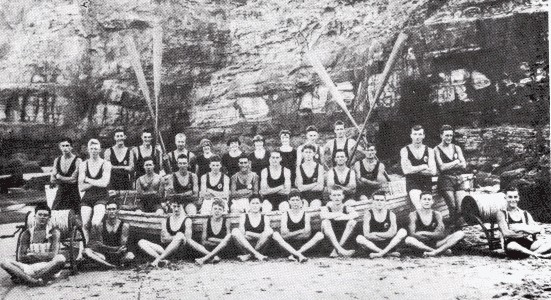 |
Thorn:
|
"Ordinance
No.
52 under the Local Government Act, on public baths and
bathing, was gazetted on 27 March 1912.
Regulations
which
had been in operation in respect of public baths, were
extended to cover beaches and river bathing, and dressing
facilities.
In
addition, a new regulation provided for an inspector to
order bathers to refrain from surf shooting, whether
with or without a surfboard, where the practice was likely
to endanger or inconvenience other bathers.
86. NSW
Government Gazette 27 March 1912, Sydney Morning Herald 29
March 1912."
- S&G Champion: Drowning, Bathing and Life Saving (2000) page 167.
"A
successful surf carnival was held at North Steyne, Manly
on Saturday afternoon, 28 December 1912.
The
display was witnessed by 15,000 spectators.
...
One of
the prinipal attractions was the presence of a team of
native swimmers from the Ellice Islands.
They
entertained the crowd with their quaint songs and war
dances, combined with clever exhibitions of surf and boat
displays in the breakers.
139.
Sydney Morning Herald 30 December 1913, Daily Telegraph 30
December 1913."
- S&G Champion: Drowning, Bathing and Life Saving (2000) page 177.
"Manly
Council's bathing inspector wrote to the aldermen, asking
them to consider having a portion of the beach set apart
for shooting the breakers with boards.
Many
boards were being used by bathers on the fringe of the
crowd.
Some who
were unaware of the restrictions used a board in the
thickest part of the bathing crowd.
If the
suggestion were carried out, it would relieve the
congestion in the southern corner of the beach.
Dr Neale
was opposed to the use of boards in the surf.
They
were, in his opinion, very dangerous.
He had
been struck in the back while bathing, and it was the
reverse of pleasant.
He had
seen no fewer than ten surfboards among the thick of the
bathers.
He moved
that the bathing inspector be instructed to enforce the
regulation dealing with using boards while shooting the
breakers.
Alderman
Paterson seconded the motion, which was carried, Alderman
Heaton having expressed his opinion that a portion of the
beach should be set apart for the sport of shooting the
breakers with boards.
Alderman
Quirk said that he had witnessed a clever exhibition by a
young man who "shot" the breakers with a board.
For fully
100 yards he came in standing on the board, and was loudly
applauded by a thousand people for his feat.
147.
Evening News 22 January 1913, Sydney Morning Herald 24
January 1913."
The Sydney
Morning
Herald, 24 January 1913, page 7 noted :
"... no
fewer than ten surfboards in the thick of bathers."
- S&G Champion: Drowning, Bathing and Life Saving (2000) page 179.
Harald
(or Harold) Baker contributed a series on surfing to the
Evening News...
26.
Evening News 28 November 1913.
- The first (?)
article was an overview of several northern clubs, page 189.
45.
Evening News 16 January 1914.
- Manly, page
193
48.
Evening News 22 January 1914.
- surfing
costumes, pages 193-194.
50.
Evening News 29 January 1914.
- rescue
techiques, pages 194-195.
51.
Evening News 5 February 1914.
- Manly's
mobile surf tower, page 195-196.
- S&G Champion: Drowning, Bathing and Life Saving (2000) pages 189, 193, 193-194, 194-195, 195-196.
"The Dee
Why Life Saving and Surf Club held its first annual
carnival on Saturday, 14 February 1914 at Dee Why Beach.
The
programme was a first class one, and reflected great
credit on those responsible for its compilation.
There was
an attendance of about 3000.
Nine
clubs were represented in the grand parade and march past,
which was a very creditable display.
...
The
ladies' surf race was an item which aroused much interest.
Two
competitors, however, were all that came forward when
entries closed, and the race resolved itself into a "swim
over" for one lady.
Miss
Letham (Freshwater) and Miss Abrahams (BrookvaIe) were the
contestants, who had to swim from a boat, which was
anchored about 30 yards from shore, and finish at a line
on the beach.
Miss
Letham got the best of the start, and came right away from
her opponent, putting up a very good swim and winning
easily.
Miss
Abrahams, it was reported, had to be assisted to shore by
a life saver.
She
afterwards denied that she had required the services of a
life saver, stating that, having obtained a bad start, she
was leisurely swimming ashore, and was rather annoyed at
the attentions paid her by the life savers.
58.
Sydney Morning Herald 16 February 1914, Manly Daily
cuttings February 1914 in the Dee Why LS&S Club minute
book."
- S&G Champion: Drowning, Bathing and Life Saving (2000) page 197.
The
Warringah Shire Council Chambers on Monday night, 9 March
1914, were crowded with surfing enthusiasts, who gathered
in response to President Quirk's invitation to each surf
club in the shire to appoint representatives to meet
council and discuss various matters, particularly
regarding taking proper precautions to ensure the safety
of bathers, furnishing each beach with a surfboat, a surf
reel, lifebuoys, and the appointment of beach inspectors.
...
The
Freshwater representative said his beach was one of the
most popular around Sydney, and it was necessary that
someone clothed with authority should have charge.
Among the
nuisances his club had to cope with was the intoxication
of some bathers, the use of surfboards, and larrikinism.
The
Collaroy representative also said boards should be done
away with.
67.
Warringah Shire Council minutes 23 February 1914, 9 March
1914;
Evening
News 10 March 1914; Sydney Morning Herald 17 March 1914.
- S&G Champion: Drowning, Bathing and Life Saving (2000) pages 199-200.
The North
Steyne Club journeyed to Newcastle, circa 1911, for a
demonstration of surfing and lifesaving techniques.
The squad
included Edward 'Appy' Eyre, Freddie Williams, beltman Rohan
McKelvey and the Sly Brothers with their boat.
The locals were
impressed with:
"the
double banking of Charlie Bell and Ralph Durer on a small
board measuring 1 1/2 foot by 1 1/2 foot "
- W.
H.. Commins, first treasurer of North Steyne Club and the Surf
Bathers' Association.
Quoted in
Maxwell: Surf(1949)
page 37.
Another report
from Newcastle is quoted from Joe Palmers' Fifty
Years of Vigilance and Service, probably an official
history of the Newcastle Surf Life Saving Club, circa 1958,
partially funded by the SLSA.
The book does
not appear available in any of the relevant library
collections.
Joe Palmer claims that the first club member to use a surfboard on Newcastle Beach was Cecil Lamb, one of the staff of the Gentlemen's Club in Newcomen Street, in the 1911-1912 season:-
"His
board resembled a laundry ironing board, but Cecil
perservered in his attempts to ride it on the waves - with
moderate success.
Mervyn
Chippindall and Jack Riordan followed; the latter was more
persistent and successful."
[4]
'Fifty Years of Vigilance and Service' - Joe Palmer.
-Conrick: Northern
Lifesaver (1989) page 95.
Initially noted
by Dave Kelly contributing to realsurf.com.au forum, January
2008.
C.B. Maxwell:
Surf (1949),
page 235, and Reg Harris: Manly LSC
(1961), page 53, report that .C.D. Paterson of Manly brought
the first known solid wood Hawaiian Alaia to Australia in 1912
on returning from a world tour.
First
unsuccessfully tested at North Steyne, the board was
eventually retired to the family home at the Spit to be
used as a ironing board.
Note that Chris
Cornick (1989) dates the arrival of this board as 1908 and
Alby Thoms (2000) indicates 1909 (page 20), see above.
The earlier the
board did arrive in Australia then references to other surfers
who made copies of the board are more plausible.
New York Times
December 6,
1912, Friday, Page 13, 968 words
ORIGIN OF
CRAWL STROKE.; Australian Swimmers Gave First Idea and
Americans Improved on It.
This
month marks the ninth anniversary of the origin of the
"American crawl," the swimming stroke that has placed
American athletes at the top of the world in sprint
swimming.
In 1912, the Daily
Telegraph reported on the second Freshwater
Life Saving Carnival held on the 26 January.
A detailed
account of the days events included the following comments:
"A
clever exhibition of surf board shooting was given by Mr.
Walker, of the Manly Seagulls Surf Club. With his Hawaiian
surf board he drew much applause for his clever feats,
coming in on the breaker standing balanced on his feet or
his head."
- The
Daily
Telegraph 27 January 1912, page 21.
Note that a Mr. "Walker " is included in the lists of early boardriders by both Maxwell and Harris, below.
The oldest was
Manly Surf Club, formed on 16 July 1907, closely followed by
North Steyne Life Saving Club in September that year.
Manly Life
Saving Club and
The Manly
Seagull Surf and Life Saving Clubc hanged their name to the
South Steyne Life Saving Club in 1913 and briefly affiliated
with the Surf Bathing Association of NSW before amalgamating
with the Manly Life Saving Club in 1914.
- Harris: Manly LSC (1961) pages 10 to 11.
Following the
arrival of C.D. Paterson’s board a small group attempt
surfriding on replica boards. ...
A.
the Walker Brothers, Steve McKelvey, Jack Reynolds, Fred
Notting and Basil Kirke
- Maxwell: Surf (1949) page
235.
B. Jack
Reynolds,
Norman Roberts, Geoff. Wyld, Tom Walker, Claude West (aged 13)
and Miss Esma Amor
- Harris: Manly LSC
(1961) pages 53-54
.
Made from
Californian redwood by Les Hinds, a local builder from North
Steyne, they were 8 ft long, 20" wide, 11/2" thick and weighed
35 pounds.
Riding the
boards was limited to launching onto broken waves from a
standing position and riding white water straight in, either
prone or kneeling.
Standing rides
on the board for up to 50 yards/metres were considered
outstanding.
- Maxwell: Surf (1949) page
235.
- Harris: Manly LSC
(1961) pages 53-54
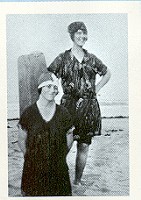 |
Harvey: History Queensland Surfing (1983) page 8. |
- Galton: Gladiators of the
Surf(1984) page 13.
.
In the same
year Freshwater Club held a canoe race, won by a junior, Dick
Matheson.
-Henderson in Myers: Freshwater SLSC (1983) page 85.
In the Illawarra, circa 1913, Thirroul Surf life Saving Club appealed to the Bulli council to regulate “boards shooting waves in the surf”.
- Middleton & Figtree: Illawarra SLSC (1963) page Ten.
Fred Notting
designed the first boat strictly for surf rescue, commissioned
by Manly Surf Life Saving Club in 1913.
After studying
rough water craft from around the world, Notting based his
design on the Norwegian work boat - a 24 foot double -ender of
white huon pine with exaggerated rocker.
Built by Holmes
of Lavender Bay for 36 pounds (sans gear and oars) it was
christened M.L.S.C., but was more commonly known as
the 'Banana' boat due to the accentuated rocker.
- Maxwell: Surf
(1949) pages 91 -92
- Harris: Manly LSC
(1961) pages 44-45.
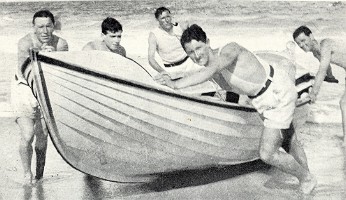 |
Manly Surf Life Saving Club's Second boat. Designed by Fred Notting. Photographed at the Deewhy's first carnival, 1913 - 1914. Crew : (from left to right) : Bill Piggott, Sid. McAulciffe, Fred Notting (pipe), Geoff Wyld and R. Quinn Harris: Manly LSC (1961) page 44 |
Manly
Surf Carnival
The
Greatest Surf Event of the Year
All
Champions Competing
Saturday
January 24
Procession
from
Pier, 2.30 pm
Admission
6d.
Chairs 6d. extra to Balconies 1/-"
On Sunday 22nd
February 1914, the day after Deewhy's first carnival, seven
swimmers were washed out to sea in a strong northerly rip.
All were
rescued using the newly introduced belt and reel but two boys,
O. Overton and H. Starkey, were swept towards Long Reef.
Manly club
member, Jack Talyor took a fishing skiff from the beach and
accompanied by H. Duckworth from Maroubra (to bale), managed
to rescue the boys.
The success of
the rescues resulted in bravery awards for the
lifesavers from Warringah Shire, and an unheard of donation
of 1250 pounds, distributed amongst the Shire's five
Surf Life Saving Clubs.
These funds
were used to improve buildings and equipment, most
significantly a sufboat for each club.
Based on Fred
Notting's design, although a few feet shorter, the boats were
built by Holmes of Lavender Bay at a total cost of 135 pounds.
The new boats
were delivered to Freshwater, Deewhy, Collaroy, Narrabeen and
Newport clubs in the first months of 1915.
- Maxwell: Surf (1949) pages 94 -99.
"As
Freshwater Surf Club already had a club house, built at
the end of 1910, they asked for additions to be made to
it.
Warringah
Council resolved to appoint William Owen and Abe Mallinson
as beach inspectors at Freshwater.
At the
same time it was resolved that the beach inspectors be
written to and asked to prohibit the use of surfboards on
Freshwater Beach.
79.
Warringah Shire Council Minutes 20 April 1914.
- S&G
Champion: Drowning,
Bathing and Life Saving (2000) page 204.
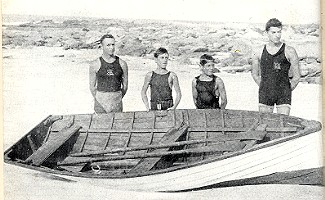 |
|
Participants in an extreme rescue at Deewhy, 22 February 1914. |
- Harvey: History Queensland Surfing (1983) page 8.
Charlie Faukner read of Duke Kahanamoku's surfriding and used his experience (and board?) as an aqua planner on the Tweed River to ride at Greenmount in 1914.
- Harvey: History Queensland Surfing (1983) page 8.
This claim
appears tenuous, but possible.
Aquaplaning had
originated by being towed behind yachts circa 1900 and high
speed motor boats were in use on Sydney Harbour as early as
1908.
- Inglis: Sport in Australia (1912) page 285.
Also note that Isobel Letham also may have had aquaplanning experience previous to her introduction to surfboards.
At Deewhy, before 1914, 'Long Harry' Taylor "made a board resembling an old-fashioned church door, but his efforts in the surf were so futile they became ridiculous."
- Thomas: Deewhy SLSC (1962) page 30.
In an
unaccredited account of Duke Kakhanamoku's visit to Cronulla
in 1915, the commentator notes...
"While
there were already surfboard exponents on our own and
other metropolitan beaches, Duke Kahanamoku first focused
public attention on surfboard riding in NSW."
See Duke visits Cronulla, 1915
A photograph
taken at Freshwater in 1914 shows several handboards carried
by juvenile surfers.
The use of
small boards was common in Hawaii and the USA in 1900's,
particularly as beginner or juvenile craft in preparation for
larger boards, but is less documented in the literature than
full size boards.
It is possible
that some Hawaiian knowledge and/or boards did reach Australia
in this period, as in the case of Grace Wooton-Smith in 1915.
The 14 years
since the turn of the century saw a rapid growth in surf
bathing and surfriding.
The Surf Life
Saving movement had been firmly established and there were the
beginnings of an Australian beach culture.
Various
craft (surfboats, the Sea King, prone and standing
boards) had been used in Australian waves and there was a
knowledge of Hawaiian surfriding.
The arrival in
Australia of Olympic swimmer and famed Hawaiian surfer, Duke
Kahanamoku, was eagerly anticipated.
| home | catalogue | history | references | appendix |
"(16th April 1788) we walked across the neck, where some canoes were landing which they did with ease altho' a very great surf was running"
"As we were
going in to the first cove on the east side called Spring
Cove, we were joined by three canoes with one man in each.
They hauled
their canoes up and met us on the beach leaving their spears
in the canoes.
We were soon
joined by a dozen of these and found three amongst them with
trinkets &c. hanging about them that had been given to
them a week before by the governor on his first visit to
this place.
Our people
and these mixed together and were quite sociable, dancing
and otherwise amusing them. One of our people combed their
hair with which they were much pleased; several women
appeared at a distance, but we could not prevail on the men
to bring them near us.
We had here
an opportunity of examining their canoes and weapons: the
canoe is made of the bark taken off a large tree of the
length they want to make the canoe, which is gathered up at
each end and secured by a lashing of strong vine which runs
amongst the underbrush.
One was
secured by a small line.
They fix
spreaders in the inside; the paddles are about two feet
long, in shape like a pudding stirrer; these they use one in
each hand and go along very fast sitting with their legs
under them and their bodies erect and although they do not
use outriggers I have seen them paddle through a large surf
without over-setting or taking in more water than if rowing
in smooth water.
From their
construction they are apt to leak when any weight is in
them; the man nearest that point of the canoe, where the
water lies, heaves it out behind him with a piece of wood in
the hollow of his hand, still keeping his body erect as when
rowing.
They are by
far the worst canoes I ever saw or heard of.
I have seen
some so small as eight feet long and others twice that
length.
In these
canoes they will stand up to strike fish, at which they seem
expert."
While there is
evidence that indigenous inhabitants on the northern coast of
Australia were known to swim in the surf,
the following account is unfortunately confusing and particularly unclear in what "their eccentric and amusing evolutions" actually were.
"More than
this, when they have learned (how to swim), necessity
appears to be the only thing that induces them to enter the
water alone, though with white men a blackfellow becomes as
willing as a water-spaniel, and nothing seems to give him
more pleasure than a "bogie" , i.e. swim (pronounced bo'ge ???)
on the sea-coast.
Encouraged
by white men, and accompanied by them, hand in hand, leaping
and shouting, a party of
aborigines
will run to meet the breakers.
Extended in
a line, they will stand to meet the incoming of the
small seas, and will perform the most
amusing
feats, as the force of the breakers drives them back to the
shore.
On the
approach of a large wave the white man will usually dive and
work their hands into the sand,
so to obtain
a firm hold as the sea bursts over them; while the blacks on
the contrary, will rise on the
crest, and
continue to go through their eccentric and amusing
evolutions as usual."
- Steedman,
Charles: Manual
of Swimming (1867) page 265.
Whatever the
relationship with the surf the coastal aborigines, these
skills and knowledge were not transfered to the new
inhabitants from Europe.
Certainly by
the turn of the century, aborigines now living in the Sydney
region were signicantly disconnected with much of their
original culture.
| home | catalogue | history | references | appendix |