surfresearch.com.au
 |
surfresearch.com.au
ramasy :
pitcairn island, 1821
|
Dr. David Ramsay :
Surfing on Pitcairn Island, 1821.
Extracts from
Ramsey, Dr.
David :
The
Scrapbook of the Log of the Ship "Surry", Pitcairn Island
April 1821.
Pitcairn
Islands Study Center : Historic Papers
http://library.puc.edu/pitcairn/studycenter/store/papers.shtml
Introduction.
Following an
extended stay at Matavai Bay in Tahiti in 1788-1789, Midshipman
Fletcher Christian led the infamous mutiny on the Bounty,
setting Captain Bligh adrift in a longboat.
After returning
to Tahiti, Christian was desperate to find a sanctuary from
punishment by the Royal Navy and eventually settled the then
uninhabited and remote Pitcairn Island with some of the
mutineers and a number of, mostly female, native Tahitians.
As the mutineers
progressively eliminated themselves by misadventure or murder,
Pitcairn became a integrated culture of English and Tahitian
influences.
The island
settlement was discovered in 1808 by Captain Folger in the Topaz,
who reported his surprising find to the British Admiralty.
However there was
litle official interest in pursuing what was now merely remnants
of the mutiny.
A number of
vessels visited the island before the Surry in 1821,
when the inhabitants were observed surfing on small boards.
In 1823, a
British whaler, Cyrus, left two of her crew on Pitcairn,
John Buffett and John Evans, who provided an injection of
European influence, but this was minor in comparison to the
significant social dislocation resulting from the arrival of
Joshua Hill in 1831.
Due to the
pressure of an increasing population on the small island,
several attempts were made to relocate the inhabitants before
there was a major relocation to Norfolk Island in 1856, where
the descents of the Bounty mutineers' continued their
enjoyment of surf-riding.
Whereas European influence on Pitcairn was principally evident
in a resurgent Christianity, Polynesian culture maintained a
strong bond with the ocean, most notably a continuation of
surfboard riding in relatively difficult conditions.
In particular,
note"a flat board about 3 feet long, on the upper side smooth
and on the under a ridge like a keel", page 7.
The "ridge
like a keel" appears to be a design feature intended to
give the board directional stability, commonly known as a fin
and usually accredited to Tom Blake in 1935.
Alternatively,
there is a very remote possibility that it was added to give
board structural strength.
As such a feature
is not recorded in any of the reports of traditional surfboards
of Tahiti or the Hawaiian Islands, it is likely that the
Pitcairn board was developed in a combination of the Tahitian's
native design and the European seaman's knowledge of boat
building.
Also see:
For Ramsay's
biography, see:
Australian
Dictionary of Biography Online Edition
http://adbonline.anu.edu.au/biogs/A020314b.html
Research Note:
Ramsay's account of surf-riding on Pitcairn Island was
previously identified on The Museum of British Surfing
web page.
http://www.thesurfingmuseum.org.uk/history_1899.asp
Unfortunately, as
at October 2009 it is no longer available:
"Please note
that our web history has been withdrawn while we redesign the
website."
Also see:
1834 Frederick Bennett : Surfing on Pitcairn
Island.
1852 Matthew Moresby:
Surfriding
on Pitcairn Island.
Also
1868 Mrs. Selwyn : Surfriding on Norfolk
Island.
Cover Note
This is a copy
of the scrap book of the log of the ship "Surry" (Captain
Thomas Raine) written by the ship's doctor (Dr. Ramasy) giving
an account of their visit to Pitcairn Island in April 1821.
Page 4
We saw the
Island early next morning and got up with it in the afternoon,
we were going round the island when I observed the English
flag on the S.E. side and we immediately hauled up for it, we
soon observed a canoe coming off and two of the inhabiants in
it - they asked how we did in pretty good English - we hove to
and they came on board - soon after other canoes came off and
all came on board - they appeared highly pleased to see us and
invited us on shore.
The Captain,
2nd Mate and myself went into the gig.
On our
approaching the shore the danger from landing through such a
surf obliged us too lay on our oars till the canoes which we
had got ahead of came up to us.
Then we were
quite enraptured the mountainous height of the land, the
abrupt precipes, the roaring surf and the coppered natives on
the black rocks, their fairy forms now seen now hid by the
dashing wave seemed the genii in the fancied regions in
Alladin.
But we were
afraid to land as there is no beach and the breakers running
high, we waited till the men in the canoes came up with us and
they should show us the way to get ashore.
The channel
formed by large rocks being very narrow, it requires great
caution in the surf.
One man
Quintrel swam out to us to watch the signal and tell us when
to pull in, another stood on a high rock with a branch to wave
to him, the rest stood on each side of the rocks showing the
passage through which the boat must go.
The man on the
rock seeing the sea smooth gave the signal and in we went.
When we came
to the men on the rocks they took hold of the boat and ran her
slap out of the surf and then ...
Page 5
... took her
all of us having got out on their shoulders and carried up
into the shade.
Page 7
....
The Capt
returned and told me that after loading the boats which was
done by swimming through the surf with the fruit, they to his
great astonishment amused themselves by taking a flat board
about 3 feet long, on the upper side smooth and on the under a
ridge like a keel, and went out on a rock and waited till a
large breaker came and when the top of it was close on them,
away they went with the piece of wood under their belly on the
top of this breaker and directed themselves by their feet into
the little channel formed by the rocks, so that men the surf
left them they were only up to their knees in water.
They are very
dexterous in keeping off the rocks which to us would be
inevitable death.
Their method
of swimming is like the dog but inclining a little to one
side.
The road from
the village to the beach is very steep and narrow in some
places but both men and women run up and down with great ease
with a load on their shoulders and were very deirous of
carrying us up or down any difficult place.
Captain
Raine:
Log of
the Ship "Surry", Pitcairn Island April 1821.
Quoted in
Simmons, James C.: Castaway in Paradise
- The Incredible Adventures of
True-life Robinson Crusoes.
Sheridan House, 1993, page?.
Noted by Peter Robinson,
Director of The (British) Surfing Museum
http://www.thesurfingmuseum.org.uk
The following
quotation was forwarded by Peter Robinson, Director of The
(British) Surfing Museum in June 2009, who is awaiting access to
the original ships documents held by the National Maritime Museum.
"They have a piece of wood, somewhat
resembling a butchers tray, but round at one end and square at
the other, and having on the bottom a small keel.
With this they swim off to the rocks
at the entrance to the little harbour, getting on which they
wait for a heavy surf, and, just as it breaks, jump off with the
piece of wood under them.
And thus with their heads before the
surf, they rush in with amazing rapidity... ...they steer
themselves with their feet which they move very quickly."
Additional
extracts from:
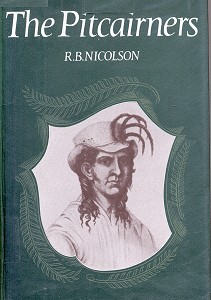
Nicholson,
Robert B.: The Pitcairners
With
the assistance of Brian F. Davies
Angus
and Robertson, 89 Castlereagh Street, Sydney,1965.
|
|
Chapter VIII: The Surry and the Russell.
Page 70
Nicholson relates
the arrival of the Surry off Pitcairn, the difficult
landing and quotes Ramsay's account of the Captain's
observarions of surfriding, as reproduced above on page 7.
He then notes:
Page 71
In Captain
Raine's own account of his visit to Pitcairn, he described the
surfboard riding of the islanders by their own term of
"sliding".
The surfboard
"somewhat resembling a butcher's tray, but round at one end
and square at the other", was used with equal dexterity by
both the men and the women.
Captain Cook
refers to surfboard riding at the Sandwich Islands during his
voyage there, but makes no mention of it at Tahiti.
As there
appears to be no early record of the sport in Tahiti, it seems
that "sliding" was developed by the young inhabitants of
Pitcairn Island themselves.
Notes
1. "he
described the surfboard riding of the islanders by their own
term of 'sliding'"
This translation
corresponds with the Hawaiian term "papa hi naru' [papa he'e
nalu], (wave sliding-board)" and has similarities with
the Tahitian "a small board, which they called 'papa
fahee' ".
See: Rev.William
Ellis : Surf-riding
in the Society and Sandwich Islands.
2. "Captain
Cook
refers to surfboard riding at the Sandwich Islands during his
voyage there"
Strictly, Cook
himself never wrote about surfing, altough some accounts by his
marineers were attributed to him by editors of the journals in
the 18th century.
3. "As
there appears to be no early record of the sport in Tahiti, it
seems that "sliding" was developed by the young inhabitants of
Pitcairn Island themselves."
Clearly this
assesment is incorrect.
The first
European report of surfing was by Joseph Banks on Tahiti in 1769
on Cook's first Pacific vovage.
See: Joseph Banks
: Surfriding in
Tahiti.
Furthermore,
William Bligh reported surfing on his visit to Tahiti to obtain
breadfruit plants (before the mutiny) and the most detailed 18th
century account, including the first report of surfboard riding
surfing in a standing position, is by Bounty
mutineer, James Morrison, after his return to Matavai Bay, circa
1788-1789.
See: William
Bligh : Surfriding in Tahiti
and James Morrison : Surfriding in Tahiti
Further
extracts from:
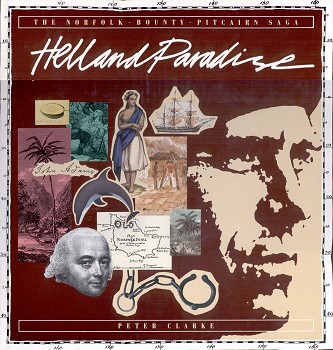
Clarke,
Peter:
Hell
and Paradise: the Norfolk - Bounty - Pitcairn
Saga.
Viking-
Penguin Books Australia Ltd.
487
Maroondah Highway
PO Box
257 Ringwood
Victoria,
3134, Australia.1986, Reprinted 1998.
|
 |
Introduction.
An excellently
written and lavishly illustrated book that connects history of
the mutiny on the Bounty and the settlements of Norfolk
and Pitcairn Islands.
Clarke implies
Folger (1808) also observed surfboard riding, although since he
remained at Pitcairn for only ten hours, this seems unlikely,
see Note 2 below.
Unfortunately he
compounds Nicholson's major error in surfriding history: "Captain
Cook had reported that surfing was unknown even in Tahiti and,
when he came across it in the Sandwich Islands, he believed it
to be unique", pages 91-92 (see notes, above).
The book includes
a rare colourised reproduction of Weber's famous "A View of
KaraKakooa, in Owyhee", circa 1778, pages 32-33.
Chapter 11
Page 91
(On Pitcairn
Island)
Their lives
were extremely simple.
Subsistence
farming and fishing occupied most of their daylight hours,
interspersed with occasional recreational activities such as
kite- flying, stilt-walking and a sport which they appear to
have developed spontaneously - surfing.
Captain Cook
had reported that surfing was unknown even in Tahiti at that
time ...
Page 92
...and, when
he came across it in the Sandwich Islands, he believed it to
be unique.
Clarke
reproduces the quotes of Ramsay and Raine on surfboard riding
as noted by Nicholson, above.
...
Two years
later (in 1808), Pitcairn had her first visitors.
After
landing her rum and gin at Hobart Town (to Bligh's disgust),
the Topaz sailed north across the Pacific and
chanced across Pitcairn with no inkling that it was
inhabited.
In his log,
Captain Folger wrote: 'I discovered a boat paddling towards
me'.
It was a
Tahitian-style canoe containing three young men 'as dark as
natives' and almost naked.
The
'natives' yelled to them- in English!
Page 94
...
Captain
Folger had discovered a race of 'Noble Savages', a race
which would have thrilled Rousseau himself.
The people
were 'tall, robust, golden-limbed and good-natured of
countenance'.
All were
extremely athletic and adept at surf-board riding.
...
Folger sent
a copy of his log to the Admiralty in 1809 and, when this
was ignored, personally wrote to them in 1813.
Preoccupied
with the activities of Napoleon, the authorities still chose
to do nothing about punishing the sole survivor of a
twenty-year-old mutiny; moreover, they apparenty
disseminated this information to very few; possibly not even
to Captain Bligh.
Page 99
...
Four years
after Bligh's death, the Surry arrived at Pitcairn,
her crew well aware of their responsibility to record
accurate accounts of this intriguing race to add spice to
the soirees of the British aristocracy and conviction to the
hope of various religious groups that here were potential
missionaries.
Chapter 13
Page 111
On 10th
December, 1823, the British whaler, Cyrus, arrived at
Pitcairn bearing two men who were to introduce to the island
its first (and almost its last) non-Bounty;
non-Polynesian blood.
As John
Adams's wife, Teio, whom he called Mary, was now blind,
Adams was finding It difficult to care for her and
simultaneously cope with the teaching of an ever-increasing
horde of children.
Upon his
request, Captain John Hall agreed to allow one of his
complement to remain on Pitcairn in the role of
school-teacher.
This was
John Buffett, a man with a remarkable history of survival.
He had
survived ferocious storms in Manila Bay and the Moluccas.
He had been
shipwrecked in the Bay of St. Lawrence, witnessing the death
of 42 souls, then shipwrecked again south of Boston.
In manner,
however, this adventure-toughened seadog appears to have
come across as a mild, soft- spoken scholar.
His friend,
John Evans, was not invited to stay but jumped ship and hid
in a tree until Cyrus sailed.
Chapter 17
Page 145
A dozen
years of relative tranquility followed the departure from
Pitcairn of the odious Joshua Hill. When Captain Wood of
H.M.S. Pandora visited the island (in 1850), sixty
years after the burning of the
Bounty (in
1790) he found the community in fine shape.
The Captain
reported:
"The
children are not swaddled and tormented as they are in
England, in consequence of which they are strong and
independent looking, not an ill-formed or deformed child
was to be seen; they go into the water when very young,
which tans their skins and renders them some shades darker
than their original coloul: The women are as expert as the
men in the surf, some of them being able to swim entirely
round the island.
The way
they effect a landing is thus: One whose experience can be
trusted mounts a rock that commands a view of the sea,
watches for the proper moment, when, at a signal from him,
the boat which has been lying as close to the breakers as
possible makes a rush and, by takmg one of the less heavy
breakers, goes flying in before it, frequently without a
stroke of the oars being necessary except to steer her ...
a trifling deviation on either side would dash it to
pieces on the rocks."
NOTES
1. "Dr
David Ramsay ... Captain Folger ... Captain Wood"
Clarke does not
reproduce his quotes from the original sources.
In several cases
the reference is simply "R.B. Nicholson's The Pitcairners".
2.
"Captain Folger had discovered a race ... adept at
surf-board riding."
The implication
that
Folger, the first to discover an inhabited Pitcairn in 1808,
also observed surfboard riding seems highly unlikely as he
remained at Pitcairn for only ten hours.
There were
several published accounts:
"The
discovery was reported by Folger to the Royal Navy 1808, a
report of which reached the British Admiralty on May 14, 1809.
It was
published in the Quarterly Review in 1810.
Captain Folger
also related an account of the discovery to his friend Captain
Amasa Delano, who published the account in his book A
Narrative of Voyages and Travels in 1817.
This account is
also included in the book Pitcarin Island, written by
Charles Nordoff and James Hall."
-http://en.wikipedia.org/wiki/Mayhew_Folger
3. "John
Buffett,
a man with a remarkable history of survival" - page 111.
Buffett
published A Narrative of 20 Years' Residence on
Pitcairn's Island in The Friend,
Honolulu, in 1846, Volume 4, pages 2-3, 20-21, 27-28, 34-35,
50-51, and 66-68.
Pitcairn
Islands Study Center : Historic Papers
http://library.puc.edu/pitcairn/studycenter/store/papers.shtml
His
recollections contain no account of the Islander's surfriding.
S&G
Champion report:
"The
North Steyne Club forwared for confirmation to the Surf
bathing association a programme for the club's annual
carnival.
Fifteen
life saving clubs would be represented, and an exhibition
of surf-shooting given by Mr. L. Bouffett, of Norfolk
Island.
48.
Sydney Morning Herald 1 December 1911."
Drowning,
Bathing
and Life Saving (2000) page 159.
Mr L. Bouffett
was probably a decendant of John Buffett who arrived
on Pitcairn Island in December, 1823 on the British
whaler, Cyrus.
The Pitcairn
islanders, largely decenced from Bounty mutineers and
Tahitian women, were renowned surfriders.
Surfing on Norfolk Island- Further Research.
The following
item is yet to be examined, but appears potentially
interesting.
Note the spelling
variation of Patterson and Patteson.
Society for
Promoting Christian Knowledge: Sketches of the Life of
Bishop Patterson in Melanesia.
London, 1873.
Notes from an
online book trader:
b/w
plates. (illustrator). iv, 204 pp.
The Bishop's
adventures in New Zealand, Melanesia, Norfolk Island.
Not in
Ferguson, but see Ferguson 13938-40 for similar items related
to Patterson and his Melanesian
mission.
Interestingly
this book has a wood engraving of surfing on p. 64, and a
lengthy description of surfing as
practiced on
Norfolk Island.
It must be an
early appearance of such a description.
Also note held
by the Mitchell Library, Sydney:
Call
Number: DSM/ A922.3/ P
Sketches of
the life of Bishop Patteson in Melanesia : a revised edition
of "The life of Bishop Patteson",
Published under
the direction of the Tract Committee.
London :
Society for Promoting Christian Knowledge, 1873?
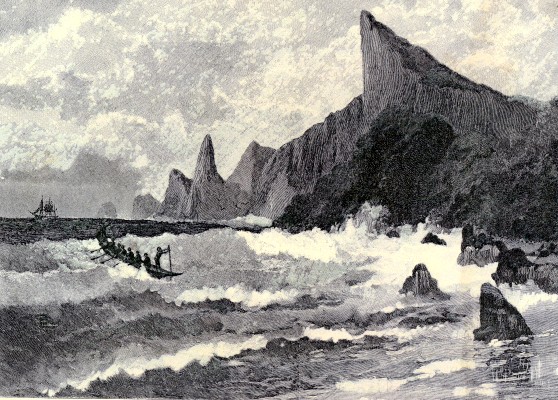
C. Schwatzburger
Sc.: Pitcairn Island
Garran, Andrew (editor):
Picturesque Atlas of
Australasia.
Picturesque Atlas
Publishing Company, Sydney, 1886-1888, page 607.
Carl Schwarzburger (1850-)
Engraver (wood-engraver);
xylographers
Studied in Germany before
moving to America in 1874. He visited Australia (NSW) between c.1886 - 1889, and then returned to the
US.
|
|
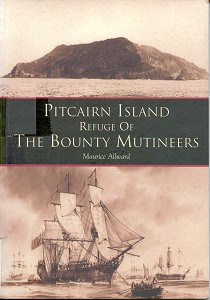
Selected
photographs from
Allward,
Maurice:
Pitcairn
Island - Refuge of the Bounty Mutineers.
2000,
Great Britain.
Tempus
Publishing Limited
The
Mill, Briscombe Port,
Stroud,
Gloustershire, GL5 2QG
|
|
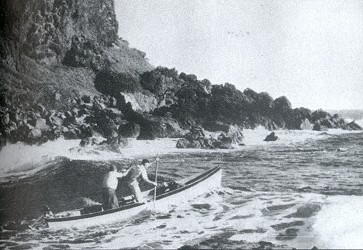 |
"Two islanders paddle their way
out of the landing cove to catch fish.
The
waves breaking on the far shore give some idea of
the danger of the task."
Allward,
Maurice: Pitcairn Island
-
Refuge of the Bounty Mutineers.
2000,
Great Britain.
Tempus
Publishing Limited
The
Mill, Briscombe Port,
Stroud,
Gloustershire, GL5 2QG
page
39.
|
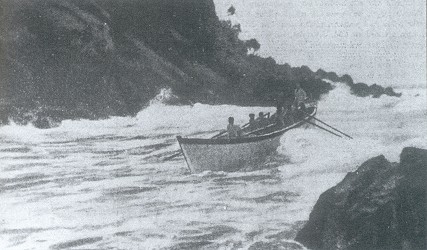 |
"A longboat returning to the
Landing Place in heavy seas.
Note
the lookout standing in the stern who watches for
a 'safe' wave before entering the bay."
Allward,
Maurice: Pitcairn Island
-
Refuge of the Bounty Mutineers.
2000,
Great Britain.
Tempus
Publishing Limited
The
Mill, Briscombe Port,
Stroud,
Gloustershire, GL5 2QG
page
81.
|
surfresearch.com.au
Geoff Cater (2009-2016) :
Dr. David Ramsay : Surf-riding at Pitcairn Island, 1821.
http://www.surfresearch.com.au/1821_Ramsay_Pitcairn.html