surfresearch.com.au
 |
surfresearch.com.au
pauline
curby, 2001 : the
myth of william gocher
|
Pauline Curby
: The Myth of William Gocher
Extract from ...
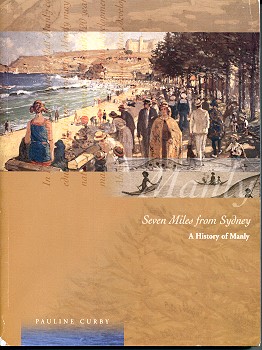
Seven
Miles from Sydney - A History of Manly
page 151
.
Curby,
Pauline : Seven
Miles
from Sydney - A History of Manly
Manly
Council, 1 Belgrave Street, Manly, NSW 2095.
Printed
by Headland Press, Brookvale, Sydney. 2001
Page
151.
'HERO'
OF THE SURF
In January
1907 a most unlikely
'hero' emerged from the pages of the Daily
Telegraph
in the form of William Gocher, a middle-aged 'newspaper
man'
(97).
Gocher was, as we have seen, an active supporter of
initiatives to
make bathing safe in his adopted home.
He was involved in the local progress
association, and had unsuccessfully stood for political
office on a number
of occasions (98).
His attempt to enter local politics in Manly in February
1903 resulted in a crushing defeat when he stood in
Wentworth Ward
against public servant Owen Carroll (99).
According to the Daily
Telegraph, although most of the residents of Manly
were unaware
of his 'triumph', he had challenged the
restrictions on daylight
bathing and initiated the 'first decisive move in the
direction of free
and open dipping on Manly's glorious beach in
Australia's brilliant sunshine'.
Apparently, on some unspecified date (100) Gocher swam
outside of the prescribed
daylight hours and unsuccessfully challenged the police to
prosecute him,
thus making a mockery of the restrictions on daylight
bathing.
This, it
was claimed, led to the legalisation of all-day bathing
(101).
This Daily
Telegraph
article and one Gocher wrote some years later are the only
primary sources
for what has become one of Sydney's urban myths; no
account of surfing
or beach culture is complete without it (102).
In Gocher's account he placed
himself beside
Truth proprietor John Norton (who claimed
to have coined the word 'wowser') as a champion of
freedom against
stuffy morality.
Manly Council was depicted as the villain in the piece
in both articles, but more so in Gocher's later article,
as the story developed
(103).
Both articles claimed that the Council, police and 'Manly
moralists'
objected to surfing per se, and that blameless
bathers were being
harassed despite wearing neck-to-knee costumes.
The fact that complaints
were only ever made when 'indecency' was involved
was conveniently
ignored.
There was no hint either that the problem of beach safety
was
a major concern for the Council, as it was for the other
beachside councils
of Sydney, or that the timing or the change of by-law
coincided with the
expiration of the baths' leases.
Gocher
seems to have been
down on his luck and about to leave Manly.
Then, in 1907, a few days after
the Daily Telegraph article appeared, his friend,
solicitor
Frank Donovan, launched an appeal so that a presentation
could be made
to him (104).
Donovan's action in 'passing round the hat'
won Gocher an engraved watch, a purse of sovereigns and a
place in history
(105).
It is
not known what effect
Donovan's collection had on the mayor's launch of a public
subscription
for the Sly brothers, conducted at the same time (106).
While the acknowledgment
of Gocher was generous, it was incongruous.
His modest achievements could
not seriously be compared with the truly heroic actions of
Happy Eyre who
worked for a minimal salary, or of the Slys, a family of
battling fishermen
who had been residents of the village since the 1860s.
The
week after the Daily
Telegraph article on Gocher, the first of many
references to his
‘role' in the lifting of restrictions on bathing
appeared. Arthur
Rosenthall, in an article for the Sydney Mail,
attributed
to Gocher's 'persistent and never-tiring agitation'
the public's
right to enter 'without molestation ...the waters of
the Pacific that
wash the shores of Manly Beach’ (107).
Editorial comment in this
special surfing edition took up the refrain: 'What Mr
Gocher, whose
services to the sport are being publicly recognised, did
as an individual
the Sydney Mail has done as a newspaper' (108).
This was a reference
to the fact that this newspaper's feature on surfing the
previous year
had been, it was claimed, the 'first newspaper
recognition of the growing
popularity of surf bathing' (109).
The
myth-making that began
in 1907 has continued.
There was considerable interest in the story in
the early 1950s, but some surprise was expressed at how
difficult it was
to ascertain 'what really happened’ (110).
It was even suggested
that a statue of Gocher should be erected in Manly.
Although an appeal
was launched nothing seems to have come of it, and in 1952
a block of Housing
Commission flats was named after him instead.
In 1980 a plaque was placed
at South Steyne to mark the spot where Gocher is said to
have swum in defiance
of Council by-laws. He was incorrectly credited With being
a former editor
of the Manly Daily and had become, with the passage of the
years, the 'first
bather entering the surf at Manly '.
Notes
97.
Daily Telegraph, 7
January
1907.
His friend, Frank Donovan described him
this way.
Daily Telegraph, 26
September
1907, in WCB1, page 17.
(Wellings Local Studies Collection,
Manly Library)
98.
Gocher actively campaigned for
political
office on a number of occasions at this time. He stood
unsuccessfully for
the Senate in 1901 and was also unsuccessful in state elections
in 1901
and 1904. On the last occasion he was an independent candidate
for the
state seat of Middle Harbour and gained only 33 votes.
See the slender entry on him in Australian
Dictionary
of Biography, page 35;
Champion, S. & G. :
Bathing, Drowning and Life Saving
in
Manly, Warringah and Pittwater to 1915,
Book House, Glebe, 2000. Page
68.
99.
Manly Municipal Council Minutes,
9 February 1903, page 202.
100.
Later accounts usually fix the
incident
as early in the swimming season 1902.
101.
Daily Telegraph, 7
January
1907.
102.
See for example a factional account,
complete
with dialogue, in
C. Bede Maxwell, Surf :
Australians
Against the Sea,
Angus and Robertson, Sydney, 1949.
Pages
14 – 16;
R. Quinn, ‘Kelly and the Shark
and
other Memories of Manly’,
in the Bulletin, 29
September,
1943, page 4.
103.
Key details differ in the two
accounts.
See
Manly Daily, 17 November 1910,
in
Manly, Warringah and Pittwater
Historical
Society archives.
104.
The article concluded that
‘it is pleasant and
interesting
to know that a movement is being made to fittingly acknowledge
the service,
journalistic and otherwise, of Mr. W.H. Gocher in winning for
Manly in
particular, and for tens of thousands of visitors in general,
the pleasure,
privilege and advantage of surface bathing at any hour of our
glorious
sunshine.’
Daily Telegraph, 7
January
1907, 12 January 1907.
105.
Sydney Morning Herald,
13
February 1907, page 9.
106.
No reference has been found to a
formal
presentation to them, although there was an ‘on the spot’
collection
on January 1907 after a spectacular rescue.
Champion, S. & G., :
Bathing, Drowning and Life Saving
in
Manly, Warringah and Pittwater to 1915,
Book House, Glebe, 2000. Page 82.
107.
Sydney Mail, 16 January
1907, page 158;
Sydney Mail, 22
February
1905, page 478.
108.
Sydney Mail, 16 January
1907, page 9.
109.
Sydney Mail, 16 January
1907, page 9.
110.
Sun Herald, 18 November
1951 in WCB8, page 85
(Wellings Local Studies Collection,
Manly Library)
Manly Daily, 28 July 1966, page 38.

surfresearch.com.au
Geoff Cater (2002-2013) :
www.surfresearch.com.au : Pauline Curby :
The Myth of Willian Gocher.
http://www.surfresearch.com.au/2001_Curby_Gocher_Myth_p151.html