 |
surfresearch.com.au
hunter : skiing in australia, 1911 |
| home | catalogue | history | references | appendix |
|
The current Director
N.S.W. Govenment Tourist Bureau and an enthusiastic skier, he indicates
a knowledge surfboard riding acquired when visiting Hawaii as a tourist
sometime before 1911.
Clearly he was not
the only Australian visitor to be exposed to the thrills of Hawaiian surfboard
riding.
For a contemporary profile of Percy Hunter, see below.
Riding is in the
standing position for both sports:
"as the surfrider
balances on a single board or runner, while coming down the side of Kosciusko
we balance on a pair of runners or skis" (page
11).
In a comparision with snow skis, the article implies the surfboard dimensions are substantial, " 7 feet 6 inches to 9 feet in length" and "five times ... 3 1/2 to 4 1/2 inches wide" (approximately 20 inches, page 11)
The report is one of the few independent sources not directly from the surf life saving movement.
This article kindly provided by Craig Baird (Surfworld, Torquay) in August 2009, who noted it "came to me via Dr. Garry Osmond (University of Queensland) after I had forwarded a Surfers Journal Article about Alexander Hume Ford (that) mentioned Percy Hunter's articles."
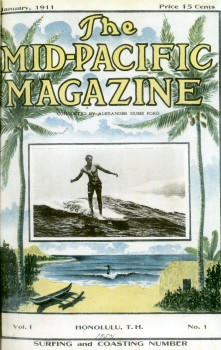
This first issue of The Mid-Pacific Magazine was subtitled the "Surfing and Coastal Number" and featured as the leading article "Riding the Surfboard", accredited to Duke Paoa (Kahanamoku) and with an extensive selection of photographs.
See Source Documents:
1911 Duke Kahanamoku
: Riding the Surfboard.
I have enjoyed the Glorious American Fourth riding down the white-capped billows at Waikiki on the elusive surfboard; in July, in Australia, we ride down the great snowy billows of Mt. Kosciusko. and the sensation is the same.
The Hawaiian surfboard is about the length of the ski, only it is five times as wide; as the surfrider balances on a single board or runner, while coming down the side of Kosciusko we balance on a pair of runners or skis.
The ski, which
has come to us from Scandinavia, is a long plank of mountain ash, from
3 1/2 to 4 1/2 inches wide, and from 7 feet 6 inches to 9 feet in length,
about an inch thick at its stoutest part, the center, tapering to about
half an inch at either end.
It is upturned
in front, in order to glide over inequalities in the snow, or small obstacles.
The foot fits
through a broad leather strap laced across the middle of the ski or shoe,
the heel being left free.
Skill in the
pastime is not difficult to acquire.
It is claimed
for ski running that it is the highest advantage that any physical exercise
can safely derive from terrestrial at traction, and the practised snow-shoer
who has tried other sports will readily admit this.
Free wheeling
down a mountain on a bolting bicycle is exciting, motoring at a hundred
miles an hour along a level road has its own peculiar sensations, ballooning
is by no means tame, and riding on the front of a flying express locomotive
makes the wind roar in your ears, and puts a tingle in your blood. I have
tried them all; but, without hesitation, I place ski-running over a snow
bank that drops away at the rate of a foot in two and a half far before
the best of them.
...
Page 12
...
I will give a
description of skiing uphill, for this may be valuable to the Hawaiian,
although he will never be able to surf up a wave.
In the old days,
I was told in Hawaii, the natives used to ski down the smooth, grassy mountain
sides, and there is one mountain peak in Hawaii, Mauna Loa, 14,000 feet
high, where real skiing might be possible.
It is probable,
however, that you will have to come to Australia to learn your skiing,
as we must go to Hawaii to learn to ride the surfboard, although we now
have a board or two at Manly beach.
...
Page 15
...
There are two
great thrills in the world- surfboard riding and skiing down the snow caps
of Kosciusko.
In Australia,
our summer (sic, should be our winter) is at its height in July;
America's summer vacation time.
The Government
Tourist Bureaus of the several Australian Colonies invite the Americans
to leave their torrid summer behind and enjoy our July snows.
Try the Hawaiian
surf- board, as I have done, and then experience life's other great thrill
- Australian skiing.
 |
The Mid-Pacific Magazine.
|
 |
|
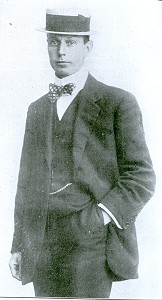
Percy Hunter,
slated for Under Secretary of New South Wales, now active Vice-President
of the Hands-around-the-Pacific Club, has made the art of "Tempting the
Tourist" not only a study but a business.
In Australia,
and around the world for that matter, Percy Hunter of Australia is known
as the man who turns the face of the tourist toward the Pacific in general
and to Australia in particular
Precy Hunter is
doing for Australia what Richard Seddon, Sir Joseph Ward, and T. E. Donne,
did for Maoriland;
they made the
world sit up and take notice of New Zealand.
Hunter, (he scorns the Mr. among friends), is more proud of the fact that he is a man of the people and helped to organize the labor party in Australia than he is of the accident of shakIng hands and chatting with King Edward.
The career of
Percy Hunter is as typical of opportunities in Australia as that of any
of our young successful
men typical of
chances in America.
Born in Ballyrat
(sic, Ballarat), as was the Australian prime minister, Dekin (sic, Deakin),
Hunter started out to eam his living at the age of eleven.
He wanted to
be a printer and moved to Melbourne and called the city of Melba his home
until the Sydney Daily Telegraph tempted him northward.
From early boyhood
young Hunter was known as the "live wire" in any enterprise or venture
in which he embarked.
Sir Joseph Carruthers,
Prime Minister (sic, Premier) of New South Wales, kept an eye on the brlght
young reporter and when Australia decided to follow New Zealand's lead
and establish a Government Tourist Bureau, young Hunter was appointed to
organize and carry the work to completIon.
Hunter proved
the right man in the right place.
So important
became his department that the finest office building in Sydney, Challis
House, was erected as its home.
Everywhere new
government hotels, government roads, and resorts came into being.
Not only the
tourist, but the people of New South Wales caught the fever and became
ardent travelers about their own country.
Four years ago
Percy Hunter and the editor of the Mid-Pacific Magazine met in Sydney,
and together outlined the Pan-Pacific campaign now being carried on.
At the Pan-Pacific
Congress in Honolulu Percy Hunter and Lorrin A. Thurston made, drew up
and proposed the motions that were adopted by that body.
Hunter is today
seeking to tempt the native-born American to settle in Australia.
It is probable
that his government will send him to the North-west to tell the American
farmers that Australia has adopted the American irrigation system with
the result that millions of acres in New South Wales, once considered desert,
are proving to be the finest wheat and orchard land in the world.
When Hunter returned
to Australia from the Pan-Pacific Congress held in Honolulu, it was to
report to his government that Australia's opportunity had come in the sanction
by Congress of San Francisco as the City of the Panama Exposition.
At that exposition
Australia will make the greatest display she has ever sent abroad.
Like the average
Australian, Percy Hunter is lanky, but with all the fire, energy and assurance
of the American youth just out of college; but with it all a prepossession
that convinces.
When Hunter talks
Australia, everything else is forgotten; he remembers only the importance
of being in earnest.
It is to be hoped
that America will have an opportunity of studying at short range this young
man, who revolutionized for an entire continent the method of handling
the stranger within the gates.
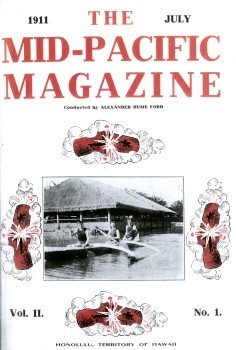 |
Volume 2 Number 1. Conducted by Alexander Hume Ford, Honolulu, Territory of Hawaii, July,1911. |
| home | catalogue | history | references | appendix |