 |
surfresearch.com.au
history
: 1956 international surf carnivals |
| home | catalogue | history | references | appendix |
|
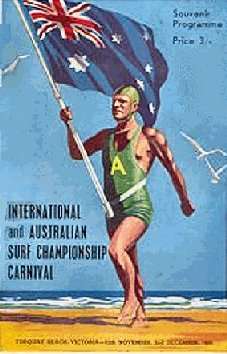
Most commentators, often quoting Greg Noll : Da Bull – Life Over The Edge (1989), focus on the International Carnival at Torquay and emphasize the occasion as an almost incidental development with dramatic consequences.
During one event, we had noticed a little point break off to the side, off a rocky point.Although context implies this happened at Torquay, Noll's recollections probably relate events at Avalon (Sydney) on the 18th November, which were possibly not filmed.
I don't remember the name of the place.
After the paddling events were over, we grabbed our boards and paddled out to the break.
There had been thousands of people watching the paddling events from shore, and they had started leaving.
Ampol Oil was covering all the paddling events, and decided to stay and take fIlms of us surfing.
Word got around in the parking lot as people were leaving, "The Yanks are surfing, you ought to see the Yanks." - Noll (1989), Page 71.
The account of the events and repercussions, has six identifiable perspectives.
Surf Life Saving
Australia (SLSA)
Association with
the Olympic Games was seen as elevating Australian surf life saving competition
sport to international prominence.
Unfortunately, although
exposure exceeded any previous event, the sport failed in its bid to be
an official Olympic demonstration sport and the location (not in
the sport's heartland of Sydney, and then some 60 miles outside of central
Melbourne) was less than ideal.
Competitively, results
were mixed, with some visiting teams performing well.
Since the teams
from the British Commonwealth were largely formed under the auspices of
the Australian movement, this was possibly less than flattering.
Despite the superior
performance of the the U.S.A. and Hawaiian teams' equipment, Australian
lifesavers apparently retained their preference for the hollow timber board
into the 1960s and it was not until the 1990s that the belt and reel was
replaced by the Torpedo Buoy.
For some clubs,
the introduction of the Malibu board caused significant disruption.
This was the third
organized association with international surfing by the Australian lifesaving
movement.
Unlike the 1956
carnival, the impact of the earlier occasions (Duke Kahanamoku's surfing
demonstrations in 1914-1915 and the large representative team sent to the
1939 -1940 Pan Pacific Games in Honolulu) were significantly truncated
by the subsequent outbreak of world wars.
| The U.S.A. -
Hawaiian Teams
For the Californian and Hawaiian surfers, the tour was an opportunity to test their skills and equipment in unfamiliar conditions. Competitively, they performed to a high standard and placed in many events. The success of their
equipment was significant, and proved the fibre glassed board would be
superior in all future surfing locations.
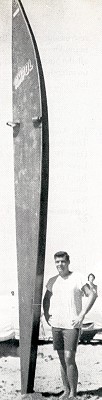
Impressed with the organization of the carnivals, members of the Californian team adopted many facets of the Australian surf lifesaving movement in the development of their own lifeguard services and there is evidence that the surf ski was of interest to some Hawaiian surfers. Image right : "Plate
33. Dick Patterson with one-man Australian surf-ski, Waikiki Beach.
On the same page,
Patterson also includes another photograph (not reproduced) ..
.
|
 |
The historian
for the County of Los Angles Lifeguard Division offers this assessment
...
"This singular
event is recognized as the most influential surf lifesaving carnival ever
held. The international surf lifesaving community was introduced to the
rescue can, lightweight paddleboards, fiberglass surf boards, relays and
iron man competition, as well as to the overall capabilities of the modern,
well trained, professional lifeguard."
On a personal
level, the tour probably had a variety of attractions beside the desire
to compete at an international level.
The experience of
travel, expanded social relations and potential romance are other possibilities.
In the case of Greg Noll, any expectation of potential romance appears to have been realised ...
Boardriders from
Other Nations
The impact of boardriders
from other competing countries was also significant, principally in New
Zealand and South Africa.
With a traditional
relationship with the Australian movement, a more primitive manufacturing
base and limited access to materials, both countries initially adopted
the Okinuee - a hollow timber adaptation of the malibu design by Australian
manufacturers.
Australian Manufacturers
While unfamiliarity
with the new materials and new production techniques would be a major difficulty
for Australian board builders, these developments were initially stalled
by the lack of suitable balsa wood.
Experienced hollow
wood builders were able to closely replicate the design, often called an
Okinuee,
by including a thick timber rail that could be shaped to a rounded edge.
The increasing demand
for boards moved the current Sydney builders from their backyards (often
in the Eastern suburbs) to industrial factories, ideally located at Brookvale,
adjacent to the multitude of surfing locations between Manly and Palm Beach.
The tour also initiated
a correspondence on construction and design between American and Australian
manufacturers that accelerated with the introduction of polyester foam
blanks.
The Australian
Press
This study is confined
to the domestic Australian press and does not attempt to locate and assess
reports in international newspapers.
Although the international
carnival was a popular item, it had to compete against the major journalistic
focus on official Olympic events, largely in metropolitan Melbourne.
The interest in
surf lifesaving was greatest in beach side Sydney, the home of the movement,
which probably accounts for the expansive coverage by that city's press.
Press reports provide a reliable chronology and generally appear to be accurate in crowd sizes, weather conditions, competition results and participants (with some misspellings).
Board descriptions
vary in their detail, occasionally identifiable as paddle boards
but mostly the boards are Malibus.
The Malibu's large
fin and it's significance are rarely reported.
The balsawood blank
and the coating with fibreglass is regularly noted.
Other possible features
of interest, such as variation in length, template shape or decor, are
mostly absent.
There is one report
of construction using redwood stringers.
It is possible that
the reporters interviewed only a small number of team members, or viewed
their boards, at the time and then applied these details to all the boards.
The
Malibu Board - A Design or a Technology?
The development
of the Malibu board (somewhere between 1946 and 1950), despite it's importance,
is historically unclear and (fortunately) outside the scope of this paper.
Several surfers
are identified as contributing, in varying degrees, to the design.
These include Joe
Quigg, Matt Kilvin, Dave Rochen, and Dale Velsey in California.
Most commentators
regard the role of Bob Simmons as pivotal, however a distinct lack of printed
resources and his early death by drowning (26th September 1954), complicate
a fully accurate assessment of Simmons' contribution.
In Hawaii, developments
appear to have lagged only marginally behind California, probably pioneered
by George Downing.
Regardless of various
individual design features or dimensions of the early models, the two elemental
developments were the application of a fibreglassed skin on to a hand shaped
blank and a large fin.
Fibreglass technology
produced a board of significant strength, a huge reduction in weight and
the ability to sculpt an infinite variety of shapes.
The use of fibreglass
was not limited to the wave riding Malibu board.
US and Hawaiian
surfers had a long tradition in surfboard racing and rescue, and the new
technology was also applied to these craft. See Blake
(1961) Pages 27 to 30 (unspecified in the text).
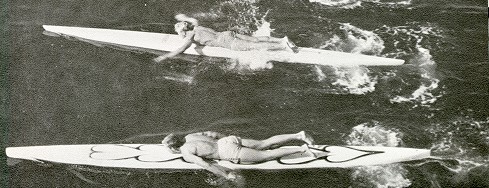
Apparently these craft were overlooked at the time by the Australian surf life saving movement, and by most subsequent commentators.
Furthermore, somewhere in this period the application of paraffin wax to the deck of the board became standard practice, greatly increasing the traction of the rider.
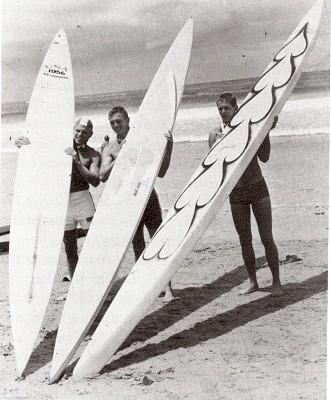 |
Tom Zahn, Greg Noll and Mike Bright with Fibreglass and Balsawood Paddleboards, Australia, 1956. Galton, page 112. The photograph (Torquay, by implication) is credited "Among the first of the malibus - around 1956". Also printed in Wells
(1982) Page 152.
Galton and Wells are in agreement on the date. A similar, but not
identical, photograph is printed in Bloomfield
(1959) facing page 161, with the credit
|
With an emphasis
on race and/or rescue performance, the lighter hollow board and the similarly
constructed surf ski were the preferred craft.
Although some solid
wood boards were still available at some clubs, these were usually
for recreational or training activities only.
Such was the status
of Duke Kahanamoku's famous Freshwater board
of 1914 ...
In the
mid-1940s the popularity of recreational board riding led to an attempt
to promote the activity independent of the formal SLSC structure.
This challenge was
quickly recognized and countered ...
"The senior
longboard became a national event in 1946 (102), but the SLSAA had been
pricked in 1945 by the formation of the Surf Board Association of Australia
which it stated was:
The board, identified by Albie Thoms (2000) as a finless board by Dave Rochlen Surfboards, was housed at Bondi for most of its stay and ridden by locals, Jack 'Bluey' Mayes, Ray Young and Aub Laidlaw.
"A Rochlen
skegless board had been brought to Sydney by the American actor, Peter
Lawford, when he arrived in Sydney in November 1950 to work on the Twentieth
Century Fox production, Kangaroo (1952), which was shot in the Flinders
Ranges in South Australia.
While filming,
he left the board at the Bondi surf club, where it was ridden by the local
beach inspectors, Jack 'Bluey' Mayes, Ray Young and Aub Laidlaw, though
it didn't seem to impress them, with Laidlaw later achieving notoriety
for banning both bikini-wearers and boardriders from Bondi Beach."
Thoms (2000) Page
63.
Contrast this with Greg McDonagh's conflicting report ...
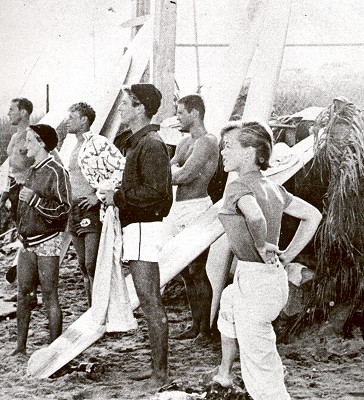 |
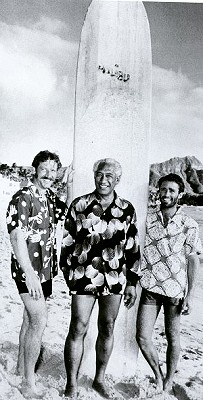 |
|
The Pit , Malibu, circa 1953. Lueras (1984) Page 115. Ricky Grigg Collection. |
Waikiki, circa 1952. Brown (2006) Page 143. |
|
"Ted Burns competing at Makaha in 1950 - said to be the first Australian to compete in Hawaii." Unknown : Looking Forward - Looking Back : History of Wollongong City SLSC 1915-2000. Page 27. The board Burns is
riding is certainly a short Malibu type board and the competition shirt
conforms with other examples in use at Makaha in this period.
Although this era precedes the development of an extended surfing press, surfboard designers published their plans in popular technical or handyman magazines as early as 1934. Bill Reid's 1953 article "Fun on a Plastic Surfboard" details a 9ft 6'' board with a long based fin constructed from a styrofoam blank with a plywood stringer, covered in muslin cloth and plastic sealer before fibreglassing. Popular
Mechanics Magazine July 1953 Volume 100 Number 1 page 159
|
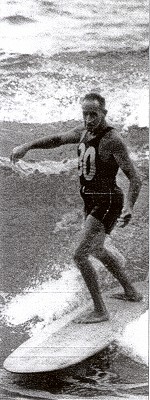 |
Circa 1955 Scott Dillion and Barry "Magoo" McGuigan, members of Bondi Surf Lifesaving Club, rode balsa boards in California at Hermosa Beach, courtesy of local Surf Life Guard Stations.
In biographical
notes, published in 1964, John ‘Nipper’ Williams, of Queenscliff S.L.S.A
claims he obtained a balsa Malibu in 1955-1956, bought used in Hawaii ...
In early 1956 Scott
Dillon returned to Bondi from the USA and purchased a Milacron, a job that
was conducive to his surfing activities.
In mid 1956 he encountered
'Flippy' Hoffman, a visiting American surfer, seriously ill with yellow
jaundice.
Flippy Hoffman was
a member of a famous surfing family that included Walter and Joyce Hoffman.
While Hoffman was
hospitalized, his balsa/fibreglass semi-gun was surfed by Scott Dillon
at Bondi Beach.
The board featured
an unusual concave deck.
This is probably
the board referred to by Bob Evans, his commentary probably dating Hoffman's
arrival in the later half of 1956 ...
"By chance
the liner carrying home of the Americans to Australia also carried two
Australian
surfboarders
returning from a world trip.
They were
Scott Dillon and Barry "McGoo" McGuigan and their non-surfing mate Bruce
Laird. Obsessed by the possibilities of what they had seen of the short
board in action overseas, the boys persuaded one of the Yanks to leave
his board in their care at Bondi while he journeyed to Victoria for the
big surf carnival.
This board,
the first of its kind to be used regularly south-side, was stored at Ross
Kelly's house and was ridden to a standstill, till its owner returned to
claim it."
Dave Simmons
recalls that "Bluey" Mayes confided that the board was highly valued by
the south side riders and effectively hidden from Hoffman on his return
to Bondi from Victoria.
On the 5th October 1956, the Sydney Morning Herald (SMH) announced the forthcoming International surf life saving program as Torquay 2nd December, Maroubra 8th December and Collaroy 9th December, 1956.
"Early in the 1956-1957 season, an International Surf Carnival, regarded as the first truly international carnival (133), and the delayed 1956 Australian Surf Championships wereThe countries invited to compete at all events included teams from Great Britain, New Zealand, South Africa, Ceylon, Hawaii and United States.held at Torquay, Victoria on 25 November and 2 December 1956 respectively, to coincide with the Olympic Games being held in Melbourne." Young, F. (2000) Page 71.
U.S.A.
- Hawaiian Preparations
Torquay surfer,
Peter Troy recalled
"... Arthur
Parkin. I think he's 94 years old, living in Queensland on the Sunshine
Coast, he was asked by the lifesaving authorities in Australia to travel
to California and Hawaii to instruct paid lifeguards to be put together
into a team to come out to Australia. And that was done I think as early
as 1952 and was sponsored by Ampol Petroleum, where they paid for that
man to go several times to America to teach these guys lifesaving methods."
The California
Surf Life Saving Association historian reports
"The Honorable
Judge Adrian Curlewis of Australia appointed Arthur Parkens (Parkyn?),
an Australian lifesaving instructor, to solicit participation from the
United States.
California
lifeguards and a contingent from the Territory of Hawaii decided to participate.
Both teams
were required trained and awarded, "The Australian Surflifesavers Medallion,"
so as to meet the international competition standards required for the
event."
There is some
uncertainty to the membership and the independence of the two teams.
Reports have alternative
spellings for many team member's names, sometimes it is unclear to which
team the member represents, and sometimes the teams are combined under
the general description "Americans".
Some reports of
the results from the various competitions are unclear.
Furthermore, Tom
Zahn's status as a representative of Hawaii was possibly questionable.
The (apparently
small) number of native Hawaiians in the team should also be noted.
What is certain is
the quality of their equipment and their ability as Watermen.
Several team members
were at the forefront of the development of the fibreglass surfboard, protégés
of Bob Simmons.
The paddle and Malibu
boards bought to Australia were built by some of the premier American designers
- Joe Quigg, George Downing and Dale Velsey-Hap Jacobs.
Although the term
only came to prominence in the surfing press circa 1978, see Warshaw
(2004) Pages 681 and 682, the Waterman concept was essentially formulated
by Tom Blake in the 1930s.
Blake (1935
and
1961)
promoted the idea of the fully qualified surfer, personified in Duke Kahanamoku,
whose skills not only included wave riding but proficiency in swimming,
body surfing, the paddle board, canoe paddling, sailing, fishing, diving,
rescue techniques and equipment construction and maintenance.
Blake's ideas were
particularly taken up by Tom Zahn who was an elite athlete, see Lynch
and Gault-Williams (2001) Pages 183 to 185.
In the early 1960s,
the concept lost its status to a heavy focus on waveriding skill that,
at an extreme, was valued over all other human traits.
That extreme was
called Micki Dora - See Steyck
and Kampion (2004).
US
Team Members
Members were selected
from various Californian professional life guard services - Los Angeles
County (LACO), Los Angeles City (LACity) and Santa Monica City (SMC).
Rusty WilliamsTeam
Captain (LACO)
Herb Barthels, Sr. Team Manager (LACity)
Tad Devine(SMC)
The son of Hollywood
actor, Andy Devine, Tad was an elite swimmer who
"Bob Burnside ... President ... of USLA 1963 - 1967"
Dave Ballinger
(LACO)
Chick McIlroy(LACO)
Paul McIlroy
(LACO)
Sheridan Byerly(LACO)
Roger Jensen(LACO)
Tim Guard-
George Downing surfboard
"Tim Guard's
lifelong residency in Hawaii has revolved around ocean related activities.
As president of McCabe Hamilton & Renny Co., he presides over the state's
largest and oldest stevedoring business. He earned his BA from the University
of Southern California in International Relations and served as an officer
in the U.S. Navy during the Vietnam era, where his combat citations were
the Bronze Star and Navy Commendation Medal. Guard's civic service leadership
roles include the Hawaii Maritime Center, Outrigger Canoe Club and Honolulu
Council of the Navy League, for which he currently serves as president.
Prior to joining McCabe, he owned and operated his own executive recruiting
company, Robert T. Guard & Associates."
The above team lists are based on those at http://www.cslsa.org/about/history.asp
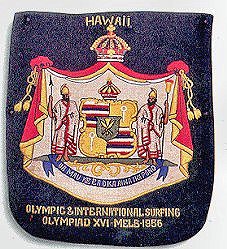 |
International Surfing Carnival, 1956. The Surfer's Journal Volume 9 No 2, 2000. Page 86. Photograph : unaccredited. |
Accompanying the Hawaiian Team in Melbourne was Duke Kahanamoku, returning to Australia as a guest of the Australian Olympic Committee
US
Team Arrival Anticipated
The Sunday Telegraph,
Sunday 11 November 1956 Page 84, noted ...
U.S. Team
for surf
Twelve American
and 10 Hawaiian lifesavers will arrive here on Tuesday to compete in surf
carnivals
in Melbourne
and Sydney.
They will
be the first lifesavers from America and Hawaii to compete in carnivals
in Australia.
The Americans
and the Hawaiians will appear at Torquay (Victoria) on November 25 and
December 2
and at Maroubra
and Collaroy on December 8 and 9.
The Americans
and Hawaiians will make their first appearance in Australia at carnivals
next weekend at Cronulla and Avalon.
Under a header "U.S. Surf team Will Tour'', a SMH article (11th October, 1956. Page 8) notes that the team will arrive in in Sydney in November and the success of the Carnival is due to a donation of two thousand pounds from Mr. G Walkley of Ampol.
Arrival
in Sydney - Tuesday 13th November 1956.
Members of the US
and Hawaiian teams arrived in Sydney on Tuesday 13th November 1956.
Noll's
narrative, and contemporary film, indicates that the teams and the Malibu
boards arrived by air ...
Noll records the initial Australian response to the new design was a mix of scepticism and laconic humour ..
Note that Greg Noll's assessment of Australian boardriding at this time is less than accurate...
Although
Noll's account appears to suggest the inclusion of the Malibu boards was
almost incidental ...
The day after the
U.S.A.-Hawaiian teams' arrival, the SMH headlined an
article "Ultra-Light Board for Surf"...
"Hawaiian
lifesaver Henry Shaffer
(sic, Shaeffer) believes his 26lb
board could revolutionise surfboard racing
(1)
in Australia.
Shaffer is
captain of the Hawaiian surf team, which arrived in Sydney yesterday with
10 American
lifesavers
to compete in international surf carnivals in Melbourne and Sydney during
the next month.
The most streamlined
racing boards in Sydney, made from 1/2 in (half inch) plywood, weigh
about
33-35 lb.
Shaffer's
surfboard is made of balsa wood reinforced with canvas, and is coated with
a thick layer of
fibre-glass.(2)
Several leading
Sydney board riders agreed last night that the lightweight balsa fibre-glass
boards
would give
the Hawaiians a tremendous advantage under normal conditions.(3)
But they claimed
the heavier Australian boards would be more at home in a big surf, where
the
Hawaiian boards
would be at a disadvantage.
Shaffer said:
"I must admit that the powerful Australian surf will be the final test
for the fibre-glass
board (4),
which has just come into vogue in the United States."(5)
The Americans,
all powerful rough-water swimmers are university graduates or students,
who spend
the summer
as professional lifeguards on beaches around Los Angeles.
The Hawaiian
and American teams will be billeted at the Balmoral Naval Depot (6)
until they leave for
Melbourne
next Wednesday.
They wiII
compete in carnivals at Torquay on November 25 and December 2, returning
to Sydney on
December 6
for carnivals at Maroubra, Dec. 8, and Collaroy, Dec. 9. "
As the teams were accommodated adjacent to Manly, a major research resource should be The Manly Daily. Unfortunately, for reasons unknown, the paper failed to archive copies circa 1955-1958 and none are held by the Manly-Warringah Library.
There is no mention
of the provision of equipment storage or for training facilities of the
visiting teams, the latter certainly requiring access to surfing conditions.
Since Manly Beach
was the closest surfing beach to the teams accommodation at Balmoral, it
is the most likely available training centre, with equipment storage facilities
at any of the beach's three surf lifesaving clubs.
Manly surfers had
reason to closely monitor the overseas competition.
The Manly SLSC sent
a team of 27 to the Torquay carnivals, contesting a variety of events.
Unfortunately, star
Manly swimmer Max Riddington was working in America and was not available
for selection.
His place fell to
another Manly club member, Barry Taylor.
The Sun journalist
covering the arrival, J. S. McAuley, briefly mentioned the new surfboard
design, but gave most prominence to Tom Zahn's paddling abilities ...
"Hawaiian
Tom Zahn will not lack staying power when he contests board contests at
the Olympic surf carnival at Torquay on Sunday week.
Zahn recently
won a 26 mile race in Hawaii.
The longest
board races in NSW are about three miles.
With the revolutionary
type boards the Hawaiians have brought with them they could trouble our
top riders."
He also gave details
of the team's competitive attire ...
"US and Hawaiian
surfers will wear colorful costumes (donated by Speedo) for
their first Australian appearance at Cronulla on Saturday and at Avalon
on Sunday."
Some details in the
article were, or proved to be, incorrect ...
"The Americans
are coastguards from Miami Beach, Florida.
They will
not be allowed to contest individual events, as they are paid professionals."
Cronulla
Beach - Saturday 17th November 1956.
In a brief report
focused on the skill of the U.S.A. team, the Sunday Telegraph (Sunday
18 November Page 76) reported ...
"U.S.
surfers impressive
The visiting
American surf team yesterday showed it could prove a major threat to Australia's
domination of international surfing.
The Americans
trained impressively before a crowd of 4000 at Cronulla beach."
Avalon
Beach - Sunday 18th November 1956.
The first public,
and most significant, demonstration of the performance capabilities of
the Malibu boards was on Sunday 18th November at Avalon beach, on the Northern
beaches peninsular.
The SMH reported (19th November, 1956. Page 3) in an article titled "Thousands Throng Beaches : Many Saved. US Surfers Show New Technique" ...
"Nearly 20,000
went to Avalon for the surf life saving carnival in which lifesavers
from United
States, Hawaii and New Zealand competed against Sydney clubs.
The American
surfers, standing sideways on small 10ft. boards and moving
at high speed,
received a warm reception from the crowd.
One of the
American surfers, Ted Levine (sic, Tad Devine) had the opportunity
to
demonstrate
his country's rescue technique in a genuine emergency.
Instead of
the Australian belt and reel, he used a "torpedo buoy' ".
Woolongong - November 1956, undated, but before Wednesday 24th.
| In the period before
the departure for Melbourne, Gordon Woods arranged to purchase a 9 ft 6”
Velzy-Jacobs surfboard from Bob Burnside.
As Burnside required the board for competition, exclusive possession would only be available to Woods when the teams returned to the U.S.A. To make certain of the deal, concerned that Burnside may receive a more attractive offer, Gordon Woods travelled to Torquay. As future owner, he was able to surf the board, his first exposure to Victorian waves. Gordon Woods, my notes from a phone conversation, 18th July 2005. Image right : Gordon
Woods and his Velzy-Jacobs Malibu board, circa 1958.
Two other boards
were known to be purchased by Manly surfers, Bob Pike and Bob Evans, and
given the Burnside-Woods arrangement it is possible that these were similar
transactions.
|
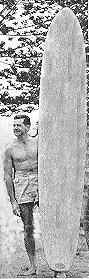 |
Bob Evans obtained a board (probably) built in Hawaii by North shore pioneer, George Downing ...
Note that this probably
was not an original finless Hot Curl,
circa 1937 but a later finned model based on the Hot Curl template.
Bob Evans was a
surfing photographer and future editor of Surfing
World magazine and prolific surf film producer.
Nat
Young (1983) also reports that ..."Peter Clare (bought)
a Quigg board" - page 89.
This claim is repeated
(but probably the source is Young) by Walding
(2003) page 25.
None of the reports appear to account for Greg Noll's (possibly self-made) board which he confirms was onsold
A report in the SMH
clearly indicates that seven Malibu boards of the Hawaiian team will be
onsold to Australian surfers at the end of the tour...
"Surfers To
Sell Boards
The visiting
Hawaiian surfers will sell their seven lightweight surfboards (1),
which created a sensation at Avalon last Sunday (2), after their
farewell appearance at Collaroy on December 9.
The boards,
which are made from balsa reinforced with two long strips of redwood (3)
and coated
with a thick
layer of fibre-glass, weigh 26lb.
The lightest
racing boards in Sydney, made from 1/2 inch plywood weigh from 33 to 23
lb.
The Hawaiian
boards, which have been used at Waikiki Beach for seven or eight years
(4),
can be made in less than a week.
Shorter, Wider
They are eight
feet long, compared with the average Australian length of 16 feet, but
are about five
inches wider
than the local board's 20-21 inches.(5)
Three hundred
people saw the Hawaiians give an exhibition of board riding after a special
carnival at
Avalon in
a big surf last Sunday.(2)
Unlike Australian
boardriders, the Hawaiians stood on the middle of their balsa boards, even
when
heavy white
water from the broken waves swept around their feet.
Harry Shaffer,
captain of the Hawaiian squad, said last night of the boards : "There is
no question of
selling out
to the highest bidder.
"We plan to
give our boards to the fellows we consider to be the real enthusiasts at
only a token
cost."
Wednesday's SMHreport
indicates that at least seven boards from Hawaii are to be on-sold to Australian
boardriders.
It is unclear if
this is the total number of boards, or if other boards were available from
the U.S.A. team.
Of the boards identified
above, two came from Hawaiian team members (Schroeder or Zahn and Guard)
and one from the U.S.A. team (Burnside).
Nat Young's report
that "Peter Clare (bought) a Quigg board".
does not identify the previous owner, boards by Joe Quigg were in use in
both Hawaii and California.
Nat Young
(1983) Page 89
There are, at least,
three boards unaccounted for.
It is known that
Greg Noll and Mike Bright brought Malibu boards to Australia, however
their fate is currently unknown.
A remote possibility
is that one transaction may have included an exchange of craft, at least
one Australian surf ski probably returning with a member of the Hawaiian
team.
In a report
despatched from Melbourne and published on the day of departure,
The
Sun's J. S. McAuley detailed accommodation and catering arrangements
for the competitors ...
"Australian
and overseas surfers billeted at Melbourne Showground will not go short
of meals during their 12-day stay. Frank Dennis, who is doing the catering
at Melbourne Stadium during the Games, is also looking after the surfers.
He has ordered nearly two tons of beef, to be eaten at breakfast. He is
providing a la carte dinners for the 350 surfers at night."
In another
article previewing Sunday's carnival, Melbourne's The Age notes
the attendance of international teams, possible highlights of the day's
events and the expectation of a large number of spectators ...
| Duke Kahanamoku
attended at least one of the carnivals at Torquay, probably the first.
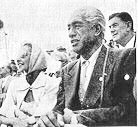
He returned to Australia for the 1956 Melbourne Olympic Games, where he and Mrs. (Nadine) Kahanamoku official guests of the Australian Olympic Organizing Committee. Duke and Nadine Kahanamoku International Surf Carnival, Torquay Victoria, 1956. Myers (1983) Page 18 and Galton, (1984) Page 108. |
 |
Following the competition,
the Daily Telegraph reported ...
"Surfing
draws 50,000
Melbourne,
Sun.
- Fifty thousand
people today saw 35 teams compete in an international carnival at Torquay.
...
The Americans
caused a surprise when they appeared with their surfboards.
Glass
Boards
The boards
were made of light fibre glass.
They were
very narrow, with rounded keels and resembled kayak canoes.
Australia's
reel and line method of surf rescue astounded the Americans.
The American
system is to carry a coil of nylon line into the surf and pay it out as
they swim to the patient."
The Age's coverage
of the contest reported a more modest number of spectators and disappointing
swell conditions ...
"Forty thousand
people, yesterday swarmed over the cliffs at the Toquay beach to
watch the International Surf Carnival.
Overseas Olympic
visitors and athletes were well represented in the crowd.
...
Despite high
winds the surf was weak and spasmodic and competitors got little help from
it.
Passing showers
sent the crowds scurrying for cover during the morning, but the sun shone
brightly for most of the afternoon.
Overseas visitors
did not see the typically Australian sport of surfing at its best because
of the poor surf."
The article makes
no reference to the use of fibreglass and balsa wood surfboards and an
extensive list of results, printed in a separate section, does not
include board, surf ski or surfboat events.
Barry Galton
report of the contest results includes ...
Compare Galton's
reported results with the claim by the Cronulla Club, noted by Faye Young
...
"At the International
Carnival (Torquay, 25th November), the (Cronulla)
Club won the ...Surf Board Race..."
Although
the Malibu board had already made an indelible mark on Sydney boardriders,
the Torquay Carnivals widened exposure to surfers from other countries
and other Australian states.
Queensland boardrider
and manufacturer, Hayden Kenny stated...
"I first came
in contact with a malibu board at Torquay beach in Victoria in November
of 1956 at the Olympic Games Surf Carnival.
The coach
of the Californian team, a Mr Arthur Parkyn (Parkens?), who
is a foundation member of Mooloolaba Surf Club, introduced me to some of
the Californian Team members who had malibu boards with them. I was able
to take one of the boards out for a few waves that day and was immediately
impressed with the wave riding capabilities of the craft.
And from that
day on I was hooked!".
Torquay
Beach - Sunday 2nd December 1956.
The SMH (Monday
3rd December, 1956. Page 12) reported
"Melbourne,
Sunday.
Only about
15,000 watched the championships.
There was
hardly any surf and by early afternoon the tide was well out to sea, leaving
swimmers a
long run and
wade to deep water.
The march past was
marred by a storm and ... a second storm cleared the beach and the
sandhills later."
"At the
Australian Championships (Torquay, 2nd December)... Brian
Keane (Cronulla)
was placed
second in the Surf Board Championship"
"We were riding sixteen and seventeen foot long boards. We knelt on them in general, we didn't have fins on the bottom of the board. Here's a guy walking down the beach with this strange little thing, and jumps on it and lies down, and everyone who was watching was thinking 'this guy isn't very good he can't even kneel!' (6) Fifty meters out from the beach he spun it around, caught a wave, walked up and down, hung toes over the nose, and did things we'd never seen before! That, basically was the reason we walked away from surf lifesaving, we wanted to learn to shape one of these things. The boards were taken with them after that weekend, we had nothing to copy. (7) We all started from scratch."
Later in 2006, Peter Troy was interviewed again, his further recollections add some relevant details.
"... Arthur Parkin. I think he's 94 years old, living in Queensland on the Sunshine Coast, he was asked by the lifesaving authorities in Australia to travel to California and Hawaii to instruct paid lifeguards to be put together into a team to come out to Australia. And that was done I think as early as 1952 and was sponsored by Ampol Petroleum, where they paid for that man to go several times to America to teach these guys lifesaving methods.(1)
At the same time, two of us, and I'm talking about another fellow called Vic Tantau (2), and myself, we were asked to give a demonstration of the early surfboard riding because of what we'd developed. So I was very fortunate to have been selected to give a demonstration of surfboard riding.
We basically went out on the 16-foot toothpicks, and Torquay beach is a very special beach for this because there's a large exposed rock off the beach called Haystack Rock, and the way it's come in on an angle on there, and they go off breaking towards the right, down into the middle of Torquay back beach, and it allows maybe a 300-metre ride on one of these surfboards.(3)
I distinctly remember being under the Torquay surf club, which was an elevated building up on lamp-posts, and they had all of the surf craft underneath, and I went under there to get something, and there was one of these American guys, and he was kneeling in the sand, and he was wrapping around a fin that he'd taken out of a little handbag that had his towel and bathers and everything in it, and he was wrapping newspaper around the edge, and putting it into a slot in the surfboard. And he picked up a piece of rock that was in the sand and he was hammering this fin into the surfboard. And of course I had no awareness of what this was about, so I was interested.(4)
I hadn't had the opportunity of ever talking to the guy, so I was just looking at him, and followed him down the beach and there was probably 8 or 10 other people on the beach that followed this guy down, carrying the surfboard under his arm, and he got into the water, (maybe it was 4 o'clock in the afternoon, I'm not quite sure) and lay on it, and of course we looked at that and thought, Well he's not very proficient because he can't even kneel on the surfboard, he's lying on it. And then we thought he wasn't very good either, because he only went 40 or 50 metres off the beach, and that was the last time we thought like that, because immediately he turned around, caught a wave in about three paddles, stood up, and crossed the wave, and then hot-dogged backwards and forwards, walking up and down the board, and we were all just - (Mick O'Regan: Gobsmacked?) Exactly.(5)
Well a couple of us went up to him, and we asked him, 'Can I have a go?' and I distinctly remember having a go on this board, but I couldn't really paddle the thing, and when I did try to stand up on it, it was so responsive, that it flipped out from underneath me (6), and so that was our only contact (1), because by that night, those guys had gone back to Geelong into their hotels (7), they'd packed their belongings and they were gone to Sydney. So the people who were on the beach that night had virtually two hours to think about it, and then they were going home to Melbourne, or to Ballarat, or Geelong, or somewhere, and within one or two weeks, those guys that were fairly competent with their hands had gone into their yards and tried to make one themselves. But they didn't have the material, so they had to make them out of marine ply with hardwood rails and they had bulkheads in the board rather like a small craft, and holes through those so that -
The four surfboards (8) that we knew those guys had, had gone that particular night, they'd gone to Sydney, and we now know that those four surfboards were bought by individuals in Sydney, and so Gordon Woods and Bob Evans and Bob Pike (9), other people in Sydney that acquired those boards, had the opportunity then of being able to copy them. But we in Victoria didn't, so we had to start off with just pure memory." (10)
Luke Williamson notes that
By the end of 1959, plans for a fibreglassed Malibu were available by post at at cost of 30 shillings. ($3.00)
On the following
day, the Sun Herald reported the conditions and results of theMaroubra
Carnival, accompanied by a photograph of B. Keane, Cronulla.
"Many boats
were swamped and skis and boards were tossed high in the air in the big
seas.
Results
Surfboard
Race : B. Keane (Aust.) 1; T. Devine (U.S.A.) 2; G. Noll (U.S.A.)
3.
Belt Race
: T. Devine (U.S.A.) 1.
Surf Race
: ? 1; T. Devine (U.S.A.) 2.
Beach Relay
: Hawaii 1; U.S.A. 2.
International
Beach Sprint : ? 1; L. Hangca (Hanagca? Honka?) (Hawaii)
2; P. Baulding (?) 3."
Upon the arrival of the national teams in Australia each was appointed a liaison officer to assist the team with their stay.(3) In the case of South Africa Dick Twight (of Collaroy SLSC) was appointed and joined the South Africans in Melbourne for the first leg of their visit. ... The team found the cool water temperature of Victorian beaches most unpleasant. More pleasant was the visit to a day of the Olympic Games and a meeting with surfing legend Duke Kahanamoku.(4) Soon the team was given a 'Kombibus' by the Association and had a relaxing drive from Melbourne to Sydney with a number of official engagements along the way.(5)
Once in Sydney the (South African) team was accommodated at the North Head army barracks (6) and continued their preparations for the international tests."
The SMH reported
the conditions and results of the Collaroy Carnival.
"Australian's
Win Most Events In Surf Carnival
A crowd of
6,000 saw Australians dominate most of yesterday's events at the international
surf carnival at Collaroy.
Australia
held a narrow lead of half a point over New Zealand after the first day
of the gala at Maroubra on Saturday.
But yesterday
Australia won the R. and R., surf race, beach sprint, board race, and marathon
surf race. ...
Conditions
were ideal.
The surf was
not as boisterous as at Maroubra, where the ski and board events were spoiled
by the big waves.
...
Double
To Lumsdaine
Barry Lumsdaine,
of Australia, won the surf race and a marathon surf relay race within 20
minutes of each other.
...
In the marathon
event competitors had to complete the course three times -swimming, on
surfboards, and on surf skis.
Lumsdaine
went further ahead with each stage, finally beating South African Leon
Coetzee by 40 yards, with 6ft 5in Hawaiian Tom Moore third.
Lumsdaine.
who is recognised as one of the best board riders in Sydney, gave the crowd
a thrill by standing up on his board as he rode a wave into the beach.
During the
afternoon:
- Brian Keane,
of Cronulla, had an easy win in the board race from Hawaiian Tommy Zahn,
who used a lightweight balsa board. and Mike Bright, of the United States.
- Tad Devine,
of the United States, son of famous film comedian Andy Devine, won the
belt race narrowly: after tripping in the run down the beach to the water.
Devine missed
selection on times in the United States Olympic team as a 400-metre swimmer
by only 0.1 s.
- Pat Manning,
of Australia, just held off the Hawaiian champion Lew Hangca in a close
beach sprint.
- Tom Schroeder,
of Hawaii, who has won several long distance canoe races in the islands,
had an impressive win in the ski race.
Schroeder
and the Hawaiian team captain, Harry Shaffer recently won a 46-mile two-man
canoe race across the dangerous Molokai Channel at Honolulu in an Aloha
Week festival.
Yesterday's
results:-
Board:
B. Keane (Aust.). 1: T. Zahn (Hawaii). 2; M. Brlght (U.S.A.).3.
Belt:
T. Devine (U.S.A.). 1: J. JarvIs (N.Z.). 2; T. Edwards (S. Africa). 3.
March past:
South Africa. 15. 1; Australia. 17. 2: New Zealand. 22. 3.
R. and
R.: Australia. 8.2. 1; New Zealand. 9.9. 2; South Africa. 9.92. 3
Beach relay:
Hawaii. 1; Australia. 2; U.S.A.. 3.
Beach sprint:
P. Mannina (Aust.). 1; L. Hanagca. (Hawaii). 2: C. Mcllroy (U.S.A.) 3.
Single
ski: T. Schroeder (Hawaii); 2: K. Ryan (N.Z.). 2: L. Cullenbourne (S.
AfrIca). 3.
Surf:
B. Lumsdaine (Aust.) 1; B. Hutchings (Aust.) 1; L. Hawker (N.Z.). 3.
Surf teams:
New Zealand. 26, 1; Australia. 30, 2; South Africa. 39, 3
Marathon
surf: B. Lumsdaine (Aust.), 1; L. Coetzee (S. Afrlca), 2: T. Moore
(Hawaii), 3.
PoInts
score: Australia. 44 1/2; New Zealand. 35; South Africa. 26 1/2; Hawaii,
U.S.A., 24."
Brawley notes
the inclusion of the "Marathon surf" event, a multi-discipline race,
as a fore-runner of the modern Ironman event.
He reports
the U.S.A. team as absent of the from the Collaroy carnival, but
notes the Malibu board demonstrations (restricted to U.S.A. surfers) and
the Americans' use of the Torpedo buoy, but not the fibreglassed paddleboards.
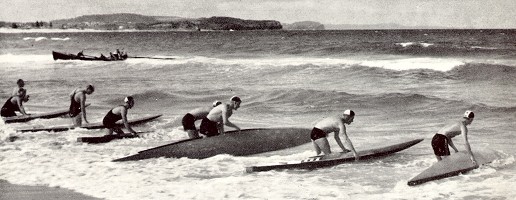
"While not
represented as a national team at the International Carnival, a team of
American professional lifeguards were also in Australia during 1956 and
conducted a number of demonstrations. As well as bringing the new Malibu
style surf board the Americans brought with them the cornerstone of their
surf life saving equipment, an apparatus which had long since been discarded
by Australian surf clubs, the torpedo buoy.
 |
The reported absence of the U.S.A. team is difficult to reconcile with the SMH's report of the Collaroy results, allocating them a total of 24 points.
Sean Brawley
provides an extended and detailed account of the use of the Torpedo buoy
and attempts by a member of the Collaroy SLSC to have Australian officials
examine it's potential.
"A lifesaver
did not have to worry about trying to drag a line through a heavy surf
and the buoy provided the patient with an immediate source of flotation.
The American lifesaving technique also relied on the rescuer taking their
patient to sea to be picked up by craft rather than attempting the often
dangerous task of renegotiating the shore break.
At the conclusion
of the Second International Test, Carnival Referee Hector McDonald was
presented with a torpedo buoy by the Americans. From the few brief demonstrations
he had seen, McDonald was convinced of their usefulness. He was certain
that if there had been a torpedo buoy on Collaroy Beach on the day of the
McKillop drowning, the young lifesaver would have been saved because he
would have floated back to the surface courtesy of the torpedo buoy and
his rescuers would have had less trouble getting out to sea as they did
with a belt. (detailed on pages 208 to 213)
He gave the
torpedo buoy to the Gear Improvement Committee of Sydney Branch to conduct
appraisal tests. Shortly after he was informed that the committee saw no
practical use in the torpedo buoy. Surprised, he approached those members
of the Committee who had supposedly tested the device, and found that none
of them had even seen it, let alone tested it.(81)
Outraged, McDonald got the torpedo buoy back, determined to prove the usefulness of the device. On Tuesday 2 July 1957, McDonald had Bill Abbott and Dick Twight trial the device in a big surf at Bilgola Beach. In conditions which were described as 'strenuous' with waves over 12 feet, the two Collaroy members conducted a number of tests. They found they had 'no trouble getting under the waves and out 200 yards' and in a race against a belt swimmer, the swimmer using the torpedo buoy got through the break and the 200 yards to the patient, two and a half minutes sooner than the beltman. They also found that if they were caught by a wave they came to the surface much more quickly. So strenuous were the two in their testing, a number of spectators gathered and an ambulance was called in the belief that a real rescue was in progress. In concluding their report Twight and Abbott noted: 'It is our opinion that this buoy has many uses for surf rescue work and feel that had this apparatus been available at the recent Collaroy drowning then possibly a tragedy may have been averted (82).
The report was submitted to Sydney Branch but was sat on for over a year, before McDonald finally succeeded in having the report distributed to members of the Branch Gear Improvement Committee.(83) Soon after Twight and Abbott's report finally reached the Gear Improvement Committee, Hector McDonald was elevated to Branch Superintendent, once again a first for a Collaroy member. With the power to now back his convictions, McDonald pushed for the adoption of the torpedo buoy. In this effort he was supported by the Avalon Lions Club which decided it would raise the necessary money to make the buoys and so raffled a car. With the money now available rubber manufacturer Dunlop was asked to make the first Australian made rubber torpedo buoy.(84) In the interim the petroleum company 'Ampol' secured a number of American torpedo buoys.
The reason why McDonald encountered so much opposition to the torpedo buoy is difficult to understand, given its overwhelming advantages. One view which was expressed to McDonald was the fear that Australian surf life saving would lose its position of international preeminence if it started to adopt American methods."
Brawley further
argues that the rejection of the Torpedo buoy was prompted by a fear of
the introduction of professionalism to lifesaving and concludes
Furthermore, the
Americans' equipment, the Torpedo buoy and the paddleboard, focused on
the role of the individual while Australian methods put a premium on the
value of team-work, particularly in the use of the belt and reel and the
surf-boat.
In competition,
team-work was exemplified in the March Past - an event of obscure, possibly
biblical, origin.
However, the team-work
ethos was often a deterrent to efficient rescue technique, especially
during normal weekdays when there was often less than a full compliment
of experienced crew available.
Conversely, the
enthusiasm to assist in a rescue by the inexperienced could also be detrimental.
While Australian
surf lifesaving officials initially ignored the potential of the Torpedo
buoy, flippers (U.S : swim-fins), the fibreglassed paddleboard and the
Malibu board, eventually these would adopted as practical rescue equipment.
The belt and reel
was finally replaced by the Torpedo buoy, and flippers, in the early 1990s
The impact of the U.S.A. and Hawaiian surfers and their boards was further enhanced in the new year when film of the team surfing Collaroy was shown as cinema newsreel footage - Movietone News 28/3 (1957).
|
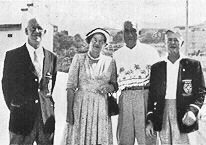
Claude West, Isabel Latham, Duke Kahanamoku and Lionel McDonald (Freshwater S.L.S.C. President), Freshwater Beach, 1956. Forbes in Myers (1983) Page 18. |
 |
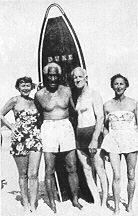
Duke Kahanamoku, Claude West and their board. Freshwater Beach 1956. Forbes in Myers (1983) Page 18. |
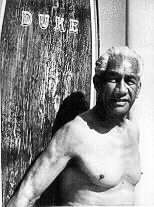
Duke Kahanamoku and his 1914 board . Freshwater Beach 1956. Carroll (1991) Page 29. Peter Luck Productions |
Balmoral Beach Club - ? December 1956.
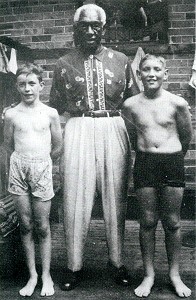
| Possibly in the
same week as the visit to Freshwater, Duke Kahanamoku visited the Balmoral
Beach Club, probably to renew friendships with Clem and Lou Morath, forged
at the 1939-1940 Pan-Pacific Games in Honolulu.
Image right :
|
 |
Bondi
Beach - ? December 1956.
The American-Hawaiian
surfers made an appearance at Bondi Beach.
Three and half minutes
of the team surfing, was recorded on film and included in the 1957 documentary,
Service
in the Sun.
To Come
: Zahn and Noll Others?
Detailed account
of riders performance - wave count lefts/rights turns and trims.short colours
Unfortunately, the History of the Bondi Surf Bathers Life Saving Club 1906-1956, has no information subsequent to February 1956 and therefore no details of the December visit of U.S.A. and Hawaiian surfers.
Manly Beach - ? December 1956.
Departure - ? December 1956.
Competitive
Results - An Overview.
Considering the unfamiliar surfing conditions
and the alien contest structure, the competitive results of the visitng
American and Hawaiian surfers appear to indicate a strong, if not dominant,
performance.
Apart from the outstanding results of
Cronulla's Brian Keane in the two Sydney internationals, the visitors dominated
the board paddling events.
Their ability was recognised from their
fist appearance at Cronulla.
The results indicate that the
U.S.A. and Hawaiian competitors performed well over a range of formats,
venues, craft and conditions.
Whether these results caused Australian
officials any concern of a possible threat to their dominace of the fledging
world movement is unclear.
It appears the performance of the American
teams, like their advanced equipment and methods, were politely ignored,
exemplifed by Brawley's account of SLSAA adminstrators' refusal to empirically
assess the merits of the Torpedo buoy, after the Collary carnival, see
above.
Post
Carnival Exposure
The impact of the
U.S.A. and Hawaiian surfers and their boards was further enhanced when
film of the team surfing Collaroy was shown as cinema newsreel footage
- Movietone News 28/3
(1957).
This was followed
by a colour film Service in the Sun (1957), commissioned
by sponsors Qantas and Ampol Australia, including three and half minutes
of the team surfing Malibu boards at Bondi.
"The films and our boards became the basis for the modern surfboard movement in Australia."
Greg Noll also
filmed Australian surf, sequences were later included in films shown in
America...
| Australian
Surfboards - Post 1956.
In 1956 the lack of balsa would be side stepped by immediately adapting Tom Blakes' now well proven Hollow board to Malibu dimensions with a large fin - known as the Okinuee. This design was manufactured by the noted 16 footer builders - Gordon Woods, Bill Wallace, Norm Casey and Barry Bennett. The enthusiasm for the new design was such that Gordon Woods had built and tested his first Okinuee before the US team departed. Gordon
Woods, Phone conversation, 18 th July 2005.
- Scott
Dillon Interview 29th June 2005. Coffs Harbour NSW.
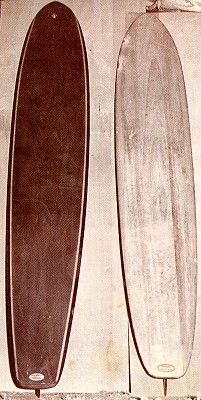
Gordon Woods' Velzy-Jacobs fibreglassed balsawood Malibu surfboard, purchased from Bob Burnside (right) and his first plywood copy. Nat History (1983) page 90. Photograph : Gordon Woods. |
 |
| By 1958, Australian boardriders were using
a variety of craft.
Consider the image, left. Malibus and Pigs, Bondi 1958. Source : Unknown, probably newspaper cutting. From the right, the first board with the shield decor and script "B.R." is probably a hollow Okinuee Malibu template. The next three are wide tail Pigs, the design credited to Dale Velsey of California. The second Pig , at centre, is probably a fibreglassed balsa board and the script decor, the rider's name. |
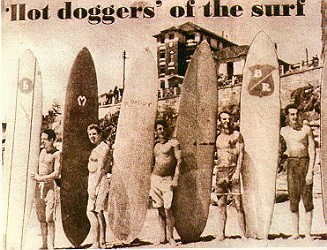 |
The third Pig is held by famous Bondi surfer,
Jack "Bluey" Mayes and is marked with an "M".
It is probably an early polystyrene board
built for Mayes by Scott Dillon and Noel Ward in Wellington Lane, Bondi,
circa 1958.
The final Malibu board is of particular
interest.
It is fibreglassed
with two widely spaced timber stringers in a very light toned blank,
possibly bleached balsawood.
This board closely
resembles one of the six boards filmed at Freshwater Beach in November
1956, noted above.
The "6" is
possibly a SLSC craft number.
Historians of surfing culture may note the riders are wearing long legged shorts, certainly a radical change from all previous Australian beach wear, but I could not possibly comment.
Surfboards
in New Zealand and South Africa - Post 1956.
With a traditional
relationship with the Australian movement, a more primitive manufacturing
base and limited access to materials, New Zealand and South Africa initially
adopted the Okinuee - the hollow timber adaptation of the malibu design
by Australian manufacturers.
In New Zealand the
design specifications were quickly absorbed, but the development of a locally
produced fibreglass board was still some years away.
The Levine
was a brand name for New Zealand hollow timber board marketed as a do-it-yourself
pre-cut kit, circa1958.
Based on the Malibu
board it featured a wide square tail, narrow rounded nose and a standard
D fin set right at the pod.
Most interesting
is the full vee bottom from nose to tail.
Common factory length
appears to be 9 ft 1 inch.
| .In New Zealand
the design specifications were quickly absorbed, but the development of
a locally produced fibreglass board was still some years away.
The Levine was a brand name for New Zealand hollow timber board marketed as a do-it-yourself pre-cut kit, circa1958. Based on the Malibu board it featured a wide square tail, narrow rounded nose and a standard D fin set right at the pod. Most interesting is the full vee bottom from nose to tail. Common factory length appears to be 9 ft 1 inch.Phone conversation with Tony Reid, New Zealand, circa 1999. Image right :
Williamson
(2000) Page 12.
Luke Williamson notes
..."In 1957, in Hamilton (New Zealand), Peter Miller made a longboard
based on a design published in 'Australian Outdoors Magazine' and it was
probably the most up-to-date surfboard in the country at the time.
Peter Miller: 'I built a a 10' longboard, 24" wide by 4" deep out of a 'I built a 10' longboard, 24" wide by 4" deep, out of a hollow white pine frame screwed to redwood nose and tail blocks. This was covered with thin marine ply. The rails were rounded, shaped redwood, and the fin was wood; 12" deep, shaped and fibre glassed to the board. I remember turning up at the Mount Maunganui Surf Life Saving Club with it when I had finished. No one had seen such a short board, and had never seen rounded rails or a fin. "That fin won't last the day, " shouted the club members. The board was hard to stand up on so I glued beading along the rails to stop myself from slipping off when standing -no one had told us about using wax.'' Williamson
(2000) Page 11.
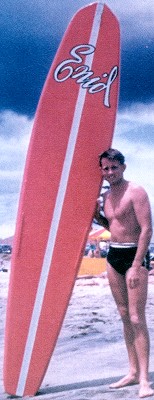
The Okinuee also
appeared in South Africa.
Image right:
|
 |
A further alternative
of using polystyrene foam, commercially available for insulation, was adapted
by Greg McDonagh at Freswater and Scott Dillon with Noel Ward at Bondi,
probably around1958.
It is possible that
by this time some builders may have seen or heard of Bill Reid's "Fun
on a Plastic Surfboard" article from 1953 that uses a styrofoam
blank.
The tour initiated
correspondence on construction and design between American and Australian
manufacturers,
that accelerated
with the introduction of polyester foam blanks.
Upon arrival, the Americans enthusiastically
promoted their new designs in the press; however the impact of the boards
in action was dramatic and the exposure had long term repercussions.
The impact was probably first in evidence
at Avalon Beach on the afternoon of Sunday 18th November, 1956.
Demand for the new board design was tempered
by a limited supply of balsawood and unfamiliararity with fibreglass technology,
but Australian board builders replicated the design in the well established
hollow plywood construction.
With improved access to materials, surfboard
manufacture swiftly moved from a backyard or surf club activity to an industial
factory location, initially centred in Brookvale, Sydney.
While boardriders were enthusiastic, Australian
surf life saving officials largely ignored American equipment and methods.
In the short term, some surf life saving
clubs actively discouraged the use of the Malibu board and viewed it's
popularity as a threat to their dominant beach presence.
In the long term, fibreglass technology
would dominate surfcraft construction and however, the Torpedo buoy would
eventually replace the belt and reel.
REFERENCES
The
International Surf Carnivals, Australia, 1956.
Australian Newspaper
Extracts
from Sydney Morning Herald, Daily Telegraph, The Sun and The Age.
| home | catalogue | history | references | appendix |