surfresearch.com.au
 |
surfresearch.com.au
bob
mctavish : pods for primates #1
|
Pods for Primates
A PERSONAL HISTORY OF
SURFBOARD DESIGN - Part I.
By Bob McTavish
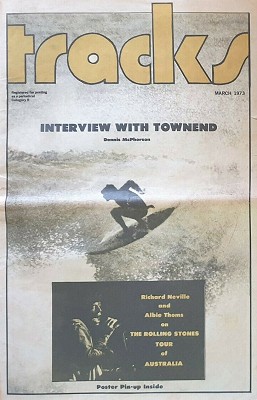
Tracks
March 1973
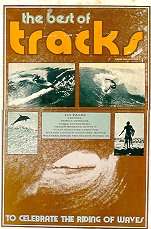
Reprinted in The
Best
of Tracks 1973, pages 120 - 121.
Introduction
Bob McTavish's ground breaking and
inspirational historical overview of Australian surfboard design
from the early solid timber boards until the current designs,
circa 1972, is a major influence on the creation of this web
site.
The sub-title,
possibly added by editor John Witig, is possibly an oblique
reference to Kenneth Clarke's outstanding 1969 BBC television
documentary and subsequent book, Civilisation - A Personal
View.
My notes in
brackets note spelling errors, some historical clarification and
associated links to relevant material in surfresearch.com.au.
Also see Part 2.
Though old time shapes seem crude in
retrospect, you can bet their creators put as much thought
into them as any modern-day shaper does.
It's just the
accumulated knowledge and competition that have whittled the
board down to what it is today.
And anyone's
story on shapes can really only reflect their own personal
experience.
Some of the
boards I thought were outstanding, other people have glanced
over, and vice-versa.
This story is
an attempt at a knowledgeable and open minded general view.
Ok,
starting our general view from under a palm tree on Waikiki
Beach two hundred years ago, the nearest thing to Eden,
almost permanent offshore winds, perfect climate, magic
iridescent water and lots of swells.
The few guys
out would have been on "Olo" (errata : Alaia) boards,
round-nose square tail 8-12 feet long, solid wood, good for
low buoyancy and going straight off on the beautiful
greenies.
Out comes
the king after awhile on his deluxe model (Olo), 16-18 feet of solid wood.
A bit easier
on the paddle, built for the big days, when it was time for
him to show why he was king.
So when
Duke Kohunomuku (sic, Kahanamoku) came to
Australia it was an Olo (Alaia,#100) he shaped out of a slab of
pine, and showed the amazed beach goers how to get some
value out of the surf.
Mainly the
rides were straight ins, but there was some angling going
on.
So on
through the hollow board era.
The hollows were a radical tangent
from centre.
Basically
14-16 feet with extremes on these figures.
Paddling
became the feature, probably partly because the surfboard
contests were simply paddling contests, out round a buoy
thing.
The surf
club era in Australia.
The (United)
States was a little less far out.
Boards
stayed more around the 10-12 foot mark, with a school of 8
foot devotees.
They
utilised the hollowness to improve performance, getting into
mild turns and some pretty hot angling, the era of taking
your girl out on the front of your board, or a dog.
Also drag
foot turns, headstands, backwards rides.
Basically,
the hollow boards were plywood deck and bottom, a few spares
(sic, spars) and ribs, and redwood, cedar, or pine
rails, square or solid shaped round ones.
A few people
were experimenters, the most famous was (Bob) Simmons
in the States, a true gremmie.
Lived in his
car, with blacked out windows for sleeping, cruised the
coast surf hunting, when it was free and easy, discovering
super spot after super spot.
Rincon,
Malibu,Windansea.
Simmons
lived and died surfing.
He was the
one who put a fin on a board (debateable, usualy
credited to Tom Blake, circa 1934).
And it's
stayed there.
One of the
interesting designs in the end of the finless era was the "hot curl".
A long
narrow rolled bottom shape, with a deep vee, which served
some of-the functions of a fin, mainly holding the tail in
the wave for hot trims.
There were
some searing rides on faster waves of California and of
course, Hawaii's racey walls were the perfect challenge for
the "hot curl".
Some of the
early finned models weren't a lot different from some modern
shapes, with some elaborate woodwork to give the desired
shape.
Then when
Simmons put together balsa and glass, things started to
cook.
The shapes (#101) were wide and long, but
pretty much along the modern concept, speed from the tail,
emphasis on turning and speed, with the forward shuffle
being popular, and even a few bodgies walking forward.
Pretty soon
a little tail-lift came in, to make the turns a bit sharper,
and it was found that the walking and shuffling became
easier, and it was advantageous to get forward as
you'd lay the whole board on the water and speed would go
up.
Enter the
trimming era.
This was
where the states (sic, States) were at, when
a visiting team of lifeguards brought their little sticks to
Australia (International
Surf Carnival Torquay 1956, held in
conjunction with the Melbourne Olympic Games).
Balsa and
glass, teardrops or (sic) around 9'-9' 6" and speed
shapes, 10' 6" or so.
I cannot
convey to you what a sensation these little pods seemed to
us primates, champions of the bronzed sands, patriots of the
paddle board.
Shock,
delight, scepticism.
But there
it was.
Turning,
walking, trimming, noseriding, outbacks (sic, cutbacks)
even.
1956.
No balsa at
first, so it was a rapid redesign of the hollow idea (the
Okinuee).
The makers
of the paddle boards, the sixteen footers, Bennett, Wallace,
Woods, kept on going.
Joe Larkin ,
Mick Hall, Bill Climer (sic Clymer), were the early
employee shapers, Les Patterson, Midget (Farrelly).
A bit later
Nipper Williams, who got one of the original American
balsas, became the early glasser.
Greg McDonagh got into the
coolite foam and epoxy resin making strong, light and
cleverly made boards.
'1959-1960'.
But, for
some reason they didn't make it big.
Roger
'Duck' Keiran in Queensland had the first shaping machine,
milling out balsa shapes.
And spray
gun glosses.
Duck had
many good ideas.
Removal fins
even.
Small fins.
His timing
was wrong that's all.
Ducky's
glasser Dick Laycock came to McDonagh's when Ducky's 'Okinui
Club' factory folded in Queensland, and the foam era began.
All the
shops started blowing their own blanks in fibreglass and
iron braced moulds.
(Barry)
Bennett, (Gordon) Woods, (Greg) McDonagh,
young Denny Keogh on
the North side and Bill Wallace in a leaky Bronte shed, and
Noel Ward and Scotty Dillon in a
Bondi basement (errata : "a garage, not a basement"
- Scott Dillon).
In 1960 the
first magazine came out - Severson's Surfer annual
- Bennett imported a stack - foreshadowing later moves.
Lee Cross
did an Australian version later that year, and a second in
1961.
In that
magazine we saw the first media look at design.
The ads
featured foam details.
The back
pages had a little story on Midget's & (Dave) Jacko's
(Jackman) boards for Hawaii.
11 foot
guns.
Dillon came
northside.
McDonagh
developed textured decks, a glue up machine, experimented
with a sanding machine.
Woodsie
pumped 'em out.
Bennett was
clean.
Joe Larkin
moved to Kirra to become Queensland's fourth shop.
Ray Woolsey
had been going for years in Brisbane.
A carpenter
with surfer son (, ?) Jeffries had made beautiful
balsa boards in Brisbane but faded when foam came in.
A plastics
firm, MPI, had powered on the foamies for a while in Ducky's
Qld shop, and a few years later Jeff Godby slipped into the
same factory.
For some
reason, Scott Dillon (Surfboards) started to boom in
Sydney, probably because it was the gremmie shop and
gremmies were the thing.
The yank
Dewey Weber in his rip-zip-pivot shoulder roll turn style
had a fair following.
Rodney
Sumpter and Mickey Mabbit (little Dooley) had the Peninsula
guys buying boards there, and Nat
(Young) and Kenno (Bob Kennerson)
got the Collaroy/Narrabeen guys buying.
Shapes
didn't do much in this era.
The standard
tail lifted things.
Square fins
were big, then the Phil fin or Reverse fin.
In 1962
Foley boards had a bit of interest.
A 6 ' 6"
wide tail board, another foreshadow.
Midget got
with Keyo (Surfboards) and he did things.
He peeled
Gopher (Rodney Sumpter) and Nat away, put 'em on
little 9' 9", thin pippy hot doggers and Nat came on.
Midget did a
balsa board 9' 7" and won Makaha (Contest, December 1962),
went to California, and matured rapidy .
His shapes
on his return looked very Reynolds Yater, a fluid design
leader in the states (sic).
Longer up to
10 feet, softer bottoms, littler round rails.
Continuing
his run he went into 'hook' tails, lengthening one rail by
an inch or two and slightly offsetting the tail shape.
They didn't
last, but don't give up!
They still
could get going.
Especially
the asymetrical or offset part.
A few guns
took on in these mid-years.
Scott Dillon
and Bob Pike shaped quite a few, along the lines of Dick
Brewer's Surfboards Hawaii designs (#102).
10' 6"-12'
6" huge bowls under nose, and six feet of dead straight tail
ending in an elaborate laminated wood tail block.
But the
dream of Balsa guns was done by Les Patterson, both at
Dillons and when he started up Dales (Dale Surfboards).
Dale's
hot-dog boards were nice.
Hippy, with
more tail lift, and beautiful color pigment jobs.
Dave
Chidgey, who had been a Foley board fanatic, got Midget and
McTavish to shape him an 8 foot gun, of balsa.
This little
zipper did it, Dee Why point got done over, if only he'd
stuck it out and they'taken on then, we could have had hot
sticks in the uncrowded days.
Surfing
Hollowdays (film, by Bruce Brown) came out and Phil (Edwards)
was really up there, the man. The American Surfer (magazine)
featured Hobie (Surfboards) ads of Phil's model; enter the golden
model era!
Enter three
stringers!!
Enter the
super- smooth "functional" era.
The Didge (Midget
Farrelly) took the lead, going to 10' 6" heavy, speed lined
multi - stringer boards, first at Woodsey's (Gordon
Woods Surfboards), then his own shop.
The thing
was to surf loose, slack jointed, feel the flow, sensitise
the equilibrium, trim, trim, trim, trim, but keep it smooth.
Looking
back, this thing got pretty ridiculous, so many people
thinking it was the outward traits that made it work.
Shot wrists,
bandy legged forward stances, wiggle waggle the head.
But the
thing really was that the speed potential was so
great, a 10' 6" stream-lined trimmer, and lines were
the most conducive to carving turns yet seen in "hot dog"
shapes.
Midget
really saw the potential and transcended "functional",
allowed the wave to become the base, the rhythm, the
platform, the basic frame to build on.
His speed
carried him through, past, and off and back on and in
then fast fast fast through again. Even the white
water was territory to be exploited for racey trims.
The weight
that could be sunk into the turns was pretty great.
Leverage off
a 35 pound board, especially moving fast could really make a
mess of a section, or propel you from one direction, for
example a left fade, through a muscle straining turn behind
the curl, and the momentum would carry you right back along
the bottom up into the tube again, if you could extend it
that far.
The man
himself arrived back here in 1964 in all his quiet glory.
The occasion
was the first world contest, a real thriller, with Midget
putting it together to edge out (Mike) Doyle and (Joey)
Cabell.
Phil surfed
around a bit, Palm Beach, Burleigh, Kirra (and Byron Bay).
Just to see
him made your eyeballs spin, but witness him wait for His (sic)
wave, set it up in his paddle, fade, turn, then somehow wind
it out to maximum speed and hold it there for timeless
second after second, with section after section ripping by,
grasping for him but without chance, then when he was ready,
he'd slam it into reverse, fling himself in full layout
fashion against his momentum, pendulum his giant board back
under him and trim it out left under the soup of the wave
had just desecrated.
Ole!!
So artful,
graceful, powerful, and so fine!
Cabell
really impressed some with his opposite approach.
His thing
was to stuff himself into (the) curl at every
opportunity, foresaking almost anything to do it, then dress
up the situation with a noseride if possible.
This meant
the wave became everything, every nuance and change in the
rate of peel had to be answered.
He rode
high, swooping out of the top to accelerate, trimming it
through, then stepping up to hold it back in there as long
as he could.
This
approach captured the imagination of those that had the nice
waves to work on, so up at Noosa it got going, with (Bob)
Cooper, Russell Hughes, Algie Grud, myself, Kevin Platt,
making the boards to suit at Hayden's
(Surfboards).
Mickey Dora, the Malibu
Monster, was the Californian idol of the time.
His cat like
pussy footed grace has not been forgotten.
No man ever
surfed sneakier, sleeker or slipperier, and the boys in the
Noosa toobes loved it!!
But no one
ever came near the man himself.
Shorter,
9'- 9' 6" fuller throughout, thin rails, finer.
Cabell's
model made at McDonagh's was the forerunner.
The Hayden
boards soon took on in Sydney, Brian Morris and Bondi guys
took to them.
Meanwhile
the Nat was coming on strong on massive Gordon Woods boards,
10' 4" and 10' 6", giant maroon planks, which were merely
toys to the big kid.
Long Reef,
Collaroy and Narrabeen were his hang-outs, and hang out he
did.
To see Nat
rip down an eight foot Reef peak, charge off (a) huge
backside turn and start stepping for the nose while still at
the bottom, arrive at the tip as he hit the top, curl both
feet over the nose and just fly across a big slope,
all loose and gangly, sent terror to your heart!
This kid
could do anything!!
Have mercy!!
To see him
crocodile paddle out overtaking everyone, knee paddle up on
tow (sic, toe) tips, digging deeper and faster than
was humanly possible, then stop and glide, let out a string
of obscenities, paddle out past everyone, take anyone's
wave, it was his, even if you were his best china plate (sic,
slang: china plate - mate - friend), noseride for seconds,
slam cutbacks, swear again, step up there again, laugh loud,
step back, flutter 10' 6" around like a paddle-pop stick,
charge up front and gun the shorebreak, swear a few more
times.
And do it
all day.
Next Midget
wowed everyone by winning the ' 65 (1965 Australian)
Championship on a stringerless (sic) clear piece of plastic,
little, wide, goodbye Phil.
Stringerless
came on strong. (#110)
Nat made Sam, a 9' 5" super thin, and went
off to win the (1966, San Deigo)
world championship, with tight, fast, busy surfing, as
opposed to (David) Nuuhiwa's ultimate trim noseriding
- rubberman style.
So that was
the thing that was going in Aussieland in 1966.
Shortish,
9'-9'6", 221/2 wide, hot dog shapes, Greenough fins,very
very deep, 12" at least.
Top shops
were Haydens, Cords where the Hayden gang went, Keyo's,
who'd always done well since the Farrelly days, Farrelly's
small business at Palm Beach, Woodseys, Bennetts, who'd
always made nice boards, Wayne Burton and Ron Grant shaping,
and over the southside Peter Clarke had Keith Paul (sic,
Paull) doing nicely, and Jacko's (Brian Jackson) always in there,
shaping.
Queensland
and Sydney were the real centres, the other states often
bought or thought their boards from there.
Local shops
were going, now manoeuvres consisted of turning from the
tail, walking to the centre to turn and maybe to the nose to
tail.
The stage
was set for change.
Images.
Despite the poor editing of the
article, the selection of images and the design layout are to
Tracks usual high standard. The photographs have been widely
reproduced.
1.Duke and board, 1935
2. Surfer, Waikiki, circa 1900.
Background image to text.
3. Phil Edwards, noseride.
4. Bob Simmons' Balsa, Plywood, Styrene
laminate surfboard, circa 1949.
5. Standard malibu surfboard, circa
1966.
6. Joey Cabell, noseride
surfresearch.com.au
Geoff Cater
(2000-2021) : Bob McTavish : Pods for Primates Part 1
http://www.surfresearch.com.au/1972_McT_Pods1_Feb.html