 |
surfresearch.com.au
history : solid
wood
|
solid wood : 1915 - 1934
| home | catalogue | history | references | appendix |
|
surfresearch.com.au
history : solid
wood
|
The huge
enthusiasm for boardriding generated by Duke Kahanamoku's
demonstrations was initially dampened by the onset of World
War 1, particually with the huge loss of troops in the failed
attempt, beginnning in April 1915, to invade Turkey on the
Gallipolli penisular.
Many young
Australians lost their lives on the battlefields of Europe,
including Manly Surf Club captain, journalist and Olympic
swimming champion, Cecil Healy.
"North Steyne had 53 of its 71 members enlist, while 108 joined up from Bondi (ten of them to be killed overseas), 37 enlisted from Collaroy (six died) and 20 members of a large enrolment from Manly also failed to return."
At North
Wollongong, "Fifty-eight members were in the
services, 6 being killed in action in the 1914-18 war."
With many
surf lifesavers volunteering for military service, many clubs
reported difficulties in maintaining patrol numbers and some,
such as Narrabeen, became inactive.
Despite
the difficulties of diminished membership, many clubs managed
to maintain a beach presence led by the few members considered
unfit or too young for military service.
Despite bitter
political discord, Australia did not use conscription during
the 1914-1918 War and while the age required for overseas
service was 21, it was not unknown for some enthusiastic
recruits to falsify their date of birth.
In Manly,
patrols were supplemented by a number of juniors, largely
recruited from Manly Public School and the Manly Amateur
Swimming Club.
These
"probationary members" were not required to pay
membership fees.
At
Cronulla, numbers fell to such an extent that the council
employed "an extra professional lifesaver" and
limited member's access to their clubhouse.
Remnants of the
membership such as Neville Cayley, Frank Moore and the
tireless Frank Stroud continued to maintain patrols and,
similar to Manly, patrols were supplemented with junior
lifesavers recruited from the Cronulla school.
At North
Wollongong:
"Despite the
serious depletion of membership as a result of enlistments
in World War I, the Club continued to be active.
Surf awards
were gained in 1914-15, none in 1915-16, then 14 Bronzes in
1917-18."
Despite
the apparent shadow of the European War on Australian society,
not all citizens could be said to be suffering.
Surf Life
Saving's outstanding historian, Sean Brawley, notes:
"(Ken) Hall recalled that the war years were a great time for young men such as himself, who were not old enough to enlist, because with so many men away the attracted the attention of older women when patrolling the beach."
While
Hall may have seen certain "romantic" benefits come his way at
the relatively remote Collaroy, on the more popular beaches
closer to the city the rewards were possibly greater.
Although
sensibly cloaked in innuendo, romantic liaisons occupy a
significant amount of copy in The Surf, the world's
first, if not only, surfriding newspaper.
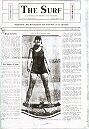
| The
first credited Australian surfing magazine was Manly
Surf Club's The
Surf, 1st December 1917. It ran for twenty editions, till 27 April 1918. Image Right: Vol 1 #1 Cover - Margan & Finney: Pictorial
History (1970) page 85.
|
 |
Following Duke Kahanamoku's surfing demonstrations in Australia (and New Zealand), many boards were made based on Duke's design within one season.
Some of
the Surf Life Saving Clubs became an established as centres of
boardriding , the clubhouse being a storage facility for the
boards, in a similar role to the Beach Clubs in Hawaii of the
period.
The use of
prone craft as an introduction to basic surf skills dates to
pre-history and has had many variations.
As Duke's
keenest pupil, Claude West (initially at Freshwater Club,
later moved to Manly) was one of the top boardriders for the
next 10 years.
Starting on one
of Duke's original boards (#100),
he was an enthusiast who encouraged others (notably 'Snowy'
McAllister of Manly and Adrian Curlewis of Palm Beach) and
whose surfing skills were a great asset as a professional
lifesaver at Manly Beach, where he often used a board for
rescues.
Duke
Kahanamoku's tandem partner, Isabel Letham, continued
boardriding at Freshwater up to 1918 when she moved to the USA
to work as a professional swimming instructor.
Other prominant
boardriders in the Manly area were Steve Dowling, 'Busty'
Walker, Geoff Wyld, Ossie Downing,
Reg Vaughn (Manly), Tom Walker (Seagulls), Barton Ronald,
Billy Hill and Lyal Pidcock.
Circa
1915 Collaroy Surf Life Saving Club member, Alf 'Weary' Lee
saw Duke Kahanamoku's Dee Why demonstration and built his own
board according to Duke's design.
Since the board
was stored in the club house, it was available for younger
club members to be introduced to boardriding.
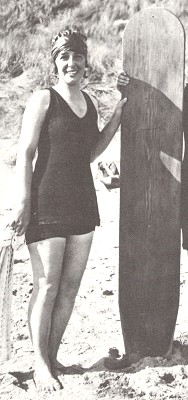
| Circa
1915, seventeen year old Grace Wootton (nee Smith) was
encouraged to try (prone) boarding at Point Lonsdale,
Victoria. Using a board brought to Australia by a Mr. Jackson and a Mr. Goldie from Hawaii. After some basic instruction Grace Wootton became a proficient and enthusiastic surfer, and a local carpenter was commisioned to make her her own board for the following season. The board was solid timber, finless and approximately 6 ft x 16 inches x +1inch thick. The cost of 12 shillings included her initials (GW) carved at one end. Photographs of Grace Wootton taken in 1916 show her surfing and her personally modified woolen swimsuit, purchased from Ball and Welch (Outfitters), Melbourne. - Wells: Sunny
Memories(1982) pages 157-158.
Image
right :
Grace Smith Wooton and Win Harrison, Point Lonsdale, Victoria, circa 1916. - Wells: Sunny
Memories(1982) page 157.
|
|
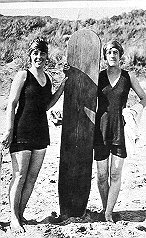
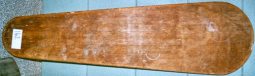
| Similar
boards to Grace Wootton's were in already use in NSW and
Queensland at this date, and they would were used
worldwide up to the 1960's. There are documented examples from Hawaii, USA, Australia, New Zealand, Bali, U.K. and South Africa. See Catalogue entry right... |
|
In Queensland,
two copies of Duke Kahanamoku's Alaia design were procured by
Greenmount Surf Lifesaving Club.
The increase in
(mainly prone) boardriding raised issues of public safety, and
in 1916 Coolangatta Town Council established restricted areas,
infringements punishable by board confiscation.
The arrival of
the two boards prompted further replicas made and surfed by
Sid 'Splinter' Chapman, Andy Gibson and a surfer known only as
Winders.
Prices varied
from two shillings and sixpence to seven shillings and
sixpence.
- Harvey: Queensland
Surfing (1983) page 8.
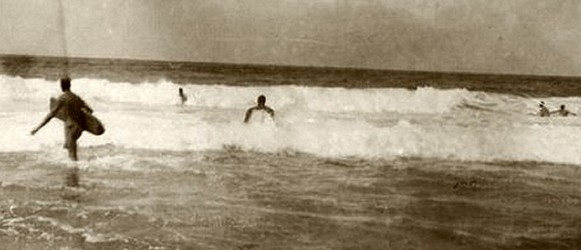
| Colonel Charles Guy Powles
surfing at Marakeba. Photograph taken
September 1917 by an unknown photographer. Ref: PA1-o-813-20-1 http://natlib.govt.nz/records/22409383?search[direction]=asc&search[il][collection]=Photographic+Archive&search[page]=4&search[path]=items&search[sort]=sort_date&search[text]=surf |
 |
| The
first credited Australian surfing magazine was Manly
Surf Club's The
Surf, 1st December 1917. It ran for twenty editions, till 27 April 1918. Image Right: Vol 1 #1 Cover - Margan & Finney: Pictorial
History (1970) page 85.
|
|
The Deewhy Surfer, circa 1919-1920, was possibly a similar publication, .
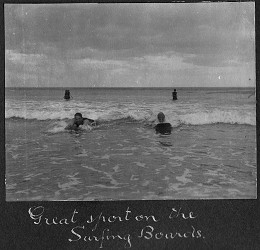 Great Sport on the Surfing Boards. |
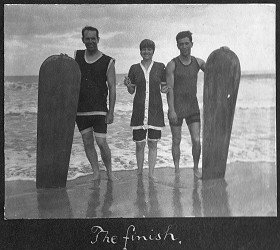 The Finish. |
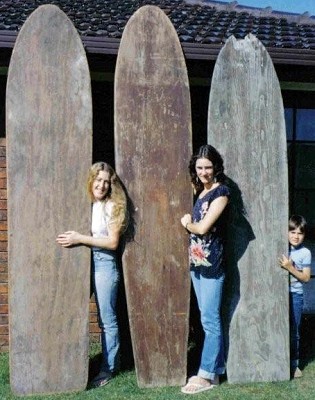 |
Note the narrow tail of the centre board. The board on the far right was given to Peter Troy. Image courtesy of Leonie Vrymoet, November 2009. Leonie noted: 1981.. thought it might be of interest to you... Cheers. Regards Leonie" |
Palm
Beach is to become a favoured board riding beach, producing
several champions and a strong pro-surfboard lobby within the
ASLA.
A solid
wood board shaped by John Rawson is held by Quicksilver
Australia, currently displayed at their George Street store,
Sydney.
In February
1920 Claude West used his board to rescue a swimmer at Manly.
The patient was
the Australian Goveror-General, Sir Ronald Mungo Fergerson,
who presented his rescuer with his silver dresswatch.
A
newspaper report of 'Australian' Championships at Manly, March
1920 records the results of a
surfboard race
as ...
1. A. McKenzie
(North Bondi)
2. Oswald
Downing (Manly)
3. A. Moxan
(North Bondi).
A similar
newspaper report of the Bondi Championships, April 1921
records the results of a surfboard race as 1. A. McKenzie
(North Bondi)
2. A. Moxan.
Other starters
were Oswald Downing and Claude West (Manly).
Although
Australian board construction and design were essentially
static during this period, Hawaiian and U.S. mainland
boardriders made considerable to improvements.
With the end of
World War 1 in 1918, military technological developments such
as the development of industrial glues and varnishes were able
to be incorporated into surf craft construction.
First
commercial application was by Pacific Systems Homes (USA) with
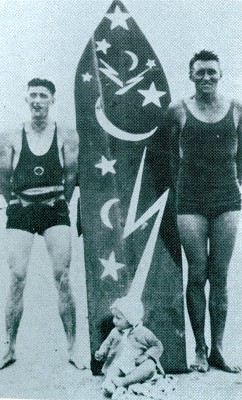
their famous Swastika model constructed of a laminated pine,
balsa and redwood blank, circa 1930.
The development
of laminated plywood was essential in the development of the
Hollow board.
Around 1925,
Tom Blake began experimenting with hollowed boards, and
in 1931 he submitted a patent application for a ' Water Sled'.
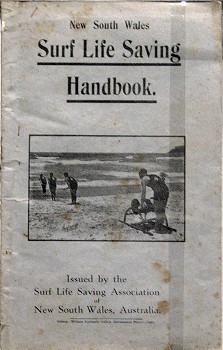
| By
1921, the Surf Life Saving Association printed their
first handbook circa 1921. The book probably formed the basis for subsequent publications accredited as the Handbook of the Surf Life Saving Association of Australia, see below. Image
right: |
 |
| At the
North Bondi carnival: "Surf Board Race- J. C Downing. (Manly), 1; E. Roston (North Bondi), 2." - The Sydney Morning Herald, Monday 13 February 1922, page 10. In the
1921-22 season, Manly SLSC procured their third
surfboat, the Johnnie Walker.
- Harris: Manly LSC
(1961) page 42.
At the
Australian Championships at Manly 1922, the board event
(demonstration or race?) results were . 1. Claude West (Manly), 2. A. McKenzie (North Bondi) 3. Oswald Downing (Manly) West, who had apparently dominated the demonstations, was soon to retire. Oswald
Downing was an early board builder and a trainee
architect and had drawn up plans.
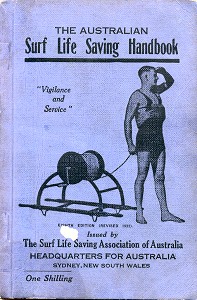
See details in the 1938 tenth edtion, image and link right. |
 |
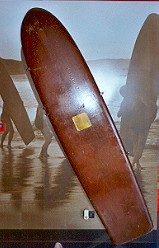
| Ossie
Downing's board was later given to 'Snowy'
McAlister.
The
board was donated by 'Snowy' McAlister in 1974 to the
SLSA . - Galton: Gladiators
(1984) page 33.
For board details Catalogue #175, image and link right.
|
 |
At the
1924 the Australian Championships, Manly, the surfboard
display was won by Charles Justin 'Snowy' McAlister of Manly
Surf Club.
He saw Duke
Kahanamoku in 1915, and soon after began surfing on his
mother's pine ironing board:
"I
used to wag school and rush down to the beach with it. I
got away with it a number of times,
but
she eventually found out because I would come home
sunburnt."
This was
followed by a self-made plywood board and his first full size
board, a gift from Oswald Downing, see above.
"I used to
go into the timber yards in the city and buty a ten by three
foot piece of wood about two feet thick (sic,
inches?), which I had delivered to the cargo whalf beside
the Manly ferry.
I'd lug it
home, then carve it, varnish it overnight and try it out the
next morning.
We were
getting murdrered in those days.
The boards
had no fins.
We'd go
straight down the face of the wave instead of riding the
corners as the Duke had done. When we saw him do that we
thought he was just riding crooked."
The start
of a impressive competitive record, 'Snowy' McAlister won
board displays in Sydney in 1923-24 (Manly), 1924-25 (Manly),
1925-26 (North Bondi) and 1926-27 (Manly, second Les
Ellinson).
His record at
Newcastle was even more outstanding with wins in 1923-24,
1925-26, 1927-28, 1930-31, 1931-32, 1934-35 and 1935-36.
All these
victories were on solid boards.
He competed to
1938 and then made a comeback at the 1956 Olympic
Carnival, Torquay.
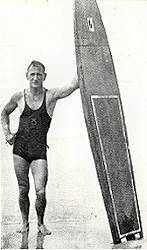 |
Image
left : Snowy McAlister, Manly circa 1928. Probably a Snowy McAlister shaped board, not the Downing board. - Harris: Manly SLSC
(1961) page 54.
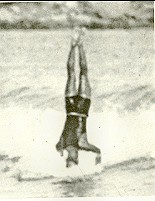
Image
right : Snowy McAlister, Bondi, circa 1925. Possibly the Downing board. - Harris: Manly SLSC
(1961) page 54.
|
 |
Circa 1923
Adrian Curlewis purchased a used 70 lb board from Claude West,
to surf at Palm Beach...
"owner
in hospital owing to using same"- West was
injured while transferring a patient to a surfboat.
This
board was replaced by one of similar design in 1926 by Les V.
Hind of North Steyne for five pounds and fifteen shillings,
including delivery.
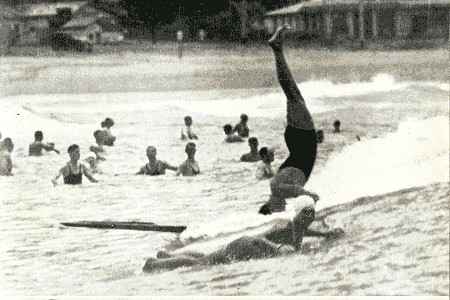
Curlewis
became a noted surf performer, illustrated by a photograph
printed in Surf in Australia magazine in 1936.
The
photograph was subsequently re-printed in Maxwell's Surf
(1949) and Brawley's Palm Beach
SLSC (1996) page 55.
 |
 |
|
- Maxwell: Surf (1949) , facing page 208. Note that the other boardrider in the phototgraph is female. |
Maroubra, circa 1929. Pacific Longboarder Magazine Volume 1 Number 2, Page 62. |
"Sir Adrian
Curlewis was born in 1901.
He graduated
from Sydney University and was called to the Bar in 1927.
He served in
Malaya in World War II and was a prisoner of war from 1942
to 1945.
His
commitment to public service is also exemplified by his
Presidency of the Surf Life Saving Association of Australia
from 1933 to 1974, his position as sole Life Governor of
that Association from 1974, and his Presidency of the
International Council of Surf Life Saving from 1956 to 1973.
He was a New
South Wales District Court Judge from 1948 to 1971, retiring
at the age of 70."
"Upon
moving to the new premises the Club sought further
balterations and contracted a Newport builder to begin work.
As a
courtesy the club informed the Council of its plans to
establish a surfboard locker under the building (to house
the reputed 16 boards of members held in the club), and to
build a fence.
On both
counts the Council refused, leading to yet more acrimony."
- Brawley: Palm Beach
SLSC (1996) page 30.
"During the
1920's, many members from Sydney and Helensburgh lodged in
the club house at week ends.
At the
northern end of the building in the boatshed lockers kept by
individual members were located, each mainly with a nickname
painted thereon, such as "Sheik, Spike, Daki, Grumpy, The
Polar Bear, Soapy, Yuk, Lardy" and many others." -
Thorn: Stanwell
Park SLSC (1983) page 14.
At
Coolangatta boardriding continued to expand during the 1920's.
Basic
competitions (using a standing take-off) were organised and
riders included Clarrie Englert, Bill Davies, 'Bluey' Gray and
later, Jack Ajax.
'Bluey' Gray
wrote to Hawaiian and Californian surfers in an attempt to be
aware of current developments. Problems in sourcing suitable
redwood saw 'Splinter' Chapman, by now considered the coast's
top rider, use local Bolly gum to build boards.
The design
remained a faithfull replica.
Sid 'Splinter'
Chapman could still recall the dimensions in sixty years later
"because the design that the Duke used was the best."
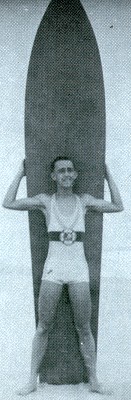
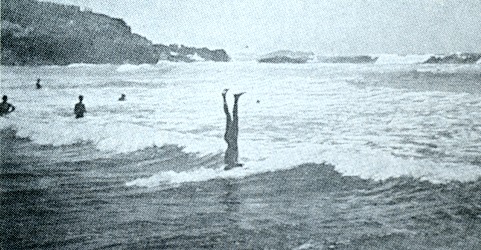 Above : Clarrie Englet headstand , Queensland 1920's Harvey: Queensland Surfing (1983) page 8. This is actually a photograph of Tommy Walker at Yamba in 1912-1913. See: before duke 1900 - 1914 Right
: Ken Mainsbridge and solid wood board,
Queensland 1920's |
 |
Circa
1925 Sydney rider Anslie 'Sprint' Walker surfed at Portsea,
Victoria.
Transport
problems were overcome by leaving the board at the beach,
buried in the sand.
The board was
eventually donated to the Torquay Surf Live Saving Club, but
was destroyed when the club house burnt down in 1970.
Subequently
'Sprint' Walker built a replica from Canadian redwood with an
adze - the original method.
Donald Arlie
"Mick' Warden (1904-1956) of Milton on the NSW south coast,
attended Hawkesbury Agricultural College along with
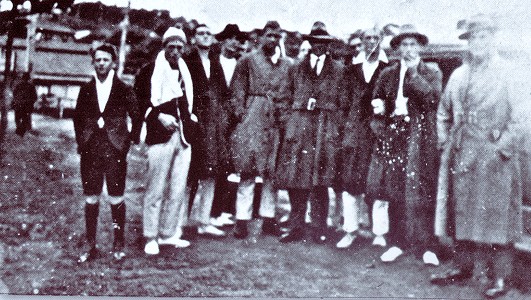
fellow swimmer Andrew "Boy Charlton.
Following college he moved to Wollongong and joined the Austinmer SLSC in 1922 and was a member of the recue and rescusitation team that won the Illawarra Branch Championship in 1924.
- Johnson: Mollymook SLSC (2010) page 5.
In 1923,
Charton visited Austinmer, where stayed at Iden, the
home of a Mrs. Warden, probably a relative of Mick Warden.
While there, he
attended the Santwell Park SLSC carnival, photographed (fifth
from the left) with members of the Austinmer team.
Returning in
1924, Charlton performed briefly in the local rock pool.
- Wilton and Salm : Austinmer SLSC (2009) pages13-.15
 |
- Wilton and Salm : Austinmer SLSC (2009) pages13-.15. |
In December
1925 Warden visited Honolulu for four months where he became
interested in surfboard riding, possibly meeting the
Kahanamoku brothers.
Mick returned
to Wollongong with two Hawaiian solid timber boards, <MW>
and Toots II.
He continued to
compete for the Austinmer club and in 1934 moved back to
Milton where he was instrumental in the formation of the
Mollymook SLSC.
- Johnson: Mollymook SLSC (2010) page 5.
Toots II was
pictued
outside the clubhouse in a photograph of the Austimer's
champion R&R and surf teams in circa 1925, and a similar
photograph was taken of the club's 1928-1929 R&R
champions, see below.
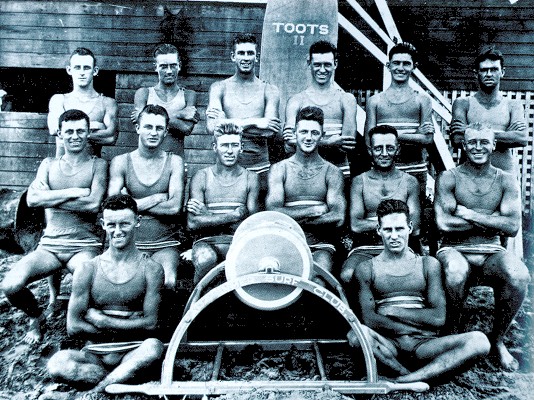 |
Austimer's champion R&R and surf teams with Toots II, circa 1925. Wilton
and Salm : Austinmer
SLSC Right:
Detail
from |
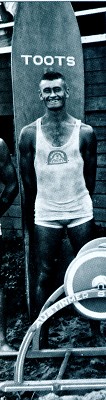 |
- noted by
Ivan Johnson, phone call July 2011.
Many thanks to
Ivan.
<MW> , with a square nose and repairs, is currently is held in the Mollymook SLSC and Toots is photographed with Fred Mumford outside the original Mollymook surf club in 1938.
- Johnson: Mollymook SLSC
(2010) pages 23 and 24.
Also see:
Mollymook
Beach, Milton
http://trove.nla.gov.au/work/15561413?q=subject%3A%22SURFBOARDS%22&c=picture
Also see Snow McAlister : Sprint Walker, Solid Wood Boards and Victorian Surfing
'Sawfish',
Manly
Surf Life Saving Club’s 4th surfboat, was financed by public
showing of a 18 foot sawfish caught by club members on October
10, 1926.
Launched in
December 1926, the boat was designed by Fred
Notting.
A double-ended
clinker-built but with four thwarts (Oars Nos. 2 and 3 now
offset), it was been the standard ever since.
The sawfish was
accquired by the Australian Museum for exhibit.
'Snowy'
McAlister was the national (?) surfboard champion 1924 to
1928.
He visited
England and South Africa ? on the way to the Amsterdam
Olympics in 1928, accompanying another Manly Surf Club member
and Olympic swimmer, Andrew 'Boy' Carlton.
During
the 1920's Russell Henry 'Busty' Walker used a
canoe to act as a judge at the buoys at Manly Surf Carnivals
and others had used canoes in the surf at Bronte and Bondi.
"Canoe
Race: 'She'll Do' (Wright and Olsen), 1.
Most of
the other competitors were swamped by getting brondside-on
to the breakers."
- Bondi
Surf Carnival.
The Sydney
Morning Herald, Monday 7 January 1924, page 6.
The use of these craft was a possible early influence on G.A. Crakanthorpe's development of the surf ski, circa 1930.
|
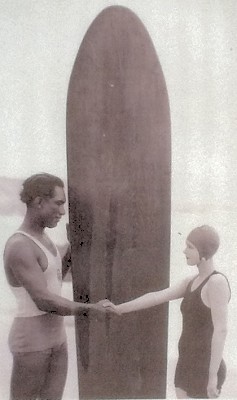
Duke Kahanamoku and Isabel Letham, Waikiki - California, 1920s. Duke's swimming suit bears the Outrigger canoe club logo. Image courtesy of Loch Ledford, Currumbin. Loch notes: "I'm from Hawaii, growing up there in the early 50's and being a member of the old Outrigger Canoe Club when it was on Waikiki beach where the hotel is now. Duke was still actively surfing then and I as young surfer spent many times with him in the water or on many celebration activities where he was always the main attraction. I along with many thousands attended his "Beachboy" funeral at Waikiki." Many thanks to Loch. |
 |
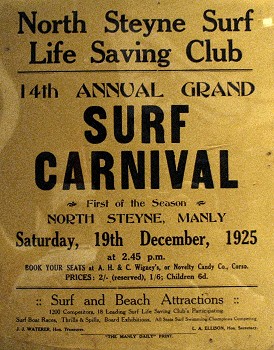
| The
North Steyne Surf Life Saving Club promoted their 4th
annual carnival, scheduled for Saturday 19th December
1925 at 2.45pm, with a flyer printed by the Manly
Daily Press.
The
noted "Surf and Beach Attractions" included:
Image
right: |
 |
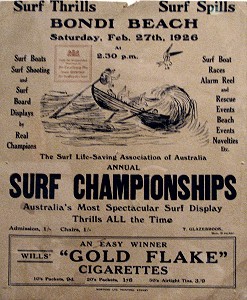
| The
Australian Surf Life Saving Association promoted their
annual surf championships, scheduled for Saturday 27th
February 1926 at 2.30 pm, with a flyer printed by the
Mortons Ltd. Sydney.
It
noted : Image
right: |
 |
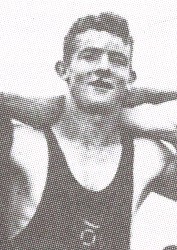
In the late 1920's, Collaroy SLSC member Bert Chequer (image below) manufactured surfboards commerically - 15 shillings cheaper than North Steyne builder, Les Hind...
| "In the early 1920s, Chequer had been captivated by the likes of board riders such as Weary Lee, Chic Proctor and Ron Harris and made his first surfboard at 17 using a design similar to Buster Quinn's. As the years progressed, however, he refined Quinn's design, to produce a board which was the envy of many other board riders in the Club. Dick Swift requested he build him a board (the board is still in the Club house) and with delivery of the board a flood of similar requests were forthcoming. With little work in his father's building business, Chequer decided to try his hand at commercial surfboard building -one of the earliest such enterprises in the country. The cost of a Chequer board was £5 which included delivery. |
 |
A board
took just on two days to build and was totally shaped by
hand.
Once shaped
the board was coated with Linseed oil, before two coats of
Velspar yacht varnish was applied.
In his
initial experimentation with the varnish on his own board,
the yellow finish it gave off prompted the board to be known
as the 'Yellow Peril'.
Boards were
usually intricately marked either with a name, the initials
of the owner, or with the Club emblem.
Chequer was
soon supplyIng individuals and clubs up and down the New
South Wales coast and as far away as Phillip Island in
Victoria.
While the
business was relatively successful, there was a downside for
Chequer.
Because he
was a surfboard manufacturer, making money out of what was
now regarded as a piece of life saving equipment the
Association claimed he was no longer an amateur by their
definition.
He was
therefore prohibited from surf life saving competition
between 1932 and 1936."
During
1920-1921, George Cunha returned to Australia for a series of
swimming competitions along with , American swimmers Ludy
Langer and Pua Kealoha.
The Kealoha
family had a stong connection with surfboard and canoe
surfriding at Waikiki in the early years of the 20th century.
Events were
held in Victoria at St. Kilda on 19th February and Melbourne
City Baths on the 23rd and 26th February.
They may have
also appeared at Newcastle, NSW.
The First
Club House
In its first
year, the fledgling club negotiated some land from Warringah
Shire Council at the foot of the headland.
Syd Lupton
designed a club house.
Warringah
Council donated £150 and Manly Council was persuaded to
contribute £200.
Club members
spent all their spare time for the next eight weeks
preparing the foundations with tools borrowed from Manly
Council.
The wooden
building cost £481 (the average wage for a man in NSW was
£4/13/6).
When it was
completed, members worked again to fit out the interior and
paint and oil the timbers. Finances were so tight that they
could not afford the £15 deposit for electricity to be
connected. Eventually, it was donated by W. Shirley.
The
official opening was held at the beginning of the next
season.
It was clear
that members had'heen hard at work during the winter
organising sponsorships from local businesses, which
featured in the programme."
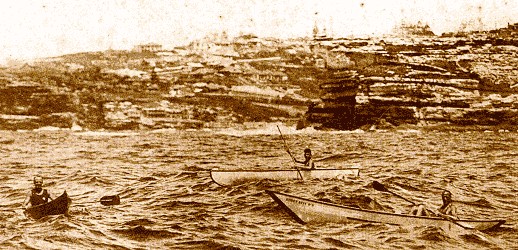 |
Bondi Beach circa 1926. The Stickey Beak is in the foreground. Elder: North Bondi SLSC (2006) page 45. |
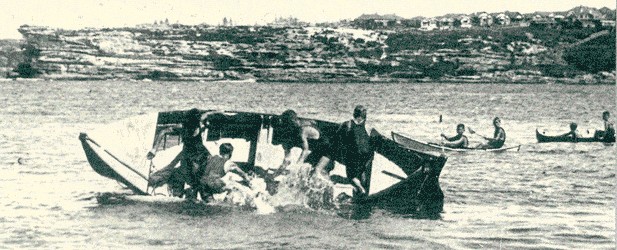 |
Bondi Beach circa 1926. Note the accompanying surf canoes, right. Elder: North Bondi SLSC (2006) page 50. |
| In the
late 1920's T.A. Brown and A. Williams used a corkwood
board from Honolulu at Byron Bay NSW.
Eric Mallen purchased a cedar slab that was once the counter of the Commerical Bank, and had it shaped into a fouteen foot board by Jack Wilson. Proving to be too unwieldy, the board was later cut down, decorated and named 'Leaping Lena'. On large days Eric Mallen would 'leap' off the end of the large jetty that ran out from Main Street to save paddling. - Harvey: Queensland
Surfing (1983) page 8.
Image
Right
Byron Bay NSW, circa 1929 - Harvey: Queensland Surfing (1983) page 8 |
|
Charlton came second in the 1500
metres and second in the 400 metres.
Other swimmers at the games included
the American team members Johnny Weismuller and Buster Crabbe,
both who later played the role of Tarzan in Hollywood films.
On the day of 400 metre semi-finals:
"Among the crowd that day was a
group of Charlton supporters who had come from the Manly Surf
Club, including two late arrivals, Sandy (sic) McAlister
and Tommy Farrell.
They had saved every penny to
travel tourist class on the liner Jervis Bay with just
one purpose: to see their close friend win the 1500 metres.
When a stowaway caused the Jervis
Bay to be delayed they transferred to another vessel,
but further problems occurred in London and they missed the
race.
Having gone forty-eight hours
without sleep they arrived at the pool while Charlton's 400
metres heat was being swum.
McAlister, a champion board rider,
talked his way on to the starting boards and saw the rest of
the races from a prime position."
- Fenton: They Called him Boy (2006) page 189.
Following the Olymic competition,
McAlister travelled to England, apparently with a surfboard, and
was interviewed by the Daily Mail on his intention to
surf on the beaches of Cornwall.
See Source Documents:
1928 The Daily Mail : Snowy
McAlister -Surf-board Riding, Cornwall.
 |
Thorn:
Stanwell
Park
SLSC |
| Two men surfboarding
on Bondi Beach, New South Wales, 27 February 1929. 1 negative : glass, b&w ; 8.3 x 10.8 cm. Fairfax Archives. Trove Fairfax Corporation. 1929, Two men surfboarding on Bondi Beach, New South Wales, 27 February 1929 , viewed 1 March 2018 http://nla.gov.au/nla.obj-157488129 |
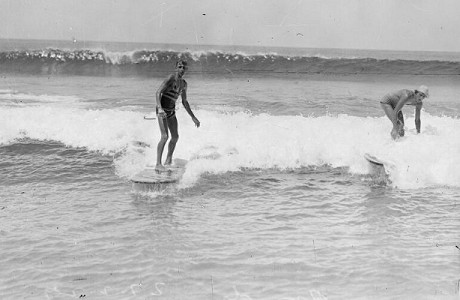 |
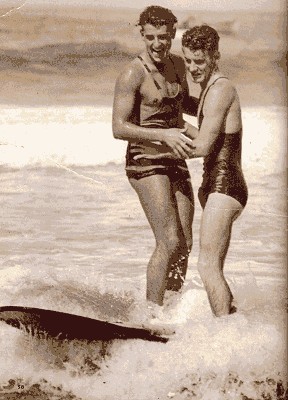 |
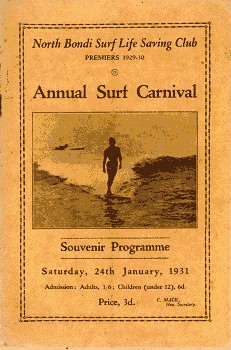 North Bondi Surf Life Saving Club Annual Surf Carnival Souvenir Programme, Saturday 24th January 1931. |
|
and Jack Cunnigham riding tandem, Bondi 1930. Elder: North Bondi SLSC (2006) page 58. |
of a surfboard rider on the cover. Elder: North Bondi SLSC (2006) page 51. |
"While
Greenwell's drowning resurrected the debate on surf belts,
there were two more immediate and positive developments from
the drowning.
The first
was an intensification of Association trials using waxed
line to see if it would 'overcome the difficulty of
seaweed'.
The other
was the Association's endorsement of the use of surfboard as
life saving equipment. In the Greenwell drowning itself, the
surfboard had proved its usefulness in a heavily seaweeded
surf.
In the
1920s surfboards had been used by a number of clubs as
rescue apparatus.
While the
line and reel remained the predominant rescue technique, the
surfboard rivalled the surf boat for the number of rescues
accorded to it each season.
Such use,
however, had been against the wishes of the Association and,
as noted, lifesavers such as Manly's Claude West were
reprimanded for their use.
From the
1929/30 season the Collaroy Annual Report began to record
rescues performed by board noting that two such rescues had
been performed during the season.
The
following season four such rescues were recorded.
The figure
was probably in fact much greater, the surfboard often being
used to assist a swimmer who may have been getting into
difficulties.
While
confined almost exclusively to surf club use, surfboards
were usually only used by members who were not on patrol
duty.
These
declarations in club annual reports concerning the use of
surfboards in rescues demonstrated to the Association that
most clubs saw them as useful rescue craft.
Within the
Association individuals such as Greg Dellit, Adrian Curlewis
and Bert Chequer (who had joined the Board of Examiners)
began to champion the surfboard.
It was soon
agreed that they should be trialled so their usefulness
could be gauged.
These trials
were held in the swimming pool of the Tattersals Club in
Sydney and proved very successful.
The
usefulness of the board as a flotation device in a multiple
rescue and for a lone lifesaver were quickly apparent.
The fact
they mostly went over rather than through sea weed was also
noted.
With the
trials a success it was left to Greg Dellit, during a visit
to the Cronulla clubs, to publicly announce that the
surfboard would now be considered a piece of rescue
apparatus by the Association. (#22 : SMH, 21 September 1931)
Interestingly
the
dimensions of the Association approved surfboard matched
exacly the dimensions of a surfboard Bert Chequer had been
manufacturing for a few years."
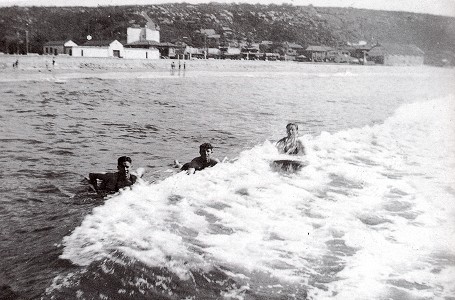 |
- Brawley: Collaroy SLSC (1995) pages 95 - 96 Note : 2. Unusual behind-the-break photograph, taken from the pool. |
The
invention of the surf ski is normally credited to Dr.
G.A.'Saxon' Crackanthrope, a stalwat of the Manly Club, circa
1930.
Dissatifiaction
with his ability to ride a surfboard and the possible
influence of surf canoes (see above) led to Crakanthorpe's
development of the surf ski.
The original
design was 8 foot x 28 inches x 6 inches thick with a 12
inches spring in the tail (tail lift), solid cedar planks and
a double bladed paddle and footstraps(?).
Other
claims to the invention of the surf ski include ...
- Bill
Langford at Maroubra pre World War ll;
- a 1934 design recalled by Denis Green of oil impregnated canvas stretched over a timber frame, again at Maroubra
- a type
of ski used by two brothers at Port Macquarie NSW on their
oyster leases, and occassionally in the surf circa 1930
- a "first
appearance
on Newcastle beaches during the 'twenties, and came to
Deewhy about 1932"
In 1933
Jack Toyer of Cronulla and Dr. J.S. Crackanthrope registered a
patent for the surf ski.
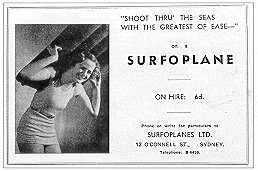
The Surf-o-plane was invented by
a Sydney doctor circa 1932, Dr Ernest Smithers of Bronte NSW,
who worked for eight years to develop it.
-Noted, with
thanks by Alison Lee (daughter of Dr. Smithers) by email,
September 2001.
A prone craft
made of an inflated molded rubber, it was a immediate success.
Apart from the
ease of paddling and wave catching due to the buoyancy, danger
to the rider and other bathers was mimimal.
For this reason
they were accepted in general bodysurfing areas, whereas
wooden prone boards were limited to designated boardriding
zones.
A patent application (#9929 Class 3) for a "Surf plane" by E. E Smithers and C. D. Richardson was lodged on the 7th October 1932.
"Canoe
Race
- Indiana (North Bondi), 1; Bronte Hawl (Clovelly), 2;
Flying Scud (South Curl Curl), 3.
Junior
Surf Boat Race - Bondi (J. Simmons, E. O'Rourke, J.
Watson, C Sara, D. Wightman), 1; Maroubra, 2.
A
splendid race wonn by less than a yard.
Senior
Surf Boat Race - Cronulla A (J. Monro, J. Toyer, R. K.
McCaffrey, W. Ellis, J. Turner), 1; Cronulla B, 2; Bondi,
3.
Surf
Iifesaving Board Rescue Event- J. Cunningham and K. Weekes
(North Bondi), 1; J. Stroud and F. Boorman (North Bondi),
2.
Senior
Belt Race - L. Sharp (Queenscliff), 1; J. Miller
(Cronulla), 2; A. Laidlaw (North Bondi), 3.
Surfoplane
Race
- F. Adler (Maroubra), 1."
- North
Bondi Surf Carnival.
The Sydney
Morning Herald, Monday 20 February 1933, page 5.
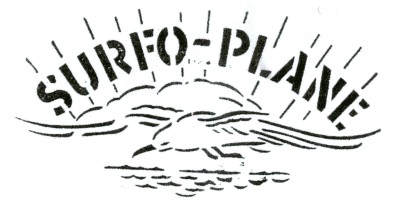
On 14th December 1933 the Patent Office accepted a Trade Mark design for the "Surfo-plane":
"CLASS 49
(Games of
all kinds and sporting articles not included in other
classes.)
61,515
Rubber surf board.
ERNEST ERIC
SMITHERS, and CARL WORDSWORTH RICHARDSON,
of 193
Macquarie-street, Sydney, NSW, Australia, manufacturers,
- 11th March,
1933."
 |
|
|
Official Journal of Trade Marks and Designs Volume 3, Number 13, 1933, page 1421. |
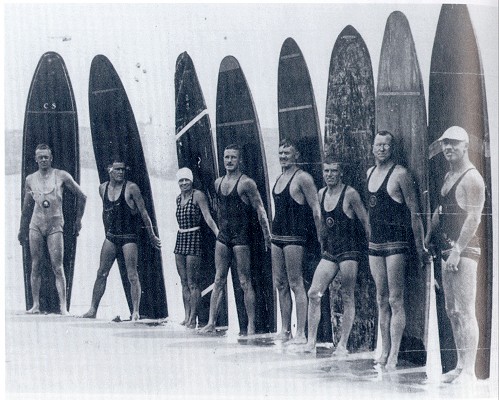
Thoms: Surfmovies(2000) page 40. |
| home | catalogue | history | references | appendix |
| The
Surf Life Saving Association of Australia : 1938 The Australian Surf Life Saving Handbook Tenth Edition (Revised 1938) JNO, Evans and Son Printing Coy., 486-488 Kent Street Sydney, New South Wales Soft cover, 287 pages, black and white photographs, black and white illustrations, Index. * Highlights : Specifications and 'Instructions for use of' solid wood Alaia surfboard pages 182 - 183 'Specifications for Surf Life Saving Boats' pages 161 - 167. Also note photographs... 'Propelling a sufboard' page 83, Five riders and boards at shoreline (uncaptioned) page 102, Surfskis (uncaptioned) page 180, 'Showing surfboard "shooters" taking a wave' page 181, 'The Rubber Surf Float' page 267 |
|
| The
first credited Australian surfing magazine was Manly
Surf Club's The
Surf, 1st December 1917. It ran for five editions, till 27 April 1918. Image
Right: |
|
| Making
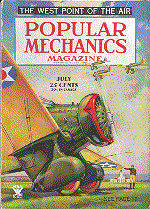
Money at the Beach in Popular Mechanics July 1934 Vol 62 No. 1 pages 115 - 117 Plans and specifications for a solid wood Bellyboard |
 |
| home | catalogue | history | references | appendix |