pods for primates : a catalogue of surfboards in australia since 1900
home catalogue history references appendix

surfresearch.com.au 
  history : the racing 16 
the australian racing sixteen : 1934


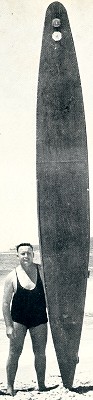
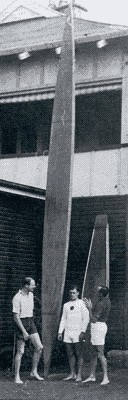
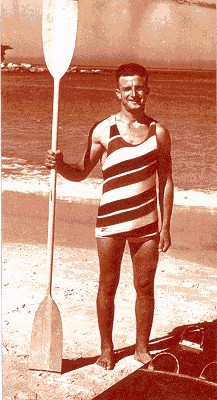
Frank Adler and Hollow Racing 16
cropped from Maxwell, facing page 117.

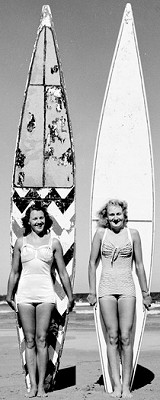
  The Racing 16, a hollow board with timber frame with plywood skin, was first built by Frank Adler at Maroubra, no doubt based on the widely circulated design by Tom Blake (USA).
Given the emphasis established by the Life Saving  Clubs on rescue and racing, the light weight advantages of the design were quickly realised.
Although some  builders may have recreated their Alaia boards, most were to follow Tom Blakes' lightweight copy of a traditional Olo, with lenghts eventually reaching sixten feet and the boards narrowing to less than 20 inches.

 As was the case with the Hollow board's paddling successes in Hawaii and the USA, the design dominated at carnivals.
This was  demonstrated by Frank Adler's competition wins despite his considerable weight (Maxwell?).
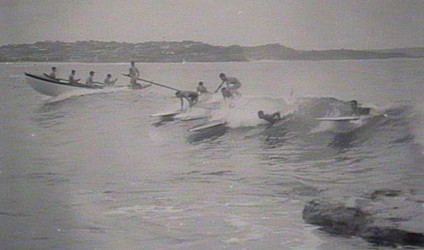
The design however downplayed wave riding technique and taking the largest wave on a straight line to the beach was considered the fastest, race wise.

An addition noted on Australian boards is the (stainless) steel handle fixed at the tail,  used by the rider to hold and/or push the board through breaking waves.
Some examples also use an very fine timber gunnel on the rail, to assist in balance when both paddling and riding.

In 1934 Tom Blake added a small water ski type fin/skeg to one of his hollow boards.
Although an significant addition, because of the emphasis on paddling, the small size relative to the board, the increased danger and the difficulty in attachment, many riders did not consider fins necessary and it rarely appears on Australian examples of long Hollows.

 Many examples of this long serving (1934 to 1956) design are in existence, mostlong established ASLA clubs have one mounted in the clubhouse.
In Victoria, Surfworld The Surfworld Museum has three examples : #31, #32 and #33;
In Coffs Harbour  Scott Dillon;
In Sydney,Northside see
Barry Bennett Surfboards, 188 Harbord Road Brookvale or
Quicksilver, The Corso, Manly.
Southside see Brian Jackson Surfboards
The ANMM, Darling Harbour has several examples, note # 00015143 but these are  generally not on display. See Notes on ANMM Collection

The adoption of the Hollow board was not the only surfcraft development of this period.
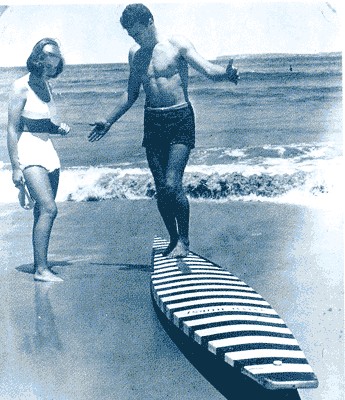
The Surf ski, Surf-o-plane and the Belly board were significant alternatives to wave riding of the period.
The belly board initially adaptated the paipo design, built of laminated solid wood with steamed or shaped scooped nose, in the manner described in Popular Science/Mechanics of the time.
Later models used laminated plywood, and later still fins and sometimes a nose grip.
See Surfworld,  #17 and #25

Structually, if a board is hollow it should have a drain or pressure plug to let out any water from dings and to equalise the pressure for climatic extremes.

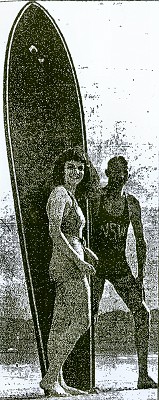
In 1935-1936 Bern Gandy accquired an imported Redwood-balsa laminatesurfboard, probably from California. and surfed it at Lorne, Victoria.
Impresed with the lightness of the board compared to the solid redwoods, he built his own 10ft 6'' model.
The blank was two 10'' x 4 '' balsa blocks with a redwood stringer.
This new board was surfed at Torquay in 1937, and Bern took the board with him when he relocated to Sydney in 1938.
- Press clipping, unsourced, on display at Scott Dillon's Legends Surfing Museum, Coffs Harbour, June 2005.

A surf canoe was designed and built by Jack Myers in 1933 at Freshwater.
It was 9 foot x 2 foot 6 inches with a semi-rounded bottom.
Construction was a hardwood keel, local tea-tree ends with buoyancy tanks and covered with marine ply.
Jack and his canoe, named 'Lady Ruth', placed second in South Curl Curl's carnival on 1st January 1934. Myers page 85.

In 1934 Jack Myers designed and built another canoe with George Henderson , this one a lighter model with canvas stretched over a ribbed frame and named 'Hot Shot'.
George Henderson and 'Hot Shot' won the canoe race at Curl Curl's carnival, 1st January 1935.
Myers page 85.

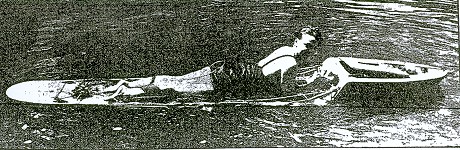
1934 Surf Ski, hollow board construction applied to Dr G.A. Crakanthorpe’s original design and used up to the mid 1960’s.
Early models were 8 ft x 28" x 6" thick with a '12" spring in the tail'* (tail lift), but an emphasis on paddling soon saw lengths extended and widths narrowed.
 Maxwell page 245.*

Plans and specifications for a solidwood Bellyboard were printed in an article Making Money at the Beach, Popular Mechanics July 1934 Vol 62 No. 1 pages 115 - 117

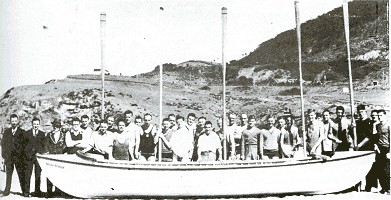
 1935 'G.K.' Manly surf life saving Club’s 7th surfboat, carvel built by E. & A. Townes, of Newcastle.
This lighter design was adopted by many other clubs.
Harris, pages 45-47.
 
In  late 1935, Collaroy SLSC member Bert Chequer, a noted surfboard shaper, used his board in a mass rescue. 
Assisted by 13 year old Bill Abbott, who twice swam out with belts, and a goup of inexperienced juniors on the reel, they managed to successfully return a group of approximately 10 persons to safety. 
Brawley (1995), pages 96 - 97.
 

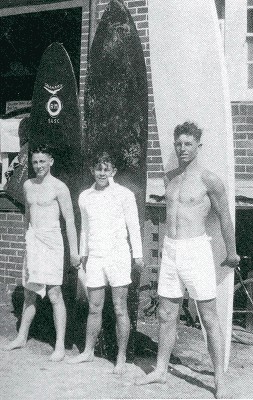
Image right :

Bob Maladay and Ron Hall with Solid Wood Boards, 
Bill Abbott with Hollow Paddleboard, 
Collaroy SLSC, circa 1938.
The solid wood boards were possibly shaped by Bert Chequer.
Bob (Robert) Maladay's board features the Collaroy club emblem and his formal initials - RM.
Brawley (1995), page 97.

Dr Ernest Smithers' Surfoplane ...
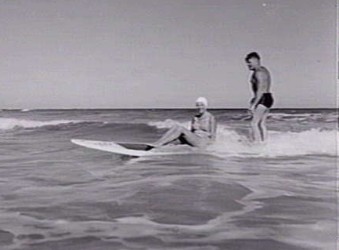
'' was soon in mass production, being hired by the half hour on Sydney beaches, and proving popular with all ages and both genders.
Surf-o-planes were... filmed for Movietone News 6/7 (1935), ...Movietone News 7/15 (1936), ...Movietone News 8/13 (1937), ...Movietone News 9/14 (1938) , which included shots of Dr Smithers riding his invention at Bronte, ...and...Movietone News 10/6 (1939) "
Thoms, page 40.

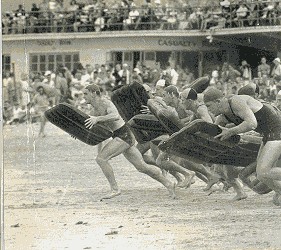
The craft was extremely popular, Manly Surf Life Saving Club reported 261 rescues for the 1938-9 season, half of which were carried out on or swept off rubber floats.
Bloomfield, pages 54 to 57.

Surf-o-plane riding was included in 1938 Australian Surf Titles (only time, won by Jack 'Strawb' Turnbull) and in the Makaha contest for a period in the 1930's.

In 1936 Jack Toyer of Cronulla extended the surf ski to improve paddling.
Bloomfield page 69

Concurrently 'Mickey' Morris and 'Billy' Langford developed the double ski, although their first model proved too narrow. Maxwell page 245.

During 1937, the Surf ski was adopted as standard life saving equipment after extensive testing at Maroubra (Maxwell page 245) and included in the Australian Chamionships as a rescue event with a paddler and patient. Galton page 79.

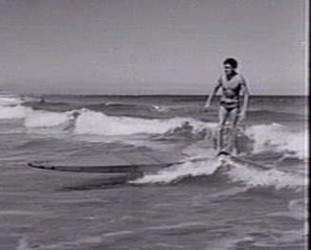
The Surf-ski was first seen on film in Movietone News 8/51 in 1937 at Manly, the riders riding sitting and standing with the paddles attached to the nose by rope.
Thoms page 40.

In 1937 at Hurstville, NSW, a company ("the only surf ski manufacturers") marketed a surf ski at seven pounds and fifteen shillings, packing and delivery by rail or boat for two shillings and sixpence, or fifteen shillings deposit and payments of three shillings and sixpence per week.
Wells page 155

In circa 1938 'Snowy' McAlister moved onto hollow longboards, and several seasons later converted it to as surf ski.
Wells page 160.

On Sunday, 6th February 1938 the most celebrated rescue in the history of Australian surf life saving took place at Bondi beach.
Sean Brawley, in examining the events of that day, noted
Having had his name registered and his handicap awarded, Francis calculated he had 20 minutes to spare before the race and so headed for the water with a rubber surf mat known as a 'surfoplane'.

The surfoplane had been introduced to Bondi Beach a few seasons earlier by Stan McDonald.
On his retirement, McDonald had designed a rubber surf mat that he called a 'beacher'.
Along with his chairs and mutton oil tan: spray, McDonald leased the mats in their hundreds;riding them became a popular surfing activity at a time when board riding was still a marginal and almost exclusively surf club activity.
The surf mats soon became more popularly known as 'surfo- planes', the name of a rival surf mat manufacturer.
Brawley (2007) page 134.

In the 1938-1939 season, Bill Hawkins of Manly paddled from Manly to Maroubra in three hours and was reported as missing when strong headwinds caused him to shelter in Manly cove on the return journey.
Maxwell  page 246.

In 1939 a  highly sophisticated example of solid wood design was shaped by L.A.Morath. of Manly LSC Features include rail and tail grips, concave deck, metal tail and nose plates.
A branded Outrigger Canoe Surf Club logo was possibly added to the board after Morath represented  Australia at the Pacific Games, Honolulu ?
Held by Morath family of Balmoral, restored to original condition by ICS/Chatswood. Nov, 1998.
Currently displayed at Balmoral Beach Life Saving Club, Sydney.
See.#105

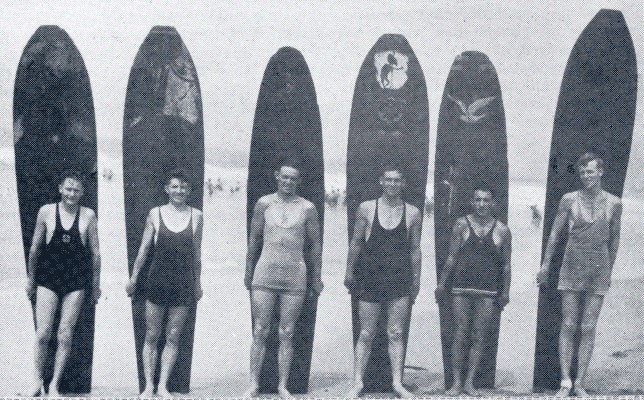
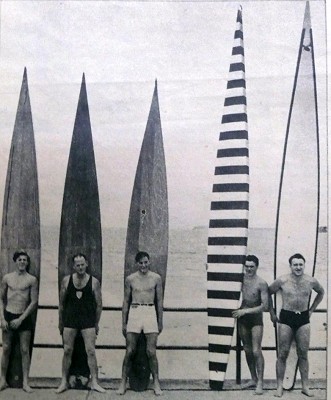
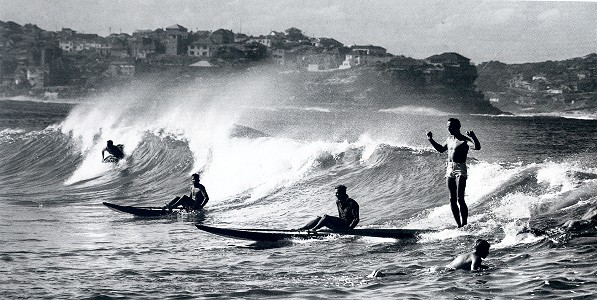
The Australian surf team to the Pacific Games, Honolulu were selected at local competitions.


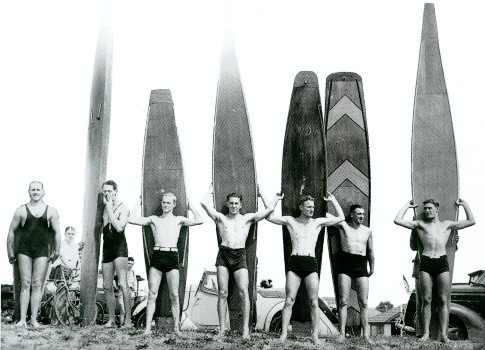
Entrants for paddleboard race, 
Northern beaches, Sydney,
circa 1939.
Note :
1. Several races were held as selection trials for the 1939 -1940 Pan Pacific Games in Honolulu.
2. The photgraph has been substantially cropped, the rider on the far left is missing the top half of his board.
3. Variations in board length and design.
4. Lou Morath, second from the right.
Other riders should be identifiable.

Longhurst, page 78.


The Australian surf team  were selected at local competitions.
Boardriding representatives to the Pacific Games, Honolulu included...
Dick Chapple (North Bondi),
Keightly ('Blue') Russell (Palm Beach), and
Lou Morath (Manly). 'Blue'
Russell, who made hollowboards and  popularised the kneeling position for paddling, won the Hawaiian championship.
Maxwell  page 241-242.

Hermie Doerner capped off such representative honours for the club in 1939 when he was selected for the SLSA team that visited Honolulu.
Brawley (2007) page 146

Doerner captained the team, which was accompanied by Bondi club stalwart, Tom Meagher.
Jaggard (2006) page 192.


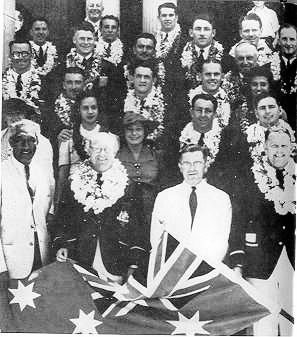
Duke Kahanamoku (left) welcomes the Australian team to the Pacific Games Honolulu, 1939.
Wilson, page 36.


circa 1940's
Olympic swimmer and industrialist Sir Frank Beaurepaire's rubber company manufactured a Surf-o-plane using the Advanx brand.
There were eventually three models - Elite (5ft), Standard (4ft) and Small (3ft).
Colours other than black were also available - yellow and black with yellow stripes.
Sold to the public from the factory at Neild Avenue, Rushcutters Bay Sydney for 8 pounds ($16.00), the company also offered a repair service and compressed air fill ups.
ABC Radio Talkback, circa 1998.

By the 1960 the design was available from several companies, notably Clarke Rubber and Advanx, and with the expanded use of the automobile sales were directed more at the general public than the hire concessions.
This was principally done by elaborate decor, for example the Advanx Marlin model as surfed by Nick Carroll in 1969, while some later models had twin fins.


Image right :
Blue Russell, Elton Ifould and other 
with 20 foot tandem board,
Palm Beach, circa 1940.
Brawley, page 56.


1945
"Because of the disruption to the surf clubs and their memberships during World War II, Australian Championships were not held in the seasons between 1940 and 1945 (48). As a substitute, the SLSAA oranised zone competitions, which were held during the 1942-19843 and 1943-1944 seasons in the Sydney metropolitan area. These competitions culminated in a metropolitan championship carnival, and were followed by a SLSAA 'patriotic' championship carnival, the proceeds of which went to charities such as the Australian Red Cross Prisioners-of-War Fund, and the Australian Comforts Fund (49)."
Young Page 59
Circa 1945
Hollow board owners who were committed wave riders determined a small area of the board where they stood and enhanced grip by applying a paint and sand mix.
Some riders alternatively applied a small section of timber ridges across the board - in a similar manner to modern adhesive rubber deck patches.
Boards were heavily varnished or painted  to cover and protect the copper nails.
Reported and illustrated by Scott Dillonat his Legends Surfing Museum, Coffs Harbour, June 2005.

1945-6

"The senior longboard became a national event in 1946 (102), but the SLSAA had been pricked in 1945 by the formation of the Surf Board Association of Australia which it stated was:
'attempting to encroach upon the preserves of constituted authority guarding
surf bathers by running a pseudo 'Surf Board Championship of Australia' (104)'
It seems that the SLSAA did not want this new 'hedonistic' Association, which also had women members, involved in its competition or competing for the social space which was occupied by disciplined surf life saving clubs on Australian beaches. The Board Association was refused affiliation by the SLSAA on the grounds it was not a life saving club, and members of life saving clubs were prohibited from participating  in surf events organised by an unaffiliated association. The advent of the board Association seemed to precipitate the SLSAA's formation of a Surf Board and Ski Section, and formulation of appropriate rules for use of boards and skis in its affiliated clubs, as a means of recues and in carnivals (105)."
Young, F. (2000) Page 66
circa 1946
Hollow maple, silky oak and marine ply board John K. McLennan, Queensland, no fin
 Australian National Maritime Museum   #000158050
See Notes on ANMM Collection

In 1948 Bill Wallace was sweep of the Bronte SLSC boat.
- Photograph, unsourced, on display at Scott Dillon's Legends Surfing Museum, Coffs Harbour, June 2005.

December 1948 : Outdoors and Fishing Magazine, Hudson Publications, Sydney.
A full page advertisment for Mick Simmons' Sports Stores includes  "The Winner" a surfmat described as a 'canvas and rubber inflated surfboard', priced at 67/- (67 shillings?).
In the classfied section , Seacraft Plans Pty Ltd, Sydney listed a large number of boat  plans for sale by mail, including plans for surfboard, 14 ft and 10ft, and surfski. Price 8 shillings.
The issue also contained advertising for metal and rubber suction cup roof racks to transport a boat or skis.

1951
 "Keith Suann was the (Cronulla) Club's inaugural surfboard champion in the 1951-2 season (102)".
Young, Page 66


Belly board, surf skis, hollow board and others, Manly Beach circa 1951
Photograph probably Ray Leighton
Longhurst, page 79.

1954
"The (Cronulla) Club's fortitude was tested in 1954 when Jantzen Girl, an already successful surf boat, was destroyed by a freak wave at the North Steyne carnival in January. Launched in 1952-1953 season, it was built by the Club's Vice-President Roy Phillips employing the latest technology, and to the specifications of leading Cronulla boatmen.   ... a new surf boat apty named Good Samaritan was launched in March 1954,"
Young Page 68

surfresearch.com.au

home catalogue history references appendix

REFERENCES FOR THIS SECTION
books
1949 Maxwell, C. Bede  Surf : Australians Against the Sea
Angus and Robertson Sydney

1959 Bloomfield, John   Know-how in the Surf
Angus and Robertson 89 Castlereagh Street, Sydney

1961 Harris, Reg. S.The History of Manly Life Saving Club 1911-1961
Published by Manly Life Saving Club, NSW Printed by Publicity Press Ltd.

1964 Severson, John: Surfing Around the World
  Doubleday and Company, Inc, Garden City New York.

1965 Farrelly, Midget. As told to McGregor, Craig : This Surfing Life
 Rigby Limited, James Place, Adelaide

1966 Finney, Ben and Houston, James D. : Surfing – A History of the Ancient Hawaiian Sport
Pomegranate Books P.O. Box 6099 Rohnert Park, CA 94927  Reprint 1996

1968 Kahanamoku, Duke With Brennan, Joe:  Duke Kahanamoku’s World of Surfing
Angus and Robertson Publishers Sydney , Australia 1972 2nd Edition  A&R Paperbacks, Sydney , Australia

1968 Pollard, Jack (ed.) : Ampol’s Sporting Records
Jack Pollard Pty. Ltd., 42 Pacific Highway,  North Sydney NSW 2060
Reprinted 1969, 1971, 1973

1970 Margan, Frank and Finney, Ben R. :  A Pictorial History of Surfing
Paul Hamlyn Pty Ltd, 176 South Creek Road, Dee Why West, NSW 2099.

1964 Pollard, Jack (ed.):  The Australian Surfrider
K.G.Murray Publishing Co.P/L,142 Clarence Street , Sydney Australia

1972 The Best of Tracks   (Vol. I) Editors : Falzon, Albert; Stewart, John; Grissim, John. :
Tracks Publishing Co Pty Ltd. P.O. Box 178 Avalon, NSW.
'Bob McTavish’s Personal History of Surfboard Design – Pods for Primates Parts 1' (pages 120 – 122).

1992 Stell, Marion K. :  Pam Burridge
Collins Angus & Robertson Publishers (Australia) Pty. Limited
A division of Harper Collins Publishers (Australia) Pty. Limited
25 Ryde Road, Pymble NSW 2073, Australia

1979 Pearson, Kent : Surfing Subcultures of Australia and New Zealand
 University of  Queensland Press, St. Lucia, Queensland

1997 Warshaw, Matt : Surfriders – In Search of the Perfect Wave
Tehabi Books, Inc. Collins Publishers, 10 East 53rd Street, New York, NY 10022

1978 Warwick, Wayne A Guide to Surfriding in New Zealand Second Edition
Viking Sevenseas Ltd Wellington, New Zealand

1979 Young, Nat ; Photographs by McCausland, Bill: Nat Young’s Book of Surfing
A.H. & A.W. Reed Pty. Ltd. 53 Myroora Rd, Terry Hills, Sydney.

1983 Young, Nat with McGregor, Craig : The History 0f Surfing
Palm Beach Press,40 Palm Beach Road, Palm Beach NSW 2108

1997 Kampion, Drew: Stoked : A History of Surf Culture
 General Publishing Group Los Angles
 1998 Second edition by Benedikt Tashen Verlag GmbH, Hohenzollernring 53, D-50672 Koin.

1991 Carroll, Nick (editor): The Next Wave : A Survey of World Surfing
 Collins Angus & Robertson Publishers Pty Ltd 4 Eden Park, 31 Waterloo Road, North Ryde NSW 2113


web sites
Malcom Gault-Williams: LEGENDARY SURFERS


surfresearch.com.au
home catalogue history references appendix