surfresearch.com.au
 |
surfresearch.com.au
the malibu : 1948-1953
|
1948 - 1953
The
Birth of the Malibu : Bob Simmons, Joe Quigg, Matt Kilvin, and
George Downing.
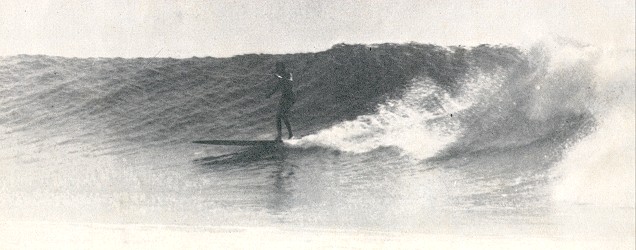
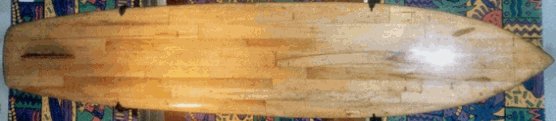
Bob Simmons Malibu Circa
1947
Surfer July 1976 Volume17 Number 2 page 46
Les Williams Archives
Although his boards were probably
never currently surfed in Australia, the contribution of Bob
Simmons to surfboard construction,while occasionally over-rated, is integral to any history of
surfboard design.
While the Tom Blake Hollow board had secured it's position as the
preferred paddling board in Hawaii and California, it did not dominate wave riding as it did in Australia, .
In both surfing centres the
ancient alaia designs retained popularity and were still being
replicated, although lengths had increased up to 12 feet and
weight had been greatly reduced by laminating balsa wood between
redwood stringers and rails.
Alternatively timber sections could be chambered before
lamination.
See Popular
Science magazine,
1938.
These were the first factory boards, manufactured by Pacific
Homes Systems in California, notably the infamous Swastika model of 1939.
During the late 1940's Bob
Simmons' experiments with surfboard design had convinced him of
the benefits of scooped nose lift, and he became known for his
''scarf'' jobs - sections added to an existing timber board on the
nose to allow more lift.
It was this work that led him to the use of resin and fibreglass,
developed during the Second World War, to strengthen the added
sections.
And
there is a photo of George Downing, Russ Takai and Wally
Froiseth on the beach at Malibu, circa 1947.
Downing told me he ran that board into the pier and cracked
the nose, and Bob Simmons fixed it:
"That was the
first time I saw fiberglass and resin," George said.
- Ben Marcus: email, December
2008:
Although not primarily
seeking weight reduction, he also experimented with polystyrene
foam, in common use as an insulation material.
As the foam reacted unfavourably with polyester resin, Simmons
laminated the foam inside solid wood rails and plywood decks and
bottoms.
This construction approach would be reprised in the late 1980's
with the development of timber laminated epoxy boards.

|
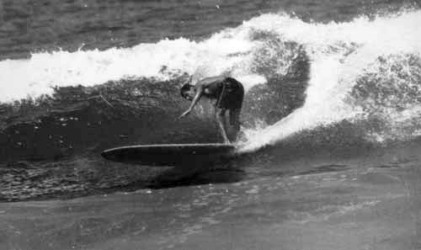
Bob Simmons - or Dave
Barham,
Malibu,
1948.
Photograph
: ?
Surfer
July 1976 Volume17
Number
2 Page 61.
Matt Kivlin, Rincon, 1951.
Miki Dora Archives.
|
 |
Note that the first
fibreglassed board is credited to Pete Peterson and Brant
Goldsworthy in August 1946, but it was apparently two moulded
halves joined by a seam tape, and not the common laminated method.
- Nat
Young, (1983) pages 61 and 64.
The experiments with laminated
fireglass resulted in the development by Bob Simmons, Matt
Kilvin and Joe Quigg of the modern surfboard – a shaped
blank covered with fibreglass and resin with attached fin, or on
some examples, multi (twin) fins.
At some stage the timber laminated timber/polystyrene blank
gave way to the simpler all balsa wood blank that allowed infinite
design variation in the shaping.
Many early examples of this design featured a multi-block blank of
4'' x 5'' x 36'' balsa sections, recycled from the buoyancy added
to World War Two rescue rafts and lifeboats.
Previous
to Bob Simmons' work, the fin, usually a long based keel, had
become an accepted addition.
Although its first use is credited to Tom Blake in 1934, because
of the emphasis on paddling, the small size relative to the board,
the increased danger and the difficulty in attachment, many riders
did not consider fins as a necessity.
Large, high aspect (or upright) fins did not become firmly
established until the late 1940s following the by George
Downing and Wally Froiseth experiments
in Hawaii.
They made a test board with a removable fin slot and rode it with
different fin designs in different positions, and without a fin.
Their conclusion was that a board with a fin had superior
performance, virtually regardless of fin design. (Kelly,
page 121)
The introduction of fibreglass largley
solved the structural difficulty of attaching the fin, and the
complexities of fin design would be an area of intense
experimentation for the next forty years.
Bob Simmons made on some
examples, twin (multi) fins.scooped nose lift and rope turning
handles. All features with further work to come.
In 1953, the Easi-Bild
Pattern Method of Construction series included the
"easy-to-build 10ft Surfboard," a world of fun
for those who "ride in with the waves" or "paddle under the
sun."
Build
it Yourself No. 247 Surfboard
Published by Easi-Bild, 1953.
|
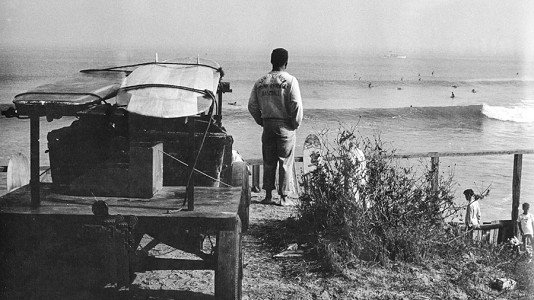
Bob Simmon's
Flat-bed Truck at Malibu, 1949. Photo: Bob Simmons.
|
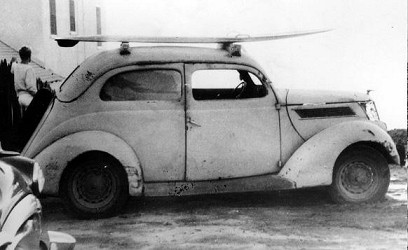
Bob Simmon's
Car, 1950.
Photo: John Ewell
|
Joe Quigg and
Bob Simmons, Malibu,1950. Photo: Miki Dora Archives.
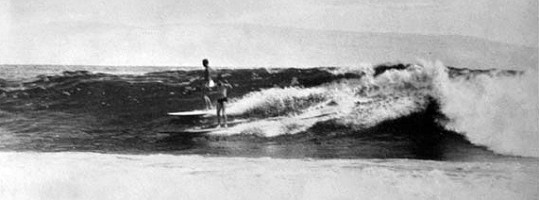
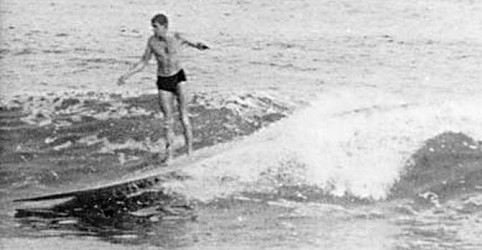
Bob Simmons,
Malibu,1950.
|
|
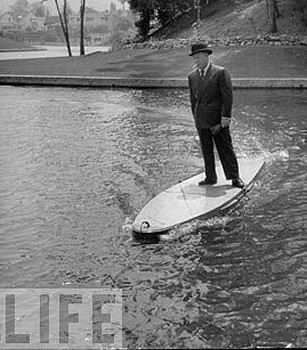
Motorized
Surfboard, 1948 -
Hollywood inventor Joe Gilpin riding his motorized
surfboard.
Photo
by Peter Stackpole.
Time and Life
Pictures/Getty Images/LIFE.com |
|
Australia
Circa 1950
Surfboats adopted the tucked stern, as
opposed to the original double-ender design inherited from the
whaler. This design is still in current use, 2001. Some veteran
boatman of the time believed the double-ender more sea-worthy and
this design is still used in similar craft in the USA - the Dory.
Harris,
page 48
1950-1951 The first recorded
fibreglass and balsawood surfboard in Australia accompanied
Hollywood actor and Malibu Point surfer, Peter Lawford.
He was in Australia in 1950 to film Kangaroo,’
released in June 1952, it was
the first Technicolor movie filmed on-location in Australia.
Filming was based at Pagewood Studios,
Sydney, and locations included South Australia, New South Wales
and Queensland.
See http://www.us.imdb.com/title/tt0044788/maindetails
In 1954, actor Peter Lawford,
filming in Australia, aroused widespread interest amoung surfers
with a board called a Malibu...
- Greg McDonagh in Pollard,
page 56.
The board, identified as a
finless board by Dave Rochlen Surfboards, was housed at Bondi for
most of its stay and ridden by locals, Jack 'Bluey' Mayes, Ray
Young and Aub Laidlaw.
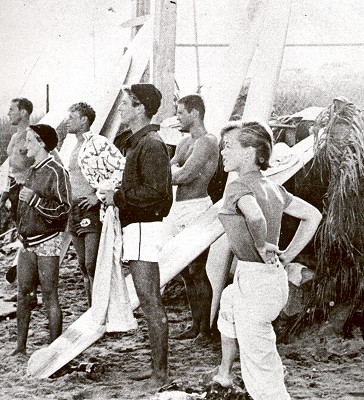 |
Image
left,
Actor Peter Lawford and other
Malibu Surfers,
The Pit , Malibu, circa 1953.
Lueras,
Page 115.
Ricky Grigg Collection.
Lawford brought a similar fibreglassed board to Australia
in 1950,
while on location to shoot Kangaroo. |
A Rochlen skegless
board had been brought to Sydney by the American actor, Peter
Lawford, when he arrived in Sydney in November 1950 to work on
the Twentieth Century Fox production, Kangaroo (1952), which was
shot in the Flinders Ranges in South Australia.
While filming, he left the board at
the Bondi surf club, where it was ridden by the local beach
inspectors, Jack 'Bluey' Mayes, Ray Young and Aub Laidlaw,
though it didn't seem to impress them, with Laidlaw later
achieving notoriety for banning both bikini-wearers and
boardriders from Bondi Beach.
- Thoms,
page 63.
It was possibly a recreated Hot Curl design, dating from 1937,
similar to boards made by Joe Quigg in this period.
For the Hot Curl Story, see Fran
Heath in LEGENDARY SURFERS.
Also Matt Kilvin on Joe Quigg and
Dave Rochlen, in Longboard
magazine, Vol No. pages ? )
Dave Rochlen was the favoured builder
amoungst Hollywood surfers, noted for the outstanding quality of
the colour and decor design.
In 2006 the Bishop Musem
published the much anticipated Surfing
- Historical Images from the Bishop Museum, edited
by DeSoto Brown.
On page 143 a photograph
titled
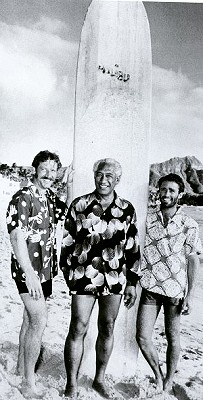
Importantly the board clearly
bears the offset script "MALIBU" on the nose.
It is clearly the board Lawford
took to Australia, confirmed by a photograph printed in Brawley (2007)
page 216, see below.
The photograph was included
in an interview with Duke published in 1965 with the
following caption:
Richard Boone, Duke and
Peter Lawford pose on the beach at Waikiki in 1947.
Lawford had one of
those new "Malibu" boards made of balsa and
fibreglassed.
Duke tried it- but
preferred his own 16 footer.
Surfer
Magazine, Volume 6 Number 1 March 1965 page 18.
.
|
 |
In 2007, renowned suf lifesaving historian Sean Brawley
wrote of Lawford's 1950 visit in his history of the Bondi Surf
Bathers Life Saving Club.
The start of the Malibu era in
Australian surfing is usually associated with the year 1956.
At Bondi, however, the revolution had knocked on the door six
years earlier, when the Hollywood actor Peter Lawford came to
Australia to make the film Kangaroo.
The brother-in-law of John F. Kennedy brought with him a 10 and
a half foot, banana nosed, solid balsawood board designed by
Californian builder Dave Rochlen. (See Endnote 19, page 323,
below).
Lawford never called the
board a Malibu, and the Bondi locals called the style a Zip
board because of its greatly reduced length and' zippy'
behaviour on a wave.
To those lucky enough to ride it, the board simply became known
as Peter, and the first Australian to take it into the surf at
Bondi was chief beach inspector Aub Laidlaw.
With Lawford in South
Australia making his film, Laidlaw and Basil McDonald were the
most frequent users of Peter.
Performing a number of rescues, the board soon had the words
W.M.C. Patrol stencilled to its face.
The third most frequent user of the board was 'Bondi Mermaid'
Pam Pass.
Pass had had difficulties riding a sixteen, but with Laidlaw's
careful tuition she was soon a competent practitioner.
For a time Peter was stored in the McDonald surfoplane
concession before it found a more permanent home in the North
Bondi board rack.
Laidlaw's and McDonald's
use of the board suggests that the two men saw that it possessed
certain properties for lifesaving that the toothpicks did not, a
fact that would be recognised in the 1960s when the Malibu
became the basic design for SLSA rescue boards.
This said, the board did not spark the type of response that
would greet its return in 1956.
When Lawford collected his board and returned to the States,
there was no rush to reproduce the design, and Bondi board
riders turned their back on surfing's future.
This rejection was the result of three factors.
First, Lawford was not a particularly outstanding practitioner
of the art of surfing and therefore was incapable of showing
Bondi board enthusiasts its true potential.
Second, Laidlaw's and McDonald's practical use of the board had
not seen them explore its recreational capabilities (though
allegedly Pam Pass did this with some success).
Third, reputedly; 'Peter' did not possess what the 1956 Malibus
had -a 'skeg' (fin):9 It would be the power of the fin that
would mesmerise surfers in 1956.
+
When the American and Hawaiian
teams arrived in Australia in 1956 for the international
carnivals they brought their surfboards with them.
In stark contrast to the toothpicks, the American boards amazed
many an experienced Australian surfer when their owners showed
what the boards were truly capable of.
Without fins the Australian boards simply had no capacity for
lateral movement once a course had been set on the wave.
With fins, the Americans could not only alter the course of the
board but, with a deft transference of weight, they had the
ability to increase its speed on the wave.
- Brawley (2007), page 216.
Endnote 19, page 323.
There is some debate about whether
the board was'skegless' (finless). Pam Pass, who rode the board
and wrote about the experience in 1956, claimed the board had a
fin. Within surfing history, however, it has been commonly
accepted that the board did not have a fin.
- Brawley (2007), page 323.
Peter Lawford, Malibu, and an
interested beach-goer.
Brawley (2007),
page 216.
|
|
National Championships 1954-1955
Clyde and R.
(Clarrie?) Budd of the Helensburgh-Stanwell Park SLSC came
second in the double ski at North Steyne.
At the 1956-1957
State Championships, Clyde and W. Piggott came third in the Open
Double Ski at Coffs Harbour.
Clyde Budd -a very keen competitor in ski events, showed
outstanding talent at designing and manufacturing surf skis
and could also turn his hand at club dances as a musician.
- Thorn: Stanwell Park SLSC
(1983) page 67.
(circa
1955) Scott Dillion and Barry "Magoo" McGuigan, members of
Bondi Surf (Lifesaving?) Club, surf balsa boards in California
at Hermosa Beach, courtesy of local Surf Life Guard Stations.
- Scott Dillon Interview by Neil
Armstrong. Longboarding Magazine, Number 5, Autumn 1999,
page 23.
- Scott
Dillon Interview 29th June 2005. Coffs Harbour NSW.
1956
John ‘Nipper’ Williams, of Queenscliff S.L.S.A, obtains a balsa
Malibu, bought used in Hawaii, and surfs it at Manly Beach, NSW.
- Biographical Note in Pollard,
page 71.
...'Nipper'
Williams, who had been using a beat-up old Malibu for six
months, also was showing form.
'Nipper's'
board was about 8' 6" and had been brought back by a travelling
Australian businessman for his 11 year old son six months
earlier.
Everyone else thought it was a joke - except "Nipper" and several
thousand Californians.
- Bob
Evans in Surfing World (1972) Vol 16 # 4, pages 30 to 35. .
For the full article see:
- Bob Evans: Remember
the time when?
A retrospective
covering the period from the introduction of the Malibu board
1956 to 1966.
In early 1956,
Scott Dillon returned to Bondi and puchased a milk-run, a job that
was condusive to his surfing activities.
Mid 1956 he encountered 'Flippy'
Hoffman, a visiting American surfer, seriously ill with yellow
jaundice.
Flippy Hoffman was a member of a famous
surfing family that included Walter and Joyce Hoffman.
While Hoffman was hospitalised, his
balsa/fibreglass semi-gun was surfed by Scott Dillon at Bondi
Beach.
The board featured an unususal concave
deck.
By the end of 1956 Scott Dillon had
ordered an Okinuee, a finned hollow
timber board, from Gordon Woods.
- Scott Dillon Interview by Neil
Armstrong. Longboarding Magazine, Number 5, Autumn 1999,
page 23.
- Scott
Dillon, phone conversation, 2000.
- Scott
Dillon Interview, 29th June 2005, Coffs Harbour NSW.
By chance the
liner carrying home of the Americans to Australia also carried
two Australian surfboarders
returning from a world trip.
They were
Scott Dillon and Barry "McGoo" McGuigan and their non-surfing
mate Bruce Laird.
Obsessed by the possibilities of what they had seen of the
short board in action overseas, the boys persuaded one of the
Yanks ('Flippy' Hoffman ?) to leave his board in their care at
Bondi while he journeyed to Victoria for the big surf
carnival.
This board,
the first of its kind to be used regularly south-side, was
stored at Ross Kelly's house and was ridden to a standstill,
till its owner returned to claim it.
- Bob
Evans: Remember
the time when?
Surfing World Vol 16 # 4 1972
pages 30 to 35.)
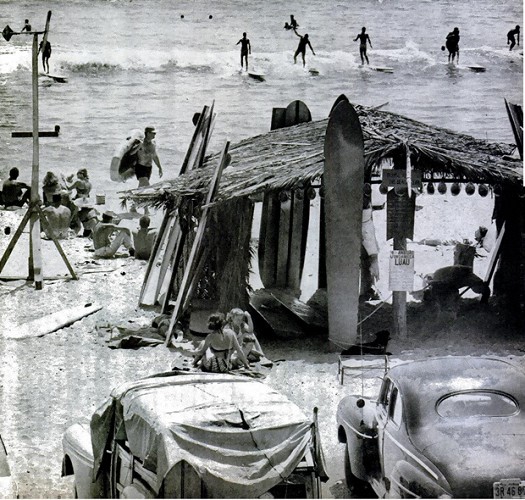
|
San Onofre Shack and Surfboards,
1950.
Life 28 Aug 1950, page 116
John
Ewell with a Bob Simmons' early model
timber/styro-foam laminate board, circa 1951.
Uncredited. [probably
John Ewell Collection ]
Surfing February 1989 Vol 25 No. 2, page 71.
|
Note
The two boards in the foreground are
later glassed balsa boards, similar to # 101.
The shorter board (sub 8 ft?) is
particually interesting.
In the left background, the tail of a
hollow board shows leaning on the other side of the hut.
John Ewell is preparing a biography of
Bob Simmons.
See Notes on Fibreglass for John
Ewell's comments on Bob Simmons' use of fibreglass cloth (soon).
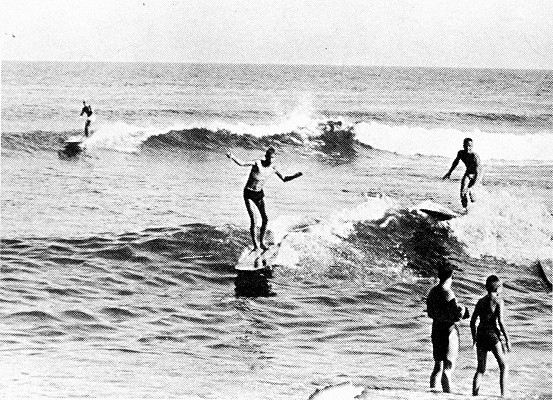
|
Kit Horn, Bob Simmons and
Buzzy Trent riding
solid
laminates, Malibu, circa 1941 - 1944.
Surfer March
1981 Volume 22, Number 3, page 36. (uncredited).
Flippy Hoffman (right) and Bob
Simmons, Makaha, winter of 1952-1953.
Photo: The Hoffman Family/SHF
|
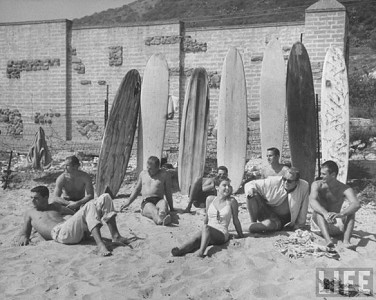 |
Kathy "Gidget"
Kohner and Friends,
Malibu
Pit, 1959.
Life
Magazine
|
surfresearch.com.au
REFERENCES
FOR
THIS SECTION
books
1959 Bloomfield, John Know-how
in
the Surf
Angus and Robertson 89 Castlereagh
Street, Sydney
1961 Harris, Reg. S.The
History of Manly Life Saving Club 1911-1961
Published by Manly Life Saving Club,
NSW Printed by Publicity Press Ltd.
1966 Finney, Ben and
Houston, James D. : Surfing – A History of the Ancient
Hawaiian Sport
Pomegranate Books P.O. Box 6099
Rohnert Park, CA 94927 Reprint 1996
1968 Kahanamoku, Duke With
Brennan, Joe: Duke Kahanamoku’s World of Surfing
Angus and Robertson Publishers Sydney
, Australia 1972 2nd Edition A&R Paperbacks, Sydney ,
Australia
1970 Margan, Frank and
Finney, Ben R. : A Pictorial History of Surfing
Paul Hamlyn Pty Ltd, 176 South Creek
Road, Dee Why West, NSW 2099.
1964 Pollard, Jack
(ed.): The Australian Surfrider
K.G.Murray Publishing Co.P/L,142
Clarence Street , Sydney Australia
1972 The Best of
Tracks (Vol. I) Editors : Falzon, Albert;
Stewart, John; Grissim, John. :
Tracks Publishing Co Pty Ltd. P.O.
Box 178 Avalon, NSW.
'Bob McTavish’s Personal History of
Surfboard Design – Pods for Primates Parts 1' (pages 120 – 122).
1992 Stell, Marion K.
: Pam Burridge
Collins Angus & Robertson
Publishers (Australia) Pty. Limited
A division of Harper Collins
Publishers (Australia) Pty. Limited
25 Ryde Road, Pymble NSW 2073,
Australia
1997 Warshaw, Matt : Surfriders
–
In Search of the Perfect Wave
Tehabi Books, Inc. Collins
Publishers, 10 East 53rd Street, New York, NY 10022
1978 Warwick, Wayne A
Guide to Surfriding in New Zealand Second Edition
Viking Sevenseas Ltd Wellington, New
Zealand
1979 Young, Nat ;
Photographs by McCausland, Bill: Nat Young’s Book of Surfing
A.H. & A.W. Reed Pty. Ltd. 53
Myroora Rd, Terry Hills, Sydney.
1983 Young, Nat with
McGregor, Craig : The History 0f Surfing
Palm Beach Press,40 Palm Beach Road,
Palm Beach NSW 2108
film
1985 A History of
Australian Surfing Nat Young.
magazines
1971 Modern World
July Shane Steadman/Terry Fiztgerald (possibly) :
'Surfboard Design' pages 30 to 36.
1972 Surfing World.
Volume 16 #4. Bob Evans : 'remember the time when...'
pages 30 to 35.
web sites
Malcom Gault-Williams: LEGENDARY SURFERS
Ben,
Thank you for the opportunity to contribute.
As usual, as my work is continually updated, nothing is "fixed in
stone".
Suggestions for Zahn and Noll to Australia 1956, below.
My "edits or fixes or additions" in italics.
Unfortunately at present my computer is failling to satisfactory
display the content at
http://www.flipsidedesigns.com/shf/timeline/timelineFull.html
which of course I am keen to read.
Zahn, Noll and Bright to Australia 1956
(Mike Bright was touted as the current US champion (Zahn
considered a member of the Hawaiian team) and apparently his
performance had most impact on the Australian surfers.)
Entry ID
Thumbnail Image
Date: For Item Placement
Date: Readable Format
1956
Short Headline
Aussies Get a Look at the Malibu Board
Fibreglass (Malibu) Revolutionizes Australian Surfboard Riding.
Short Description
The common wisdom that Tommy Zahn and Greg Noll introduced the
modern Malibu Chip to Australia in
1956, might be predated a few years by
While Australian boardriders had some limited exposure,
noteably by a surfing Hollywood star, to the the
fibreglassed surfboards developed in California and Hawaii in
the early 1950s, the visit of Hawaiian and Californian
boardriders in late1956 saw an explosion in surfboard numbers on
Australian beaches.
Long Headline
This is why Australians Call Longboards "Malibus"
Have to think about this.
Full Story
The accepted surf history wisdom is that Greg Noll and Tommy Zahn
(and others) took modern, Malibu chip
surfboards to Australia in 1956, when they traveled down under
with all their kit to compete in surf
lifesaving festivals (carnivals) that ran in conjunction
with the Summer Olympics in Melbourne.
But according to Australian surf historian Geoff Cater at the
www.surfresearch.com.au website, the
1956 trip (was) pre-dated by Hollywood actor and Malibu
Point surfer, Peter Lawford taking his surfboard down to
Australia in 1950, where he did some surfing in between shooting a
movie.
The movie starred Lawford, Richard Boone and Maureen O'Hara in
the first American studio production shot in Technicolor
on-location in Australia. Filming was based at Pagewood Studios,
Sydney, and locations included South Australia, New South Wales
and Queensland.
Surfmovie historian, Albie Thoms (2000) wrote " A Rochlen
skegless board had been brought to Sydney by the American actor,
Peter Lawford, when he arrived in Sydney in November 1950 to
work on the Twentieth Century Fox production, Kangaroo (1952),
which was shot in the Flinders Ranges in South Australia. While
filming, he left the board at the Bondi surf club, where it was
ridden by the local beach inspectors, Jack 'Bluey' Mayes, Ray
Young and Aub Laidlaw, though it didn't seem to impress them,
with Laidlaw later achieving notoriety for banning both
bikini-wearers and boardriders from Bondi Beach."
Dave Rochlen was the favoured builder amoungst Hollywood
surfers, noted for the outstanding quality of the colour and
decor design of his boards.
Bondi SLSC historian, Sean Brawley (2007) describes the board
as "a 10 and a half foot, banana nosed, solid balsawood board designed by Californian builder Dave
Rochlen" and notes the most frrequent riders as "(Aub)
Laidlaw and Basil McDonald ... The third most frequent user of
the board was 'Bondi Mermaid' Pam Pass." Citing the
recollections of Pam Pass, Brawley raises the question
whether the board was in fact, "skegless". He also reported
"Lawford never called the board a Malibu, and the Bondi locals
called the style a Zip board because of its greatly reduced
length and' zippy' behaviour on a wave. To those lucky enough to
ride it, the board simply became known as Peter."
Several available photographs of the board, one with Duke
Kahanamoku and co-star Richard Boone at Waikiki, confirm a
length of approximately 10ft 6''. As the board closely resembles
a classic Simmons' fibreglassed balsa board of the period it is
questionable whether it was, as is commonly asserted, finless.
Furthermore, the word "Malibu" was clearly emblazoned across the
deck.
(Digression: I have all these photographs (of course without
copyright) and in a recently acquired history of the Royal
Hawaiian Hotel, one of Lawford aged 11 at Waikiki, where
he first experinced surfboard riding. Accredited as "Peter
Lawford, later to become a widely known actor, sits on the
oceanside terrace with his parents, Gen. and Mrs. Sydney Lawford
, in November 1934. Lawford would go on to a long acting career
and a marriage into the Kennedy clan. Hawaiian Archives."
In the hope that some one in California might be able to
comment on Lawford and/or the board design/manufacturer etc. I
will try to post these on the surfblub)
While the impact of Lawford's Malibu was negligible, in the
early 1950s several Australian boardriders rode them on trips
across the Pacific. Ted Burns of Wollongong competed at Makaha
in 1950 on a similar board and circa 1955 Scott Dillion
and Barry "Magoo" McGuigan, members of Bondi Surf Lifesaving
Club, rode balsa boards in California at Hermosa Beach, courtesy
of local Surf Life Guard Stations. On the northern beaches, John
‘Nipper’ Williams of Queenscliff secured a balsa Malibu from a
friend who had bought it second-hand in Hawaii in 1955 and on
returning to Bondi in 1956, Scott Dillon rode the board of
visiting Californian surfer, "Flippy" Hoffman, while he
recovered from an accute illness.
According to the www.usla.org website: " Decades after
professional lifeguard agencies had been established at beaches
throughout America, Australia was chosen to host the 1956 Summer
Olympics. The volunteer lifesavers of Australia decided to hold an
international, invitational competition. California lifeguards and
a contingent from the Territory of Hawaii agreed to participate.
The California lifeguards organized themselves under the banner of
the Surf Life Saving Association of America (SLSA), although they
were solely from the Los Angeles County and Los Angeles City
lifeguard agencies."
The appearance of the Californian and Hawaiian teams was
eagerly anticipated, particularly in Sydney, then the centre of
Australian surfrding. The Australian surf life savers saw the
carnival to promote their organisation, methods and
equipment, principally the reel and surfboat, on the
international stage. While the visiting Americans were similarly
enthusiastic about their lightweight fibreglassed paddleboards
and the torpedo tube, it was the wave riding Malibu board that
made a dramatic impact on Australian surfing.
Although the first international carnival was scheduled for
Torquay in Victoria in December, the most emphatic demonstration
of the Malibu's potential was demonstrated two weeks earlier in
extreme surf at the Avalon carnival. Following the organized
events, where the American teams had little success, severval
riders took to the surf on their wave riding boards. Ross
Renwick recalled in 1957 "Australians on the beach were stunned
again and again as the Hawaiians shattered the popular theory
that short boards were not good on big waves, and when they
finished an hour later not a person had left the beach."
In a subsequent article, Renwick noted "When the Hawaiian Surf
Team left Australia early in 1957, they left behind them a type
of surfboard which was to revolutionise the sport within 12
months. Less than a year after they left, as many as 100
of their Okinuee-type boards could be seen at any one beach at
the one time, if a good surf was running. Before this, when the
16 ft. surfboard was in vogue, most board riders stayed at the
one beach, leaving it usually only to go to surf carnivals."
Understandably, the new design was in great demand and the
Sydney Morning Herald (November 21, 1956) reported under the title
"Surfers To Sell Boards":
"The visiting Hawaiian surfers will sell their seven
lightweight surfboards, which created a sensation at Avalon last
Sunday, after their farewell appearance at Collaroy on December 9.
The boards, which are made from balsa reinforced with two long
strips of redwood and coated with a thick layer of fibre-glass,
weigh 26lb. The lightest racing boards in Sydney, made from 1/2
inch plywood weigh from 33 to 23 lb. The Hawaiian boards, which
have been used at Waikiki Beach for seven or eight years, can be
made in less than a week.
Shorter, Wider
They are eight feet long, compared with the average Australian
length of 16 feet, but are about five inches wider than the local
board's 20-21 inches.Three hundred people saw the Hawaiians give
an exhibition of board riding after a special carnival at Avalon
in a big surf last Sunday. Unlike Australian boardriders, the
Hawaiians stood on the middle of their balsa boards, even when
heavy white water from the broken waves swept around their feet.
Harry Shaffer, captain of the Hawaiian squad, said last night of
the boards: 'There is no question of selling out to the highest
bidder. We plan to give our boards to the fellows we consider to
be the real enthusiasts at only a token cost.' "
According to Nick Carroll: "Bob Pike was there when Californian
lifeguard surfers Noll and Tom Zahn came to demonstrate the first
lightweight Malibu-style boards at surf club carnivals in 1956.
During their stay, Zahn left a board at the Manly Surf Club, and
Pike borrowed it. One afternoon he was coming in from a surf when
Zahn angrily confronted him, 'What are you doing with my private
property?' Pike immediately fibbed and said he was thinking of
buying the board. Zahn changed his tune and offered it for sale.
Stunned, Pike had to get money from his father to make good on the
deal."
Bob Pike was a noted big wave rider and the first
Australian to make his mark on the north shore of Oahu in the
ealy 1960s. Other Sydney surfers to accquire Malibu boards were
Bob Evans and Gordon Woods. Evans recalled in 1972 "I paid Tim
Guard 46 (pounds) for a beautiful, hot curl board built by
George Downing."
Manly surfer, Bob Evans,.was the original publisher of Surfing
World magazine, a surf photographer, prolific film producer and
an enthusic promoter of the art, establishing the ASA and the
driving force behind the "first World Championship" held
at Manly in 1964.
Gordon Woods, originally from Bondi, was a recognized builder
of paddleboards and, due the unavailabity of suitable
balsawood, quickly reproduced the Malibu board in timber and
plywood. Usually about 10 foot, the boards had significant
rocker and a substantial fin. Critically, the rails were
constructed of wide timber panels that were hand shaped to
a rounded edge, unlike the square "box" rails of the
paddleboards. These models, known as "Okinuees" , were
relatively short-lived and by 1959 Woods was building boards of
fibreglass and balsawood before quickly moving on to foam in the
early 1960s and remaining one of the industry's
major manufacturers until the early 1970s..
.
DID TOM ZAHN AND TOM MOORE TRAVEL WITH THE HAWAIIANS?
Some ten members of the US and Hawaiian teams arrived in
Sydney by plane on Tuesday 13th November 1956. The other
ten team members may have come by sea or on a different flight
(details unknown).
Noll's narrative, and contemporary film, indicates that
the teams and the Malibu boards arrived by air:
"Tom Zahn, Mike Bright, Bobby Moore and I paid the extra
freight to take our surfboards with us to Australia ... When the
boards were first taken off the airplane and put on a flatbed
truck ...". Noll (1989) page 70.
It is probable that the larger paddleboards were also in the
same shipment, although it is possible, with lengths exceeding
14 feet, they came by sea freight.
MAYBE NICK OR GEOFF CATER CAN COMMENT HERE ON WHAT EFFECT THE
MALIBU BOARDS
REALLY HAD.
IS THAT WHY THEY CALL LONGBOARD "MALIBUS" TO THIS DAY?
Still ruminating.
External Links
Australia 1956 = http://www.surfresearch.com.au/1956.html
Australian Newspaper Extracts =
http://www.surfresearch.com.au/1956_Olympic%20Carnival_SMH.html
Image 1
Caption 1
Found this on the www.shaperstree.com website, under a profile on
Mike Bright. Not sure where Tommy
Zahn is.
Image 2
Caption 2
surfresearch.com.au
Geoff
Cater (2000-2017) : History : Birth of the Malibu, 1948 -1953
http://www.surfresearch.com.au/1948_Simmons.html