 |
surfresearch.com.au
twin
fin history
|
A Brief History of the Twin Fin
| home | catalogue | history | references | appendix |
|
surfresearch.com.au
twin
fin history
|
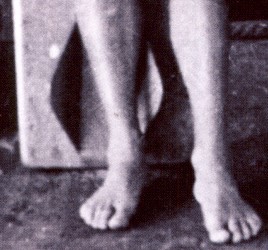 |
Tom
Blake Twin fins,circa 1943.
Timber 4 x 12 b @ 2 inches (Approximation) Hollow timber board. Note fin camber. The feet are Tom Blake's. Uncredited
photograph,
|
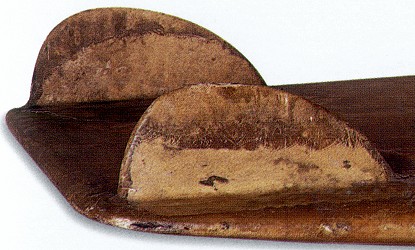 |
Simmons'
Twin Fin, 1948
Wood and fibreglass 6 x 12 b @ 2 inches (approximation) Bob Simmons' Laminate Board, USA. Dick
Metz Collection,
Dana Point, California.
|
| 1950's
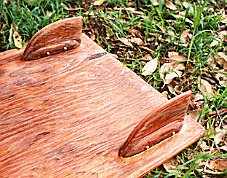
During the 1950's prone boards appeared in a plethora of designs and constuction methods. See the Paipo catalogue for examples dating from the 1930's. A large proportion were finless, those that did attach a fin used a longbased keel type fin. Bellyboarders at some stage incorpated twin fins on their wide tailed boards, similar to the plywood example, right. With the introduction of foam blanks these design were reproduced in the new medium. See Barry Bennett example, below. |
 |
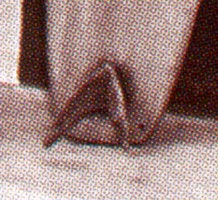 |
Butterfly
Fin, 1955
Laminated Timber 8 x 7 b @ 4 inches (Approximation) Velsy-Jacobs Surfboards USA Photograph
: Bob
Meistrell
|
Fin
experimentation
on surfboards1950 to 1966 was extensive.
A variety of
designs,
some extreme, proliferated, however singularity and a standard
0'' to 6''placement
remained a design constant.

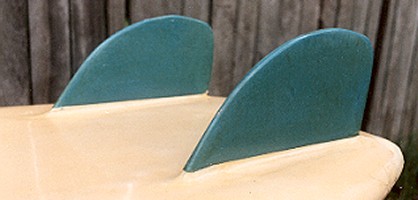 |
Twin
Keel Fins,
1964
Pigmented chop strand mat 4 1/2 x 9 1/2 b @ 1 inches #
50 Barry
Bennett Surfboards Belly board
|
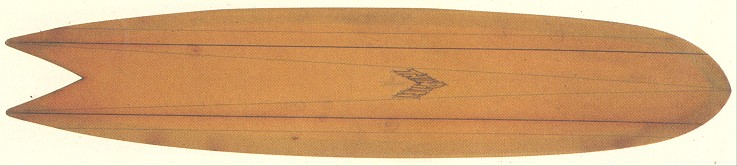
Early models were produced at Bing Surfboards by designer Mike Eaton (later noted for his Bonzer design) in conjunction with 1970 World Champion Rolf Aurness and David Nuuihwa.
Concurrently
at Hobie
Surfboards, Twin Fin 1 models were also built, notably
by Corky Carroll
and Terry Martin, the top in-house shaper.
|
circa 1970. www.Classic Bing Surfboards with thanks. Note tipped in Guidance System fin boxes. See below. Photograph:
Unaccredited
|
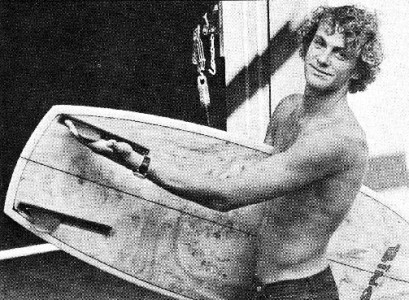 |
The issue also
included
an article by multiple US champion, Corky Carroll
Corky Carroll:
"Twin
Fins"
Surfer
Magazine
Volume 11, Number 5 November 1970 Page 59.
The article
includes
a photogragraph by Brad Barrett of Carroll and a Twin fin very
similar
to the board ridden by Corky in John Severson's
Pacific Vibrations,
1972.
The following
article
by Cory Carroll was posted online at his web site...
http://www.corkycarroll.com/
as
part of a series on surfboard evolution.
There is a
wealth
of detail in this brief account , of particular note ...
1. The
awareness
of Australian surfers, Ted Spencer and Wayne Lynch, stars of
Paul Witzig's
Evolution,
1970.
2. First
design credited to Mike Eaton for Rolf Aurness at Bing
Surfboards,
mid - 1970.
3. The
toeing-in
of the fins appeared in the earliest models.
4. The
rapid
development and commercialisation of the design.
5. The
equally
rapid demise of the design.
6. The
influence
on further fin design, notably the Tri-fin, (#211).
By Corky Carroll ( http://www.corkycarroll.com/ )
We left off last week in the spring of 1970, and the aftermath of the World Championships in Australia. There were sort of two different directions in surfboard design going on at the same time.
One was speed shapes. (#56) These were like smaller versions of big wave boards. The problems with these were that it took bigger or at least really fast and lined up waves to make them work very well. A bunch of guys sitting around on little teardrop like boards in typical small California surf was sort of silly. But there were many doing that. The other was very short and wide boards (#45) like the ones Ted Spenser (Spencer) and Wayne Lynch were working on in Australia. These were just the opposite, interesting in small surf but hopeless in anything with size and power.
I was sort of stuck in the middle but was leaning toward the shorter and wider direction. I made one board with three fin boxes. But it was what we called a swallowtail, two points with a cut away in the center. The rail fins went on the outside tails and the center fin was forward in the center. Opposite of what we now use as a ' Thruster.' Also the fins I used where all pretty big. It didn't turn well. Actually it really didn't turn at all, It just went straight. Seemed like a good idea though.
Then one day Rolf Aurness showed up with a short and wide little board with two fins that an extremely good surfboard designer named Mike Eaton had made him (see above). It had a wide squaretail and the fins where on the outside rails. I tried it and could see immediately that this design could work. The problem was, in my opinion, that it was almost square and the fins were aimed toward the center, in a bit too much. Within an hour of riding that board I was in the shaping room with Terry Martin, one of Hobie's top shapers at the time, making my own version of this new design. It had a bit more shape to it and I only aimed the fins in a tiny bit.
A day later I rode it and was completely amazed at the capabilities of the 'twin fin.' These things could do incredible turns and still maintain speed. This was the first board that I was able to carve a 360 degree turn on. Two days later I had an ad together for SURFER magazine and had a twin fin model on the market, the 'Spacestick.' Did I mention that we were still a bit in the cosmic era? Everything was 'spacey' and 'far out.' Well, these boards were pretty spacey and far out so I had no choice but to call them 'Spacesticks.' Looking back I guess I could be embarrassed about this, but I'm not.
In Hawaii the next winter we found out that the twin fins were not all that great in big surf. Then we started working on designs using three fins (#211); one big fin in the middle and two little fins on the rails.
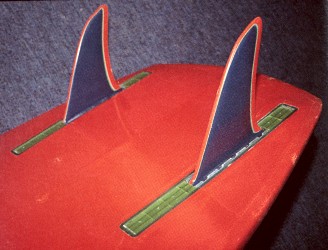
| 1970
Guidance System Twin fin I Unknown constuction 5 x 7 b @ n/a inches (Approximation) Note the symetric foil. Photo:
Don Balch
|
 |
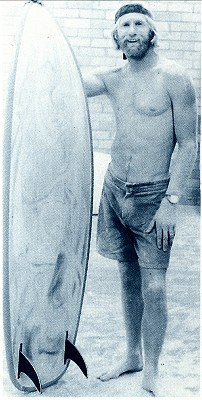
| The
design was directly
imported to Australia in 1970 by visiting Santa Cruz
shaper Tom Hoye
to Bennett Surfboards.
Image
right:
The
design
had a strong following in Sydney, particularly at
Narrabeen, where
Usually
sub
6 ft x 20" with 10" diamond pod. Glue line
stringer.
Although
the design
quickly disappeared from mainstream production in
Australia, a number of
surfers found the design complimented their style or
local conditions.
|
 |
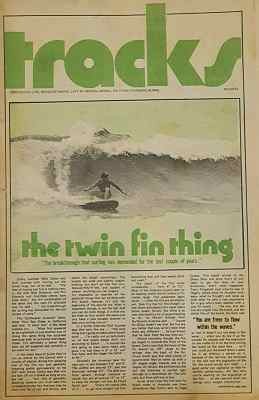 |
the
twin fin thing
"the breakthrough that surfing has demanded for the last couple of years." Tracks December 1970, Number 3. Mark Warren on the cover. 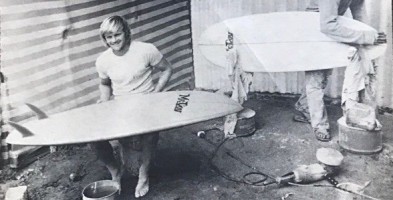 Mark Warren
and McCoy Twin fin, Single Fin Egg in the
background.
Tracks December 1970, Number 3 page 14. |
Surfing World Volume 15 Number 1 summer 1971.
Surfer
magazine
Volume 12 Number 1 March 1971 featured Twin fin advertisements
by:
Hansen
Surfboards,
Bing Surfboards, Gordon and Smith Surfboards and Hobie
Surfboards (Positive
Force IV Series).
The design by
Con
Surfboards featured a raised deck area that maximized volume
but kept the
rails and nose thin.
Surfer
magazine
Volume 12 Number 2 May 1971 featured Twin fin advertisements
by Gordon
and Smith Surfboards and Hobie Surfboards.
In a indication
of future developments, as well as single and twin fin models
fitted with
finboxes, Surfboards Australia offered a wide tailed board
with a centre
and two side finboxes.
The design was
probably
intended to give the rider a choice of fin setup rather than a
trifin arrangement.
International
Surfing
March 1971 included an advertisement for Honeycomb Surfboards
titled Are
you ready for theTwin Fin?, It's ready for you in Honeycomb.
|
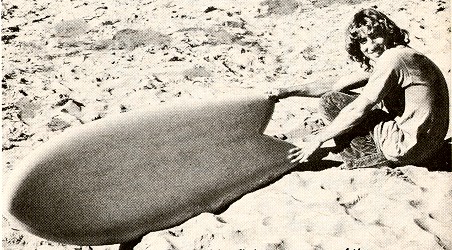
Steve
Lis and
Fish kneeboard, circa 1972.
Note -
the date is
an estimation, and I suspect that the surfer is
possibly Rex Huffman..
|
 |
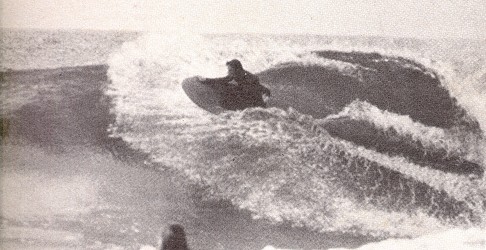 |
Steve
Lis
and Fish kneeboard, circa 1974.
Photograph : Jeff Devine Surfer June 1978. Volume 19 Number 2, Page 45. |
The wide fish tail was later supplanted by the more popular Swallow tail.
|
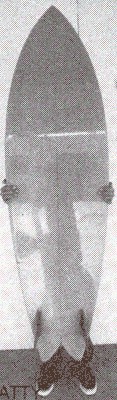
Clyde Beatty
and Rocket Fish,
|
 |
The use
of twin fins on prone boards, common in the 1960's, continued
into the
1970's, for example the mass produced
Bellybogger,
circa 1974.
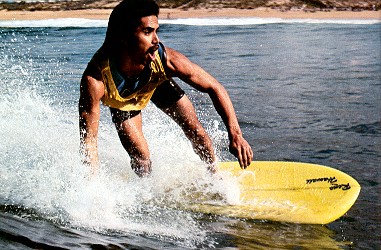 |
2SM / Coke Surfabout, Narrabeen, 1976. Surfing World Magazine Volume 24 Number 4 ? page 42 |
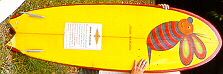 |
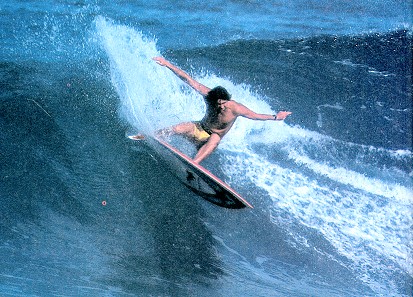
Mark
Richards'
first Twin fin II,
based on Reno Abelira's Fish, Coke Contest 1976 Photograph: Andrew Canning |
 |
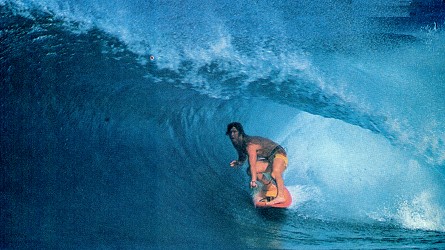
Mark
Richards
and 6ft 4'' Twin
Off The Wall, 1977. Photograph : Lance Trout Surfing Magazine February 1980. Volume 16 Number 2, page 90. |
| Mark
Richards
and 6ft 4'' Twin
Off The Wall, 1977. Photograph : Lance Trout Surfing Magazine June-July 1978. Volume 14 Number 3, page 47 |
 |
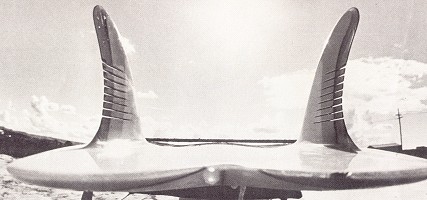
| Michael
Cundith
Slotted Twin Fin , 1977.
Sky Surfboards, Byron Bay. Photograph : Don Blach. Surfer Magazine, June 1978. Volume 19 Number 2 page 64. |
 |
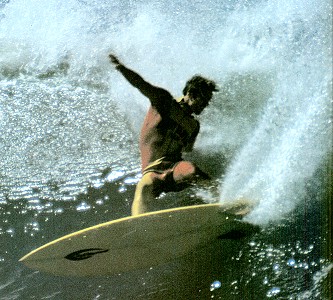
| Image
right :
Steve Brom and Rocket Fish, circa 1977. Photograph : Brian Gillogly Surfer Magazine, Volume 18 Number 2, page 57. July 1977. Note : Fins toed and tipped. Long base/short height profile. Estimated length 5 ft 10''. Twin pin nose on vertical board. |
 |
 |
Carl
Hayward,
Rocket Fish cutback, Huntington, 1978.
Photograph : Dr.Peter Brouillet. Surfing magazine, December 1978. Volume 14, Number 6, page 66. |
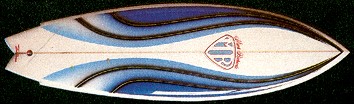 |
Mark
Richards
Twin fin, (est. 6 ft 3'')
Gordon and Smith Surfboards (USA) Surfing Magazine June 1981. Volume 17 Number 6, page 93. |
|
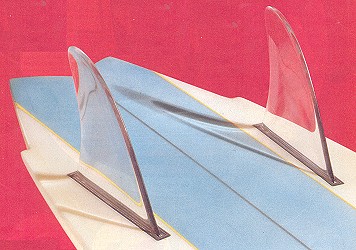
Mark Richards Model Gordon and Smith Surfboards (USA) Surfing Magazine May 1979. Volume 15 Number 5, page 9. |
 |
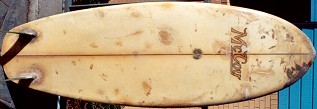 |
1970
McCoy, Twin fin I 5 ft 7" |
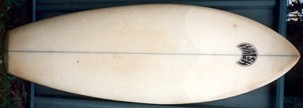 |
1970
Walsh, Twin fin I 5 ft 4" |
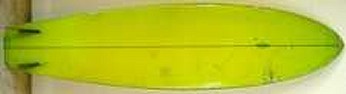 |
1970
Hansen-Cronulla Twin fin 1. 5ft 11'' |
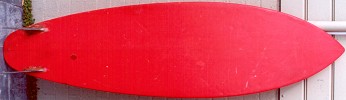 |
1970
Farrelly Twin Fin #1 |
 |
1971
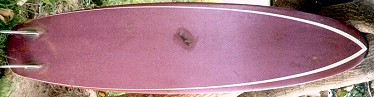
Pat Morgan Twin fin I 6 ft 7'' |
 |
1978
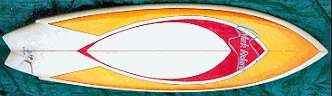
Mark Richards, Twin fin II 5 ft 10" |
 |
1978
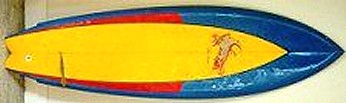
Mark Richards Twin Fin 2 6 ft ? K.P. |
 |
Bryne
Bros.
Surfboards
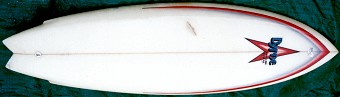
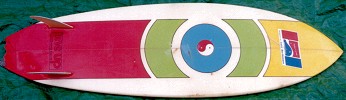
Twin Fin II 1978 Shaped by Laurie Byrne. |
 |
Hawaiian
Pro
Designs,
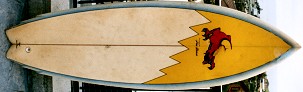
Twin fin II. 6 ft 1" 1979 Larry Bertelmann Model |
 |
Mark
Richards
Twin fin, 1979
double flyer swallow tail, 5ft 4'' Shaped by Mark Platter |
|
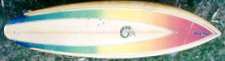
Mark
Richards'
first Twin fin II, based on Reno Abelira's Fish,
Coke Contest 1976
Photograph: Andrew Canning |
 |
#55 Pipedreams Flyer Roundtail Twin Fin II 1979 6 ft 2'' |
| home | catalogue | history | references | appendix |