a period of transition : 1967-1968
"the shortboard revolution"
Introduction
In the second
half of 1967, intense competition between a group of elite
surfers, shapers and manufacturers in Sydney, Australia, saw the
beginnings of a progressive reduction in surfboard volume,
commonly designated as the Shortboard Revolution.
This
experimentation initiated further volume reduction up to 1970,
thereafter profoundly changing surfing performance and board
design world wide.
As surfboard
dimensions were progressively reduced, these smaller boards
increased the speed at which manoeuvres were completed and
surfers rode deeper and longer in the critical part of the wave.
At the 1970 World Titles, former ASA President Bob Spence summarised the extent
of change in surfing equipment and technique since 1967:
"The revolution in the shape of surfboards
has brought with it so many new riding manoeuvres and styles
that judges will be hard put to keep up with the times. At no other period in our surfing history has
there been so much to learn. Great interest will be focused on the degree of
success each piece of new equipment achieves in bigger waves."
- 1970 World Titles, Bells Beach, souvenir program, quoted in Baker:
Australia's Century Of Surf(2011) page 160.
McTavish vs. Brewer : Stoked!
(2009)andGoing
Vertical (2010).
This paper was
prepared largely in response to the 2010 film Going
Vertical, and its associated publicity campaign,
that purported to examine the conflicting claims by Bob McTavish
of Australia and Dick Brewer of Hawaii in determining who was
responsible for the Shortboard Revolution.
By establishing
two opposing claimants, no doubt enhancing dramatic impact, the
film greatly over-simplifies this important historical period.
Although using
substantial (but highly edited) archival sources, the design
developments in Australia are accredited uniquely to Bob
McTavish.
While undoubtedly
McTavish played an integral role in the early development of
smaller boards, he was not an independent designer but rather a
leading figure in the Sydney board design "hot-house" of 1967.
Among the other
participants, the role of Midget Farrelly was substantial.
On the other
hand, by merely relying on Brewer's recollections, the film
effectively creates a "straw man" whose claims without any
archival documentation are, at best, dubious.
It also fails to
analyse the contribution of any other American and/or Hawaiian
shapers.
Incredibly,
according to Bob McTavish's introductory comments at the
Sydney premier of the film, interview footage with noted
Hawaiian surfer and shaper, George Downing, never made the final
cut.
Furthermore,
while McTavish is a noted big wave rider, the initial short
board designs were specifically manufactured for the small beach
break waves of Sydney, yet during the late 1960s Brewer's
reputation was firmly entrenched as the builder of big wave
guns, primarily for the massive north swells of the Hawaiian
winter.
The distinction
between small and big wave surfboard design is not canvassed in
Going Vertical.
While Going
Vertical is heavily indebted to Bob McTavish's
autobiography, the most detailed work examining this period, it
must be conceded that the book is unquestionably self-serving
and a significant number of his claims conflict with his earlier
writings and several must be considered, at best, tenuous.
Although it is
impossible to completely reject his (admittedly entertaining)
contribution, it presents potential difficulties for future
historians' attempts at serious analysis.
Therefore, while
an exhaustive critique of Stoked! by chapter and verse
would be tedious, as McTavish is to a significant extent
rewriting history some of his claims require, what may be
considered by some, trivial appraisal. Sources
The primary
sources are contemporary articles from various surfing
publications and a number of surfing films.
However, note
that for magazines at this time there was a substantial
publishing lag, up to three months, between composition and
distribution.
Compounding this
difficulty, during 1967-1968, the the two major Sydney surfing
magazines, Surfing World and Surf International,
fail to date many of their editions, and in some cases the
publication date is an estimation.
For films, the
lag was significantly longer and in some instances, by the time
the film was released the board designs were largely obsolete.
Secondary sources
are retrospective magazine articles, books or films; that is
works that were published significantly after the period under
discussion.
Generally, the
value of secondary sources diminishes as the gap between
publication and the actual events increases.
The most
informative contemporary article that details the critical last
six months of 1967 is an interview with Midget Farrelly,
possibly conducted by magazine editor John Witzig, published in
Surf International in early 1968, but clearly recorded
before he left for the winter season in Hawaii.
Extensively
quoted in this paper, it is strongly suggested that the article
should be read in its entirety, see:
Farrelly, Midget
: An
Interview on the progress and development of the modern
surfboard. Surf
International, Volume 1 Number 3 February 1968,
pages 35 to 37. Film Selections Available Online Bob
Evans: High
on a Cool Wave (1968)
Duke Kahanamoku´s World of
Surfing 1968 TV Special Part 2 https://www.youtube.com/watch?v=5AtEa84LsjY
5:09-8:59 George Downing Duke Kahanamoku´s World of
Surfing 1968 TV Special Part 1 https://www.youtube.com/watch?v=78BJnL1HnTY
5:57-6:26 Jock Sutherland, Pipeline and Sunset Beach Disclaimer
1. As an
Australian surfer, I have attempted to not be overly influenced
by nationalist tendencies.
2. Unfortunately,
I (still) do not have full
access to the range of American surfing publications of the
period, which possibly severely limits the analysis.
Any relevant
correspondence would be appreciated.
3. Although
surfing at Manly Beach in 1966-1967 and personally witnessing
some of the design developments discussed here, I have attempted
not to rely on my (questionable) memory.
Revolutions in Surfboard
Design – An Overview. Revolution: 2.
A complete or marked change in something. - Macquarie
Dictionary (1991). Surfboard:
in this context these comments refer to boards ridden in a
standing position.
Undoubtedly many
designs have been “invented” outside of the mainstream
manufacturing process, however they are only adopted by the
surfboard riding community at large and become a design standard
when they are either (and often a combination of):
1. available as a
commercial item.
2. given media
exposure.
3. demonstrated
in contest performance.
For aeons
surfboards were constructed from solid timber billets.
Since the turn of
the 20th Century, surfboard design has generally advanced in an
evolutionary process with small incremental changes.
However, at
several critical points design has undergone a marked change, at
the time effectively rending previous designs virtually
obsolete.
These changes
occurred in a relatively short time, usually about three years,
and formed the standard design parameters for the subsequent ten
years, in some cases longer.
The accreditation
to the following designers is simply a guide, and not exclusive.
The Hollow
Board Revolution 1926-1929.
Tom Blake (US) - Harry McLaren (Australia)
This improved
floatation and a reduction in board weight by 50%, while, generally, lengths
increased.
Ininitially
designed as a paddleboard, it vastly improved the surfboard’s
potential as a rescue device, and was particually suited to slow
waves with gentle faces.
However, its potential as a wave riding board was limited, and it's importance is sometimes
over-rated, as for a long period it co-existed in popularity with
solid timber boards.
The
Fibreglass-Balsa Revolution 1947-1949.
Bob Simmons, Joe
Quigg, Matt Kivlin.
Vast improvement
in structural integrity and a return to the subtlety in design
of the solid timber board, particularly in rail shape.
The addition of a
large area fin greatly improved directional stability and
turning performance.
The Foam
Revolution 1956-1958.
Dave Sweet, Gubby
Clarke, Hobie Alter.
Further reduction
in weight (20%?) from the balsa/fibreglass board and a vast
expansion of design possibilities.
In particular
note, circa 1966, surfboard designers' adoption of George
Greenough’s high aspect fin design.
The “Short
Board” Revolution, 1967-1970.
Midget Farrelly,
Bob
McTavish, Kevin Platt, Dick Brewer, many others.
While the
reduction in length is the focus of most commentators, from 1967
the standard board radically reduced in volume (L x W x D).
In 1967 most
boards were 9 ft 4’’ x 23’’ x 3’’, by 1970 this had shrunk to
6ft 4’’ x 18’’ x 3’’, with an effective reduction in volume of
approximately 40%.
Although
substantially reducing paddling ability, the use of a smaller
board significantly advanced wave riding performance.
The “Thruster”
Revolution, 1980-1983.
Simon Anderson.
From 1970
surfboard design experienced a wide variety of experimentation.
Most critical was
the universal adoption of the down rail, often attributed to
Mike Hynson.
Other variations
were in template shape, rocker, and fin design and
configuration.
The impact of the
introduction of the leg-rope (US: surf leash) circa 1974, should
not be overlooked.
It not only
improved safety, wave count and encouraged surfers to ride more
extreme locations, it also reduced structural demands
resulting in even lighter boards.
In 1981 Simon
Anderson introduced his three-fin Thruster design,
effectively supplanting previous fin configurations.
Some Design Precedents *
Before 1967
several designers had experimented with significantly smaller
than the current standard sized boards, in many cases scaling
down the standard dimensions for juveniles or riders of smaller
stature.
Note that these
experiments were not adopted at the time by the majority of
surfers, and the acceptance of smaller boards as the industry
standard was only established post 1967.
Included in an
extensive range of Tom Blake surfboard models and other aquatic
craft and accessories (aquaplanes, water skis, paddles and swim
fins) detailed in a Los Angles Ladder Company brochure published
in 1940 was the Breaker Board:
"A small
surf board which enables the user to ride breakers. Ideal for
children and for use in swimming pools as a flutter board. ... Size 5 ft.
long, 18 in. wide."
Although
designated as an aquaplane (note that these were often built by
surfboard manufacturers), an early application of a vee bottom
is evident in a 1934 brochure by the Thompson Bros. Boat
Manufacturing Company, which offered two models- the Hawaiian
Surf Board and the:
" 'Hawaiian
Floater' ... a hollow, built-up board. It had a
slight V shaped bottom, 6 feet long and 28 inches wide. ... List price
in the '34 brochure, $8.00 for the Surf Board and $12.00 for
the Floater!"
- http://www.chris-craft.org/discussion
:
early aquaplane info needed
thompsonboatboy
Posted:
Monday February 11, 2008 3:21 pm
Vee in the tail section was also
used in 1936 by Wally Froiseth, Fran Heath and John Kelly
at
Waikiki in their narrow-tail
gun, the Hot Curl, to improve control of their finless
boards in large waves.
Perhaps the most
famous of the early experiments was the Darrilynboard,
slightly smaller than normal board built by Joe Quigg for
Tom Zahn's then current girlfriend, Darrilyn Zanuck, in 1947.
The board was
subsequently ridden by many elite surfers and was considered
integral in the development of the Malibu Chip.
In 1954, Dale
Velzy produced his first Pig board, moving the wide
point bellow the mid-point which substantially increased the
tail area and improved turning performance.
- Holmes: Dale Velzy (2006) pages
101 and 102.
- Marcus: The Surfboard (2007)
pages 103 and 104.
- Motil: Surfboards (2007)
pages 114 and 115.
The Pig
template was adopted in 1958-1959 by Australian manufacturers
when they built their first fibre glassed boards (see Catalogue:#60
and #99) and was much in evidence
in the shorter designs developed in Sydney in 1967.
In the early
1960s Velzy manufactured a short board, designated the Seven
Eleven (7 ft 11''), which was later replicated (circa 1965) by
Dewey Weber, see Joey Hamaski's comments below.
- Joe
Tabler's Surf Blurb, 2 Aug 2010. http://www.surfbooks.com/
Posts by Herb
Torrens, Michael Richard and Don Fleming.
McDonagh
Surfboards, one of Sydney's earliest fibreglass board builders,
experimented with Coolite foam blanks in 1958 and
produced a range of boards in varying lengths: "pig board 9
ft., hot dog board 8 ft. 6 in., teardrops 8 ft., 7 ft. and 6
ft."
In 1961 Bob
McTavish purchased "the Goose", a 6 ft Gordon Woods
surfboard from Ken Wiles surfshop in Brisbane.
The board was
probably intended for a juvenile or, less likely, a surfer of
small stature.
Moving to Sydney
in 1962, McTavish built several boards similar to the Goose
for Chocko Ferrier, Dave Chidgley (both riders of small stature
similar to McTavish) and female surfer Christine Binning.
These " 6 '
6" wide tail board(s)", were designated as Foley boards,
a reference to asimilar design featured in the second
edition California's Surfer magazine (further details
unknown).
- McTavish: Pods for Primates The Best of
Tracks Magazine April? 1973, page ?
- McTavish: Stoked! (2009) page
125.
Dave Chidgley is
shown riding at short Foley board at Currumbin Beach,
Queensland, in Dennis Elton's Follow the Surf
(1963).
Dick Brewer noted
in 1989:
"When (Pat)
Curren visited me at Surfboards Hawaii in Haleiwa during
1963, he had a 9'4" full gun, an 8'4" semi-gun 3" thick, and
a 4'6" twin-fin kneeboard. All these
boards were ahead of their time."
- Brewer, Dick:Lust
in
the Dust - An Era of Big-Wave Equipment Evolution. Surfer,Volume 30 Number
10 1989, page 105. Surfboards in December
1966. Australia
At the end of 1966, the established Australian design was
between 9ft and 9ft 8'' long and about 23'' wide.
It featured a
round nose and a 6'' square tail, and constant rocker.
The bottoms were
rounded with a thin high rail, the design typified by Sam
(#522 ), Nat Young's 1966 World
Contest winning board.
(In the beach
celebrations following the contest Sam disappeared -
apparently "souvenired" by a spectator).
Generally the
blanks had a single timber stringer, although some had a
stringerless blank, first introduced by Midget Farrelly in 1965,
in an attempt to make the board lighter, see #110.
Some boards had a
concave nose to enhance noseriding (see below).
A deep Greenough style fin,
usually in excess of 10'', was set less than 6'' from the tail.
Greenough
initially fitted this fin design to his kneeboard circa 1960, however they were not
added to conventional boards until 1965.
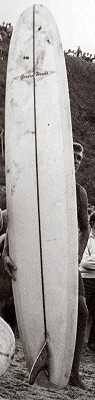
Gordon
Woods Surfboards : Sam by Nat Young, 1966. (digital
reconstruction)
California
Despite Young's emphatic win at the World Contest in San Diego
in 1966, and with half the finalists from Australia (ex-Avalon
surfer Rodney Sumpter 5th and Midget Farrelly 6th), most
Californian surfers and manufacturers continued to promote their
noserider models.
Most boards were
between 9ft 6'' and 10 ft and around 23'' wide.
They featured a
round nose, often with a deep concave section, parallel rails
with a wide square tail.
A wide variety of
fin designs were available, some fitted either a specific
manufacturers' fin box or to the universally available Waveset
(previously Morey's Skeg Works 1965) range .
See Tom Morey's
Noseriding Contest 1965.
Weber Surfboards :
Performer by Dewey Weber, 1967.
Hawaii
Big wave board designs dominated the focus of Hawaiian builders,
with lengths between 10 and 12 feet and widths generally less
than 22''.
With a pointed
nose, a foil template with the wide point well forward of centre
and a narrow square tail, the boards had distinct nose lift with
a relatively straight planning section in the tail where the
rails were low and hard.
Given the
stresses encountered in large surf, the most boards had a wide
timber stringer, multiple timber stringers or a combination of
both.
Fins were usually, often longbased, variations of the standard
D-fin, occasionally Dorsal.
Noted designers included George Downing, Pat Curran, and Dick
Brewer.
Hobie Surfboards :
Hawaiian Gun by Dick Brewer, c1964.
However, while California either
ignored or severely denegrated the Australian
approach, as exemplified by Nat Young's victory in
1966 and the writings of Bob McTavish, it appears
that some of the Hawaiian competitors, such
as Jock
Sutherland, Jeff Hakman, and Jackie Eberle, were
impressed.
At
the beginning of 1967, if
a choice "in style" was to be made between
California's Noseriders or the Australian
"involvement school," by the
winter of 1967-1968, the
Hawaiian approach was definitely closer to the
later.
Following the Duke contest at Sunset Beach,
Midget Farrelly reported:
"Almost every surfer out
there was riding the big waves the same way
we (Australians, and not the
Californians) tried to ride our little
waves."
George Greenough and the Velos,
1965-1966.
Overshadowing
the move to smaller surfboards in the late 1960s, the
contribution of Californian kneeboarder George Greenough
is undisputed.
While Velo,
his unique flex bottom kneeboard design, never produced
a practical equivalent application for stand up
surfboards (although it probably it had some influence
on Tom Morey's invention of the Boogie Board circa
1971), in Australia his high aspect fin became the
industry standard by 1967 and world wide by 1968.
Greenough's
wave riding, featuring a combination of radical turns
and commitment to riding deep in the curl, set the
standard for the future direction for surfing
performance.
In
addition, his outstanding surfing photographs and films
were themselves a major influence.
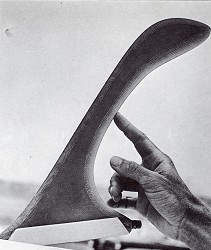
Image top right:
George Greenough and Velo Spoon and high-aspect fin, 1966?
Photograph by John Witzig?
in
?
Below:
George Greenough, Honolua Bay,
Maui, 1967.
Photograph
by John Witzig
in
Witzig, John: The
Australians
in Hawaii, Part 2 - Maui.
Surf International Volume 1.
Number 5 May 1968 page 23.
Peter Drouyn's Lightweight
Board, 1966.
In Switchfoot
(2003), Andrew Crockett detailed Peter Drouyn's victory in the
Junior ranks at the 1966 Australian Titles held at Coolangatta,
and noted his early enthusiasm in riding shorter and lighter
boards.
"Bob
McTavish shaped Drouyn's board for the titles that year and
he shaped it lightweight. Drouyn kept
saying he wanted it shorter and lighter. This was a
new concept at the time and led by Drouyn in 1966."
Interviewed for
the book, Bob McTavish commented:
"I
must admit, I could have overlooked a few things with Drouyn
in my recall of history, but I do know for sure that in
1966, that is pre-revolution, Drouyn was pushing for change. I shaped
him the board he won the Aussie juniors on in 1966 and he
wanted it light light light, which we did, we only did a
single glass job. He wanted
to be able to bottom turn like you wouldn't believe and I
made the mistake of making the tail too wide, still thinking
Malibu style then you know."
Compare and
contrast that McTavish's comment that "I made the mistake of
making the tail too wide" with his Easter 1967
experiments, noted below.
Drouyn stated:
"We were in
the shaping bay for half a day working on that board and in
the end it came out perfectly. I knew what
I wanted and thanks to Bob he let it happen."
McTavish added:
"...
I'd say Drouyn was the first high profile surfer to push
hard for Lightweight. I'd go
further than that, and say he was frustrated with the whole
concept of surfboards at the time ... he was truly ready for
the shortboard revolution of the next year before anyone..."
- Crockett,
Andrew: Switchfoot
(2005) pages 192-193. Nat Young's First Vee-Bottom,
December 1966.
After returning
from his victory in San Diego in 1966 without Sam, Nat
Young shaped several new boards at Gordon Woods Surfboards. One
of these had a vee-bottom section in the tail, and was ridden in the Makaha Contest(s) in the winter of 1966-196and at the
Australian Championships at Bells Beach at Easter 1967.
In September
1967, in an article prepared several months earlier, The Paddle-out Entry, Nat
Young commented on his newest board:
"Its statistics in length,
thickness, and width were similar to "Sam," my World Contest
board, but the bottom shape was completely new. Directly in front of the fin, the
board had a definite V-bottom. This made the board so sensitive
that it felt like one's first drive in a fast car, or
climbing on an untamed stallion. It was so sensitive and fast out
of the turn that you could not maintain your balance no
matter how hard you tried."
- Surfer, Volume
8 Number 4, September 1967, page 78.
At the end of 1967, Young noted:
"We started
off in the power school of surfing with rounds, which was
developed by McTavish, and then I found out later on that V
bottoms could be more sensitive so we worked on them, and
the board I took back for the sixty-six, sixty-seven Makaha
Surfing Championship had a V in it, and that was over a year
and a half ago." ...
(McTavish) was directly responsible for the continuation of
my idea, the V-bottom surfboard."
Note that there
were two "Makaha Contests" that winter, Nat competing in both.
Randy Rarrick noted (edited): "The 'Makaha Surfing event' was a made for TV special that
ABC did, because Nat Young had been eliminated in the main
Makaha event. They picked Nat because he was the reigning
World Champion and they hand picked all the other
surfers so they would have contestants from France, Peru,
California and Hawaii, besides Nat from Australia. The Makaha organizers were unhappy with ABC,
because it caused confusion over the official' event."
- Randy
Rarrick: The
Surf Blurb 26 March 2012.
For footage, see:
Makaha ABC Invitational, 1966
.
[filed as: 1967
MAKAHA SURFING CHAMPIONSHIPS] http://www.youtube.com/watch?v=wwn9PFMCVho
An excerpt from
ABC's Wide World of Sports (US television program), screened in
1967, with footage from the beach, helicopter and water
shots from a power boat.
Results: Nat
Young (Australia) 1st, Reno Abellira (Hawaii) 2nd, Mike Purpus
(California) 3rd.
The official 1966 Makaha contest was won by Fred Hemmings,
the
other finalists included Joey Cabell, George Downing,
Felipe Pomar and Nat Young.
In September 1967, in an article prepared several months
earlier, Nat commented on his newest board
"Its statistics in length,
thickness, and width were similar to "Sam," my World Contest
board, but the bottom shape was completely new. Directly in front of the fin, the
board had a definite V-bottom. This made the board so sensitive
that it felt like one's first drive in a fast car, or
climbing on an untamed stallion. It was so sensitive and fast out
of the turn that you could not maintain your balance no
matter how hard you tried."
Bob McTavish recalled, in 1973, that
Young's vee bottom board was constructed in early 1967:
"Nat
in Easter of '67 made a 9' 7" board with 6' of V in
the bottom which was based on a Greenough design. This
thing turned like crazy and carved incredible arcs."
The vee in the bottom of Nat's board is
not noted in the available contemporary contest reports
(by Ross Kelly and Barry Sullivan, below), is not
discernible in photographs or film of the contest, and
its significance not canvassed in Going Vertical
(2010).
Regrettably,
neither of these boards is not mentioned in Nat Young's
autobiography, and he gives an apparently conflicting
account:
"When
Sam disappeared, the honest truth is I felt unsure
on other surfboards. I
really believed he was magic and I just couldn't
surf anything else. I
tried lots of different boards but it just wasn't
the same - I built boards with exactly the same
outline and vital statistics but they just didn't
work like Sam had. I
sort of gave up and severed my relationship with
Gordon Woods ..."
Right: Nat Young and Gordon Woods Surfboard,
Australian Titles Final, Bells Beach, Easter 1967.
In 2009, in his intensive and enthusiastic account of
his early surfing and shaping career, published McTavish wrote
that Nat's incorporation of the vee-bottom in his "Easter board" was influenced by
George Greenough:
"George had
suggested it as a way of allowing the wide tails to bank
into a turn more easily. In fact, on
George's behest, Nat had just added some vee to the basic
'Involvement' style board he was surfing at Bells that
Easter. It looked
good, though on his standard width tail it was a little
lost, a little unnecessary."
This statement
appears to have a internal contradiction - George Greenough
suggests that vee may allow "the wide tails to bank into a
turn more easily", yet Young shapes his initial design on
a standard tail template.
More likely,
Greenough initially recommended reformatting the standard round
bottom with two flat planning panels (the vee bottom), a feature
that was later adapted onto wider tailed boards. Sydney, January 1967. In January 1967, Midget Farrelly, "former wold champion and
Sun-Herald columnist" continued to present the
Sun’s
Surf Safari, a series of
demonstrations, instruction, and general
promotion of surfing for the Sydney newspaper along the coast.
The other team members were Bobby Brown, of Cronulla, and Bondi's Robert Conneeley, accompanied by the "BMC Mini Zebra."
They apeared at Coogee (3rd), Maroubra (4th),
North Wollongong (10th), Bronte (11th), Newcastle (12th), Newport
(13th)
Whale Beach.( Monday )
- The Sun, Sydney, Tuesday, January 3 1967, page 11,
and susequent editions (various pages).
Following their commitments presenting The
Sun Surf Safari at Wollongong, including an
appearance at the Big W department store in Warrawong,
Farrelly, Brown and Coneeley surfed a rising "4-6ft" swell at Sandon Point.
With "more than 50 kids sitting on the Point watching
(none ventured into the water) ... Brownie was in his
element ... Farrelly and Conneeley were also turning it
on."
-
Trembath, Murray: On the Boardwalk The Sun, Sydney, January 13 1967, page 60?
Nose riding
competitions had dominated the Californian competition
scene during 1966, as a result of the success of Tom Morey's Nose
Riding Contest at Ventura, 3 - 4th July 1965,
one of the first to offer cash prizes in the
beginnings of professional contest surfing. As the rider was
clocked when standing on the
"nose of the board," for each wave and an
accumulated time, it was necessary to
define this area.
While many noserider boards had this section in the decor,
the recently available aerosol sray grip (Slipcheck, Grip
Feet, Con-trol) allowed a coloured nose-patch to be added
post production, and was evident on several boards at the
Austrailan championships that Easter, see below. The Windandsea club had
intended to stage the first noseriding contest in Australia,
however, North Queensland's Caloundra Surf Riding Club held
the first on 7-8th January.
"The contest was won by a 16 year old school boy, Andy
Geddes, with a total time on the nose of 12.5 in his best
three rides.
Longest individual ride was 5.2 s."
Windandsea’s "high prize-money" contest, with was scheduled for April.
-
Trembath,
Murray:
On
the Boardwalk The
Sun,
Sydney, January 13 1967, page 60?
At the end of
January, the Sydney Sun advertised a surfboard clearance sale at 61 Ethel Street, Seaforth.
They were offered at a substantial discount, perhaps a
stock of now obsolete D-fins originally ordered by a
chain store.
-The Sun, Sydney,
Friday January 20 1967, page 58.
As a result of
mis-management, the 1967 NSW championships originally scheduled for 28-29th
January were postponed at an
emergency meeting of the
contest committee of the NSW Surfrider’s Assoiciation on the previous Wednesday.
Re-scheduled for Avlon on
February 18-19th, the pressing
issue was the selection of the State team for the Australian championships to held at Bells Beach over Easter.
As such, only
heats and rephages were held to select the top 15 seniors
15 juniors and 6 girls (sic), with
the finals to be run at a later date.
Entry forms,
available at board shops, were to be lodged by February
13th.
Similar mismanagement was also evident in inter-club
competition:
"Windansea
has lost both the Dee Why Shield and the Air New Zealand
Trophy for failing to have contests within specified
periods of time."
In
the waves, St. George (Cronulla) was defeated by Mid-Steyne
(Manly) "in a good 6ft surf" at Manly Beach on Sunday 22nd
January.
Although St. George
won three of the five heats, Mid-Steyne
accumulated more points.
Kevin Platt (M-S) top-scored , followed by
Bob Brown and Frank Latta, both of St. George. During January, the (Sydney University) Union Theatre screened Bob
Evans' High on a Cool Wave
(1967-1968), Murray Trembath noted
that:
"The
first half is shot up around Noosa and Double Island Point
where Nat Young, Bob McTavish and belly boarder (sic) George
Greenough really turn it on. The second half has a few old shots, and more
recently the world championships in California and surfing in
Hawaii. The shots of Peter Drouyn surfing
Sunstet and Pipeline at 8-10- ft on his 9 ft board are
probably the best in the film.
Drouyn’s last ride at Pipeline has to be seen to be believed."
- Trembath, Murray:
On the
Boardwalk
The Sun, Sydney, Friday January 27 1967, page 62.
In February, Graham Cassidy was appointed as
the journalist for the Sun'sOn the Boardwalk, his
first column noting a large consigment
of wetsuits and vests to Victoria and the
approach of Cyclone Dinah, with the prospect of large waves on the
north coast.
An article about
the surf generated by Dinah at Noosa by Dr. Robert Spence was
later
published in Surfing World, March 1967.
Cassidy's article also detailed an impromptu
contest between Midget Farrelly and Nat Young at North Avalon, on the previous holiday weekend:
"Midget, with his grand 30 yard nose rides across the wall and Nat
with his powerhouse manoeuvres in 'the soup' were a delight.
...
The off-the-cuff encounter was a terrible indication of what we
can expect in the championships."
-
Cassidy, Graham: On
the Boardwalk The Sun, Sydney, Friday February
3 1967, page 60.
Graham Cassidy was instrumental in initiating the 2SM-Coca-Cola Surfabout contest in 1974, and he was
ASP's executive director in the late 80s/early 90s.
He also co-authored Greats of Australian Surf (1983 and
1989)
Australian Championships,
Bells Beach, March 1967.
With the expected
big wave conditions common around this time of the year at Bells
Beach, the 1967 National Championships were eagerly
anticipated.
The coming
together of the country's best riders resulted in an intense
focus on the performance of the participants and their
equipment.
Midget Farrelly
recalled:
"... I felt
quite inspired after watching some of the surfers at the
Australian Championships atBells a little
more closely than I ever had done before. I think I
summed up Bells as being the kind of contest where people
actually wanted to get outand get more out
of a wave than have ever been gotten out before. They wanted
to ride Bells in a way that had never been done before."
Footage of free and competition surfing
at Bells Beach in Paul Witzig's Hot
Generation (1968) and
photographs of the contest support Farrelly's
observation that the contestants "wanted to get more
out of a wave than have ever been gotten out
before."
Australian Titles, Bells Beach,
1967. 1. Nat Young 2. Midget Farrelly
3.Ted Spencer
Photographs by Alby Falzon
Surfing World
Volume 9 Number 1 April-May 1967, pages 21 and 23.
1.
2.
3.
- Witzig, Paul : The Hot Generation
Trailer (1967) https://www.youtube.com/watch?v=sgisHsJZ0vw
This
introduction includes a number of waves shot at Bells Beach,
Easter 1967.
In a contest report, Ross Kelly detailed some of the recent
advances in board design:
"Many new
ideas showed up at Bells. Bernard
Farrelly's super light big board with a huge nose lift,
which allowed him to stand further off the tail
and so level and trim the board against the water line.
Nat
fattened his fins and especially the leading edge to reduce
drag, similar to the foil on a dolphin'sfin.
The trend
was for very light thin railed boards, many with nose and
back sections sprayed for extrafeet grip. (Spectator
McTavish killed them all by only spraying the middle).
Russell
Hughes from Noosa used a radical 9' 10" gun with a pure
planing section aft flowing into a10" pod and 18"
fin. The board
proved fast and interesting."
Nat's fin, "similar to the
foil on a dolphin", is not immediately evident in the photograph
noted above.
As noted by Tim Baker (2013), Midget
Farrelly's "super light big board" is certainly
shorter than Nat Young's.
For an effective comparison, see the photograph
below.
The image to the right shows the board's concave
nose section and a high-aspect D fin, probably set
in an early version of Farrelly's experimentation
with finboxes.
The board continued the development of Midget's Stringerless
design, introduced in early-mid 1965 and ridden to
victory in that year's
Australian Championships at Manly, with Nat Young second,
followed by Bob McTavish.
The design was given international exposure when
Farrelly was a finalist at the 1966 World Contest in
San Diego, and was reproduced in California by
Gordon and Smith Surfboards from 1967 to1969.
While there was some reduction in weight,
for Midget "the main reason for
dropping the stringer was that the rocker could be
adjusted while the shape was being glassed."
These boards required some finesse in their construction.
As the curing process tended to
pull the rocker out of the board,
this required the rocker to be maintained, and even
enhanced, by securing the freshly glassed board in a frame, or jig. This method is still
used in the mass manufacture of modern stringerless
EPS and urethane boards.
- Midget Farrelly: personal phone
conversation, 12 March 2014, email 21 May 2014, with many
thanks.
Local
manufacturers quickly picked up on the
concept, and by the summer of
1966-1967, many Australian manufacturers were
producing stringerless models, including Bennett,
Wallace, and Gordon Woods. The stringerless concept was
not generally adopted by manufacturers in California or
Hawaii, except for
the previously noted, Gordon and Smith's Farrelly Stringerless model and, later, Corky
Carroll's Flexible model for Hobie Surfboards in
1968.
Left: Nat
Young and Gordon Woods with stingerless models, Deewhy
Point, 1965-1966.
Image
courtesy of Gordon Woods Archives.
Originally
printed in Surfing World (1965?), subsequently
in Young: Nat's
Nat, page 75.
Despite the widespread use of Farrelly's stringerless
design in Australia, in 2009 Bob McTavish claimed it as
his own, as developed at Keyo Surfboards, rather
belatedly, in mid-late 1967.
Also, note that "coloured foam"
stringers were relatively uncommon.
"The glassing was radically different
to the years previous. I wanted lighter weight in these new
shortboards, and had convinced Denny (Keogh) to drop
the wooden stringer to save weight. The blanks were glued with a of coloured
foam up the centre, to give the shaper a centerline to
carve in the correct rocker
curve. As such, the shaped blanks were quite
flexible, so in order to establish and preserve the
correct rocker, I made cradle,
a jig. When the glasser, John "Flecky" Fleck
saturated the glass with resin, or "wet-out," he would
then carefully lay that board onto the cradle while
the resin "went off" or hardened. As soon as that was hard, another took its
place, and so on. Keyo Plastic Machines were the shortest
boards in the world, and by far
the lightest."
Future
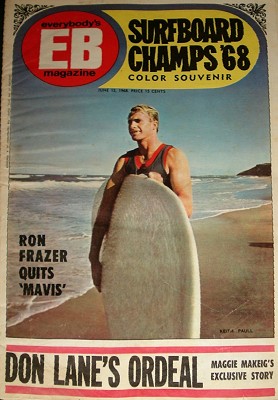
Australian champion, Keith Paull was photographed riding
non-competitor McTavish's board, "only spraying the middle" with aerosol-grip, during the contest at Bells Beach.
It had a
similar tail to the "10 inch pod" on Russell
Hughes' board, an indication of future developments, and
the "pure planing section aft" was probably a
flat tail section as opposed the the common rolled
bottom.
McTavish
writes that he shaped Hughes' board (reported as 9ft
10'' by Ross Kelly), and a similar one for himself,
apparently for the expected large waves of Bells Beach.
"One
experimental board was a wide-tailed gun, based on
George Greenough's kneeboard, but blown up from his
4'10 to 9'6! What
a beast! I
shaped one for Russell Hughes as well, and we'd
surfed them at big Palm Beach peaks once or twice,
and Narrabeen on a big day as well. They
were absolute rockets! Fastest,
meanest machine ever, like dragsters ... fast in a
straight line. But
there was simply too much of them ... way too big. But
it proved a point: if you're going to go that route
- wide-tailed and flat - you have to shrink the
board considerably."
In Paul Witzig's Hot
Generation (1968) footage, it appears (in
his wipe-outs) that Hughes' board also featured a
chamfered vee tail, a feature common on many later
vee-bottoms.
Keith
Paull, Bells Beach, 1967.
Photograph: Alby Falzon.
Surfing World
Volume 9 Number 1
April-May 1967, page 28.
Also significant was the board of fellow
Queensland surfer, Peter Drouyn, Junior Champion in 1966
and who was making his initial entry into the senior
ranks
An early
proponent of lighter and shorter boards (see above)
Drouyn was:
"Riding
a very short and light board, Peter gained
tremendous acceleration from his turns to power from
the soup under some 'impossible' heavy Bell's
curls."
-
Sutherland, Barry: Australian
Champs
'67.
Surfabout Volume 4 Number 1, June 1967, page 23.
Unfortunately, photographs of Drouyn's
board only suggest, and do not effectively illustrate,
it's length.
Australian Finalists, Bells Beach, Easter
1967. Peter
Drouyn (Carey), Keith Paull (Peter Clarke) Ted Spencer
(Keyo) Nat Young (Gordon Woods) Midget Farrelly
(Farrelly).
Not shown:
Bobby Brown (Jackson)
Reprinted in Baker: Century of Surf (2013) page 148.
(cannot locate original printing, probably SW 1967)
As well as
Drouyn's "very short and light board", McTavish also
claims that he built two, presumably, similar size boards before
the 1967 Australian Championships.
He implies these
were in response to the deficiencies already apparent in the
boards he and Hughes rode during the Bells' contest.
"Hence, I
made two freaky 8 footers, with long double concaves running
right through the otherwise flat bottom, and a rakey single
fin with George Greenough's flex design built in. Robert
Conneely, a fine Bondi surfer and surf shop owner, and
former Australian Junior Champion in 1964, bought one, and
Paul Witzig bought the other. I didn't
have any money to buy one myself. These two
boards were actually the first shortboards of the
Revolution, as they came before the Plastic Machine of a
month or two later. They were
thin and therefore hard to paddle, but we all surfed them
fairly well at Winkipop, the neighbouring reef break to
Bells. The
difficulty with them was the extreme power generated in the
tail, which made it very difficult to bank into a turn. But the
sheer speed was phenomenal!"
Before returning
to Sydney, in conversation with Victorian surfers "Claw" Warbick
and Brian Singer (the proprietors of the Bells Beach Surf Shop
at Torquay, later Rip Curl Surfboards and Rip Curl Wetsuits),
McTavish indicated that his next designs would incorporate vee
in the bottom, presumably based on Nat Young's board noted
above.
"I told
them what I'd learned so far, and that I was going back to
Sydney to add some vee to the bottom of the next bunch of
experimental boards."
Considering the
intense interest in board design and surfing performance
generated at the Bells contest (note Midget Farrelly's comments
above), it is highly unlikely that Bob McTavish was the only
surfer-shaper who was aware of the possibilities of combining
the various design elements in evidence during Easter 1967- thin
rails (all), stringerless (Farrelly), reduced length (Farrelly,
Drouyn), concave nose sections (Farrelly, Bobby Brown), a 10''
wide tail (McTavish), and vee in the tail (Young?).
The contest
results were based on points accumulated over several rounds and
was ultimately won by Nat Young, with Peter Drouyn second
and Midget Farrelly in third place.
Other senior
finalists included Ted Spencer, Keith Paull and Bobby
Brown.
The Junior
champion was Wayne Lynch and fellow Victorian, Gail Couper, won
the Women's.
Second in the
juniors was Butch Cooney, followed by Kevin Parkinson and
Richard Kavanaugh. Dick
Brewer and the Pipeliner, 1967-1968.
Californian-Hawaiian
shaper, Dick Brewer has claimed, in two different accounts, that
"the mini-gun was happening in (a) the spring"
or (b) the summer of '67". Both accounts appeared substantially after the events,
and although supported by other's recollections, there is
a distinct lack of any contemporary documentation, neither
photographs, film, magazine articles or advertisements, or
related contest results.
This is in marked contrast to the considerable amount of
material illustrating developments in Australia.
For the US media
in 1967,
surfing and surfboard design was in two clear divisions.
Small wave riding, with faces up to 6ft, largely focused
on California and
was dominated by
David Nuuihwa and the Noserider model.
Hawaii was the home of large wave riding, generally 7ft
6'' and above, and regular
finalists in the recent Duke and Makaha contests included
George Downing,Ricky Grigg, Fred Hemmings, Paul Strauch, Joey
Cabell, Mike Doyle, Jeff Hakman, and
Jock Sutherland.
In the winter of
1966-1967, Hawaiian guns were around 10 to 12 feet long,
a
foiled square-tail, with distinct nose lift
and a relatively straight planning section in the tail.
The
fins were usually, often long-based, variations of the standard
D-fin, occasionally Dorsal and set close to the tail.
See:
MacGillivray, Greg and Freeman, Jim: Free and Easy
(1967)
However, by the winter of 1967-1968,
there had obviously been considerable advances.
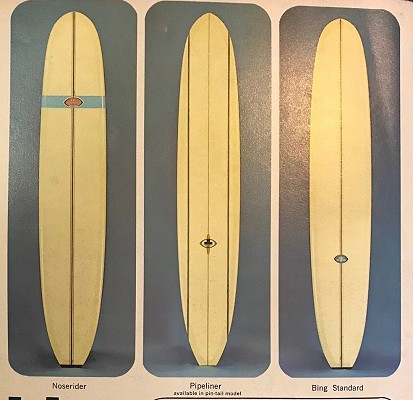
For the top riders, lengths were down to 9ft 6'', and the
template, while still a foil, had been "softened" to a rounded
pin-tail, exemplified by Brewer's Pipeliner series for Bing
Surfboards.
The straight
planning section had been replaced with a more regular
rocker, and, importantly, variations of
Greenough's high-aspect fin , set further up the board, were
now standard, as in Australia.
While these
changes, undoubtedly, were strongly influenced by Dick Brewer, as
in Australia, their widespread adoption was more likely to be
the result of a number of competing designers and surfers; if
not only, the vastly under-rated, George Downing, who was
actively shaping and competing in Hawaii at the time.
Also note that these developments in Hawaii were essentially
focused on large wave riding, and it was still nearly twelve
months before the shorter board would fully supplant the
Noserider for the small wave mainland markets.
To return to Dick Brewer's recollections.
In the first, printed in 1989, Brewer identified Gary Chapman* and Barry Kanaiaupuni as the first
Hawaiian surfers to make the change to smaller boards in
mid-1967:
"In 1967 Gary Chapman rode Sunset
Beach on a 9'7" Brewer, then an 8'6". Barry Kanaiaupuni rode Chapman's
boards, and said, 'This is what's happening-R.B. ... small
guns.' This was six months before Nat
Young and Bob McTavish would show up with their 9' deep vee-
tankers."
Since Young and
McTavish arrived in Maui in late December 1967, this would imply
that Chapman and Kanaiapuni rode these boards at Sunset Beach in
June, at the height of the Hawaiian summer.
The second
version appeared four years later, with a different cast, dating
Brewer's building (re-building?) of the first Hawaiian
shortboard several months earlier, in the Northern Spring
(April-May?) of 1967:
" I'd
made a 9-foot 10-inch gun for David Nuuhiwa in the spring of
'67, and David broke the nose off, so I redrew it at 7 feet
8 inches with a 17- inch nose on it - a tanker nose - and
Randy Rarick was a patcher and he reglassed it. I took that
board out and rode it at Chun's, at the left called Piddlies
- phenomenal roller coasters with that heavy nose and the
gun tail. That board
became the proto-type for the Bing Lotus. So, the
mini-gun was happening in the spring of '67."
Brewer's
recollections were confirmed in the article by Randy Rarick.
- Marcus: Surfboard (2007)
page 159, quoting Drew Kampion in The Surfer's
Journal, May 1992.
Paul Holmes (2008) paraphrases Brewer's
quotation, initially back-dates it to "late summer 1967"
(July-August?), but later in his book
notes:
"Models and Shapers Overview - November 1967: Dick
Brewer designs the Lotus."
The claim this is occurred in "the spring
of '67" is unlikely, as Nuuhiwa's 9-foot 10-inch Bing Pipeliner
was probably not shaped until August 1967.
Tom at the Classic
Bing
Surfboards web sitepost several images of a
BingPipeliner and notes:
"Chuck
Linnen's original California Pipeliner Gun. Dick
Brewer shaped three Pipeliner Guns when he visited the
Hermosa shop in the summer of 1967, for team riders David
Nuuhiwa and Chuck Linnen and Grant Reynolds (Bing's
glasser). Unlike
the other Pipeliner Guns, which were made in Hawaii by
Brewer in 1966-67, these three were made for riding big
surf in California. This one
is 10'7" !"
The images
include a "a photo right out of Bings order book" that
indicates that Linnen's board ("#7986") was ordered
and/or shaped on "8-3-67", that is 3rd August
1967.
- Classic Bing
Surfboards http://www.classicbingsurfboards.com/mid60sbings.html
Even accounting
for the board being "made for riding big surf in California",
the extreme length hardly illustrates Brewer's recollections
that "the mini-gun was happening in the spring (or the summer)
of '67".
Furthermore, in this second version, Nuuhiwa has the board made in/for
California, but (sometime
later) apparently
breaks the nose off in Hawaii,
where the re-shaped board is said to be ridden, and it's
performance assessed, only by Brewer himself, and perhaps
Randy Rarick.
At best, these recollections indicate that during 1967, Brewer
was, on occasion, experimenting with sub-9ft boards, but this
hardly compares with the enthusiastic adoption of the shorter
board by Australia's elite surfers.
Further embellishing the second account, Brewer emphasized his comittment to a
significant reduction in surfboard length, apparently still in
1967:
"For some
reason, all of this innovation led to Brewer being relieved
of his command at Bing. Gary
Chapman had purchased a reject blank and carried it over to
Bing's factory where Brewer shaped it into an 8-foot 6-inch
mini-gun. "Bing fired
me the next day," Brewer told Kampion."
- Marcus: Surfboard (2007)
page 160, quoting Drew Kampion in The Surfer's
Journal, May 1992.
Brewer's firing by Bing Copeland was either a short-lived, and
he was quickly re-employed, or the dismsal was at least twelve
months later.
Initially
employed in late 1966, Bing Surfboards were still promoting
Brewer's Pipeliner model in July 1968.
Being fired in July 1968 for shaping
"an 8-foot 6-inch mini-gun" is
somewhat less significant than being dismissed for the same offence
in late-1967.
Bing
Surfboards : Pipeliner
by Richard Brewer , 1967-1968.
Sydney, May-June 1967.
On their return
to Sydney following the 1967 contest at Bells Beach, competition
between a group of elite surfers, shapers and manufacturers saw
the beginnings of intense experimentation in surfboard design.
Midget Farrelly
noted:
"There is
one thing, though, between Manly and Palm Beach you've got
twenty miles, and I would say at times
there seem to be about two thousand surfers. In amongst
that two thousand and twenty miles you've got the best
surfers in the whole country. So
something has got to happen. Things have
got to pop."
At the forefront
of this group was Bob McTavish, Kevin Platt, Ted Spencer, David
"Baddy" Treloar and Neil Purchase (see above) at Keyo Surfboards
in Brookvale and Midget Farrelly, with Warren Cornish, building
boards at Palm Beach.
Other Brookvale
manufacturers/shapers included Gordon Woods Surfboards with Bob
Kennerson (?), John Otton at Wallace Surfboards, Geoff
McCoy at Bennett Surfboards and Shane Surfboards with Russell
Hughes, Richard Harvey and Dee Why's Peter Cornish.
South of the
harbour Keith Paull was at Peter Clarke Surfboards, Bobby Brown
was at Gordon & Smith Surfboards and Gordon Merchant was
shaping at Jackson Surfboards.
At Bondi, Robert
Conneelly had opened his surf shop, retailing his own designs
under the Hayden Surfboards label.
Forty years
later, McTavish clearly recalled the shaping his first vee
bottom board at Keyo Surfboards, circa May 1967:
"A month
later back in Sydney, I shaped the first Plastic Machine. I went a
full 9 feet, to try to integrate the nose riding we had
developed so well, with the new vee tail idea. The nose
had a six-foot long concave, while the tail had two six-foot
vee panels wrapping up alongside the nose concave in the
middle three feet."
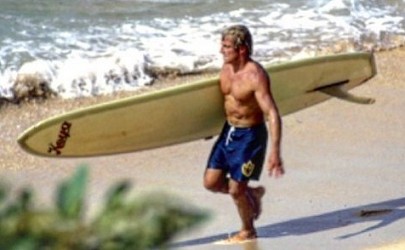
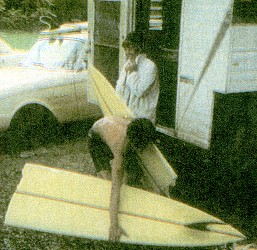
A widely
published photograph by John Witzig of McTavish carrying what is
possibly this board is reprinted in Stoked! on page 363,
in black and white, while a colour version appears on the rear
dust jacket.
Furthermore, he
relates the, often told, story of the naming of his latest
shape:
"I loaded
the shaped blank into my unregistered Morris 1000 van (which
I'd bought off Keyo's sander Brian Hughes for $10) and
headed off home to Palm Beach, where I had a bedroom at Paul
Witzig's house. While
unloading it to carry it inside and groove on the shape for
the night (an unusual habit in itself), Paul called out from
the verandah, "It looks like a Plastic Machine!" The name
stuck, and next morning I took the shaped blank back to
Keyo's and wrote in the six-foot long concave "PLASTIC
MACHINE" in psychedelic lettering. Hmmm. A moment of
dubious history."
The designation of McTavish's Keyo model as the (Fantastic)
Plastic Machine had considerable precedents.
Bob Cooper designed the Blue Machine for Morey -Pope
Surfboards, California, during 1966 and San Francisco's
Jefferson Airplane released their recording Plastic
Fantastic Lover
in
February 1967.
Also note Russell Hughes' Crystal Vessel
(Crystal Ship by The Doors, January 1967), and Keith Paull's Happening
(The Happening by The Supremes, March 1967).
In Stoked!
(2008), McTavish recalled designing the decal:
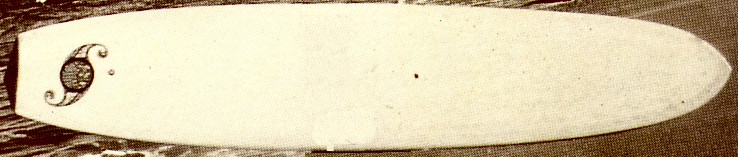
"About this time Denny Keogh approved my getting a flash
psychedelic logo done, so I showed him how I'd sketched a
knock-off part of the 'Mellow Yellow'
jacket art, a yin-yang symbol with the words Plastic Machine
replacing Donovan's. I dropped my artwork off at Jim the Printers, and
gave him the brief. I wanted plenty of colour. And it had to be hippy! ... The new Plastic Machine
logo proved to be a winner.
The first colour art, the first psychedelic surfboard sticker.
It started a rash of Haight-Ashbury inspired art that every
surfboard manufacturer on planet got into over the next couple
of years.
Chrystal Vessels. White Kite. Involvement (sic) Model. Faith.
Spirit. Et al."
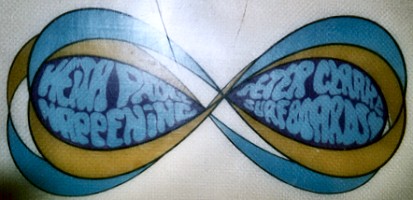
Clearly, before McTavish designed his decal in late-1967, "coloured psychedelic surfboard stickers" were
already in common use by many Australian manufacturers.
1.
2.
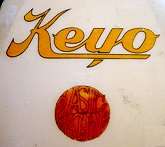
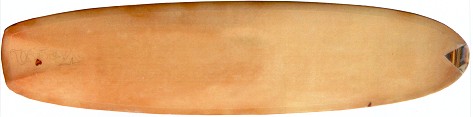
1. Farrelly Surfboards decal,
Stringerless 9 ft 0", 1967.
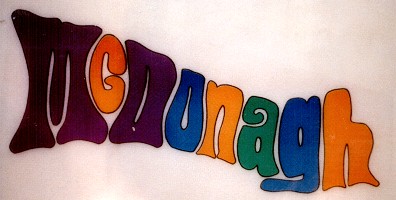
2. McDonagh
Surfboards, Psychedelic/Op art decal, circa 1967.
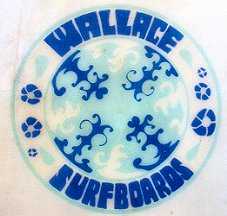
3.Wallace
Surfboards, Floral Circle decal, circa 1967.
[There was also a larger version, with two
"wings"
extending from the circle.]
3.
4.
Midget
Farrelly's 8ft 8", July 1967.
The
earliest report that specifically indicates a move to shorter
boards, with a discernible improvement in performance,
is Midget Farrelly's 8ft
8'' board, built at Palm Beach, and noted by Bob McTavish
(circa July 1967):
"At Avalon
on those beautiful turning waves - vertical at the top with
a good soft curve in the bottom. Midget's
been pulling his 8' 8" around in the tightest arcs ever seen
done by a full surfboard."
Interviewed in
December 1967, Farrelly recollected the developments of the past
year:
"I remember
midway through the winter I made my first 8 foot 8 board and
I thought that wasshort, but then
about September they started to go even farther."
In late
1968, advertising copy for Farrelly's V Pintail model
by Gordon and Smith Surfboards, San Deigo, indicated that
Farrelly's experimentation may have begun slightly earlier,
probably after the Australian Titles at Easter:
"In May
1967, Midget wrote to us from 90000 miles away about a
completely new thing he was working with. It was the
V Bottom. We delayed
work on it because at first it sounded impractical and we
questioned its acceptance. This was
our first introduction to this radical design. Finally in
the Fall of '67 we were convinced that Midget's new model
for '68 would be a V Bottom."
- Gordon and
Smith Surfboards: Take What We Have & You'll Have What
it Takes. (Advertisement) Surfer,
Volume 9 Number 4, September 1968, page ?
Gordon and
Smith's premier designer, Skip Frye, was a member of the
Californian Windansea team that toured Australia in November
1967, see below. Neil Purchase's The
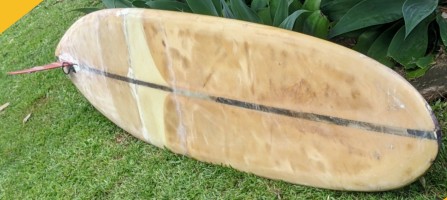
Virgin, mid- 1967. In 2000 Manly
surfing enthusiast, David Bell, purchased what was
obviously a late 1960s vee bottom surfboard, although at
the time it was completely covered in blue house paint.
He
subsequently had the paint (and, regrettably, other
colour decor) professionally removed which revealed at
the tail a small Keyo (Surfboards) decal incorporated
into a pencil script identifying the board as the "Virgin".
In his
initial attempts to determine the provenance, Manly surf
memorabilia expert Mick Mock directed David to a 1998
Tracks magazine profile of Manly surfer David "Baddy"
Treloar by Derek Hynd.
Hynd
reported:
"Heleft Balgowlah High at 16 and took on the role of
shit-kicker at Keyo Surfboards. These
were the innovative days of the McTavish Plastic
Machine, and Baddie saw it all unfold. The
way he tells it, an unsung Keyo worker played a
heavy role in its development. 'Like
me, Neil Purchase was a shit kicker, 8 till 4, no
time off to surf. He
made the first vee-bottom short board, a
stringerless 7'4". It
had a black bottom and a clear deck. Neil
made it from scratch. He
called it "The Virgin". The
big names used to work around the surf, and Ted
(Spencer) took it for a surf at Long Reef, then
(Bob) McTavish and (Kevin) Platt rode it.' "
- Hynd,
Derek: Surfers in History - David Treloar Tracks,
December 1988, page 28. Treloar's
recollections were not completely accurate - the board
held by David Bell is in fact 8 ft 4'' long, a much more
reasonable size for the period.
Extended
accreditation: Illustrating the complex and ad hoc nature of
research, in June 2010 I was contacted by Andrew Kidman in
regard to a board design by Rod Ball and during our phone
conversation I mentioned my current project was revising the
history of transition boards during 1967.
Andrew noted that he had some material that I may find
interesting and posted a booklet compiled by David Bell that
contained his photographs and dimensions of the Virgin
and copies of several relevant magazine and book articles,
including the Tracks' article quoted above.
Therefore, thanks
to David Bell, Mick Mock, Andrew Kidman, Derek Hynd and David
Treloar.
Keyo Surfboards
: The Virgin
by Neil Purchase, 1967.
Sydney, July-September 1967.
In recalling the
era in 1972, McTavish wrote of the progressive reduction in
length and, firmly establishing Farrelly's contribution, and
noted that this was primarily the result of an acute awareness
of other manufactures' developments. "Later on
in the year Kevin Platt and myself at Keyo's started making
V bottoms. First they
were 9', then 8' 6" then 8', then down to 7' 1 0". ... At the same
time Midget's shop at Palm Beach was running stiff
competition with us at Keyo's. As we'd cut
2" off, Midget would cut 4" off, then vice versa."
Note McTavish's "Later
on in the year" (July-August 1967?) is somewhat at
variance with his detailed account in Stoked!
In 2005 McTavish
was more expansive on the contribution of other surfers and
shapers: "I
certainly wish Drouyn was in Sydney when it all came down in
'67... and I secretly think Peter wishes he was there too...
along with Ted(Spencer)Baddy (David
Treloar), Kevin Platt, Midget, Keith (Paull)..."
- Bob McTavish,
quoted in Crockett, Andrew: Switchfoot (2005)
page 193.
Note however that
Drouyn was in Sydney, at least briefly, to compete in the
Windansea Contest in late November 1967, see below.
In the week
between the first rounds and final, the Windansea team with Eric
Blum's film unit and several Australians travelled up the North
Coast of NSW, terminating at Coolangatta, Queensland:
"First stop
was Peter Drouyn's house. ... The first
thing his mother asked Peter was how he did in the contest
... he told her he'd been eliminated early on ..."
In a Bob McTavish
interview conducted by Avalon's David "Mexican" Sumpter and
published in 2006, his recollections fall somewhere between his
1972 Tracks article noted above and the those presented
in Stoked!:
"Sumpter: Where did Midget
and other manufacturers fit in? As soon as
you were starting to bring the boards down in size, Midget
must have been pretty close to the action?
McTavish: Midget was
building boards at Palm Beach in Frankie Gonsalves' boat
shed, just him and Warren Cornish. I was at
Keyo's, and we had a dynamic crew working there. Kevin Platt
and I were the shapers, Baddy Treloar and Ted Spencer were
hanging around all the time, and Neil Purchase was doing a
great job sanding and learning to shape." ... So the next
weekend I made one 8'2'', and while I was doing this I was
surfing at Palm Beach or Avalon every afternoon because I
was living there, and Midget. ..he'd see what I was riding
and a couple of days later he would have something very
similar, maybe even an inch shorter! So we
didn't talk too much - we'd just each show up each afternoon
with these shorter boards. He was
really into it! I recently
read an interview he did for Surf magazine about those times
and you can tell he was totally stoked in what we call the
Plastic Machine era through the winter of '67.
- Pacific
Longboarder, Volume 9 Number 5, 2006, page 50.
Note that in this
interview, Farrelly implies that the deep vee bottom board was
his own design:
"The
progression towards round bottoms has proven that a round
bottom definitely puts you back inthe wave, but it
often leaves you there too. There had
to be an answer. I felt a
split planing surface under the tail, set at different
angles, would provide the displacement of around
bottom plus the planing advantages of a flat bottom."
- Farrelly,
Midget : An
Interview on the progress and development of the modern
surfboard. Surf
International, Volume 1 Number 3 February 1968, page
35. Bobby Brown Tribute,
October 1967. Following the
untimely death of Cronulla's highly talented bobby Brown,
Jack Eden's Surfabout
featured Bobby in both a cover and centre fold-out in the
October 1967 edition.
The photographs were mostly from a recent session at
Sandon Point, Brown riding his new Gordon
and Smith stringerless model with a deep nose concave. Midget
Farrelly's stringerless models were now produced by most
of Sydney's manufacturers, as indicated by advertisements
for
Wallace Surfboards,
"Real performance with the latest flexible
Stringerless Models",
Scott Dillon Surfboards,
and
Gordon Woods Surfboards, featuring Bob
Kennerson, offering
a choice of either "stringerless, high density colour foam
stringer or redwood stringer."
The latest design had the latest fin, the
"stage 3 George Greenough," with some taking the flex-fin
idea to extremes.
A interesting, but short lived, development
was the Mini-board, documented by Jack Eden, a
kneeboard
"long" enough to be walked and trimmed.
- Surfabout Volume
4 Number 3,
October 1967. The enthusiasm for the shorter boards with the
deep vee bottoms was evident in an interview conducted with Bob
McTavish, Kevin Platt and Ted Spencer at Keyo Surfboards for Surfing
World, probably recorded in late October 1967.
It was accompanied by a selection of photographs by Alby Falzon, shot mainly at Long
Reef, around the same time.
Kevin Platt commented:
"Every
little bit of the board works. If
you came back from the nose about 1' 6" and cut a
foot out of it, then just glue it back togetheragain,
that's more or less what we've got now. ... Putting
the "V" in a long board was like putting a super
charger on an ordinary car."
- McTavish,
Platt, Spencer. Surfing
World, Volume 10 Number 1, December 1967- January
1968, pages 31 and 32.
Kevin
Platt , Queenscliff, late 1967.
[page
36]
Following
Midget Farrelly's example of completing "the tightest
arcs ever seen done by a full surfboard" (McTavish,
quoted above), the shapers emphasized the turning
capability of their new designs, and Platt noted:
"With
a shorter board you can manoeuvre much better. The
thing is, this new board brings in a complete new
approach to surfing ... the vertical performance."
- McTavish,
Platt, Spencer. Surfing
World, Volume 10 Number 1, December 1967- January
1968, page 31.
This was
endorsed by McTavish:
"Being
shorter, you can put it in smaller places, in small
curls. You
can ride it in bad conditions and get more
pleasure."
- McTavish,
Platt, Spencer. Surfing
World, Volume 10 Number 1, December 1967- January
1968, page 32.
Bob McTavish, Long Reef, late 1967.
[page 38, #1 of a
sequence of 4]
Of the three, Ted Spencer took the
reduction in length to an extreme.
In the
photographs accompanying the articleone
photograph of Spencer has a caption indicating the board
length as 5 ft 6'' (page 36).
Spencer,
however, noted the possible fluidity for future
developments:
"
We get our kicks from this right now; who knows,
what's going to happen tomorrow. We
might go in a completely different direction."
- McTavish,
Platt, Spencer. Surfing
World, Volume 10 Number 1, December 1967- January
1968, pages 33.
Ted
Spencer, Long Reef, late 1967.
[page 35]
In an article published concurrently in
John Witzig's recently introduced Surf International,
McTavish further extolled the virtues of a reduction in
length accompanied by a wide tail, but also indicated
considerable variation within these parameters:"Elimination
of two feet of board. ... You
see, the turn area doubles as a planing area. It's
wide and flat. ... That
wide, wide tail will not mush in. That
short length (7 feet and up) can be spun into a
cut-back without ever digging and sinking. ... Farrelly,
Spencer, Young, Platt and this kid, were all riding
considerably different styles of units attime
of writing, six weeks before news-stands."
Bob McTavish Cutback,
Keyo Plastic Machine, 1967.
Photograph:
(Witzig-Falzon?)
in Carter: Surf
Beaches (1968) page 66.
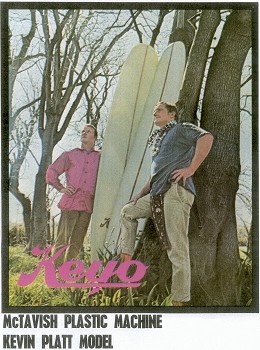
Keyo Surfboards McTavish
Plastic Machine, Kevin Platt
Model, 1967.
Surf International
Volume 1 Number 1,
December 1967, page 4.
Later, McTavish described the production line at
Keyo's: "I needed help to shape all those orders, so Denny
found Phil Monkman, a fine carpenter and keen-to-learn shaper.
I'd carve out all bulk: the template, the rocker
curve, the thicknesses, and the basic then he'd clean it up
and sandpaper the blank till it was pretty. That way the shape was all McTavish, but we could
now get thirty or forty a week through. That's not counting Kevin Platt's boards, as he
was shaping steadily in the next bay as well, doing similar
boards to mine."
At this stage,
the major surfing identities missing from the Sydney scene were
Peter Drouyn (noted above), Wayne Lynch, and the 1967
Australian Champion, Nat Young:
"Nat was
missing in celebrity-land for the first few months of the
revolution."
- Bob McTavish,
quoted in Crockett, Andrew: Switchfoot (2005)
pages 192-193.
In an extended
interview in late 1967 with Brian St. Pierre, Nat confessed that
following the Australian Championships at Bells Beach:
"I haven't
been on a board for five months."
- St. Pierre,
Brian: The
Fantastic Plastic Voyage (1969) page 93. Sydney, November 1967.
At the beginning of November, it was announced that
there was to be no world championship for 1967, held annually since
1964, and expected to be in
Hawaii.
With the failure of Hawaiian
officials to accept the offer to stage the world
titles, the next event was set for 1968, with
Victoria putting in an early tender for a contest at
Bells Beach, that was held in 1970.
Largely influenced by sponsorship from US
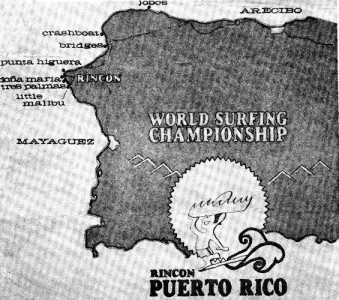
television, the contest was scheduled for Puerto Rico in November 1968.
This served to further enhance the importance of the
upcoming Hawaiian winter and the scheduled Duke Kahanamoku and
Makaha contests, and in Sydney, the Windansea
contest was referred to, on one occasion, as a
"mini-world contest."
-
Evans, Bob: World Contest for Vic.
The Sunday Telegraph, November 5 1967, page 122.
- Evans, Bob: Would you believe tiny
Puerto Rico? The Sunday Telegraph, November 11 1967, page 120?
Nat Young gave an expanded account of his five month sabbatical
and his first encounter with the new vee-bottom design in his
1998 autobiography.
Apparently no
longer contracted to Gordon Woods Surfboards and impressed by
McTavish's enthusiasm, according to Young, he built his first
vee-bottom at Keyo Surfboards.
"McTavish
was working for Keyo Surfboards just down the road from my
office in Brookvale and I'd call in every now and then to
say hello and check on his latest shaping job. One day
after not having been to Keyo's for a few weeks, I walked
through the showroom and there were ten new boards, all in
the 8-foot range and all with deep vee bottoms and concave
noses. The 4
inch-deep vee held right off the tail, giving them a
different look, like nothing I'd seen before. Bob
explained that he'd been making them shorter and shorter
over the past few weeks and insisting the little "Plastic
Machines" were really exciting to ride. ... I asked
Denny Keyo if I could use Bob's shaping bay and, for the
first time in six months, I shaped a new board. It was 8
feet long by 23 inches wide and like McTavish's had a
12-inch pod across the tail with a 4-inch vee. The
stringerless blank was really hard to hold while shaping and
I had to use a brick to keep it in one place. The
thickness of those Plastic Machines also made them appear
strange, as they held the thickness of the centre right
through to the tail. And I soon
found that glassing them was a nightmare. The idea
was to get the board as light as possible, so a thin skin
had to be put on the bottom to hold the curve, then a
couple, of layers on the deck to give it some strength and
rigidity. I took the
new board out in a 3-footer inside Narrabeen "Alley" to test
it and thought I'd never get used to the feel, it was so
weird. After an
hour of practise, and a few long swims to the beach, I began
to get the feel of the vee and found how interesting the
pocket-riding type of surfing could be."
In mid-November 1967, Bob Evans reported in his regular column for a Sunday newspaper
that Nat Young had recently returned to surfing (October?), following intensive instruction in snow sking
over the winter.
Initially he rode "his old board," but now had acquired a new board:
"Just last week, "Nat" took delivery of an
8ft. 8in. vee-bottom, vee-back version of the new super-board
trend, from Gordon Woods."
Note
that the length (8ft 8'' and 8ft) and the factory (Gordon
Woods and Keyo) differ to that recalled by Nat in 1998, and
that photographs of the time show that his first vee-bottom
was not "stringerless", see below.
Evans was enthusiastic about the
perfomance of both Nat and "the new unit," demonstrated by an accompanying
photograph (see below):
"I was surfing there (Long Reef)
myself ...
This board encourages the rider to follow the action pocket on
a wave, like never before.
Full rail turns and unbelievable bursts of speed, were
commonplace on every wave ridden.
He (Nat) would drive down the face of the wave, in a prone
position until about 10 feet out in front then, rising and
shifting weight simultaneously, would snap the most savage
full rail turn imaginable, and go rocketing diagonally upward
at the crest of the wave, where he would hang a similar
amazing full rail cut-back and then, in a series of stalling
turns and acceleration bursts, milk the wave of all its
power."
- Evans,
Bob: What
happend to Nat Young? The Sunday Telegraph, Sydney, November 19 1967, page 96 (?).
Long Reef was the location of many of the
photographs for Surfing World'sMcTavish, Spencer,
Platt article noted above, and the same edition had a
similar photograph to that published in the Sunday Telegraph, with the caption:
"The
wind blows strong from the nor'east but, the water is
smooth with only a faint ripple to disturbthe
surface. Nat Young arrives alone afternoon; the
surf is 5'7''. It is good long reef and Nat' rips. His bottom turns are unbelievable and he
snaps his fin on the third wave." - Surfing World, Volume 10 Number 1, December 1967-
January 1968, page 122.
Vee Bottom bottom turn.
Surfing World Volume 11 Number 1.
June 1968.
Nat Young, Gordon Woods or Keyo
vee-bottom,
Long Reef, mid-November 1967.
Photographs:
Evans?- Falzon ?
The Sunday Telegraph, 19 November 1967.
Surfing World,
December 1967- January 1968, page 39.
.
Although based at Lorne in Victoria, Wayne Lynch
apparently kept a keen interest on the developments in Sydney,
and during late 1967 ordered a number of Keyo surfboards from
Bob McTavish.
" 'Claw'
Warbrick managed to secure Plastic Machine #4 for his
protégé Wayne Lynch, commonly regarded as the most exciting
young surfer in Australia, and a board numbered in the
twenties for himself".
- Jarratt, Phil:
Sands and Suits
(2010) page 93.
Also see
McTavish, Bob: Stoked!
(2009) page 368.
By the end of
October most Sydney manufactures were producing their
interpretation of the vee-bottom design.
Lengths were
around 8ft 6'', or shorter, and the width between 23 -24 inches,
located between 4 and 10 inches behind the mid point,
reminiscent of Velzy's Pig board of 1954.
Noses were full
and round with a square or diamond pod approximately 10 inches
wide, often deeply chamfered or dished.
While they mostly
featured a rolled bottom in the centre flaring into a deep vee
in the tail, nose sections could be flat, concave, or
occasionally double concave.
Note that some surfers and shapers, while not
adopting the deep vee-bottom, eagerly followed the trend for a
reduction in length.
The rails had a
thin 50/50 profile, often shaped from a stringerless blank,
glassed in Volan cloth and regularly an extra layer deck or
kneel patch, as the boards were still knee-paddled.
The high aspect
fin had a long base, about 12 inches deep with a large rake,
either a Greenough Stage
3 or similar.
Set at least 8
inches from the pod, the leading edge was thus around 20 inches
from the tail, further reducing the effective board length.
In a review of the Sydney surboard industry at the end of October 1967,
journalist Graham Cassidy notes it's
healthy state, while
"boards
continue to get shorter, wider, lighter ... most leading (manufacturers are)
channeling out 30 to 40 a week."
The popularity of the recent changes in designevidenced
by the "cock-a hoop
customers," who demanded "an 8ft 9in plank, with
razor-edge rails, turned up nose, scooped deck or what have you!"
"While radical changes
regarding brevity, width and weight have not stimulated
objection," the recent increases in prices were less-popular.
Foreshadowing the impact the "short board"
would have on the huge US market, the rapid changes in design
devastated the second-hand board market and the manufacturers refused to trade in, what were now, "antiquated monstrosities."
South of the harbour, Gordon
and Smith surfboards were $92 and $97 Brian Jackson's, around the corner.
In Brookvale, Barry Bennett and Scott
Dillion boards were $90, Peter Clarke (Northside, and Taren Point) customs were $95-$98, and
the same for a Keyo "McTavish" signature
model.
At Palm Beach, "Midget Farrelly rules
the roost, extracting $120 for his masterpieces."
- Cassidy,
Graham: On the
Boardwalk. The Sun, Sydney, Thursday
November 2 1967, page
78.
In his late 1967 design interview, Midget
Farrelly indicated that the contemporary surfboard length was
now substantially less than 8 feet for expert surfers:
"... there
is a general trend towards a shorter board. Last summer
it seemed everyone was riding nine feet. We had come
down from around nine five, nine six, and they were
considered short boards. During the
winter, boards went a little farther. I remember
midway through the winter I made my first 8 foot 8 board and
I thought that was short,but then about
September they started to go even farther. Generally
they have gone down six inches to a foot and in the last
three months the top surfers havedropped their
lengths down two feet."
He further
detailed other design developments that accompanied the
reduction in length:
"The
problem has always been if you make a shorter board how do
you get it to do everything a longboard does. I think
most of the good surfers now realize it's not one dimension
of a surfboard that guaranteesthat it works. As we get a
little bit more sophisticated with design we are looking
towards displacement volume togive us a true
measurement of a surfboard. While we
have gone down in length we have come up in a few other
things. The design
is so radical that we do need a basic thickness of at least
three inches. The
introduction of the V bottom means more defined planing
areas, more positive areas on thebottom of the
board. Rail shape
has changed from a pointed, critical, radical rail to a
softer, rounder, more oval rail. The general
rocker of a surfboard has been altered. The nose is
kicked radically while the tail flows away in a soft line. So you have
got the V, the more defined planing areas, nose rocker, and
the change in rail shape, butI think most
significant and obvious change is in outline. We have
almost got a very basic old fashioned outline: big, wide,
square tail, parallel rails and a bluntnose. You
wouldn't say that the boards of today are beautiful at all."
Some vee-bottom
boards were featured in, New Zealander, Andy
McAlpine's Children of the Sun(1968), with
segments shot in
North Queensland and Sydney.
Note that the
title reprises the opening lines of Bob McTavish's first article
for Surf International, "Ladies and
Gentlemen and Children-of-the-Sun", quoted above.
Starring the
outstanding local surfer of the time, Wayne Parkes, McAlpine
exposed local surfers to these developments on his return home
before the end of the year.
Parkes would
later take a short vee-bottom board to Hawaii for the 1967
winter season, where it was also ridden by Peter Drouyn at
Honolua Bay on Maui, see below.
As foreshadowed
in his Surfing World interview,Ted Spencer was the
one of the first to surf and then move on from the vee-bottom,
and, probably in early November 1967, he and Bob McTavish shaped Little
Red.
In contrast with
his previous wide tailed vee bottom board, this 8 ft 4 inch
design featured a semi-pin nose, rounded pintail, and without
incorporating the deep vee-bottom.
A board of considerable significance, similar
boards would be one of the most popular Australian
designs in 1968-1969.
"For what
it's worth, so called Little Red board was 8'4" in length
single stringer 23" wide and was shaped by Bob McTavish and
I at Keyo Surfboards in Brookvale Australia. ... Regards,
Ted."
- Ted Spencer,
personal email, November 2003.
Many thanks to
Ted Spencer for this invaluable contribution. Corky
Carroll: The Curl Line,
November 1967. In an
article published in late 1967, California's most
competitive surfer, and a vocal critic of "the
Australians," Corky Carroll:
"analyzes
a new trend in surfing and compares it with the
old style ... today's surfer
has evolved a technique so he moves in the direction of the
curl- on both sides of it- and becomes part of the wave
itself."
Carroll's
"new trend" appears remarkably similar to the Bob
McTavish's "new trend (Witzig's New Era)"
of Surfing World, January 1967, and quoted
in John Witzig's "Nat
vs. Nuuhiwa ... How Do We Compare?" of the
same edition, the later reprinted by Surfer
in May, under the far more controversial title
"We're Tops Now":
"The direction is involvement. The way to get
involved, obviously, is place yourself in a hairy position,
under, in over, around the curl, quite often in contact
with it."
Carroll makes no account of recent developments
in surfboard design, and no mention of Australian surfing, except
for a brief, but obvious, condemnation of the views of
Nat Young and John Witzig: "we are best; you are
kooks"(in bold in the article).
In fact the article adopts many of the Australian
critiques, in particular by relegating noseriding to
only one of a pallette of potential manourves "to
stay as close to the curl as possible."
The accompanying photographs strongly feature
Hawaian based surfers, Jock Sullivan, Billy
Hamilton, and Barry Kanaiaupuni,
and it is clear that Carroll's "new trend" had
not yet made an impact on California's Windansea
surfers visiting the South Pacific.
The effective "maneuver line" track, added to the
photograph below, was later used on photographs of
Wayne Lynch in Witzig's Surf International,
circa 1969.
The curl
line and how the high performer relates his surfing to it,
is illustrated here in a ride by Jock Sutherland. Sutherland moves up and down and surfs
both sides of the curl line, in contrast to the "old
timers" who positioned
themselves in the curl (on the curl line) and rode away
from the break.
- Carroll, Corky: The Curl
Line.
Photographs
by Ron Stoner. Surfer Volume 8 Number 5
November
1967, pages 56-5.
New Zealand, November 1967.
When members of
the Californian chapter of the Windansea Club, accompanied by a
Hollywood film unit including producer Eric Blum and writer
Brian St. Pierre, arrived in New Zealand in mid November 1967,
they were already aware of some of the developments taking place
in Australia.
The New
Zealanders were even more up-to-date, with some personally
visiting Australia in the last six months
One,
Andy
McAlpine, returned with film that he had shot in Australia earlier that
year, which included footage of McTavish and Platt surfing at
Manly Beach on their short vee bottoms, which was eagely viewed
by all.
In an interview
with St. Pierre, Skip Frye, a top shaper at Gordon and Smith
Surfboards in San Diego, indicated the visiting American
surfers' awareness of the Australian move to shorter boards,
noting:
"Australia's
the
main place that everything's happening. Everything
that's happened here in New Zealand has been what the top
guys in Australia have done, so over here it falls a little
more on the crude side than what we'll be seeing in
Australia, I think. They've
been going as short and light as possible, and working with
varying bottom contours, trying to get better
manoeuvrability; I don't know yet how successful they've
been.
As well as Young
and McTavish, Frye noted the influence of Midget Farrelly:
"He is very
technically involved also, probably just as much as
McTavish. I know he's
one of the foremost craftsmen that I have ever come across. A lot of
these ideas may have possibly originated from him. As far as
the new V tail-chines, as they call them, the first I heard
about it with these small boards was from Midget. He and
McTavish were kind of playing around with the idea at the
same time, six months ago or a year ago, I don't know when
it started, but I think McTavish just worked a little harder
on it than Midget did."
Skip Frye's
employer, Gordon and Smith Surfboards, manufactured Farrelly's Stringerless
model in California since 1966.
Joining
the conversation, New Zealander Peter Wray, indicated the extent
that the Australian shapers had reduced the length of their
boards:
"When you
get to Australia, you're going to see really radical boards. McTavish
and Midget now are riding seven foot six boards, twenty-four
inches wide, two foot back from the nose, great big double
concaves under the nose which McTavish thinks he'll ride
Sunset on."
- St. Pierre,
Brian: The
Fantastic Plastic Voyage (1969) page 71. The Windansea Contest, Long
Reef and Palm Beach, 24th
November and 2nd December
1967.
When the
Californian Windansea team, led by club president (?) Thor
Svenson, arrived in Sydney on the 24th November, the highlight
of their visit was to be a "mini-World contest" against the
leading Australian surfers.
Fiirst place was a return airline ticket to Hawaii, courtesy of
John Witzig's recently issued magazine, Surf International.
Representing
California were Skip Frye, Mickey Munoz, Steve Bigler, Mike
Purpus, Peter Johnson, and Ken Morrow.
Munoz was a surfer with
wide experience and ablity, he was
one of the first to ride Waimea Bay in 1957 and surfed (in a
wig) in tjhe role of Gidget in the 1959 film.
Bigler placed 4th and Frye 13th in the previous year's
world contest in San Deigo.
Accompanying the
team, but apparently not competing, were several women surfers -
Margo Godfrey, Joey Hamaski (second in the world contest) and
Barrie Algaw.
Several, named earlier by the press as team members, did not attend,
including California's Corky Carroll and Jeff Hakman from Hawaii.
Likewise, Malibu's Mickey "da Cat" Dora, apparently for "personal reasons, like his inability to wear a smile
when in the company of certain other team members."
-Cassidy,
Graham: On the
Boardwalk. The Sun, Sydney, Thursday
November 2 1967, page
78.(JC-GC) The
first rounds were held at Long Reef over three days and featured
most of the top local riders, with the notable exception of Nat
Young and Bob McTavish, who did however appear as a contest
judges for the final.
Competitors
included Midget Farrelly, Ted Spencer, John Monie, Russell
Hughes, Robert Conneelly, Keith Paull, Butch Cooney, David
Treloar, Peter Cornish, Peter Drouyn, Frank Latta,Kevin Parkinson, Ken Middleton, Richard Harvey, and
Wayne Lynch, who travelled up from Victoria but had to return
for school exams before the finals.
Alternately, following the "innovations (of) the last 12 months,"
the Australian boards varied:
"in length from 7ft. 6in. to 9ft. and in
infinite variety of spectacular bottom shapes ... Frank Latta, whose board achieved a
new all-time chunki-ness, 26in. wide, 11in. back, 7ft. 10in.
long: in surfboard dimensions, that is, almost square."
-Evans,
Bob: Oh, those boards! The
Sunday Telegraph, December 3 1967, page 121.
Film of the heats in the
fast-breaking beach break waves of Long Reef, in Eric Blum's The
Fantastic Plastic Machine (1969), show that the performance
of the Australian surfers and boards as clearly superior to
that of the visiting Americans.
Most, but not all, of the Australian surfers are
riding variations of the short vee-bottom board, for example Keith Paull's 8ft Happening
model by Peter Clarke Surfboards.
Thor Sevenson, Peter Drouyn, Keith
Paull and Vee-bottom, and others, Long Reef,
November, 1967.
Photograph: Jeff Carter
Carter: Surf
Beaches (1968) page 33.
Keith
Paull Happening - Peter Clarke Surfboards Infitity
decal, 1967.
St. Pierre noted how the new designs were
rapidly adopted in the Australian market:
"Perhaps
one of the first things an outsider notices about surfing in
Australia is the speed with which surfers there latch on to
innovations in equipment and style. Perhaps
it's just their natural competitiveness, but young and
unknown surfers are right behind the leaders, picking up on
their ideas, sometimes adapting them a little more, and
generally pushing on; it makes the scene exciting to be in,
even if only for the atmosphere it has - everybody's up most
of the time."
Postponing the
finals to the following weekend, the American team, some
Australians and the film crew travelled to the far North Coast
of NSW, not without several difficulties, during the interval.
On the return to
Sydney, the finals were run at Palm Beach with Midget Farrelly,
Ted Spencer, John Monie and Russell Hughes, representing
Australia, and Mike Purpus and Steve Bigler from California.
The judges were
Nat Young, Bob McTavish, Skip Frye and Mickey Munoz.
Lester Brien detailed the range of
surfboard designs:
"It
is interesting to note the variations in surfing
equipment. Farrelly
has two boards, both extremely small, light and wide
backed; one has an accentuated scoopout
of the back top deck. Spencer
has a very short pin tail, a large fin set about 12
inches from the back. Money
and Hughes are riding the more conventional 9-ft.
performance boards. The
American equipment is different altogether, perhaps
their surf demands length, I do not know. Purpus
has a rather large, thin-backed, wide-nosed board,
the widest point being about one-third from
the tip, from there it takes a long but gradual
taper to the back. Bigler
is on a somewhat shorter but basically same shaped
board."
Farrelly's 8ft vee-bottom featured a
deep chamfered vee pod, and was covered with a
white-gelcoat.
Right: Midget Farrelly
Stringerless Vee-bottom, Palm Beach,
December 1967.
Photograph: Jeff Carter
Continuing his development of effective finboxes, the
board had a slot shaped in the bottom of the board which
was then, with considerable difficulty, re-inforced with
multiple layers of fibreglass.
The box was fitted with a deep and thin high-aspect fin,
with the surface area balanced between the base and tip,
a precursorto Midget's Fathead fin (1995).
The fin was held in the box by either sealing with a thin
layer of finish resin, which could be easily broken for
removal or replacement, or a wad of paper that wedged the
fin in the box.
- Midget Farrelly:
personal phone conversation, 12 March 2014.
Right: Midget
Farrelly's Removable Fin, Palm Beach,
December 1967.
Photograph: Jeff Carter
Carter: Surf
Beaches (1968) page 33.
Midget Farrelly and Vee-bottom Stringerless,
Palm Beach (?), December 1967.
Photograph: Dick Graham.
Subsequently published in Surfing, 1968.
While the waves at Palm Beach for the final were
smaller and slower than Long Reef, and could be said to be more
suitable for the American boards, the Australians dominated the
final, with Farrelly and
Spencer, on their shorter boards, clearly contesting for first place.
Lester Brien
wrote:
"It is a
hard pick; over the 40 minutes I would not hesitate in
giving it to Farrelly, but the contest was tobe decided
over the best 7 waves. ... It is so
close. A
discussion is called, it is agreed that on 40 minutes
Farrelly had won, but that the contest was over7 waves and
the contestants having been told this, it is not practical
for a wider points margin tooperate. Spencer had
top scored on two sheets; Spencer had won, Farrelly second,
Hughes third."
- Brien, Lester:
Windansea
Invitational
Surfing Contest. Surf
International, Volume 1 Number 3, February 1968, page 22.
- Eric Blum: The
Fantastic
Plastic Machine (1969) - footage of the final.
Following the
contest, several American surfers were interviewed for Jack
Eden's Surfabout Magazine.
Mike Purpus commented on the
Australian boards:
"... I ride
a 9'5" surfboard and I thought that was really small before
I came here. Then I
arrived and I talked to Midget Farrelly a great deal and I
think his board is the best one Ihave seen over
here and I have seen McTavish's and Young's. I will take
back some of his fundamental ideas and incorporate them in
my own model that I haveback in
California."
In the same
article, the diminutive female surfer and sponsored rider for
Dewey Weber Surfboards, Joey Hamaski, indicated that some
shapers in California were also experimenting with shorter
boards, admittedly for riders of smaller stature (Hamaski was 5
ft 2 inches, her board 7 ft 11 inches):
"Dewey
Weber has had these boards for two years now and nobody
thought they would work;like all my
friends thought I was crazy to ride a board so smallbut
I like it."
Before their
departure for Fiji, the next stop on the Windansea tour, several
US surfers purchased new vee-bottom boards from Sydney
manufacturers:
"There is
no doubt, though, that the Americans had learned more; half
a dozen of them had bought V-bottom boards to take back with
them, and all were planning to experiment with the
short-board concept and the flexible-fin idea and many of
the other things we'd seen."
Note that when
the film was released, footage of the visit to Fiji (and
subsequently Tahiti) was inserted before the sequences filmed in
Australia, to enhance the dramatic impact of the new Australian
board designs.
If the new Australian boards were ridden in Fiji
and Tahiti, which would seem likely, they certainly were not
filmed, or the footage included, in the released film. The North Shore Winter,
December 1967.
As the Windansea
team was returning to California, some with new Australian short
vee-bottom boards, surfers around the world were preparing for
their annual pilgrimage to the large winter surf of Hawaii, and the prestigous Duke Kahanamoku and Makaha contests.
The importance of the season was enhanced by the failure of
Hawaiian officials to accept the offer to stage a world contest;
previously held annually since 1964, and the next championships
were not scheduled until November 1968 in Puerto Rico.
Over a three week period the competition was intense, typified by
a day at Haliewa where the elite, literally, battled for the
waves.
In 1968, Nat Young and Bob McTavish's sessions at Honolua Bay,
Maui, would receive international media exposure, courtesy of Paul and John Witzig, and later Eric Blum, although the immediate impact was perhaps
less dramatic than it was later portrayed.
In the two weeks before Christmas, the
surf was not as large as previous winters, with Waimea Bay
breaking only once, but was consistant at 5 to 15ft, and with
predominately offshore winds.
As the actual dates of these events are currently
unclear, their provisional order is the Duke Contest in mid-late
December, the Haleiwa Session
probably later in December 1967, the Makaha Contest on the 26th December-1st January
1968, and the Honolua Sessions, around
the 28th-30th December.
[Provisional-
awaiting access to Surfer and Surfing magazines, 1967-1968.
Unfortunately, with the American surf media firmly concentrated
in California, and in 1967 obsessed with
noseriding, Hawaii appeared mostly in photograph
portfolios, usually featuring giant waves or as a tropical
paradise, in preference to written articles.
Also,
regardless of origin, most surfboard design material was more
likely to be in the advertisements, rather than in articles.
The lack of
contemporary documentaion of the developments in Hawaii, unlike
those in Australia, has meant that most subsequent accounts have
relied upon the recollections of Dick Brewer, which are not
without some difficulties, see above.]
While
Brewer's claim that "the mini-gun was happening in the
spring of '67" is likely an exaggeration, there is
considerable evidence that by the winter of 1967, the elite
Hawaiian surfers were beginning to decrease the size of their
boards, if only for large waves.
This is clearly demonstrated in a comparison of the available photographs and film of the
winters of 1966 and 1967.
While boards in excess of 10ft were common in 1966,
they were now down to 9ft 3'' and considerably more refined.
Featuring a pointed nose, slightly rounded pintail, and a
high-aspect Greenough influenced fin, and were ridden by all the
top Hawaiian surfers, notably Joey Cabell,
according to John Witzig,possibly the most
outstanding surfer in Hawaii this year.
Cabell's Hobie, was variously described as 9ft 4", 9ft
5'', or 9ft 8", and said to be shaped by Dick Brewer, although Joey Cabell has confirmed that he shaped the board
himself, which was about 9ft 5 inches.
-
Farrelly, Midget: Twelve
Days in Hawaii.
Surfing World Volume 10 Number 3, March 1968, page 36.
- Witzig, John: The
Australians in Hawaii, Part 1 - Oahu. Surf
International Vol. 1. No. 4 March 1968 page 28.
- Mr. Joey Cabell, personal interview, Freshwater Beach, 10th January
2015.
Joey Cabell and 9ft 5"" Hobie pintail,
Hawaii, December 1967.
Joey Cabell - Surfing at its best, Makaha.
Photo: Leroy Grannis.
Joey Cabell, Haleiwa. Photo: Leroy Grannis.
Cabell at Backdoor on his 9'5''
Brewer pintail. Photo: John Witzg.
Joey Cabell
and George Downing, Haleiwa. Photo: Leroy Grannis.
Joey Cabell,
Haleiwa. Photo: Tim McCullough
As in
Australia, these developments were likely to be the result of a
number of competing shapers and surfers, with Honolulu the
main centre of manufacture with the North Shore as the
testing ground.
One of the oldest was Dick Metz's Hobie Shop, a mainland label with a
large stable of elite surfers including Joey Cabell, Corky Carroll, Micky Munoz, and
Joyce Hoffmann.
Hobie Surfboards
also had a long term relationship with Hawaii's master
surfer-shaper, George Downing, who was possibly shaping boards
there, along with others.
-Holmes: Hobie Alter (2013) page
At the time, Downing was known to
have shaped boards at Charlie Gallanto's Greg Noll Surf
Center in Honolulu, under his own and, on occassion, the Greg Noll label.
Noll's top
surfer-shaper in Hawaii was Ben Apia, and team riders included Ricky Grigg, Fred Hemmings, and
Paul Strauch.
- Kampion: Greg Noll - the Art of the Surfboard
(2007) page
Other important shops operating in Honolulu during the
period were the Inter-Island Surf Shop, with Mike Diffenderfer shaping, and
Dick Brewer's first label, Surfboards Hawaii, now under new
management. Apart from
those previously noted above, other progressive
performers in the winter waves of Hawaii were Jock
Sutherland, Jeff Hakman, and Jackie Eberle,
incidently all cometitors at the 1966 World Titles in
California.
Photography note: Fred van Dyke wears white shorts with
a red band at Haleiwa, 1967.
As blanks were imported from the mainland,
there was a limited stock available for the winter, which
was, no doubt, highly valued and tightly controlled by the
local manufacturers, Midget Farrelly
noted:
"you
couldn't buy a pintail on the island- every blank and
finished board was accounted for."
- Farrelly, Midget: Twelve
Days in Hawaii. Surfing
World Volume 10 Number 3, March 1968, pages 35-37.
Most of the Australia surfers
travelling to Hawaii took their current boards.
Showing his
commitment to the short vee-bottom, Midget Farrelly had
only his stringerless 7 ft 8" board, as ridden in the
Windansea Contest.
Windansea winner,
Ted Spencer had his Little Red
pintail,
and the other finalist, Russell Hughes:
"who had only arrived that afternoon
with Midget, used his wide-tail Bells big wave board to
get into a few curls."
- Witzig,
John: The
Australians in Hawaii, Part 1 Oahu. Surf
International Volume 1 Number 4, March 1968,
pages 29. Over several articles, Bob
Evans noted the
Australian surfers in
Hawaii that winter,including Robert
"Nat" Young, Geoff Hannan, David
Sames, Bill Hannan, Bob McTavish, John Witzig, Steven Ash,
Frank Lever, Midget Farrelly, Russell Hughes, Ted Spencer,
Peter Drouyn, and Dr. Bob Spence, representing as official Judge at
the Mahaka International Contest.
Also note, the
previously unheralded, Rodney Sneed, a young surfer from Surfers
Paradise who managed to get to the
quarter-finals of the 1967
Makaha Contest, before the officials discovered he was
substituting for the official Australian competitor, who had
failed to attend.
Evans detailed some of the Australians'
equipment:
"Peter Drouyn, Queensland's
star performer, has two slightly more conservative
models; a concave nosed 9-footer for standard waves and a
mini-gun 9ft. 4in. long."
"Bob Spence has designed
a 9ft. 6in. board with a very unusual wide tail section
giving great lift tor such a short board."
New Zealander, Wayne Parks had self-shaped "9ft.
3in. stubby, built by Atlas-Woods in Auckland, New Zealand",
which was also ridden by Drouyn at Honolula Bay, and
Californian, George Greenough, rode his Hodgeman mat and an
early red Velo (#3?) Spoon. Evans wrote that McTavish and Young were to travel to
Hawaii with a quiver of new boards:
"Nat Young has been working out design
theories for months ... Gordon Woods has provided the
facilities of his custom shop to ascertain that the three
"surfer stubbies" for Nat are refined in detail.
His board quiver contains a hippy 8ft. 8in. rolled bottom,
an 8ft. 7ln. speed machine with the stylised rail contor
of a racing snow ski specifically for Hawaiian waves
only, and a radical deep vee-bottom with a gun nose
measuring 8ft, 8in."
and
"Bob McTavish already has departed;
two radical vee-bottomed surfing units tucked under arm. Young Manly man Ted Spencer, who won the
Wind-and-Sea contest last week, has an 8ft. 6in.
vee-bottom "stubbie" and a 6ft. 6in. vee-nised "gun" all
fabricated by the progressive KEYO shop."
This is highly misleading.
Spencer took his Little Red pintail, and
McTavish and Young only lengthened, or gunned, versions of the
vee-bottom design, approximately 9ft 4'' and 9ft 6''
respectively, shaped at Keyo Surfboards, specifically for the
North Shore.
The noses were pinned, and Young's had a more parallel ("racing snow ski") template than
was common for the standard vee-bottom of the day.
This compromise accentuated the importance of the vee-bottom
design over, up till now, the associated reduction in length,
and by the time they arrived in Hawaii, many top surfers were
already riding boards of similar length.
Note that the reported intentions to take a quiver of boards may
have been quickly abandoned when the additional cost of
air-freight was calculated.
Also, that Evans, in several columns, refers to Nat Young
shaping at Gordon Woods Surfboards, when the factory was more
likely Keyo's.
This was probably because Young had long-term sponsorship at
Woods, a major advertiser in Evans' Surfing World, and
his current contracts were in limbo.
-Evans,
Bob: Hawaii, here we come again. The Sunday Telegraph, December 10? 1967, page 121 -
Young, Nat: Nat's Nat (1998)
page 163.
- Cassidy: On the Boardwalk. The Sun, 1967, page
-Evans,
Bob: The truth about 'Super' Stubbies. The
Sunday Telegraph, January 14 1968, page 96.
Keyo Surfboards : Vee-Bottom Stringerless Gun
by Bob McTavish, December 1967.
Regrettably, Bob Evans' film The Way We
Like It (1968) has never been released in video or
DVD format, apparently due to contractual difficulties following
Evans' premature death in 1976.
Premiering at
Sydney's University's Union Theatre in November 1968, it
included Drouyn at the 1967 Mahaka titles, Farrelly, Young and
Drouyn surfing at Haliewa that same year, and the 1967
Australian titles.
However, the Haleiwa squence was later added to High on a
Cool Wave (1968), and is available online.
- Thoms, Albie: Surfmovies (2000)
page 103. - Evans, Bob: High
on a Cool Wave (1968)
http://aso.gov.au/titles/documentaries/high-on-a-cool-wave/clip3/ Duke Kahanamoku Contest,
Sunset Beach, mid-December 1967.
The Duke
Kahanamoku Invitational held at Sunset Beach was considered the
premier Hawaiian surfing contest, slightly overshadowing the
long running Mahaka Contest.
Competitors were
selected by the organizers, largely based on reputation, and
included invitees from Hawaii, California, Florida, Peru and
Australia.
Although Nat
Young received an invitation to the contest, he passed the
honour (and the pre-paid airline ticket) to Bob McTavish.
Note that it is probable
that Young did not require the airline ticket, as that may have
been provided by Eric Blum's production company, and that the formal invitation to the contest, and the support
of Dr. Bob Spence, appears to have greatly assisted in McTavish's
application for a US visa, as he had been previously deported from
Hawaii for illegal entry in 1963.
If the intention of Young in relinquishing his
invitation to McTavish was to secure the later's entry into the
US, it was certainly successful, if the intention was to
demonstrate and promote the performance of "their" vee-bottom
design in Hawaiian waves, it was unwise.
Young was the far superior competitive surfer, and unlike
McTavish, had the experience of several consecetive Hawiian
winters, and he made the final of the next Duke contest.
Despite test
riding his vee-bottom at Sunset, Makaha and on Maui before the
contest and noting its deficiencies in the powerful Hawaiian
waves, Bob McTavish persisted in riding his Plastic Machine
in his heat of the Duke Contest.
Also note,
foreshadowing future developments, he had also ridden and was
impressed by fellow competitor Mike Hynson's pintail, reported
as both 9ft 6'' (page 385) and 9ft 3'' (page 388).
The conditions
for the contest were good, but less than ideal:
"The surf
for the Dukes meeting was running at 8 -10 ft. Hawaiian
size, 12 -15 ft. Australian or Californian size. ... It was
smooth but irregular, it was unpredictable, it was
inconsistent and at times it was so consistent that there
were several waves to choose from." The surf
was so tricky that it required a lot of ability and
concentration to do well in those conditions."
- Farrelly,
Midget: Twelve
Days in Hawaii. Surfing World
Volume 10 Number 3, March 1968, page 35.
The judges
included Phil Edwards, Wally Froiseth,
Kimo Hollinger and Walt Hoffman, and the 24
contestants were judged in heats of six:
Heat
1
Herbie
Fletcher
Mike
Hynson
Dick
Katri
Paul
Strauch #
* #
*
(California)
(California)
(Florida)
(Hawaii)
Heat
2
Eddie
Aikau
Corky
Carroll
Mickey
Dora
Mike
Doyle #
Jeff
Hakman #
Dick
Keating
* Other
competitors included Ricky Grigg (California), George Downing
(Hawaii) and possibly Joey Cabell (Hawaii).
# Advanced to the
final.
The top two
competitors from each heat advanced to a nine man final*:
Jock
Sutherland 1st, (H.3)
Paul Strauch 2nd, (H.1)
George
Downing, 3rd (H.x)
Mike
Doyle (H.2)
Jeff Hakman (H.2)
Rusty
Miller (H.3)
Ben Apia(H.3)
Jackie Eberle 7th, (H.4)
Ricky
Grigg (H.x)
-
*Grigg, as last year's
winner, may have been seeded to the final, and three competitors (Apia, Miller, and Sutherland) advanced
from Heat 3.
The
Hawaiian surfers dominated the results -1st Jock Sutherland was
first, followed by with Sunset veterans Paul Strauch and George
Downing.
Midget Farrelly
summarized Sutherland's performance:
"Jock
Sutherland was definitely the best surfer in the contest. He was so
fresh, so clean, and so fast and wasn't scared of anything. Here's a
typical example of Sutherland: He takes off goofy-foot and
goes 'right'. When he
hits the bottom of the wave he turns 'left', switches feet,
comes out of the curl, climbs with afull turn
vertical up the face, gets into the shadow, stretches out
and just lets the curl clip him twice in a row. I think
this was his winning ride of the contest."
- Farrelly,
Midget: Twelve
Days in Hawaii. Surfing World
Volume 10 Number 3, March 1968, page 36.
Confirming
Farrelly's analysis, Jock Sutherland's outstanding ride was
recorded by the ABC Wide World of Sports television cameras.
- ABC Wide
World of Sports Television Program, 1968 (actual release
date unknown).
ABC Wide World of
Sports: Duke Kahanamoku Contest 1967.
DVD formatted by
Doug Cavanaugh, courtesy of Ben Marcus, with many thanks.
Some of the contest footage was later used in a
television special, The World of Duke Kahanamoku, screened
later in 1968. https://www.youtube.com/watch?v=5AtEa84LsjY
The Wide World of Sports program, aired
sometime after the passing of Duke Kahanamoku on 22nd
January 1968, was a compilation of contest footage
augmented with archival material describing the early
career of Duke, interviews with some competitors, judges
and Kahanamoku, beach scenes, and stock footage by
Californian film makers, MacGillvray and Freeman.
Some
interviewees attempted to disassociate surfers from the
negative image portrayed by the popular press- Paul
Strauch wore a suit and tie and drug use was decried by
Fred Hemmings and Ricky Grigg.
Grigg
noted that surfing is "two sports - what goes on on
the beach and what goes on in the water."
Jock
Sutherland, in contrast to future developments,
predicted "Big guns are the answer for anything over
12 feet".
George Downing's extended interview was illustrated with
examples of a finless solid timber and a modern foam
board- a short (8 ft?) pintail with a high aspect
Greenough style fin.
Similar
boards were shown in a sequence on board construction in
a shop front factory with a large window opening onto
the street.
Contemporary
footage recorded Downing riding an solid wood board,
ancient surfboards in the Bishop Museum and Duke
Kahanamoku displaying his 16 foot board, famously ridden
in 25 foot Castles surf for "a mile and a eighth -
and that's a long way!".
Bob McTavish and Keyo V-bottom, Sunset
Beach, 1967.
Photo: RonStoner.
Kimo Hollinger
analysed his judging criteria as a combination of wave size,
critical positioning, manoeuvres, and courtesy.
Despite test
riding his vee-bottom at Sunset, Makaha and on Maui before the
contest and noting some deficiencies in the powerful Hawaiian
waves, Bob McTavish persisted in riding his Plastic Machine
in his heat of the Duke Contest.
Also note,
foreshadowing future developments, he had also ridden and was
impressed by fellow competitor Mike Hynson's pintail, reported
as both 9ft 6'' (page 385) and 9ft 3'' (page 388).
- McTavish, Bob:
Stoked! (2009) pages
383 to 389.
Unfortunately, the ABC's Wide World of
Sports footage of the heat records only one of
McTavish's rides ( a wave "shared" with Claude Codgen),
however Midget Farrelly, largely confirming Fred
Hemmings' description as The Spin-Out King,
commented on McTavish's commitment and the limitations
of his board:
"McTavish went out there with a board that had never
been used at Sunset, ever. That
is to say nobody had ridden that kind of board
there. He
went out under average to poor conditions. He
was completely guts-up. Whenever
he lost his board, he swam so hard that you would
have sworn he was a machine. Whenever
he dropped in, he dropped in like he was skydiving. He
really powered down the face, it was only when he
went to make his turn that, that wide, flat, fattail
just wouldn't sink in and bite.
Bob McTavish: Spin-out King, Duke Contest, Sunset
Beach, December 1967. Photo: Darling.
... McTavish
was outclassed in performance, he was outclassed in
equipment, he was outclassed in almost
everything. What was so
great about McTavish was that the harder he got beaten down
by those waves, the harder he
belted himself right back out there again. He had
twice the guts but half the equipment."
- Farrelly,
Midget: Twelve
Days in Hawaii. Surfing World
Volume 10 Number 3, March 1968, pages 35 and 36.
John Witzig was
briefer, but essentially confirmed Farrely's contest report:
"For
McTavish it was a couple of swims, and at Sunset it is just
allover. More
probably than not, Jock Sutherland would have won whichever
way the contest was run. His
fantastic knowledge of how a difficult Sunset would break
was so evident in his choice of wave. He would
fade far left, then change feet and crank a bottom turn
under twelve feet of white water. He was
superb, there was little doubt about it."
Not all the Hawaiian surfers were immediately
dismissive of the Australian vee-bottom.
Bob Evans reported that George Downing "the most
knowledgeable surf man in Hawaii," was:
"impressed with many of Mac's (McTavish's) tight maneuvers
on the extremely critical waves of Sunset. Downing indicated that the problems that Mac was
having with his turns and follow-through was a matter of
modification to suit Sunset's particular wave.
Downing told me he was particularly impressed by the speed
achieved coming out of the turns and recognized that the board
was designed to give maximum flexibility up and down the face
of a steep wave, rather than across the wall."
- Evans, Bob:
The Truth about "Super" Stubbies. The Sunday Telegraph, January 14 1968, page 96. Unfortunately, I currently do not
have access to the contest reports of the Duke, and the Makaha,
contest published in the two Californian based magazines of the
period: Surfer,
Volume 9 Number 1, March 1968. Duke
Invitational and coverage of the Makaha International Surfing
Championships. Surfing,Volume
4
Number 1, June 1968: Jock
Sutherland wins the third annual Duke Invitational at Sunset,
while Cabell takes the 15th annual Makaha International
Surfing Championships. The North Shore, late-December, Midget
Farrelly surfed his
stringerless 7 ft 8"at many North Shore breaks, including
sizeable Sunset Beach with Ted Spencer: "When he (Ted) paddled
out at Sunset and said (to me) "Gosh,
this isn't like Manly," I knew he was serious."
He
was quickly convinced that his board was totally unsuitable
for these powerful waves:
"The boards that worked so well in
Sydney were now impotent pieces of foam and glass. The
tails were too wide-too much area between fin and rail
to make a vital turn at high speeds."
This was especially
evident when he was confronted with 15 to 20 ft. Waimea
Bay:
"I looked at my 7 ft. 8 in. and felt that
it was rather impotent compared with the other guys' 10
ft. 3 in. to 10 ft. 6 in. pin tails. I took one
mental wipe-out at Waimea and that finished my day's surfing
there. Bruce Valuzzi finally
comes by me and says, 'Yea, well what's the power school
doing today?' then paddled out."
Some of the visting Australians
with Island connections were able to borrow boards, Farrelly observed Russell Hughes on
borrowed board at Haleiwa:
"I watched him
(Hughes) in some 6 - 8 ft. waves and he adjusted really
fast, faster than any Australian I've seen. He rode his
own boards for a couple of days then switched to a pin tail
and did just fine."
-Farrelly,
Midget: Twelve
Days in Hawaii. Surfing World
Volume 10 Number 3, March 1968, pages 35 and 36.
Hughes' "own
boards" included his wide tailed 9ft 10'' board, shaped by Bob
McTavish, ridden at the recent Australian Championships at Bells
Beach (see above).
Likewise, Midget noted
McTavish riding Mike Hynson's pintail:
"McTavish ... looked
good on a borrowed pintail ... at Sunset."
McTavish was also
"experimented" with other boards.
Following the Duke Contest, Nat Young encountered Bob at
Haleiwa:
"When we
caught up with McTavish a few days after the event he wasn't
even surfing his own short(sic) board - it was as
though he'd given up - and watching him surf Haleiwa on a
big conventional board borrowed from David Nuuhiwa, I
thought he looked awkward and stiff. Amazed by
his about-face, I couldn't understand what he was doing and
it was hard to get much sense out of him. But later
that afternoon, when I cornered him outside the house where
he and Nuuhiwa were living, he sounded fine, promising to
follow us to Maui when I told him I'd be going there next
day."
In the book,
Young laters attributes McTavish's behaviour to the high quality
local cannabis, available courtesy of Hynson and Nuuhiwa.
- Young, Nat: Nat's
Nat (1998) page 164. The Haleiwa Session(s),
late-December 1967.
In late December, Haleiwa often provided
the prime conditions and was the focus for intense
competition by elite, particually one strong offshore
day that was extensively recorded by a squad of
photographers.
The surfers included Paul Strauch,
Joey Cabell,
Ben Apia, Nat Young, George Downing, Ricky Grigg, Mike Dolye, Fred van
Dyke, and Peter Drouyn.
Note that several other published photographs and
some film was also shot at Haleiwa later that winter, probably in
January 1968, where Nat Young's board has the repaired nose
section, damaged at Honolua Bay at the end of December.
Also note that Californian photographer,
Steve Wilkins was also at the Haleiwa sessions, and
his excellent web site specifically dates it as 1st
December 1967.
This must be incorrect as Nat Young was still in
Australia as late as 4th December 1967.
On his return to
Australia, John Witzig wrote a two part article
detailing his impressions of the Hawaiian winter of 1967
for his magazine, Surf International.
Although titled
The Australians in Hawaii, in the main, over the
two articles the main focus was on his travelling
companions, Nat Young, Ted Spencer and Bob McTavish.
However, he directly acknowledged
his highly personal view: "I preface this
story with the advice that if this is not an
absolutely accurate reconstruction of our trip to
the Sandwich Islands, then it is the best that I can
make up."
Witzig's report of a session at
Haleiwa, several days after the Duke contest, identified
two approaches to surfing performance and surfboard
design, initially evident at the 1966 World Contest,
that would dominate developments over the next five
years.
Bob Evans' film of the session, in High
on a Cool Wave (1968) largely confirms
Witzig's account, which is worth
quoting at length, however some may dispute his
description of Peter Drouyn's waves
as "not
much more than stand-up rides."
"I have seen Haliewa on a
number of occasions. It has been flat,
or it has been reasonable. On one day, with
a good swell, and a side wind at Sunset, Haleiwa was
12' and good. It was so good
that I just could not imagine that Haliewa could get
like that, and neither, I imagine,could the eighty surfers
in the water, or the one hundred and eighty other
photographers on thebeach. I wonder on
reflection whether the rest of them wasted as much
film as I did that day. The spray was
particularly bad and through the lens it just looked
like a messy mass of blues andgreys and sprayey-whites.
Still, if the photographs were
to end up as a disappointment, then certainly the
surfing on that day atHaliewa was not. To my mind it was
Cabell and Nat who were again outstanding. Hawaiian Joey was
coming from far inside and making waves where even
George Downing andRicky Grigg weren't. Nat gave up, more
because of the limitations of the crowd than because
of those of his board orability. Certainly, Drouyn
came from inside on a few waves, but they were not
much more than stand-uprides. Cabell though,
was outstanding. Tight in the
curl, his 9'8" pintail board would fly across the
face of the fantastic Haliewa waves. What had become
apparent, at Sunset on that late afternoon, was now
compounded at Haliewa. There were two
schools of thought: Nat and acceleration, Cabell and
flow. It is difficult
to the point of being impossible to try to evaluate
one approach as against the other. There is a
considerable gulf between the two, attributable to
the basic experience that has, as its result, either
of the two points of view. As an Australian,
I was more used to Nat's approach to surfing, and if
it should appear that I ambiased in my appraisal, then it may
very well be that this is so.
I cannot but think that the
general approach of the pintail-flow school of
thought is a logicalextension, and perhaps conclusion,
of a style of riding big waves that began with the
first attempt onthe big surf of the North Shore in
the late 50s and early 60s.
In contrast, the short board-
acceleration school of the Australian surfers
appears to me to hold thekey to the future. I would be the
last to claim that on the North Shore this year the
Hawaiians, on their conventionalequipment, were out-performed by the
Australians on their short, V bottom boards. Yet I cannot
contain the enthusiasm that I feel for the
breakthrough in performance big wave surfingthat I feel must
ultimately flow from this initial Australian assault
on the Hawaiian surf. Most probably
there are lessons to be learnt from each approach. Perhaps in some
way, a marrying of the flow and acceleration is not
impossible. The sort of board
that this would necessitate is quite beyond my
knowledge. While we were in
Maui, shaper Dick Brewer began to experiment with V
bottoms on pintails. Perhaps there is
an answer here. Yet I find the
two styles of approach to surfing to practically be
the antithesis of one another. To my mind the
potential is with the Australian surfers and their
equipment. There is greater
experimentation being done in Australia, and the
excitement and inspiration thatmust arise from this, not to mention
the equipment, assures a significant place in the
future."
- Evans, Bob:High
on a Cool Wave (1968)
http://aso.gov.au/titles/documentaries/high-on-a-cool-wave/clip3/
In 1970 Bob McTavish contributed an
article to Surfer, illustrating that "the
two schools of thought" identified by Witzig
continued to resonate.
See
McTavish, Bob: Streaks
and Slugs (Surfer Tips Number 45).
Surfer, Volume 11 Number 2, May
1970, pages 27 and 29.
Per Paul Strauch: [The] Photo was taken
in the 60's at Haleiwa at its best running 10 -12' on a
NW with beautiful conditions... I remember the day well.
It was a hairy takeoff because the guy on the red board
dropped in on me and in a nano second, Joey Cabell was under me with George Downing
in close pursuit. I think I crowded the guy in front
of me into pulling out, but my memory stops there.
Great day and super crowded since Haleiwa was the
place to be!
Anonymous
said...My guess is fall/early winter of 1967, based on the
graphics on Cabell's board...it was a 9'6'' Downing pintail,
as I recall.
Nat, McTavish, Brewer, Drouyn,
Honolula Bay, Maui, late-December 1967.
Whereas the Duke and
Makhaka contests and the Haleiwa session(s) on Ohau were
widely covered and witnessed, the Honolua Bay sessions on Maui were relatively obscure,
although covered by two professional film units- one from
Califormia, under Eric Blum, and Paul
Witzig from Australia.
Their "significance" only became apparent later
with extented media coverage, Witzig's footage was scripted as the climax when "one day the
perfect waves came to Honolua," with more than a nod to Bruce Brown.
John
Witzig detailed the sessions in words and photographs, the later, and those of Californian,
Steve Wilkins, were widely printed,
and re-printed, in magazines and books.
Wilkin's
excellent web site specifically dates images of Nat Young and
Bob McTavish riding their vee-bottom Keyo Surfboards on 28th
and 30th December 1967, which is consistant with other
accounts.
Honolula
Bay is in a swell shadow, requiring a large outside
swell to break, usually when the North Shore of Ohau
is nearing maximumun size.
Its picturesque location and high quality
right-handers have been the subject of many surf
photographers and film-makers, with sequences in
several previous surfing films, including Bob Evans'
XXXX, (196-5?) featuring Nat Young.
This is the some of the largest, and certainly the
best quality, Honoulua surf filmed up to this time.
Following the
Duke Contest, while preparing to fly from Honolulu for the
island of Maui, Nat Young encountered McTavish
at Haleiwa:
"When we
caught up with McTavish a few days after the event he wasn't
even surfing his own short(sic) board - it was as
though he'd given up - and watching him surf Haleiwa on a
big conventional board borrowed from David Nuuhiwa, I
thought he looked awkward and stiff. Amazed by
his about-face, I couldn't understand what he was doing and
it was hard to get much sense out of him. But later
that afternoon, when I cornered him outside the house where
he and Nuuhiwa were living, he sounded fine, promising to
follow us to Maui when I told him I'd be going there next
day.
I was
travelling to Maui with John and Paul Witzig and the hot
young Sydney surfer Ted Spencer; George Greenough was going
to fly in direct from California and Doc Spence came over
for a few days before going back to Oahu to fulfil his
obligations as the official judge for the Makaha contest."
The highlight of
the stay on Maui was a week excellent surf at the famous right
handers of Honolua Bay, film of these sessions becoming the
highlight of both Paul Witzig's short Hawaii 68 (1968),
later added to the American release of The Hot Generation
(1967, 1968), and Eric Blum's The Fantastic Plastic
Machine, which due to production difficulties was
not released until 1969.
- Thoms, Albie: Surfmovies(2000)
page 101 and pages 106 to 107.
- The Hot Generation (excerpts)
http://vimeo.com/26214475
These films, the
widely reproduced photographs by John Witzig and a vast plethora
of book and magazine articles simply too numerous to detail have
contributed to the widely held view that the Honolua sessions
were the inspiration for what is commonly called The
Short-board Revolution.
Critical to this
perspective was the meeting of McTavish and Dick Brewer, said to
convert Brewer, and hence other Hawaiian and American shapers,
to building either vee-bottom and/or smaller boards.
Nat Young, Honolua Bay, December 1967.
Photograph:
John Wizig Surf
International Vol. 1. No. 5 May
1968 page 26.
In a contemporary article, perhaps composed
before his departure from Hawaii, Bob McTavish wrote:
"Good
Honolua is a tube from take off to calm centre. This day
Nat and I had our deep Vees going. Ted S. had
his 8'9" pintail in one piece till it was two pieces. Buddy Boy
was visiting Him on most rides - in spite of his overlong
machine. George did
It quite often. .. Paule made It. Six hours
at six to eight feet. Only a few
there. Coupla
cameras, coupla shapers - one was R. B.
Dick was digging the whole thing. Those Vees
- pulling turns in the most tight spots, gaining speed in
those turns, thrusting out ofthem. Making
waves, making them tighter. Pintails
were beautiful - in the fall line. Magical
Mystery Tours. But the
U.S. - going round, up, thru- thrusting!! YOU got the
speed. YOU went
where you wanted - when you wanted. Said R. B.
when asked - "They work."
Dick Brewer
went to his groovy tin shed and made a beautiful pintail -
'V' bottom.
Just a
basic change of design - no "yippee-we did it first" because
who is "we"? We are all
brothers 'V' is one change - many many more coming up from
many many people - sonames don't
matter."
- McTavish, Bob:
A
plastic drinking straw... Surf
International, Volume 1 Number 3, February - March 1968,
page 11.
The passage
specifically relates the incorporation of the vee-bottom into
Brewer's pintail design, and not a committment to a reduction in
length, except for the aside "Buddy Boy ... in
spite of his overlong machine."
In addition, the
closing comment, "so names don't matter", indicates a
substantial change in attitude as evidenced in the claims
advanced several decades later in Stoked! (2009)
and Going Vertical (2010).
Despite
McTavish's obvious enthusiasm for the wide tail vee-bottom
design at the time, he later acknowledged the design's
deficiencies:
"We took
our boards to Hawaii in late 67, they were, just large
versions of V bottom stubbies we were riding in the
shorebreaks of Australia and they were pretty miserable
failures except for Nat's board which was more of an arrow
planshape and Ted Spencer's little double end sausage which
went well in small surf."
While Brewer and
others have disputed the impact of the Australian vee-bottom,
one of Brewer's team riders has subsequently confirmed the
Australian influence, at least the impetus to construct shorter
boards:
"Gerry
Lopez supports that story with his own recollection: 'I
think it was in late '67,' he told Drew Kampion. 'Brewer had
just moved over to Maui from the North Shore and was shaping
in Lahaina. Reno
Abellira and I each took a blank over there to get our
boards made by him. Reno got
his shaped first, but before he could shape mine, Nat and
Greenough and McTavish and Ted Spencer and a couple of other
Aussies showed up with those wide-tailed, vee-bottom boards. They wanted
to go ride em at Honolua Bay, but there wasn't any surf
there. John P.
Thurston had a surf shop at the Cannery in Lahaina where all
the boards were glassed, and they came there, and we met em,
and Brewer and McTavish kind of bullshitted for a long time. So the next
day we go back to do my board - I think wanted like a 9 foot
8-inch, which was considered a shorter board then - and
Brewer just takes the saw and cuts a foot of the blank, and
it's 8 feet 6 inches, and he tells me, 'That's how big a
board you're getting.' "
Holmes: Bing Surfboards (2008)
page 164, quoting Drew Kampion in The Surfer's Journal,
unspecified.
Reno and broken Brewer pintail,
Honolula Bay, December 1967.
Photograph:
John Wizig Surf
International Vol. 1. No. 5 May
1968 page 22.
Gerry Lopez outlines his early shaping history,
including recalling his 8 ft 6'' Brewer- "the very first
mini-gun", in his book Surf Is Where You Find It,
Patagonia Inc. (2008).
The relevant
chapter, The Buddy, is online at: Patagonia: The
Cleanest
Line http://www.thecleanestline.com/2008/04/the-buddy.html
Incidentally,
while "Ted S. had his 8'9" pintail in one piece till it was
two pieces" appears to indicate that Little Red was
fatally injured at Honolua Bay, it was actually 8 ft 4'' and
survived to return to Australia:
For what
it's worth, so called Little Red board was 8'4" in length ... It didn't
break badly in Hawaii and I took it back to OZ. Regards,
Ted."
- Ted Spencer,
personal email, November 2003.
Many thanks to
Ted Spencer for this invaluable contribution.
Furthermore,
although McTavish expressed the opinion in 1972 (above) that "Ted
Spencer's little double end sausage which went well in small
surf" , his enthusiasm for riding different designs,
including Hynson's pintail and Nuuihwa's "big conventional
board" at Haleiwa, is demonstrated by a John
Witzig photograph of McTavish riding Little Red on a
substantial wave at Honolua Bay printed on the cover ofSurf International, Volume 1 Number 12, circa 1969.
Finally, for
those with a (possibly unhealthy) interest in surfing
literature, McTavish's Surf International article
includes the often quoted "A GIANT GREEN CATHEDRAL AND I AM
THERE", invariably ridiculed as an example of one of the
many excesses of the era.
Likewise, Jock
Sutherland was derided for his similar themed description of
tube riding as "In the Pope's Living Room" in a 1970 Surfer
magazine interview (Volume 11, Number 6, page 72).
Both possibly owe
a debt to Phil Edwards, a surfer unlikely to be associated with
the psychedelia of the late 1960s, who, when describing his
first ride at the Banzai Pipeline, wrote:
"The pipe was swirling thinly on top and it was a burst of
green crystal with shafts of sunlight coming through it. It was like
a whirling cathedral; yet, immense, overpowering, somehow
quiet."
Gerry Lopez's "a
couple of other Aussies" on Maui included the Doc Spence,
the Witzig Brothers, and Peter Drouyn,
following his third place in the Mahaka Contest:
"Honolua Bay
was probably the best surf we had over there, although
Haleiwa was pretty good.
We had
Honolua at 15 -18 ft., consistent and only 12 guys in
the water.
...
I was
riding one of the small stubby boards.
I
borrowed it from Wayne Parkes, the New Zealand surfer."
- Drouyn, Peter:Drouyn Surfing World,
Volume 10 Number 3, March 1968, page 14.
Bob Evans "filmed every aspect of his (Drouyn's) performance"
at Honolula Bay, the photograph below published in Evans'
Sydney newspaper column in early 1968.
Peter Drouyn, Honolula
Bay, Maui, December 1967.
- riding Wayne Parkes' 9ft 3in Atlas-Woods (NZ)
"stubby." Photograph: Bob Evans (digitally
adjusted). The Sunday Telegraph, January 21 1968, page 70.
In 2010, Herb Torrens recalled visiting Maui at
the end of 1967:
"As far as
the Shortboard Revolution - and I certainly agree it was -
is concerned, I think it dependson where you
were. I came to
Maui in '67, shortly after Mac and the boys stormed Honolua
on their short V-bottoms. I arrived
with a 10-foot gun and a 9'6" semi-gun, both pintails in the
latest style. That style
lasted about two weeks. Brewer was
on Maui at the time and he shaped a couple of 8'4 pintails
for Jock Sutherland and Jeff Hackman, who were going to
school there at the time. They turned
everything upside down at Honolua, and within weeks, we were
all stripping down the long boards and re-shaping them into
short boards. I remember
driving down Front Street in Lahaina one morning and seeing
loads of trash cans lined up with stripped fiberglass. Yes, it was
a revolution and if you weren't riding a short board by the
end of that winter, you were an outcast. So, in my
thinking, the Aussies definitely had an impact when they
came, but Brewer and Bruce Jones took short board design to
new levels. I can't
remember what happened after that...it was the sixties!"
- Herb Torrens: Comments
on the "Shortboard Revolution".
Posted on surf
blurb, Sat, 21 Aug 2010.
In an online article on Surfing & Cannabis uploaded in June
2021, Paul Evans wrote:
1967: Surfer Magazine is conflicted. Legendary cartoonist Rick Griffin embroiders a two-page
magazine illustration with marijuana leaves, whilst the same
year an editorial notes “No real athlete uses stimulants to
improve performance,” and that “the fad of pot smoking will
pass from the scene.” It didn’t. “Down on the beach, you’re in the most beautiful
environment, relaxing, surfing, having a great time, [and] if
someone was going to break out a joint, you’re in the best
place to do it.” notes Nat Young, who also reveals that he and
Bob McTavish “smoked a big fat one” before every Honolua Bay
session that winter.
Other
relevant, but currently unexamined, magazine articles:
Surfer,
Volume 9 Number 3, 1968. Corky
Carroll, 1967 Surfer Poll Award winner, Noseriding
cover. "The Challenge
from Down Under" featuring Bob McTavish and Nat Young.
Surfer,
Volume 9 Number 4, 1968. Nat Young at
Honolua Bay cover in vee bottom outline. Drew Kampion
essay explores "the super short, uptight, v-bottom, tube
carving plastic machines and other assorted short subjects"
David "Baddy" Trealor, Noosa, January 1968.
Photograph
by Albert Falzon.
Possibly Surfing World, Volume 11, Numbers 1-6.
.
Makaha Contest,
26th December 1967- January 1968.
By the 31st December, the preliminary rounds of the Makaha contest
had been completed in "beautiful 6ft. to 10ft. waves."
The 450 entrants, from South Africa, Hawaii, Peru, New Zealand,
Mexico, Brazil, Australia, and the US, were reduced to a five man
final comprising Joey Cabell (1963 champ), Fred Hemmings (1966
champ), Ben Aipa, Leroy Ah Choy, and Peter Drouyn, the only
non-Hawaiian.
As runner-up in the 1967 Australian titles, Drouyn was seeded
into the quarter-finals, winning this event and his following
semi-final on "a special pin-tail board he had helped to construct
only the day previously."
Another Surfers Paradise surfer, Rodney Sneed, who was possibly an
associate of Drouyn, progressed through the heats to the
quarter-finals, before the officials discovered he was
substituting for the official Australian competitor, who had
failed to attend.
On a "sunlit day of offshore breeze and eight-foot ground swell,"
the contest was won by Joey Cabell, with Fred Hemmings second, and
Peter Drouyn in third place.
On his return to Queensland in early 1968, Peter Drouyn "brought
back the only Hawaiian pin-tail board," perhaps the board he used
in the Makaha contest.
- Evans, Bob: Makaha effort tickles Peter. The Sunday Telegraph, January 7 1968, page 47.
- Evans, Bob: The truth about 'Super' Stubbies. The Sunday Telegraph, January 14 1968, page 96.
- Evans, Bob: Echoes from Hawaii. The Sunday Telegraph, January 21 1968, page 70.
Meanwhile, in California and Hawaii:
"Hobie is marketing a new Australian-type board to be
designated a "MINI-BOARD" and George Downing and Fred
Hemmings, the big men in Hawaiian surfing, have been testing
pin-tail boards (not much longer than eight feet) in
powerful Hawaiian waves reaching over ten feet."
- Evans,
Bob: Rincon...
it s a "frozen asset" The
Sunday Telegraph, February 18 1968, page 108. Future topics : 1968 Australia: Post Hawaii, 1968. As rumors of the limited success of the heavily
promoted wide-tailed Vee-bottom boards began to circulate on
Australian beaches, many were eager to try the current
pin-tail designs.
As
illustrated below, this pin-tail was fashioned in an
amateur enthusiast's backyard from a mid-1960s Malibu, the
fibreglass has been stripped form the back half of the board and
the tail reshaped as a pin; leaving remnants of the original
blue off-set stripe and silhouette of a scalloped resin-pigment
deck band.
The fin-box is mid-1970s.
The blue turtle sticker on the nose is 1990s?
California: Post Hawaii, 1968.
McTavish visits
George Greenough at Santa Barbara, California, and shapes
Tracker model for Morey-Pope.
Hobie Gary
Propper model vee bottom 8'6"
1968 Corky
Carroll mini model
8 foot Greek,
Maui Model lam, single fin
Rick VEE bottom
with single wave set fin.
Hansen 7'4
Derringer V bottom, bolt fin, Bobby Brown Memorial Contest,
Cronulla, 1968.
Saturday 10th
January, 1968 - Wanda.
Sunday 11th
January, 1968 - Sandshoes.
1st Midget
Farrelly
2nd Keith Paull
3rd Ted Spencer,
4th Frank Latta,
5th Robert
Connelly,
6th Kevin
Parkinson.
See:Lester Brien :Bobby Brown
Memorial Contest. Surfing World
Volume 10 Number 4, March-April 1968, pages 32 to 35.
Surfer Magazine Vol 8 . No 6 .
January 1968
Micky
Dora gives his view of the contest scene.
The
opening of the first Wave pool.
Rio de
Janeiro.
US
championships at Huntington Beach.
George
Greenough in Australia, eight pages including Noosa
aerial and in-the-tube photo of Russell Hughes at
Point Cartwright.
Photographer Rick Stoner picks his best photos of 1967.
Cartoons
and Six pages of readers photos.
Bing Surfboards:
Noserider, Pipeliner (available in pintail model),
Bing Standard. International
Surfing
Volume 3 Number 6
January 1968.
Australian
Championships, Sydney, 1968.
1st Keith
Paull,
Other
finalists - Nat Young, Ted Spencer, Midget Farrelly,
Robert Coneneely, Lester Brien.
Junior:-
Wayne Lynch,
Women -
Judy Trim
Wayne Lynch and O'Neill
Short John, 1968. Involvment
model by John Arnold Surfboards.
Midget
waxes up his yellow pin-tail, Long Reef. Midget
Keith
Paull
Nat
Others: Robert Coneely, Ted
Spencer, ? Campbell (4th in the Womens).
EB:
Everybody's Mag,12th June, 1968
Batcheldor and Wright, South
Africa, 1968.
In early 1968
John Batcheldor and Tony Wright, from the NSW South Coast,
travelled to South Africa taking with them some of the first
short Australian designs.
They were
photographed and interviewed by then-resident Ron Perrott for
John Witig's Surf International. "Perrott:
John, you brought an eight foot, vee-bottom Aussie board
across with you. What reaction
did this board get from the locals? Batcheldor:
John Whitmore said it was the most beautiful board he's ever
seen. Perrott: Why?
Because it was different? Batcheldor: It
was just so well shaped; he'd seen other short boards but
didn't like them. He's so set in
his ideas. Then he got to
have a ride on one and it kinda changed his mind. Perrott: Do
you think surfers appreciate what you're doing with these
boards? Batcheldor:
The better surfers can, but there aren't many around. We met some
guys the other day and they couldn't stop laughing at my
board. One picked it
up, still laughing, then said, 'Christ !.' "
Surfing June 1968
Volume
1 Number 2 Introduction of the
V bottom and transitional boards , The Australian
charge- Nat Young, Ted Spencer, Bob
McTavish, Peter Drouyn, and Midget Farrelly Interview: What happened to Phil Edwards? Leo Hetzel: Cabell,
Cabell, Ole!
Bing Copeland: Maui Dutch Vandervoort:
Puerto Rico Discovered (cover photo) Duke Boyd: New
Challenges for the Committed- Innovative moves in surfing
Mickey Munoz: Is there any surf in Tahiti? Ron Haworth: Duke Kahanamoku- The Last Days Dick Graham: The Australians, including Danny Bond (quoted from Surfing
World, October 1967), Bob McTavish. Dick Brewer: The Mini
Board
Rusty Miller: The V-bottom Board Advertising Greg Noll
Surfboards: The
Bug Gordie Surfboards O'Neill Wetsuits,
featuring Bob Cooper .
Pintail and Short V-Bottom
Models, Harbour Surfboards, Seal Beach California.
Surfer,
July 1968, Volume 9 Number 3, page
Double page advertisement for Bing Surfboards:
Hawaiian Pintail
The
Hawaiian Pintail is a true high performance speed
board. The Bing Experimental Team put a lot of time and
research into its design before releasing it to the
public ... about six months of full out testing! When we finally finished, Dick Brewer said "the
Baby PINTAIL is a magic break-through," and
recommended it for the advanced surfer. David and I concur, even so, we thought all
involved surfers would like to know about our research
and development program (of) our progressive designs. Isn't that what surfing's all about? Bing Copeland
Jock Sutherland, Rights and
Lefts, Photo: Stoner. SurferNovember 1968 Volume 9 Number 5.
European Championships, La
Barre France, 1968.
Following the
1968 Australian Championships, Nat Young, Wayne Lynch and Ted
Spencer flew to Rome in company with Paul Witzig to shot footage
for his next film.
They then
travelled by car to France, arriving in Biarritz in August 1968
and competed in the European Championships at La Barr and
built new boards at Michael Barland Surfboards.
Following the
contest they travelled to Morocco with Rodney Sumpter,
ex-Avalon, now resident in England, before flying to Puerto Rico
to prepare for the World Contest.
Their exploits
would be documented in Paul Witzig's Evolution, released in
1970.
- Young: Nat's Nat
(1998), pages 174 to 180.
Concurrently
Billy Hamilton and Mark Martinson and travelled to Europe
with film-makers, MacGillivray-Freeman where they joined up with
Keith Paull.
While the
American surfers ride boards based on the wide tailed vee bottom
designs developed in Australia the previous year, Keith Paull
(like the other visiting Australians) has a round tail design.
The footage would
be included in Waves Of Change, released in 1969,
subsequently repackaged as The Sunshine Sea in
1970.
While the
visiting surfers competed in the European Championship,
apparently due to contactual conflicts, regrettably neither
Witzig or MacGillivray-Freeman filmed the contest held in
excellent surf.
The Australian
surfers dominated the results:
1st Wayne Lynch
2nd Nat Young
3rd Keith Paull
- Wayne Lynch:France. Surf
International Vol. 1. No. 11 January 1968 ?
Page 12.
Also
see: Surfer,
Volume 9 Number 6, 1969. "The Challenge
from Down Under" featuring Bob McTavish and Nat Young.
World Contest, Puerto
Rico, 5-14 November, 1968. Given that most competitors were
unfamiliar with conditions in Puerto Rico, many arrived in the weeks
before the contest to prepare for the contest.
However, a number of international visitors arrived at
the San Jaun airport on 2
November 1968 where Duline McGough, a surfer-paddler
from California, photographed
a pile of about a dozen surfboards recently unloaded,
and none in board bags.
There is considerable variation in lengths, with the
shorter boards in the foreground, and a range of fin
designs, the black-railed pintail in the foreground may
have a WaveSet-type fin and box.
See: History of Women's Surfing https://hwsurf.smugmug.com/United-States/1968-World-Surfing-Contest/i-4q4RWgp/A https://hwsurf.smugmug.com/United-States/1968-World-Surfing-Contest/i-dxZJGVc http://www.historyofwomensurfing.com/duline-mcgough/
Boards at the airport, San Juan.
Puerto Rico, 2 November 1968.
Photo: Duline
McGough
In his page
devoted to the 1968 World Contest, Rod Rogers recalled: This issue of Surfer
Magazine (Vol. 9, No. 6, Jan 1969) has become one of my all
time favorites.
I spent most of the semi-finals and finals surfing 2nd Rock at
Maria's Point with the surf in the 8-12' range.
Mostly rode my Paipo-60, but also spent some time on a
friend's McTavish V-Bottom. and
We grommets didn't care too much for the California group, nor
for Fred Hemmings.
They all seemed so constipated on their long boards and went
about town with an inflated sense of self-importance.
David Nuuwiha and Reno Abellira rocked on down-the-line speed
and the Aussies were lot's of fun with their progressive
approach to wave riding and friendly dispostion--they also
would loan us groms their boards!
Drew Kampion captured these feelings correctly in his coffee
table book, Stoked!
Surfing Volume 1 Number ?
February 1969.
Cover: Mike Doyle, Hansen Surfboards, Puerto Rico, November 1968. Doyle was the
big wave reserve
on
the Californian team.
Page 27 Joey Cabell, Semi
Final 3,
World Contest,
Domes, Puerto Rico, November 1968. Cabell is riding David Nuuhiwa's board,
substituted after breaking his fin.
Nuuhiwa surfed in the first semi-final.
Also note: Surfer,
Volume 9 Number 6, January 1969. Nat
Young at La Barre, France, cover. Articles
Fred Hemmings wins the world title in Puerto Rico. The
evolution of the Short Board, Phase II with Drew
Kampion. Filmmaker
Eric Blum introduces "The Fantastic Plastic Machine,"
featuring George Greenough's never-before-seen
in-the-tube perspectives. John Witzig: Wayne Lynch
- Towards an International Man
International
Surfing Volume 4 Number 2 (1969) Short
Board Round Up.
International
Surfing (US)Volume 5 Number 1,
February-March1969. The
World Contest held at Rincon, Puerto Rico. In the
world contest, 15-year-old Margo Godfrey won the
women's division, while Fred Hemmings captured the
men's division. Plus a
look at early shortboards.
Keith Paull,
Domes, Puerto Rico 1968. Photo: Barry Church.
Wayne Lynch, Domes,
Puerto Rico 1968. Photo:
Doug Fiske.
Joyce Hoffman, Domes, Puerto Rico 1968. Photo: Doug
Fiske.
Margo Godfrey, Domes, Puerto Rico 1968. Photo: Doug
Fiske.
Fred Hemmings, Rincon, Puerto Rico, 1968. Photo:
David Singletary.
Nat Young and Ski,
Puerto Rico, November 1968.
Below:
Nat and Ski, 1968 World Contest
Final, far
left.
Other
World Contest
Finalists:
Mike
Doyle, Russell Hughes, Fred Hemmings,
Midget (hidden behind Eduardo) and Reno. ABC-TV footage
Russell Hughes,
Puerto Rico, November 1968.
Midget Farrelly and others,
Pueto Rico, 1968.
Surf International
January 1969, Volume 2, Number 1, page 24.
Stills taken ABC Wide World Sports Television
film of the
final of at Rincon on14 November, 1968.
It was probably screened
December 1968-January 1969.
World Contest
Finalists: Nat, Mike Doyle, Russell Hughes, Fred
Hemmings, Midget (hidden behind Eduardo) and Reno.
Midget
Farrelly pre-World contest final.
Duke Kahanamoku Invitational,
Sunset Beach 1968.
1st Mike Dolye
(USA)
2nd Ricky Grigg
3rd Fred Hemmings
Other finalists
Rusty Miller, Eddie Aikau, Felipe Pomar, Jock Sutherland and Nat
Young.
Nat Young and
Midget Farrelly were invitees and both made the semi-finals.
1969
Corky
Carroll's Super-Mini for Hobie Surfboards, California.
Special
by Mark Markinson Harbour Surfboards, California, 1969.
Martinson's specifications for his board for the
World Contest in Puerto
Rico 1968, mailed from Portugal.
Surfer: World
Contest Edition
Volume 9 Number 6 January 1969
Errata 1. In a early draft, Gary Chapman was
incorrectly identified as Garry "Owl" Chapman.
Garry was the
brother of Craig "Owl" Chapman, so called for his poor eyesight.
- thanks to Steve
Shearer. 2. Rod of mypaipoboards.org advised by
email:
"One cannot
ignore the innovation and experimentation going on in the
paipo/bellyboard and kneeboarding world.
In addition to
your mentions of George Greenough, it is important to recognize
those folks that strayed
from the
kipapa-style (prone) of riding the paipo/bellyboard and went
"stand-up," such as Wally Froiseth and Val Ching.
This
experimentation and riding of these very short boards was taking
place in the mid- to late-50s, when Froiseth made his first "Pai
Po" boards and at least in the mid-60s when Val Ching was riding
The Wall."
http://mypaipoboards.org/mags/magazines.shtml#Surf_Guide
http://mypaipoboards.org/mags/SurfGuide/1965-v3n01/PaipoArticle.pdf
Geoff
Cater (2010-2022) : A Period of Transition - Shortboard
Revolution, 1967-1968. http://www.surfresearch.com.au/1967_VeeBottom.html
Waterman :
the life and times of Duke Kahanamoku / David Davis Davis, David
https://trove.nla.gov.au/work/193142169
SURFING WORLD Vol 10. No 2 1968
Duke Kanhanamoku obituary by Bob
Evans.photo
David Treloar (hot junior) - eight page
spread.
Kevin Platt: Surfboard design, mainly
the Vee Bottom 8ft Stubbies.
"Ride a White Horse". new movie by Bob
Evans
Photos from the Australia Vs the U.S.
Wind'n'sea Club contest.
SURFING WORLD Vol. 11 . No5 . 1968 ?
Design: Ric Chan-Deep in Curl
Territory "tracker,wide back and pintail designs are about 8
ft and only 15 to 20 lbs in weight". is the place to be and the
photos Interview: Wayne Parkes, N.Z. champ gets ed.
Western Australia tohold the next Aust.
Champs, 5 pages.
Tasmania
Mangawhai in N.Z.
Ads - carroll Surfboards "Go small this
summer to better surfing." SURFING WORLD MAGAZINE 1967 VOL 11 No 1 Surfabout surf magazine Volume 4 Number 3
" Summer 1967 Issue " . This
magazine has a fold out mural instead of the usual centre
fold and with the recent passing of Bobby Brown the
bi-fold is of Bobby surfing his stringerless DEEP nose
concave George Greenough single fin malibu that the
adjacent article states Bobby Brown designed . Inside
front cover is a full page advert for Gordon Woods with
Bob Kennerson head shaper making either stringerless ,
high density colour foam stringer or redwood stringer with
the new modern GW in the diamond decal . Wallace
surfboards are also offering " Real performance with the
latest in flexible Stringerless Models " with a new custom
surfboard costing $92.00 !!!! There is a long 4 page
article titled " MINI BOARDS YET ! " that I thought would
be the new shorter malibu's but no this is about kneeboard
design and riding written by Jack Eden .
4 pages on " Torquay : Birthplace of
Victorian Surfing " with the Surf Life Saving club being
formed in 1946 . 7 pages on the Newcastle &
Hunter Valley Surfboard Championships . With interviews
with Phylis O'Donnell , Lynn Stubbins , Midget Farrelly
and Peter Cornish with Peter talking about his new Bob
Kennerson shaped Gordon Woods with " stage 3 George
Greenough fin " with Mark Richards father Ray Richards and
Gordon Woods himself advising Peter Cornish not to take
out his new light weight surfboard in the competition
!?!?
4 pages on " South Coast Secrets" . Inside back
cover has a funky advert for Scott Dillion surfboards with
Scott Dillion laying over the hull of a new stringerless
longboard showing the flex in this new fandangled flex fin
madness . Back cover is of Nat Young wearing SPEEDO 's
though quite cool looking Okanui style board shorts .
Sydney, October 1967.