surfresearch,com.au
 |
surfresearch.com.au
witzig/brien : windansea contest,
1967
|
John Witzig and Lester Brien : Windansea Contest,
1967.
Witizig, John &
Brien, Lester: Windansea
Invitational Surfing Contest.
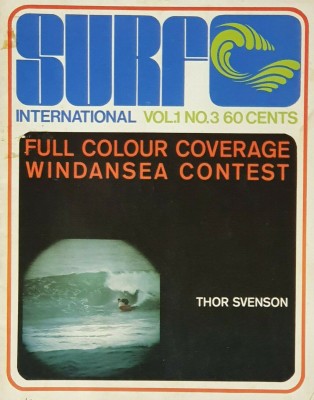
Surf International
Volume 1 Number 3, February 1968,
pages 20 to 25.
Introduction.
Two contest
reports on the crucial Windansea Invitational Contest held on
Sydney's Northern beaches over two weekends at the end of
November (Long Reef) and early December (Palm Beach), 1967.
Pages 21, 23 and
25 were devoted to photographs.
The contest was
filmed and included in Eric Blum's Fantastic
Plastic Machine, released in 1969.
The difficulties
in producing the film are detailed by scriptwriter BrianSt.
Pierre in his The Plastic Fantastic Voyage- Across the South
Pacific with Surfers and a Camera, 1969.
Page 20
On Sunday
the 3rd of December, Ted Spencer won a trip to Hawaii with
Air New Zealand.
The magazine
(our magazine) had given it as a prize for the WindanSea
Invitational Contest.
The occasion
was the visit of the Californian WindanSea team on their
South Pacific Tour.
That Sunday
was pretty funny.
There were a
few arguments even though there were only six surfers going
into the water.
Midget, Ted,
Russell, Bigler, Purpus and John Monie.
The
eliminations to find the final six had taken three days.
Or sort of.
The previous
Saturday had been used for heats at Long Reef.
The Sunday
for eating, drinking and speeches.
The Monday
for the semi-finals.
The finals
waited a week.
Actually
most of the competitors went miles from the scene of combat.
The north
coast beckoned and they got a bit of surf.
The south
side of Angourie especially.
Apparently
the Americans settled in a little better.
They
impressed most of the strines.
Purpus had a
fin first take off.
He'll
probably be remembered for it.
Skip Frye is
smooth and stylised.
Bigler
stands up very straight on the nose.
The girls
seemed happy.
Thor talks.
And tries to
sort out all the opinions into some sort of policy.
And
sometimes succeeds.
Actually in
the final it's pretty difficult.
The
cameramen are still on everyones' backs.
Though they
have to pay to be so.
The final
goes on.
Ted and
Russell start slowly.
Midget is
consistently consistent.
And good
too.
He continues
to be.
Somehow Russ
fails to really click.
It's Ted who
gets about four of the larger longer rights.
It's enough
to let him win and he does.
It's a trip
to Hawaii.
What a far
cry from Palm Beach this small and sloppy day.
All the
finalists come out of the water and then we have the prize
giving.
The trophies
are dozens of paper flowers.
No bakelite.
No chrome.
They have
first and second on them.
And third,
but they are all the same.
But the
first has the trip and it has all been very tense.
Somehow we
all get through the ordeal.
Then we
know that despite any crap, someone is going to Hawaii who
does deserve it.
And we know
that there will be a next time for the contest.
And there
will be another Ted Spencer.
John Witzig
It was
Sunday and a southerly.
The
Americans were back in Sydney, ready for the finals of the
WindanSea Invitational, the heats of which had been held at
Long Reef the previous weekend.
Semi-finals
on the Monday had reduced the field to six surfers:
Australians Farrelly, Spencer, Hughes and Money; and
Americans Bigler and Purpus.
The finals
were to be held at Palm Beach, the beach farthest north of
Sydney.
At high tide
the basin was deep, the waves too full.
I settled
down with the Sunday papers and waited for the contestants
to arrive.
Most of the
Americans were already there, waiting; the Australian
competitors, with their advantage of local knowledge, arrive
late at various intervals throughout the morning.
By 1.00 p.m.
the basin is working; long rights are swinging in about 100
yards north from the southern headland.
The area is
cleared and the contestants are allowed in the water; they
have time to make final adjustments to their equipment.
Judges Young
and McTavish are out, ripping the surf, showing the
contestants the standard they expect.
Spencer
paddles out, hard turns and long nose rides.
Farrelly is
carrying his equipment onto the beach.
Hughes waxes
up, then rides a smooth track; recent winner of the
Newcastle and Hunter River Valley Championships, he has not
yet been out of Australia and it is easy to see that he
wants to win. Bigler and Purpus are on the beach, creating
interest with their equipment and by their very presence.
On his
arrival in Australia veteran surfer Pete Peterson had said
that the Australians will find something worthwhile in
American surfing.
Today will
decide.
It is
interesting to note the variations in surfing equipment.
Farrelly has
two boards, both extremely small, light and wide backed; one
has an accentuated scoop out of the back top deck.
Spencer has
a very short pin tail, a large fin set about 12 inches from
the back.
Money and
Hughes are riding the more conventional 9-ft. performance
boards.
The American
equipment is different altogether, perhaps their surf
demands length, I do not know. Purpus has a rather large,
thin-backed, wide-nosed board, the widest point being about
one-third from the tip, from there it takes a long but
gradual taper to the back.
Bigler is on
a somewhat shorter but basically same shaped board.
From the
first wave I can see that both Bigler and Purpus are better
surfers than I had first given them credit for, but it is
hard to judge, as their brand of surfing is entirely
different.
They show
that stunt riding does have a place in contest surfing.
Purpus in
particular pulls off some amazing manoeuvres, manoeuvres
that are just not seen in Australia, let alone in Australian
contests.
One of the
more regular stunts is the fin first take-off; he stands up,
fin digs in, he revolves with the board and comes out right
way round and, more often than not, hanging five.
I notice
from the public's reaction that he is their champion.
I doubt
whether the judges will see it the same way.
Both Bigler
and Purpus are, by Australian standards, awkward.
With their
longer boards they are severely handicapped in vertical
movement on the wave; also, a forehand or backhand turn
takes more effort than the Australians with their lighter
and smaller boards.
The
accentuated body movements of the Americans, necessary in
order to get their manoeuvres completed, gives them a ...
Page 22
... clumsy
appearance.
It is only
on the nose that they resemble the Australian surfer.
Bigler comes
through some beautiful sections, high up on the face,
stiff-legged, on the tip.
Purpus shows
tenacity as he semi-crouches on the nose and sticks there,
stalling and accelerating by weight displacement.
There is no
doubt that the Americans treat contest surfing in a
completely different light to the Australians.
They seem to
concentrate on accomplishing a particular manoeuvre, of
following it through and holding it as long as possible.
In
comparison the Australians look smooth and confident, they
do not play tricks with the wave but suck all it has to
offer and leave it, drained, on the beach.
A year of
hard competition has sharpened the Midget's competitive
touch and from the start it is evident that he is the force
to beat.
Spencer
starts slowly but ends strongly.
Physically
more powerful than Farrelly, he is driving deeper into the
sections, harder into the cutbacks.
Under, over,
on top of, Ted Spencer is a top proponent of the modern
Australian style, a hard and fast-moving competitor.
Hughes'
deceptively easy style whipped him through some hard
sections for some fine nose rides but leaves him slightly
behind in the run for the money.
It is a
hard pick; over the 40 minutes I would not hesitate in
giving it to Farrelly, but the contest was to be decided
over the best 7 waves.
Spencer had
done some hard and spectacular surfing on two of his larger
waves, coming through, on the nose, whipping his board from
top to bottom with a powerful knee action.
I watched as
the judges totalled.
Four judges
and their results are worth noting.
Nat
Young
1.
Spencer
2.
Farrelly
3.
Bigler |
Bob
McTavish
1.
Hughes
2.
Farrelly
3.
Spencer |
Skip
Frye
1.
Farrelly
2.
Spencer
3.
Hughes |
Micky
Munoz
1.
Spencer
2.
Farrelly
3.
Bigler |
It is so
close.
A discussion
is called, it is agreed that on 40 minutes Farrelly had won,
but that the contest was over 7 waves and the contestants
having been told this, it is not practical for a wider
points margin to operate.
Spencer had
top scored on two sheets; Spencer had won, Farrelly second,
Hughes third.
The judges
do not like to hassle over the scores, most believing
surfing to be an art form and find something aesthetically
wrong in deciding a winner in such a way, there on the sand,
the stakes a trip to Hawaii.
Frye and
Munoz backed the American judging system of time and
distance.
Here was a
positive winner, you set a surfer a task and he gets it
done; if a surfer knows he had to get a 10-second nose ride
then he can train, prepare himself to perform this
manoeuvre.
If he fails
then he loses the contest, no hassle, every surfer knows
where he stands.
It is easy
to see where the American contest approach originates, it is
inherent in ...
Page 24
... their
judging system.
Our verbal
arguments are not so strong, we are armed with bits of paper
representing 40 minutes of surfing, and yet we are arguing
over a winner, unable to decide.
The
Americans have good logic, a nice tidy result is the result
of their system.
On the
other hand, our surfers have shown themselves distinctly
superior.
True, the
American system might give a positive result, but a
restrictive wave system acts as a clamp on an individual's
style.
Our position
loses in verbal argument but comes out on top if you view
surfing as an art form. Perhaps the Americans see surfing as
an art, but surfing contests as a specialist sport.
Perhaps,
after all, we are on the wrong track; for it does seem cheap
when guys go in and surf it out and then the winner is
decided on split hairs; but that's it, I believe our system
is the best of a bad lot. I do not believe that a contest
winner should be a specialist performer.
In a contest
we should be looking for the best all-round performer, not
the best at some particular manoeuvre.
Surfing is
beautiful and a surfing contest should try to reflect this
as much as possible; let the technocrats go back to the
office, I already work there five days a week.
Pete
Peterson was right.
I did learn
a lot from the Americans. their contest approach, their
logical judging methods.
They do have
something to offer; we are all contributors to a great
sport.
The
WindanSea Invitational was a good show and I know at least
one surfer who does not have any doubts as to our present
judging system: Ted Soencer, as he wings his way to Hawaii,
for waves, enjoyment and perhaps a contest or two.
Lester Brien
 |
Witizig, John &
Brien, Lester:
Windansea Invitational
Surfing Contest.
Surf International
Volume 1 Number 3,
February 1968, pages 20 to 24
.
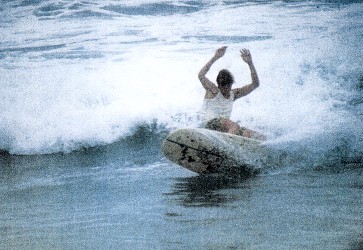
Image left:
Wayne Lynch, Long Reef ?,
page 24.
"Australian Junior
Champion, Wayne Lynch, qualified for the Semi Finals
but had to return to Victoria for examinations", page 23.
|
 |
Surf International
Volume 1 Number 3, |
surfresearch.com.au
Geoff Cater (2010) : Witzig
and Brien : Windansea Contest, 1967.
http://www.surfresearch.com.au/1968_Witzig_Windansea_Comp_Surf_Int_V1n3.html