surfboards
in australia since 1900
 |
surfresearch.com.au
farrelly : design interview, 1968
|
Midget Farrelly : Design Interview, 1967-1968.
Farrelly, Midget :
An interview on the progress and development
of the modern surfboard with Midget Farrelly.
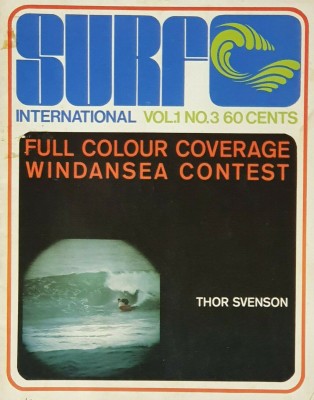
Surf International
Vol. 1. No. 3 February 1968,
pages 34 to 37.
Introduction.
The interview,
most probably conducted by editor John Witzig, reprises Midget's
view of Australian (Sydney) surfboard design developments
through 1967.
Despite the
publishing date of February 1968, it was clearly conducted in
December 1967 before both visited Hawaii at the end of the
year.
Page 34
An interview
on the progress and
development of the modern surfboard
with Midget Farrelly.
'I am looking for a different kind
of wave, the kind that throws the power up behind
you and sends the board skittering on its rail and
its fin so that you
have
got to get your body out over the board and the
water and be like that
man
on the motor bike.'
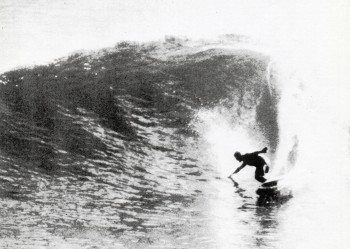
[Photograph by John Wizig: Bob
McTavish, Yagen, 1967.]
|
|
Page 35
Could
you explain in basic terms just what has happened to
surfboards in the last twelve months?
Well, nothing really radical has happened to the majority of
boards yet, but there is a general trend towards a shorter
board.
Last summer
it seemed everyone was riding nine feet.
We had come
down from around nine five, nine six, and they were
considered short boards.
During the
winter, boards went a little farther.
I remember
midway through the winter I made my first 8 foot 8 board and
I thought that was short, but then about September they
started to go even farther.
Generally
they have gone down six inches to a foot and in the last
three months the top surfers have dropped their lengths down
two feet.
Any
other basic differences except length?
Yes.
The problem
has always been if you make a shorter board how do you get
it to do everything a long board does.
I think most
of the good surfers now realize it's not one dimension of a
surfboard that guarantees that it works.
As we get a
little bit more sophisticated with design we are looking
towards displacement volume to give us a true measurement of
a surfboard.
While we
have gone down in length we have come up in a few other
things.
The design
is so radical that we do need a basic thickness of at least
three inches.
The
introduction of the V bottom means more defined planing
areas, more positive areas on the bottom of the board.
Rail shape
has changed from a pointed, critical, radical rail to a
softer, rounder, more oval rail.
The general
rocker of a surfboard has been altered.
The nose is
kicked radically while the tail flows away in a soft line.
So you have
got the V, the more defined planing areas, nose rocker, and
the change in rail shape, but I think most significant and
obvious change is in outline.
We have
almost got a very basic old fashioned outline: big, wide,
square tail, parallel rails and a blunt nose.
You wouldn't
say that the boards of today are beautiful at all.
Do you
equate all this change with definite progress in surfboard
design?
Well, I have to look at why I changed my board and I feel
that I am progressing.
When I look
around at some of the other shops I think they are
progressing too, because we don't change the board and then
change the style nowadays.
What I
thought of- we've ridden the flats of the waves, we've
ridden down the waves, we've ridden across the waves, and at
different times under freaky circumstances we have ridden up
the wave.
It would be
more exciting if we were able to use gravity or centrifugal
force to hold us up under the wave in the lip, and this can
only be achieved through power drive or sharp acceleration
or some kind of sustained momentum into the top of the wave
and out of the top of the wave.
I think it
all stems from the re-entry or whatever you want to call it.
Doesn't
the very lightness and smallness of these boards restrict
their momentum?
No, it doesn't.
The
lightness or heaviness of a board is best governed by the
lightness or heaviness of the wave. There seems to be a
general yardstick in surfing, thin light boards thin light
waves, thick heavy boards thick heavy waves.
Of course
what was thick, is now absolutely revoltingly thick, and
what was thin and unridable is now desirable.
A light thin
surfboard is more sensitive.
From a
manufacturer's point of view how much change in surfboard
design can be attributed directly to controlled fashion?
I think that unless you have got a guaranteed market you
can't ignore fashion.
The Sydney
board builders have had a good winter and a good summer.
I think the
reason they have had a good year is because people have been
buying a new style of board.
Now we break
it down into three months for surfboards.
The
surfboard built today is infinitely better than the one
built three months ago.
Is the
development that has taken place in Australia applicable
only to Australian surf?
At the present rate it probably is.
We have
realized more and more so that we are riding our own waves
in our own way.
I looked at
Nat and as well as seeing the World Champion I could see a
little bit of the future for Australian surfing.
He had
condensed his style to what he needed the most.
The short
board has done this to a certain extent.
You can't
get away with imitation surfing.
Anything
that is done on a short board has to be done very
purposefully because it shows.
I think we
have burnt off all these unnecessary characteristics in our
surfing styles.
As
individuals we have come to a very ideally suited style for
local conditions anywhere around Australia.
This is what
has really influenced surfboards in Australia right now.
In
California or Hawaii changes come yearly.
I think we
are not having a surfboard revolution as much as we are
having a style revolution.
Well, in
other words, the rest of the world isn't moving along a
similar path to Australia.
No, definitely not.
I think that
what we have done, really, is to utilize our waves and
ourselves and our boards to get an unbeatable approach to
our own waves.
The perfect
example of this was the WindanSea team here.
There were
plenty of good surfers but in our waves their boards weren't
doing what our boards were, and their styles weren't either.
They did
adjust, some of the more aggressive surfers seemed to fit
very naturally in some instances.
What do
you think your part is in the development of the modern
Australian surfboard and the modern Australian style of
surfing?
Well, I felt quite inspired after watching some of the
surfers at the Australian Championships at Bells a little
more closely than I ever had done before.
I think I
summed up Bells as being the kind of contest where people
actually wanted to get out and get more out of a wave than
have ever been gotten out before.
They wanted
to ride Bells in a way that had never been done before.
They weren't
afraid of Bells, and I think this sort of inspired me to try
to create some pattern for progress.
I felt that
the gravity a motor bike rider in a cage creates for himself
could be applied to the basic cylindrical shape of a wave.
I have
always known the standard principles of, for instance, the
difference between a yacht hull whichis a displacement hull
and a speedboat hull which is a planing hull.
By a
combination of the two I thought you could achieve a board
to plane as well as displace so as to achieve speed and
control all in one.
The
progression towards round bottoms has proven that a round
bottom definitely puts you back in the wave, but it often
leaves you there too.
There had to
be an answer.
I felt a
split planing surface under the tail, set at different
angles, would provide the displacement of a round bottom
plus the planing advantages of a flat bottom.
Radical
changes in direction won't be achieved on a long board.
I found that
by reducing length any dimension that argues with my
physical domination of the board I got a much more
responsive board to say the least.
Reduction in
fin areas changed the performance of my board.
The board
would maintain forward direction but would also provide
greater side slip.
Actually the
surfboard is turning more into a hot rod.
We are not
building beautiful instruments or beautiful boats or
anything any more, they are just basic hot rods.
I think
that's as far as my part goes.
I create a
pattern of progress for myself; it's quite obvious that by
reducing the board's domination of my surfing I can dominate
the board and then start working on the wave.
Well,
how much ot this is applicable to the kids who buy your
surfboards?
What does
it really mean to them?
Is it too
tar advanced above the commercial market to have a direct
application to it?
It is, if they haven't seen you surf one of these boards.
It's the
same thing as giving refrigerators to Eskimos if they didn't
know how to use them.
Do you
think the market is enough in tune in Australia?
Yes, it is in Sydney now.
If it is
happening in Sydney now, it will be happening in the rest of
Australia in three months.
The kids
themselves are quite critical and if a new style of surfing
is adopted by a top surfer on a new board, then a lot of
people are going to examine it very quickly.
A perfect
example of this is Manly.
A person who
provides one of the newer designs has to understand what is
going on, and I think it should be obvious from the new
style of surfing what is going on.
All I can
say is that things are developing so much more right now.
So much more
is being done and known.
These new
boards are definitely more demanding.
Some of the
poorly built ones are so demanding that in fact people can't
even paddle them, and once they do get away they seem ...
Page 36
Three
photographs:
Top: One of Bob
McTavish at Angourie (?) and a quote from the
interview:
'When you
are hanging on like a bob sled team so that you are really
trying to do what the fly is doing.'
Bottom: Two of
David Treloar and a quote from the interview:
'Between
Manly and Palm Beach you've got twenty miles, and I would
say at times there seem to be about two thousand surfers.
In amongst
that two thousand and twenty miles you've got the best
surfers in the whole country.
So something
has got to happen.
Things have
got to pop.'
Two moods of
manly surfer David Treloare.(sic)
An Interview on the progress and
development of the modern surfboard with Midget Farrelly.
and a quote from the interview:
'I am
looking for a different kind of wave, the kind that throws
the power up behind you and sends the board skittering on
its rail and its fin so that you have got to get your body
out over the board and the water and be like that man on the
motor bike.'
Page 37
... to spin
out.
A properly
designed small board say around eight feet; should paddle
quite well and should have good wave traction.
What is
going to be the effect of this Australian development on
the United States following the WindanSea team?
Well, without looking at it politically- I mean a few of
those guys who came out here are all tied up with surf teams
and manufacturers- to use Steve Bigler's words, it will
either be a fantastic fad and it will blow the whole scene
over there or else it will be a dud from the word go.
I think
personally that there are enough of the kind of waves that
this new small board needs over there to be ridden well, and
like Pete Peterson said, if somebody gets over there this
summer, on one of these boards, the people just won't
believe it.
I think they
are looking for something new over there.
This is sort
of evident from the attitude of the surfers who came out.
What
about Hawaii?
Well, the thing about Hawaii that is so constant and so
undeniable is the wave conditions.
Heavy waves
and heavy offshore winds.
Now I think
that on the right days this kind of board can be ridden
there, too.
It's a
well-known fact that on a 15-foot Makaha point day if it's
glassy you can take a hotdog board out and just wail on
those big mounds of water.
But I've
seen the best big wave riders spin out on a gun on a
ten-foot offshore day.
I think that
with the right kind of person riding one of these short
boards on a smooth 12- to 15-foot Sunset Beach day, driving
straight at the bottom, and then changing direction and
going back almost over its own wake towards the top of the
curl and then rebounding off the curl and coming back over
just a'head of the white water.
I think this
is the ultimate aim of every surfer I have ever seen ride
Sunset; to get to that vertical almost upside down position
and then to sweep down to the flat at the last section with
the lion at his heels.
Do you
imply that Australia has reached the stage of making a
genuine contribution to world surfing?
Well, I don't imply it, I know it.
But I think
Australia reached that stage when her first good surfer
achieved any sort of recognition anywhere at any time.
But
generally and as a nation I think Australia is definitely
contributing something nobody else has even thought of.
Because,
well, it's unheard of riding small to big waves on a little
board, and I think that if the whole project is handled
diplomatically and intelligently this could become a far
reaching thing.
I think it
could go just about everywhere.
Nat showed
that a big guy on a little board can do a lot, and I think
the good surfers now are proving that regardless of who you
are, big or small, on one of these little boards, if you use
the right approach, you can do more than a lot, you can do
wonders.
Where
exactly is the change in equipment leading to as far as
performance is concerned?
To
greater performance or to performance in a different
direction?
Performance in a more definite direction instead of clouded
mysterious points in the future.
It's evident
to everybody how good a surfer is now.
Everybody
has the same goal and by just applying themselves to this
goal they come out with their own style, their own standard
of ability, without the characteristics of era styles.
I look
around at most good surfers and average surfers and it's
rare to find two good surfers with one absolutely copying
the other.
It's so
obvious now that you need to get your body to do so many
things and that you are so taken up with this, that you
don't really have time to put your hands above your head or
below your knees. A good surfer is obvious from his speed in
the wave, his position back in the wave, his radical changes
of direction and his control of white water.
It seems to
me that "grace and poise" have long since given way to a do
or die effort to get into the most important part of the
wave: up inside, underneath; it's the vertical, the throw,
pitching, twisting, convulsion of water up high and back
towards the curl.
If you are
riding up under the curl you can't maintain one angle of
trim, you have to get up there in the first place and get
the heck out of there in the second place, and get up there
agaln.
It's not
that it's repetitious, but it's time consuming inasmuch as a
surfer doesn't have a chance to look like he's on the
shoulder, or in the curl, or behind the white water.
He'll be
doing all three things anyway.
While it
is very difficult to evaluate at this time, it would be
apparent that genuine progress is being made in Australia
in surfing.
Why has
it happened in Australia?
And
conversely, why hasn't it happened anywhere else?
Why?
Well, I think that in the last year Australians have set
themselves such high standards that they had to live up to
those standards insomuch as any easing up on that pattern of
progress would have meant falling behind.
I think that
there are a lot of young surfers like Russell Hughes or Ted
Spencer who are so bent on being good, so determined to make
the top, that they are pushing the older guys who themselves
are pushing to stay in front.
It's very
competitive.
There is no
doubt about it.
In one week
you will see something new done in the water and at the end
of that week, if it's good, well, the other guys will have
adopted it.
I don't mean
a hand position or a head position, I mean something like a
new way to drift on the wave or a new kind of fin
refinement.
Everybody
picks up on it and it seems to me like highly competitive
progress and a genuine desire to be good.
Don't
these same conditions exist in other countries?
In
California, for example?
They do.
They
definitely do.
It would be
easy for me to say that everybody in California is hooked on
noseriding or something like that, but I don't really know.
I haven't
been there for a year.
There is one
thing, though, between Manly and Palm Beach you've got
twenty miles, and I would say at times there seem to be
about two thousand surfers.
In amongst
that two thousand and twenty miles you've got the best
surfers in the whole country.
So something
has got to happen.
Things have
got to pop.
In
California Skip Frye might live 150 miles away from David
Nuuhiwa in Los Angeles, and Cooper is up at Santa Barbara,
and he's a-long way from Skip.
You don't
get much competitive progress there.
I think
that if this group breaks up that we have right now and go
their own way, then I think you'll see a lapse.
I honestly
think that the reason we have progressed is that to have a
reasonably small group that is compact and really working
hard at getting ahead.
It might be
a little severe saying that they are all trying to beat each
other, but I wouldn't say that they are not trying to beat
each other.
The
future?
Well, what I'd like to do is naturally to surf every wave
that I can get my hands on.
Every good
wave.
I am looking
for a different kind of wave, the kind that throws the power
up behind you and sends the board skittering on its rail and
its fin so that you have got to get your body out over the
board and the water and be like that man on the motor bike;
your head will be upside down and your feet above you and
you will be stuck there like a fly.
I am trying
to work up into the curl and then back out of it at
lightning speed and I know these other guys are too so it's
a pretty common goal.
I think the
natural final stages of the present progress is putting this
board onto a wave in Hawaii. Your moment of truth will be
when your tail is high on the wind-blown wall at Sunset and
you are trying to force the rail in to get some traction to
kill any skitter that's going to come somewhere between the
nose and the fin.
When you are
hanging on like a bob sled team so that you are really
trying to do what the fly is doing. We are going to try to
carry this thing into big waves.
It's
definitely worked in small waves and the board has some
similarities to a gun, so I don't see why it shouldn't work.
I'm keen to
try in Hawaii.
Anyone who
is there for about a month or two could probably get one of
those things stuck right up under a big peak with the shore
obscured from view by a cascade of water, and in this
situation there is so much true involvement with overcoming
your situation that there is no thought as to whether you
are looking right or you are doing the right thing.
It is a
natural situation in that you have so much to contend with,
that your body and your mind will interpret how you should
overcome it, and it will be obvious by the way that you do
it, how your style is your own.
|
Surf International
Vol. 1. No. 3 February
1968,
pages 34 to 37..
|
surfresearch.com.au
Geoff Cater (2007-2016) :
Midget Farrelly : Design Interview, 1967-1968.
http://www.surfresearch.com.au/1968_Farrelly_Design_Interview_Surf_Int_V1n3.html