 |
surfresearch.com.au
polynesian surfriding : tahiti to 1900 |
| home | catalogue | history | references | appendix |
|
Contents
| u3.1
Samuel Wallis, 1767.
u3.2 Louis de Bougainville, 1768. u3.3 Joseph Banks, 1769. u3.4 Banks' Surfcraft, 1769. u3.5 William Anderson, 1777. u3.6 The Bounty at Matavai Bay, 1788. u3.7 Surfriding Conditions, 1788. u3.8 James Morrison, 1788. u3.9 Royal Tahitian Surfriding, 1788. u3.10 William Bligh, 1788. u3.11 George Tobin, 1792. |
u3.12
James Wilson, 1798.
u3.13 Rev. William Ellis, 1822. u3.14 J. A. Moerenhout, 1834. u3.15 G. F. Gordon-Cummings, 1886. u3.16 Henry Adams, 1891. u3.17 Tueria Henry, 1928. u3.18 Ben Finney, 1956. u3.18 Tahitian Surfboard Construction. uEndnotes uAppendix A: Maps. uAppendix B: Weather Reports. |
Overview
The eariest European
explorers of the Pacific Ocean noted the maritime and aquatic skills of
the Polynesians.
Joseph Banks, a
member of James Cook's first Pacific expedition, reported surfriding on
the west coast of Tahiti in 1769.
This was ten years
before Cook's visits to the Hawaiian Islands in 1778 and 1779 on his third
and final Pacific vovage.
While the exact
design and construction of the Tahitian surfcraft in his report is unclear,
the activity was undoubtedly surfriding.
The most detailed
report of ancient Polynesian surfriding is by James Morrison at Matavai
Bay, Tahiti, in 1788.
Boatswain's mate
on the Bounty, despatched to Tahiti under the command of William
Bligh, Morrison was one of the mutineers and he eventually stayed nearly
two years in the Society Islands.
His journal is a
substantial record of native culture and his account of surfriding, read
in conjunction with Bligh's log, dramatically indicates the extreme surf
conditions favoured by Tahitian surfriders.
Calculations based
on Bligh's charts indicate these waves were in the range of 10 to 20 feet,
still considered a serious challenge by modern surfriders.
Anticipating later
Hawaiian accounts, Morrison notes surfriding was practised in large numbers
by all ages and classes and that some surfers rode in a standing position.
His report on the
expert surfriding skills of the Tahitian chiefs identifies the first named
surfrider, Iddeah, the wife of a local chief Ottu (or Tu) and a woman of
impressive talents.
The Rev. William
Ellis wrote of surfriding on Huhaine, an island to the north of Tahiti,
circa 1820 and in the Hawaiian islands in 1823.
Although he reports
Tahitain surfriding and surfboards as inferior to Hawaii, there are significant
similarities and in locating the surfriding on the reefs outside of Fare
Harbour, Ellis' account indicates that ancient surfriders rode transversely
across the wave face closely following the peel of the curl in the manner
of modern riders.
While some commentators
have insisted the ancients essentially rode straight towards the beach,
to do so at these locations could invite serious injury.
Only one report partially
details the dimensions and design features of Tahitian surfboards (Wilson,
1798) and there are no accounts of surfboard construction.
However the early
journalists provide extensive commentary on native carpentry, particular
in relation to canoe buiding.
Analysis of these
reports suggest that surfboards were probably shaped from a billet - a
seasoned section of timber split from a log; a process in marked contrast
with the widely quoted account of Hawaiian surfboard construction by Thomas
Thrum in 1896.
Furthermore, the
accounts of Banks and Bligh invite speculation as to the possible adaptation
of damaged canoes and paddles in the formative era of ancient surfboard
construction.
3.1
Samuel Wallis, 1767.
The island of Tahiti
was discovered (1) by the English explorer,
Samuel Wallis, in command of the Dolphin on 18th June 1767.
Arriving on the
east coast, Wallis was unable to locate a suitable anchorage due to the
large swell preventing safe entry to the inside of the reef:
"The (long) boats continued sounding till noon, when they returned with an account that the ground was very clear; that it was at the depth of five fathom, within a quarter of a mile of the shore, but that there was a very great surf where we had seen the (drinking) water." (2, 3)
Despite conditions that threatened the safety of the Dolphin, the ship's officers in the long boats reported that the Tahitians negotiated the surf without difficultly:
"The officers
told me, that the inhabitants swarmed upon the beach, and that
many of them
swam off to the boat with fruit, and bamboos filled with water." (4)
The Dolphin
was securely anchored on the north coast at Matavai Bay and while contact
with the Tahitians was initially confrontational, relations subsequently
improved and the expedition was able to trade for much needed provisions
during a stay of five weeks.
This was followed
by a further visit of two weeks on the neighbouring island of Moorea.
Wallis wrote extensively
of the construction of Tahitian canoes, by implication noting advanced
maritime skills. (5)
His notes on Tahitian
canoe construction are discussed below, see 3.14.
The successful landing,
identifying Tahiti as a suitable southern hemishere location to observe
the transit of Venus in 1769, was the precedent for the expedition of James
Cook.
3.2
Louis de Bougainville, 1768
Two French ships,
Etoile and Boudeuse, under the command of Louis de Bougainville
arrived on the east coast of Tahiti at Hitia'a on 4th April 1768
While the visit
was less than two weeks (they departed 15th April), in Europe the accounts
of the crew, largely focused on Tahitian sexuality, were cited as evidence
in support of the theory of "the noble savage", propounded by the
French philosophers Voltaire and Jean Jacques Rousseau.
French author, Nolwenn Roussel (2005) writes of a brief description of surfriding on Tahiti, attributed to Bougainville himself:
" ... des 1768, Louis Antoine de Bougainville, Francais et commandant la fregate du roi 'La Boudeuse', a rapporte dans ses notes que les insulaires « etaient capables de chevaucher la crete des vagues en se tenant debout sur des planches ».
... in 1768,
Louis Antoine de Bougainville, the French commander of the royal frigate
'Boudeuse',
reports in
his notes that the islanders 'were able to ride the crest of waves
while standing up on boards'." (6)
Unfortunately, the
quotation cleary has a wider context, is not annotated and the source is
yet to be identified.
Initial research
suggests that, amoung various cultural observations, the French journalists
did report on the sailing and swimming skills of the Tahitians. (7)
3.3
Joseph Banks, 1769.
The Endeavour,
commanded
by Lt. James Cook, arrived at Tahiti on 13 April 1769 to prepare
for observations of the transit of Venus, the visit lasting for two months.
The success of Cook's
expedition was substaintally enhanced by the inclusion of a group of scientists
and artists led and funded by Joseph Banks.
An immense amount
of natural and cultural information was collected, including an early written
account of Polynesian surfriding by Joseph Banks.
(8)
"Cook's journals are the starting point for all studies of the history and culture of four major island groups in Polynesia (Society, Tonga, New Zealand and Hawai'i) and of eastern Australia, Vanuatu (New Hebrides) and New Caledonia." (9)
While the anthroloplogical
evidence connecting Tahiti and the Hawaiian Islands is subject to often
conflicting interpretations, most agree regular contact had ceased by the
end of the thirteenth century. (10)
The early European
reports appear to accurately represent, to the best of the journalists'
understanding, the independent developments of several hundred years of
ancient Tahitian surfriding.
See Chapter 1 (in
preparation).
Joseph Banks, in
company with Lt. Cook and Dr. Solander, left the
Endeavour's
anchorage
at Matavai Bay on the 28th May 1769 and travelled to the west coast, initially
by boat and then on foot, where they stayed overnight. (11)
The following morning
on their return to Matavai Bay, Banks reported in his journal:
"In our return
to the boat we saw the Indians amuse or excersise themselves in a manner
truly surprizing.
It was in
a place where the shore was not guarded by a reef as is usualy the case,
consequently a
high surf
fell upon the shore, a more dreadfull one I have not often seen: no European
boat could
have landed
in it and I think no Europaean who had by any means got into could possibly
have
saved his
life, as the shore was coverd with pebbles and large stones." (12)
Banks is impressed
by the potential danger of surfriding, specifically notes the location
as adjacent to a break in the reef allowing the swell to reach the shore
(13)
and
indicates the wave size as
"high".
Given the extensive
nautical experience of Cook, and the intensive crash-course of Banks and
Solander in crossing the Southern Ocean, the wave height was probably considerable.
He continues:
"In the midst
of these breakers 10 or 12 Indians were swimming who whenever a surf broke
near
them divd
under it with infinite ease, rising up on the other side; but their chief
amusement was
carried on
by the stern of an old canoe, with this before them they swam out as far
as the
outermost
breach, then one or two would get into it and opposing the blunt end to
the breaking wave were hurried in with incredible swiftness.
Sometimes
they were carried almost ashore but generaly the wave broke over them before
they were
half way,
in which case the (they) divd and quickly rose on the other
side with the canoe in their
hands, which
was towd (originally swam) out again and the
same method repeated.
We stood admiring
this very wonderfull scene for full half an hour, in which time no one
of the actors
atempted to
come ashore but all seemd most highly entertaind with their strange diversion."
(14)
Initally identifying
a dozen bodysurfers, diving under the waves, Banks focuses on the
activities of those using " the stern of an old canoe", hereafter
refered to as the surfriders.
The nature of the
Tahitian surfcraft is at the core Banks' report and, while
apparently specific, invites further analysis given the significance of
a first report.
See 3.4,
below.
Banks' report of
the Tahitian surfriders' performance details four of the basic elements
of surfriding: the paddle-out, the take-off, the ride-in and the pull-out.
(15)
The performance
appears relatively sophisticated; the take-off at "the outermost breach"
is
probably on the green wave face and not merely in the white-water,
maximizing the potential wave size and length of the ride.
Riding on the green
face is further indicated: while some rides went all the way to the shore,
"generaly
the wave broke over them before they were half way".
Banks' phrase "with
incredible swiftness" may indicate an element of riding transversely
across the wave, the rider apparently travelling faster than the wave speed.
When the wave "broke
over them' the ride was terminated ("the pull-out") by the rider diving
down and forcing the board under the water to emerge behind the wave and
paddle back out.
"generaly the wave broke over them before they were half way, in which case the (they) divd and quickly rose on the other side with the canoe in their hands, which was towd (originally swam) out again and the same method repeated." (16)
The manouvre could
be described as an "island pull-out".
While breaking surf
often appears extremely violent to the uninitiated observer, the greatest
danger to the experienced surfrider occurs as a result of a collision with
a solid object; either the bottom of the seashore, their board or another
rider's board.
Control of the board,
particularly at the termination of the ride, enhances the safety of all
surfriders. (17)
Banks' appreciation of this "truly surprizing (and) strange diversion" features in most subsequent accounts.
3.4
Banks' Surfcraft
Analysis of Joseph
Banks' description of the Tahitian surfcraft as "the stern of an old
canoe" (and later in the text simply as "the canoe"), from an
experienced surfriders' perspective, is intuitively problematic.
Taking the description
at face value, it is unclear how the apparent bulk of a canoe stern, even
riden with extremes of strength and skill, could achieve the surfriding
performance suggested by Banks.
There is a possibility
that the description is misleading and close examination of the text demonstrates
some incongruencies.
This is not questioned
by J. C. Beaglehole who, perhaps understandably, simply paraphrases Banks
(18);
The first, and crucial,
difficulty is that as "no one of the actors atempted to come ashore",
it
is unclear how closely Banks was able to examine the craft or, at this
stage, his intimate knowledge of Tahitian canoes.
The surfriding narrative
appears six weeks into the visit, long enough to have some familiarity
with the culture and language but well short of the knowledge detailed
in Bank's comprehensive notes on Tahitian canoes compliled
ten weeks later as the Endeavour sailed south from the Society Islands.
(19)
One possible explanation
is suggested, below.
Secondly, the implied
dimensions are confusing.
While apparently
large enough to support two riders, the craft is small enough that the
riders "divd and quickly rose on the other side (of the wave)
with the canoe in their hands".
Only the shape of
one end of the craft is indicated: "opposing the blunt end to
the breaking wave".
However, by implication,
this suggests the (unreported) inverse: "the pointed end was directed
shore-ward".
J. C. Beagleholes'
1974 edition has Banks noting "the canoe ... was towd out again".
While perhaps consistent
with the impression of a "stern of an old canoe" , this is likely
an inefficient method of negotiating the surf zone and would require considerable
physical strength.
In the original
manuscript Banks initially wrote that the craft was
"swam" out,
but later crossed out the word and adjusted the text to "towd".
(20)
The consideration of an alternative term may indicate Bank's difficulty in describing the paddling process
Lasty, in examing
the text of the surfriding narrative, while the phrase "one or two would
get into it " (my emphasis) appears to imply the concave shape
associated with a canoe, it could be interpreted to mean "caught by the
wave/s".
Note that Banks
has previously used the term "into" to indicate such a meaning:
"no Europaean who had by any means got into (the high surf) could possibly have saved his life" (21)
An examination of
the descriptions and illustrations of contemporary Tahitian canoes further
complicates an understanding of Banks' description.
Wallis reported
in 1767:
"The boats or canoes of these people, are of three different sorts." (22)
The three designs
were the all-purpose single log canoe with outrigger, a large double canoe
suitable for inter-island voyages and a large double canoe with a covered
superstructure for royal or ceremonial use.
The first two were
paddled and, depending on size, also had sails, but the later was only
ever employed paddlers.
According to function,
there were significantly different stern features.
The largest of the
double-hull design was the fighting canoe with extremely elongated sterns
up to 18 feet above the waterline. (23)
The extreme sterns
of these craft, often elaborately decorated with carvings and banners denoting
rank or status, are beauifully illustrated by William Hodges in
"War
Galleys at Tahiti, circa 1774", one of a series of composite
works painted after Cooks' second visit.
(24)
The stern was less pronounced on the more common sailing, and the rarer ceremonial, canoes:
"their Sterns
only are raisd and those not above 4 or 5 feet; their heads are quite flat
and have a
flat board projecting forwards beyond them about 4 feet." (25)
According to Banks, the raised stern greatly assisted in negotiating the surf zone:
"The only thing in which they excell is landing in a surf, for by reason of their great lengh and high sterns they would land dry in a surf when our boats could scarcely land at all, and in the same manner put off from the shore as I have often experienc'd." (26)
As Banks notes:
"The form of these Canoes is better to be expressd by a drawing than by any description." (27)
There are a numerous
works by visiting European artists illustrating the various designs of
Tahitian canoes, including one drawing annotated in Banks' hand. (28)
A large ceremonial
canoe was illustrated by one of the two artists aboard the Endeavour,
H.D. Sporing:
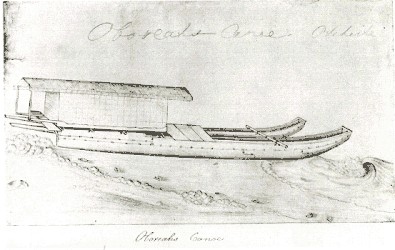 |
British Museum Add. MS 23921-23a (29) Purea, an elderly
queen of Tahiti,
|
Alternatively, if
the surfriding craft was simply one section or panel split from "the
stern of an old canoe", then it is difficult to comprehend how Banks
was able to provide such an apparently definitive description.
One possible senario,
alluded to previously, is that the description was suggested to Banks in
conversation with a Tahitian observer or commentator, subject to inaccuracies
in translation.
Cook's policy of
establishing cordial relations for trade and avoiding potential violent
conflicts with the native inhabitants of the Pacific depended upon effective
communication.
After anchoring
at Matavai Bay, by the end of the first week :
"The gentlemen began to study the Tahitian language." (30)
For the crew of the Endeavour, some basic language difficulties were probaly overcome by consultation with those marineers who had visited Tahiti previously with Wallis in 1767. (31)
No subsequent account
yet identified describes the use of damaged canoes for surfriding.
Although not detailed
in any of the available literature, the recycling of damaged canoes into
smaller craft may have been practised in the formative era of ancient surfboard
construction.
Before proceeding,
further consideration should be directed to Sporing's illustration reproduced
above.
Note that if, for
any reason, Banks' description refered not to the stern, but to the bow
(stem or head) of a Tahitain canoe as described and illustrated above,
then the surfcraft was undoubtedly a surfboard.
Thirty years later,
missionary James Wilson would use exactly such a description:
" a small board ... like the fore part of a canoe" (32)
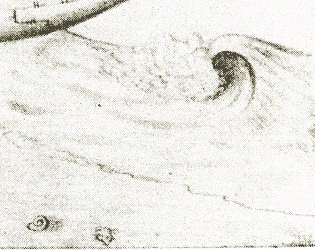
| Also note the wave
study in the lower right of the drawing, detailed right.
This is a near photograhic representation of the dynamics a breaking wave - in surfriding parlance: "a hollow left-hander". (33) It features the thick
base, thin curl, effervescent white-water, smooth surface (possibly resulting
from a light off-shore wind) and, critically, the conical structure of
the wave face that is integral to the dynamics of transverse wave riding.
|
|
3.5
William Anderson, 1777.
On Cook's third
Pacific voyage, before arriving in Hawaii, a report of canoe surfing in
the Society Islands was recorded by William Anderson, surgeon on the 'Resolution'
(35),
in August-September 1777.
"He went out
from the shore till he was near the place where the swell begins to take
its rise; and,
watching its
first motion very attentively, paddled before it with great quickness,
till (it) had
acquired sufficient
force to carry his canoe before it without passing underneath.
He sat motionless,
and was carried along at the same swift rate as the wave, till it landed
him on
the beach.
Then he started
out ... and went in search of another swell.
I could not
help concluding that this man felt the most supreme pleasure while his
was driven so fast
and smoothly
by the sea." (36)
The canoe was, almost
certainly, fitted with an outrigger and the performance shares the basic
surfriding elements identified by Banks.
The take-off is
finely calculated by the rider on the outer-most break and ridden
"till it landed him on the beach."
The Tahitian canoe
surfrider probably rode directly to the beach, at least "as the same
swift rate as the wave."
Anderson's evaluation
of the rider's amusement as "the most supreme pleasure"
is, arguably, not an exaggeration.
3.6
The Bounty in Tahiti, 1788-1789.
Another member of
Cook's crew to visit Tahiti in 1777, and subsequently Hawaii in 1778-1779,
was then mid-shipman, William Bligh.
Bligh returned in
to Tahiti on 26th October 1788 as captain of the Bounty on
an unsuccessful mission to collect and transport breadfruit plants to the
West Indies.
The mission was
terminated by the infamous mutiny led by Fletcher Christian in 1789, precipitating
Bligh's epic 3600 mile voyage in an open boat. (37)
" 'Bounty'
was the first British ship to spend the summer's rainy season in Tahiti.
The season
still brings hurricanes and even today small ships prefer not to
be exposed
in the Pacific." (38)
At Matavai Bay, the
first anchorage in Tahiti, the Bounty was subjected to extreme swell
events that threatened the safety of the ship.
For a tabulated
record of the swell and weather conditions discussed henceforth, see
Appendix
B: Weather Reports: Matavai Bay and Toaroah Harbour, Tahiti.
On Thursday 6th November, one week after arrival, Bligh's journal records the first indication that his anchorage is exposed to northern swells (Swell #1):
"Much Swell setting into the Bay." (39)
The swell apparently continued for several days and on Sunday 9th the Bounty's log notes:
"... less Swell than Yesterday, but still much surf on the shore" (40)
A larger second swell (#2) arrived two weeks later, on Monday 24th November Bligh's journal reports:
"A very great
swell has set into the Bay, from which I have been expecting the Wind from
the
Westward,
but I now find it is owing to a N.N .E. Wind that has been blowing at Sea."
(41)
On Thursday 4th December, eight days later, the swell (#3) was again on the rise (42) and the log for the following two days notes:
"Much swell
setting in and the Sea at times breaking on the Dolphin Bank.
The Ship rolling
very much and a heavy Surf on all parts of the Shore." (43)
and, more dramatically:
"I experienced
a scene of to day of Wind and Weather which I never supposed could have
been met with in this place.
By Sun set
a very high breaking Sea ran across the Dolphin Bank, and before seven
O'Clock (7 am) it made such way into the Bay that we rode
with much difficulty and hazard.
Towards Midnight
it increased still more, and we rode untill eight in the Morning in the
midst of a
heavy broken
sea which frequently came over us.
The Wind at
times dying away was a great evil to us for the Ship from the tremendous
Sea that broke
over the Reefs
to the Eastward of Point Venus, producing such an outset thwarting us against
the
Surge from
the bank which broke over us in such a Manner, that it was necessary to
batten every part of the Ship.
In this state
we remained the whole Night with all hands up in the midst of torrents
of Rain, the Ship
sending and
rolling in a most tremendous manner, and the Sea foaming all round us so
as to threaten
instant destruction.
" (44)
By Wednesday 10th December, this swell had abated:
"In the Morning very little Swell in the Bay." (45)
Continuing the roughly bi-weekly pattern, the swell rose again (#4) and on Saturday 20th December, Bligh reported:
"A very heavy
Swell in the Bay and a great sea on the Dolphin Bank
& much
Surf on the shore, Ship rolling very deep." (46)
The journal of James Morrison, boatswain's mate on the Bounty, confirms Bligh's report and indicates the difficulties this presented the crew.
"On the 20th
(December)
we
had heavy rains & a strong Gale of Wind from the N W which brought
with it a heavy sea from that Quarter breaking so violently on the Dolphin
Bank that the Surge run fairly over the Ship, and the Carpenter who was
the evening before Confined to his Cabbin, was now released to secure the
Hatches.
Several things
were washd overboard & had not the Cables been very good the ship must
have gone on shore.
Next day the
Gale abated, but the surf run very high on the shore so as to prevent landing
either in Canoes or Boats." (47)
These events encouraged Bligh to seek an alternative anchorage.for the Bounty.
"as the
Weather was become unsettled and so much Sea
run into the
Bay, ... it was unsafe for the Ship to ride here" (48)
On the 24th December
he relocated the ship south-west of Matavai Bay to Toaroah Harbour for
the remainer of his stay.
While riding safe
at Toaroah Bay, the northern swells were still in evidence and the log
records another increase in swell (Thursday 8th January, #5).
Towards the end
of the month there was a further week of extreme surf (#6), 22nd to 28th
January :
"A very heavy Sea breaking allover Matavai Bay and as much on the Reefs here." (49)
and, five days later:
The northern swells
made one more appearance before Bounty's departure on the 5th April
1789.
On Monday 2nd March,
Bligh reports:
"The Wind blowing
Strong from the N. W.
I sent a Man
down to Taowne Harbour (t) to see if the Sea set much in, it being open
to that quarter.
He returned
with an Account that a great Sea broke all over it and that it would have
been bad riding
there for
any Ship, and that a Great surf run on the Shore.
Matavai is
equally bad, but here we lye as smooth as in a Mill-pond." (51)
On 8th March, seven days later, this swell (#7) is still very much in evidence:
"A High Sea running over the Dolphin Bank into Matavai Bay." (52)
After relocating the Bounty's anchorage, Bligh summarized the stay at Matavai Bay:
"Since I have
been here Matavai has shown itself to be a very dangerous place, a high
breaking sea
almost constantly
running over the Dolphin Bank unto the Shore, and likewise over the Bank
near to
one Tree Hill
where the sea breaks with great violence." (53)
3.7
Surfriding Conditions at Matavai Bay, 1788.
The seven major
swell events recorded in Bligh's journal in Tahiti, given his previous
nautical experience and the danger to the Bounty, certainly indicate
waves of considerable, if not extreme, size.
Bligh's charts record
the minimum depth of the Dolphin Bank at 2.25 fathoms, approximately 13
feet, allowing for a tidal variation of less than 12 inches. (54)
Basic calculations;
assuming ocean waves initially break at a depth of 1.3 times the wave height
(55);
give a minimum wave height of approximately 10 feet to break on the Dolphin
Bank.
To break on the
outer limits of the reef (at six fathoms or 36 feet), the estimated wave
height is approximately 27 feet.
Bligh's and Morrison's
reports indicate some of these swells were probably to the larger end of
this range.
| Image right:
The "Bounty's" anchorage at Matavia Bay, Tahiti 26th October to 24th December, 1788. (56) The compass alignment
is an poor approximation.
As a result of two
extreme surf events that threatened the safety of the ship, Bligh moved
the Bounty to Toaroah Harbour for the remainer of the visit, departing
Tahiti on Sunday 5th April 1789.
|
 |
The prevalent wind
direction reported during the impact of the large swell events indicate
strong on-shore winds (W and NW) at Matavai Bay, less than ideal conditions
for
surfriding.
However, these swells
ran for several days before and before and after the peak impact and alternative
wind directions were in evidence.
The log records
a significant number of days where the swell was fanned by offshore winds,
approximately anywhere in the quadrant from NE to SE.
On Friday 19th December,
with the onset of the fourth major swell event, the log records the wind
as ESE to ENE and Bligh writes:
"Towards Morning
a long Swell began to set into the Bay and by Noon broke
across the
Dolphin Bank altho the Wind fresh off the Shore" (57)
Sublime surfriding
conditions occur with the combination of suitable bottom contours, signficant
swell, off-shore winds, warm air and warm water temperatures.
For the duration
of the Bounty's stay in Tahiti, the temperature ranged between 76
and 85 degrees Farenheit, or 25 to 29 degress Celsius.
Without historical
documentation, it is probably safe to assume the water temperature was
similar to the present range:
"The water
temperature averages 26° C in the winter and 29° C in the summer,
with less
than one degree of variation from the surface down to 45m." (58)
While the extreme
swell conditions at Matavai Bay, vastly different to his visit with Cook
in August-September 1777, came as a suprise to Bligh, they were probably
eagerly anticipated by the Tahitian surfriders.
Joseph Banks wrote
in 1769:
"The people excell much in predicting the weather, a circumstance of great use to them in their short voyages from Island to Island.
They have many various ways of doing this (Banks notes one method); and in this as well as their other predictions we found them indeed not infallible but far more clever than Europreans." (59)
One critical observation
from a study of these accounts that must be stressed is the relative rarity
of such extreme and sublime surfriding conditions.
(60)
These conditions
are not in evidence during the winter visits of Wallace (June 1767), Cook
(May 1769, May 1774, August-September 1777) and Bligh's second voyage to
transport breadfruit to the West Indies (July 1792).
While the possibly
of such events was undoubtedly increased with Bligh's extended stay, the
critical factor was seasonal - the visit of the Bounty coincided
with Matavai Bay's direct exposure to the summer northern swells.
If the Bounty
had arrived at Tahiti four weeks later when the north swells were running,
it is likely Bligh would sought an alternate anchorage.
The reports by Cook's
crew and the subsequent post-contact accounts in Tahiti and Hawaii, where
the expedition commanders invariably sought anchorages protected from the
predominant swell direction, must be examined in this context.
3.8
James Morrison, 1788.
James Morrison was
boatswain's mate on the Bounty and was one of the mutineers.
His journal is a
highly detailed account of ancient Tahitian culture, significantly enhanced
by his extended stay in Tahiti from 1788 to1791.
(61)
Morrison's long-term
exposure, covering the full twelve month climatic cycle, to traditional
culture contrasts markedly with the relatively short-term visits to Polynesian
islands by most Europeans in the 18th century.
Furthermore, his
dramatic account of surfriding is enhanced by the extreme swell conditions
that caused Bligh and his crew considerable difficulty and threatened the
safety of the ship.
James Morrison's
account essentially replicates the earliest Hawaiian surfriding reports.
This report, although in an attached overview of Morrison's stay in Tahiti, specifically dates the surfriding activity to the fourth of the extreme swell events, with an estimated wave height between 10 and 27 feet, reported and discussed above.
"This Diversion took place during the time the Bounty lay in Maatavye (Matavai) Bay when the Surf from the Dolphin Bank ran so high as to break over her, and we were forced to secure the Hatches expecting the Ship to go on shore evry Minute." (62)
Morrison describes some of the basic elements of surfriding, as previously recorded by Banks, except that the most skilled ride in a standing position:
"they get peices
of Board of any length with which they swim out to the back of the surf,
when they Watch the rise of a surf somtimes a Mile from the shore &
laying their Breast on the board, keep themselves poised on the Surf so
as to come in on the top of it, with amazing rapidity watching the time
that it breaks, when they turn with great Activity and diving under the
surge swim out again towing their plank with them ... some are so expert
as to stand on their board till the Surf
breaks" (63)
The description of
the board "of any length" indicates a significant range of
dimensions; probably determined by skill, body size, social status and/or
the materials available for construction.
Certainly the boards
were specifically constructed for surfriding, and not an adaptation as
possibly implied by Joseph Banks and indicated by William Bligh, discussed
below.
Riding in a standing
position was not noted by members of Cook's third Pacific voyage and does
not appear to be confirmed in accounts from Hawaii until circa 1825 by
Rev. William Ellis.
(64)
The minimum surfboard
dimensions for successful riding in the standing position are open to debate.
(65)
Furthermore, Morrison
gives some some indication of the extreme surf conditions favoured by Tahitian
surfriders, indicating the rider's preference for a critical wave shape
and the potential maximum wave height and the length of the ride.
The distance from
the beach, "a mile", is consistent with the previously estimated
wave heights.
"When the Westerly Winds prevail they have a heavy surf Constantly running to a prodigious height on the Shore ... the part they Choose for their Sport is where the Surf breaks with Most Violence ... they Watch the rise of a surf somtimes a Mile from the shore" (66)
He reports that
the arrival of large surf was a significant community event and surfriding
was practised by both sexes and all ages.
The potential dangers
were substantially reduced with the selection of suitable ("smaller")
conditions and the skill of swimming taught at an early age.
"at this diversion
both Sexes are Excellent ... the Children also take their sport in the
smaller surfs and as Most learn to swim as soon as walk few or no accidents
happen from Drowning....
They resort
to this sport in great Numbers and keep at it for several Hours." (67)
The number of riders is considerable, enough to require those paddling out to avoid those riding in:
"as they often
encounter each other in their passage out and in they require the
greatest Skill
in swimming to keep from running foul of each other " (68)
This was not always successful, but such collisions were apparently considered an integral part of surfriding and the occassional "very Coarse landing" suffered without rancour or dispute:
"which they somtimes cannot avoid in which case both are Violently dashd on shore where they are thrown neck & heels and often find very Coarse landing, which however they take little Notice of and recovering themselves regain their boards & return to their sport." (69)
Morrison briefly records Tahitian canoe surfriding, confirming the earlier report of William Anderson and the contemporary account by Bligh, below.
"They have also a diversion in Canoes, which they steer on the top of the Surf with Great dexterity, and can either turn them out before it breakes or land safe tho it Break ever so high." (70)
3.9
Royal Tahitian Surfriding, 1788.
Significantly James
Morrison's account notes the expert surfriding skills of the Tahitian ruling
class, consistent with Polynesian legends but not recorded in the earliest
accounts from Hawaii by Europeans. (71)
"The Chiefs
are in general best at this as well as all other Diversions, nor are their
Weomen behind hand at it.
Eddea is one
of the Best among the Society Islands & able to hold it with the Best
of the Men Swimmers." (72)
Note that the assessment
of Iddeah's (Morrison's
Eddea) surfriding skill may not be Morrisson's
independent view, but was probably based on the communal consent of Tahitian
surfriders.
It is unlikely to
be the result of some organised competitive event.
See Chapter 1 (in
preparation).
Iddeah and her husband
Tu (also known as Otoo, named as Tinah by Bligh) formed a
personal and commercial relationship with Bligh. (73)
Upon first meeting
her on board the Bounty at Matavai Bay in October 1788, Bligh wrote:
"His wife (Iddeah) I judged to be about twenty-four years of age: she is likewise much above the common size of the women at Otaheite, and has a very animated and intelligent countenance." (74)
Three months later, while preparing to depart Tahiti, Bligh affirmed his initial assessment:
"she is one of the most intelligent persons I met with at Otaheite." (75)
Besides her surfriding
skills, Iddeah's social, physical and mental prowess was considerable.
Invited to witness
a wrestling competition, Bligh reported:
"Iddeah was
the general umpire, and she managed with so much address
as to prevent
any quarrelling, and there was no murmuring at her decisions." (76)
A mother of several children; with (a somewhat surprised) Bligh she discussed and demonstrated native childbirth, and was highly amused by his account of English methods. (77)
Some of Iddeah's other talents were less maternal:
"Iddeah has
learnt to load and fire a musquet with great dexterity, ...
It is not
common for women in this country to go to war, but lddeah is a very resolute
woman, of a large make, and has great bodily strength." (78)
On a day recorded
as one of the most extreme surf condtions (5th-6th December), her canoe
paddling skill was outstanding.
Bligh's journal
notes:
"The sea broke
very high on the beach; nevertheless, a canoe put off, and, to my surprise,
Tinah, his wife (Iddeah), and Moannah, made their way good
through the surf, and came on board to see me.
There was
no other person in the canoe, for the weather did not admit of useless
passengers: each of them had a paddle, which they managed with great activity
and skill." (79)
Ten years later,
Iddeah's son was now the local chief, Pomare.
Circa 1798, the
newly arrived English missionary, John Williams, post-dated James
Morrison's report of her surfing skills:
"The women are very dexterous at this sport; and Iddeah, the queen-mother, is considered the most expert in the whole island." (80)
3.10
William Bligh, 1788.
Following the second
major swell event at Matavai Bay, on Friday 28th November William Bligh
also briefly reported canoe surfriding; confirming the accounts of William
Anderson and James Morrison.
They also practise
with small Cannoes in these high surfs, and it is seldom that any of them
get
overturned
or filled. " (81)
He was more expansive on the subject of Tahitian surfriders, apparently using canoe paddles as surfcraft, recording some of the basic elements of surfriding (paddle-out, take-off and ride-in) and, like Banks, notes the potential danger of the activity.
"The heavy
surf which has run on the shore for a few days past has given great amusement
to many
of the Natives,
but is such as one would suppose would drown any European.
The general
plan of this diversion is for a number of them to advance with their paddles
to where the
Sea begins
to break and placing the broad part under the Belly holding the other end
with their Arms
extended at
full length, they turn themselves to the surge and balancing themselves
on the Paddles
are carried
to the shore with the greatest rapidity." (82)
Given this report
parrallels James Morrison's, there is a remote possibility Bligh's description
of the surfcraft as "paddles" is misleading, although Bligh's reputation
for exactitude makes this highly unlikely.
Joseph Banks, assisted
by J. C. Beaglehole's Footnote, describes Tahitian paddles as:
" a long handle
and a flat blade resembling more than any thing I recollect a Bakers peel
Footnote:
The shovel used to place bread in the oven and withdraw it. "
(83)
The use of inverted
canoe paddles is confirmed by the method of "placing the broad part
under the Belly holding the other end with their Arms".
Such a technique
was unlikely to be suitable in deep water and the paddles were probably
used close to the beach.
One, highly spectulative,
senario is that the extreme and sublime conditions placed such high demand
on the available surfboards that canoe paddles were used by some surfriders
as substitute craft.
The use of canoe
paddles as surfcraft by ancient surfriders invites further speculation.
(84)
Laurie McGinness (1997) partially quotes Bligh's report (85) and comments:
"The sport
was very crude in those early years.
They did not
have specially constructed boards, but simply used paddles, presumably
from their canoes.
Nor, apparently,
did they attempt to trim across the wave, but rode straight in to the shore.
Surfing of
this type was widespread throughout Polynesia.
It had no
cultural importance and took no great skill to perform.
Only in Hawaii
did surfing develop significantly." (86)
To some extent this is an understandable analysis based on Bligh's edited report, however James Morrison's account obviously contradicts several of McGinness' conclusions.
Like Morrison, Bligh also notes the potential for riders colliding and notes such encounters are successfully avoided by "duck-diving":
"As several
seas follow each other they have those to encounter on their return, which
they do by
diving under
them with great ease and cleverness." (87)
Bligh confirms previous assessments of the rider's pleasure and notes the practical advantages of swimming and surfriding skills.
"The delight
they take in this amusement is beyond anything, and is of the most essential
good for
them, for
even in their largest and best Cannoes they are so subject to accidents
of being overturned
that their
lives depend on their swimming, and habituing themselves to remain long
in the Water. " (88)
The question of why Bligh did not make the connection between Tahitian and Hawaiian surfriding, given that he probably saw or, at the least, heard reports of Hawaiian surfriding ten years earlier with Cook in 1778-1779, remains unanswered.
3.11
George Tobin, 1792.
Bligh was again
dispatched to Tahiti in 1791 in the Providence, accompanied by Lt.
Nathaniel Portlock in the Assistant, successfully completing the
transportation of breadfruit plants to the West Indies in 1793.
In July 1792, George
Tobin, an amateur artist and journal-keeper for the voyage, recorded juvenile
surfriding in Tahiti.
"It is common to see the children at five or six years of age amusing themselves in the heaviest surf with a small board on which they place themselves outside the breaking, whence they are driven with great velocity to the shore, fearless themselves, nor are the least apprehensions of accidents entertained by their parents." (89)
Any concerns of the
parents were, no doubt, allayed by their own familiarity with the dangers
of surfriding.
Clearly, the surf
conditions did not compare with those peviously experienced by the Bounty
in
1788-1789 and Tobin appears not to have conversed with Bligh or others
on the subject.
3.12
James Wilson, 1798.
European contact
with the already waring Polynesian chiefdoms would dramatically realign
political power, with a near terminal impact on the traditional culture.
Military power was
dependent on acquiring western firearms, munitions and sail power and the
alignment of the Bounty mutinners with the house of Tu significanly
altered Tahitian politics.
In 1797, the traditional
culture was confronted with an alternate spirituality by the arrival of
Christian missionaries from the Missionary Society (later the London Missionary
Society) on the Duff.
One of the missionaries,
James Wilson wrote of the exceptional swimming skills of the Tahitians:
"They are uniformly excellent swimmers and divers; it was affirmed that one of the natives swam from Otaheite to Eimeoi (15 miles;) he was in consequence esteemed and worshipped as a god; for they declared that as the channel was infested with numerous sharks, and the distance so great, none but a god could pass safely." (90)
His account of surfriding, highly reminiscent of Morrison, recognises the challenge of extreme conditions:
"They have
various sports and amusements; swimming in the surf appears to afford them
singular
delight.
At this sport
they are very dexterous; and the diversion is reckoned great in proportion
as the surf runs highest and breaks with the most violence: they
will continue it for hours together, till they are tired." (91)
Wilson provides the earliest dimensions for Tahitian surfboards, in this case certainly ridden prone, and notes that some riders were bodysurfers.
"Some use a
small board, about two feet and a half long, formed with a sharp point,
like the fore part
of a canoe;
but others depend wholly on their own dexterity." (92)
While the basic mechanics of surfriding are effectively described, Wilson notes the stylish raising of the outside or non-steering leg, apparently indicating the riders transversed the wave face:
"They swim out beyond the swell of the surf, which they follow as it rises, throwing themselves on the top of the wave, and steering with one leg, whilst the other is raised out of the water, their breast reposing on the plank, and moving themselves forward with one hand, they are carried with amazing velocity, till the surf is ready to break on the shore, when, in a moment, they steer themselves with so quick a motion as to dart head foremost through the wave, and, rising on the outside, swim back again to the place where the surf begins to swell, diving all the way through the waves, which are running furiously on the shore." (93)
Wilson also reports surfriding is practised in smaller conditions by children and the activity, despite the inherent danger to European eyes, is essentially injury free:
"The children take the same diversion in a weaker surf, learning to swim as soon as tbey can walk, and seldom meet with any accident except being dashed on the beach; but hardly is ever is a person drowned." (94)
Whereas some writers (such as Ellis, below) make much of the potential danger of shark attack, Wilson records a remarkable response by these Tahitian surfriders:
"If a shark comes in amoung them, they surround him, and force him on shore, if they get him into the surf, though they use no instrument for the purpose: and should he escape, they continue their sport without fear." (95)
Such acts of bravado were likely directed at smaller specimens of the species.
3.13
Rev William Ellis, 1822.
The religious conversions
and the rejection of "pagan" values (96)
so eagerly sought by the missionaries failed to materialize.
Facing irrelevance
and challenged by the increasing influence of European commerical interests,
under intense local pressure the missionaries eventually provided access
to armaments, imported from the new British colony in Australia.
Again, most benefit
went to the house of Tu, now lead by his son, Pomare II. (97)
Victory by Pomare
II at the battle of Feipi in 1815 firmly entrenched the Christian church
in Tahitian politics and commerce and effectively established an alternate
state religion, directly in conflict with the traditional beliefs. (98)
In this period of
political and cultural upheaval, William Ellis arrived on island of Huahine,
north-west of Tahiti, in June 1818 with other Missionary Society members
to further advance Christianity in the Pacific islands.
Ellis moved on to
Hawaii in 1822, but after completing a tour of the major islands his wife's
illness forced a return, via America, to England. (99)
On his return he
published A Journal of a Tour Around Hawaii in 1825
(100)
and quickly followed with an expanded work, Narrative of a Tour of Hawaii
in
1826 that included a report of surfriding. (101)
In 1829 he produced
a three volume work, Polynesian Researches, detailing his
missionary experience and cultural observations in the Society Islands,
Tubuai Islands and New Zealand. (102)
Volume I included
a report of surfriding at Fare harbour on Huhaine. (103)
Polynesian Researches
was
reprinted in 1831 with the addition of a fourth volume on Hawaii including
the earlier surfriding account from the Narrative (1826) and the
earliest printed surfriding illustration. (104)
While Ellis's report
of surfriding at Huhaine certainly preceeds the Hawaiian account, the publication
dates appear to imply the reverse.
Interpretation is
further complicated by Ellis' comments that compare and contrast elements
of the two Polynesian cultures, no doubt written later in preparing his
notes for publication.
(105)
Ellis writes:
"One of their
favourite sports is the 'horue' or 'faahee', swimming in the surf, when
the waves are high, and the billows break in foam and spray among the reefs.
Individuals
of all ranks and ages and both sexes follow this sport with great avidity.
<...>
I have often
seen along the border of the reef forming the boundary line to the harbour
of Fare in
Huahine, from
fifty to a hundred persons of all ages, sporting like so many porpoises
in the surf that
has been rolling
with foam and violence towards the land; sometimes mounted on the top of
the
wave, and
almost enveloped in spray, at other times plunging beneath the mass of
water that has
swept like
mountains over them, cheering and animating each other; and by the noise
and shouting
they made
rendering the roar of the sea and the dashing of the surf comparatively
imperceptible." (106)
The surfriding breaks are located at the channels through the surrounding coral reefs:
"They usually
selected the openings in the reefs or entrances of some of the bays, where
the long
heavy billows
rolled in unbroken majesty upon the reef or the shore." (107)
Ellis's account, apart from the naming of the board, closely corresponds with the previous report by James Morrison at Matavai Bay:
"They used
a small board, which they called papa faahee- swam from the beach to a
considerable
distance,
sometimes nearly a mile- watched the swell of the wave, and when it reached
them, resting
their bosoms
on the short, flat-pointed board, they mounted on its summit, and amid
the foam and
spray rode
on the crest of the wave to the shore; sometimes they halted among the
coral rocks, over
which the
waves broke in splendid confusion." (108)
The Tahitian name
for the surfboard, "papa faahee", is similar to the Hawaiian "papa
he'e nalu", transcibed by Rev. Ellis circa 1824 as "papa hi naru".
(109)
He records variatrions
of the island pull-out, originally noted by Banks and also reported by
Morrision, and notes the relative lack of danger for skilled riders:
"When they
approached the shore, they slid off the board, which they grasped with
the hand, and either fell behind the wave or plunged towards the deep and
allowed it to pass over their heads.
Sometimes
they were thrown with violence upon the beach, or among the rocks on the
edges of the
reef.
So much at
home, however, do they feel in the water, that it is seldom any accident
occurs." (110)
As previously noted, Ellis compares Tahitian and Hawaiian surfboards and the respective surfriding populations:
"Their surf-boards are inferior to those of the Sandwich islanders, and I do not think swlmming in the sea as an amusement, whatever it might have been formerly; is is now practiced so much by the natives of the South, as by the North." (111)
The inferiority of
the boards perceived by Ellis probably refers to the larger dimensions
and/or the fine polished and stained finish that he noted of the the Hawaiian
boards. (112)
The comparison of
the popularity of surfriding between the two island groups, "not ...
now practiced so much by ... the South (Tahiti), as by the North
(Hawaii)",
may
reflect a recent rapid deterioration in the traditional culture under the
impact of divergent European influences, but this discrepancy in numbers
was probably always the case given the Hawaiian islands larger population,
larger landmass with greater natural resources and the superior quality
and quantity of the Hawaiian surf.
Ellis relates the danger of shark attack to surfriders from both locations:
"Both were
exposed in this sport to one common cause of interruption; and this was,
the intrusion of
the shark.
The cry of
a 'mao' among the former (Tahiti), and a 'mano' among the
latter
(Hawaii), is one of the most terrific they ever hear;
and I am not surprised that such should be the effect of the approach of
one of
these voracious
monsters.
The great
shouting and clamour which they make, is principally designed to frighten
away such as
may approach.
Notwithstanding
this, they are often disturbed, and sometimes meet their death from these
formidable
enemies. (113)
The danger of shark
attack is reported by other 18th century commentators, however in most
cases they detail attacks as the result of vessels breaking up at sea,
the sharks progressively consuming the survivors.
Such an account
is provided by Ellis himself. (114)
Statisically, in
modern times the number of fatal sharks attacks on surfriders in the surf
zone is small compared to the danger in the open ocean or enclosed bays
and rivers.
Athough shark numbers
were significantly reduced during the twentith century by fishing and,
in some places, by a policy of extermination (115),
Ellis possibly exaggerates the danger to surfriders for dramatic effect.
3.14
J. A. Moerenhout, circa 1834.
J. A. Moerenhout was a merchant and diplomat
who travelled from Valparaiso, Chile, at the end of 1828 to the Pacific
islands, spending most of his onshore residence in Tahiti.
His book (116)
is a thee part treatise on Polynesia. composed following a return to France
in 1834 and only occassionally quotes directly from his journal entries.
The formating of the work, with a myriad
of sections and sub-sections, is sometimes confusing.
The text makes it clear that Moerenhout
is familiar with the works of the early European explorers and the author's
preface notes that he had read "the works of the missionaries",
including the Rev. William Ellis (who reported surfriding at Fare, Huahine
circa 1820).
"I had at my
disposal scarcely anything more than the works of the missionaries, some
of which, it is true, offer interesting facts.
Mr. Ellis's,
among others, has often indicated to me most significant points of my research."
(117)
The First Part details the geography of
a large number of Polynesian islands, with the noteable exception of the
Sandwich (Hawaiian) Islands.
These reports include some accounts of
Polynesian surf skills and some descriptions of Polynesian canoes.
While the book makes several comparative
references to the Sandwhich Islands, Moerenhout does not specifically record
his landing there. (118)
The Hawaiian references may be derived
from Moerenhout's written sources, especially Ellis.
Moerenhout first encounters the power of the Pacific swells at Pitcairn Island, the current residence of some of the Bounty mutineers and their Tahitian companions, in 1829:
" 'On that
day there was a strong gust from the north, which could be felt even in
our water; the sea, rolling in long waves, also broke with such a din on
the rocks with which the island is surrounded on all sides that it seemed
unapproachable to us, even for the smallest boats.
We finally
arrived at the watering place, but without being able to make out the little
bay on account of the violence of the waves.' " (119)
Polynesian aquatic skills in these conditions
were demonstrated by one of the Tahitians successfully steering the longboat
to a landing (see a later account, below) and their calm conrol in extreme
conditions, although the estimated wave height, "more than twenty feet",
may be an exaggeration..
After landing the longboat on the shore,
Moerenhout (quoting from his journal) writes:
" 'I had left
the boat, seeing around me only rocks almost like peaks, looking for some
indication of a route or some kind of path and not being able to find one,
when I heard the two islanders who accompanied us cry to the sailors: Save
yourselves, Save yourselves!, and, turning around, I saw a horrible wave
of more than twenty feet in height rollover them.
The natives
held the boat with a long rope.
Our sailors
were saved, but not without taking on part of the wave, which broke on
the rock with the noise of thunder, hit, them, and caused them to be swept
away.
I was a witness
then of one of the most singular sights that I have seen in my life.
These two
islanders, fixing themselves on the rock with their sinewy arms, held the
boat's rope, looked calmly at the coming sea, and at a signal which they
gave to each other crouched down simultaneously to let the mass of water
rollover them.
I believed
them to be lost when, a moment later, to my great astonishment, I saw them
get up as if nothing had happened, a maneuver which they repeated up to
three times; but then the sea, a little more calm, let them recall the
sailors and let them leave with the boat from that little bay, which they
then said was not safe on that day.' " (120)
The swimming skill of the Tahitians at Pitcairn in the surf zone is beyond Moerenhout's powers of description:
" 'One of the
natives again seized the helm to allow the boat to clear the pass, and
as soon as we were led out he wished us good day and jumped into the sea.
He swam in
the midst of waves and breakers with a skill which you would have to see
to get a true idea of, and in a few minutes we saw him safe and sound on
land.' " (121)
On the 29th February 1829, the skill of shooting a wave in a longboat is demonstrated in the vincinity of Lord Hood Island by one of the "Pitcairn people":
" 'In approaching
the land our pilot had the boat stop for more than a quarter of an hour,
not far from the reef, beaten by the sea with a rage which seemed not to
be going to let us land, while a number of enormous sharks surrounded our
boat, appearing to look at us as assured prey if the waves capsized us
or broke us on the rock.
The men in
the little dugouts had, however, already reached land and stayed on the
reef, ready to receive us.
Seizing a
favorable moment our pilot cried to the sailors to row, and finally carried
by the crest of a wave which took us at a frightful speed, we landed in
a few seconds on the reef, amid floods of foam.' " (122)
Later, writing about Tiooka and Oura (Taaroa and Taapouta of the Indians) and the neighbouring islands, Moerenhout's account shows advanced surf-swimming skills are also practised in the Marquesas Islands:
"Since the
sea was too high to be able to land on the reef and the noise of the waves
did not allow us to be heard from that distance, I gave them a signal to
come, but they refused.
Then my servant,
born on the Marquesas, threw himself into the sea and, crossing the surf
by swimming, arrived on the reef in a few minutes, where he was covered
with caresses by the Indians, so gentle and simple when circumstances do
not make them depart from their true character." (123)
On Moerenhout's second voyage in 1832 he
visited Matavai Bay, the anchorage of Wallis, Cook and Bligh (see above),
that had been superceded as a port by Papatee by this time.
While not recorded as a location for surfriding,
Dolphin Reef and its exposure to summer swells is noted.
"Before arriving
at Point Venus we drew back a distance from the coast because of a reef
which extends to the east of this point nearly two miles from land, being
the more dangerous in that it is still hidden under the water.
A whaling
ship had almost been lost there about two years before.
After having
doubled this point we again hugged the land, skirted the reef indicated
in all its north-west part by the waves which break over it continually.
We were close
enough to see Matavia distinctly and the bay where in 1766 Wallis came
to anchor, to the great astonishment of the islanders.
It was also
in this bay, or rather in this roadstead, that Cook cast anchor each time
he visited Tahiti.
On entering
the pass Wallis touched on a rock or part of the reef which he called Bolphin's
(sic,
Dolphin) rock.
The reef exists
today and has scarcely increased since, which can be explained, in my opinion,
by its position in the center of the pass.
There is in
fact a continual current there occasioned by the river, quite large at
this spot, and by the sea water, which, dashed over the reef in all the
eastern part, returns to the sea following the pass of Matavai.
This unsafe
bay is used only by warships, which are in danger there from November to
May.
I spoke in
the tale of my first voyage to Tahiti of the serious damage which the Russian
warship the Croky experienced there in 1830."
(124)
This First Part records further examples of the skill of Polynesian canoe paddlers (125), the effectiveness of their observations at sea (126) and several descriptions of Polynesian canoes (127).
The Second Part, Ethnography (which contains the surfriding report), is based on the totallity of Moerenhout's readings and observations across Polynesia.
"The second will present, under the title of Ethnography, all the remarks which my long stay in these countries and my relations with the inhabitants have allowed me to gather relative to their language, their religion, and their customs." (128)
In this part, the various Polynesian settlements are treated as one culture, therefore determining the chronolgy or location of the reports is usually impossible, except where some special variations are reported as in the discussion of canoe racing noted below.
In the Second Part: Ethnography, Chapter Three: Customs, II: Private Customs, A. Education, Moerenhout writes:
"... what pleased
them the most was to play in the water.
In that fiery
climate water was for them a second element, in which they spent at least
a quarter of their lives.
Scarcely had
it been born when the mother carried her child to the river, and from that
moment on until he could take care of himself she washed him several times
a day; as a result children in general knew how to swim almost as soon
as they knew how to walk." (129)
In the Second Part: Ethnography, Chapter Three: Customs, II: Private Customs, C. Domestic Life, Section Thee: Pleasures, 3. General Festivities (Taupitim or Oron), Moerenhout writes of the popularity of canoe racing and notes some of the inter-island variations.:
"It was the
areois and the fatou note paupa which were most in favor and attracted
the greatest crowd, although in several places there were a great number
of other diversions, the principal ones of which were:
...
4. The fatiti
achemo vaa, a dugout race."
This was the
favorite amusement of the inhabitants of Tongatabou and other Friendly
Islands, and the superior performance of their dugouts made them just as
formidable in sea fights as their swiftness in running in land battles.
Dugout races
were not the custom at all in the Society Islands, and they were not held
except in the great festivals and in the public merry-making.
For a purpose,
as in the foot races, they had some flag, which the victor took away.
All the dugouts,
whatever their size, could enter the contest, but never more than two at
a time, from the smallest paddled by only two persons, to the double dugouts,
which often had twelve to twenty.
Once the signal
for departure was given the rivals' craft were followed by a great number
of others, which had to keep behind them all the time; the people who were
in them uttered cries and tried to encourage them, each one the backer
of his side, along with the crowd, which kept on the shore or endeavored
to follow the direction of the dugouts in their course.
The tumult
continued to increase from the moment of their arrival, the moment in which
a piercing cry from the conquerors was heard and from all those on their
side, which they repeated up to three times, raising their arms and waving
their flags and other objects in the air.
These demonstrations
were repeated for each of the couples engaged in the contest; and from
the pleasure which they seemed to take in this amusement, it was astonishing
that it was not more generally extended.
In the Friendly
Islands the dugouts also met with sails.
These games
were so much the more brilliant in that they took place in a calm and serene
time and in that the spacious bays formed by the coral reefs which surrounded
all the islands were moreover natural bays, the most suitable in the world
for that type of exercise. (18, Footnote)
(Footnote) 18. The inhabitants of the Friendly Islands attached such an importance to the construction of the dugouts intended to meet in these public contests that, after they had been launched and tried out, those which did not respond to their expectations and the speed of travel were immediately condemned and destroyed." (130)
In the same section, General Festivities, other activities are noted:
"There were still a number of other common amusements, some of them daily, which didn't stop them from devoting themselves to them during solemn festivities." (131)
Included in these "other common amusements" is surfriding:
"3. The horoue
or goroue, which consisted in letting themselves be carried by the
ocean waves, keeping on the top.
The most agreeable
amusement for them of all those which had been created for the water.
For its theater
this exercise had openings in the reefs, places where the sea broke with
the greatest furor.
Among all
the feats or skills which men in different countries have succeeded in
doing I know of none which surpasses this one or which causes more astonishment
at first sight.
Generally
they have a plank three to four feet long with which they take to the sea
at a certain distance, waiting for the waves, diving under those which
are not strong enough, and letting several of them roll over their heads
until a very high one comes along, which cries from the spectators on the
shore announce to them, always gathered in great numbers along the shore.
Lying on their
plank they wait for their wave, and at the instant when it approached them
they give themselves a movement which lets them reach the crest, from which
they are seen immediately carried with the rapidity of an arrow towards
the shore, which you would think they would be thrown upon in tatters,
but when they are very close, a little movement returns them and gets them
to leave the wave, which at the same instant breaks with a crash on the
sand or on the rocks, while the Indian afloat, and without ever leaving
his plank, leaves while laughing to start his terrible play over again.
Men and women love this diversion with a furor and practice it from their
youngest years; some of them gain a skill which goes beyond all belief.
I have seen
some of them in very bad weather jump to their knees on their plank and
hold themselves so in equilibrium while the flood carries them with a terrifying
speed." (132)
The text certainly indicates the Moerenhout
saw surfriding, however it is unclear if his observations were confined
to Tahiti (the island of longest residence) or if surfriding was also noted
on other islands.
The inclusive format adopted in Part II
would tend to imply the activity was widespread.
Moerenhout gives a description of basic
surfriding activity (the paddle-out, wave selection, the take-off, the
ride and the dismount) and, echoing Banks and Ellis, locates the activity
at "openings in the reefs, places where
the sea broke with the greatest furor".
He also reports
that surfriding was practised by both sexes of all ages and was a community
event with "spectators ... always gathered in great numbers along the
shore."
Importantly, Mereonhout
records some advanced surfriding skills, the riders "jump to their knees
on their plank" on, apparently, large swells ("in very bad
weather").
He estimates the
length of the Tahitian boards as "three to four feet long", substantially
longer than the only other specific account ("about two feet and a half
long") by James Wilson in 1789.
As previously noted, Moerenhout credits the journals of the early missionaries in the Preface and there are some similarities, noteably the use of the indigenous name, with the surfriding account at Fare on Huahine by Rev. William Ellis, above.
3.15
C. F. Gordon-Cummings, c 1883.
Continuous outbreaks
of internal conflict, Chrisian evangelism, commerical exploitation and
the ravages of introduced diseases on the native population preciptated
a rapid decline in traditional culture and the old religion.
(133)
At the time of Cook's
first visit in 1769 the population of Tahiti was probably about 40,000.
By 1800 it plummeted
to less than half that; by 1840 the native popuation was 9,000 and continued
to decline even further. (134)
With the increasing
challenge to Brtish power by France and the Roman Catholic church in the
late 1830s, the situation deteriorated into another war, culminating in
the surrender of Tahitian political power to France in 1847. (135)
Towards the end of
the 19th century many traditional activities had virtually disappeared.
Several visitors
to the Society Islands who had some knowledge of surfriding, probably from
Hawaii, and were aware of the earlier surfriding accounts there, failed
to observe the activity.
In the early 1880s, C. F. Gordon-Cumming, no doubt reflecting on Rev. Ellis' account of the numerous riders at Fare, commented:
"Surf-riding
was formerly a characteristic sport in most of these groups, and especially
at Tahiti, where fifty years ago it was the favorite pastime of men, women
and children.
There, however,
it has fallen so entirely into disuse, that during the six months I remained
in the Society Isles I never once saw it." (136)
Her "negative report" is similar to the account of Henry Adams, below.
3.16
Henry Adams, 1891.
Henry Adams, indicating
the domination of Christian worship over the traditional culture, reported
from Tahiti circa 1891:
"If they have
amusements or pleasures, they conceal them.
Neither dance
nor game have I seen or heard of; nor surfing, swimming, nor ball-playing
nor anything but the stupid, mechanical himene (hymn-singing)."
(137)
3.17
Tueria Henry, 1928.
The only indigenous
writing on Tahitian surfriding is by Tueria Henry, published by the
Bishop Museum Press in 1928.
The work was based
on material collected by John M. Orsmond, a contemporary of fellow missionaries
John Williams and William Ellis.
Unfortunately, her
entry for surfriding in a retrospective of Tahitian sports essentially
replicates Rev. Ellis' report circa 1820 and offers no substantial insights,
apart from contradicting Gordon-Cumming and Adams in noting that it is
still practised:
" 'Fa'ahe'e",
surf-riding, was much indulged in, mostly by young men and women in favorable
places where the sea rolled in breakers over sunken rocks.
The board
used was called 'papa-fa'ahe'e' (board-for-surfriding).
The pleasure
in this sport would have been unalloyed but for sharks that sometimes came
and wounded or carried away someone out of reach of timely help.
Surf-riding
is still practised to a small extent." (138)
More interesting is the, previously unrecorded, entry for high-diving:
" 'Neue or
naue'.. plunging into water, has always been a favorite pastime of children
and grown people.
They plunge
off high cliffs into the deep sea or off rocks and trees into deep fresh-water
pools, and they swim and dive like fishes.
Diving is
called 'titi-aho-roa' (holding-long-breath), and swimming is called 'au'."
(139)
While underwater
diving and swimming are obviously part of surfriding activity, high diving
parallels surfriding in the elements of "thrill' and "style".
Some commentators
on Hawaiian culture, noteably John 'Ii, also detail high diving activities.
(140)
3.18
Ben Finney, 1956.
In preparing material
for his master’s thesis in anthropology at the University of Hawai’i, Ben
Finney travelled throughout the Pacific.
In a paper on Tahitian
surfriding (141), one of several
deriving from the thesis (142), he
discussed several of the accounts noted above and wrote:
"In 1956 I
had the occasion to visit Tahiti and several other islands of French Oceania.
I saw young
people surfing at Takapoto, Tuamotu islands, and at Hiva-Oa, in the Marquesas
Islands,
but I did
not observe surfing on Tahiti." (143)
Finney does not indicate
if the "young people surfing" appeared to be maintaining a traditional
activity or whether the widespread publication of surfriding images and
articles had to some extent revived the sport.
If the former, it
may be that Tahiti experienced a more emphatic and extensive exposure to
European values whereas those island of less commercial or political importance
retained some remnants of traditional culture.
Interestingly, in a footnote to the paper, Finney canvassed a direct historical connection between Tahitian and Hawaiian surfriding:
"Considering the probability of colonization of Hawaii by Tahitians, I suggested in my thesis that 'surfing' became an important sport initially in Tahiti, which was later brought to Hawaii where it reached its highest development." (144)
On the current available
evidence, this would seem a reasonable proposition, however in his later
works, Ben Finney reassessed and moderated this view.
Ben Finney's work
on the origins and spread of surfriding is examined in Chapter One: The
development of a Polynesian Aquatic Culture, in preparation.
In the 1960's, with the widespread adoption of the modern fibreglassed Californian and Hawaiian surfboard, surfriding began a return to popularity in Tahitian waters, despite the fact that by then it was well known "There is no surf in Tahiti." (145)
3.18
Tahitian Surfboard Design and Construction.
In the accounts
examined above, there are only two empirical descriptions of a Tahitian
surfboard.
James Wilson reported
in 1798:
"a small board,
about two feet and a half long, formed with
a sharp point,
like the fore part of a canoe". (146)
J. A. Moerenhout, who observed riders kneeling on their boards (circa 1883), reported the craft as substantially longer:
The other descriptions
are less informative, indeed Joseph Banks' report of 1769
is possibly misleading, although there may be a connection between his
accountand Wilson's "like the fore part of a canoe".
See the discussion
of Banks' Surfcraft, above.
James Morrison's "peices of Board of any length" (1788) probably indicates some boards were longer than Moerenhout's estimate, given he reports they were able to be ridden in a standing position.
Rev. William Ellis'
"short, flat-pointed board" (c1820) confirms the pointed nose indicated
by Wilson and probably a flat cross-section, common in most examples of
ancient Hawaiian surfboards.
See Chapter 4, and
following. (in preparation)
Not unsuprisingly, there are no accounts of how these boards were constructed; however Samuel Wallace, Joseph Banks, Sydney Parkinson and James Morrison wrote extensively of the skill of Tahitian carpenters and canoe builders.
In Polynesian tradition,
natural resources (like timber) were provided by a host of gods, spirits
and departed ancestors.
Harvesting was often
accompanied by a variety of religious rites, often including an element
of sacrifice, usually proscribed by a priest or master craftsman.
See Chapter 1 (in
preparation)
Natural resources
were also subject to control by a ruling elite that was complex synthesis
of secular and religious power. (148)
"One aspect
of their power was their authority to impose a taboo: they could forbid
the harvesting of certain plants, the killing of certain animals, or the
fishing of sections of a lagoon.
And while
this power was usually only exercised fer a brief period to ensure ample
supplies for forthcoming feasts on ritual occasions, it gave them strong
powers of conservation - essential to island living." (149)
Like many European marineers who followed him, Samuel Wallis studied Polynesian canoes and described their construction, rigging and use in Tahiti:
"The boats
or canoes of these people, are of three different sorts.
Some are made
out of a single tree, and carry from two to six men: these are used chiefly
for fishing, and we constantly saw many of them busy upon the reef: some
were constructed of planks, very dexterously sewed together: these were
of different sizes, and would carry from ten to forty men.
Two of them
were generally lashed together, and two masts set up between them; if they
were single, they had an out-rigger on one side, and only one mast in the
middle.
With these
vessels they sail far beyond the sight of land, probably to other islands,
and bring home plantains, bananas, and yams, which seem also to be more
plenty upon other parts of this island, than that off which the ship lay.
" (150)
Discussing the second design, Wallis observed:
"The plank
of which these vessels are constructed, is made by splitting a tree, with
the grain, into as many thin pieces as they can.
They first
fell the tree with a kind of hatchet, or adze, made of a tough greenish
kind of stone, very dexterously fitted into a handle; it is then cut into
such lengths as are required for the plank, one end of which is heated
till it begins to crack, and then with wedges of hard wood they split it
down: some of these planks are two feet broad, and from 15 to 20 feet long.
The sides
are smoothed with adzes of the same materials and construction, but of
a smaller size.
Six or eight
men are sometimes at work upon the same plank together, and, as their tools
presently lose their edge, every man has by him a cocoa nut-shell filled
with water, and a flat stone, with which he sharpens his adze almost every
minute." (151)
The timbers favoured for canoe construction are identified as "the apple tree" and the breadfruit. (152)
"The wood which
they use for their large canoes, is that of the apple tree, which grows
very tall and strait.
Several of
them that we measured, were near eight feet in the girth, and from 20 to
40 to the branches, with very little diminution in the size.
Our carpenter
said, that in other respects it was not a good wood for the purpose, being
very light.
The small
canoes are nothing more than the hollowed trunk of the bread-fruit tree,
which is still more light and spongy.
The trunk
of the bread-fruit tree is six feet in girth, and about 20 feet to the
branches." (153)
Both timbers were
subsequently similarly identified by Sydney Parkinson, one of two artists
employed by Joseph Banks on the Endeavour voyage, in 1769.
Parkinson lists
seven species used for canoe construction in his catalogue of plants.
(154)
The breadfruit (Tahitian:
uru,
Hawaiian: ulu) is recorded as one of the species suitable for Hawaiian
canoes and surfboards. (155)
Joseph Banks records an inventory of Tahitian stone-age tools for carpentry:
" ... an axe
of Stone in the shape of an adze, a chisel or gouge made of a human bone,
a file or rasp of Coral, skin of Sting rays, and coral sand to polish with,
are a sufficient set of tools for building a house and furnishing it with
boats ...
Their stone
axes are made of a black stone not very hard but tolerably tough; they
are of different sizes, some that are intended for felling weigh 3 or 4
Pounds, others which are usd only for carving not so many ounces.
Whatever these
tools want in goodness is made up by the industry of the people who use
them." (156)
J. C. Beaglehole's footnote identifies the stone (a variety of basalt) and the quarry location:
"These adzes
(and other stone tools very often) were made from a black dolerite found
on the island of Maurua (modern Maupiti) 24 miles west of Borabora, where
there was a sort of quarry which
supplied the
whole of the Society Islands with the valued material. " (157)
Tommy Holmes' (1993) account of Hawaiian canoe building tools (Chapter 4) also indicates their adzes were made from basalt and the quarrying paralleled the Tahitian case, on a substantially larger scale:
"Most Hawaiian
stone adzes came from one of the quarries on Hawai'i, Kaho'olawe, Moloka'i,
O'ahu, or Kaua'i.
...
The most important
of these quarries was on the southern flank of Mauna Kea.
It was not
only the largest in Hawai'i but the largest in the entire Pacific region,
covering some 7 1/2 square miles, at an elevation of between 11,000 and
12,400 feet" (158)
Clearly the harvesting
of timber, usually from the hinterland, required a major community effort.
Joseph Banks notes:
"Felling a
tree is their greatest labour, a large one requires many hands to assist
and some days
before it
can be finishd, but when once it is down they manage it with far greater
dexterity than is
credible to
an Europrean." (159)
James Morrison was
intimately acquainted with native carpenters.
In early 1790, under
his direction, some of the Bounty mutineers remaining at Tahiti
planned to build a schooner with the intention of returning to England.
(160)
A journal entry
in January 1790 records the first steps in construction:
"On the 4th
the Weather being fair, I set out to the Hills accompanied by some of Poenos
Men, & one
who lived
with myself Constantly, in quest of timbers, and returned with several,
the Poorow being
plenty in
the Mountains; but Mostly at a Good distance as they always take the first
at hand for their
own Use- these
We sided as usual and laid them to dry" (161)
The timber Morrison
harvested, "Poorow", is currently unidentified.
Significantly, note
that Morrison includes a period of seasoning in the harvesting process
("these We sided as usual and laid them to dry"), necessary to produce
stronger and lighter timber that is less partial to splitting or warping.(162)
For Tahitian canoe construction the largest trees were used in their entirety, Banks writes:
"The first
stage or keel ... is made of trees hollowd out like a trough
for which
purpose they chuse the longest trees they can get" (163)
However, in most cases timber was required in smaller dimensions and to this end Banks reports the log was split into billets (164):
"If it is to be made into boards they put wedges into it, and drive them with such dexterity (as they have told me -for I never saw it) that they divide it into slabs of 3 or 4 inches in thickness, seldom meeting with an accident if the tree is good." (165)
Banks may not have witnessed the splitting process, but Wallace did (see above) and Morrison observed:
"they are very dexterous at Spliting" (166)
In November 1788, William Bligh had no difficulty in commissioning supplies of timber:
"I had no want of my own People to cut Wood, for the Trees were felled and cut up with the greatest ease and readyness by the Natives, who also with much chearfulness carried every billet of it to the Tents altho near half a Mile distant." (167)
The reduction into
billets, if the log was not required whole, probably occurred at the logging
site, significantly reducing the labour in transporting the timber to the
coast.
James Morrison's
experience is representative:
"And here I
may also observe that a deal of Labour might have been saved by workmen,
who
understood
their business, by trimming the Timber in the Mountains, which would have
made a
Considerable
Odds in the Weight" (168)
Alternatively, on one occasion Bligh noted the transportation of complete logs from the forest to the shoreline, as must be the case for canoe hulls.
"The wood that
we had got at Matavai being expended, I applied to Tinah, who sent three
trees down
to the water side before night, which when cut up made a good launch load."
(169)
The billets were
trimmed to the required surfboard dimensions and shape, no doubt after
a period of seasoning.
Banks writes of
the speed and dexterity of Tahitian carpenters:
"These slabs they very soon dubb down with their axes to any given thinness; in this work they certainly excell; indeed their tools are better adaptd for it than any other performance; I have seen them dubb of the first rough coat of a plank at least as fast as one of our carpenters could have done it; and in hollowing, where they have liberty to raise large floors of the wood, they certainly work quicker, owing to the weight of their tools: those who are masters of this business, will take of a surprizing thin coat from a whole plank, without missing a stroke; they can also work upon a peice of wood of any shape as well as they can upon a flat one, for in making their canoes every peice is formd first into its proper shape, bilging or flat: for as they never bend a Plank all the bilging peices must be shap'd by hand which is done intirely with axes." (170)
Of the canoe builders on Raiatea, one of the Leeward Islands, he notes:
" I have seen
them take off a skin of an angular plank without missing a stroke,
the skin itself
scarce 1/16 part of an inch in thickness." (171)
Banks was not impressed with the examples of fine carving he examined, but notes the fine finish evident on Tahitian woodwork:
"All their work however acquires a certain neatness in the finishing for they polish every thing, even the side of a canoe or a Post of a house, with Coral sand rubbd on in the outer husk of a Cocoa nut and rays skin, which makes them very smooth and neat." (172)
Sydney Parkinson observed Tahitian canoes under construction and also recorded the use of abrasives:
"This day we
also saw them polishing their canoes, which was done with the madrepora
fungites, a
species of
coral, or sea mushroom, with which they also polish the beams of their
houses." (173)
The splitting of
logs into boards was widespread and culturally ingrained across the Pacific.
From 1865, Kanakas
from the South Pacific Islands were brought to Queensland and northern
New South Wales as agricultural labourers, principally in the sugar cane
industry. ,
Johnny Iltong, an
Australian born decendant from tne New Hebrides, recalled life on the banks
of the Tweed River in the early twentith century:
"When the Islanders
built their houses they used to cut their timber down at the scrub and
hall it up by horses and then they would trim them and make their own floor
boards.
They had wedges
made and their own mattocks to split the timber.
They even
made their own fishing boats.
They had a
big shed built on the Kingscliffside of where the caravan park is now.
It was a lock
up shed where they used to ketch the boats.
They used
to take their boat out to sea to catch fish." (174)
The above analysis
clearly suggests a method of construction of Tahtian surfboards (and probably
paddles).
Harvesting was usually
accompanied by specified religious rites.
Trees of the required
dimensions, likely one of the species identified for canoe construction,
were felled at inland locations with heavy stone adzes.
The fallen trees
were trimmed of the branches and cut to length into logs.
The logs were then
split, sometimes by heating one end to crack the timber, into billets about
four inches thick with timber (possibly stone) wedges.
After and/or before
a period of seasoning, for probably at least 12 months, the billets were
transported to the coast.
Billets of suitable
dimensions were shaped into surfboards with a selection of progressively
smaller and finer stone adzes. (175)
A smooth finish
was produced with various natural abrasives.
Note that this method
does not parallel, indeed contradicts, significant elements of the most
detailed and widely quoted account of Hawaiian surfboard construction published
by Thomas Thrum in 1896. (175)
See Chapter 7 (in
preparation).
2.
For
screen clarity, the text is presented in my standard online format.
Each sentence takes
a new line and paragraphs are indicated by a spaced line (replacing indentation),
thus:
Reproduced text
is in "bold italics", enclosed in double apostrophes.
Reproduced text
in the Endnotes is in "italics", enclosed in double apostrophes.
The font is Arial
12 point, but this may be adjusted by the reader's browser settings.
3.
Wallis,
Samuel in
Hawkesworth, John:
An
Account of the Voyages in the Southern Hemisphere by Commodore Byron, Captain
Carteret, Captain Wallis and Captain Cook.
Drawn up from the
Journals which were kept by the several Commanders and from the Papers
of Joseph Banks, Esq.
In Three Volumes
Printed for W. Strahan
and T. Cadell in the Strand,1773.
Volume II ?, page
438.
http://southseas.nla.gov.au/journals/hv23/contents.html
4.
Wallis
in Hawkesworth: Voyages (1773), page 438.
As experienced ocean
voyagers, the Tahitians were obviously familiar with the immediate needs
of marineers and, on occassions, probably supplied their own crews with
this method.
5. In 1990, Bengt Danielson wrote (in English):
"While the accounts by the discoverer of Tahiti, the British Navy captain Samuel Wallis, and other European explorers who called at Tahiti at an early date contain much information about most other native sports, nothing is said about surfing."
Danielson,Bengt:
"Surf
Polynesian: Une Glisse Historique / The Fall and Rise of Polynesian Surfing."
Tahiti Magazine
79, Centre Vaiama,
B.P. 20725, Papeete, Tahiti, Number 20, 1990, page 16.
Note that only the
ships of Bougainville's expedition visited Tahiti (1768) between the visits
of Wallis (1767) and Cook (1769).
Danielson appears
therefore, by implication, to include the journals of Bougainville as reporting
"nothing
... about surfing."
See 3.2
Also note that the article is printed in French and English versions; the French text reads:
"Dans man etude <<Jeux et sports anciens dans Ie Pacifique>>, publiee a I'occasion des le Jeux du Pacifique, qui eurent lieu a Tahiti en 1971, j'ai reuni les temoignages les plus importants des premiers navigateurs europeens, dont les recits ne contiennent cependant que tres rarement des renseignements sur Ie surfing"
This does not appear to correspond to the English version noted above, a rough translation (assisted by google translation) reads:
"In a previous study 'Games and Sports in the Pacific', published in conjunction with the Pacific Games Festival, which took place in Tahiti in 1971, I joined together the most important testimonies of the first European navigators, whose accounts, however, contain only very little information on surfing".
Danielson in Tahiti Magazine, (1990), Number 20, page 14.
6.
Roussel,
Nolwenn:
Jardin de Recif: Sur la trace des premiers surfeurs tahitiens.
(Reef Gardens:
Tracing the First Tahitian Surfers.)
Atlantica, Biarritz.
2005, page 17.
The quotation was
translated into English with the assistance of google
translation and revised courtesy of M. Jean-Louis Boglio, see below.
Unfortunately, the
reference to Bougainville is not included in Roussel's Bibliographie
(Bibliography).
As Bouganville spent
only 11 days on Tahiti and recorded the visit in a mere four dozen pages
of his journal, the existence of such an account must be considered remarkable.
Bougainville, Louis
de: A Voyage Around the World
Translated from
the French by John Reinhold Forster.
T. Davies, Russell
Street, Covent Garden, London 1772.
Fascimile edition
published by:
N. Israel, Keizersgracht
539, Amsterdam C.
and
Da Capo Press, 227
West 17th Street, New York 10011, 1967.
Bougainville's account
of Tahiti is from page 220 to page 274.
Mlle. Roussel has been contacted by email, currently awaiting a reply.
7. Maritime book specialist, Jean-Louis Boglio, in response to my enquiries arising from the work of Nolween Rousell, above, reported by email in July-September 2007:
re:" The Pacific
Journal of Louis-Antoine de Bougainville 1767-1768,
I just read the
parts dealing on the short call in Hitia'a in April 1768:
- by Bougainville
himself who was commanding the expedition of 'Boudeuse' and 'Etoile',
- by Jean-Louis
Caro second in command of 'Etoile',
- by Francois
Vivez surgeon on 'Etoile',
- by Charles
Felix-Pierre Fesche volunteer on 'Boudeuse'
- by Prince
Nassau-Siegen, a passenger
- by Philibert
Commerson, naturalist of the expedition
They mention
excellent swimming by both men or women, canoes (paddles or sails), but
not SURFING."
The relevant editions
and page numbers are yet to be established.
Many thanks to Jean-Louis
at http://www.maritimebooks.com.au,
for his invaluable contribution and assistance with the translations.
8.
Alan
Moorehead writes:
"Banks ... gives
us the first known description of surfing in the Pacific."
Moorehead,
Alan: The Fatal Impact - The Invasion of the South Pacific 1767-1840.
Mead and Beckett
Publishing
139 Macquarie Street,
Sydney, Australia, 1987, page 41.
First published:
Hamish Hamilton
Ltd
27 Wrights Lane,
London, W8 5TZ, 1966.
As of 2007, the status
of the reports from Tahiti are not recognised in any English book that
ventures to detail the history of surfriding.
The first report
is widely attributed to "Captain James Cook in Hawaii in 1789",
and to list said works here would be excessive, tedious and unlikely exhaustive.
In fact, Cook himself
never wrote of surfriding in Polynesia.
In the works that
provide a quotation, the text is often Dr. Douglas' edited version (1784)
based on Lt. James King's journal and written after Cook's death.
See Chapter 4 (in
preparation).
In a series of 1990
magazine articles, Bengt Danielson credits, alternatively, Cook (in French)
then Banks (in English) with the first report of Polynesian surfriding.
Only the Engish
version includes an extensive quotation from Banks.
Danielson
in Tahiti Magazine (1990), Number 20, pages 14-15. (French)
Danielson
in Tahiti Magazine (1990), Number 20, pages 16-17. (English)
In 2005, Nolwenn Roussel, writing in French, noted that Cook observed surfriding in Tahiti in 1769:
"en 1769, James Cook, le commandant anglais du vaisseau du roi l'Endeavour, a clairement vu et compte « dix ou douze indiens » qui surfaient."
Roussel: Jardin de Recif (2005), page 16.
Circa 2006, Banks'
account is noted online at:
Chris Jones: Captain
Cook
http://www.herriotcountry.com/content/captaincook/captaincook.php
Peter Robinson: British
Surfing Museum
http://www.thesurfingmuseum.co.uk/history_1899.asp#
Geoff Cater: surfresearch
http://www.surfresearch.com.au/1769_Banks_Surfing_Tahiti.html
9.
Campbell,
I.C.: A History of the Pacific Islands.
Canterbury University
Press
University of Canterbury
Private Bag 4800,
Christchurch 1, New Zealand, 1992, page 51.
First edition: 1989.
For online resources
for the life and voyages of James Cook see:
The Captain Cook
Society
http://www.captaincooksociety.com/
10.
Lumis,
Trevor:
Pacific Paradises - The Decline of Tahiti and Hawaii.
Pluto Press Australia.
7 Leverson Street,
North Melbourne, Victoria, 3051, 2006, pages 16-17.
www.plutoaustralia.com
11.
Banks,
Joseph: The Endeavour Journal of Joseph Banks 1768 - 1771.
Edited by J. C.
Beaglehole
The Trustees of
the Public Library of New South Wales in Association with Angus and Robertson
89 Castlereagh Street,
Sydney.
Second Edition 1963.
First published February 1962. Two Volumes
Volume 1, page 281.
The overnight stay
was not uneventful.
Sydney Parkinson,
one of two artists engaged by Banks to record the voyage, reported:
" in the morning, some missed their stockings, others their jackets and waistcoats, amongst the rest, Mr. Banks lost his white jacket and waistcoat, with silver frogs, in the pockets of which were a pair of pistols, and other things: they enquired for them, but could get no account of them, and they came away greatly dissatisfied, having obtained but one pig."
Parkinson,
Sydney: A Journal of a Voyage to South Seas in His majesty's Ship,
the Endeavour.
Edited and published
by Stanfield Parkinson, London 1773.
Entry for 11th -19th
June 1769, pages 30-31.
http://southseas.nla.gov.au/journals/parkinson/title.html
J. C. Beaglehole notes "Cook had his stockings stolen from under his head while still awake" and in a footnote, quotes Parkinson's description of Banks' attire and comments: " so Banks cut an elegant figure, even in Tahiti."
Beaglehole,
J.C. : The Life of James Cook.
Stanford University
Press, Stanford, California. 1974, page 181 and Footnote 3.
Original publisher
: A. & C. Black, Ltd. London, 1974.
12. Banks: Journal (1963), page 283.
Bank's surfriding
report, although transposed to Cook's voice, was first published in:
Hawkesworth, John:
An
Account of the Voyages in the Southern Hemisphere by Commodore Byron, Captain
Carteret, Captain Wallis and Captain Cook.
Drawn up from the
Journals which were kept by the several Commanders and from the Papers
of Joseph Banks, Esq.
In Three Volumes
Printed for W. Strahan
and T. Cadell in the Strand,1773.
Pages 135-136
http://southseas.nla.gov.au/journals/hv23/contents.html
Alan Moorehead (1966) assessed the merits of the various publications arising from the Endeavour voyage:
"The fact was
that Cook had been much embarrassed by Hawkesworth.
He had not been
able to correct the text before publication (though Hawkesworth said he
had), and many of the observations and descriptions that had been ascribed
to him were not his own at all.
Now that Dr Beaglehole
has produced for us Cook's own journal, few people will bother to read
Hawkesworth's volumes; the rough sailor's account is incomparably the better
of the two.
Banks suffered
just as much.
His fresh and
lively journal was not published until long after his death and then in
a form so bowdlerized by the editor, the eminent botanist Joseph Hooker,
that Dr Beaglehole has been moved to comment that the work was not so much
a journal as a scene of carnage."
Moorehead: Fatal Impact (1987), page 65.
13. Bengt Danielson (1990) locates the surfbreak "at Vaiatu river in Pae", however this is not obvious in Cook's or Banks' journals and Beaglehole indicates it is unclear where the pinnace was beached and the journey on foot started.
Danielson
in Tahiti Magazine (1990), Number 20, page 17.
Beaglehole in Banks:
Journal (1963), Footnote 3, page 281.
14. Banks: Journal (1963), page 283.
15.
The
basic elements of surfriding activity are:
1. Onshore analysis
of the surf conditions.
2. The paddle out.
3. Wave selection,
usually incorporating a period of waiting.
4. The take-off.
5. The ride.
6. The pull-out.
7. Return to shore.
16.
Banks:
Journal
(1963),
page 283.
Bank's original
manuscript shows he originally wrote that the surfcraft was "swam"
out, but the word was crossed out and substituted with the very different
"towd"
out.
See Endnote 20.
17.
If surfriding can be said to have "Rules", Rule #2 is probably "Don't
let go of the board".
Since circa 1977,
this rule has been substantially relaxed with the near universal adoption
of the leg rope (USA: surf leash).
Attaching the rider
to the board with an elastic cord, this invention proved an effective safety
device, significantly advanced surfriding performance and reduced the potential
of board damage; which further encouraged the development of lighter surfcraft.
The first rule of
surfriding is "Don't Panic".
This advice is also
written in large red letters on the cover of :
Prefect, Ford; et.
al: The Hitchhiker's Guide to the Galaxy.
Megadodo Publications,
Ursa Minor Beta, continously updated.
18.
Beaglehole:
Cook
(1974),
page 181.
J.C. Beaglehole's
personal experience of surfriding dynamics is unknown.
19.
The
Endeavour arrived on 13th April, Banks' surfriding narrative is dated 28th
May and the detailed overview of Tahitian canoes on 14th August, 1769.
There is an earlier
report on canoes dated 21st July 1769 at Opoa on the island of Raiatea,
north west of Tahitia.
20.
Banks,
Joseph: Endeavour Journal Manuscript, 1768-1771, page
259.
Held by the NSW
State Library, Sydney.
http://image.sl.nsw.gov.au/cgi-bin/ebindshow.pl?doc=safe1_13/a1193;seq=160
21. Banks: Journal (1963), page 283.
22. Wallis in Hawkesworth: Voyages (1773), page 486.
23. Banks: Journal (1963), page 365.
24.
Hodges, William: War Galleys at Tahiti, circa 1774.
National Maritime
Museum, London, C3409.
The painting is reproduced
in:
Cameron,
Ian: Lost Paradise - Exploration of the Pacific.
Century Hutchinson
Ltd.
Brookmount House,
62-65 Chandos Place Covent Garden, London WC2N 4NW, 1987, page 141.
and
Moorehead:
Fatal
Impact (1987), page 78.
One of the photograhic reproductions is inverted or flopped.
25. Banks: Journal (1963), page 365.
26. Banks: Journal (1963), page 367.
27. Banks: Journal (1963), page 319.
28.
Unsigned:
Construction
of Canoes.
British Museum Department
of Manuscripts, Add. MS 23921, f.23b.
Reproduced in:
Banks:
Journal (1963), Plate 20.
Beaglehole's notes
read:
" Construction
of Canoes Add. MS 23921, f.23b.
Pencil drawings
of various details of canoe construction, 27.4 x 22.3 cm., unsigned.
Hulls with cross-sections,
'deck-house', paddle, mast and rigging.
Annotations in
Banks's hand."
29.
Sporing, H.D.: Purea's Canoe.
British Museum Department
of Manuscripts, Add. MS 23921-23a.
Reproduced in:
Cook,
James: The Voyage of the Endeavour 1768-1771.
The Journals
of Captain James Cook on His Voyages of Discovery.
Beaglehole, J. C.
(editor)
The Boydell Press,
Sydney, 1967, Volume 1, Figure 31 (between pages 112-113).
Also published by:
Hakluyt Society,
The Cambridge University Press, 1967.
30. Beaglehole: Cook (1974), page 179.
31.
John
Gore was masters mate on the Dolphin under Byron (1764-1766) and
Wallis (1766-1768) and served as one of Cook's lieutenants.
Other members of
the Endeavour's crew who seved with Wallace included Robert Molyneux,
Richard Pickersgill and Francis Wilkinson.
Beaglehole: Cook (1974), pages 138 and 139.
32.
Wilson,
James: A Missionary voyage to the Southern Pacific Ocean, Performed
in the Years 1796, 1797, 1798. 1799, ... in the Ship Duff.
T. Chapman, 1799.
(1813), page 72.
33.
Sporing,
H.D.: Breaking Wave Dynamics, 1769.
Detail from
Purea's canoe.
British Museum Department
of Manuscripts, Add. MS 23921-23a.
Reproduced in:
Cook:
Journals
(1967), Volume 1, Figure 31 (between pages 112-113).
It is highly unlikely
that this is a representation of one individual wave, but rather a composite
of a number of similar successive waves breaking towards the beachfront
while Sporing was drawing the canoe.
Sporing's wave is
reminesent of the famous wave portrait by Japanese artist Katsushika Hokusai,
"Under
the wave off Kanagawa" circa 1825; see top of this page.
34.
From the Introduction (in preparation):
"The unique spatial and temporal
transience of the individual ocean wave is elemental to the unique activity
of surfriding."
The photographic
image of the unridden wave (a wave portrait) is a common staple of most
surfriding magazines, books and films.
For one example,
see:
Hawk, Steve : Waves.
Chronicle Books.
85 Second Street,
San Francisco, California, 94105, 2004.
For film, see the
very long, multi-sectioning, hollow right-hander in the opening sequence
of:
Falzon, Alby: The
Morning of the Earth, 1972.
The location is
possibly Winki Pop, Bells Beach, Victoria.
35.Anderson visited Tahiti and briefly Hawaii, but died in the northern Pacific on 3rd August 1778 before the expedition's return to Hawaii in 1779.
Beaglehole: Cook (1974), page 614.
36.
Quoted in:
Warshaw, Matt:
The
Encyclopedia of Surfing.
Viking
Penguin Books Australia
Pty Ltd
250 Camberwell Road
Camberwell, Victoria
3124, Australia, 2004, pages 134 - 135.
The location
is not identified and the quotation is possibly incomplete.
Warshaw credits the
quote to James Cook, as does Dela Vega et. al, who note on page 15:
"In
(Cook,
1784) Vol. II, Chapter 9, 1777, Capt. Cook describes canoe surfing in
Tahiti."
Dela
Vega, Timothy T. et al: 200 Years of Surfing Literature - An Annoted
Bibliography.
Published by Timothy
T. Dela Vega.
Produced in Hanapepe,
Kaui, Hawaii. 2004.
Initially based
on Daved Marsh's online database (The Water Log- not currently available),
the book was compiled from contributions of a worldwide group of over twenty
surfriding historians and collectors.
In a personal email,
July 2006, Patrick Moser, Drury University, noted (amoungst other important
information):
"the famous description
of Tahitian canoe riding by William Anderson (not James Cook) on Cook's
third voyage".
Sincere thanks to Patrick Moser for his substantial contribution to this subject.
I am currently unable to determine the complete quotation and the original reference beyond that as noted by Dela Vega et. al.
37.
The
Mutiny on the Bounty has been covered in numerous historical and fictional
works, including several feature films, and hopefully requires no exhaustive
annotation here.
Set adrift in the
Bounty's
23 feet launch with 18 members of the crew, Bligh's 3600 mile voyage in
an open boat following the mutiny is less recognised in popular culture,
but celebrated by naval historians.
For a concise account
of the the events surrounding the Mutiny, see:
State
Library of NSW: Mutiny on the Bounty: The Story of Captain William Bligh
seaman, navigator, surveyor and the Bounty mutineers.
State Library of
NSW, 1991.
A richly illustrated
exhibition catalogue with a selection of essays.
At the first attempt,
Bligh's mission on the Bounty terminated with the intervention of the mutiny.
While he succeeded
in the task of transporting the breadfruit plants to the West Indies on
the second voyage, 1791 to1793, their cultivation there as a commerical
crop was initially a failure.
Egan, Elizabeth:
Introduction
State Library of
NSW: Mutiny on the Bounty (1991), page 15.
Both expeditions were largely instigated by Sir Joseph Banks (knighted following his celebrated success on Cook's first Pacific voyage), as was the founding of a penal colony at Botany Bay in New Holland in 1788 (subsequently Australia).
38.
Glynn
Christian: Mutineer Who Made History.
State
Library of NSW: Mutiny on the Bounty (1991), page 31.
39.
Bowker,
R.M. and Bligh, Lt. William: Mutiny!! Aboard HM Armed Transport 'Bounty'
in 1789.
Bowker and Bertram
Ltd.
Old Bosham, Sussex,
England, 1978, page 256.
Selections from
the official log of H.M.S. Bounty.
Page 3 notes:
"this log being
written up daily by the clerk, John Samuel, under the directions of the
Commander."
40. Bowker and Bligh: Mutiny!! (1978), page 260.
41.
Bowker
and Bligh: Mutiny!! (1978), page 262.
Given the size and
duration of these swells is is probable that they were not generated locally,
but originated in the far Northern Pacific.
42. Bowker and Bligh: Mutiny!! (1978), page 266.
43. Bowkerand Bligh: Mutiny!! (1978), page 267.
44. Bowker and Bligh: Mutiny!! (1978), page 267.
45. Bowker and Bligh: Mutiny!! (1978), page 269.
46. Bowker and Bligh: Mutiny!! (1978), page 275.
47.
Morrison, James: Journal on HMS Bounty and at Tahiti, 1787-1792.
Mitchell Library,
Sydney. pages 20-21.
Journal of James
Morrison on the ‘Bounty´ and at Tahiti, bequeathed to the Public
Library of N.S.W.
by will of the
late Rev. A.G.K. L´Estrange, through the medium of Messrs Church,
Adams, Prior and Palmer, Solicitors, 11 Balford Rd, London, W.C.
http://image.sl.nsw.gov.au/Ebind/cy515/a1221/a1221000.html
First published as:
Morrison, James:
The
Journal of James Morrison, Boatswain's mate on the 'Bounty', describing
the mutiny & subsequent misfortunes of the mutineers, together with
an account of the island of Tahiti.
The Golden Cockerel
Press, London,1935.
Noted and quoted
in Dela Vega et al. (2004),page 24:
"1st descriptions
of surfing in Tahiti 'at this diversion all sexes are excellent... the
children also take their
sport in the
smaller surfs'. "
The surfriding content
of the 1936 edition is on pages 226 and 227.
http://southseas.nla.gov.au/journals/morrison/101.html
The quotation may
be slightly misleading, despite the conditions some Tahitians were able
to reach the ship indicating substantial swimming and surfing skills.
Morrison continues
on page 21:
"However several
of the Natives found the way off through it, and brought bunches of Cocoa
Nuts with them that were full as much as one of us could haul up the side
tho they had swam off with them through a tremendous surf."
48. Bowkerand Bligh: Mutiny!! (1978), page 275.
49. Bowker and Bligh: Mutiny!! (1978), page 291.
50. Bowker and Bligh: Mutiny!! (1978), page 295.
51. Bowker and Bligh: Mutiny!! (1978), page 301.
52. Bowker and Bligh: Mutiny!! (1978), page 302.
53. Bowker and Bligh: Mutiny!! (1978), page 293.
54. Bowker and Bligh: Mutiny!! (1978), Plate 10, between p 260 and 261.
55.
Bascom,
Willard : Waves and Beaches.
Anchor Books
Doubleday and Company
Inc. Garden City, New York 1964, pages 159 -160.
All wave sizes are
based on Bascom's method of estimating breaking
wave height.
Bascom: Waves
and Beaches (1964), page 173.
56.
Bligh,
William: A Voyage to the South Sea.
Facsimile of the
1792 edition.
Hutchinson group
(Australia) Pty Ltd
30-32 Cremorne Street
Richmond Victoria, 3121. 1979
First facsimile
reprint by the Libraries Board of South Australia, edition no. 121, Adelaide,
1969, from a copy held by the State Library of South Australia.
Originally published
by George Nicol, London, 1792.
Cropped and the
compass bearing added, from the map between pages 104 and 105.
57. Bowker and Bligh: Mutiny!! (1978), page 274.
58.
Tahiti
Tourtime
http://tahitinow.com.au/about-tahiti/faq/
59.
Banks:
Journal (1963), page 368.
The method detailed
by Banks, if he transcribed it correctly, does not appear to conform to
modern meteorological principles:
"but one only that I know of which I never heard of being practisd by Europreans, that is foretelling the quarter of the heavens from whence the wind shall blow by observing the Milky Way, which is generaly bent in an arch either one way or the other: this arch they conceive as already acted upon by the wind, which is the cause of its curving, and say that if the same curve continues a whole night the wind predicted by it seldom fails to come some time in the next day"
60. As previously noted: "The unique spatial and temporal transience of the individual ocean wave is elemental to the unique activity of surfriding." (From the Introduction, in preparation).
Certainly, Finney and Houston's contention that "Good surfing waves are not unusual; they occur frequently in many parts of the world" is true only in the most general sense.
Finney,
Ben and Houston, James D.: Surfing – A History of the Ancient Hawaiian
Sport.
Pomegranate Books
P.O. Box 6099 Rohnert
Park, CA 94927 1996, page 19.
Point Venus is rated as suitable for advanced riders in The World Atlas of Surfing (2007):
"An extremely hollow right-hander breaks
off the western end of the barrier reef at Pointe Venus.
This is a very intense wave with a
heaving takeoff and bowling tube section right off the peak.
It's very shallow, so protection from
the coral is a good idea.
| WAVE TYPE
WAVE HEIGHT BREAK TYPE BEST SWELL BEST WIND BEST TIDE BEST TIME HAZARDS |
Right
3-1 0 ft (0.9-3.1 m) Reef NE S Mid-high November-February Shallow, sharp coral |
Surfrider Foundation:
The
Altas of World Surfing
Harper Collins
Publishers
25 Ryde Road,
Pymble, Sydney, NSW, 2073, Australia, 2007, page 114.
For a current (2007)
overview of surfriding at Point Venus, Matavai Bay, see:
http://www.wannasurf.com/spot/Australia_Pacific/Polynesia/Tahiti/Point_Venus/index.html
61.
James Morrison spent the intial five months with Bligh in Tahiti 1788-1789,
but following the mutiny he elected, along with fifteen others, to remain
in Tahiti when the Bounty returned there on the 21st September 1789
to reprovision before seeking a secure refuge, eventually Pitcairn Island.
Morrison and the
other crew members of the Bounty were arrested by Captain
Edwards who arrived in March 1791 on HMS Pandora.
In total, Morrison
spent two years in Tahiti: five months with Bligh and nineteen months after
the Mutiny.
After an horrific
return voyage to England he was condemed to death, reprieved and pardoned.
In the introduction to his overview of Tahitian culture, Morrison's journal notes on page 207:
"Mean while I shall endeavour to give some account of the Island of Taheite or King Georges Island and of the Manners and Customs of the Society Isles in General with an account of their Language such as I was able to procure during my stay on shore there of Nineteen Months, exclusive of Near five Months which elapsed while the Bounty lay there under Lieutenant Blighs Command and five Months More which we expended after the Taking of the Ship before we landed most part of which time We were conversant with the Natives."
62. Morrison: Journal (1792), pages 358.
63. Morrison: Journal (1792), pages 357-358.
64.
Ellis, Rev. William: Polynesian Researches: Hawaii
A New Edition,
Enlarged and Improved
Charles E.
Tuttle and Company
Rutland, Vermont
and Tokyo Japan,1969, pages 370-371.
The works of William Ellis relating to Polynesian culture are fully detailed in part 3.9 and below.
65. Finney and Houston (1996) write:
"True surfing requires a full-sized board, usually six feet or longer and at least around eighteen inches wide, that can support the rider entirely, allowing him or her to ride prone, kneeling or standing."
Finney and Houston: Surfing (1996), page 24.
In the modern era
there are exceptions, that is boards ridden in a standing position smaller
than the dimensions prescribed by Finney and Houston.
Also note such dimensions
are rudimentary without reference to volume or weight, the defining characteristics
determining a surfboard's floatation.
Furthermore, for
any particular board, waveriding in a upright stance is also a function
of the rider's mass, skill and the individual wave characteristics.
Finally, the definition
of "True surfing" as stand-up surfriding is questionable.
Circa 1966-1969,
the (innermost) extremes of surfriding performance for Australian stand-up
boardriders were defined by Californian kneeboarder, George Greenough.
See Chapter 1 (in
preparation).
66. Morrison: Journal (1792), page 357.
67. Morrison: Journal (1792), page 358.
68. Morrison: Journal (1792), page 358.
69. Morrison: Journal (1792), page 358.
The spectactular
"very
Coarse landing" , or "wipe-out", is often viewed with a perverse
pleasure by experienced observers.
To the uninitiated,
the "pleasure" as reported by the wiped-out surfrider appears even stranger.
70. Morrison: Journal (1792), page 262.
71.
The surfriding success of members of Hawaiian royalty features in several
oral legends and is occassionally reported by post-contact commentators.
Their skill was
probably the result of several factors, not the least a lifestyle unconstrained
by labour.
Finney
and Houston:
Surfing
(1996), page 40.
A superior diet,
beach-front accomodation, inter-island mobility and access to the finest
craftsmen and materials probably also helped.
For an account of
a royal Hawaiian surfing lifestyle, see Chester S. Lyman's report from
Waikiki in1846.
Lyman, Chester S.:Around
The Horn To The Sandwich Islands And California 1845-1850.
Yale University
Press, New Haven,1924, Chapter II, page 73.
Noted and quoted
in:
Dela
Vega et.al:
Surf Literature (2004), page 22.
Also see Chapter 5 (in preparation).
72. Morrison: Journal (1792), page 358.
73.
While
Bligh's relationship with Tinah (previously Otoo, alternatively Tu and
Tynah) and Iddeah displayed some affection, the commericial and political
advantage to their clan further altered the existing Tahitian power structure.
Critically, on departure
Bligh presented Tinah with "two muskets, a pair of pistols, and a good
stock of ammunition".
Bligh:
Voyage
(1792),
page 140.
The situation continued
to deteriorate with the return of the Bounty mutineers in 1790.
See:
Barclay,
Glen: A History of the Pacific - From the Stone Age to the Present Day.
Futura Publications
Limited
110 Warner Road,
Camerwell, London SE5, 1979, pages 70 to 72.
First Edition:
Sidgwick and Jackson
Limited, Great Britian, 1978.
Tinah and Iddeah's
descendants, Pomare I and Pomare II, would play a major role in the ongoing
decline of traditional Tahitian culture.
See
Taaroa,Marau and
Adams, Henry: The Memoirs of Arii Taimai, a History of Tahiti.
Paris, 1901
HTML edition by
Ray Davis
Chapter 11.
http://www.pseudopodium.org/repress/tahiti/11.html
As an illustration
of the Mutiny's status in modern culture, Tinah and Iddeah were depicted
in:
The Simpsons:"The
Wettest Stories Ever Told".
Episode Number:
374 Season Number: 17 First Aired:
Sunday April 23, 2006.
Part 2 Bart's Tale:
"The Mutiny on the Bounty."
Cast
Captain William
Bligh: Seymor Skinner
Fletcher Christian:
Bart Simpson
Tinah: Homer
Simpson
Iddeah: Marge
Simpson
74. Bligh: Voyage (1792), page 66.
75. Bligh: Voyage (1792), page 121.
76. Bligh: Voyage (1792), page 89.
77.
Bowker
and Bligh: Mutiny!! (1978), page 256.
While a discussion
of natural childbirth is outside the parameters of this paper, Bligh's
recollection of the conversation is noted here as a possible insight into
Iddeah's vibrant personality.
"Ideeah, Tynah's
Wife began a Strange conversation, which was how the Women of England were
delivered of their Children, and as I complied readily with the knowledge
I had of the matter, I was led to the same curiosity with respect to the
Otaheite Women.
In this particular
I was fully satisfied, and Iddeeah represented the Woman in labour.
...
From her enquiries
she found our English Women suffered much and had Assistance in the moment
of labour, at
which she laughed heartily.
'Here,' she said
(placing herself in the posture already described) 'let them do this &
not fear and the Child will be safe.'
I was now asked
if our Women had more than one Child at a birth, I told her frequently
two, and sometimes three; three she said was 'eeno' or bad, that some Otaheite
Women had three Children, but that the Woman generally died and some of
the infants."
Her final comment on the undesirability of multiple births is possibly an oblique reference to the Polynesian practice of infantacide as an a method of population control, although how wide-spread the practice was amoungst the general population is disputed by historians.
For one appraisal,
see:
Lumis:
Pacific
Paradises (2006).
A number of Tahitian
and Hawaiian references to infantacide are listed in the Index, page 208.
78. Bligh: Voyage (1792), page 133.
79. Bligh: Voyage (1792), pages 100 -101.
80.
Wilson:
Voyage
in the Duff (1813), page 73.
Commenting of a
draft version of this paper Patrick Moser noted, August 2007:
"My sense of the
Wilson text was that it essentially copied Morrison's.
I know that Morrison's
journal was made available to Wilson, and much of it (as I recall) was
a straight 'cut and paste' from Morrison's account."
This may not be immediately
obvious, given that Morrison's journal was not published till 1935.
This information
is critical in establishing historical accuracy and, thanks to Patrick,
the text has been adjusted.
The "contamination"
of reports by writers obviously influenced by reading previous accounts
obviously questions their historical accuracy.
In this case it
is impossble to know if Wilson is simply transcribing (and post-dating)
Morrison's account of Iddeah's surfriding skill or he has confirmed Morrison
by independent enquiry and/or reporting the contemporary oral tradition.
Other elements of
Wilson (3.12) are, fortunately, slightly
clearer.
The narrative context
and the information supplementary or in contradiction to Morrison (the
board dimensions, cocked-leg riding style, body surfing, no stand up riding
and the response to shark attack) indicates he independently observed the
activity.
For the majority
of the text that corresponds with Morrison (but not in the case of Iddeah
discussed above) it is possible that these elements were confirmed by Wilson's
observations and he has adopted Morrison's "terminology" for his narrative.
81. Bowker and Bligh: Mutiny!! (1978), page 262.
Daved Marsh, in a personal email May 2007, confirmed the original reference as:
Bligh, William, (1754-1817):
The log of the
Bounty; being Lieutenant William Bligh's log of the proceedings of His
Majesty's
armed vessel
Bounty in a voyage to the South Seas, ... Now published for the first
time from the
manuscript in
the Admiralty records, with an introduction and notes by Owen Rutter, comments
on
Bligh's navigation
by Rear-Admiral J. A. Edgell ... and four engravings on wood by Lynton
Lamb.
London: Golden Cockerel
Press, 1937. Two volumes.
The entry is in
Volume 1, pages 408-9.
The edition was
limited to 300 copies.
Many thanks to Daved for his contribution.
82. Bowker and Bligh: Mutiny!! (1978), page 262.
83. Banks: Journal (1963), page 366 and Footnote 1. by J. C. Beaglehole.
Beaglehole includes a sketch of a Tahitian canoe paddle (unfortunately not to scale) in a selection of illustrations at the end of Voulme I. (Plate 20), detailed on page xxi and reproduced below.
"20. Construction
of Canoes
Add. MS 23921,
f.23b.
Pencil drawings
of various details of canoe construction, 27.4 x 22.3 cm., unsigned.
Hulls with cross-sections,
'deck-house', paddle, mast and rigging.
Annotations in
Banks's hand."

84. The recycling of damaged paddles (or canoes, as previously suggested above) into surfboards may have been one possible method of construction for ancient Polynesians.
| Consider the image
right,
Hawaiian paddles, circa 1800, Bishop Museum Collection. (i) The paddles (hoe) held by the Bishop Museum have an average blade (laulau) length of 23 inches and a width of 12 inches. The large bladed paddle to the right (b) is a steering paddle (hoe uli). It is 7ft 4'' long with a blade 38 inches x 16 inches. (ii) Note that the paddles
were shaped from on piece of timber and a broken shaft would render the
paddle unusable.
i. Buck, Peter
Buck (Te Rangi Hiroa): Arts and Crafts of Hawaii.
ii. Buck: Canoes (1957), pages 277 to 280. |

|
85.
McGinness,
Laurie:
Wildwater - The Surfriding Way of Life.
Jack Pollard Publishing
Pty Ltd. Rigby Ltd Sydney 1977.
McGinness' quotation from Bligh reads:
"The heavy surf
which has run on the shore for a few days past has given great amusement
to many
of the Natives,
but is such as one would suppose would drown any European.
The general plan
of this diversion is for a number of them to advance with their paddles
to where the
Sea begins to
break and placing the broad part under the Belly holding the other end
with their Arms
extended at full
length, they turn themselves to the surge and balancing themselves on the
Paddles
are carried to
the shore with the greatest rapidity."
McGinness: Wildwater (1977), page 1.
86. McGinness: Wildwater (1977), page 1.
87. Bowker and Bligh: Mutiny!! (1978), page 262.
88. Bowker and Bligh: Mutiny!! (1978), page 262.
89.
Tobin,
George: Journal on HMS Providence, 1791-1793.
State Library of
New South Wales, 2003, pages 211-212.
Call No.: ML A562,
CY 1421
http://image.sl.nsw.gov.au/Ebind/cy1421/a1220/a1220000.html
.
Two hundred years
after composition (1797), Tobin's journal was published in 2007:
Tobin, George: Captain
Bligh's Second Chance.
An Eyewitness
Account of his Return to the South Seas by Lt. George Tobin.
Edited by Roy Schrebier.
University of NSW
Press Ltd.
University of NSW,
Sydney, NSW 2055, Australia, 2007.
The surfriding report
is on page 122 of this edition.
90. Wilson: Voyage in the Duff (1813), page 66.
Patrick Moser, August
2007 has noted that James Wilson had access to a copy of James Morrison's
journal and significant sections of his account replicate elements of Morrison.
See Endnote 80,
above.
91. Wilson: Voyage in the Duff (1813), page 72.
92. Wilson: Voyage in the Duff (1813), page 72.
93. Wilson: Voyage in the Duff (1813), pages 72-73.
94.Wilson: Voyage in the Duff (1813), page 73.
95. Wilson: Voyage in the Duff (1813), page 73.
96.
Pagan
values: Some elements of Polynnesian culture were in direct contravention
of the missionaries' beliefs, notably human sacrfice, infantacide, homosexuality
and the worship of idols.
See:
Moorehead:
Fatal
Impact (1987), page 98.
97. Lumis: Pacific Paradises (2006), Chapter 13.
In the introduction to George Tobin's journal, Roy Schrebier writes:
"From their first
contact with Europeans some twenty years earlier, they (Tu/Pomare and
Iddeah/'Itia) recognised the superiority of western technology over
Tahitian, especially in the area of weapons.
As a result,
they plotted and schemed with each successive European ship's appearance
to obtain the fire power necessary to dominate Tahiti and the surrounding
Society Islands.
<...>
As part of this
plan, Tobin became 'Itia's 'tiao' and on departing presented her with a
firearm.
He never realised
that this final gift had been the object of her plan from the first."
Schrebier in Tobin: Bligh's Second Chance (2007), pages 10 and 11.
98. Barclay: History of the Pacific (1978), page 83.
99.
WIKIPEDIA
http://en.wikipedia.org/wiki/William_Ellis_(author)
Reference:
Ellis, John Eimeo
and Allon, Henry: Life of William Ellis, 1873.
100.
Ellis, Rev. William: A Journal of a Tour Around Hawaii, the Largest
of the Sandwich Islands.
J.P. Haven, New
York and Crocker, Boston,1825.
Noted in:
Dela
Vega et. al: Surf Literature (2004), page 18.
Reports the surfriding
content at:
"page 65.
Mentions the
heiau 'Pakiha'...when the King was playing in the surf...'
Does not contain
the chapters and descriptions of the Narrative." (noted below).
Given the Boston publisher, this work may have been printed in the USA before Ellis and his wife returned to England.
101.
Ellis,
Rev. William: Narrative of a Tour of Hawaii, or Owhyhee, with Remarks
on the History, Traditions, Manners, Customs and Language of the Inhabitants
of the Sandwich Islands.
H. Fisher &
Son./ P. Jackson, London, 1825-1826.
Second Edition 1827.
Five editions by
1929.
Noted in:
Dela
Vega et. al: Surf Literature (2004), page 18.
Reports the surfriding
content as "pp. 276-8."
102.
Ellis, Rev. William:
Polynesian Researches, During a Residence of Nearly
Six Years in the South Sea Islands.
Volumes I to III.
Fisher, Son and
Jackson, London, 1829.
Noted in:
Dela
Vega et. al (2004), page 18.
Reports:
"vol I, pp. 223,
305. Ellis descr!bes surf riding in Tahiti (sic, actually Huhaine)
and compares them to Hawaiians.
(Short quotation
illustrating the comparison).
Noted the Tahitian
surf God was named Huaouri.
Does not include
Hawaiian text."
The second edition,
published by: Fisher, Son and Jackson, London, 1831 is online at
http://books.google.com/books
Search: "Polynesian
Researches Volume 1"
Later edition
Ellis, William:
Polynesian
Researches: Society Islands, Tubuai Islands, and New Zealand
Charles E. Tuttle
Co., Rutland, Vermont, U.S.A.; Tokyo, Japan, 1969.
Ellis' account of surfriding at Huhaine is accredited and extensively quoted in:
Greenwood, James:
The
Wild Man at Home: or, Pictures of Life in Savage Lands.
Ward, Lock, and
Co.,
Warwick House, Dorset
Buildings, Salsbury Square, E.C. circa 1887.
103.
Lumis writes:
"in May 1821
... The revolt started on Huahine, an island whose people had had much
less contact with Europeans,"
Lumis:
Pacific
Paradises (2006), page 160.
For a current (2007)
overview of two surfriding locations at Fare, Huahine, see:
http://www.wannasurf.com/spot/Australia_Pacific/Polynesia/Huahine/index.html
Note that several
commentators, for example McGinness (1997) noted above, have implied that
ancient surfriders "rode straight in to the shore".
A surfrider who
rode straight to shore (and not transversely across the wave face) at either
of the two locations identified at Fare above, could possibly end up with
a face-full of coral reef.
104.
Ellis,
Rev. William: Polynesian Researches, During a Residence of Nearly Eight
Years in the Society and Sandwich Islands, Volumes I to IV.
Fisher, Son and
Jackson, London, 1831.
Noted in:
Dela
Vega et. al: Surf Literature (2004), page 19.
Reports:
"vol. IV, pp.
368-72. Hawaiian surfing text from the Narrative.
This edition
introduces, on its title page (See on pg. 8) the first published drawing
of a man standing on a surfboard, by F. Howard.
Both Narrative
and Polynesian Researches have been reprinted several times, and
many do not have the surfing content and etching."
Volume IV was published
separately in 1969:
Ellis, Rev.
William: Polynesian Researches: Hawaii.
A New Edition, Enlarged
and Improved
Charles E. Tuttle
and Company
Rutland, Vermont
and Tokyo Japan,1969.
Introduction by
Edourad R. L. Doty, 471 pages.
Fourth printing
1979.
Surfriding text
pages 368 - 372.
Surfriding illustration
by F. Howard: frontpiece; fold-out map.
Ellis' account of
Hawaiian surfriding is reproduced in:
Finney
and Houston:
Surfing
(1996), Appendix C. Pages 98 to 99.
The illustration
by F. Howard is reproduced on the frontpiece.
105. For example, Ellis not only compares surfriding in the Society and Hawaiian islands, but like-wise compares canoe construction across Polynesia:
"The double canoes
of the Society Islands were larger, and more imposing in appearance, than
most of
those used in
New Zealand or the Sandwich Islands, but not so strong as the former, nor
so neat and
light as the
latter."
Ellis:
Polynesian
Researches (1831), Volume 1, page 164.
.
106.
Ellis:
Polynesian
Researches (1831) Volume 1, pages 223 and 224.
107. Ellis: Polynesian Researches (1831) Volume 1, page 223.
108. Ellis: Polynesian Researches (1831) Volume 1, page 223.
109.
Ellis, Rev. William (1794-1872): Polynesian Researches:
Hawaii.
A New Edition,
Enlarged and Improved
Charles E.
Tuttle and Company
Rutland, Vermont
and Tokyo Japan,1969, page 369.
110. Ellis: Polynesian Researches (1831) Volume 1, pages 223-224.
111. Ellis: Polynesian Researches (1831) Volume 1, page 224.
112.
Ellis
describes Hawaiian surfboards as:
"generally five
or six feet long, and rather more than a foot wide, sometimes flat, but
more frequently slightly convex on both sides.
It is usually
made of the wood of the erythrina, stained quite black, and preserved with
great care."
Ellis: Polynesian Researches: Hawaii (1831) Volume IV, pages 369 and 370
113. Ellis: Polynesian Researches (1831) Volume 1, page 224.
114. Ellis: Polynesian Researches (1831) Volume 1, page 224.
115.
In Australia in the 1960's some beachside councils employed shark meshers
to set deep water nets to substantially reduce shark numbers.
Concurrently, skindivers
(notably, Ben Cropp) developed a spear with an explosive head specifically
to improve the efficiency of shark extermination.
On the east coast,
several species, including the Great White, are now protected.
116.Moerenhout,
J. A.: Voyages Aux Iles Du Grand Ocean.
Adrien Maisonneuve, Paris, 1959.
Reprint of the 1837 original, in two volumes.
First edition 1944.
English translation:
Moerenhout,
J. A.: Travels to the Islands of the Pacific Ocean.
Translated by Arthur R. Borden, Jr.
University Press of America Inc.
4720 Boston Way, Lanham, Maryland,
0706.
3 Henrietta Street, London,WC2E 2LU England,
1993.
117. Moerenhout: Travels to the Islands of the Pacific Ocean (1993), page xvi, Footnote 4.
118. This may be indicated in the "Map drawn by Moerenhout showing the routes of the three voyages", which although listed (page ix) as an illustration on the Endplate is not included in the 1993 edition at hand.
119. Moerenhout: Travels to the Islands of the Pacific Ocean (1993), page 17.
120. Moerenhout: Travels to the Islands of the Pacific Ocean (1993), page 18.
121. Moerenhout: Travels to the Islands of the Pacific Ocean (1993), page 23.
122. Moerenhout: Travels to the Islands of the Pacific Ocean (1993), page 55.
123. Moerenhout: Travels to the Islands of the Pacific Ocean (1993), page 101.
124. Moerenhout: Travels to the Islands of the Pacific Ocean (1993), page 145.
125. Moerenhout: Travels to the Islands of the Pacific Ocean (1993), page 57.
126. Moerenhout: Travels to the Islands of the Pacific Ocean (1993), page 85.
127. Moerenhout: Travels to the Islands of the Pacific Ocean (1993), pages 78 and 88.
128. Moerenhout: Travels to the Islands of the Pacific Ocean (1993), page xvi.
129. Moerenhout: Travels to the Islands of the Pacific Ocean (1993), page 318.
130. Moerenhout: Travels to the Islands of the Pacific Ocean (1993), pages 356 to 357 and Footnote 18 on page 373.
131. Moerenhout: Travels to the Islands of the Pacific Ocean (1993), page 359.
132. Moerenhout: Travels to the Islands of the Pacific Ocean (1993), pages 359 to 360.
133. Lumis: Pacific Paradises (2006), pages 155-156.
134. Moorehead: The Fatal Impact (1987), page 107.
135. Lumis: Pacific Paradises (2006)., Chapter 19.
136.
The text is listed and selectively quoted in DelaVega
et al. Surf Literature (2004), page 16, as:
"Cumming, Gordon
C.F.
A28_ Fire Fountains:
The Kingdom of Hawaii, Its Volcanoes, and the History of its Missions.
2 Vol. (Edinburg
& London: W. Blackwood & Sons, 1883) vol. I, pp. 99-105.
Views surf-riding
at Hilo."
DelaVega et al.also
note a subsequent reprint of the surfriding account:
"
A29_ "Hawaiian
Sports: Surf Riding at Hilo, Hawaii"
Paradise of the
Pacific Magazine, vol. 4, no. 5, May 1891, p. I.
Text reprinted from
Fire Fountains."
The correct accreditation
is:
Gordon-Cumming,
C. F.
Fire Fountains
: The Kingdom Of Hawaii; Its Volcanoes And The History Of Its Missions
William Blackwood
and Sons, Edinburgh and London, 1883, 1886, 1888.
Lightning Source
Inc. and Kessinger Publishing, 2007
137.
Adams,
Henry (1838-1918):
Letters of Henry Adams: 2 Volumes.
Houghton Mifflin
Co., Boston, 1930 . Volume 1, page 476.
Letter to Elizabeth
Cameron, Tautira, Sunday 16th March 1891.
Noted in:
Dela
Vega et al.: Surf Literature (2004) page 10.
Surfriding content:
"Vol 1, page 476.
(Adams) Notes
state of surfing in Tahiti in 1891".
138.
Henry, Teuira.: Ancient Tahiti.
Based on material
collected by J. M. Orsmond.
Bernice P. Bishop
Museum, Honolulu, Hawaii, Bulletin 48, 1928, page 278.
139. Henry: Ancient Tahiti (1928), page 278.
140.
A comparison of the elements of thrill and style between Polynesian surfriding
and high diving is discussed in Chapter 1 (in preparation).
The Hawaiian accounts
are examined and assessed in Chapter 5 and following (in preparation).
141.
Finney,
Ben R.:
Fa'ahe'e: I'ancien sport de Tahiti. (Fa'ahe'e: Ancient
Soprt of Tahiti.)
Bulletin de la
Societe des Etudes Oceaniennes
Numbers 127 and
128, Papeete, Tahiti, June - September 1959, pages 53 to 56.
Note that the article
is not included in the list of Finney's works in DelaVega
et al. Surf Literature. (2004), pages 41 and 67 to 68.
Inexplicably, it
is not cited by Ben Finney himself in either:
Finney, Ben and Houston,
James D.: Surfing – The Sport of Hawaiian Kings.
Charles E. Tuttle
Company Inc.
Rutland, Vermont
and Tokyo, Japan, 1966, Third printing 1971, Bibliography (page
or in the expanded later edition:
Finney and Houston: Surfing – A History of the Ancient Hawaiian Sport (1996), Bibliography (page.
142. Ben R. Finney's other published papers on surfriding, as noted in DelaVega et al. Surf Literature. (2004), pages 41 and 67 to 68, are:
Hawaiian Surfing:
a Study of Cultural Change.
University of Hawaii,
Honolulu,1959, page 135.
Surfboarding
in Oceania: Its Pre-European Distribution.
Weiner Volkeerkundliche
Mitteilungen (Viennese Ethnological Bulletin)
Vienna, Austria
1959, pages 2:23 to 36.
Surfing in
Ancient Hawaii.
The Journal of
the Polynesian Society
Volume 68 Number
4, December 1959, pages 327 to 347.
The Surfing Community:
Contrasting Values Between the Local and California Surfers in Hawaii.
Social Process
in Hawaii
Volume 23, 1959,
page 73.
The Development
and Diffusion of Modern Hawaiian Surfing.
The Journal of
the Polynesian Society
Volume 69 Number
4, December 1960, pages 315 to 331.
Surfboarding
in West Africa.
Weiner Volkerkundliche
Mitteilungen (Viennese Ethnological Bulletin)
Volume 5, 1962,
pages 41 to 42.
143.Finney: Fa'ahe'e: Ancient Sport of Tahiti (1959), page 55.
144.Finney: Fa'ahe'e: Ancient Sport of Tahiti (1959), page 55, Footnote 11.
145.
"There
is no surf in Tahiti."
The tag was used
by Californian surf film producer, Bruce Brown, in his definitive The
Endless Summer (1966) when narrating several surfriding sequences
that are probably some of the earliest film shot in Tahiti.
In 1990, Jean-Pascal
Couraud wrote (in French, English translation by Carolyn Visciano):
".(Surfriding)
didn't reappear in Tahiti ... until 1954 when Hiro Levy brought back a
board made of balsa from a stay in Hawaii.
...
The first surfing
club, the "Tahiti Surf Club", wasn't founded until 1964 and only had 34
members."
Couraud, Jean-Pascal:
"Surf
- the Story of a Reconquest."
Tahiti Magazine
79, Centre Vaiama,
B.P. 20725, Papeete, Tahiti, Number 20, 1990, pages 10 and 11.
While Brown and his
featured surfriders, Robert August and Mike Hynson, confined their riding
to coastal locations adjacent to breaks in the outside reef, by the 1990s
surfers were again riding waves breaking on the outside reefs.
One break, Teahupoo,
has achieved international fame.
It is currently
a venue on the professional competition circuit and the location is detailed
in::
McKenna, Tim: Teahupoo:
Tahiti's Mythic Wave.
Edizioni White Star,
Vercelli, 2007.
146. Wilson: Voyage in the Duff (1813), page 72.
147. Moerenhout: Travels to the Islands of the Pacific Ocean (1993), page 360.
148. Lumis: Pacific Paradises (2006), pages 52-55.
149. Lumis: Pacific Paradises (2006), pages 54.
150. Wallis in Hawkesworth: Voyages (1773), page 486.
151. Wallis in Hawkesworth: Voyages (1773), page 487.
152.
Tahitian apple tree (Spondias dulcis)
http://www.hort.purdue.edu/newcrop/morton/ambarella_ars.html
Breadfruit (Artocarpus
altilis)
http://www.hort.purdue.edu/newcrop/morton/breadfruit.html
153. Wallis in Hawkesworth: Voyages (1773), page 488.
154.
Parkinson:
Journal
(1773),
pages 37 to 45.
i."E
marra. 'Nauclea-orientalis',
Of the timber
of this tree they build their large canoes", page 37.
ii. "Tawhannoo.
'Guettarda-speciosa'.
The timber of
this tree, which grows pretty large at Toopbai, and other low islands near
Otaheite,
serves to make
stools, chests, paste-troughs, and various other utensils; they also build
canoes of it." , page 39.
iii. "E
avee. 'Spondias-dulcis'.
This is a large
stately tree, and often grows to the height of forty and fifty feet: ...The
wood serves for building canoes, and for several other purposes.",
page 39.
iv. "E
aowiree. 'Terminalla-glabrata'.
This tree, which
grows to a large size, is often planted in their Morais, and near their
houses, for the
sake of its agreeable
shade; the wood serves to build canoes, make chests, stools and drums:
the
kernel of the
nut which is in the fruit, though small, has a very pleasant taste.", page
40.
v.
"Tamanno. 'Calophyllum-inophyllum'.
... The wood
is greatly valued by them on account of its beauty and duration. They
build canoes,
make stools, and other utensils of it: it is most likely planted in the
Morais, being sacred
to their god
Tan_ecute", page 41.
vi. "E
hootoo. 'Betonica-splendida'.
This beautiful
tree grows to a considerable height, ... and of the wood they build small
canoes." , page 41.
vii. "Tooneenna.
'Hernandia-ovigera'.
Of the wood of
this tree they make a sort of very small canoes, and several other necessary
utensils." , page 44.
viii. "E
ooroo. 'Sitodium-altile'.
This tree, which
yields the bread-fruit so often mentioned by the voyagers to the South-seas,
may
justly be stiled
the Staff-of-life to these islanders; for from it they draw most of their
support. This tree
grows to between
thirty and forty feet high, has large palmated leaves, of a deep grass-green
on the
upper-side, but
paler on the under; and bears male and female flowers, which come out single
at the
bottom or joint
of each leaf.
<...>
Of the wood they
build canoes, and make several other sorts of utensils; and, of the bark
of young
plants of it,
which are raised on purpose, they make very good cloth, which is but little
inferior to that
made of Eaowte,
only somewhat more harsh and harder." , page 45.
Beaglehole, in his footnotes to Banks (1963), lists three timbers for canoe building:
"The timbers used for canoe-building were mainly Faifai ('Serianthes myriadenia') a large valley-growing tree, a favourite for "pahi"; the Uru or breadfruit, and the Hutu ('Barringtonia speciosa')"
Beaglehole in Banks: Journal (1963), page 319, Footnote 4.
Only the breadfruit appears in common with the species noted by Parkinson, although any discrepancy may be due to modern botanical reclassification.
155. Tommy Holmes details Hawaiian canoes made from breadfruit and notes:
"Of the light woods, breadfruit was apparently least used; not only was the breadfruit tree fairly rare and needed as a food source; the one variety available to the Hawaiians was usually unsuitable in girth and height for making canoes."
Holmes: Hawaiian Canoe (1993), page 23.
The Bishop Museum
collection of ancient surfboards includes:
“a child’s board
of breadfruit wood, 34.5 in long, weighing 2 pounds 10 ounces.”
Buck, Peter Buck
(Te Rangi Hiroa): Arts and Crafts of Hawaii.
Section VIII
Games and Recreation.
Bernice P. Bishop
Museum Special Publication 45.
Bishop Museum Press.
1525 Bernice Street
PO Box 19000-A Honolulu,
Hawai’i, 1957, page 384.
Reprinted 1964,
1994.
Several writers record breadfruit used for Hawaiian surfboard construction, the earliest Rev. William Ellis, circa 1824, at Waimanu on the north-east coast of the island of Hawaii.
Ellis: Polynesian Researches: Hawaii (1831) Volume IV, page 370.
Three later reports
span fifteen years (1873-1888) and all are located at Hilo, Hawaii, on
the same coast as Waimanu.
While the individual
detail of the respective accounts indicate the journalists personally witnessed
surfriding, undoubtedly they had read previously published accounts; principally
James King (1789, known to them as Cook) and Rev. Ellis (1824); and their
writings indicate some of these influences.
See Chapter Five,
and following (in preparation).
The common report
of surfboards constructed from breadfruit, initially indicated by Ellis,
maybe such an example.
However, as tourists
and guests of local residents, their readings and observations may have
been supplemented by commentary or discussion from their hosts and/or the
local oral tradition (itself possibly based on Ellis) and account for the
congruence.
Nordhoff, Charles
: Northern California, Oregon and the Sandwich Islands.
Ten Speed Press
Box 4310 Berkeley,
California 94704,1974, page 51.
The article was
originally printed in
Nordhoff, Charles
: "Hawaii Dei"
Harper's New
Monthly Magazine, August 1873, Pages 382 to 402.
First published
in book form by Harpers and Brothers, New York, 1874.
Bird, Isabella L.:
Six
Months in the Sandwich Isles - Amoung Hawai'i's Palm Groves, Coral Reefs
and Volcanoes.
Mutual Publishing,
1215 Center Street, Suite 210
Honolulu, Hawaii
96816. 1988, 2001, 2004, page 69.
Originally published
as
The Hawaiian
Archipelago: Six Months Among the Palm Groves, Coral Reefs and Volcanoes
of the Sandwich Islands.
John Murray, London,
1875.
Knox, Thomas W. (1835-1896)
:The Boy Travellers in Australasia.
Adventures of
Two Youths in a Journey to the Sandwich, Marquesas, Sociey, Samoan and
Feejee Islands and Through the Colonies of New Zealand, New South Wales,
Queensland, Victoria,Tasmania and South Australia.
Charles Tuttle Co,
Rutland, Vermont & Tokyo, Japan.
Paul Flesch &
Company, Melbourne,1971, page 32.
Originally published
by Harper & Brothers, New York,1889.
The probable derivative
elements from Ellis in these accounts was noted by Patrick Moser after
reading a draft copy of this paper, August 2007, and the text has been
adjusted.
Again, many thanks
to Patrick.
156.
Banks:
Journal (1963), page 363.
| Beaglehole includes
a drawing of a Tahitian adze in a selection of illustrations at the end
of Voulme I. (Plate 23a), detailed on page xxii (below) and reproduced
right.
"23a. [Tapa Beater
and Adze]
The adze closely
resembles Hawaiian examples.
|

|
157. Beaglehole in Banks: Journal (1963), page 363, Footnote 1.
158.Holmes: Hawaiian Canoe (1993), page 25 and photograph page 26.
159. Banks: Journal (1963), page 363.
160.
Coleman, Ronald A.: Tragedy of the "Pandora."
State
Library of NSW: Mutiny on the Bounty (1991), page 49.
161. Morrison: Journal (1792), page 113.
162.
The
seasoning of timber is a crucial process in successful carpentry.
British timber craftsman,
Terry Porter writes :
"When wood is
dry its dimensional stability is greatly increased.
Also, its weight
may be considerably reduced with the loss of water, which makes it more
convenient to handle.
Moreover, dry
wood is not normally susceptible to sap stain and decay.
Wood greatly
increases in strength when dry: its stiffness, hardness and overall strength
can increase by 50% compared to its green state." - page 12.
and
"Normally; air-drying
will only reduce the moisture content of wood - the normal equilibrium
moisture content - to between 15 and 20%, but that can vary with climate
and humidity.
A basic rule
of thumb is that hardwood needs one year of seasoning for every inch (25mm)
of thickness, and softwood half that time."
- page 13.
Porter, Terry: Wood:
Identification & Use.
Guild of Master
Craftsman Publications Ltd,
Castle Place, 166
High Street, Lewes, East Sussex BN7 1XU, 2006.
First edition 2006.
Tommy Holmes (1993) quotes Fornander on the importance of drying logs to the successful construction of Hawaiian canoes:
"Of wiliwili,
Fornander notes that 'it was also made into canoes, provided a tree large
enough to be made into a canoe can be found; but it is not suitable for
two or three people, for it might sink in the sea.
But it must not
be finished into a canoe while it is green; leave it for finishing till
it has seasoned,
then use it.'
"
Holmes: Hawaiian Canoe (1993), page 23.
In a sidebar article "A Thoroughly Modern Olo: Greg Noll Builds Ancient Surfboards the Old Hawai'ian Way", Ben Marcus notes:
"Once the board is roughed out, the koa has to dry, sometimes for two years."
Marcus, Ben: Surfing
USA!: An Illustrated History of the coolest sport of all time.
Voyageur Press
123 North Second
Street, PO Box 338, Stillwater, MN 55082 U.S.A., 2005, page 31.
The article originally
appeared in Hawaii Magazine (not dated in Marcus).
163. Banks: Journal (1963), page 319.
164.
billet
"A small thick
stick of wood"
The Macquarie Library:
The
Macquarie Dictionary
Macquarie University,
NSW 2109 Australia, p173.
"Crude timber
or polyurethane foam block from which a board is shaped."
www.surfresearch.com.au/glossary/B
165. Banks: Journal (1963), page 363.
166. Morrison: Journal (1792), page 113.
167. Bowker and Bligh: Mutiny!! (1978), page 262-263.
168. Morrison: Journal (1792), page 115.
169. Bligh: Voyage(1792), page 116.
170. Banks: Journal (1963), page 363-364.
171. Banks:Journal (1963), page 320.
172. Banks: Journal (1963), page 364.
173. Parkinson: Journal (1773), page 26.
174.
Itong, Johnny: History and the South Sea Islanders of the Tweed.
Johnny Itong, P.O.
Box 157, Coolangatta, Queensland 4225, 1994, pages 14-15.
175.
For photographs illustrating the construction of a solid wood surfboard
from a billet, see:
McAlister, "Snowy"
and Pithers, Frank (Photographs): Sprint Walker (Design)
Tracks Magazinecirca
1972-1973.
Reprinted in The
Best of Tracks,1973, page 119.
"Unfortunately
some years back the Torquay club house burned down, destroying all records
including Sprint Walker's original surfboard which the club had preserved
and mounted in the clubhouse.
A new clubhouse
is now built and opened recently at Torquay beach.
Well known Sydney
surf boat builder Bill Clymer an ex-member of Torquay Life Saving Club,
was commissioned to build a replica of Sprint Walker's original surfboard."
175.
Thrum,
Thomas G., Nakuina N. K. ,et.al: "Hawaiian Surf-riding".
Thrum, Thomas G
(editor) : Thrum's Hawaiian Almanac and Annual for 1896.
Thos. G. Thrum Publisher,
Honolulu, Hawaii, 1896. pages 106 to 113.
In the introduction,
Thomas G. Thrum notes the article was "prepared for the Annual by a
native of the Kona district of Hawaii, familiar with the sport"
and the translation assisted by "N. K. Nakuina, himself
no stranger to the sport in earlier days".
The text of the article
is essentially reproduced in:
Finney
and Houston:
Surfing(1996), Appendix E, pages 102 to 105.
Finney and Houston
do not include a list of seven ancient surf breaks, "Names of some noted
surfs", that concludes the article on page 113.
A photograph "Canoe
surf riding at Waikiki" and two illustrations of surfboardriders that
accompany the article are not reproduced.
The complete copy
of the original article was forwarded by Daved Marsh, August 2007.
Many thanks to Daved
for his assistance and contributions.
Texts not included
in the Endnotes.
John Robson's unique
work provides a wealth of information in the form of maps that provides
a geographical context to Cook's voyages that is simply not possible from
the many written accounts.
Robson, John:Captain
Cook's World - Maps of the Life and Voyages of James Cook R. N.
Random House New
Zealand
18 Polard Road,
Glenfield, Auckland, New Zealand. 2000.
For the Endeavour's voyage to Tahiti, see Maps 1.05 to 1.10 and the text on pages 47 and 48.
For a general overview of global exploration, the book at hand is:
Debenham, Frank:
Discovery
and Exploration - An Atlas of Man's Journey into the Unknown.
Paul Hamlyn, London,
1968.
First published
by:
Chr. Belser, Stuttgart,
1960.
| Map
1
Matavai Bay and Surroundings, Tahiti. Image right:
Maps by Miss valerie Scott and Mr. Bruce Irwin, adapted from the Hakluyt Society's edition of the Journals of Captain Cook. |
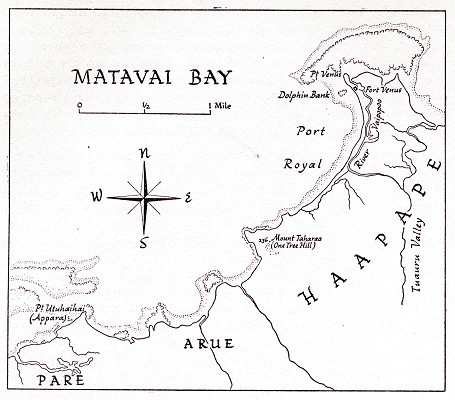 |

Bligh,
William: A Voyage to the South Sea
Fascimile of the
1792 edition.
Hutchinson group
(Australia) Pty Ltd
30-32 Cremorne Street
Richmond Victoria, 3121. 1979
First fascimile
reprint by the Libraries Board of South Australia, edition no. 121, Adelaide,1969,
from a copy held
by the State Library of South Australia.
Originally published
by George Nicol, London, 1792.
Map between pages
104 and 105, cropped and adjustred.
THE OFFICIAL
LOG OF H.M.S. 'BOUNTY'
COMMANDED
BY LT. WILLIAM BLIGH
Bligh's Explanatory
Notes, page 3.
"To Exemplify
my Log of the proceedings of the Ship it is to be Observed, That by Cloudy
Weather is to be understood the Sun is not to be seen or but very seldom.
Fair Weather
or Open Cloudy Weather is when the Sun can be frequently seen, but the
Sky not free of Clouds.
Fine Weather
is when the Sky is generally Clear and pleasant, but few Clouds and not
Windy.
Hazey may
be applied to either One or the other, and then it is to be understood
the boundary of Sight is not so extensive as at other times.
All other
expressions respecting the Weather will be generally understood without
error." (page 3)
The temperatures
are in degrees Fahrenheit.
Compass Rose
 |
The Compass
Rose.
Note: In the log, the word 'by' is written 'B'. Image left:
|
| Date |
|
|
|
| Tu 28
Oct 1788 |
E and ENE | 77 to
82 |
Fresh Breezes and fair Weather with Showers of Rain in the Middle part. |
| W 29
Oct 1788 |
E and ENE | 79 to
81.5 |
Fair Weather and a pleasant Trade Wind with some light showers of Rain and Lightning in the Middle part. |
| Th 30
Oct 1788 |
E and ENE | 79 to
81 |
Fresh Breezes with Rain and Lightning in the Middle part and fresh Gales with heavy Rain towards Noon. |
| Tu 04
Nov |
NE to EBS | 78 to
81.5 |
Fresh Breezes and Squally with Rain. |
| Th 06
Nov 1788 |
E and EBN
Then via S to W. |
79 to
82 |
Moderate Breezes
& Cloudy Wr. with much Rain.
Much Swell setting into the Bay. Swell #1 |
| Su 09
Nov 1788 |
EBN and
ESE |
81 to
81.5 |
Moderate Breezes and fair Wr. with less Swell than Yesterday, but still much surf on the shore |
| Th 13
Nov |
NA | NA | Having exposed myself much to the heat of the Sun and a dry scorching Wind |
| F 21
Nov 1788 |
ENE to ESE | 80 to
83.5 |
The first part of this day Light Breezes and cloudy with heavy Showers of Rain, the Middle and latter more moderate and but few Showers. |
| M 24
Nov 1788 |
EBN and
EBS |
83 to
85 |
Moderate and
fair Wr.
A very great swell has set into the Bay, from which I have been expecting the Wind from the Westward, but I now find it is owing to a N.N.E. Wind that has been blowing at Sea. Swell #2 |
| F 28
Nov 1788 |
NA | NA | The heavy
surf which has run on the shore for a few days past ...
Bligh's surfriding report, 3.10 above. |
| Sa 29
Nov 1788 |
E and SEBE | 78 to
81 |
Strong Breezes and fair Wr. with some light showers of Rain. |
| M 01
Dec 1788 |
ESE | 78 to
81 |
Very Strong Breezes
at E.S.E. with some showers of Rain.
The Air is now become more free and pleasant than it has been since I have been here. |
| T 02
Dec 1788 |
ESE | 77.5 to
79 |
Very Strong Breezes and cloudy Wr. with a few showers of Rain. |
| Th 04
Dec 1788 |
ESE | 78 to
80 |
Fresh Gales and
Cloudy Wr. with some light showers of Rain.
Much swell into the Bay. Swell #3 |
| F 05
Dec 1788 |
EBS, variable
to NW and later ESE and S |
77.5 to
79 |
Fresh Gales and
dark cloudy Wr. with much Rain in the Middle part and some Calms.
Much swell setting in and the Sea at times breaking on the Dolphin Bank. The Ship rolling very much and a heavy Surf on all parts of the Shore. Tynah and his wife came and dined with me altho the Sea very rough. |
| Sa 06
Dec 1788 |
ESE to NW. | 78 to
81 |
I experienced
a scene of to day of Wind and Weather which I never supposed could have
been met with in this place.
By Sun set a very high breaking Sea ran across the Dolphin Bank, and before seven O'Clock (am) it made such way into the Bay that we rode with much difficulty and hazard. |
| W 10
Dec 1788 |
NA | 81 to
82 |
Wind and Weather
as Yesterday
In the Morning very little Swell in the Bay. |
| Th 11
Dec 1788 |
Variable | 78 to
82 |
Light Variable Winds round the Compass and fair Wr. |
| Sa 13
Dec 1788 |
ESE | 78 to
81 |
Fresh Breezes and fair Wr. with some Rain. |
| Su 14
Dec 1788 |
SE and ESE | 78 to
80.25 |
Fresh Breezes at S.E. and E.S.E. with Squalls and Rain. |
| Th 18
Dec |
EBN, SE, ESE and Variable. | 77 to
81 |
Fresh Breezes and Cloudy with much Rain towards Noon fair Wr. |
| F 19
Dec 1788 |
ESE to ENE | 79 to
82 |
Moderate and
fair Wr. with some Squalls of Rain.
Towards Morning a long Swell began to set into the Bay and by Noon broke across the Dolphin Bank altho the Wind fresh off the Shore, Swell #4 |
| Sa 20
Dec 1788 |
EBN | 77 to
80 |
Fresh Gales and
dark Cloudy Wr. with heavy Squalls of Rain Thunder and Lightning.
A very heavy Swell in the Bay and a great sea on the Dolphin Bank & much Surf on the shore, Ship rolling very deep. Morrison's surfriding report, 3.9 above. |
| Tu 23
Dec 1788 |
E, ENE and NE | 77 to
78.5 |
Fresh Breezes and dark gloomy Wr. with continual Rain and much Thunder and Lightning. |
| W 24
Dec 1788 |
E and ENE | 77 to
79.5 |
Fresh breezes at E. and E.N.E. and dark cloudy Wr. with much Rain and some intervals dry. |
| Anchorage relocated to Toaroah Harbour, Oparre. | |||
| Th 25
Dec 1788 |
ENE | 77 to
80 |
MODERATE WINDS AT DARK CLOUDY Wr. in the Afternoon with some Rain but fair in the Morning. |
| F 26
Dec 1788 |
EBS and ENE | 82 to
83 |
First and Middle parts Modte breezes and Squalls of Rain, the latter a fresh Trade and fair Wr. |
| Sa 27
Dec 1788 |
E.N.E. and W | 79 to
82 |
Strong breezes and fair Wr with light Winds and calms in the Night & Morning. |
| Su 28
Dec 1788 |
Variable | 80 to
81 |
Fair Wr with Fresh Breezes in the day with some showers of Rain and light Variable Winds at Night. |
| M 29
Dec 1788 |
ENE | 79.5 to
82 |
Fair Wr with a few showers and fresh Breezes in the day with light Airs and Calms in the Night. |
| W 31
Dec 1788 |
ENE | 81 to
83 |
Fresh breezes and fair Wr the first and latter part, the middle Calm and Lightning. |
| Th 01
Jan 1789 |
ENE, Variable
to North |
80 to
82 |
First part fresh Breezes and Cloudy, Middle Calm and the latter moderate with very heavy Rain. |
| F 02
Jan 1789 |
NE, ESE, ENE | 79 to
82 |
Squally with Rain first and middle part and Light Winds from the Land. Latter part fair Wr. |
| M 05
Jan 1789 |
ENE | 79 to
81.5 |
Very Squally with much rain and some Calms in the Middle part. |
| Tu 06
Jan 1789 |
ENE and
sometimes W |
79 to
81 |
Very Squally Wr and Rain with Thunder and Lightning. |
| W 07
Jan 1789 |
ENE and EBS | 79 to
82 |
Very Squally
Weather with Rain.
Thunder and Lightning. |
| Th 08
Jan 1789 |
ENE | NA | Variable weather
with some Rain Thunder and Lightning and blowing hard at times.
Much sea settling into Matavai Bay. Swell #5 |
| F 09
Jan 1789 |
ENE | 80 to
84 |
Fair Wr with Strong Winds at Sea, and some Calms in the Night and a few light showers of Rain. |
| Sa10
Jan 1789 |
ENE and ESE | 79 to
82 |
Strong Breezes
and fair Wr but the Sky much Streaked and threatens more dirt.
In the Night, Calm. |
| W 14
Jan 1789 |
ENE | 79 to
82. |
Fresh breezes
and Fair Wr.
Calms in the Middle part and some small Rain with Thunder and Lightning. |
| Th 15
Jan 1789 |
ENE | 80 to
84 |
Strong Trade and fair Wr with Calms in the middle part with Lightning and som slight showers of Rain. |
| F 16
Jan1789 |
ENE | 80 to
83.5. |
Fair Wr and Fresh Breezes at with Calm in the Middle part. |
| Sa 17
Jan 1789 |
ENE | 79 to
83.5 |
Fresh Trade at E.N .E. with Calm in the Middle part and some showers of Rain. |
| M 19
Jan 1789 |
W and ENE | 81 to
83.75 |
Strong Breezes
and fair Wr with some Rain.
Thunder and Lightning and Calm in the Middle part. |
| Th 22
Jan 1789 |
Variable | 79 to
81.5. |
Variable Weather
with Calms, Rain and Thunder and Lightning.
Wind all round the Compass. A very heavy Sea breaking allover Matavai Bay and as much on the Reefs here. Swell #6 |
| F 23
Jan 1789 |
East, ESE | 77 to
80.5 |
Fresh Gales and
Squally weather with much Rain, Thunder and Lightning.
A very heavy Sea set in on all the Reefs. |
| Sa 24
Jan 1789 |
NE, E and W | 79 to
83 |
Variable and
bad Weather with Rain.
Calms and Thunder & Lightning. Fair towards Noon. |
| Tu 27
Jan 1789 |
Variable | 77 to
81 |
Variable Weather
with Calms and a great deal of Rain. Wind all round the Compass.
The Sea at Matavai still keeps up |
| W 28
Jan 1789 |
ENE and ESE | 78 to
82 |
Fresh Gales and
hard Squalls with heavy Rain.
Thunder & Lightning. Wind Towards Noon Cloudy Wr. Much Sea in Matavai. |
| Sa 31
Jan 1789 |
NE and ESE | 80 to
83.5. |
Fair Wr with some light showers of Rain and Lightning. Calms in Middle part. |
| W 04
Feb 1789 |
NA | NA | Fresh Breezes
and Cloudy Wr with Squalls and Rain at times.
Calm and Thunder and Lightning. |
| F 06
Feb 1789 |
E.N.E. and
between the N. and West |
76 to
77. |
Untill Midnight
Moderate Breezes and dark Cloudy Wr with Rain at times.
The remaining part of the 24 Hours fresh Gales with a continual heavy Rain and a Cold Air. |
| Su 08
Feb 1789 |
W, NE,
W and ENE |
77 to
80.75 |
Moderate Wr with Rains, with fresh Breezes and Squally in the latter part. |
| M16
Feb 1789 |
ENE, Westerly,
E and ENE |
77 to
80 |
Very Squally Wr with heavy Rain at times untill the Morning, then Cloudy. |
| Tu 17
Feb 1789 |
ENE | 80 to
82 |
Very Squally and Strong Winds at times, some Rain, Light Winds with Intervals of fair Wr. |
| Th 26
Feb 1789 |
NEBE, SE, NBE | 81 to
83 |
Fair Wr the first and Middle parts with some light showers, the latter dark Cloudy Wr and some Rain. |
| M 02
Mar 1789 |
NW, WNW,
WBS |
78 to
80.5 |
Fresh Gales and
Squally Weather with constant heavy Rain.
The Wind blowing Strong from the N. W. (At) Taowne Harbour ... a great Sea broke all over it ... a Great surf run on the Shore. Matavai is equally bad. Swell #7 |
| Sa 07
Mar1789 |
W and round the Compass | 80 to
82 |
Light Variable
Winds and much Rain.
Wind Westerly and round the Compass. |
| Su 08
Mar 1789 |
W | 81 to
82 |
Moderate Breezes
and Cloudy Wr, much Rain and at times Calm.
A High Sea running over the Dolphin Bank into Matavai Bay. The changes of the Air is very sudden sometimes it is exceedingly Sultry and Hot, and then in turn frequently Chilly, |
| W 18
Mar 1789 |
NW'ly | 79.5 to
84 |
Light Winds with Calms and fair Wr. |
| Th 19
Mar 1789 |
NEBE, EBS
and ENE |
80 to
83.75 |
Light Winds and Calms, latter part Cloudy Wr. |
| W 25
Mar 1789 |
NE and
Westerly |
80 and 83.5 | Fair Wr with Light Winds and Calms in the middle part. |
| Th 26
Mar 1789 |
NE and ENE in the
Night.
Westerly Airs. |
NA | The Afternoon and Morning of this Day fresh Gales and Cloudy with fair Intervals, the night fair Wr and Calms with some flaws of Wind. |
| F 27
Mar 1789 |
NE and ENE | 80 to
84 |
Fresh Gale and
Squally with some Rain the first and latter part, the middle less Wind,
some Rain Thunder and Lightning.
New Moon to day. |
| Sa 28
Mar 1789 |
N, NE and ENE | 81 to
83.5 |
Strong Breezes, moderating in the Night with Showers of Rain, Thunder and Lightning. |
| Su 29
Mar 1789 |
N Ely | 80 to
83 |
Strong Breezes moderating in the Night with Showers of Rain, Thunder and Lightning. |
| M 30
Mar 1789 |
ENE | 80 to
83.5 |
Fresh Breezes and Squally Wr with some Showers of Rain. |
| W 01
Apr 1789 |
NA | NA | The first and middle part Fresh Gales and Squally, moderating at intervals and some Showers of Rain, the middle part Light Winds and showers. |
| Sa 04
Apr 1789 |
EBN | 81.5
to 83 |
Fresh Breezes and Cloudy Wr the first and latter part, the middle Light airs and Calms. |
| home | catalogue | history | references | appendix |
Finney, Ben R: "Surfboarding
in Oceania: Its Pre-European Distribution."
Weiner Volkeerkundliche
Mitteilungen (Viennese Ethnological Bulletin)
Vienna, Austria
1959 (SB) pp. 2:23-36.
"The summer after
I received my M.A. I was studying German in Vienna, in preparation for
my PhD studies which required that I be able to read at least two other
scientific lan- guages besides English. Anyway the editors of the "Viennese
Ethnological Bulletin" asked me for an article from my thesis, so I wrote
this one about the distribution of surfing around the entire Pacific, not
just Hawai'i and Polynesia." Ben Finney (4/7/03)
Finney, Ben R: "Surfing
in Ancient Hawaii."
Journal of the
Polynesian Society
vol 68 no.4, Dec.
1959 (SB)pp. 327-347.
"I wrote this
analysis of ancient Hawaiian surfing for the Journal of the Polynesian
Societ}-; a New Zealand publication that is one of the oldest anthropology
journals in the world still being published." Ben Finney (4/7/03)
Finney, Ben R: "The
Surfing Community: Contrasting Values Between the Local and California
Surfers in Hawaii"
Social Process
in Hawaii, vol. 23 1959. (SB) p. 73.
"As a "Coast
Haole" from Windansea and Steamer Lane I noted the cultural dif- ferences
between California and Hawaiian surfers." Ben Finney (4/7/03)