 |
surfresearch.com.au
the catalogue
#221
|
| home | catalogue | history | references | appendix |
|
surfresearch.com.au
the catalogue
#221
|
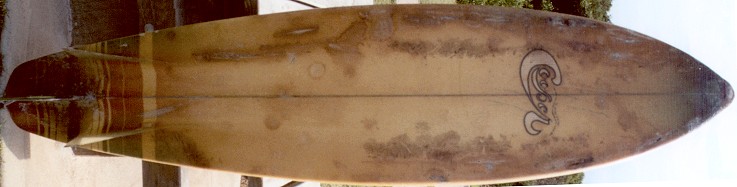
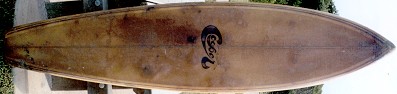
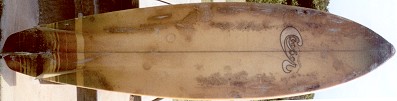
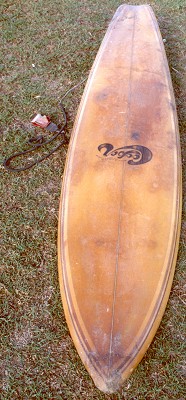
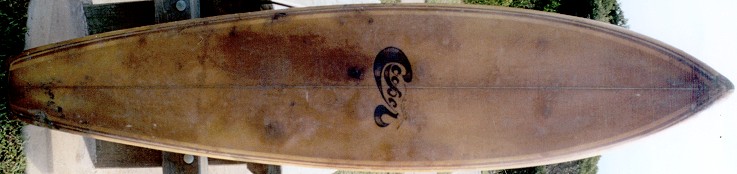
| 1974 Cooper Surfboards Bonzer 6 ft 11 1/2" | #221 |
|
Length
:
|
6
|
ft |
11 1/2
|
inches | L2d | 6ft 10 1/2'' |
|
Width
:
|
19 1/2
|
inches |
Wide
Point :
|
+7
|
inches | |
|
Nose :
|
13 1/2
|
inches |
Tail :
|
12 1/2
|
inches | |
|
Thickness
:
|
3 1/2
|
inches |
Pod :
|
6 1/2
|
inches | |
|
Nose
Lift :
|
inches |
Tail
Lift :
|
inches | |||
|
Weight
:
|
kilos |
Volume
:
|
litres | |||
|
Diamond :
|
+1
|
inches |
| FINS:
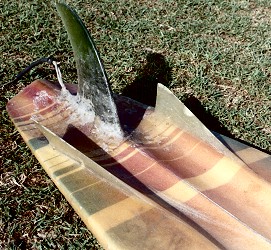
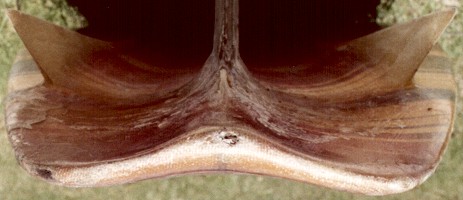
Centre fin : 7 inch x 6'' base @ 6'' Plastic molded wide base. Bonzer
/ Keel fins : 2 1/2" x 8 1/2'' base @ 10''
Resin
legrope attachment behind the fin. |
 |
| DECOR
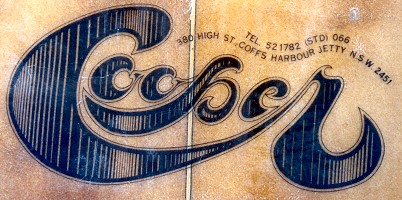
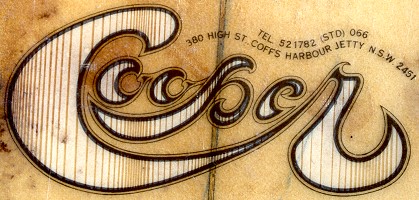
DECALS: Deck: Cooper and address, black script @ s/spot. Bottom: Cooper and address, white and black script @ s/spot. MARKINGS: Deck: None Bottom: |
 |
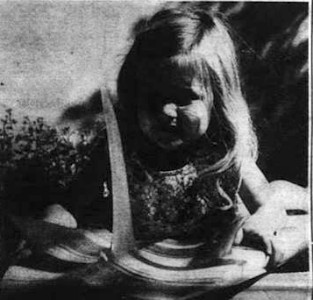
| The
Advocate Coffs Harbor, Wednesday, 5 September 1973, page 1. New
Board Much Faster
Three year old
Caitlin Cooper doesn't know much about riding
surfboards,
but you can bet your life she won't be too much older before she does. Caitlin is lying on one of the revolutionary boards being built by her father. |
 |
Steve further noted in April 2006:
1. I
don't know about the green spray - But I didn't put it
there, so I am not sure if it original
2. The
centre fin is original ( I did a crap job of fibreglassing
it back in after I lost it hitting rocks at
Phillip
Island)
3. The
leg rope attachment behind the fin was original to my
knowledge, and was there when I got the board.
COMMENTS
The board was
possibly shaped by Bob Cooper or Billy Tolhurst.
The spray and
glassing probably by Bob Cooper.
The banded
spray design on the bottom has some similarity to the
illustrated Mike Eaton model, below.
The board has
been extensively repaired (poorly) and at some point the
resin/glass leg rope attachment behind fin was added.
| MANUFACTURER/SHAPER
HISTORY Bob Cooper had an indelible influence on Australian surfing and surfboards. He started surfing at Malibu in 1952 and saw the sport before the onslaut of commercialism that followed the Gidget Revolution, circa 1962. He worked for Velzey, Yater and Morey-Pope Surfboards, where he designed the Blue Machine (circa 1967-1968) that featured an assymetric fin. In 1959 he made his first visit to Australia, followed by an extended stay 1964 - 1966 and permanent residence from 1969. In this period he worked for or with Barry Bennett, Gordon Woods, Joe Larkin and Midget FarrellySurfboards, importing invaluable construction techniques from his U.S. experience. Circa 1970, Bob Cooper started Cooper Surfboards at Coffs Harbour, NSW. Other shapers at the factory included Billy Tolhurst, Ronnie Goddard, and Richie West (USA). Cooper Surfboards was the first Australian manufacturer to promote indigenous Koori surers, circa 1971. The company was sold to Ritchie West, circa 1980 and in 1993 Bob Cooper moved to the Sunshine Coast, Queensland. |
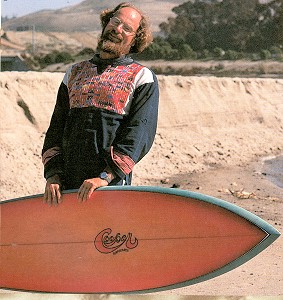
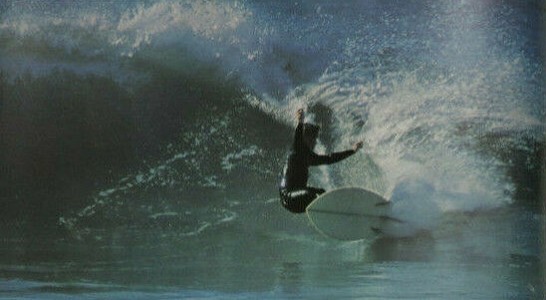
Photograph by Warren Bolster Australian Surfers Journal Volume 3 Number Two, Autumn 2000. Page 74. |
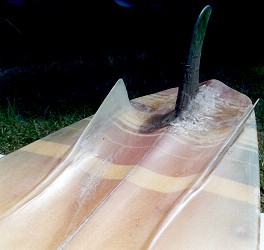
DESIGN
HISTORY
Original design
first shaped in December 1970 by Duncan and Malcom
Campbell (USA) characterized by forward concave leading
to double concave each side of the centre fin with two keel-
type fins set on the rails
(radically
toed-in and cambered).
See
http://www.bonzer5.com
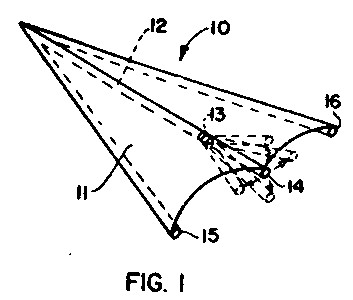
The bottom
design has similarities with the shape of Rogallo hang
gliders, first designed in the late 1940's as a method of
recovering returning space capsules by NASA.
F. M. Rogallo
predicted in 1949 that "Portable delta wings will give
bith to a popular sport"
- quoted
in Desfayes (1974)
page 41.
By the early
1970's, hang-gliding was a sport in rapid transition with a
large amount of media exposure.
As a sign of
the powerful influence of Australia in world surfing at this
time, the name Bonzer (also Bonzar,
Bonza)
is an Australian expression for “excellent”.
In late 1973,
the Campbell Brothers lisenced the design to Bing
Surfboards for commercial development.
The design then
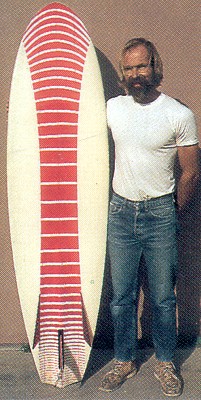
became associated with Bing's head shaper, Mike Eaton, who had
played a significant role
in the
development of the Twin fin 1 in 1970. See image and notes,
below.
The Bing models
were noted for the wedged Bonzer decal that was laminated on
the side fins.
Australian
exponents of the design included ...
Peter Townend
(Gordon and Smith Surfboards). See image below.
Ian Cairns
(Gordon and Smith Surfboards), rode a Bonzer to
first place, 1973 Smirnoff Contest, Laniäkea ,
Hawaii and
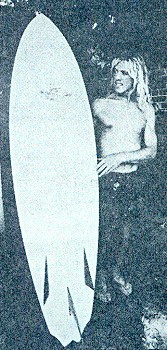
Terry Richardson (Skipp Surfboards). See image below.
It was a (admittedly complex) combination of previous design experiments - multiple fins were first used by Tom Blake circa 1940, tail concave by Bob Simmons in 1950, tri-fins by Brewer in 1970, keel fins go back to Blake and were re-introduced on short boards in 1972.
While some commentators have seen the Bonzer as a direct precedent for Simon's Thruster, its influence was probably substantially less significant than Brewer's Tri-fin experiments (that critically noted that placing the rail fins behind the centre fin made it "track", when positioned in front the board was "looser"), MR's Twin fin, McCoy's wide tailed No-Nose design, and of course the direct influence of Frank William's Twin-fin with a small centre trailing fin.
See: Cambell
Bros. Surfboards: History (July 2011)
http://bonzer5.com/history/timeline/1970-birth-of-the-bonzer/
|
Seen here with his 70's brain child 'the bonzer'." Photograph : Drew Kampion Nat : History (1983), page 108. Following legal representation by the Campbell Brothers, this caption was changed in the second edition (1994) to read... "Mike Eaton of California; responsible for reviving the twin fin. Seen here with The Bonzer. Designed by Malcolm and Duncan Campbell of Oxnard, California." |
 |
MAGAZINES
Articles
1. Jim
Neece : The Bonzer
Surfer
magazine Vol 14 # 3 September 1973 page 64
See image
below.
2. Steve
Core: The Bonza
Surfing World
Volume18 Number 2. November 1973
3. Mick
Mock : Richo's Choice
Deep
magazine , No 18 Spring 2000, pages 22 to33
4. John
Wythe White :Surf Wars :The Bonzar, June
16, 1999
http://www.honoluluweekly.com/archives/coverstory%201999/6-16-99%20Boards/6-16-99%20Boards.html
5. Steve
Barilotti
: Belief System : The Bonzer Saga
The Surfers
Journal 2004? Volume 13 No. 2 pages?
 |
 |
Articles by
Bob Cooper
1970 Bob Cooper
: Magic
Subjectivity of
surfboard design, with particular reference to Phil Edwards' Baby.
Surfing
WorldMagazine Volume 14 Number 4, circa August 1970.
Pages 14 to 17.
1980 Bob Cooper :
Colour
A brief
history, design options and comments on the psychological
impact of surfboard decor.
Surfing
WorldMagazine Volume 29 Number 2, circa March 1980?.
Pages 28 to 49.
Advertising
:
BOOKS
Warshaw,
(2005) Bonzer : page 73. Bob Cooper : Page 136.
CONDITION: 4.7
 |
 |
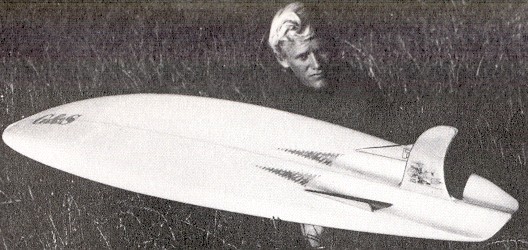 Peter Townend and G&S Bonzer, circa 1974. Nat : Fundamentals (1985) Page 102. |
Terry Richardson and Bonzer:
Skipp Surfboards, circa 1975. Photograph : Steven Coo Tracks, January 1976, page 25. |
 |
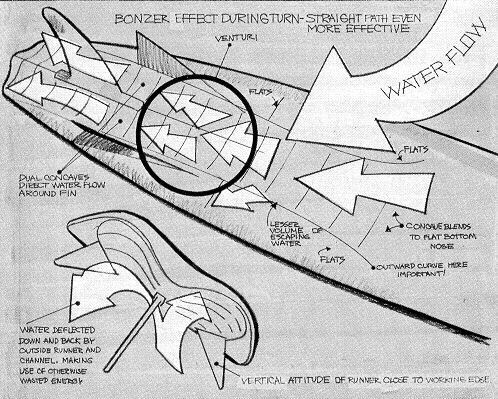 |
Plans
for F. M. Rogallo's Delta Wing Kite,
circa 1969. April 21, 1970 Patent Number 3,507,464 Filed March 18, 1969. Desfayes,
Jean-Bernard : Jim Neece :"The Bonzer"
Surfer Vol 14 # 3 September 1973 page 64. |
 |
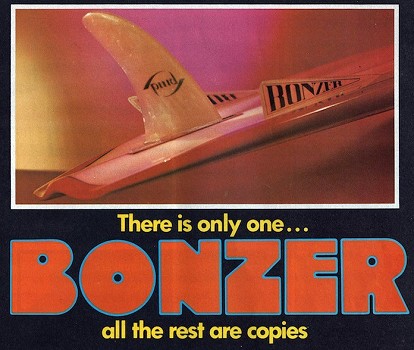 |
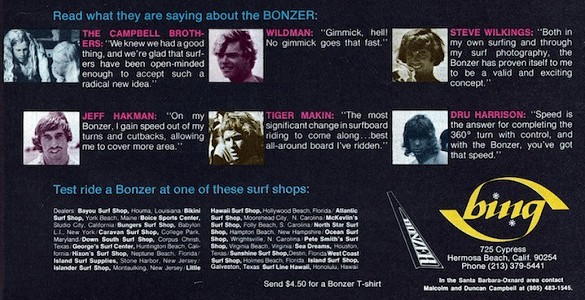 Bing Surfboards :Only One Bonzer, 1973. Featuring the Campbell Brothers, Wildman (Jim Neece), Steve Wilkings, Jeff Kahman, Tiger Makin and Dru Harison. |
 |
Surfing Comedy Album 1974. page 25. |
| home | catalogue | history | references | appendix |