 |
surfresearch.com.au
surfer : tommy walker |
| home | catalogue | history | references | appendix |
|
| In one of a series
of articles in The Referee preceding the 1939 Pacific Games in Honolulu,
Harry Hay wrote:
"What great strides this sport has made in Australia! A few years ago it was hardly known in this country. The Hawaiians introduced us to this exhilarating, thrilling pastime, and to these romantic tropical islanders is due our warmest thanks." - The Referee, 9 February 1939, page 15. In response, Manly
surfer, Tommy Walker wrote a letter to Hay that was published under the
heading
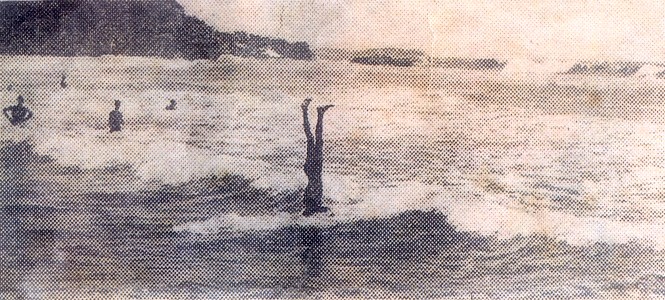
In a letter to Harry M. Hay, Australia's foremost swimmimg and surf coach.- Tommy Walker, one-time surfboard champion at Manly (N.S.W.), writes: "I saw an article
by you in 'The Referee' re surfboards, so enclose a photo of myself
and surfboard taken in 1909 at Manly (Image right).
|
 |
| Note that the claim
to be the first surfboard in Australia can only be attributed to the paper's
sub-editor, and not Tommy Walker.
This may, or may not, be the Hawaiian surfboard often claimed to be imported by Manly identity, C. D. Paterson, sometime between 1908 to 1912. Walker's clain to
winning a surfboard shooting contest no doubt refers to the boardriding
performance of a Mr. Walker at the second Freshwater Life Saving
Carnival as reported by The Daily Telegraph, 27 January
1912, page 21.
Image right:
|
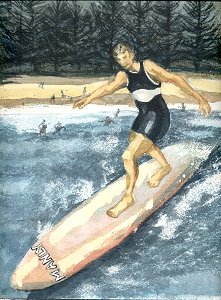 |
Tommy Walker was
a seaman and worked extensively on the SS Kyogle which travelled
between Yamba and Sydney regularly.
He would spend the
winter months in Yamba and in summer head back to Manly.
- Debra Novak: Is Yamba The Birthplace of Australian Surfing Photography?
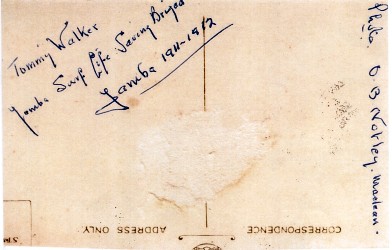
O.B. Notley was a
professional photographer based at Maclean and served as a surf instructor
and treasurer at the Yamba Club where he took a number of photographs of
Walker surfing.
These were printed
as postcards.
|
Tommy Walker, Yamba Beach circa 1911. Photograph by O.B. Notley. Image courtesy of Ray Moran, Manly Life Saving Club Australian Surfing Museum. |
 |
|
Annotation in handwriting reads: Tommy Walker Yamba Surf Life Saving Brigade Yamba 1911-1912 Photo O.B. Notley. Maclean. O.B. Notely was a
life member and
Image courtesy of
Ray Moran,
|
 |
|
Yamba Beach circa 1912. Photo O.B. Notley. Maclean. Image courtesy of
Ray Moran,
|
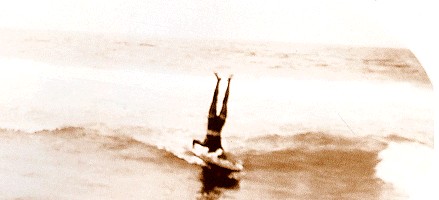 |
He noted:
In your recording
the sad death of Mr. John Ralston (December 10) you referred to the first
surfboard
brought to
Australia in the 20's.
This is not
quite accurate.
I enclose
a photo of Tomy Walker in his favorite attitude on a 14ft. surf board at
Yamba in the 1912-1913, season.
D. B. NOTLEY,
Copacabana.
(sic, the initials
D.B.
were incorrectly transposed by the newspaper journalist).
Newspaper clipping
courtesy of Ray Moran, Manly Life Saving Club Australian Surfing Museum.
Note: The photograph
was printed Harvey: Queensland
Surfing (1983) page 8, captioned:
"Clarrie Englet
headstand , Queensland 1920's"
Walker incorrectly
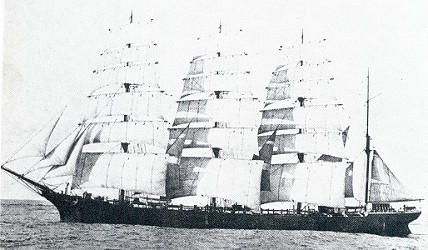
transcribed the spelling of the sailing vessel on which he visited Hawaii.
It was the Poltalloch,
a four masted barque, rigged with royal sails above double top and topgallant
sails.
She was launched
in February 1893 at the shipyard of Workman, Clark & Co., Belfast,
for Potter Bros of London under the command of Captain J. Connel.
In 1901 the Poltalloch
was stranded at the entrance to Willada, Shoalwater Harbor, Washington.
Sold to Eschen &
Minor, Victoria, British Colombia in 1909, she continued to ply her trade
in transporting cargo in the Pacific..
On January 2, 1916,
she was wrecked at St Patrick's Causeway, near Harlech, Wales, during towage
from Queenstown to Leith.
- http://www.bruzelius.info/Nautica/Ships/Fourmast_ships/Catalogue.html
On my request, Lillian Simpson, Public Enquiries Librarian, Australian National Maritime Museum, searched the resources of the Museum's library and located two arrivals in Sydney only for this vessel:
13 June 1910
from Portland, Oregon (28 March 1910) with a cargo of timber.
16 April 1912
from Victoria, British Colombia (1 February 1912) with a cargo of timber.
-Many thanks to Lillian Simpson and the Australian National Maritime Museum.
A search of the shipping
records at the State Records Authority of New South Wales for these arrivals
do not record any of the crew or a passenger as Walker.
While these arrivals
to not fit with Walker's recollections, there is a distinct possibility
that Walker boarded and disembarked from the vessel at another port or
ports.
Evening Bulletin.
Honolulu, November
19, 1910, page 6
Credited with
the fastest passage of the year from Australia, the British ship Poltalloch,
Captain Armstrong, arrived at San Francisco on October 26, fifty-eight
days from Newcastle.
The Pollalloch
sailed from Newcastle August 29 and had fine weather to the equator, which
was crossed twenty six days out in longitude 107 west.
To lattitude
25. north, variable winds were encountered and to 40, north strong southeast
to south west gales.
The square rigger
wss off port three days in a dense fog.
lUUbll.hed I7SO
Chronicling America
Evening bulletin.
(Honolulu [Oahu, Hawaii) 1895-1912, November 19, 1910, 3:30 EDITION, Image
6
Image and text provided
by University of Hawaii at Manoa; Honolulu, HI
Persistent link:
http://chroniclingamerica.loc.gov/lccn/sn82016413/1910-11-19/ed-1/seq-6/
- Gibbs, Jim: Pacific Square Riggers
- Pictorial History of the Great Windships of Yesterday.
Schiffer Publishing Ltd. 1469 Morstein
Road, West Chester, Pennsylvania, 1980, 1987, page 36.
Although his article
is essentially a tourist promotion for Australian ski resorts, in comparing
the sport with surfboard riding, Hunter provides significant information
on Australian surfing.
Notably "we
now have a board or two at Manly beach" (page 12).
It is highly probable
that these boards were those ridden by Tommy Walker and his relatives at
Manly, circa 1909.
The current Director
N.S.W. Govenment Tourist Bureau and an enthusiastic skier, he indicates
a knowledge surfboard riding acquired when visiting Hawaiia as a tourist
sometime before 1911.
Clearly he was not
the only Australian visitor to be exposed to the thrills of Hawaiian surfboard
riding.
Riding is in the
standing position for both sports:
"as the surfrider
balances on a single board or runner, while coming down the side of Kosciusko
we balance on a pair of runners or skis"(page 11).
In a comparision with snow skis, the article implies the surfboard dimensions are substantial, " 7 feet 6 inches to 9 feet in length" and "five times ... 3 1/2 to 4 1/2 inches wide" (approximately 20 inches, page 11)
The report is one of the few independent sources not directly from the surf life saving movement.
Hunter, Percy:
July
Skiing in Australia
Mid Pacific Magazine,
January 1911, pages 11-15.
This article kindly
provided by Craig Baird (Surfworld, Torquay) in August 2009, who
noted it "came to me via Dr. Garry Osmond (University of Queensland)
after
I had forwarded a Surfers Journal Article about Alexander Hume Ford (that)
mentioned Percy Hunter's articles."
Confirming Tommy Walker's recollections and his surfing prowess, in a report of the Freshwater club’s second annual carnival on the 26th January 1912, the Telegraph noted:
"A clever exhibition
of surf board shooting was given by Mr. Walker, of the Manly Seagulls Surf
Club.
With his Hawaiian
surf board he drew much applause for his clever feats, coming in on the
breaker standing balanced on his feet or his head."
- Telegraph, 27th January 1912, page 21.
The Seagulls Club was one of several at Manly Beach at the time and the membership was later incorporated into the Manly Life Saving Club.
No doubt Walker had
a significant impact on the Northern beaches and a number of other surfers
took to board riding.
In the summer of
1912-1913, reporting on the potential danger to surf swimmers, the Sydney
Morning Herald noted there were:
"... no fewer than ten surfboards in the thick of bathers."
- Sydney Morning Herald, 24 January 1913, page 7.
The enthusiasm for
board riding was given huge boost with the tour of the Hawaiian Olympic
swimmer, Duke Kahanamoku, to
Australia in the summer of 1914-1915.
At one of his surfing
demonstrations at South Steyne Beach, the press reported:
The breakers
were favorable for the pastime, and the Honolulu champion made some magnificent
returns to
the shore standing on his big surfboard.
He was however,
greatly impeded on this occasion by local surfers, who wished to give exhibitions
of their own
at the same time.
- The Sun, 11th January 1915, page 6.
Tommy Walker was
a member of the Walker family who had an indelible impact on Australian
surfriding.
Following Duke Kahanamoku's
Australian tour in the summer of 1914-1915, his Freshwater board was handed
over to George and Monty Walker of Manly who, “because of the fine work
Claude West had done in popularising surfboard riding, eventually gave
it to Claude West, and he still has it, a prized possession.”
- Curlewis, Adrian:
Notes
on surfboard riding prepared by S.L.S.A., circa 1948, page 3.
Papers pertaining
to C. Bede Maxwell’s Surf: Australians Against the Sea, 1949.
Mitchell Library,
Sydney, ML MSS 196.
During the 1920's Russell Henry 'Busty' Walker used a canoe to act as a judge at the buoys at Manly Surf Carnivals, one of the precedents to the adoption of the Harry Mclaren's surfski by Sydney surfers in the early 1930s.
-Maxwell: Surf (1949) page 237.
Circa 1925 Sydney
rider Anslie 'Sprint' Walker, a relative of Tommy Walker, was transfered
by his employer to Melbourne where he surfed his board at Portsea, and
later at Torquay.
Transport problems
were overcome by leaving the board at the beach, buried in the sand.
The board was eventually
donated to the Torquay Surf Live Saving Club, but was destroyed when the
club house burnt down in 1970.
Subequently 'Sprint'
Walker built a replica from Canadian redwood with an adze - the original
method.
- Wells:
Sunny
Memories(1982) page 153.
Also see Snow
McAlister : Sprint
Walker, Solid Wood Boards and Victorian Surfing- Tracks
Magazine circa 1972. Reprinted 1973 in The
Best of Tracks, page 191.
At the end of the1930s
the surf ski made its first excursion outside Australian waters.
Reciprocating the
gift of the board left with them by Duke Kahanamoku in 1915:
“The Walker Brothers sent a surf ski to Duke Kahanamoku at Honolulu and members of the Australian Pacific Games Team which visited Honolulu in 1939 say Duke was often seen paddling around on his ‘ski from Australia’.”
- Curlewis, Adrian:
Notes
on surfboard riding prepared by S.L.S.A., circa 1948 pages 3-4.
| In a letter to
Harry M. Hay, Australia's foremost swimmimg and surf coach.- Tommy Walker,
one-time surfboard champion at Manly (N.S.W.), writes:
"I saw an article
by you in 'The Referee' re surfboards, so enclose a photo of myself
and surfboard taken in 1909 at Manly.
Editor's Notes:
|
|
Walker was a well
known figure at Manly at the time he writes about.
He figured in
a couple of unusual, if not remarkable, incidents.
* * *
Time came when Tommy decided to catch a shark for the purpose of exhibiting it to the public at three-pence a head.
He brought three other lads into the enterprise and between them they raised the necessary capital to buy a hook and line and to hire a tent in which to install the monster of the depth.
But first they
had lo catch their fish.
They selected
Fairy Bower beach as their base and set a watch on the hill overlooking
it.
On the second
day of their vigil, the required shark was sighted.
Like a policeman
on his beat, he came leisurely from the direction of South Steyne.
And he was a
whopper, a tiger, 14ft 2in in length, as was proved later.
He was duly landed
struggling on to the beach and a curious public had paid £12/10/-
to view him when the Council's inspector of nuisances intervened to the
manifest relief of the residents in the vicinity.
But one may ask,
"Where does the hero stuff come in?"
Well, it was
this way.
When the shark
was sited, the watchers on the hill signalled to Tommy (who was waiting
on the beach) and he immediately set out in a small dinghy to drop the
bait at the spot it was anticipated the shark would cross.
The craft capsized.
So Tommy swam
with the bait, a 7lb salmon, and lilerally spilt it into Ihe shark's mouth.
The shark grabbed
it - and the rest was easy.
Someone said,
"I wouldn't have done that for £10,000."
Tommy replied
simply, "There was no danger - when salmon are about, a shark has no time
for anything else,"
Miss Schilling had crossed a deep channel and was resting on a sandbank, and was watching Walker shooting.
He could swim
like a fish.
This was at it
time when large surfboards were unknown in Australian waters.
However, Walker
did not need any adventitious (sic) aids when shooting, at which he was
one of the recognised adepts.
II was impracticable, however, to shoot right into the sand because of the channel, which banked the surf up.
Afler his third
shoot, Walker appeared to be in sore trouble in the channel.
His scream for
help galvanised the dancing star into action.
With powerful
strokes, swimming trudgeon style, she quickly covered the necessary 30
yards to reach the youth who was sinking for the third time.
He appeared to
be in a fit and struggled violently as the gallant lady swam with him to
the shore.
* * *
Just at this moment the professional lifesaver, the late 'Appy Eyre, arrived, and he worked on the unconscious form of Walker, who, when he came to his senses, ejaculated, "Well this is the last time I'll go surfing immediately after a heavy breakfast."
The evening papers
rang with the story, and the performance at the Royal was held up that
night when Miss Schilling appeared on the stage.
Members of the
audience from all parts of the theatre rose and cheered, and cheered, and
cheered again.
And Tommy - what
of him?
Just about that
time, a week beforehand, in fact, Claude Eric Ferguson McKay had been appointed
to the position as Williamson's publicity man.
Walker, if unwittingly, had brought one of Williamson's stars into the limelight - had given her the opportunity of appearing as a heroine in a drama off the stage.
McKay was delighted.
He presented
Walker with a brand new £5 note.
| home | catalogue | history | references | appendix |
Source: State Records Authority of New South Wales: Shipping Master's Office; Passengers Arriving 1855 - 1922; NRS13278, [X94] reel 403. Transcribed by Joyce Pickup, 2004.
1912 Apr 16 POLTALLOCH
BARQUE Page 295 1901_1926
1910 Jun 13 POLTALLOCH
BARQUE Page 291 1901_1926
Source:
Pacific square-riggers
Reference ID:
888810068
Title:
[Images of vessels from 'Pacific square-riggers.']
Author:
Gibbs, Jim
Abstract:
Illustrations of named vessels only indexed. Images are black and white
unless stated otherwise.
Descripton 1:
Biographies
Poltalloch
A four-masted
steel barque built in 1893 by Workman, Clark & Co., Belfast.
Dimensions: 86,66×12,80×7,41
meters [284'4"×42'0"×24'4"] and 2254 GRT and 2139 NRT.
Rigged with royal
sails above double top and topgallant sails.
1893 February
Launched at the shipyard of Workman, Clark & Co., Belfast, for Potter
Bros., London. Captain J. Connel.
1901
Stranded at the entrance to Willada, Shoalwater Harbor, WA.
1909
Sold to Eschen & Minor, Victoria, BC.
1916 January
2
Wrecked at St Patrick's Causeway, near Harlech, Wales, during towage from
Queenstown to Leith.
Collection: 551
Shipwrecks, by name
Title: Poltalloch
Date/circa: November
26, 1900
Photographer:
unknown
Ship Stats: tonnage:
2250 tons; type: bark
Subjects: Poltalloch
(bark); Shipwrecks
ID#: CRMM 551-17380
Notes: The Poltalloch
was en route to Puget Sound to load grain for the United Kingdom when a
heavy fog shrouded the coastline of the Washington shore. She went on the
sands north of the entrance to Shoalwater Bay, opposite North Cove, and
the outgoing tide left her high and dry. The crew dropped the Jacob's ladder
and walked ashore. In 1902, disaster was averted when the crew of the Professor
Koch used the grounded Poltalloch to set course, but was warned they would
run aground by the captain of the steamer Fulton if they did not change
course.
Ship POLTALLOCH
official number 102822 date of voyage 14 July 1900 - 18 January 1902.
Poltalloch Burial Chamber (Dolmen) at map reference NR823976
County: Argyll
Country: Scotland
Nearest village:
Kilmartin
Nearest town:
Lochgilphead
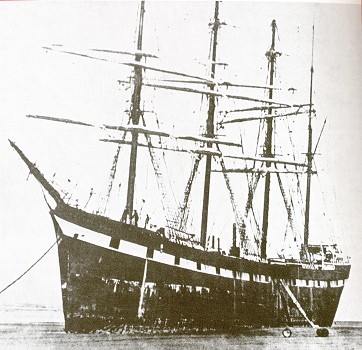 |
"Sea of sand - British bark POLTALLOCH imprisioned on the sands on the outer fringes of Willapa bay entrance yearns for her freedom. She grounded in the fall of 1900 and spent nearly a year and a half on the shoals before being refloated. Her master, Captain Young, stood by her to conduct salvage operations." page 198 |
| home | catalogue | history | references | appendix |
1 John Bach, A Maritime History of Australia, Melbourne, Pan Books, 1982, p. 70
Stuart Lee, Riverboats of the Clarence, Yamba NSW, Port of Yamba Historical Society, 2003
4 Mary Shelley Clark, Ships and Shores and Trading Ports: the social and working life of coastal harbour and river towns in New South Wales, Sydney, Waterways Authority of New South Wales, 2001, p 93.
Trove
1880 'THE CLARENCE
ELECTORAL DISTRICT, 1880.', Clarence and Richmond Examiner and New England
Advertiser (Grafton, NSW : 1859 - 1889), 7 September, p. 4, viewed 4 June,
2012, http://nla.gov.au/nla.news-article62117648
It is probable, however, that you will have to come to Australia to
learn your skiing, as we must go to Hawaii to learn to ride the
surfboard, although we now have a board or two at Manly beach.
LADY LIFE-SAVER.
The customary
procedure in the surf at Manly when a channel is formed is for men to be
continually rescuing ladies from the dangerous water.
This, however,
was reversed about 9.30 o'clock yesterday morning, when Miss Ivy Schilling,
the well-known dancer of "Our Miss Gibbs" Company, saved Mr. Tom Walker,
one of the most skilful surfers who frequent the South Steyne beach.
Walker had been
shooting the breakers for some time, when a wave carried him into deep
water.
He states that
he then was seized with violent cramp in the stomach, and threw up his
hands.
Jack Reynolds,
the Manly life-saver, was basking on the beach, not being on duty; and
he took no notice of Walker going under for the simple reason that he knew
him to be a strong swimmer.
Walker said he
realised this would likely occur, and felt his position to be all the more
desperate on that account.
Just as he was
faced with this ordeal he noticed someone swimming strongly towards him.
He was taken
hold of, and assisted into shallow water.
By this time
"Happy" Eyre, the relieving beach attendant, had dashed in to his assistance.
Both were surprised
to see that Walker's rescuer was a girl.
She had handled
the emergency coolly and expertly, and there was considerable enthusiasm
when she helped the beach attendant drag Walker out of the water.
After working
on the young man for some minutes he recovered.
Walker attributes
his trouble to going into the water too soon after breakfast.
The Sydney
Morning Herald
Monday
1 January 1912, page 12.
SWIMMING
NORTH
STEYNE SURF CARNIVAL,
HEAVY
SEAS.
Swimming Carnival
The swimming carnival,
promoted by Messrs. McGrath Bros. of Grafton, lessees of the Grafton Baths,
was held yesterday at the foot of Duke-st, and attracted, about 700-people.
...
Most Comical
Dive.- M. Walker
...
Musical Life
Buoys.- E. B. Biden 1, C. Walker-; 2. About 20 entered.
This was conducted
along the same principal as musical chairs in a parlour game.
Trove
1912 'Swimming Carnival.',
Clarence and Richmond Examiner (Grafton, NSW : 1889 - 1915), 11 January,
p. 8, viewed 9 June, 2012, http://nla.gov.au/nla.news-article61651241
Also note:
Football.
FIXTURES
FOR TODAY
Centrals v. Railway
Workers, at Grafton Oval, to-day:
...
Centrals will
be represented by: ... C. Walker,
1912 'Football.',
Clarence and Richmond Examiner (Grafton, NSW : 1889 - 1915), 15 June, p.
11, viewed 9 June, 2012, http://nla.gov.au/nla.news-article61659958
And:
Tho following
is
the list of further donations received in aid of St. Mary's now church
up to, and including Friday, 23 rd May:-
...
Mr. C. Walker,
sen. 16 - 6- 6.
1913 'St. MARY'S
CHURCH.', Clarence and Richmond Examiner (Grafton, NSW : 1889 - 1915),
27 May, p. 2, viewed 9 June, 2012, http://nla.gov.au/nla.news-article62063540
And:
Fire at Dorrigo.
Last week at Dorrigo,
a building known as, the Shack, evidently the abode of a number of voung
bachelors, and owned by. H Mr. F. Harrigan, was burned to the ground.
Mr. C. Walker
was the sole occupant of the building when the fire was noticed (about
3 a.m.), by Mr. Spratt. and the sleeper was quickly aroused.
About £70
worth of wearing apparel was lost, also £20 in notes, some silver,
beds, bedding, tables, chairs, crockery, gun, School of Arts secretary's
books; etc.
Besidès
this, Mr. Chas. Walker, local officer in connection, with the forestry
Department, lost valuable forestry books and papers. The building was insured,
but the bachelors are mourning their losses.
1913 'Fire at Dorrigo.',
Clarence and Richmond Examiner (Grafton, NSW : 1889 - 1915), 21 June, p.
4, viewed 9 June, 2012, http://nla.gov.au/nla.news-article62065107
And:
Kyogle, 702 tons;
Capt. Farrell, crossed the bar at 6 a.m. yesterday.
Passengers -
..., C. Walker,
1913 'SHIPPING.',
Clarence and Richmond Examiner (Grafton, NSW : 1889 - 1915), 12 August,
p. 4, viewed 9 June, 2012, http://nla.gov.au/nla.news-article62068026
And:
The monthly meeting
of committee was held at the Club shed last evening, Mr. C. G. Norrls,
(hon. treasurer) presiding.
...
The following
new members were elected : Active, H. C. Makinson, F. J. Barnard and J.
Anderson. Honorary, C. Walker and E. Syer.
1913 'CRICKET.',
Clarence and Richmond Examiner (Grafton, NSW : 1889 - 1915), 2 December,
p. 8, viewed 9 June, 2012, http://nla.gov.au/nla.news-article62073960
And:
... and C. Walker was transferred from the honorary to the active list.
1914 'Grafton Rowing
Club.', Clarence and Richmond Examiner (Grafton, NSW : 1889 - 1915), 6
January, p. 7, viewed 9 June, 2012, http://nla.gov.au/nla.news-article61622650
The
Daily Telegraph
27
January 1912, page 21.
(Freshwater Carnival)
NEW SURFING REGULATIONS.
The Government
has gazetted an ordinance relating to public baths and bathing-places,
but the only new feature is that which governs surf shooting.
Clause 10 reads
as follows: "Where any inspector considers that the practiceof surf shooting
(I.e.. riding on the crest of the breaking wave), whether with or with-out
a surf board, is likely to endanger or inconvenience other bathers, such
inspector may order bathers to refrain from such practice or to remove
to a place where such practice will not cause danger or inconvenience.
Bathers shall
comply with such orders.
Any inspector
may take possession of any surf board used in contravention of his or another
inspector's orders, and retain it until the bather from whom it was taken
resumes his ordinary dress, or until such inspector considers that surf
boards may again be used without endangering or inconveniencing the public"
Clarence
and Richmond Examiner
Grafton,
28 December 1912, page 4.
YAMBA, Friday.
The pleasures of Boxing Day at Yamba were sadly brought to a terrible carlye (?) in the afternoon by the xxx(?) escape of several surfers from drowning, one of whom, after continuous efforts at resuscitation, succumbed.
The first occurrence
happened at a quarter to one, when Mr. George Mitchell, of Harwood, was
carried out on thc outer breaker. For some time he was ably supported by
Mr. Sailor Fitzgibbon, of Grafton, who had gone to his assistance, but
it was noticed from the shore that the rescuer was tiring.
At this time
Messrs. O. B. Notely and C. J. Englert, of Maclean, both members of the
Club, arrived at the scene, and quickly proceeded to assist in the work
of rescue with the line.
Prior to this
Captain Redman, went out after Mitchell without the line, and on arrival
at the spot found him struggling feebly, and succeeded in holding him up
until the beltman arrived, who then, brought him ashore.
The rescued man
was quite conscious, and after being attended to soon recovered the
shock.
Shortly after
dinner William Murphy and J. Banney went into the surf, the former being
abouty 100 yards out, ànd the latter 20 yards.
The current at
this time was running out at the rate of about seven miles per hour.
The crowd on
the beach soon realised that both were in difficulties, and Messrs. Notely
and Englert were soon in the surf to effect a rescue.
Notely jumped
in from the rocks on the southern side, and swam to Banney, and succeeded,
in bringing him to the rocks. Excitement was intense, for at this moment
a wave separated them, but Notely went after him again and, this time was
successful in bringing him to the rocks, where he was assisted by Mr. A.
Graham, of Maclean.
In the meantime
C. J. Englert swam out from the rock's to Murphy, and for fully quarter
of an hour succeeded in holding him.
The line was
quickly run out, and Mr. E. White proceeded out as beltman, with Notely
as first linesman.
When the beltman
was about ten yards from Murphy, who was still being supported by Englert,
the crowd thinking that he had reached him started to pull.
The mistake was
soon noticed, and the line released, and the beltman once more proceeded
to the rescue, but again the line was pulled in too soon by the public.
White again demonstrated
his bravery and once more attempted to reach the men.
This time he
was successful.
By this time
J. Unwin and T. Walker (members) arrived, and took charge of the line,
but being unable to keep thc crowd from the line, the men were drawn towards
the beach for too fast, with the result that both were underwater most
of the time.
Englert was pretty
well exhausted through the suspended struggle of supporting Murphy; and
lost the line.
From the inner
breaker Murphy was carried ashore by Messrs. Unwin, Walker and Notely.
They instantly
endeavoured to restore animation,using the Schaffer method.
Englert, in the
meantime- the hero of the day finding the current too strong to swim directly
to the .rocks, proceeded south with the current with the hopes of reaching
the rocks lower down.
R. Miller, with
the belt of No. 2 reel, which was in readiness on the beach, went to his
assistance by means of a powerful swim, and both were eventually drawn
to the beach.
The members of
the Brigade demonstrated, their knowledge of "life work" in magnificent
fashion.
After work had
been in progress for three-quarters of an hour in the endeavour to restore
Murphy, Dr. Macartney, Grafton, arrived on the scene, and rendered medical
assistance.
Treatment was
kept up for three hours; and after every effort had been utilised the Dr.
pronounced life to be extinct.
The body was
taken-charge-of by the police, and taken to the hotel.
The greatest praise,
is due C. Englert for his splendid work of rescuing White.
He also showed
great pluck in making a third attempt to reach Murphy.
Both bathers,
said Captain Redman, were bathing outside danger signals, which were placed
in position by him early in the morning.
On account of the sad fatality the Brigade postponed their social, which was to have taken place that evening.
Trove
1912 'FATALITY AT
YAMBA.', Clarence and Richmond Examiner (Grafton, NSW : 1889 - 1915), 28
December, p. 4, viewed 9 June, 2012, http://nla.gov.au/nla.news-article61669830
Clarence
and Richmond Examiner
Grafton,
Tuesday 28 January 1913, page 5.
Frequenters of
Manly are up in arms at the action of the local Council in suppressing
surf-board shooting on the ground that it is dangerous to other bathers.
Clarence
and Richmond Examiner
Grafton, NSW
: 1889 - 1915), 22 December 1914 , page 2.
DISTRICT NEWS
The fourth annual
carnival under the auspices of the Yamba Surf Life-saving Brigade is to
be held at Yamba on New Year's Day.
A unique and
interesting programme bas been arranged, which includes championship swimming
events, etc.
An exhibition
of shooting the breakers with the aid of a board is to be given by Mr.
T. Walker, who has had considerable experience on other well-known beaches.
Trove
1914 'DISTRICT NEWS.',
Clarence and Richmond Examiner (Grafton, NSW : 1889 - 1915), 22 December,
p. 2, viewed 9 June, 2012, http://nla.gov.au/nla.news-article61640169
Clarence
and Richmond Examiner
Saturday
26 December 1914, page 16.
(Advertising)
FOURTH
ANNUAL
GRAND
AQUATIC CARNIVAL AT YAMBA, NEW YEAR'S DAY,
YAMBA SURF LIFE
SAVING BRIGADE.
SWIMMING.
Trove
1914 'SWIMMING.',
Clarence and Richmond Examiner (Grafton, NSW : 1889 - 1915), 29 December,
p. 7, viewed 4 June, 2012, http://nla.gov.au/nla.news-article61640449
Clarence
and Richmond Examiner
Grafton,
5 January 1915, page 7.
YAMBA SURF LIFE SAVING BRIGADE.
The fourth annual,
aquatic carnival was held in the Yamba Bay on New Year's Day.
The weather was
everything that could be desired and an enormous crowd lined the shores
of the bay.
As soon as the
boats arrived the contests were commenced, but owing to the tide being
unfavourable some of the races had to be abandoned.
It is a great
pity that such was the case as the championship race caused much disappointment
and ill-feeling, a protest having been entered against the winner, which
the committee has set aside for hearing.
Otherwise the
sports on the whole were up to expectations.
The following officiated: Judges, Messrs. A. McLachlan and W. Peoples; starters, H. M. Henderson and W. Craig; committee, Messrs. E. J. Gibson, T. Walker, H. Till, W. Craig, L. McDonald, H. Smith, H. Englert, P. Kingsbury, C. G. Englert (secretary), O. Notley (treasurer).
Results:-
Boys Campionship,
15 years and under, 5O yds.- M. McDernid and J. Englert (dead heat) for
first; Bawden second.
Youths Handicap,
15 years and under, 50 yds.- V. Shore, 1 sec, 1; M. McDermid, scr., 2.
Won by a yard.
100yds Championship
of Clarence River, trophy valued £2 2s.- G. Phillis (Harwood), 1;
A. Henry (Grafton), 2.
Time, 1.14.
Other starters:
C. McGrath, A. Saul, Jack Spring, A. Evans, Rowell.
A protest was
lodged against winner.
Brace Relay Ràce,
200yds.- 1. Englert and V. Shore, 1; Henderson and S. Keogh, 2.
100yds. handicap
had to be abandoned owing to insufficient water being in the bay.
After lunch sports
were held on the ocean beach.
The members of
the Surf Club gave a very creditable exhibition of life saving and shooting
the breakers, T. Walker being very brilliant in his surf board display.
Trove
1915 'LATE SPORTING.
YAMBA SURF LIFE SAVING BRIGADE.', Clarence and Richmond Examiner (Grafton,
NSW : 1889 - 1915), 5 January, p. 7, viewed 9 June, 2012, http://nla.gov.au/nla.news-article61643604
SHOOTlNG THE SURF.
At Yamba on New
Year's Day Sam Walker, a member of the Life Saving Club (undisernable),
gave an interesting exhibition of
shooting the
breakers on a redwood surf board 11 ft. long and 3 ft. wide.
Getting well
out on the edge of the break, Walker mounted his board, whistled "Tipperary"
for a few seconds, and then found
himself back
on the beach again.
It was fine to
see him standing (sometimes on his head) on the board, sailing in at a
fast rate of speed.
It is remarkable
to see him maintain his balance on the board, for a person would have to
be an athlete as well an being an expert
surfer.
We can safely
say that in Sam we have a great rival of "Duke" Kahanamoukua, who is at
present creating such a sensation
amoungst the
surfing fraternity of Sydney, remarks the "Advocate."
Trove
1915 'SHOOTING THE
SURF.', Northern Star (Lismore, NSW : 1876 - 1954), 9 January, p. 4, viewed
4 June, 2012,
http://nla.gov.au/nla.news-article72106349.
Clarence
and Richmond Examiner.
Grafton,
Tuesday 9 March 1915, page 7.
The Australian
Gazette is full of interesting events, and is bound to be popular.
...
The great swimmer
Kahamanoka will also be seen at a surf carnival giving an exhibition on
the surf board.
Trove
1915 'AMUSEMENTS.',
Clarence and Richmond Examiner (Grafton, NSW : 1889 - 1915), 9 March, p.
7, viewed 4 June, 2012, http://nla.gov.au/nla.news-article61646571
The Sydney
Morning Herald
Wednesday
17 March 1915, page 8.
SWIMMING.
KAHANAMOKU'S
RECORDS.
..
Last Saturday
at the Freshwater Club's Carnival the club won Mr. Arthur Griffith's trophy
for the 1000 yards surf relay race.
This was the
second consecutive win.
The race was
won fairly easily, and as all the members are young, the prospect for future
years seem very bright.
Manly also gathered
the senior and novice alarm reel races.
The display given
by T. Walker on a "Duke" surf board was very good indeed.
The canoe and
surf boat competitions provided some good exhibitions.
*-?
The Prlncn of Wales enjoyed a unique re- ception at Honolulu, on Wednesday, and lett the samo day for Australasia.
Aeroplanes, Dying low, dropped wreaths of flowers on tho decks of p.M.S. Renown on
arrival.
, On landing at the Jetty from the launch, the prince Inspected war veterans; also the guard
of honour. r
The Hawaiian ceremony of glf t-toringlng was then performed on the wharf, wreaths being placed round the Prince's neck.
Leading Hawallans presented his Royal Highness with a gold-mounted stick and
other gifts.
Outside the Iolana Palace, ,a great crowd acclaimed the Prince, while a battery flred
a salute of 31 guns.
Fix this text
The day's visit included surf-riding, the Koyal visitor being piloted by Duke Kahana moku, the champion swimmer.
1920 'SUMMARY.', The Sydney Morning Herald (NSW : 1842 - 1954), 16 April,
p. 1, viewed 9 June, 2012, http://nla.gov.au/nla.news-article15882087
1918 'ENTERTAINMENTS.', The West Australian (Perth, WA : 1879 - 1954), 14 February, p. 6, viewed 9 June, 2012, http://nla.gov.au/nla.news-article27469280
1919 'The Week at a Glance.', The Queenslander (Brisbane, Qld. : 1866
- 1939), 22 March, p. 10, viewed 9 June, 2012, http://nla.gov.au/nla.news-article22370739
•.MARIBYRNONG WATER CARNIVAL --- - - MARIBYRNONG EN FETE. SUCCESSFUL EFFORT AIDS UN EMPLOYED FUND. The meteorological conditions last Saturday afternoon did not tend to
make outdoor sports attractive. Suc ceeding the showers which favoured
us earlier in the day, and which after all did not succeed in laying- the
dust, came a "nipping and an eager air," with cold biting winds which made
la dies put on their winter furs and men don overcoats.
...
An American novelty in the form of aqua-plane riding was introduced
with mu:h success. The gentlemen who gave the exhibition stood upon surf
boards, which were towed behind mo *or beats proceeding at the rate of
21 miles an hour. As the surf-boards ploughed up the water and bounded
after the tugs, the difficult feat of maintaining equilibrium by the men
who handled the reins rendered tihe sport fairly exciting to onlookers.
These events, especially when given in. a rough sea, as in Sydney Harbour,
are likely to become very popular.
1915 'MARIBYRNONG WATER CARNIVAL.', The Essendon Gazette and Keilor, Bulla and Broadmeadows Reporter (Moonee Ponds, Vic. : 1914 - 1918), 25 March, p. 4 Edition: Morning., viewed 9 June, 2012, http://nla.gov.au/nla.news-article74588222
The fourth annual, aquatic carnival was held in the Yamba Bay on
New Year's Day.
The weather was everything that could be desired and an enormous
crowd lined the shores of the bay.
As soon as the boats arrived the contests were commenced, but owing
to the tide being unfavourable some of the races had to be abandoned.
It is a great pity that such was the case as the championship race
caused much disappointment and ill-feeling, a protest having been entered
against the winner, which the committee has set aside for hearing.
Otherwise the sports on the whole were up to expectations.
The following officiated: Judges, Messrs. A. McLachlan and W. Peoples; starters, H. M. Henderson and W. Craig; committee, Messrs. E. J. Gibson, T. Walker, H. Till, W. Craig, L. McDonald, H. Smith, H. Englert, P. Kingsbury, C. G. Englert (secretary), O. Notley (treasurer).
Results:-
Boys Campionship, 15 years and under, 5O yds.- M. McDernid and J.
Englert (dead heat) for first; Bawden second.
Youths Handicap, 15 years and under, 50 yds.- V. Shore, 1 sec, 1;
M. McDermid, scr., 2.
Won by a yard.
100yds Championship of Clarence River, trophy valued £2 2s.-
G. Phillis (Harwood), 1; A. Henry (Grafton), 2.
Time, 1.14.
Other starters: C. McGrath, A. Saul, Jack Spring, A. Evans, Rowell.
A protest was lodged against winner.
Brace Relay Ràce, 200yds.- 1. Englert and V. Shore, 1; Henderson
and S. Keogh, 2.
100yds. handicap had to be abandoned owing to insufficient water
being in the bay.
After lunch sports were held on the ocean beach.
The members of the Surf Club gave a very creditable exhibition of
life saving and shooting the breakers, T. Walker being very brilliant in
his surf board display.
1915 'LATE SPORTING. YAMBA SURF LIFE SAVING BRIGADE.', Clarence and Richmond Examiner (Grafton, NSW : 1889 - 1915), 5 January, p. 7, viewed 9 June, 2012, http://nla.gov.au/nla.news-article61643604
Beautiful Hawaii.
Describing his
holiday in Hawaii, Mr. John Burroughs,of the "Century Illustrated," says
he had gone to Honolulu reluctantlv, but tarried there joyfully.
...
One of the novel
pleasures in which most travellers indulge while in Honolulu is surf-riding
at Waikiki, near Diamond Head.
The sea, with
a floor of lava and coral, is here shallow for a long distance out, and
the surf comes in at intervals like a line of steeds cantering over a plain.
We went out in
our bathing-suits in a I long, heavy dugout, with a lusty nativo oarsman
in ecch end.
When several
hundred yards from shore, we saw, on looking seaward, the long shining
billows coming, whereupon our oarsmen headed the canoe towards shore, and
plied their paddles with utmost vigour, uttering simultaneously a curious
excited cry.
In a moment the
breaker caught us, and, in some way holding us on its crest, shot us toward
the shore like an arrow.
The sensation
is novel and thrilling.
Tho foam flies;
the waters leap about you.
You arr coasting
on the sea, and you shout with delight, and pray for the sensation to continue,
but it is quickly over.
Tho hurrying
breaker slips from under you, and leaves you in the trough; while it goes
foaming on the shore.
Then you turn
about and row out from shore again, and wait for another chance to be shot
toward the land on the foaming crest of a great Pacific wave.
1913 'Beautiful
Hawaii.', Northern Star (Lismore, NSW : 1876 - 1954), 14 February, p. 6,
viewed 9 June, 2012, http://nla.gov.au/nla.news-article72400011
The
Register News-Pictorial
Adelaide,
Wednesday 18 February 1931, page 17.
DOUG
AND MARY FALL IN LOVE WITH HONOLULU
By Mary Pickford
IT is one of the traditions of the Hawaiian Islands that if the lei cast upon the waters by the departing visitors is carried to the shore, its wearer will return again.
So before our
ship had moved a hundred yards from the pier I tossed my lei into the sea.
But even if the
wreath of sweet scented flowers did not float back to the land, I am returning
to Honolulu.
For of all the
places Douglas and I visited on our trip around the world, Honolulu is
the most beautiful and alluring.
...
The day the Asama
Maru arrived in Honolulu was one of those perfect days that one associates
with tropical islands.
The sea and sky
were a gorgeous blue in the brilliant sunshine and there was a gentle breeze
that put life into the flags that decorated the port.
It was inspiring
to see the Stars and Stripes again, especially floating over such ...
[Photo captioned]
Mary Pickford
... an attractive
spot.
A welcoming committee
composed of Lorin P. Thurston, a former athlete who had promised to take
Douglas surfing if he ever came to Honolulu, 'Dad' Center, and Duke Kahanamoku;
the famous swimmer, came on board off the port to decorate us with leis.
When we reached the dock they conducted us to their motor cars for a brief
sightseeing tour before proceeding to the beach at Waikiki.
Every moment
heightened the first impression Honolulu had made on us.
We saw the Island
of Oahu from the Pali, a precipice a few miles back of the city, and returned
over tho Tantalus road, a
magnificent mountain
drive to the Royal Hawaiian Hotel.
The beach was
our Mecca and with out even having luncheon we hurried into our bathing
suits for our first experience with surfing.
It requires a
lot of practice to ride a surf board like the natives at Waikiki Beach.
It is not only
a trick to keep one's balance on the narrow plank as it rides on the top
of the wave, but to get into an upright position takes acrobatic
ability.
When a big sea
is running only the most expert of surf riders attempt it.
Fortunately the
waves were not particularly high and, with Duke Kahanamoku as my instructor,
I went out to the reef with a surf board.
With his help
I managed to gain my feet on the little strip of planking and I was so
proud as I balanced myself on the crest of the wave that I shouted to Douglas,
who was riding his board nearby, to watch me.
But my triumph
was short lived.
The words were
hardly out of my mouth when I fell off into the sea and, if it had not
been for Duke Kahanamoku, some one would have had to come to my rescue.
A second, and
even a third attempt met with the same results, but at least I was able
to stand up long enough to get the thrill of the sport.
And, when I saw
how many times Douglas lost his footing, I did not feel that I had acquitted
myself so poorly.
Unless one has
seen Waikiki Beach from the crest, of a wave, one cannot fully appreciate
its magic beauty.
It is not a large
beach but nodding palm trees that fringe it and the green hills that form
its background give it an unrivalled setting. Nowhere will you find the
water clearer or its temperature more agreeable.
From the grove
of coconut palms along the shore, you will hear snatches of Hawaiian songs
carried over the water.
Some of these
native melodies are genuinely affecting, in Honolulu the tempo of most
of those songs is much slower than we have boon accustomed to hearing and
it is surprising how greatly it improves them.
Even the ukuleles
have a new charm in this romantic setting.
While we' were
dressing for dinner a score of Hawaiian girls wearing the long skirts that
the early missionaries brought to these islands, circled the hotel singing
their native melodies, a composite theme of tribal love songs and missionary
hymns.
And they paused
under the balcony of our suite to serenade us.
After dinner,
a group of Samoan dancers gave a performance in the garden, which was more
of a novelty than the Hawaiian Hulu, with which every one is familiar.
The native dances
of the tattooed warriors and their various rituals were heightened by the
outdoor background under the tropical moon.
There is no place
in the world where departing visitors arc showered with such attentions
as at Honolulu.
They are decorated
with leis of perfumed flowers and, when the ship leaves the dock, 'Aloha'
is sung by a choir of superb voices to the accompaniment of the Royal Hawaiian
bands.
The plaintive
melody, sung as only native Hawaiian women can sing it, is tear compelling.
I know I was
visibly affected.
Douglas and I
stood by the rail listening to it until it was inaudible across the bay.
My lei went over
the side before the ship's bow was clear of the pier.
And, when I told
Douglas why I had thrown it overboard, he tossed his lei after it.
Trove
1931 'DOUG AND MARY
FALL IN LOVE WITH HONOLULU.', The Register News-Pictorial (Adelaide, SA
: 1929 - 1931), 18 February, p. 17, viewed 10 June, 2012, http://nla.gov.au/nla.news-article54176972
Where Was Tommy?
While Duke was steaming from Honolulu in late 1914 it is possible Tommy was also at sea, on the Kyogle, and heading towards Yamba, his north coast surfing home.
On 22 December,
the same day that the Sydney Morning Herald announced the controversial
aborted boardriding exhibition by Duke at Freshwater, the Clarence and
Richmond Examiner reported that on New Year's Day the Yamba Surf Life-saving
Brigade Carnival would feature:
"An exhibition
of shooting the breakers with the aid of a board is to be given by Mr.
T. Walker, who has had considerable experience on other well-known beaches."
The accounts of
the carnival were enthusiastic, one reporter describing Tommy Walker as
"very brilliant in his surf board display."
Another noted
that he was an expert surfer and athlete, sailing in at a fast rate of
speed while standing (sometimes on his head) on his 11 ft. redwood surf
board.
Well aware of
Kahanamoku's impact on the surfing fraternity of Sydney, the reporter was
quick to nominate Tommy as "a great rival."
It is unknown
if Tommy Walker was still in Yamba in early March.
If so, he would
have surely endeavoured to see The Australian Gazette's footage
of surfboard riding by Duke Kahanamoku, then showing at the Theatre Royal,
Grafton.
Shot in Sydney
at one of five exhibitions by Duke, unfortunately, no copy of this highly
significant film is known to have survived.
Certainly Tommy
Walker was back in Sydney by the 13th March 1915, where at Freshwater his
display "on a 'Duke' surf board was very good indeed."
editor@manlydaily.com.au
John Morcombe
Simon Allard
simon@thetommywalkersurfclassic.com