 |
surfresearch.com.au
ancient hawaiian surfboards: 1941-1970 |
| home | catalogue | history | references | appendix |
|
Two images accompany
the following text
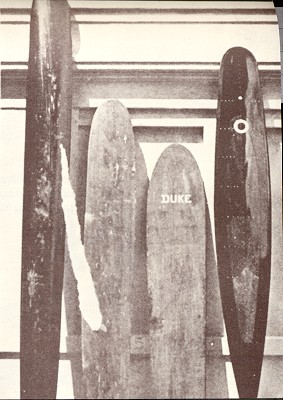
HISTORIC COLLECTION
(Figure
1)
At the Bishop
Musewn, secure in a vault-like room of heavy concrete along with countless
other artifacts of early Hawaiian culture, is this collection of surf-
boards. The prehistoric models show a clear-cut dis- tinction between the
Alaia and those of 010 design. However, no examples of the 010 board made
of Wili Wili wood are here, or seem to be in existence. Sev- eral of these
boards are links in the evolution of de- sign from 1900 to the 1930 period.
The museum has not room to display this full collection.
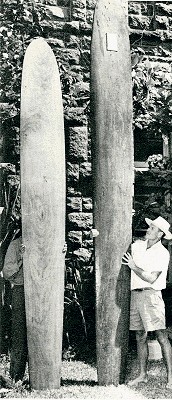
SURFBOARDS OF
ANCIENT TIMES (Figure 2)
Of interest to
every surfrider and on display in the Bishop Museum of Honolulu are these
two authentic models of the Ancient Royal Hawaiians. The one at the left
is an Alaia, made of wood of the Breadfruit tree. It is an inch and one
half thick maximum, and weighs about 70 pounds and was used by the commoners
of Hawaii. The Board on the right of a similar shape, called Olo, is about
six inches thick at the center. Both boards have a convex top and bottom
and fairly sharp edges. 1'he long one is made of Hawaiian Koa wood, but
the chieftains favored a light, balsa-like wood called Wili Wili, native
to Hawaii, but now scarce. This Olo model weighs 168 pounds. One made of
Wili Wili wood might weigh 60 pounds. It is believed they were generally
ridden in a prone position on big waves while the thin one has good steering
qualities for small surf and was easily ridable in a standing position.
Page
Page 43.Page 43.Page 43.

Dimensions vary between 6 feet and 12 feet in length, average 18 inches in width, and between half an inch and an inch and a half thick. The nose is round and turned up, the tail square. The deck and the bottom are convex, tapering to thin rounded rails. This cross-section would maintain maximum strength along the centre of the board and the rounded bottom gave directional stability, a crucial factor as the boards did not have fins.
Any discussion of the performance capabilities is largely speculation. Contemporary accounts definitely confirm that Alaia were ridden prone, kneeling and standing; and that the riders cut diagonally across the wave. Details of wave size, wave shape, stance and/or manouvres are, as would be expected, overlooked by most non-surfing observers. Most early illustrations of surfing simply fail to represent any understanding of the mechanics of wave riding. Modern surfing experience would suggest that high performance surfing is limited more by skill than equipment. It is a distinct probablity that ancient surfers rode large hollow waves deep in the curl - certainly prone, and on occassions standing.
By 1000 A.D these
principles were confirmed...
13. Large waves
are faster than small waves.- a larger board is easier to achieve
take off.
14. Steep waves
are faster than flat waves.- a smaller board is easier to control at take
off.
15. Control is more
important than speed
16. Surfboards are
precious.

There are no contemporary accounts of how the boards were ridden, but it is most likely that the design was specifically for riding large swells on outside reefs, rather than on breaking or curling waves. In 1961, Tom Blake suggested that the Olo may have been ridden prone.
In the 1920's, Tom Blake and Duke Kahanamoku reproduced the design in a hollowed version to radically reduce the weight. See #5xx, below
| This third set also
includes a photograph of a selection of four surfboards and the caption
Illustrations, Third set, Plate , between pages 48 and 49. The image, right, is as reproduced in the 1983/1985/1996 reprint of Hawaiian Surfboard, retitled as Hawaiian Surfriders 1935. The image crops the tails of all the boards and the nose of Paki's board. The white scar appears to be a tear in the page from which the later edition was copied. |
 |
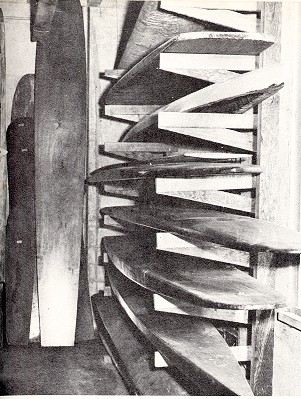 |
Image left
Bishop Museum Surfboard Collection, circa 1959. Photograph: Star Bulletin. HISTORIC COLLECTION
(Figure
1)
|
| Image right
Alia board and Paki's Olo, Bishop Museum Collection, circa 1959. Photograph: Star Bulletin SURFBOARDS OF
ANCIENT TIMES (Figure 2)
|
 |
| home | catalogue | history | references | appendix |