 |
surfresearch.com.au
ancient hawaiian surfboards: 1940 |
| home | catalogue | history | references | appendix |
|
Tom
Blake (1902-1982?)
probably compiled some of his academic research for the book
at the Bishop
Museum, Honolulu following his restoring the museum's two
large olo boards,
circa 1925. (5)
His historical
account
of the constuction and use of ancient Hawaiian surfboards
identifies and
extensively quotes from several of the sources discussed
above.
Despite access
to
the exensive resources of the Bishop, some of the earliest
material, for
example the accounts by Cook's crew (see part 2), probably was
not available.
Unlike
previous commentators
(6),
Tom Blake's analysis was assisted by an wealth of practical
surfriding
experience (7), evident in Blake building and riding a
reproduction
of an ancient design. (8)
An adult
'convert'
to surfriding (9), Blake enthusiastically promoted the
activity
in the press (10), print (11) and importantly,
water photography.
(12)
His enthusiasm
was
further fuelled, but not dominated by, a commericial interest
apart from
the financial benefits of of publication (13),
principally the sale
of his surfboard designs.14
In some
repects,
this enthusiasm may have led Blake to over-state or embellish
his work.
Surfriding was
a
royal ancient Hawaiian sport, however it was not the
only one (15)
and
it was not the exclusive preserve of the nobility as in some
european contexts.
(16)
Tom Blake
attended
High School but did not attend colledge to complete his
education.(17)
It is likely
that
Blake had copies or access to a significant number of
surfriding articles
published in Hawaiian newspapers, several of which he wrote
himself. (18)
These may
contain
some of the original sources later included in The
Hawaiian Surfboard,
along with selections from Blake's articles. (19)
It is also
possible
that Bishop Museum staff were able to direct Blake in locating
suitable
sources.
In his account
of
restoring Paki's boards, Tom Blake writes of consultations
with "Mr.
Bryan, curator of the museum' (20)
While Tom Blake
did not read Hawaiian, no doubt some Bishop Museum staff were
available
to translate any early documents written in the native
language, post 1800.
(21)
Blake
initially approached
the National Geographic Magazine in 1930 with a
x,000 word
article and a selection of surfriding photographs.
While the
editor
was interested in the images, the article was rejected and a
2,000 word
alternative requested. (22)
In 1930 Tom
Blake
published the first of two magazine articles (23),
probably culled
from his original draft intended for the National
Geographic.
(24)
Both the
articles
would later be incorporated into The Hawaiian Surfboard.
(25)
Apparently the
second
article forwarded to the National Geographic was
not acceptable
either, although a selection of the photographs, with Blake's
explanatory
captions, was eventually printed in May 1935. (26)
The editor was
able
to link Blake's photographs with another article on American
aviatrix
Emelia Earhart's stop-over in Hawaii on her attempt at
crossing the
Pacific.
The surfriding
images
included one with Earhart riding in a canoe.(27)
While some of
the
published images dated back to before 1930, this was certainly
a comtemporary
photograph.
6.2
The
first chapter is a compliation and analysis of ancient
Hawaiian legends
with a surfriding theme, although there are numerous
digressions on associated
topics.
If this style
was
carried over from the article prepared for the National
Geographic,
it might be one of the reasons for that document's rejection.
On page 18,
Blake
identifies two ancient surfboard designs by quoting Fornander
(5.9).
(22)
Blake notes
that
the two designs, apart from the variation in structural
features, are intended
for different surfriding conditions.
"This passage (Fornander) shows the different boards best suited to different kinds of waves." (23)
He developes this basic report into detailed descriptions, apparently collated from various sources.
"The
alaia
as the thin board was called, ranged from a few feet, a
child's size, to
about twelve feet long for adults.
The
larger
one being about one and one half inches thick through the
center, levelling
off on both top and bottom to about one-quarter inch at
the edges.
<...>
The
comparatively
small size of the alaia board made it easy to handle in
such waves.
It was
made
of the hardwood of the koa and breadfruit tree.
The Olo, indicating the longer boards, was of wili wili wood, a porus light wood like balsa, in fact, wili wili is Hawaiian balsa, just as koa is Hawaiian mahogany, of which there are sixty-seven different kinds in the world." (24)
Blake's
rigorous
distinction between the timbers suitable for each design may
be contradicted
by Ellis' (3.5) report of 1825:
"a board
...generally
five or six feet long ... usually made of the wood of the
erythrina (willi
willi)" (25)
He argues strongly, for boards of considerable length, that structual limitations of willi willi timber were a major factor in adopting the thick design.
"An alaia designed board of wili wilIi would not be strong enough, therefore, the Olo type was about six inches thick maximum, down the center of the board, and made of convex top and bottom so the edges beveled off to about one-half inch all around." (26)
The two olo examples held by the Bishop museum are examined and Blake appears to concede that as they are made of koa, there is apparently confict with the analysis above.
"The
Hawaiian
chief, Pakai, was a famous surf rider around the 1830
period.
His two
great
surfboards are now in the Bishop Museum.
Although
these
two boards are of Olo design, long and thick, and of heavy
koa wood, I
feel that koa was second choice for the making of this
long board.
Wili
wilIi
being generally used.' (21)
Olo boards
were made
of willi willi, unless they were made of something else. (22)
To confuse the
issue
further, Blake subsequently claims exclusive royal use for the
willi willi
olo board.
I also believe that while the wili wili board of Olo design was reserved for the use of the chiefs, the koa board of Olo design was not restricted to the alii (chiefs), but was for general use because of the scarcity of wili wili wood and plentiful occurrence of koa." (23)
The koa wood olo boards require Blake to substantially modify Thrum*'s emphatic1896 report (see 5.2)
"It is well known that the olo was only for the use of the chiefs" (24)
A detailed discussion of the olo board's riding charareterics are discussed later in Blake's book (and in this paper).
"How the Olo long board was especially adaptable to the swells or unbreaking wave, will be clearly brought out in a later discussion on modern surfing." (25)
In contrast to Blake's somewhat unsatisfying account of the olo board, the reported response from Duke Kahanamoku is probably closer to the mark.
"Duke
Kahanamoku's
answer to the reason for the old wili wilIi boards being
reserved for the
chiefs is that it was a very scarce and valuable wood.
Therefore,
the
chiefs had wili wili boards for the same reason that a man
has a Rolls-Royce
automobile today, that he is wealthy and can afford it." (26)
6.3
On
page 30 Blake investigates the religious ceremonies
associated with
surfboard construction, first outlined by Thrum* in 1896.
Note that it
has
been previously argued that Thrum's* account bears significant
similarities
to accounts of ceremonial rites identified with ancient
Hawaiian canoe
building, see 5.2.
His inital
assumption
is probably correct, to a degree:
"The routine of surfboard making was similar, no doubt, if the board belonged to a chief, to that of canoe building." (27)
At best, these
rites
would only apply to a small percentage of all boards ever
constructed.
Futhermore, to
assume
an equality of status between the surfboard and the canoe in
ancient Hawaiian
culture is questionable.
Despite the
ancient
Hawaiian's committment to surfriding documented in their
legends, certainly
the canoe held the premier position in this maritime culture.
Blake selectively quotes David Malo to illustrate the canoe building process.
"Malo
says:
' The building of a canoe was an affair of religion.
They took
with them to the mountains as offerings, a pig, coconuts,
kuma (red fish),
and awa.
Having
come
to the tree they sacrificed these things to the gods with
incantations
and prayers and there they slept.
The
kahuna
alone planned out and made the measurements for the inner
parts of the
canoe.
The
inside
was finished off by means of the adze (made of lava or
other stones).
The
ceremony
of lolo?, was consecrating the canoe, in which the diety
was again approached
in prayer.
This was
done
often after the canoe had returned from an excursion at
sea.' " (35)
As noted in
3.5,
given the status of Malo's account as from one who grew up
under the tradional
culture and its early composition, it is important what he did
not say
about surfboards.
In an extensive
list of 30 items ranked in importance, tilted The
Valuables and Possessions
of the Ancient
Times
(Chapter
22, Pages 76 to 81), he does not specifically include
surfboards.
Canoes are
rated
very highly (points 7 and 8), immediately following items of
royal or religious
significance,
Malo provides a
six page account of the construction process and the
accompanying religious
ceremonies, from which Blake selectively quotes.
6.4 Blake returns to ancient board design on page 30, with a quotation credited "Kealakakua Bay ... of 1783 vintage, by Ellis, Captain Cook's historian." (37) and he concludes :
"The
boards
used by these natives were undoubtedly of the aleia or
thin type.
The Olo,
or
long thick board, would not be practical on so short a
surf, and rocky
a shore.
The long
surf
and unbroken swells are better suited to the Olo board." (38)
Blake might
also
have noted that the report is from a southern coast in the lee
of the prevailing
swells.
For a detailed
discussion
of the location of Cook's reports, see 2.8.
A further
quotation
by "Archibald Campbell, in his work, Voyage Around the
World,
1806-1812" (39) follows without discussion
or analysis,
see 3.1.
Another
quotation,
credited as by "Ellis, in a work of 1823 ", is an
edited version
of the Rev. William Ellis' account
of surf-riding
at Waimanu, published 1831. (40)
See 3.5
Note that the
quotation
does not include Ellis' report, noted above 6.2, that appears
to conflict
with his analysis.
"a board ...generally five or six feet long ... usually made of the wood of the erythrina (willi willi)" (41)
It is
possible, but
unlikely, that the full text was not available to him.
Blake directs
his
comments to Ellis' account of juvenile surfriders and the
drying, oiling
and storage of the board:
"I can
say
that many children, boys of about eight years old, can
ride the waves on
a surfboard.
True,
they
stay near shore, but master the same technique as their
older brothers.
The great
regard of the ancient Hawaiian for his surfboard,
displayed by his care
in drying and oiling it and even wrapping it in 'tapa and
hanging it in
his house, gives some idea of the value and high place the
surfboard had
in his life." (42)
6.5
Next, Blake quotes the full entry by Malo on surfboards (43)
and
emphasises his historical significance.
" the
work
of Malo, the Hawaiian historian, with translations by
Emerson.
Malo was
born
in 1793, was known to be writing in 1832, and died in
1853.
An
honest,
conscientious writer, he devotes but a short chapter to
surf riding as
practiced by the old Hawaiians.
However,
his
work is invaluable in building the chain of surfboard
customs." (44)
Blake notes Emerson's objection to the extreme length of "four fathoms or even longer" suggested by Malo, and suggests a plausible interpretation.
"Emerson found him over
estimating
distances or sizes on two occasions.
I believe Malo meant yards when
he used fathoms.
How many of you know how long a
fathom is? Six feet." (45)
Emerson's notes do refer to this one
case
of over-estimating, Blake must have identified another instance
somewhere
in the book.
Blake's suggestion appears
reasonable,
the adjusted lengths attributed to Malo would then cover a range
of 3 feet
to longer than 12 feet, however full agreement probably requires
further
evidence.
Blake's analysis of design features
of
the olo board, previously established by reference to Fornander
circa 1910
(5.9 ), is now 'confirmed' by Malo circa 1839 and once again the
status
of Paki's boards is apparently side-lined.
"Malo's statement that a
'narrower
board was made from the wili wili,' bears out my theory that
the Olo, or
long type board, was not usually made of the hardwoods from
koa and breadfruit
trees, but of the soft, light wood of the wilIi wili tree.
Those koa boards of chief
Paki's
in the the Bishop Museum, are really a bit too heavy,
although handling
well in the water, and riding the big swells in a good
manner.
I choose, for the big waves, a
hollow
board weighted with lead to make it steady. I find seventy
pounds a good
weight for a hollow board for big surf." (46)
6.6
The notes confirm Blake's extensive experiments with these
designs, apparently
building and riding a reproduction model in the process of
developing his
hollow designs. (47)
A detailed account of the restoration
of Paki's boards follow, an unprecedented and unique opportunity
for Blake's
research. (48)
It is reproduced here in full:
"I
recently
had the privilege, and hard work, of restoring Paki's
museum boards to
their original condition.
For
twenty
years or more they had been hanging or tied with wire
against the stone
wall on the outside of the museum, covered with some old
reddish paint
and rather neglected.
My
inquiries
into the art of surfriding disclosed to me the the true
value of these
two old koa boards. They are the only two ancient
surfboards of authentic
Olo design known to be in existence today.
I made an
appeal to Mr. Bryan, curator of the museum, to restore the
boards to their
former unpainted finish and begged a more worthy location
for their display
in the museum.
Permission
was
refused by the directors on the grounds that I might
injure the evident
antiquity of Paki's boards.
After two
years, I made a second appeal, and was granted permission
to restore them
and given promise of a more suitable location inside the
building to keep
them.
In the
restoration
of Paki's old boards, I discovered that they are
undoubtedly much older
than anyone suspected.
In fact,
they
were probably already antiques when Paki acquired them.
I shall
give
my reasons for this inference.
Underneath
the
old red paint was several coats of blue paint. and
underneath, that
were hard layers of a sand colored paint, and underneath
that in many spots
was marine deck seam compound filling in worm eaten parts
of the board.
On the
largest
board, the tail, in part, was rebuilt of California
redwood to give the
board its original shape.
Paki,
according
to Stokes, was born on Molokai in 1808, and lived until
1855.
It was
probably
around 1830 when Paki was man enough to handle these big
boards.
The old
whaling
ships were sometimes seen in Honolulu harbor then and the
several kinds
of paint beneath the old red surface, also the ship's deck
seam compound
and redwood tail patch were available even before 1830.
Therefore,
I
assume that Paki dug up these two fine old discarded
worm-eaten boards,
had the redwood patch put on one, the deck caulking
compound and paint
on both, and painted them, so he could use them himself.
In their
restored
condition, the worn holes and patches show clearly under
the varnish finish.
Two fine
examples
of a now extinct design are these two old board on which
Chief Paki once
rode the Kalahuewehe surf at Waikiki.
It is
said
that Paki would not go surfriding unless it was too stormy
for anyone else
to go out.
His
reputation
of going out only in big surf is the natural thing when a
man gets beyond
his youth. Today, it takes big waves to get the old timers
out on their
boards." (49)
Blake's
estimated
history of Paki's boards indicates their construction
possibly pre-dates
Cook's visits in 1778 and 1779.
Elements of
Blake's
reconstructed board history appear to parallel in detail and
date a first
person report by Chester Lyman from Waikiki in 1846. (50)
See 4.2
Blake
undoubtedly
did not identify this account, it is inconceivable he would
not have used
it if available.
Specifically,
Lyman
notes:
"The
young
chiefs are all provided with surfboards, which are kept in
the house above
mentioned.
They are
from
12 to 20 feet long, 1ft wide, & in the middle 5 or 6
inches thick,
thinning towards the
sides
&
ends so as to form an edge.
Some of
these
have been handed down in the royal family for years, as
this is the royal
bathing place." (51)
Lyman
describes the
thick olo board (although the narrow width is unusual), makes
the earliest
assocciation between this design and Hawaiian royalty and
identifies Waikiki
as a royal surfing location.
Unfortunately,
he
does not identify the timber used to build these boards or
their relative
weight.
Blake's
assumption
"that Paki dug up these two fine old discarded worm-eaten
boards"
appears a weaker, if more dramatic, option to Lyman's reported
"handed
down in the royal family for years".
Lyman
continues:
"None of these belonging to Kamehameha 1st are now left, but one used by Kaahumanu & others belonging to other distinguished Chiefs & premiers are daily used" (52)
Malcom Gault
Williams
notes Kaahumanu (1768-1832) was the favorite wife of the noted
surfrider
Kamehameha the Great (1753?-1819) and served as regent from
1824 to1832
(53)
Lyman's claim
that
one of the boards was "used by Kaahumanu"
would possibly
date the board's construction around 1800-1810, likely her
mature surfriding
years, but it may be older.
He also notes:
"according to ... I'i, they liked to surf Kooka, a break located at Pua'a, in north Kona"(54)
I am unable to identify the specific island or the location in Finney and Houston (1996). (55)
6.7 Blake extensively quotes, and occassionally paraphrases, John Caton's report from Hilo in 1880 (see 4.9) between pages 41 and 42 to forceably argue that ancient Hawaiians:
"slide
the
wave to get away from the break"
and
"stood
upon
the surfboard in olden times just as we do today" (56)
Although some
earlier
accounts, with judicious reading, imply that standing riders
slid diagonally
across the wave face, this detailed account is notable
for the empirical
data (by noting the rider's motion relative to the compass
points) that
dramatically illustrates that the rider is transversing the
wave face.
Until this
point
the paper has successfully avoided discussing the complex
nature of surfboard
riding mechanics.
Suffice it say,
Blake's histrorical analysis confirming that ancient Hawaiians
rode waves
transversely while standing is correct.
It may be
possible
to extend Blake's argument to more extreme conclusions.
(57)
Blake writes:
"Caton describes these boards as being about one and one-half inches thick, seven feet long, coffin shaped, rounded at the ends, chamfered (beveled) at the edges; about fifteen inches wide at the widest point near the forward end, and eleven inches wide at the back end." (58) page 42
Blake's commentary claims the boards are constructed of koa (Acacia koa) or breadfruit (ulu) (Artocarpus incisus), but is unclear if this is further paraphasing Caton or Blake's conclusion.
"Clearly, boards of the aliea, or thin design, were usually made of koa or wood of the breadfruit tree." (59)
His conclusion, with or with-out confirmation by Caton, is
probably
correct.
His comparison of Caton's alaia with the boards of his day is
difficult
to resile with the performance of contemporary (2007) surfboards.
"At
Waikiki,
today, a board of the above dimensions is used only by
children up to twelve
years old. (60)
Blake notes that Caton (probably for the first time in surfriding literature) raises the question of how surfboards "work" or, more formally, the dynamics of surfboard mechanics.
"Caton found the natives could not explain why they were propelled shoreward with such astonishing speed, nor could Mr. Caton explain it himself, nor could his friends. He hoped that someday, someone would study the question and find an answer to it." (61)
Blake writes
that
"the
answer is relatively simple" (62),
however the opposite
is the more likely case.
There are
several
"simple" difficulties with Blake's analysis.
"Gravity
does
the trick.
The front
slope of the wave on which one slides presents a down-hill
path, while
the friction of the slippery board against the water is
very small." (63)
The friction
on the
board on the water is significant - overwise the board would
sink.
Futhermore the
friction,
or controlled drag, allows the rider to control the board and
maintain
direction.
"It's
the same
as skiing on a snow-covered hill, and there is no doubt as
to what makes
one slide down a hill on skis.
However,
in
skiing, one can start down hill from a stationary
position, while in surfriding
some
momentum
must
first be attained , to catch up with the incoming swell.
This is
accomplished
by paddling the board with the hands and arms." (64)
- Blake(1935)
page 43.
The notion
that the
rider must "catch up with the incoming swell ... by
paddling the board
with the hands and arms" is a common misunderstanding,
even by some
experienced surfriders.
Technically the
wave "catches" the rider.
While the wave
face
("slope") is an essential component of successful
surfriding, the
analysis does not account for wave speed, wave height or the
complex conical
shape of the breaking wave (which is different from a
white-water wave-
"a wave of translation").
Blake does not
explain
the unique dynamics of transversing of the wave face, which he
has previously
established on pages 41 and 42. (65)
6.8
The
next section is of historical interest, its impact stretching
beyond surfboard
design
A discussion of
body surfing technique paraphrases Duke Kahanamoku:
"Duke
Kahanomoku
calls attention to the fact that to catch a wave for "body
surfing," in
the true Hawaiian manner, it is necessary to swim before
the breaker using
the modern crawl stroke, with a flutter kick.
As a boy,
Duke 'body-surfed' and swam the crawl stroke before the
world had a name
for it.
Also the
ancient
Hawaiians, adapt at "body surfing," swam the crawl stroke
as part of the
sport; therefore, the origin of the so-called new crawl
swimming stroke
dates back to antiquity.
The crawl
kick was also used in conjunction with the short
three-foot surfboards
used at Waikiki beach around the 1903 period." (66)
page 43
Essentially,
the
argument proposes a direct relationship between ancient prone
board propulsion
and the 'modern' swimming style identified by swimming
commentators as
the Crawl. (67)
The argument is
a strong one. (68)
Simple
observation
demonstrates the overarm action of board paddling is exactly
the motion
of the Crawl swimming stroke, likewise the 'flutter-kick'
corresponds
directly the method used by prone board riders.
The swimming
stroke
is essential for successful bodysurfing, which undoubtedly
pre-dates European
exploration of the Pacific.
6.9
Blake
quotes from an 1891 article by Dr. Henry Bolton based on
his research,
surfing photography and personal surfriding experience on
Niihau.
Originally
presented
as a lecture with "projections from the original
photographs" in
1890, the text quotes and compares Jarves, Bird and Cummings.
(69)
It is presently
unclear if Blake is directly quoting Boulton, or Boulton
quoting his sources.
"In
1891, Bolton
wrote: 'The sport of surf riding, once so universally
popular, and now
but little seen.'
As seen
on
the Island of Niihau, Bolton describes surf riding:
'Six
stalwart
men assembled on the beach, bearing with them their
precious surfboards.
These
surfboards,
in Hawaiian, 'papahee- nalu,' or 'wave sliding boards,'
are made from the
wood of the veri veri (willi willi), or
breadfruit 'tree.
They are
eight
or nine feet long, fifteen to twenty inches wide, rather
thin, rounded
at each end, and carefully smoothed.
The
boards
are stained black, are frequently rubbed with coconut oil,
and are preserved
with great solicitude, sometimes wrapped in cloths.
Children
use
smaller boards.'
...
Here we
find
the same kind of surfboard, the aliea type used in Niihau,
as seen by Caton
in Hawaii, at the other end of the group of Hawaiian
Islands." (70)
While Blake's
conclusion
that the boards are "aliea type" is correct, note one
of the suitable
timbers for this design is "veri veri" - possibly willi
willi.
If so, this is
in
apparent contradition with Blake's contention:
"An alaia designed board of wili wilIi would not be strong enough" (71)
6.10 Thrum's* article is extensively quoted, cited by Blake as a reliable source:
"In the
'Hawaiian
Annuals', published in 1896, is an account of ancient
surfriding, prepated
by a native of the Kona district of Hawaii, familiar with
the subject.
The
valuable
work was translated by Nakoina, a former surfrider.
I feel
this
to be the finest contribution on old surfriding in
existence and am sure
the 'native from Kona' knew the art of surfriding well." (72)
Following Thrum's* report on staining and oiling of the finished surfboard, Blake quotes Emerson's (or Alexander's) notes to Malo's account of canoe building, but ommits the writer's personal contribution:
"I can vouch for it as an excellent covering for wood." (73)
Blake adds an oral report of a sealing process, apparently not recorded in any surfboard or canoe building context.
"I am
told
by Cottrell (74), who saw the performance, that a
surfboard made
of wili wili wood was buried in mud, near a spring, for a
certain length
of time to give it a high polish.
I should
say
that the mud entered the porous surface of the wilIi wili
board acting
as a good 'filler' for sealing up the surface.
When the
board
was then dried out the mud surface became hard and was
polished and oiled
to a fine waterproof finish." (74)
At first
glance this
seems a practical and relatively easy waterproofing process.
Indeed, a
smooth
surface approaching the finish of the modern fibreglassed
board might be
possible.
However, with
some
reflection the question of 'grip' arises, particularly if the
board was
to be ridden in a standing position.
Surely, before
the
application of parrafin wax circa 1935 (75) a suitable
compromise
between a smooth shape and fine timber grain providing a
suitable friction
with the rider was necessary.
6.11 Unlike this paper, Blake finds only one fault with Thrum's* analysis, the extreme width of "two or three feet wide".
"I can
detect
only one error in the work.
That
writer
says the Olo board of wili wili was 'two or three feet
wide.'
This
makes
the board too wide to paddle comfortably and also too wide
to give a good
performance.
The width
of the Olo board was from one to two feet wide, instead of
from two to
three." (76)
While this objection is valid (see 5.2), the following inference is confusing:
"I also infer, from that error, the writer to be unfamiliar with the wiIi wili, or chief's board." (77)
If Thrum* is "unfamiliar
with
the wili wili, or chief's board", then not "only one"
but
all the details relating to this design are questionable.
It is dificult
to
see how Blake's subsequent conclusions can be supported in
this context,
however he does indicate a contemporary case in conflict with
the general
consensus.
"It is
also
evident from his writing that the Olo, or long thick
board, was not made
of koa and ulu, but of only wili wili.
Therefore,
Paki's
boards of Olo design and made of koa are an exception and
not the
rule.
They
really
are too heavy to please the average surfrider.
On the
other
hand, we have today an enthusiastic and skillful surf
rider, Northrop Castle,
who has a board weighing more than either of Paki's.
Castle's
board
weighs about two hundred pounds, and he likes it." (78)
6.12Blake's next reference is unclear in its source and its importance.
"In the
American
Anthropologist, 1889, ...
Andrews (79)
gives the names Olo and wili wili, for a "very thick
surfboard made of
wili wili," and o-ni-ni as a "kind of surfboard," also
"pa-ha" as a name
for a surfboard.
In
Andrew's
mind there evidently was established the belief that the
wili wili wood
was the accepted wood for making the Olo or long thick
surfboard." (80)
If the
reference
is the Hawaiian Dictionary of 1880, then the entries are
probably sourced
from any number of the earlier accounts of surfriding.
It is unlikely
Andrews
devoted a great deal of thought in determining the timber
suitable for
Olo construction.
Similarly,
Blake
quotes Brigham (5.1) to support his thesis. (81)
As previously
discussed
(5.1), only Brigham's description of the common surfboard is
based on observation
and the notes on the Olo and on reported dimensions are likely
drawn from
Malo.
Blake's
conclusion
overstates the case.
"There again, we have an entirely different writer, who actually says that the Olo, or narrow board, was made of the light wili wilIi wood and up to eighteen feet in length." (82)
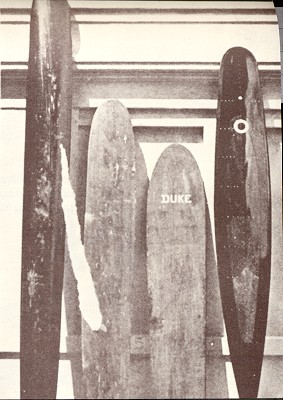
6.13 Hawaiian Surfboard has a selection of photographs, the third set between pages 48 and 49, includes Jacques Arago's (engraving by Alphonse Pellion) :"The Houses of Kraimokou, circa 1819" with a caption by Blake (83), discussed in 3.7 above.
| This
third set also
includes a photograph of a selection of four
surfboards, image right.
Unfortunately the printed image crops the tails of all the boards and the nose of Paki's board. The white scar on the left appears to be damage to the page in the book from which this 1983 edition was copied. (84) Although
only two
of the boads are ancient, the comparsion between the
relative weights of
the boards is informative.
|
 |
6.14
In
Chapter 4, "Modern surfriding", on page 59, Blake returns
to the
subject of ancient surfboards as previously promised, see 6.2
above. (86)
Quoting from one of his previously
published
magazine article (87), Blake
writes of his
recreation and testing the ancient olo design.
"In
another
magazine, 'The Pan Pacific', an article called 'Surf-
riding- The Royal
and Ancient Sport', by this writer, discloses the motif (sic?)
for trying to change the then popular and satisfactory
type of surfboards.
Written
in
1930, the article reads in part:
'Strange
as
it may seem, three old-style Hawaiian surfboards of huge
dimensions and
weight have hung on the walls of the Bishop Museum -in
Honolulu for twenty
years or more without anyone doing more than wonder how in
the world these
great boards were used, and were they not too long and
heavy to be practicable;'".
"I too,
wondered
about these boards in the museum, wondered so much that in
1926 I built
a duplicate of them as an experiment, my object being to
find not a better
board, but to find a faster board to use in the annual and
popular surfboard
paddling races held in Southern California each summer.
This
surfboard
was sixteen feet long and weight 120 pounds" (88)Page
59.
After detailing the success of the board in paddling races, a significant wave riding characteristic of the design is noted.
"What
pleases
me most is the way the board can catch the ground swells
on the reef so
much farther out to sea than the ordinary surfboard.
So my
faith
in the ideas of the old Hawaiians has been rewarded by the
performance
of a board designed by them thousands of years ago." (88)
Page 59-60
Blake had
shown that
boards of ancient olo dimensions did have a practical use,
specifically
riding waves with a gentle sloping face.
For the next
twenty
years Tom Blake's hollow board, derived from these
experiments, was a world
wide popular alternative to the solid wood board (which
closely resembled
the ancient alaia). (90)
An (obsure)
reference
dates the last of the olo riders as around the turn of the
century.
"I have
some
notes relative to the 1900 period written by Wm. A.
Cottrell (91),
one of the early surfriders at Waikiki.
He says:
"Princess
Kaiulaini was an expert surf rider around 1895 to 1900.
She rode
a
long Olo board made of wiIi wili.
She
apparently
was the last of the old school at Waikiki.' " (92) Page 60

Reprinted in
1983
by Bank Wright as
Blake, Tom: Hawaiian
Surfriders
1935
Mountain and
Sea
Publishing, Box 126 Redondo Beach California 90277 1983
Embossed hard
cover
with adhesive image.
DeLa Vega
(2004) notes "Joel Smith's edition was used to create
these plates.",
page 38.
2. "Blake's
work
has been extensively quoted by many subsequent surfing
historians
and journalists."
To detail a
complete
inventory would be pointless - almost every surfing book or
surfing magazine
article that discusses ancient Hawaiian surfing either quotes
Blake directly
or his sources.
The following
works,
excluding those of Ben Finney detailed below, are readily
available.
Nat, Warshaw,
Lueras,
Carroll,
Also Lynch:
Blake
1, 2 & 3.
3. Ben
Finney
originally prepared his research for a masters thesis in
anthropology.
The quality of
his
work has set the benhmark for all following historians of
surfriding.
Finney, Ben: Surfing
in
Ancient Hawaii
The Journal
of
Polynesian Society
December 1959
Volume
68 Number 4 pages 327 - .347.
Finney, Ben: The
Development
and Diffusion of Modern Surfing
The Journal
of
Polynesian Society
December
1960
Volume 69 Number 4 pages 314 - .331
Finney, Ben
and Houston,
James D. : Surfing – The Sport of Hawaiian Kings
Charles
E.
Tuttle Company Inc.
Rutland,
Vermont
and Tokyo, Japan. 1966.
Second printing
196?, Third printing 1971.
Finney, Ben
and Houston,
James D. : Surfing – A History of the Ancient Hawaiian
Sport
Pomegranate
Books
P.O. Box
6099
Rohnert Park, CA 94927. 1996
Soft
cover,
117 pages, 20 b/w photographs, 24 b/w illustrations,
Appendices,
Notes, Bibliography.
4. Blake,
Tom:
Hawaiian Surfriding
Nothland
Press,
Flagstaff,Arizona, 1961
Soft cover, 41
pages
- without page numbers.
5. Lynch,
Gary
and Gault-Williams, Malcom:
Tom Blake :
The
Uncommon Journey of a Pioneer Waterman
Published
by the Croul Family Foundation
Corona
del
Mar, California. 2001. Page ?
6. Note Thrum's native reporter as the one possible example, but untestable.
7. Blake contest record
8. Blake pages ?
9. Lynch and Gault-Williams: Op. cit., Chapter 1
10. Lynch and Gault Williams, clipps files
11. The above books, plus a series of design articles in magazines, almost certainly with Blake's input.
12. National geographic 1935.
13. "a
commericial interest" , apart from the possible
financial benefits
of publication.
Most authors
hope
for some financial return from their work, even if sales only
indicate
a public interest.
The publishers
of
the various surfriding articles in Hawaiian newspapers, which
are unfortunately
not available for this paper, possibly had some commercial
interest in
promoting Hawaii as a tourist destination.
In Blake's case, it appears the financial rewards from The
Hawaiian
Surfboard were not great.
The initial printing was hard cover with a dust jacket, followed
by
an imprinted cloth cover (probaly original without the dust
jacket) and
two editions in tapa cloth dust jackets..
Lynch and
Gault
Williams, pages?
14. This is
indicated
with Chapter 4 of HS.
Also see
Lynch
and Gault Williams, pages?
Garry Lynch
interviewed
Tom Blake in at Washburn, Wisconsin, on 16th April 1989.
Blake's
comments
included this assessment of the success of his commerical
surfboard building
ventures:
"And I never did make any money on it.
When royalties would mount up to thirty-forty dollars, or
maybe a hundred, I'd take out a few boards and use them for
myself, or
give them to friends.
That's the way it was then."
Garry Lynch: Tom
Blake
Interview, Washburn, Wisconsin,16th April 1989.
Notes forwarded
by Garry Lynch, with many thanks, by email, April 2007.
15. Sleding, qualifies. see Buck and Finney?
16.
European royal
sports Falcons, Hounds, Yatching, ???
In Japan,
there were even strict restrictions on who could hunt
which sorts of animals
and where, based on rank within the samurai class
http://en.wikipedia.org/wiki/Falconry
17. Lynch and Gault Williams
18. The
emphasis
on scripture by Protestant missionaries saw the rapid
development of a
written Hawaiian language to provide translated Biblical
texts.
By the late
1800s,
the written Hawaiian language had expanded into cultural and
commerical
life.
Isabella L.
Bird
reported in 1873:
"There are
four
newspapers: the Honolulu Gazette, the Pacific Commercial
Adverttser, Ka
Nupepa Kuokoa (the ''Independent Press "), and a lately
started spasmodic
sheet, partly in English and partly in Hawaiian, the Nuhou
(News)."
Bird,
Isabella
L.: Six Months in the Sandwich Isles
John Murray,
London,
1875. Pages 179.
DelaVega notes numerous articles.
19. This would be an interesting exercise, unfortunately I currently do not have access to the original articles.
20. Blake (1935): Op. cit., Page 37.
21. In
response
to an inquiry as to whether Tom Blake could read Hawaiian,
Garry Lynch
replied:
"Tom
only
knew a few Hawaiian words and phrases.
He was
constantly
in touch with the people at the Bishop and all others who
had information
and could translate any information that was out there.
He knew most
of the scholars at the time."
Garry Lynch: email correspondence, April 2007.
With thanks for the contribution.
22.
23.
24.
25.
26.
16. Fornander,
Abraham:
Forlander Collection of Antiquities and Hawaiian Folk Lore
: Translations by Thomas G. Thrum.
Bishop Museum
Press,
Honolulu, 1919-1920.
Memoirs of the
Bernice
Pauahi Bishop Museum, Volumes 4, 5 and 6.
DeLa Vega
(2004) notes "Tom Blake considered this collection one of
the most comprehensive
looks at the legends and chants of ancient Hawaii.",
page 19.
Unfortunately,
Blake's
quotation is the only copy of this report currently located
for this paper.
Blake: Op.
cit.,
Page 16
.
The quotation,
fully
discussed at 5.9, is:
'Here are
the
names of that board and the surfs.
The board is
alaia, three yards long.
The surf is
kakala,
a curling wave, terrible, death dealing.
The board is
Olo, six yards long.
The surf is
opuu,
a non-breaking wave, something like calmness."
17. Blake: Op. Cit., Page 16.
18.Blake: Op. Cit., Page 16.
19. Ellis: Op.Cit.,
20. Blake: Op. Cit., Page 16.
21. Blake: Op. Cit., Page 16.
22. Drift logs!!!
23. Blake: Op. Cit., Pages 16-17.
24. Thrum:
Op.
Cit.,
Finney and
Houston:
Op. Cit., Page 102.?
25. Blake: Op. Cit., Page 17.
26. Blake:
Op. Cit., Page 17.
37. I
am unable
to identify the published source of this quotation.
It is
obviously
an edited and rewitten version of King, as edited by Douglas,
see 2.7.
The source is
possibly
(as suggested by Blake) is a history of the voyage
written by "Ellis"
and published in 1783, the original report (or reports)
certainly dated
1778-1779.
It may be an
official
publication, hurried into print to maximise sales.
The report
cleary
is not a first person account and is basically
King/Douglas.
It has not been
considered previously as a reputable report.
Blake's quoted
text
reads
"Native men,
and women alike, enjoyed it.
In
Kealakakua
Bay (Hawaii) the waves broke out about one hundred and fifty
yards.
Twenty or
thirty
natives, each with a narrow board with rounded ends, would
start out together
from the shore and battle the breaking waves to a point out
beyond.
The surfers
would
then lay themselves full length upon the boards and prepare
for the swift
return to shore, They would throw themselves in the crest of
the largest
wave, and be driven towards shore with amazing rapidity.
The riders
must
ride through jagged opening in the rocks, and, in case of
failure, be dashed
against them."
38. Blake: Op. Cit., Page 30.
39.Archibald
Campbell,
in his work, Voyage Around the World, 1806-1812"
"They often
swam
several miles offshore, to ships, sometimes resting upon a
plank shaped
like an anchor stock -and paddling with their hands, but
more frequently
without any assistance what- ever. Although sharks are
numerous in those
waters, I never heard of any accident from them, which, I
attribute to
the dexter- ity with which they avoided their attacks."
40. Ellis,
Rev.
William: Polynesian Researches, During a Residence of
Nearly Eight
Years in the
Society and
Sandwich
Islands, Volumes I to IV..
Fisher, Son and
Jackson, London, 1831. Pages 368 to 372.
Reproduced in
Finney, Ben and
Houston, James D.: Surfing – A History of the Ancient
Hawaiian Sport.
1996.
Appendix C.
Pages
98 to 99.
Blake's
(edited)
quoted text reads:
"There are
few
children who are not taken into the sea by their mothers the
second or
third day after their birth, and many can swim as soon as
they can walk."
I can say
that
many children, boys of about eight years old, can ride the
waves on a surfboard.
True, they stay near shore, but master the same technique as
their older
brothers.
The great
regard
of the ancient Hawaiian for his surfboard, displayed by his
care in drying
and oiling it and even wrapping it in tapa and hanging it in
his house,
gives some idea of the value and high place the surfboard
had in his life."
41. Ellis: Op.Cit.,
42. Blake: Op. Cit., Page 30.
43. Malo, Op. Cit.,
44. Blake: Op. Cit., Page 30.
45. Blake: Op. Cit., Page 30.
46. Blake: Op. Cit., Page 30.
47. Lynch and Gault-Williams: Op. Cit., Page
48. Tom
Blake
is often credited with many notable achievements - the hollow
board, the
water-proof camera housing, the torpedo buoy, and others.
His work on the
ancient boards of the Bishop Museum definitely qualifies him
as the "Father
of surfboard restorers".
49. Blake: Op. cit., Pages 37 - 38.
51. Lyman,
Chester
S. (1814-1890): Around The Horn To The Sandwich Islands
And
California 1845
-1850.
New Haven: Yale
University Press 1924) Chapter II, page 73.
Travel diary in
1846 notes.
Quoted in
DelaVega
(ed, 2004): Op. cit., page 22
51. Lyman:
Op
Cit., Travel diary in 1846 notes. Chapter II, page 73.
Quoted in
DelaVega
(ed, 2004): Op. cit., page 22
52. Lyman:
Op
Cit., Travel diary in 1846 notes. Chapter II, page 73.
Quoted in
DelaVega
(ed, 2004): Op. cit., page 22
53. Gault Williams: Op. cit., page 181.
54. Gault
Williams: Op. cit., page 181.
The reference
in
I'i is
page?
55.
Finney
and Houston : 1996. Pages
Reproduced in
Gault Williams:
Op. cit., Pages 55 to 62.
56. Blake: Op. cit., Page 42.
57. Also tubed, certainly prone. Rode large waves.
58. Blake: Op. cit., Page 42.
59. Blake: Op. cit., Page 42.
60. Blake: Op. cit., Page 42.
61.Blake: Op. cit., Page 42.
62.Blake: Op. cit., Page 42.
63.Blake: Op. cit., Pages 42- and 43.
64.Blake: Op. cit., Page 43.
65. see Surfboards Dynamics
66. Blake: Op. cit., Page 43.
67. There is some dispute amoung swimming commentators as to the origin of the Crawl as illustrated by the commonly used alternatives: 'the American Crawl' or 'the Australian Crawl'.
68. List alternative claiments.
Note Polynesian connection to Australia,
69. DelaVega (ed, 2004): Op. cit., page 12
70. Blake: Op. cit., Page 44.
71. Blake: Op. Cit., Page 16.
73. Malo: Op. Cit., Pages 133 and 134.?
74. Blake:
Op. Cit., Pages 45 and 46.
No idea who
Cottrell
is.
75. A
claim
for the first use of parrafin wax was made by Alfred E Gallant
(Letters,
Longboard
Magazine, USA, 1999).
Post 1935, he
noticed
the grip of his damp feet after his mother recently applied
floor wax.
She then
advised
use of paraffin sealing wax for his surboard.
76.Blake: Op. cit., Page 47.
77.Blake: Op. cit., Page 47.
78.Blake: Op. cit., Page 47.
79.
Andrews,
Noted in
dela
Vega
80.Blake: Op. cit., Page 48.
81.
Blake's
quotation reads
"Brigham, in
Preliminary Catalogue, says: 'Surfboards were usually made
of koa, flat
with a slightly convex surface, rounded at one end, slightly
narrowing
towards the stern, where it was cut square.
Sometimes,
the
'pa-pa' (surfboard) was made of a very light wi Ii wili and
then made;ooQ1Q.
(narrow).
In size,
they
varied from three to eighteen feet in length and from eight
to ten inches
in breadth, but some of the ancient boards were said to have
been four
fathoms long."
Blake: Op.
cit.,
Page 48.
82. Blake: Op. cit., Page 48.
83. Blake's
caption
reads
" ...the
surfboard
of wili wili wood was reserved for the Chiefs. ..
The oldest
picture
of a surfboard in existence.
From a
drawing
by a French artist Pellion in 1819.
The man in
the
picture is evidently a Hawaiian Chief because of his helmet
and feather
cape.
The woman in
the picture is pounding tapa of which they fashioned their
simple clothes.
The great
size
of the surfboard lying in the yard is in keeping with Chief
Paki's museum
boards. -Photo by Baker "
Blake: Op.
cit.,
Illustrations, Third set, between pages 48 and 49, Plate 4.
84. Blake:
Op. cit., Illustrations, Third set, between pages 48 and
49, Plate
? ,
For 1983
publishing
details, see Endnote 1 above.
85.
86.
87.
88.Page
59-60
89. Possibly
Knute
Cottrell, a comtemporary of Duke Kahanamoku and a founding
member
of the Hui Nalu
club, circa
1908.
90. Page
60
ordinary
surfboard.
So my faith in the ideas of the old Hawaiians has been
rewarded by the
performance of a board designed by them thousands of years
ago.
"Dad Center,
kamaina and famous surf rider, says that when he was a boy
on the Island
of Maui, a native took a long board out in storm surf and
rode the swells
till they broke near shore. So there we have a complete
substantiation
of what the museum type board suggests. Dad continues, 'That
was in the
'90's and was about the finish of the long board on that
island. They were
occasionally used, however, more as a novelty at Waikiki,
until around
1900.
I "Around
1900
the art of surfriding was almost obsolete. Even at Waikiki
beach there
was very little as most people lived in Honolulu and it was
difficult to
get to Waikiki. Interest revived and in 1907 a group of
prominent men,
led by Alexander Hume Ford, organized and formed the
Outrif{ger Canoe Club.
The
charter
reads:
'We wish to have a place where surfboard riding' may be
revived and those
who live away from the water front
may keep
their
surfboards. The main. object of this club being. to give an
added and permanent
attraction to Hawaii and make
the Wajkiki
beach
the home of the surfrider'."
I have some
notes
relative to the 1900 period written by Wm. A. Cottrell, one
of the early
surfriders at Waikiki.
Possibly
Knute
Cottrell, a comtempoary of Duke Kahanamoku, and founding
member of
the Hui Nalu club, circa 1908.
He says:
"Princess
Kaiulaini was an expert surf rider around 1895 to 1900. She
rode a long
010 board made of wi Ii wili. She apparently was the last of
the old school
at Waikiki.
"About 1903
we
used a short board a few feet long, rather thin and wide,
like a washboard.
From 1903 to 1908 marks the true revival of the sport.
encouraged by the
following old timers: Wm. Dole, Dudie ¥iller. Duke
Kahanamoku, Harold
Castle, Geo. Freeth. Dad Center, Kauha, Ho1stein, Jordan,
Lishman, Atkin-.
son, "Steamboat" Bill, Winter, Brown. Kaupipko, Mahelona,
Kea- wamaki,
May, Curtiss, Hustace, Roth, Aurnolu and McKenzie. Some of
these men are
riding today. Many of the above men were members of ,the
first club, called
the 'Waikiki Swimming Club'; the charter members were Duke
Kahanamoku,
Knute Cot- rell, and Ken Winters. This club was an incentive
which influenced
the foundation of the Outrigger Canoe Club in 1907 and the
Hui Nalu along
about the same time."
Page 60.
Reprinted in
1983
by Bank Wright as
Blake, Tom: Hawaiian
Surfriders
1935
Mountain and
Sea
Publishing, Box 126 Redondo Beach California 90277 1983
Embossed hard
cover
with adhesive image.
DeLa Vega
(2004) notes "Joel Smith's edition was used to create
these plates.",
page 38.
2. Blake,
Tom:
Hawaiian Surfriding
Nothland
Press,
Flagstaff,Arizona, 1961
Soft cover, 41
pages
(without page numbers), 58 black and white plates, 3 black and
white ???
3. Blake's
work
has been extensively quoted by many subsequent surfing
historians.
To detail a
complete
inventory would be pointless - almost every book or magazine
article that
discusses ancient Hawaiian surfing either quotes Blake
directly or his
sources.
The following
works
(excluding those of Ben Finney) are readily available.
Nat, Warshaw,
Lueras,
Carroll,
4. Ben
Finney
originally prepared his research for a masters thesis in
anthropology.
The quality of
his
work has set the benhmark for all following historians of
surfriding.
Finney, Ben: Surfing
in
Ancient Hawaii
The Journal
of
Polynesian Society
December 1959
Volume
68 Number 4 pages 327 - .347
Finney, Ben: The
Development
and Diffusion of Modern Surfing
The Journal
of
Polynesian Society
December
1960
Volume 69 Number 4 pages 314 - .331
Finney, Ben
and Houston,
James D. : Surfing – The Sport of Hawaiian Kings
Charles
E.
Tuttle Company Inc.
Rutland,
Vermont
and Tokyo, Japan. 1966.
Second printing
196?, Third printing 1971.
Finney, Ben
and Houston,
James D. : Surfing – A History of the Ancient Hawaiian
Sport
Pomegranate
Books
P.O. Box
6099
Rohnert Park, CA 94927
Soft
cover,
117 pages, 20 b/w photographs, 24 b/w illustrations,
Appendices,
Notes, Bibliography.
5. All
reproduced
text is in Bell 14 point and not in quotation marks or
italics.
My text is in
Arial
12 point.
For screen
clarity,
the reproduced text and my own work has been adjusted to my
standard online
format.
Paragraphs are
indicated
by a spaced line (replacing indentation) and each sentence
takes a new
line.
Page 17
1. Fornander,
Abraham:
Forlander Collection of Antiquities and Hawaiian Folk Lore
: Translations by Thomas G. Thrum.
Bishop Museum
Press,
Honolulu, 1919-1920.
Memoirs of the
Bernice
Pauahi Bishop Museum, Volumes 4, 5 and 6.
DeLa Vega
(2004) notes "Tom Blake considered this collection one of
the most comprehensive
looks at the legends and chants of ancient Hawaii.",
page 19.
2. "alaia,
three yards long"
One yard equals
three feet, 36 inches or 92 cm.
The reported
alaia
is approximately 9 feet or 275 cm long.
This conforms
with
existing examples of the board.
3. "kakala,
a curling wave, terrible, death dealing."
The wave is
characterised
by its steep face and hard breaking curl.
It is typically
found in the common beach break.
4. "Olo,
six yards long."
One yard equals
three feet, 36 inches or 92 cm.
The reported
Olo
is approximately 18 feet or 550 cm long.
This reasonably
conforms with two know existing examples of the board, hower
both are in
koa wood..
5. "opuu,
a non-breaking wave, something like calmness."
The wave is
characterised
by its gentle sloping face.
A noted feature
of surfing conditions at Waikiki, Ohau, it is favoured by
canoe surfers.
6. "This
passage
shows the different boards best suited to different kinds of
waves."
Although this
is
generally correct, the performance of any surfboard is a
function of the
rider's statue and skill.
7. "The
alaia
as the thin board was called, ranged from a few feet, a
child's size,
to about twelve feet long for adults."
Buck (1959)
notes
"The Bishop Museum collection consists of 25 boards ranging
from
a child's board of breadfruit wood (Bishop Museum
catalogue number
C. 5966), 34.25 inches long, weighing 2 pounds 10 ounces to
a modern
redwood board, 17 feet 2 inches long, weighing 174 pounds."
Page 384.
While Blake
chiefly
characterises the alaia as "the thin board" with a
wide range of
lengths and widths,
Buck
(1957) and Finney (1959) make a
distinction based on riding position - prone
("body-board') or standing
models ("true surfboards"), based largely on length.
Buck (1957)
page
384
Finney
(1959)
pages 331 and 333.
This
distinction
presents several difficulties.
1. Firstly, it
requires
the observer to determine the riding position of any
particular board based
on their surf riding experience.
As noted above,
the performance of any surfboard is a function of the rider's
statue and
skill.
2. While early
reports
indicate that solid board riders did ride in the standing
position, it
is unclear if this was practised as an exclusive preference.
The ancients
may
have ridden a particular wave in a variety of positions -
prone, kneeling,
drop-knee, sitting and standing - adjusting to changes in the
wave's shape
and velocity.
3. There is no
such
distinction in the early literature.
Commentators,
such
as Malcom Gault-Williams (2005) have used the term paipo
(page 95) to indicate prone boards, but this word does not
appear in any
list of ancient Hawaiian words.
See Finney
and
Houston (1996) Appendix A, pages 94 to 96.
4. The
principal
feature for a board to be ridden in a standing position is
possibly the
width.
5. All these
commentators
fail to note the major advantage of a board with larger volume
- a significant
improvement in padding speed and distance.
It is probably
reasonable
to assume that, regardless of the statue and skill of the
rider, that smaller
boards were mostly used at surfing breaks close to shore,
while larger
boards had the potential to ride waves breaking a
considerable distance
from shore.
8. "The
larger
one being about one and one half inches thick through the
center, levelling
off on both top and bottom to about one-quarter inch at the
edges."
This indicates
that
the maximum thickness for the alaia was one and one half
inches, considerably
thinner than all subsequent surfboard designs.
9. "The
kakala,
indicates a wave that steepens up and crashes over the
shallow coral."
As noted, this
type
of wave is typically found in the common beach break.
Surfing breaks
occuring
on coral reefs are generally limted to equatorial regions.
10. "koa" (Acacia
koa)
Tommy Holmes'
authorative
work, The Hawaiian Canoe (1981, 1993), writes
extensively about
koa and its use of by ancient Hawaiian canoe builders.
Significant
sections
are of interest in a discussion of ancient Hawaiian
surfboards.
Holme's work is
fully referenced, however his notes are not included in this
paper.
Holmes, Tommy :
The
Hawaiian Canoe - Second Edition
Editions
Limited,
PO Box 10558 Honolulu, Hawaii 96816.
First Edition
1981.
Second Edition 1993. Second Printing 1996.
Koa
A
magnificent and totally unexpected gift awaited discovery by
the settlers
reaching Hawai'i.
The
islands
were blessed with extensive forests of what would come to be
called
koa, trees of extraordinary size that were found nowhere
else in the world.
These
trees
would provide wood of remarkable durability out of which the
Hawaiian
would shape his canoes.
For
some
1500 years the Hawaiian people lived in delicate balance
with their
environment, the trees they used being replaced by natural
regeneration.
Contact
with
the west shattered this fragile balance; in the span of a
few decades
koa began a radical decline that has continued even to the
present day.
"Their
huge trunks and limbs cover the ground so thickly that it is
difficult
to ride through the forest, if such it can be called,"
writes E.F. Rock
in 1913 of a once beautiful koa forest in Kealakekua, South
Kona.
Rock,
a
botanist, goes on to note of this macabre forest scene that
"90 per cent
of the trees are now dead, and the remaining 10 per cent in
a dying condition."
In
1779,
a little over one hundred and thirty years before Rock's
observations,
Lt. Charles Clerke who was with Captain Cook tells of
wandering through
the koa forest above Kealakekua: "Some of our Ex- plorers in
the woods
measured a tree 19 feet in the girth and rising very
proportionably [sic]
in its bulk to a great height, nor did this far, if at all,
exceed in stateliness
many of its neighbours; we never before met with this kind
of wood."
Similarly,
Archibald
Menzies in 1792 describes the same area: "The largest trees
which
compose this vast forest I now found to be a new species of
mimosa [koa].
..I measured two of them near our path one of which was
seventeen feet
and the other about eighteen feet in circumference, with
straight trunks
forty or fifty feet high. ..as we advanced, the wood was
more crowded with
these trees than lower down where both sides of the path had
been thinned
of them by the inhabitants."
Page
Acacia
koa, once undisputed monarch of the forests of Hawai'i,
probably evolved
from seeds hitchhiking to Hawai'i in the bowels of some
storm-blown bird
or through some other capricious act of the winds and seas.
In
an
environment that was comparatively free of competitors and
predators,
koa proliferated to where it was once-after 'ohi'a- the
second most common
forest tree in Hawai'i.
It
has
been estimated that today there is standing probably not
much more
than ten percent of the amount of koa that existed at the
time of Cook's
arrival; presently non-native species make up the majority
of the forests
of Hawai'i.
Page
Koa
sometimes reaches massive proportions.
Tall,
straight
koa trees up to 20 feet in circumference were seen by a
number
of Europeans visiting Hawai'i in the late 1700's and early
1800's.
One
legend
reputes a koa tree with a straight trunk as high as 120
feet, and
Emerson notes ten men were required to encompass another
mammoth koa tree
from
which a canoe was to be hewed. Though these dimensions are
probably exaggerated,
there undoubtedly were some quite large koa trees.
Straight
trunks
in excess of 70 feet were not unheard of; and while never
plentiful,
one can still find today an occasional 50- t060-foot
straight-trunked koa
tree.
In
1977
a 62-foot log was felled in the Honomalino forest above
Kona, from
which a ten-man, 58-foot canoe has been made.
Of
old,
certain areas such as the mountains above Hilo and Kona and
the slopes
of Haleakala produced such an abundance of high quality
canoe logs that
a very disproportionate amount of the total number of canoes
throughout
the islands came from these sites.
At
Keauhou
Ranch on the island of Hawai'i there stands what is
considered
to be the largest koa tree in the world. Its trunk measures
some 12 feet
in diameter and 371/2 feet in circumference.
Though
the
trunk only rises about 30 feet before branching, its topmost
branches
tower 140 feet above the ground.
The
tree
is probably four hundred to five hundred years old.
Page
Koa
For Canoes
Early
Hawaiians,
and canoe builders in particular, possessed an especially
detailed
knowledge of differing physical characteristics of woods,
primarily of
Acacia koa.
In
the
absence of modern-day botanical classification techniques,
the canoe
builder devised his own very sophisticated system for
classifying koa.
Through
analysis
of a tree's trunk shape and dimensions, bark, grain, and
branching
patterns, a canoe builder was able to identify each koa tree
as being of
a certain type.
Beyond
the obvious gross physical characteristics of a koa tree,
the ancient canoe
builder was most concerned with the grain, for well he knew
that each tree
possessed distinct grain characteristics. While today's
botanist will tell
you that Acacia koa is Acacia koa, he will observe that
there is, besides
the more obvious differences in physical characteristics, a
remarkable
range in the density from one tree to the next, and from one
stand to the
next.
The
density
of koa ranges from a low of about 30 pounds per cubic foot
to a
high of 80 pounds per cubic foot.
In
some
cases there will even be a significant range of grain
density within
the same tree.
It
was
apparently this maverick and obscure feature of koa wood
that most
plagued the canoe builder.
Page 29
While
the Hawaiian did not think in terms of pounds per cubic
foot, he did develop
a system of grain classification that was for all practical
purposes comparable
to a botanist's grain density scale.
Low
density
koa (roughly 30 to 45 pounds per cubic foot) was to the
canoe builder
generally soft, lightweight, and yellowish.
He
called
it koa la' au mai' a (banana- colored koa) and valued it for
its
lightness as wood for paddles, but rarely used it for
canoes.
Another
name
for this type of koa wood was koa' awapuhi, literally,
"ginger koa,"
which was regarded as female by the Hawaiians.
Mid-range
density
koa (40 to 60 pounds per cubic foot), reddish to brown, was
overwhelmingly
favored for making canoes, primarily because of its
durability, and strength-to-weight
relationship. Koa at the high end of the density range (60
to 80 pounds
per cubic foot) was almost black in color and extremely
heavy.
The
wood
of this type of tree was called koa 'i'o 'ohi'a (hard
'ohi'a-like
grain) and was usually avoided for canoes because the wood
was heavy and
hard to work.
On
the
occasion when a canoe was made of this kind of koa it was
said that
it "will never lose its heaviness until. it is smashed."
This
contrasts
to the typical koa canoe that over the years loses weight
due
to water loss from the wood.
Noting
the
tendency of koa to crack and check, canoe builder Z.P.K.
Kalokuokamaile
said that the canoe maker of old had "to be very careful for
the grain
of some trees lie [sic] all in the same direction."
(Note that one
would
expect "the tendency for koa to crack and check" to be
an important
concern to the builder using this timber for surfboards, it is
not mentioneed
in any of the traditional sources.)
Further
identification of a tree was made through its bark.
Unfortunately,
only
two types are recorded.
Kaekae
was
a whitish bark that generally covered a tall, handsome tree,
indicating
a straight grain of the la' au mai' a variety.
This
type
of tree, according to Kalokuokamaile, made "a very light
canoe and
floats well after it is built and put into the sea."
Maua
on
the other hand, was a dark red bark that typically sheathed
the tough,
heavy, black-grained ~i'o 'ohi'a, of which "the grain of the
wood twists
forward and back.
This
is
hard to make into a canoe."
Trunk
shape
and dimensions, and branching patterns provided the canoe
builder
with his most common means of identifying different types of
koa.
Holmes then
records
a list of twenty-one terms still known that were used in
identifying koa
wa'a (koa for canoes).
Page 30
10. "breadfruit tree."(ulu) (Artocarpus incisus)
11. "wili wilIi wood" (Erythrina sandwicensis)
In a section titled Other Woods, Holmes discusses the use of breadfruit and willi willi in canoe building.
Fornander
notes that besides koa, "three other kinds of wood were used
in the olden
time for building canoes, the wiliwili, kukui (candle-nut
tree), and ulu
(breadfruit tree).
The
wiliwili
is yet being used.
The
kukui
is not much seen at this time.
The
ulu
is used for repairing a broken canoe
"
Handy comments that the early Hawaiian settlers found kukui
"to be one
of their most valuable assets, perhaps the chief of which
lay in the fact
that the trunks of large trees could be hollowed into superb
canoe hulls."
Soft,
light
and easily worked, breadfruit, kukui and wiliwili were
especially
favored as play or training canoes particularly for young
aspiring canoeists
or women.
The
"baby"
or training canoes rarely exceeded 20 feet in length and
usually
were in the 10 to 15 foot range.
Of
the
light woods, breadfruit was apparently least used; not only
was the
breadfruit tree fairly rare and needed as a food source, the
one variety
available to the Hawaiians was usually unsuitable in girth
and height for
making canoes.
Holmes'
comments
probably account for the restricted use of breadfruit for
surfboard building,
certainly for larger boards.
Of
wiliwili,
Fornander notes that "it was also made into canoes, provided
a tree large enough to be made into a canoe can be found;
but it is not
suitable for two or three people, for it might sink in the
sea.
But
it
must not be finished into a canoe while it is green; leave
it for finishing
till it has seasoned, then use it."
The essential
requirement
that the timber be seasoned before finishing is not reported
in any of
the accounts of early surfboard construction.
Emerson
says
of softwood wiliwili canoes that: "If not sufficiently
durable and
resistant to the powerful jaws of the shark, they were at
least easily
manipulated and very buoyant, and made a cheap and on the
whole a very
serviceable canoe for ordinary purposes."
Degener,
in
his book Flora Hawaiiensis, noted that in the early
part of this
century canoes of wiliwili were not in "favor because of the
belief that
sharks preferred to follow this particular wood." The
limited literature
on canoes made from softwoods tends to support the ancient
Hawaiian's concern
for the greater vulnerability of light wood canoes to
occasional shark
attacks.
These
beliefs
might seem to conflict with the many reports of the use of
willi
willi for ama (outrigger floats).
Note that such
beliefs
would certainly appear a disincentive to use willi willi for
surfboard
building and there is no consideration of this in the
available literature..
Wiliwili
canoes
are almost always referred to in the literature as
near-shore, play
or training canoes. I'i notes that as a young boy he "had
learned a little
about paddling a canoe made of wiliwili wood that his
parents had provided
for him."
The restriction
of willi willi to "near-shore, play or training canoes" is
possibly a reflection
on the low strength of the timber, the ancient Hawaiians
distrustful of
its performance in the open sea conditions.
Wiliwili,
by some accounts, was never very plentiful.
Kalokuoka-
maile
notes that "in the olden days. ..there were very few places
in which
this tree grew." This is somewhat at odds with botanist W.
E. Hillebrand,
who wrote that wiliwili was "much more common formerly than
now."
It
was
said by some that Ka'u was the best place for wiliwili.
Today
wiliwili
can be found flourishing in certain areas.
The
author
has visited a grove of wiliwili above the Makena area on
Maui that
comprises several hundred acres.
Many
of
the trees are 3 to 4 feet in diameter with trunks often
rising 15 to
20 feet high before branching.
Other
sizeable
stands of wiliwili dating from precontact times can still be
found
in the Pu'uanahulu, Pu'uwa'awa'a and KaIapana areas of
Hawai'i.
Smaller
populations
are also found on Kaua'i behind Kekaha, in west O'ahu, south
and west Moloka'i, Kaupo on Maui, Ka'u on Hawai'i and on
Kaho'olawe.
Emerson
makes an intriguing reference to a certain kaukauali'i (mi-
nor chief)
who, in the time of Kamehameha I, constructed a vessel
(moku) out of a
single huge wiliwili tree.
He
named
this craft after himself, 'Waipa'.
It
was
partly covered or decked over, but had no outrigger, being
kept upright
by ballast.
It
had
a single mast and sailed with Kamehameha's fleet to Oahu."
It is not
unlikely that such a craft was built.
After
contact
there were a number of Hawaiians experimenting with new
types of
craft.
By
way
of reference, the largest wiliwili tree known, located on
Pu'uwa'awa'a
Ranch is, at breast height, almost thirteen feet in
circumference, and
fifty-five feet high.
Kenneth
Emory,
dean of Pacific anthropologists, records an informant who
told him
in 1937 of the Hawaiians training wiliwili trees to grow
tall and straight
before crowning by constantly trimming off side branches.
Page 23.
Holmes also
includes
a discussion of the use of non-native timbers, washed ashore
on the Hawaian
islands.
The use of such
timber by ancient surfboard builders can not be discounted.
Drift
Logs
The
gods
must surely have smiled on the Hawaiian people, giving them
yet another
special source of canoe logs: giant redwood, fir, pine and
other kinds
of tree trunks that drifted from the northwest coast of
America to the
shores of Hawai'i.
W.
T.
Brigham, one-time curator of the Bishop Museum, notes that
"many of
the largest and most famous double canoes of the Hawaiians
were hewn from
logs of Oregon pine brought to the shores ofNiihau and Kauai
by the waves.
I
myself saw dozens of such logs in 1864, some of great size,
some bored
by Teredo, others covered with barnacles, along the shores
ofNiihau."
Similarly
James
Hornell notes that, "in Hawaii giant logs of Oregon pine
occasionally
drifted ashore; these were greatly prized, for they were
often so large
as to serve as entire hulls without the need of raising the
sides by means
of planks sewn on; the difficulty was to obtain a pair of
approximately
equal size; sometimes a log was kept for years before this
aim was achieved."
It
was
as if nature had compensated for the chronic canoe log
shortage on
Kaua'i and Ni'ihau, for that was where most of these drift
logs landed.
Captain
George
Vancouver notes that "the circumstance of fir timber being
drifted
on the northern sides of these islands is by no means
uncommon, especially
in Attowai [Kaua'i], where there then was a double canoe, of
a middling
size, made from two small-pine trees, that were driven on
shore nearly
at the same spot."
The
log
belonged to whatever chief ruled over that stretch of
coastline where
it happened to be beached.
Menzies,
-Vancouver's
surgeon and naturalist, while crossing the Kaua'i Channel
later reported "the largest single canoe we had seen amongst
these islands,
being about sixty feet long and made of one piece of the
trunk of a pine
tree which had drifted on shore on the east end of the
island of Kauai
a few years back..
She
had
sixteen men on her and was loaded on the outriggers with a
large quantity
of cloth, spears, two muskets, and other articles, which
they were carrying
up to Mau
Page 24.

Dimensions vary between 6 feet and 12 feet in length, average 18 inches in width, and between half an inch and an inch and a half thick. The nose is round and turned up, the tail square. The deck and the bottom are convex, tapering to thin rounded rails. This cross-section would maintain maximum strength along the centre of the board and the rounded bottom gave directional stability, a crucial factor as the boards did not have fins.
Any discussion of the performance capabilities is largely speculation. Contemporary accounts definitely confirm that Alaia were ridden prone, kneeling and standing; and that the riders cut diagonally across the wave. Details of wave size, wave shape, stance and/or manouvres are, as would be expected, overlooked by most non-surfing observers. Most early illustrations of surfing simply fail to represent any understanding of the mechanics of wave riding. Modern surfing experience would suggest that high performance surfing is limited more by skill than equipment. It is a distinct probablity that ancient surfers rode large hollow waves deep in the curl - certainly prone, and on occassions standing.
By 1000 A.D
these
principles were confirmed...
13. Large waves
are faster than small waves.- a larger board is easier
to achieve
take off.
14. Steep waves
are faster than flat waves.- a smaller board is easier to
control at take
off.
15. Control is
more
important than speed
16. Surfboards
are
precious.
There are no contemporary accounts of how the boards were ridden, but it is most likely that the design was specifically for riding large swells on outside reefs, rather than on breaking or curling waves. In 1961, Tom Blake suggested that the Olo may have been ridden prone.
In the 1920's, Tom Blake and Duke Kahanamoku reproduced the design in a hollowed version to radically reduce the weight. See #5xx, below
| This
third set also
includes a photograph of a selection of four
surfboards and the caption
Illustrations, Third set, Plate , between pages 48 and 49. The image, right, is as reproduced in the 1983/1985/1996 reprint of Hawaiian Surfboard, retitled as Hawaiian Surfriders 1935. The image crops the tails of all the boards and the nose of Paki's board. The white scar appears to be a tear in the page from which the later edition was copied. |
|
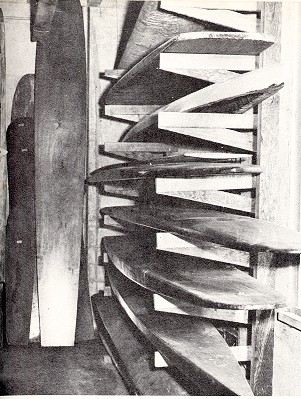 |
Image
left
Bishop Museum Surfboard Collection, circa 1959. Photograph: Star Bulletin. HISTORIC
COLLECTION
(Figure
1)
|
| Image
right
Alia board and Paki's Olo, Bishop Museum Collection, circa 1959. Photograph: Star Bulletin SURFBOARDS
OF
ANCIENT TIMES (Figure 2)
|
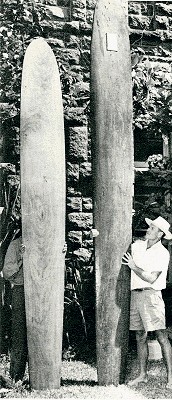 |
| home | catalogue | history | references | appendix |
As the big seas chased each
other
in from the open ocean, the west end first reached the rocky
bed,
and the instant the bottom of
the
wave met this obstruction, its rotary motion was checked,
and
immediately, the comb on the
top
was formed, so that, the foamy crest seemed to run along the
top of
the wave from west to east, as
successive
portions of it reached the rock bottom.
As soon as the bather had
secured
his position, he gave a spring, and stood upon his knees
upon the
board, and just as he was
passing
us, when about four hundred feet from the little peninsula
point
where we stood, he gave another
spring and stood upon his feet (3), now folding his arms
upon his
breast, and now swinging them
about
in wild ecstasy, in his exhilarating flight.
Here Blake paraphrases Caton,
rather
than quote him directly, and I have adjusted the text to
highlight what
I
think is Caton's input ...
... these boards as
being about
one and one-half inches thick, seven feet long, coffin
shaped, rounded
at the ends, chamfered (beveled
- Blake) at the edges; about fifteen inches wide at the
widest point
near the forward end, and
eleven
inches wide at the back end. (4)
... boards of the aliea, or thin design, were usually made of koa or wood of the breadfruit tree.
The surf bathers ... stripped to their breach cloths or malos, before going in the water. (5)
... the natives could not
explain
why they were propelled shoreward with such astonishing
speed, nor
could I (Mr. Caton)
explain
it myself (himself), nor could my (his) friends.
He hoped that someday, someone
would
study the question and find an answer to it. (6)
To continue the narrative,
Blake
goes on to suggest a, not altogether satisfactory, solution
...
The answer is relatively
simple.
Gravity does the trick.
The front slope of the wave on
which
one slides presents a down-hill path, while the friction of
the
slippery board against the
water
is very small. (7)
It's the same as skiing on a
snow-covered
hill, and there is no doubt as to what makes one slide down
a hill on skis.
However, in skiing, one can
start
down hill from a stationary position, while in surfriding
some
momentum must first be attained
, to catch up with the incoming swell.
This is accomplished by
paddling
the board with the hands and arms. (8) - Blake (1935) page
43.