pods
for primates : a catalogue of surfboards in australia since 1900
 |
surfresearch.com.au
history
: simon |
|
simon
anderson
1980
Late 1980
Simon Anderson developes the Thruster
design in response to the success of the twin fin 2 in small waves.
Familiar with the Twin fin 1, the Tri
fin and Geoff McCoy’s No Nose design, Simon was inspired by a Twin fin
2 with a small stabilizer fin in a rear fin box - designed by Frank Williams/Hot
Buttered Surfboards (- Ric Gliddon).
The design was tested extensively, one
model taken to Hawaii for the 1980 season but not exposed to the media.
Initially treated with scepticism, Simons's
succession of contest victories in 1981 (Bells Beach, Coke Surfabout and
Pipeline Masters) emphatically heralded the design’s introduction and by
1986 it had universal market domination.
See Simon
Anderson Reflects on a Decade of Shaping Surfboards (Interview)
Surfing World Magazine
Volume 30 Number 1, circa May 1981. Pages 16 to 31.
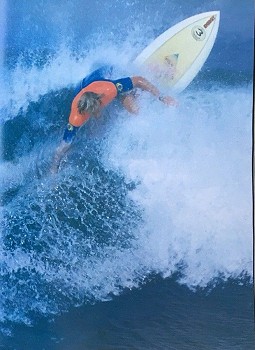
1981 Cue Pro-Junior Contast,
Narrabeen,
10 -11th and 17 -18th January
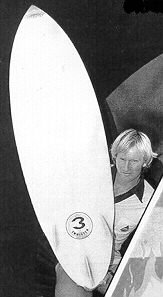
Sixth place to Warren Powell, of Lorne
Victoria, riding a Energy
Thruster.
Contest report by Nick Carroll (including
Warren Powell surfing and board portait photograhs, page 17) in...
TRACKS Magazine, Number, Pages
15 to 18 . March 1981
February 1981
The first design article on Simon Anderson's
Thruster appears in
Tracks Magazine, Number
125 Page 7.1981. See original article...
Nick
Carroll : Three Fins ? ? Simon Says ... Thrussttt !
May 1981
The rapid application of Simon Anderson's
Thruster design by other top riders and shapers...
Dougal
Walker :The Tri-Fin - Did God Mean It To Be?
Tracks Magazine
May 1981, Number 128, Page 16.
With continuing Australian influence,
MR - Bronzed Aussies - Cheyne - Rabbit, many US companies were eager to
grab a Australian surfer.
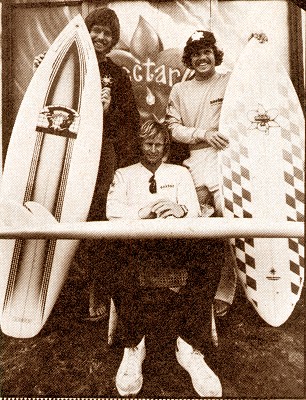
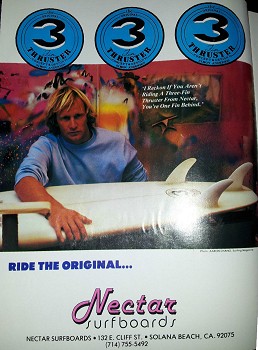
In early 1981 Nectar Surfboards signed
on Simon Anderson and were immediately 'saddled' with the latest design
fad. - the three finned Thruster.
The design was introduced to the US as
early as May 1981, and virtually ignored.
Image Right : Cropped from...
Nectar Surfboards Advertisement
Surfing Magazine Volume Number
May 1981 page 7
Reprinted in
SURFER Magazine Volume 22 Number
6 June 1981 page 13
Nectar Surfboards Pro - Series
Dean Hollingsworth - Simon Anderson
- Greg Mungall
132 E. Cliff
Solana Beach, California 920775
(714) 755-5492
|
 |
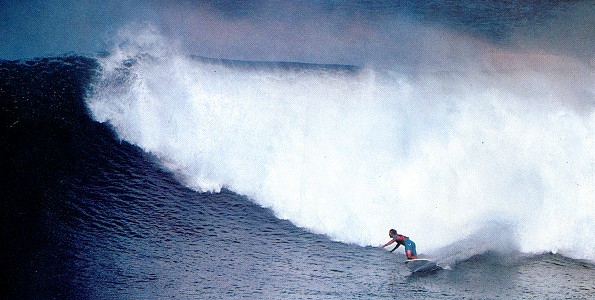
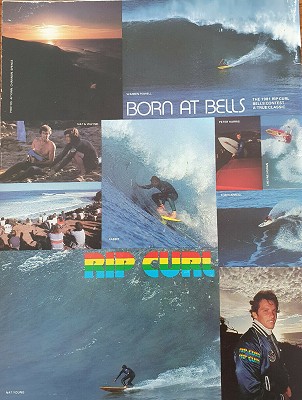
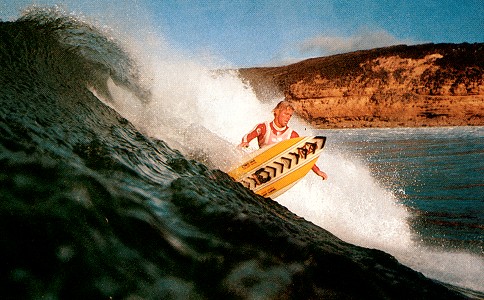
1981 Bell's Beach Contest
Remarkable not only for the largest competition
swells since 1965, but also for Simon Anderson's competitve introduction
of the Thruster design.
Not only did the board handle the extreme
conditions, but Anderson placed first.
Simon Anderson, Huge Saturday (Energy
Surfboards, Thruster)
Photograph : Peter Simons
Surfing Magazine Volume 17 Number
9 September 1981 page 35.
For film of this event see David Lourie,
Jack McCoy and Dick Hoole's Storm Riders, 1981.
The design had been previously
used by Warren Powell at the 1981 Pro-Junior (see sbove), and he also competed
at Bells with fellow Lorne surfer, Wayne
Lynch, in a "Legends vs. The World" demonstration event.
Wayne Lynch was impressed enough
with the design to immediately order three.
His previous experience with early 1970's
Tri Fin designs indicated the potential of Simon's fin setup.
Also note Tinkler Tail comments.
- Notes
from Personal Interview : 10 March 2005.
Film of Wayne Lynch riding one of his
Energy
Thrusters, see David Lourie, Jack McCoy and Dick Hoole's
Storm Riders,
1981.
As an example of the divergency in design
at this time, in second place at Bells was Cheyne Horan, riding a McCoy
Surfboards' single fin Lazor Zap.
Cheyne Horan, 2nd place (McCoy
Surfboards, Lazor Zap)
Photograph : Peter Wilson
Surfing Magazine Volume 17 Number
9 September 1981 page 34
Other competitors rode a variety of Twin
Fin (Mark Richards, Shaun Thomson) or sinle fin designs,
with a variety of models
Channel
Bottom Shane - Freefight
- Col Smith Surfboards
Clinker Bottom Byrne Surfboards
Drifta Hot Buttered Surfboards)
Common design features included ...
No-Nose, Egg or Foiled templates; Flyers;
Channels; and many tail variations.
On the large Saturday, many surfers were
under-gunned and opted to ride borrowed boards.
A sudden rise in demand for Energy
and Hot Buttered Surfboards was noted.
For example, Marc Price from South Africa
borrowed an Energy Thruster in preference to his Twin fin models.
Trials semi-finalist and future World
Champion Barton Lynch, had a fine example of big wave backhand surfing
when he shared a wave with
Wayne Lynch
(no relation).
RESULTS
1st Simon Anderson
2nd Cheyne Horan
3rd Tom Carroll
Derek Hynd
5th Mark
Richards
Terry Richardson
Richard Cram
Gabe Callaghan
Trials
1st. Bobby Owens
2nd. Mark Warren
3rd. Ian Cairns
4th. Mark Price
1981
Nat Tri Fin
Nat Young’s response to Twin fin 2 success, it featured his standard rail
and bottom designs with a No Nose template and two 4" side fins and a larger
centre Greenough fin.
 |
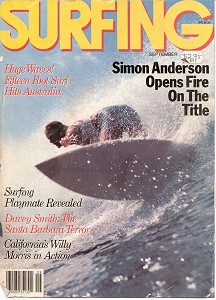
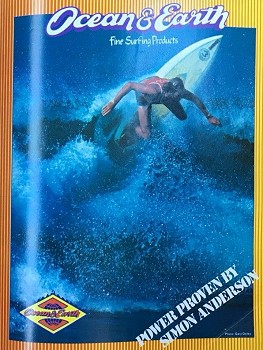
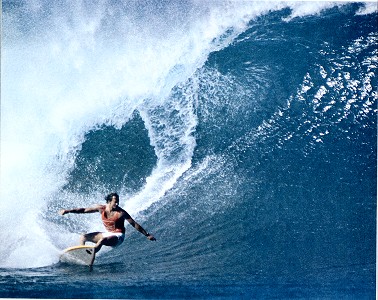
Image left :
Simon Anderson, Narrabeen, Coke
Contest, 1981.
Cover shot for Surfing Magazine
Volume 17 Number 9 September 1981.
Caption : ''After back to back IPS
wins on his revolutionary 3-fin Thruster, Simon Anderson looks to be the
man to beat in '81.''
Photograph : Aaron Chang
|
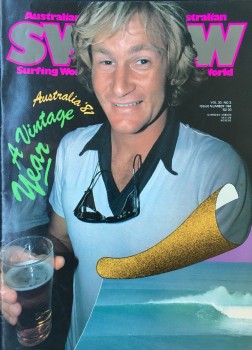
Simon Anderson
and Thruster,
Pipeline Contest,
December 1981.
Photograph : Aaron
Chang
Surfing Magazine
March 1984
Volume 20 Number
3 page 118. |
|
1982
Four Fin development of multifin experimentation
by Glen Winton following Mark Richard’s Twin fin 2 and Simon Anderson’s
Thruster.
Original design created by removing the
trailing fin of a five fin board.
Occassionally reprised, most often on
Slab kneeboards.
1985
Pro Series epoxy molded board, developed
by Bob McTavish from European sailboard technology.
Range of designs (plugs based on several
current pro-surfers’ boards) and colours with molded ‘markings’ and/or
adhesive ‘decals’.
1991
Fin Plugs alternative design to the long
used Banfield fin box, more applicable to the current thinner and lighter
shapes.
First models by FCS and AFS.
1991
Mac T: soft rails and deck board with
rigid plastic bottom in four models, developed from Morey Boogie technology
for the beginner’s market by Bob McTavish.
Other manufacturers produced similar boards.
See Morey-Doyle 1974
1994
Nadine Kahanamoku
attends dedication ceremonies for the Duke Kahanamoku Commenorative Park
on the northern headland of Freshwater Beach, 26 January.
A gift to the community
by Harbord Diggers Club, Warringah Shire Council and Freshwater Life Saving
Club, it features a statue of Duke Kahanamoku surrounded by mosaic plaques
dedicated to Australian surfing champions.
1998
The Nugget:
Geoff McCoy’s No Nose/ Lazer Zap design reprised, this time with standard
Thruster fins.
1998
Phazer: Bonzer / Thruster combination
by Rusty Priessendorfer (USA)
surfresearch.com.au
REFERENCES FOR THIS SECTION
BOOKS
1992 Stell, Marion K. :
Pam Burridge
Collins Angus & Robertson Publishers
(Australia) Pty. Limited
A division of Harper Collins Publishers
(Australia) Pty. Limited
25 Ryde Road, Pymble NSW 2073, Australia
1997 Warshaw, Matt : Surfriders
– In Search of the Perfect Wave
Tehabi Books, Inc. Collins Publishers,
10 East 53rd Street, New York, NY 10022
1983 Young, Nat with McGregor, Craig
: The History 0f Surfing
Palm Beach Press,40 Palm Beach Road, Palm
Beach NSW 2108
FILM
1985 A History of Australian
Surfing Nat Young.
MAGAZINES
WEB SITES
surfresearch.com.au