surfboards in australia since 1900
 |
surfresearch.com.au
dougal walker
: the tri-fin, 1981
|
Dougall
Walker: The Tri-fin- Did God mean it to be?
Tracks
May 1981 Number 128, page 16.
Introduction
The first entry in a
four page design feature titled Australian Unorthodox :
The Religion of Oz Design.
Published
three months after Nick Carroll's article on Simon
Anderson's Thruster
in Tracks
Number 125, Dougal Walker notes the rapid
application of the design by shapers such as
Ronnie Woodward at Hot Buttered Surfboards and other top
riders, including Tom Carroll and Mike Newling.
Note that in the same issue, Phil Byrne writes that ardent single
fin rider, Tom Carroll has been tempted
by his clinker-bottom twin fin boards.
Other contributors are Terry Fitzgerald, Rod Hocker, Geoff McCoy, Michael Rae, Phil Byrne, and Col Smith (Newcastle).
See below.
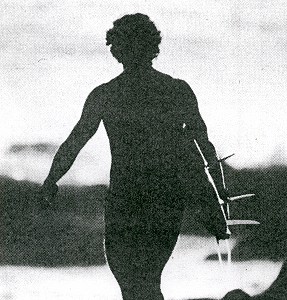
1.
Thruster
|
THE TRI-FIN
DID GOD
MEAN IT TO BE ?
Dougall
Walker
|
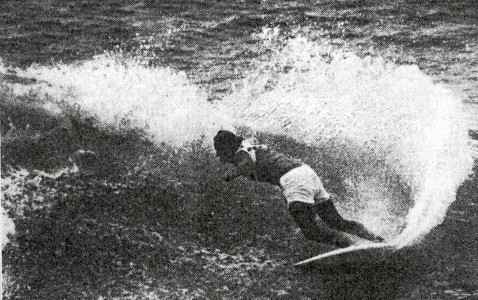
2.
Simon Thrusting
|
The reason for the birth of the
trl-fin is easy to see.
Twin fins are great for small waves, being fast and
manoeuvrable, but when put into tight spots on larger waves they
become hard to control and subject to spinning out.
Single fins are the answer to the
problem of power control, but are limited in their small wave
performance.
This is proved time and time again in high-level competition.
So the answer, you might say, is
to ride a twin fin in small surf and a single in large; but if
you try to put this into practice (as I have for the past six
years), you will find it is about as easy to adjust to the
difference as it is to surf with a broken leg.
The solution is a combination of the two - the tri-fin.
Although the idea of three fins
is not a new one, the concept of having both twin fin speed
and single fin stability sharing equal prominence is a
direction which, for some unknown reason, had never been tried
before.
In the past, three-finned boards had always been made with a
normal single fin paralleled by two very small fins on each
rail, or by a twin fin with one baby fin on the tail as a
stabilizer.
Simon Anderson's ideas on the
tri- fin were totally different.
He wanted a board that would generate speed and manoeuvres as
well as being able to get into the critical positions that
Anderson is renowned for.
The ensuing result was a board
which, to be quite honest, looked different if not weird.
Many people at this stage, including myself, were sceptical,
saying that it was just a gimmick and could not possibly work.
Many reasons for its probable failure were put forward such as
"creating drag" and "being too stiff" but once Simon was seen
riding his new brainchild most critics were made to eat their
words.
But still doubt remained as to
how well the average surfer would perform on the new design as
it is common knowledge that Simon is not exactly an average
surfer and it may have been that a surfer of less power and
agility would not have the same success.
I, along with a few of Simon's
friends from Narrabeen, decided it was worth a go.
I rode Simon's board a couple of times and found it to be
extremely fast but the board was made for a chap Simon's size
rather than little twelve-stone me.
I was interested enough to take
Simon's idea to my own shaper, the number one seed at the Hot
Buttered factory, Ronnie Woodward.
We decided to stick with Simon's basic planshape as well as
fin size and placement, but to scale the whole board down
somewhat.
This board is 6'1" by 19 3/4", a winged squaretail.
My first surf on this board was
memorable -4-5' lefts.
Within two or three waves I seemed to have adjusted to it and then started
experimenting.
I found I was able to stand with my back foot over the twin
fins and get great drive in my bottom turns and cutbacks then
being able to move my back foot to just in front of the back
fin and being able to make radical but controlled directional
changes in hollow sections or coming off the top.
This board I found to be a little less manoeuvrable than a
twin fin but definitely looser than a single and the problem
of tail drift found in twins was eliminated.
Others who had tried the experiment were also pleased and the
improvement in their surfing was obvious.
Gradually tri-fins began to spring up in surfing "hotspots"
such as Narrabeen, Newport and Manly, in a similar fashion as
twin fins did just before "twin fin madness" hit a couple of
years ago.
I was quite content to stick with this board and not
experiment any more but this was changed when it hit a
telegraph pole at 50 miles an hour after I had carelessly tied
it to the car roof with just a leg rope.
"Lifeline" was all that stopped me from doing myself in.
The next tri-fin I had made was
directed for use in small waves with more thickness in the
tail and less nose area.
It was excellent in small waves but the extra area and
thickness in the tail had shortcomings in larger waves.
For this reason I had a rounded
pin tail shaped with less area in the tail than my previous
tri-fins.
I found it performed very similar to a single fin except with
greater manoeuvring speed.
I have ridden tri-fins in waves ranging from 1-8' but I
believe they are most advantageous in the 3-6' range.
I feel to ride waves of 8' or bigger the reliable single fin
is the only equipment to use but I find that the tri-fln is
the best board for all- round conditions and with continuing
experimentation within the industry it has the potential to
make the same impact on surfing as the twin fin revolution of
the late 70's.
With surfers such as Simon
Anderson, Tom Carroll and Mike Newling surfing and ripping on
tri-fins I think that potential Is definitely there.
Dougall
Walker
|
1. Thruster
Photograph: Peter Simons
2.
Simon Thrusting
Photograph: Chris Elfes.
|
|
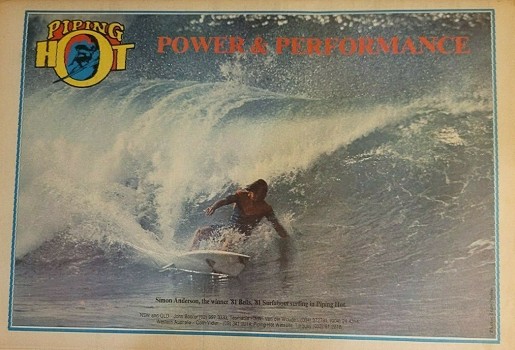
Back cover of
Tracks October 1981
Piping Hot
Wetsuits
Simon Anderson, the winner '81 Bells, '81
Surfabout surfing in Piping Hot.
Illustrating the effectiveness of his design,
Simon's the outside rail fin is clear of the wave while
the two other fins are proving excellent control on this
Narrabeen (?) wave.
To be picky, the extra
point of stability of the very stylish left arm drag is slightly
cheating. |
 |
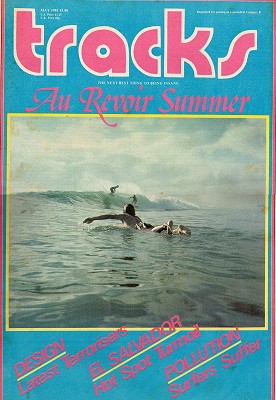
Tracks
May 1981
Number 128.
|
|
surfresearch.com.au
Geoff Cater (2000-2021) :
Dougall Walker : Tri-Fin, 1981.
http://www.surfresearch.com.au/1981_Walker_Trifin_Tracks_May_n128p16.html