pods for primates : a catalogue of surfboards in australia since 1900
home catalogue history references appendix

Click to return to souces menu
surfresearch.com.au 
 bob mctavish  : break the straight line, 1967- 8 
"LADIES AND GENTLEMEN AND CHILDREN-OF-THE-SUN."
Bob McTavish
circa 1967- 8
Surf International magazine December 1967 - January 1968 Vol 1 No 2  page 9
Copyright Bob McTavish 1967-8.
A ground breaking analysis of the future of surfing performance at the end of 1967.

The central dictum is to "Break out from the straight line" and adjust to variations in wave speed by linking a series of turns to maintain momentum and travel at maximum speed across the face.
This was a radical alternative to the accepted approach of adjusting to variations in wave speed by accelerating the board with trim and using stalls or turns to slow the board.
McTavish had detailed this later approach less than six months earlier in:
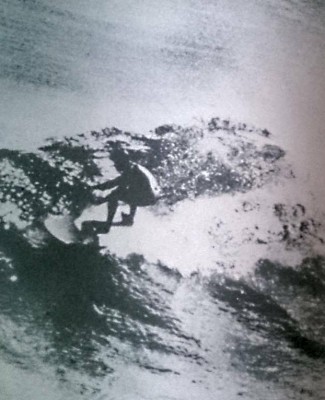
Bob McTavish is in this wave. He probably had a plan to get out of it.: -

This "constant velocity" style virtually established the direction of performance surfing for the next generation.
It was dramatically put into practice by Wayne Lynch, whose surfing in Paul Witzig's Evolution, 1968, had world wide influence.


LADIES AND GENTLEMEN AND CHILDREN-OF-THE-SUN.

Today, surfing's main school is the turn the board, walk to move out, get forward for trim, adjust a little across the board, backpedal like a log-roller to haul the board into a cut-back type.
Noseride, slide white water, stick your body into any nearby mass of fluff.
CALL IT INVOLVED, "in", New Era, high performance, aggressive.
Call it anything.
Plenty of thrills in it, deep moving out, but, oh! in a straight line.
On the tip, hanging well over, feeling good, but that crazy straight line again.
Nice wall.
Walk up some, hold back on the inside rail, let it go!
Walk up for full trim.
Moving like crazy!
But. ..in a straight line.
BREAK OUT FROM THE STRAIGHT LINE.

Go fly ...go free. ..up up and away down the barrel. ..down down and yup!
Drop, bounce, thrust. ..up, down thrust. ..cut!
SOUNDS BONZER.
HOW PLEASE?

Get your frame on the all-new
FANTASTIC SIXTY- EIGHT MODEL VERTICAL PERFORMANCE CUT- DOWN THRUST- UP INNER SPACE PROBING ZAPPER.

Kid's crazy.

SHALL I EXPLAIN FURTHER OR JUST LET THE NEWS SLOWLY, INEVITABLY, CREEP OVER THIS CARVE-UP KIDDY?
I SHALL PUT IT DOWN, HE MAY PICK UP AS HE SO DESIRES.

Here's putting down news.

Surfing equipment evolution has swung into a new phase.
A huge new breakaway direction has sprung out of the conventional surfboard move.
The entire thought behind this new flow is freedom.
The entire freedom.
This is not surfboard riding.
This is wave riding.
These are not surfboards, these new vessels.
A board is a rigid flat plank for standing poised upon, balancing, defying waves from flinging.
The little wide-back machines, vessels or flying saucers are mind vehicles, just like your bodies.
Performing, like part of your body, the new unit will take your conscious many fantastic places, in some fantastic ways.

How?
Elimination of two feet of board.
Limitation of walking.
Sounds like you're just going to hang around the tail.
Right.
Hang around upside down, sideways, doing 360 degrees, flying.
You see, the turn area doubles as a planing area.
It's wide and flat.
Many square inches of plane - acceleration and speed.
Fraction of a second from banking to full planing.
Maximum speed one-half second from banked on edge.

You can get yourself from some deep hole, out and up under the lip in the blink of an eyelid.
Up under the lip the speed you have allows you to bank up under there, much like a toboggan in an ice trough deal.
Centrifugal force.
The force that gave you the speed in the first place.
That wide, wide tail will not mush in.
That short length (7 feet and up) can be spun into a cut-back without ever digging and sinking.
Ridiculous manoeuvrability.
Especially the offsets.

Vertical performance.
Broken the straight line at last.
Replace nose riding as World's No. 1 fad?
Why not?
It's limitless.
Some exciting manoeuvres have been developed already, after only a few months of feeling out.
Try these.

The Superman.
First recognized and acclaimed at North Avalon, one Sunday nine months ago.
Ted Spencer on a standard board.
Blast up wave at great rate.
Two-thirds up, pull board out towards beach while still climbing.
Rise completely clear of the water, twist and drop back in after stall-out.
Best performed where you'd normally throw a conventional curl cut-back.
Desirable size 4 feet and up.
New equipment's great vertical speed and lightness make it a cinch.

The Flypaper is the most descriptive name yet for the hanging under the curl banked over so your body weight is almost horizontal, pinned to your board by centrifugal force.
Tremendous fun.
George Greenough developed it.

Really small arc turns are frequent on such small boards.
Really wind up some G forces in these tight powerful turns.
Feel your back ache and legs nearly buckle from rapidly doubled weight.

All kinds of bitchin climbs and drops of all classes.
Anything vertical.

At this early stage of refinement, it looks as though there will be no loss of noseriding, in fact probably a vast improvement over even the "noserider" shapes.
How?
By moving the entire controls to the nose as soon as the surfer's weight is up front.
Perhaps even taking fulcrum up to a couple or feet from the tip.
Virtually still turning over the fin but on the nose.
Imagine the sensation of powering a full banked turn up the front, with the tail snaking along behind, even whipping along behind, like a mini minor's front wheel drive feeling, but really amplified.
Take off on the tip, take the complete drop just off vertical, power into a full blasting turn with your foot over the nose.
Nice?

A great help is a changeable fin slot, it opens the range vastly.
Shallow drop- out fins, raked-back soft flex skegs, hot foils, thrust fins.
A nose slot for real nose performance.

Farrelly, Spencer, Young, Platt and this kid, were all riding considerably different styles of units at time of writing, six weeks before news-stands.
The wide range will give many results - by now we'll have the whole thing pretty wired.

Oh, yes.
It's all been done before.
Belly boards, kneeling did it.
And even Foley boards five and six years ago had the feel.
But now we're standing up digging it and doing it about doubly as well.


Surf International Magazine  Vol 1 No 2
December 1967 - January 1968   page 9
Copyright Bob McTavish 1967-8.
NOTES
1. Ground breaking analysis of surfing performance that rejects the accepted approach -
detailed in Bob McTavish is in this wave. He probably had a plan to get out of it.: -
and  establishes the dictum....
"BREAK OUT FROM THE STRAIGHT LINE.".
This virtually established the direction of performance surfing for the next generation.
It was dramatically put into practice by Wayne Lynch, whose surfing in Paul Witzig's Evolution, 1968, had world wide influence.

2. In design this is achieved by: "Elimination of two feet of board."
This translates as approximately as a board 7 foot long.
Dimensions would continue to shrink and, by 1970, the common board length was around six feet.

3. "The little wide-back machines" ( Vee Bottom Stubby) were only a brief stage of design development.
By mid 1968 the wide Vee Bottom had been replaced by a variety of designs -
foiled Pin tails,  small square tailed Trackers or Double-ender round tails.

4.  Wide tail boards would not re-emerge till 1978 with the No-Nose, typified by Cheyne Horan/Geoff McCoy's Lazer Zap.

5. Vee became a standard feature in bottom design, but has never been as deep as in these designs.

6. The use of fin boxes was initially limited, but the introduction of the Bahne box in 1970 saw the development of extremes in fin design.
Nose fins have yet to become standard features...A nose slot for real nose performance.
Also note the use of thrust fins - an term later appropriated by Simon Andeson's Thruster, 1981.

7. The dates of Surf International magazines are not specified in the publication details.
The article notes that it is written "six weeks before news-stands."
This was the standard printing lag and it is difficult to accurately date when the article was written.
Certainly with the rate of experimentation in this period, by the time the article was published, board designs had been further refined.

8. Note the inclusion of Midget Farrelly at the forefront of these design changes.
Midget Farrelly's role in this period was largely ignored by the surf media of the time and is rarely credited in retrospective artlicles.

9. There was an accompanying image, but I am unsure what it was.

10. The article does not have a formal title - the first line is quoted.


Click to return to souces menu
surfresearch.com.au

home catalogue history references appendix