surfresearch.com.au
 |
surfresearch.com.au
the
catalogue #217
|
| 1969
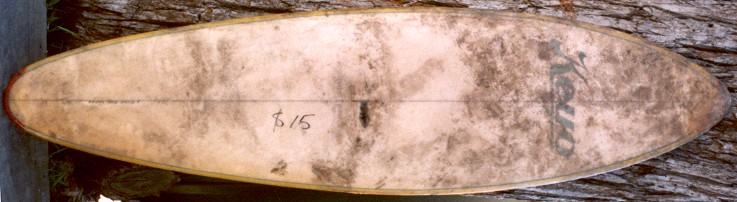
Keyo Side Slipper 6 ft 2 1/2" - shaped by Steve
Lennard |
#217
|
MANUFACTURE
MANUFACTURER:Keyo
Surfboards Brookvale Sydney
SHAPER:
Steve Lennard
DESIGN:
Side Slipper
DESIGNER:
Reno
Abellira Australia : Midget Farrelly -
Terry Fitzgerald
SPECIFICATIONS
CONSTRUCTION
Foam blank with
dark red glueline, Volan glass, spray/tint/pigment?, fin
box.
DIMENSIONS
|
Length
:
|
6
|
ft |
2
1/2
|
inches |
|
|
|
Width
:
|
19
|
inches |
|
Wide
Point :
|
+ 6
|
inches |
|
Nose
:
|
14
1/4
|
inches |
|
Tail
:
|
12
1/2
|
inches |
|
Thickness
:
|
3
|
inches |
|
Pod
:
|
?
|
inches |
|
Nose
Lift :
|
|
inches |
|
Tail
Lift :
|
|
inches |
|
Weight
:
|
|
kilos |
|
Volume
:
|
|
litres |
|
Other,
Finbox:
:
|
7
1/2
|
inches |
@ |
6 1/2 inches |
|
|
FEATURES
Nose:
rounded
Tail:
rounded
Deck:
S-deck,
domed
Bottom:
flat
Rails:
50/50 in nose and soft down rail from 1/3 rd back, harder in the
tail.
Rocker: distinct
nose
lift
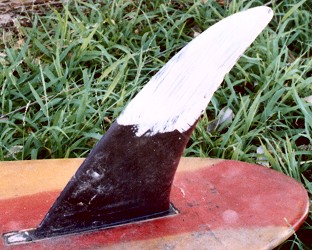
FIN
8 3/4" x
6" base
@ 6 1/2'',
Molded
black plastic
Fin box
with plastic
clip lock
Rear
leg-rope hole. |
|
DECOR
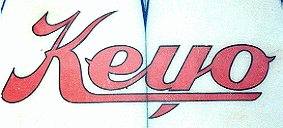
DECAL/S
Deck:
Keyo
green script at nose
Not image
left
Bottom:
MARKINGS
Deck:
Shaped
Steve Lennard 2853 6'2''
- pencil at tail
Bottom:
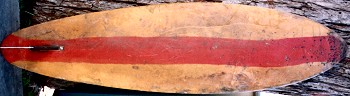
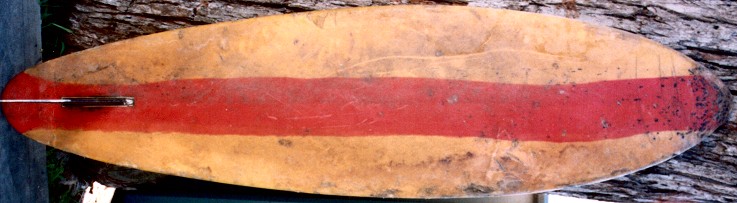
COLOUR
Deck:
Clear with yellow rail lap, light blue pinlines
Bottom:
Yellow
spray or laminated tint,
plus red
stripe
squegeed through laminate. |
|
NOTES
BOARD HISTORY
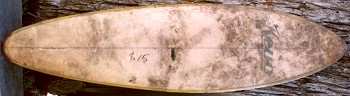
Purchased Nowra
Tip, Oct 2001
Poor condition
due
to extensive repairs in a variety of methods - note blob of chop
strand
mat on nose, left.
Unusual squegeed
red stripe decor.
Photogrphs on
purchase.
Board currently
being repaired /restored?
DESIGN HISTORY
The Side Slip (Fin
Drop
Out Stall) was first identified in 1967 by Bob McTavish in
an
article titled
bob
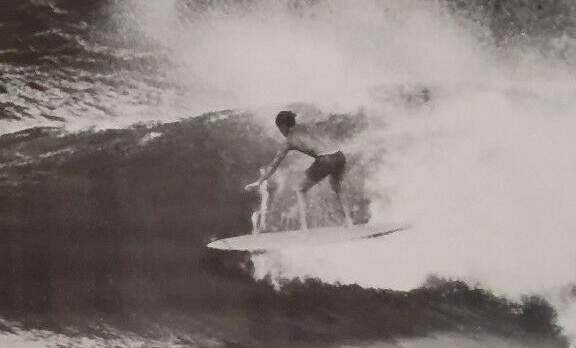
mctavish is in this wave. he probably had a plan to
get out of it.
Surfing World
January 1967, pages 15 to 21.
A detailed
compendium of manoeuvres of the era , it includes:
FIN
DROP-OUT
STALL
is by far
the most efficient, most difficult.
If
performed
correctly, it can eliminate a cutback.
Everyone
has
experienced a fin drop-out and its main effect - loss of
forward motion.
When
emerging
from a hot hollow section it's possible to remove the fin
from the wave
intentionally, and establish a sideways drift towards the
beach.
Perfect
stall.
No forward
motion.
As the wave
recovers and starts to wall, drop the fin in by
back-peddling, recover
some sort of trim, and move out.
Nat Young
and I spent two days at Noosa working on this, succeeded
about four times
each.
The big
problem
is knowing just when the fin is going to break out.
We are
working
on special nose and fin shapes for this purpose.
IMPORTANT : Not
to
be confused with "slipping the board " - a nose riding manoeuvre
that
does not disengage the fin.
As demonstrated
by Miki Dora in Bruce Brown's The Endless Summer, 1964.
This was
described
by Bob McTavish in the above article as:
SIDE SLIPS can be performed
anywhere on the front half of the board.
They throw the board out of an
inside
rail stall, and set up a highly efficient trim for half a
second while
the board is banked outwards.
This half second or so allows the
board to leap forward.
The acceleration is noticed as
soon
as the sideslip is checked, and the momentum gained from the
small drop
is redirected.
Side slipping became
an recognised manoeuvre in 1969, as demonstrated in John
Severson's
Pacific Vibrations, 1970.
Particularly well
executed by Jock Sutherland, the film also featured extreme
spinning 360's.
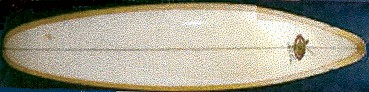 |
Image left :(Wide tail) Inter-Island
Flip Tip.
What Reno rode in '69!
www.oneworldsurf.com/restorations
16 December 2000 |
This specific
design
was first noted at Huntington Beach Contest, 1969 - design by
Reno Abellia
for
Inter-Island
Surfboards, Hawaii.
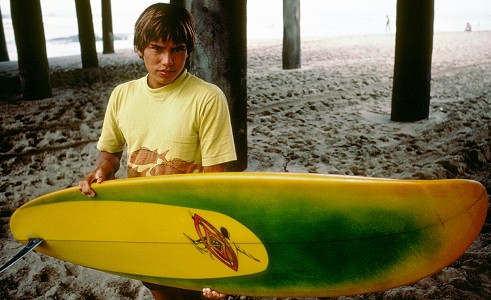
Reno
Abellira
and Inter-Island Side Slipper with hyper-kicked nose,
Huntington
Pier,
California, 1969.
Photograph Art
Brewer
- Nat Young : History,
Page
104
To initiate the
side slip the fin had to be dis-engaged, so the design
critically relied
of using smaller and inter-changable fins. Fin boxes were
virtually a required
addition.
This demand
encouraged
research into fin boxes and by 1972 the Bahne system became an
industry
standard.
A flat bottom
with
a down soft rail that reduced the possiblility of catching edges
was used
to control the side-slip and re-engage the fin
Subsequent to
this
design down soft rails became an industry standard.
A hyper kicked
nose
reduced the chance of burying the nose and helped in recovery.
Nose lift and
bottom
rocker variations would be extensively explored by designers for
the next
30 years.
In Australia the
down soft rail, with a release edge, was developed through the
experiments
of Gordon Merchant. (Find relevant articles)
In Australia the
design was taken up by Midget Farrelly (Farrelly Surfboards)
and
Terry Fitzgerald at Shane Surfboards.
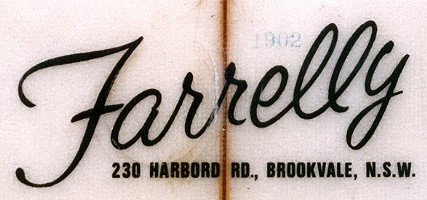
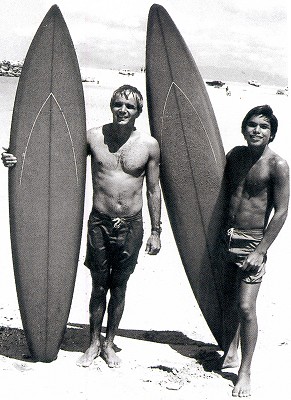
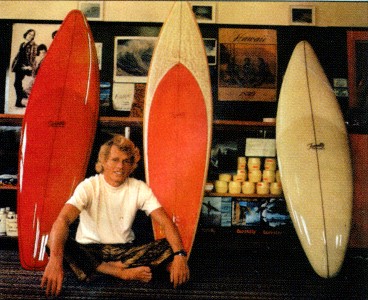
Farrelly Surfboards Advertisement,
circa 1969.
Re-printed in Walding,
page 76.
Note : The Volan deck patches
and red board on the left has
a much wider tail than the two
to the right.
-
|
 |
The only board that allows
the surfer to ride sideways,
backwards or in a spinning circle.
The slipper has advantages a conventional
board lacks
Speed comes easy, control is super
positive through the
flat bottom and low, soft rails.
Basically, the board is longer, thinner
and a diamond shape in
outline.
The fin is smaller to facilitate release
only when desired.
The rails amd bottom allow a shallow draft
fin in any case, and
the fin used is both adjustable and removable.
Midget has ridden this shape in most every
kind of wave.
Reef surf was where the speed from the
bottom and the rails was
best put to use.
In beach break the board responded to all
manouvres and created
new freedoms with side slips to hold curl position and 360's
to fill the
gap between peaks of sections.
Fantastic sensations can be had riding
whole sections backwards.
The most average surfer is going to find
this surfboard easy
to ride.
Thje side slipper can't be compared to any
other board that has
gone before it.
The only limitation this surfboard has is
the surfer who rides
it.
Farrelly
Surfboards, 230 Harbord Road, Brookvale 2018
Phone : 939-1724.
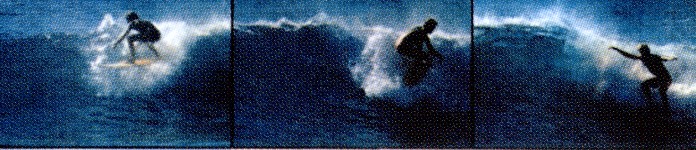
The
validity of slide
slipping as a manoeuvre was hotly debated and at the 1970
World Contest
it appears that the the judges were not impressed.
Although Reno
Abellira
and Midget Farrelly rode Side Slipper designs, there are no
contest photographs
of them (or others) side slipping.
The situation is
similar in Paul Witzig's Sea of Joy, 1971.
Due to the
lack of
suitable wave conditions, the required high skill level, the
potential
for confusion in crowed conditions and/or the rejection
by contest
officials: side slipping receded dramatically.
While the Side
Slipper
appeared to be a minor deviation, it did have a major influence on design.
1. Down soft
rails
became an industry standard.
- encouraged
research
into fin boxes ( by 1972 the Bahne system became an industry
standard).
The manoeuvre,
despite
all predictions, would re-appear in the late 1980's initially as
the Floater,
credited to Mark Sainsbury.
In an extended
re-entry
the rider disengages the fin and slides the board across the
back of
the crest.
Such a manoeuvre
was unthinkable in 1969 without the performance, particularly
the recovery
control, provided by Simon Anderson's Thruster.
Along with the
development
of getting air, modern surfing since the dawn of the
21st century commonly incorporates
variations of the side slip.
Due to the ten year
gap, the connection between side slipping in the 1969 and the
1980's was,
understandably, largely ignored by commentators.
REFERENCES:
Other Keyo
surfboards
See
Keyo Surfboards
Film
John Severson :
Pacific Vibrations, 1970.
Paul Witzig : Sea
of
Joy, 1971
Bruce Brown : The
Endless
Summer, 1964
Books
Nat Young : History,
Page
104
Walding,
page 76.
CONDITION:
5
surfresearch.com.au
Geoff Cater (2001-2022) : 1969 Keyo Side
Slipper, 6ft 2".
http://www.surfresearch.com.au/00000217.html