 |
surfresearch.com.au
polynesian
surfriding : other islands
|
polynesian surfriding : other islands
| home | catalogue | history | references | appendix |
|
surfresearch.com.au
polynesian
surfriding : other islands
|
The island
settlement was discovered in 1808 by Captain Folger in the
Topaz, who reported his surprising find
to the British
Admiralty.
However there
was little official interest in pursuing what was now merely
remnants of the mutiny.
Whereas
European influence on Pitcairn was principally evident in a
resurgent Christianity, Polynesian culture
maintained a
strong bond with the ocean, most notably a continuation of
surfboard riding in relatively difficult
conditions.
A number of
vessels visited the island before the Surry in 1821,
when the inhabitants were observed surfing on
small boards.
Crew member,
Dr. Ramsay reported:
"The
Capt returned and told me that after loading the boats
which was done by swimming through the
surf with
the fruit, they to his great astonishment amused
themselves by taking a flat board about 3
feet
long, on the upper side smooth and on the under a ridge
like a keel, and went out on a rock and
waited
till a large breaker came and when the top of it was close
on them, away they went with the
piece of
wood under their belly on the top of this breaker and
directed themselves by their feet into
the
little channel formed by the rocks, so that men the surf
left them they were only up to their knees
in water.
They are
very dexterous in keeping off the rocks which to us would
be inevitable death."
- page 7.
While the
Pitcairn surfboards were built of local timber, the
incorporation of a "ridge like a keel" appears to be
unique and is
not recorded in any of the reports of traditional surfboards
of Tahiti or the Hawaiian Islands.
It appears to
be a design feature intended to give the board directional
stability (commonly known as a fin and
usually
accredited to Tom Blake in 1935), developed by a combination
of the Tahitian native design and the
European
seaman's knowledge of boat building.
Alternatively,
there is a very remote possibility that it was added to give
board structural strength.
In 1823, a
British whaler, Cyrus, left two of her crew on
Pitcairn, John Buffett and John Evans, who provided an
injection of
European influence, but this was minor in comparison to the
significant social dislocation resulting
from the
arrival of Joshua Hill in 1831.
Due to the
pressure of an increasing population on the small island,
several attempts were made to relocate the
inhabitants
before there was a major relocation to Norfolk Island in 1856,
where the descents of the Bounty
mutineers'
continued their enjoyment of surfriding.
Ramsey, Dr.
David: The Scrapbook of the Log of the Ship "Surry",
Pitcairn Island April 1821.
Acquired from
The Pitcairn Islands Study Center : Historic Papers
http://library.puc.edu/pitcairn/studycenter/store/papers.shtml
Dutchman
Jacob Roggeveen, in command of three vessels, was the first
European to sight Rapanui on Easter Day in 1722.
He is said to have reported the islanders "swam out to
the visitors by the thousands, accompanied by small reed
skiffs."
Visiting Rapanui in 1827, Hugh Cuming noted the islanders swimming out to the vessel with supplies for the visitors, principally plantains (bananas), a practice reported on many other Polynesian islands.:
“On
standing into the Bay on the West side of the Island which
appears to be the most highly
cultivated,
we
saw the Natives collected in great numbers on the Rocks
and on nearing the shore
they took
to the Water and swam onboard each person having a small
Net or Basket or a Bunch of
plantians
on his Back for Sale or barter."
These goods were exchanged for fish hooks (made from metal) and timber, indicative of the lack of local resources:
"they where [were] particularly partial to Wood and Fish hooks for one only the[y] gave a Net or Basket full of Fruit or Vegetables."
The islanders' skill at swimming is common to many reports of early European contact across the Polynesian triangle:
"Swimming at which the[y] are very expert as I ever witness'd,"
Without acces to canoes, the Rapanui's had constructed diminutive craft made from small shrubs to assist their swimming in difficult conditions:
"when
the Sea becomes rough which occurd in the afternoon some
of them made use of small Balsas or Bundle of Flags about
2 Feet long, Six Inches thick at one End and tapering to a
point at the other.
this
the[y] place betwixt their legs to assist them in
Swimming"
While the
small "Balsas or Bundle of Flags" were not surfboards, they
were certainly an elementary floatation device of considerable
assistance.
Fischer
comments in his notes on the text:
"Cuming
further notes (MS pp.7-8) how the Rapanui make use of “small
Balsas or Bundle of Flags
about 2 Feet
long” that taper to a point at each end to assist them in
swimming out to the Discoverer,
this pora
(type of raft) was first mentioned by Lisiansky (1814:1:58).
(Footnote) 9.
In footnote 9, Steven Roger Fischer suugests the craft were of Polynesian origin and are not diretly related to the reed boats (pora) as used by ancient Peruvians:
"9. For
a physical description of this raft, see Métraux
(1940:208).
Pora were
also used for surf-riding.
Their use
most likely originated uniquely on Rapanui for want of
appropriate wood to construct
proper
vaka; i.e., they would probably not represent an
importation of similar Peruvian craft, as
Heyerdahl
has repeatedly suggested."
To be sure of a favourable reception they
brought us bananas, sweet potatoes and yams enveloped in
their reeds."
The swimmers also brought Petit-Thouars a most peculiar
wooden image representing a double head without body.
The eyes were inlaid with black obsidian inserted as
pupils into white bone.
Although he did not land, Petit-Thouars sailed close
enough along the coast to notice two types of dwellings.
He described the boat-shaped reed houses as large and
bright when seen from the sea, and added: "One could also
distinguish a very great number of small houses, black and
round like ovens."
| Amongst a plethora of
divergent theories as to the origin of the Easter
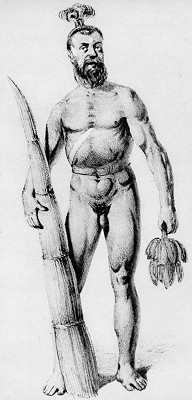
islanders, Hyderdahl noted: Thompson (1906) considered the Polynesians as one of the purest of all known people, and suggested they were Caucasians of the Alpine branch who had learnt the art of seamanship from the Phoenicians before they reached the Persian Gulf and pushed on to Polynesia by way of Sumatra. - Heyerdahl: Easter Island (1989) page 135. Also note: Métraux, Alfred:Ethnology of Easter Island. Bernice P. Bishop Museum Bulletin 160, Honolulu, 1940, page 208. Lisyansky, Yuri: Voyage round the world in the Ship Neva. Lisiansky, London, 1814. A man holding a
small pora on
Easter Island was
shown in an illustration by Radiguet.
Published in du Dupetit-Thouars: Voyage around the World on the Frigate Venus, Paris, 1841. 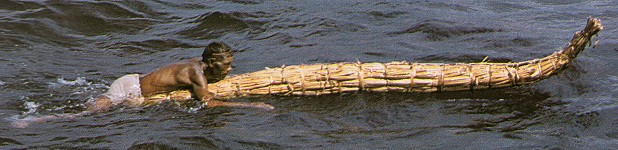 Rapanui
islander padles a replica pora, circa 1985.
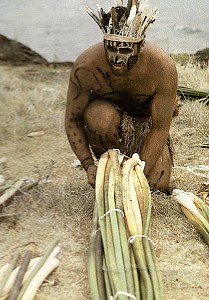
Heyerdahl: Easter Island (1989) page 21. Construction of replica pora, Rapanui, circa 1985
Heyerdahl: Easter Island (1989) page 21. |
  |
|
5.4 Samoa
1861 George Turner : Surf Riding in Somoa. 1866 W. T. Pritchard : Surf Riding in Somoa. 1887. William Brown Churchward: My Consulate in Samoa: A Record of Four Years' Sojourn in the Navigators Islands. R. Bentley and Son, 1887. Reprinted by Southern Reprints, 1987. This work follows the travels of William Brown Churchward who, in 1882, became the British Consul in Apia, Samoa, and deputy commissioner for the western Pacific. It covers much of the history of Samoa over the period as well as covering a range of tropics from pigeon hunting and oratory, to religious rituals and tattooing. https://books.google.com.au/books/about/My_consulate_in_Samoa.html?id=1DpSxgEACAAJ&redir_esc=y Pages 137: On the water, surf riding is greatly in vogue when the sea is in a fit condition ... Page 139: the line of white surf appears to be closely dotted with brown spots, the heads of the bathers; Noted by Bob Green with thanks, 2020. 1901 Also note Dr. Augustin Kraemer: Die Samoa-Inseln Unfortunately the text is in German, the title translates as The Samoa Islands - Draft monograph with special reference to German-Samoa. However, it does include one photograph of surf riding in Samoa on page 401, right. Das Wellenengleitspiel roughly translates as wave play, the term in parentheses (Fa'ase'e) presumably the Samoa name. The image shows a large number of participants, some of whom have short body boards. |
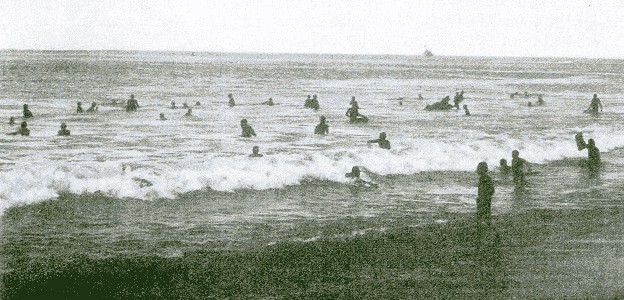
No. 43 Das Wellenengleitspiel
(Fa'ase'e) - cropped. |
In an article for the Journal of Polynesian Society (1902, page 215), S. Percy Smith, detailed the canoes and fishing practices of the Nuie islanders, drawing parallels with other Polynesian craft:
Like all
Polynesians, the Niue people are expert canoe men.
Even to
this day they go in their little canoes right round the
island on fishing expeditions, on the weather side of
which rough seas are experienced.
Every
dark night fleets of canoes are to be seen along the
leeward coast with their bright torches ('hulu') engaged
in catching flying or other kinds of fish,—it is a very
pretty sight to see them.
A canoe
is a 'vaka', as it is in all other parts in some form of
that word; but 'foulua' is also a
canoe,
now applied to ships, which are also called 'tonga'.
The
canoes have outriggers, which are fastened by two arms to
the canoe itself.
The hull
is dug out of a log, with a topside lashed on and enclosed
for a space both fore and aft.
The seams
are caulked with a hard gum called 'pili', and are often
ornamented with shells and a little very rough carving.
The Niue
canoes are more like the 'va'a-alo-atu' or Bonito canoes
of Samoa than any others I have seen, but they are not so
well-finished nor so long.
A Niue
canoe is from 12 feet to 25 feet in length, about 18
inches or 2 feet deep, and somewhat less in width.
They
carry from one to three or four people.
The
outrigger is called a 'hama'; a double canoe is
'vaka-hai-ua', but not now in use.
The
paddles are termed 'fohe', and are shaped as seen in Plate
6.
With
these the canoes can be propelled at a considerable pace,
and they sometimes sail, the sail being a 'la', the mast a
'fane'.
The
natives manage their craft very adroitly in coming onto
the reef in rough weather, for at that time the little
chasms ('ava') in the reef are not available for landing
purposes.
The final comment, "manage their craft very adroitly in coming onto the reef in rough weather", probably indicates some form of canoe surf riding, a familiar practice across Polynesia.
In a section on Amusements (page 217), Smith notes:
"Surf-riding was another amusement, called 'Fakatu-lapa' or 'Fakatu-peau', which again is common to the race everywhere, but seems to have been practised more in Hawaii than elsewhere."
Smith, S.
Percy: Nuie Island and Its People.
Journal of
Polynesian Society, Volume 11, Number 4, 1902, pages
195-218.
| 5.6 Marquesas Islands E. S. Craighill Handy notes: Surf riding (hoko) was a sport for men, women, and children, where there were beaches that made it possible. Surf riders never stood, erect as in Hawaii. The surfboard was called papa a'a tai. Presumably referring to body-surfing, he also notes: Dordillon gives pakoao as a term used for an amusement participated in by two people, one being borne inshore on the crest of a breaker while another person, coming from the shore, passed under him. See Handy, E. S. Craighill: The Native Culture in the Marquesas, 1923. |
Kennedy,
Donald Gilbert: Memoir No. 9. Supplement to the Journal
of the Polynesian Society.
Field
notes on the culture of Vaitupu Ellice Islands.
Journal of
the Polynesian Society, Volume 41, Number 9, 1932, pages
321 to 328.
In 1912, a goup of Ellice islanders demonstrated their surfing skill, and some native traditions, at a Sdydney surf carnival:
A
successful surf carnival was held at North Steyne, Manly
on Saturday afternoon, 28 December 1912.
The
display was witnessed by 15,000 spectators.
...
One of
the prinipal attractions was the presence of a team of
native swimmers from the Ellice Islands.
They
entertained the crowd with their quaint songs and war
dances, combined with clever exhibitions of surf and boat
displays in the breakers.
139.
Sydney Morning Herald 30 December 1913, Daily Telegraph 30
December 1913.
- S&G
Champion: Drowning,
Bathing
and Life Saving (2000) page 177.
| home | catalogue | history | references | appendix |